Safe and continuous delivery of energy is highly important in electrical power distribution. There are several elements in place to ensure that the power flows without interruption. Among these, busbars are one of the key components. These bars conduct electricity and connect different parts within switchboards and substations.
Busbars are coated with specialized materials to ensure they offer reliable performance over time. In this blog post, we explain to you the essentials of busbar coating materials. We also cover the key stats and factors driving the growth of the busbar coating material market.
Busbar Coating: Overview
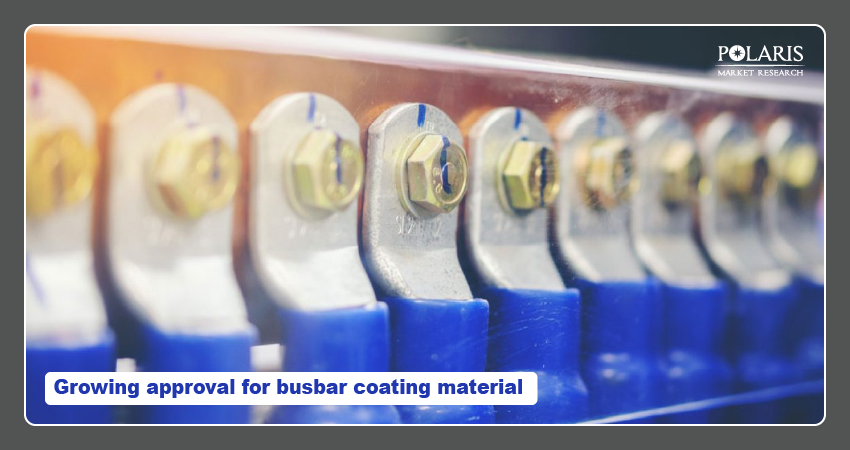
Busbars are aluminum or copper bars that carry a substantial current of electricity in distribution boards, switchboards, and battery banks. They are usually made of a polymer and a rare organic silicon rubber. They are manufactured in various shapes like solid bars, flat strips, and rods. The high surface area of some busbars allows for more efficient heat dissipation. As copper oxidizes over time, and if there is no coating, more power is required to force electricity along the surface.
Busbar coating is done to protect busbars in environments containing sulfur, ammonia, and chlorine compounds. Metal coatings, such as tin and tin-lead alloys, are applied to prevent short circuits. The nonmetal coating is applied in an abrasive environment, where the busbar requires additional safety and will be used for electrical insulation.
Busbar Coating Material Market Highlights
Our assessment reveals the busbar coating material market to witness sustained growth. The market for these materials is expected to account for a CAGR of 6.2% from 2021 to 2029. The market is projected to reach USD 274.9 million by 2029.
Busbars are cost-efficient and have many operational advantages. The growing need for secure, safe electrical distribution techniques and the concentration of renewable energy drive the busbar coating material market. Busbar coating material is also in demand due to maturing electrical infrastructure, rising electricity demand, and expanding adoption of high voltage direct current (HVDC) technology. Busbar coating is customary in making electrical equipment, chemical and nuclear plants, various outdoor applications, gas and oil coastal plants, and marine equipment.
Busbar Coating Material Types
Epoxy Powder Coating
Epoxy powder coatings, available in the powder coatings market, are commonly used for busbar insulation. These coatings offer a tough and electrically insulating layer that sticks firmly to the metal surface. The application of epoxy powder coatings is done through electrostatic spraying or a fluidized bed process. Baking of these coatings is then done at high temperatures to offer a strong finish. Epoxy powder coatings have excellent electrical insulation. They also provide protection against moisture and corrosion. The durability and smooth finish of epoxy powder coatings make them suitable for switchgear and low-voltage systems.
Polyimide and Polyester Coatings
These coatings are used in environments that require high heat resistance. Polyimide coatings are capable of handling temperatures up to 400 degrees Celsius. As such, they are suitable for aerospace and heavy-duty electrical systems. The flexibility and good insulation of these coatings help busbars in maintaining performance under changing heat and stress conditions.
Silicone-Based Coatings
Coatings made using products from the silicone market are known to be highly flexible. They can also handle extreme temperatures and resist moisture. Silicone coatings are useful in systems that experience frequent changes in temperature and humidity. These include outdoor substations, marine systems, and renewable energy systems. Silicone is also capable of resisting tracking and electrical arcing. This makes it a safe choice for high-voltage environments.
Polyvinylidene Fluoride (PVDF) Coatings
PVDF coatings have excellent resistance against chemicals, UV rays, and corrosion. These coatings aren’t strong insulators. But they do act as protective layers in harsh settings where metal parts are exposed to salt or chemicals. These coatings are often combined with other insulating coatings to reduce maintenance and make them more durable.
Recent Market Trends
Transportation is increasingly electrified, there is greater mobility, and there is an emphasis on renewable energy. Therefore, there is a greater need for power modules to become more efficient. To maximize efficiency, power transfer into and out of the inversion circuit is a crucial element. Therefore, it must be included in a holistic system design. For instance, to improve efficiency in high-voltage DC applications, connected busbar designs must reduce inductance to lower voltage spikes and enable faster switching speeds.
Busbars have rigid designs and are therefore more resistant than cables, particularly against short circuits. Due to their lower density, voltage loss is lower than that of cables of a similar length. Thus, energy loss is reduced. To improve cooling by radiation, matt black surfaces are used because they have higher emissivity than polished, light-colored surfaces. Therefore, matt black paints are being increasingly utilized for busbars.
Regional Assessment
North America is the leading region for a favorable market for busbar coating materials, driven by strong demand from the military and automotive sectors for electrical appliances. The technologically advanced devices presently require a central power distribution system to ensure equal power distribution.
Competitive Analysis
The strengthening of product adoption has witnessed many technological innovations in product design. To enhance the business's competitiveness, broad distribution channels, cost competitiveness, and regulatory agreement are being used. A few of the key players operating in the market include AkzoNobel N.V., Mersen, Storm Power Components, SolEpoxy, Inc., and EMS Industrial & Service Company.
Conclusion
Busbar coating materials are highly important in modern electrical infrastructure. They combine insulation with durability to make sure power systems operate in a safe and efficient manner. With rising adoption of renewable energy and the shift towards electric mobility, the busbar coating material market demand is expected to rise in the years to come.

.jpg)