In many industries like fuel production, fertilizer manufacturing, plastic making, and wastewater treatment, catalysts help speed up chemical reactions and make them cleaner and more efficient. However, catalysts cannot work well on their own. They need something to hold and support them, and that support is called a catalyst carrier.
Catalyst carriers keep the catalyst in place, help it work better, and make sure it lasts longer. Even though catalysts get most of the attention, these carriers play a quiet but very important role in many industrial processes.
This blog explains what catalyst carriers are, why they are important, how they are used, and the new developments that are shaping the future of the catalyst carrier market.
What Is A Catalyst Carrier?
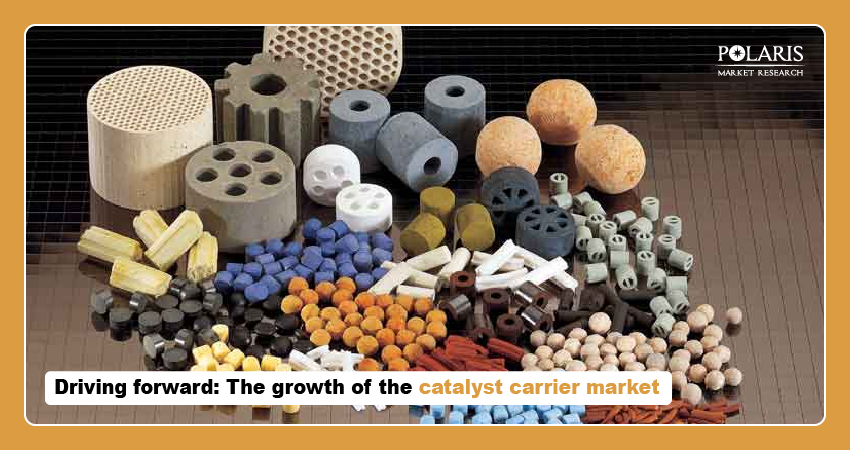
A catalyst carrier, sometimes referred to as a support material, is a support structure that supports the actual catalyst. It is similar to a scaffold that helps to hold workers. The catalyst carrier is not involved in the chemical reaction itself but provides a strong base for the catalyst to sit on, allows for a uniform dispersion of the catalyst, and gives a large capacity for the reaction to occur, which allows it to occur faster and more uniformly.
Catalyst carriers can come in a variety of materials, including:
- Ceramics (alumina or silica)
- Activated carbon
- Zeolites from the zeolite market
- Metal oxides
- Polymers
Each material has its own benefits. For instance, alumina is commonly used in petroleum refining processes because of its strength and stability. Activated carbon is used in environmental applications because it has very small pores that help channel and support the catalyst.
What Are Key Market Stats?
The catalyst carrier market is expected to account for a CAGR of 7.4% during the projection period, 2023 to 2032. The market is projected to reach USD 904.30 million by 2032.
One of the key drivers of the industry is the growing demand for cleaner fuels and reduced emissions. Catalyst carriers are widely used in catalytic converters, which are fitted to automobiles to reduce emissions of harmful gases such as nitrogen oxides and carbon monoxide. As more stringent environmental regulations are implemented globally, demand for catalyst carriers in the automotive industry is expected to rise in the coming years. Additionally, the demand for cleaner fuels such as hydrogen and biofuels is expected to boost the demand for catalyst carriers in the refining and chemical industries.
The market is growing due to the increasing demand for chemicals and petrochemicals. Catalyst carriers are used in various chemical reactions to increase efficiency and reduce byproduct formation. Demand for chemicals and petrochemicals is increasing due to investments in these sectors, particularly in developing countries such as China and India.
Why Are Catalyst Carriers Used?
Catalyst carriers are utilized in industry because they speed up catalytic reactions and even allow them to be stable and reliable. Without carriers, many reactions would slow down, become unstable, and/or deactivate too soon. Carriers provide a few important benefits:
Increased Surface Area
Catalyst carriers usually have small pores and a higher overall surface area than the catalyst particles alone, which increases the amount of material that the catalyst will be exposed to at once during reaction. This helps the reaction to happen more completely and/or faster.
Improved Stability
Catalysts can have detrimental effects that are not helped with temperature, pressure, and/or chemicals, and a durable carrier can help ensure the catalyst is protected and can still react under harsh conditions for an industrial process.
Even Distribution
A good carrier takes catalytic material and distributes it evenly across its surface area, which helps to avoid localized overheating and inefficient and/or inconsistent reactions.
Longer Life
Carriers from the catalyst carrier market help to limit clumping and degradation of the catalyst. This extends the life of the catalyst as a whole, helping to reduce the costs of replacing the catalyst.
Ease of Handling
The carriers are also designed so that the catalyst can be bulk in structure, but gives a profile that is easier to load into vessels and process through a system for an industrial process.
It can be seen that all these bring benefits to catalysts and ultimately are an important component.
Conclusion
In conclusion, the catalyst carrier market is expected to witness significant growth in the coming years, driven by rising demand for cleaner fuels, reduced emissions, and increased demand for chemicals and petrochemicals. With increasing investments in research and development, the market is expected to see more innovative products and solutions. However, the high production costs remain a major challenge for the market. Nonetheless, with the growing focus on sustainable development and the need for cleaner, more efficient processes, the market is poised to play a crucial role in driving progress toward a more sustainable future.