
Global Mortuary Bags Market Report: Industry Size, Segment Share and Forecast to 2034
REPORT DETAILS
Mortuary Bags Market Summary
The global mortuary bags market is estimated at USD 1.98 billion in 2026 and is projected to reach USD 2.17 billion in 2027, expanding to USD 3.76 billion by 2034 at a CAGR of 8.4% during 2027–2034. Hospitals, mortuaries and emergency services need safe, leak-proof body bags, and preparedness for disasters and pandemics keeps stocks high. Biodegradable and odour-sealing designs are emerging.
Market Statistics
Key Takeaways
• Standard-Duty Mortuary Bags hold the largest share, estimated at 39.00% of global revenue in 2026, supported by widespread use in routine body transportation, identification, and containment..
• Biodegradable / Compostable Materials account for an indicative 9.00% share in 2026, driven by increasing demand for environmentally sustainable mortuary products.
• The hospitals segment leads by end use with an estimated 45.8% share in 2026, while disaster response and forensic services form a key niche.
• Preparedness stockpiling keeps demand elevated above pre-pandemic levels.
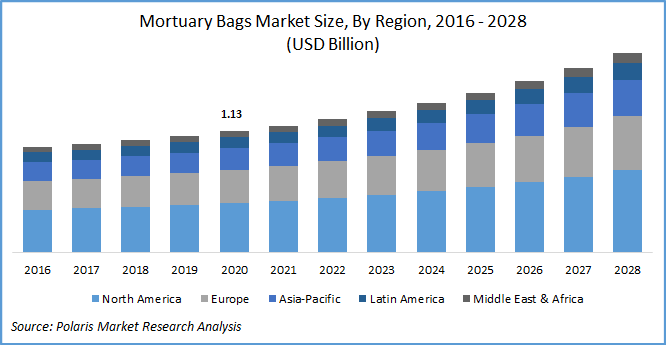
• North America holds the largest regional share, at an estimated 32.8% in 2026, supported by preparedness programmes.
• Asia Pacific is expected to be the fastest-growing region, currently at an estimated 29.6% share, as healthcare capacity grows.
• Medical disposables makers dominate.
Demand-side factors contributing to market growth include rising deaths due to road traffic accidents, sports and recreational activities, a surge in pandemic such as COVID-19, and a rise in non-communicable diseases such as cardiovascular diseases and respiratory disorders. The establishment of mortuary centers and innovations in the product such as biodegradable bags are the demand-side factors.
The increasing fatalities from road accidents are majorly attributed to lesser usage of helmets, unsafe roads, substance abuse, speeding, and lower implementation of traffic laws in emerging countries. As per the statistics published by the WHO, each year, more than 1.4 million people die in road accidents. It is also being reported that more than 93% of road fatalities occur in low and middle-income countries driving the demand for mortuary bags.
The demand for mortuary bags has surged exponentially in past one year due to the COVID-19 pandemic. As per the weekly situation report prepared by the WHO, as of 4th October 2020, there were around 34.8 million COVID-19 cases, with global deaths around 1 million. By region, America (55%), followed by Europe (23%). Globally, the highest percentage of 50% is seen in the age group of 25-64, though, the death percentage increases with age, and it was reported over 75% of the deaths were in people aged 65+ and above.
Know more about this report: Download Sample Report
Industry Dynamics
Growth Drivers
The market demand for mortuary bags has risen considerably with the onset of COVID-19 apart from this people die in road accidents, natural disasters, and non-communicable diseases. As per the statistics published by the Association for Safe International Road Travel (ASIRT), in the U.S., alone around 38,000 fatalities occur each year in road accidents. Fatalities in the U.S. from road crash is the leading cause of death in the 11-54 age group and it accounted for over USD 380.0 million in direct medical costs.
Know more about this report: Download Sample Report
Moreover, the increase in deaths due to non-communicable diseases is also projected to drive the sale of mortuary/corpse bags. According to the data published by the World in Data (WID), non-communicable diseases accounted for more than 73% of the deaths, globally. Non-communicable diseases claimed most of the lives include stroke, respiratory diseases, dementia, diabetes mellitus, lung cancer, and ischemic heart, pulmonary diseases. Faulty lifestyle, smoking, drug abuse, blood sugar, and air pollution were the major risk factors across the globe driving the market demand for mortuary bags.
Mortuary Bags Market Report Scope
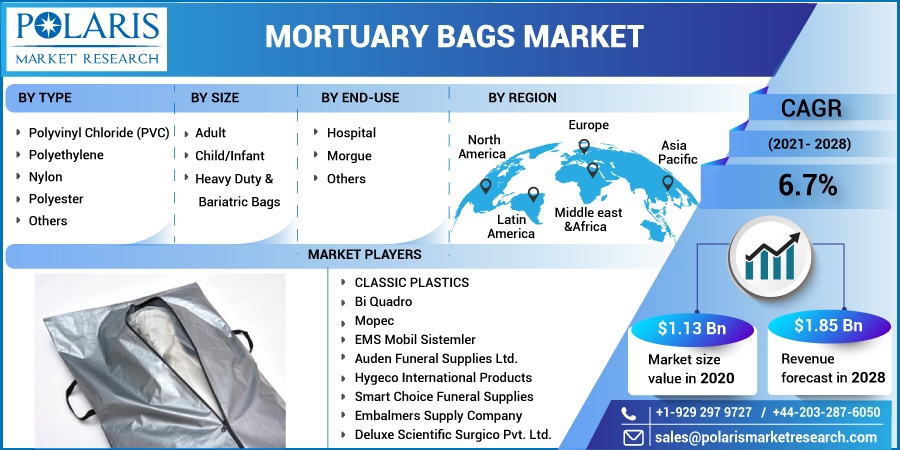
The market is primarily segmented on the basis of type, size, end-use, and region.
| By Type | By Size | By End-Use | By Region |
|
|
|
|
Source: Polaris Market Research Analysis
Know more about this report: Download Sample Report
Insight by Type
Based on the type, the global mortuary bags market is categorized into PVC, Polyethylene, Nylon, Polyester, and Others. The polyethylene segment accounted for the largest share of more than 30%, in 2020. As a raw material, polyethylene is readily available, cheaper, lightweight, durable, and is broadly used by corpse/mortuary bags manufacturers. These mortuary bags have the highest penetration in the people died with non-communicable disease.
PVC market segment is projected to witness the fastest growth rate over the forecast period. PVC mortuary bags are useful in effectively preventing the leakage of dead body fluids to prevent the spreading of communicable diseases. Stricter laws, increasing the penetration rate of PVC made mortuary bags, in the light of currently on-going COVID-19 pandemic.
Insight by Size
Based upon the size, the global mortuary bags market is categorized into adult, child/infant, and heavy-duty and bariatric bags. In 2020, the adult bags segment accounted for the majority of share during the assessment period. Deaths due to cardiovascular diseases and the COVID-19 pandemic in adults are the major factors contributing to the segment’s growth.
On the other hand, heavy-duty and bariatric mortuary bags are projected to register the highest market growth rate over the projected period. Segment’s market growth is attributed to several forecast factors such as a rise in mortality among the obese population. As per the market estimates of the Center for Disease, Control, and Prevention (CDC), there is an increase in the global obesity prevalence rate of 42.4% in 2018. Obesity results in the onset of several cardiovascular diseases such as stroke, high and low blood pressure, stroke, and other heart-related ailments..
Geographic Overview
North American market accounted for the largest share in the among all, in 2020. Demand for mortuary bags in the region, over the past few months, was primarily due to the deaths of the COVID patients. The mortality rate is the highest among the old age population. According to the statistics published by the World Health Organization (WHO), as of September 2020, in the U.S. around 210,797 people died from COVID-19 infections, which is highest among all the countries.
In Asia Pacific market, the mortuary bags industry is projected to register the highest market growth over the projected period. Market growth is primarily due to the recent surge in COVID-19 deaths, particularly in India, and other South Asian countries, increase in life expectancy, owing to increased medical attention, and improving healthcare infrastructure, resulting in a huge pool of geriatric population. Moreover, the presence of diabetic patients in the region also contributing to the market growth for mortuary bags.
Competitive Insight
- CLASSIC PLASTICS
- Bi Quadro
- Mopec
- EMS Mobil Sistemler
- Auden Funeral Supplies Ltd.
- Hygeco International Products
- Smart Choice Funeral Supplies
- Embalmers Supply Company
- Deluxe Scientific Surgico Pvt. Ltd. In the era of COVID-19
Mortuary Bags Market FAQ's
The mortuary bags market is valued at USD 1.98 billion in 2026 and is expected to reach USD 2.17 billion in 2027 and USD 3.76 billion by 2034, according to Polaris Market Research.
The mortuary bags market is projected to grow at a CAGR of 8.4% from 2027 to 2034, adding roughly USD 1.59 billion in value over the forecast period.
Hospitals, mortuaries and emergency services need safe, leak-proof body bags, and preparedness for disasters and pandemics keeps stocks high. Biodegradable and odour-sealing designs are emerging.
The main applications are hospitals, mortuaries, forensic services, and disaster response. Emergency preparedness and safer, biodegradable designs support demand.

Download Sample Report of Mortuary Bags Market
Please fill out the form to request a customized copy of the research report.


