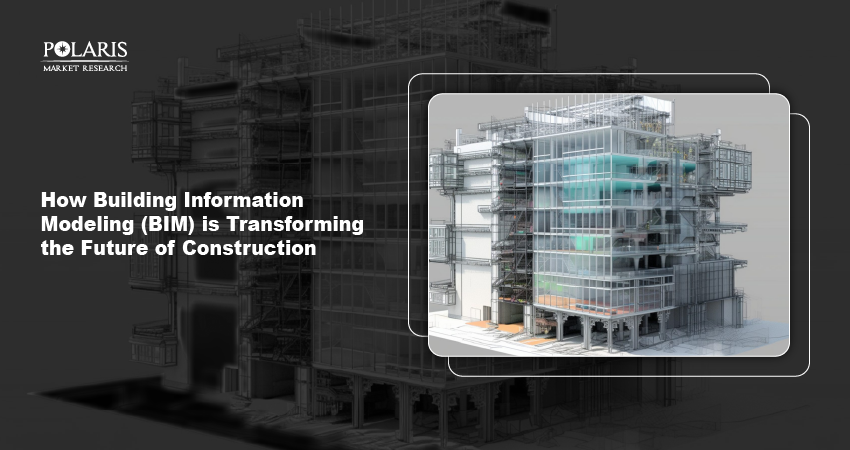
The construction industry is also undergoing a technological shift, and for all the right reasons. BIM (Building Information Modeling) is transforming the way we design, construct, and manage our built environment. It integrated data-rich 3D models with real-time collaborative features.
In traditional methods, the information was often fragmented and likely to be lost, but BIM software provides a comprehensive digital representation of physical and functional characteristics that improves efficiency and collaboration at every stage of a project lifecycle. The demand for smart, more efficient buildings is growing, and BIM serves as a pivotal technology to improve collaboration, efficiency, and project timelines.
What is Building Information Modeling (BIM)?
BIM is an inclusive process that allows architects, engineers, property developers, contractors, manufacturers, and other stakeholders to collaborate and complete the project of a building in a single 3D model through a collaborative process. Traditional 2D drawings are challenging to visualize the dimensions, scale, and ultimately how the structure will look and live once it is constructed.
CAD has now created a much closer simulation of the design on paper. BIM allows precise planning, efficient resource management, reduces waste, and optimizes workflows. It enables efficient collaboration between all the stakeholders by providing a centralized platform for sharing information in real-time.
Key Benefits of BIM Software in Construction Projects
Integration of the BIM software comes with a lot of measurable benefits, such as:
- Improved accuracy and reduced efforts: With BIM modeling, the stakeholders can work from a single model; this reduces inconsistencies and minimizes costly errors in the design.
- Increased collaboration: BIM increases collaboration among the project teams by giving everyone access to real-time information that helps coordinate the project more efficiently; this has made a big difference on large digital construction projects.
- BIM increases project accuracy: BIM can identify issues before construction; this will allow for more accurate estimations of the construction timeline, and be able to account for potential delays, as well as reinforcing the project budget.
- BIM can assist with facility management: After construction has been completed, the data that has been collected on the BIM model can be used for ongoing maintenance of the project as well as future upgrades.
BIM Technology Trends Shaping Construction in 2026
Trends related to technology in the construction sector are expected to increase the use of BIM software in 2026 and even later on. The following is an analysis of current and upcoming trends with respect to the construction industry:
- Integration with Cloud Platforms: With the use of BIM tools available on cloud platforms, teams can now work in collaboration across the globe, thus making it easier to manage construction projects.
- Application of Artificial Intelligence (AI): The application of AI in order to improve BIM tools has resulted in automation within the designing processes, as well as increased accessibility to data.
- IOT and Smart Sensor Applications: With the help of IOT and smart sensors, the use of data in construction projects has been improved.
- Sustainability: Sustainability is one area where BIM tools have played an important role, especially in energy modeling and environmental analysis.
Cloud-Based vs On-Premises BIM Solutions
Organizations can choose between cloud-based and on-premises BIM solutions depending on their requirements. Here are some factors to make the decision easier:
| Feature | Cloud-Based BIM | On-Premises BIM |
| Accessibility | Remote access from any location | Limited to internal systems |
| Cost | Subscription-based | High upfront investment |
| Scalability | Easily scalable | Limited scalability |
| Data Control | Managed by a service provider | Full internal control |
Source: Polaris Market Research Analysis
Rising Applications of BIM Modeling Across Industries
Construction is the primary use case of BIM, but it is also expanding into other industries:
- Infrastructure: Governments use BIM for roads, bridges, and even rail networks to improve planning and reduce unnecessary costs.
- Real estate and facility management: Property developers also use build ing information modeling to manage assets and optimize operations.
- Industrial projects: Manufacturing facilities use BIM to design complex production environments.
- Energy and utilities: Energy companies use BIM to manage their power plants and renewable energy projects.
Digital Twins and Digital Construction Integration
Digital twins are one of the most advanced applications of BIM. A digital twin, just as the name indicates, is a virtual replica of a physical asset that updates in real-time by using data from sensors.
Benefits of integrating digital twins with BIM offer many advantages, such as:
- Real-time monitoring
- Predictive maintenance capabilities
- Improved operational efficiency
- Enhanced decision-making based on live data
AI and Automation in BIM Workflows
AI and automation are transforming how BIM is used in construction projects. AI analyzes data while automation automates repetitive tasks to save time and improve design efficiency. Key applications of AI and automation in BIM include:
- Design optimization: Multiple design options can be evaluated with the help of an AI algorithm, and it recommends the most efficient solution.
- Reduced risk: Projects will have construction risks that can be identified before construction with machine learning based on previous comparable projects.
- Efficient timelines: AI can optimize the construction timeframes based on available resources and propose the most efficient solutions.
- Data analysis: BIM will create a sizable amount of data, and data analysis will allow for the decision-making process to be performed quickly
Future Outlook: The Next Decade of BIM Innovation
The adoption of BIM will continue to grow as the digital transformation of the construction industry continues. Some of the most prominent developments that will drive BIM into the next decade and beyond include;
- Continued growth of digital construction adoption
- Increasing capabilities of advanced simulation
- Increased Integration with emerging technologies
- Continued expansion of the construction market on a global scale
As construction technologies continue to be driven by digital innovation and data-driven decision-making, these trends indicate that construction technologies will continue to experience growth and change.
An analysis of the Computer-Aided Design (CAD) market and BIM market shows the transition is more than a trend; it’s a prerequisite for modern construction. To understand the specific market drivers, regional adoption rates, and investment benchmarks defining the next decade of digital construction, explore the latest industry analysis from Polaris Market Research.
Frequently Asked Questions
1. What is BIM software, and how is it used in construction?
BIM software creates digital 3D models of buildings with detailed data. It is used in construction for planning, design, coordination, and lifecycle management, improving accuracy and efficiency.
2. What are the main benefits of building information modeling?
Building information modeling improves design accuracy, reduces project errors, enhances cost control, and supports better planning. It also enables real-time collaboration, efficient resource management, and improved decision-making across construction projects.
3. How does BIM technology improve project collaboration?
BIM technology improves collaboration by providing a shared digital model accessible to architects, engineers, and contractors. It enables real-time updates, reduces miscommunication, and ensures all stakeholders work with consistent project data.
4. What is the difference between BIM modeling and traditional CAD?
BIM modeling uses intelligent 3D models with embedded data, while traditional CAD focuses on 2D drawings or basic 3D designs. BIM supports lifecycle management and collaboration, whereas CAD mainly supports drafting.
5. How is digital construction transforming the building industry?
Digital construction uses technologies like BIM, IoT, and AI to improve project planning, reduce delays, and enhance productivity. It enables better resource management, real-time monitoring, and efficient project execution across construction workflows.
6. What are the latest construction technology trends in BIM?
Latest BIM trends include cloud-based collaboration, AI integration, digital twins, and IoT-enabled construction monitoring. These innovations improve project efficiency, data accuracy, and lifecycle management in modern construction projects.