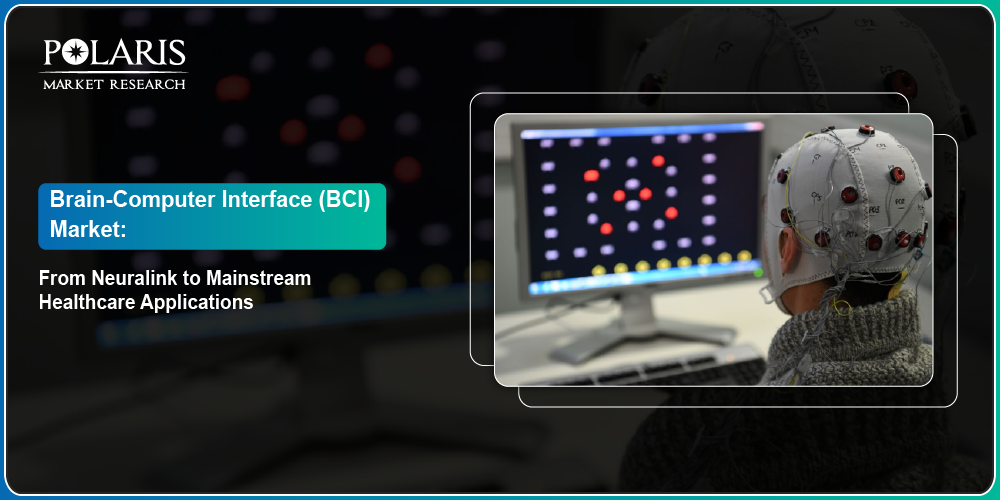
The brain computer interface market is slowly moving from the labs and into real healthcare settings. What sounded like science fiction is slowly feeling close to everyday use. BCI tools are part of the larger neurotechnology market. These tools are helping doctors, patients and researchers explore new ways to connect brains to machines in practical clinical settings.
What Is Brain-Computer Interface Technology?
Definition and functionality
Brain computer interface connects the human brain with external devices. It picks up the signals and converts them into actions on screens or machines. This is part of the technology of neural interfaces, which is applied in medicine and research.
Invasive vs non-invasive BCI systems
Some systems use neural implants that are placed inside the brain to get the signals directly. Others are non-invasive BCI systems that sit on the head and read signals safely.
Evolution of neural interface technologies
Early models were basic and slow but now devices are faster and more accurate. Growth in this field is pushing real world use. Change feels steady now in many clinical settings.
Why the BCI Market Is Accelerating in 2026
Advances in AI and neuroscience
Progress in AI healthcare innovation is shaping how brain signals are read and used. Systems are getting better at decoding thoughts into actions. This is supporting the brain machine interface market move faster than expected in real settings.
Increased funding and clinical trials
More startups and big firms are investing in neural implants. Also they are testing them in clinical trials. Funding is not limited to one region anymore. Global interest is growing, which supports faster product development and approval cycles.
Growing demand for assistive healthcare technologies
Patients with paralysis or neurological disorders are driving demand. Wearable brain devices are also gaining attention for everyday monitoring. The need is real, and it keeps pushing innovation forward in hospitals and research labs.
Healthcare Applications Transforming the Industry
Paralysis treatment solutions
Brain signals can help control wheelchairs or robotic arms. Neural implants are used in some cases for stronger signals. This area is growing within the brain computer interface market.
Neurorehabilitation therapies
Patients recovering from stroke use systems to retrain movement. Repeated signals help the brain learn again slowly. Progress is not always fast but results are visible over time.
Mental health monitoring
Wearable technology brain devices track patterns linked to stress or mood. Doctors can observe changes early and adjust care. It adds a new layer to treatment plans.
Communication assistance technologies
People who cannot speak use interfaces to type or select words. Signals become commands on a screen. It gives independence and improves daily life for many users. These developments show steady change in clinical practice and research spaces today. Adoption is uneven but interest continues to rise across regions more broadly.
Consumer and Enterprise Applications Emerging Beyond Healthcare
Gaming and immersive experiences
Gamers use brain signals to control characters or menu options with the help of brain-computer interface gaming. Some systems work with headsets and respond to focus levels. It adds a new layer to play and interaction.
Cognitive performance enhancement
Workers and students try cognitive enhancement technologies to boost attention. Devices track mental load and suggest breaks. Results vary, but early tests show promise for task efficiency.
Smart wearable integrations
Wearable brain devices now link with smartwatches and phones. They monitor stress or alertness during daily tasks. Data syncs automatically for quick review later.
Education and adaptive learning
Students use non-invasive BCI systems to demonstrate focus in lessons. Teachers receive feedback about engagement without additional tests. The neurotechnology market is gradually making its way into classrooms. The interest in these tools is increasing, but so far the adoption is limited. Changes are small but real in some schools and training centers.
Major Companies and Innovations in the BCI Market
Neural interface startups
Startups like BrainCo (founded 2015) and NextMind (founded 2017) are pushing the brain machine interface market forward. BrainCo makes Focus 1 and Focus 2 headsets for focus and gaming. NextMind offers a small non-invasive BCI system worn at the back of the head for VR and AR control. These firms aim on wearable brain devices that are easy to use.
AI-driven neurotech companies
Big and small firms use AI healthcare innovation to decode brain signals faster. This supports neural interface technology work better in real time. Companies including Emotiv, NeuroSky, and MindMaze are building tools for gaming, education, and wellness. Their work supports the BCI market forecast 2026 by making devices smarter and more dependable.
Strategic partnerships and acquisitions
Companies are partnering with game developers and big tech companies to integrate BCI into popular products. Acquisitions are rising in the neurotechnology market as companies pursue fast growth. Some focus on cognitive enhancement technologies, others on assistive uses. The brain computer interface market is becoming more crowded, but innovation stays high. Most players now offer non-invasive BCI systems that are affordable and user-friendly.
Ethical, Privacy, and Regulatory Challenges
Brain data privacy concerns
Brain signals are deeply personal. If stolen or misused, they could reveal thoughts or emotions. Users worry about who owns this data. The brain computer interface market needs clear rules on storage and access.
Ethical implications of cognitive enhancement
Cognitive enhancement technologies raise questions about fairness. Should students or workers use them to gain an edge? Some fear it could create inequality. The line between therapy and enhancement stays blurry.
Regulatory approval complexities
Neural implants and wearable brain devices face strict testing. For medical use, approvals take time. Non invasive BCI systems have fewer problems but still need oversight. The BCI market forecast 2026 depends on timely regulatory decisions. Until then, progress slows in some areas.
Market Forecast and Future Opportunities
Investment outlook
Investors are pouring money into the brain computer interface market. The BCI market forecast 2026 shows strong growth as more startups launch. Funding goes to neural implants and wearable brain devices, especially those with medical use. In 2025, the market size was USD 173.37 Million.
Commercialization timeline
Some products are already on the market, but wider adoption takes time. Non-invasive BCI systems will likely hit mainstream first. Full commercialization for medical cases may take several more years. By 2034, the market could reach USD 927.25 Million at a 20.50% CAGR.
Long-term impact on healthcare and human-computer interaction
Neural interface technology may revolutionize disease treatment and computing. AI healthcare innovation will accelerate signal decoding. The neurotechnology market could soon integrate into everyday life, making brain-controlled tools commonplace for many.
Conclusion
Brain-Computer Interface is a game-changing technology that connects human brains to machines. It helps people with paralysis, stroke, or nerve disorders. It also opens new ways to play games, learn, and work.
But we must move carefully. Brain data is very private. Using brain tools to boost thinking raises fairness issues. The brain computer interface market will grow best when companies mix bold new ideas with strong ethics, clear privacy rules, and fair access for everyone.
FAQs
• What is a brain-computer interface?
A system that enables direct communication between the brain and external devices using neural signals.
• How large is the BCI market forecast for 2026?
It is expected to reach USD 173.37 million in 2025, driven by healthcare and neurotech adoption.
• Are brain implants safe?
Generally safe in controlled clinical use, but they still carry surgical and long-term neurological risks.
• Which industries will benefit most from BCI technology?
Healthcare, defense, gaming, assistive tech, and neurorehabilitation sectors.

.png)