The production of vaccines and biologics has witnessed significant growth over the years. There has also been a rise in the use of enzymes, cell therapies, and other important molecules. As such, companies are increasingly looking for filtration systems that are fast and cost-effective. This has led to the rising adoption of tangential flow filtration to clean materials across biotechnology and other research labs.
So, what is it about tangential flow filtration that makes it so useful and scalable? Our detailed blog on the tangential flow filtration market covers all that you need to know about the filtration technique in detail.
What is Tangential Flow Filtration?
Tangential flow filtration (TFF) is an important technique in purification and bioprocessing. It allows biomolecules and other particles in a solution to be separated, concentrated, and purified. TFF has several applications in protein purification and the large and small scale bioprocessing market. It also facilitates the removal of contaminants from biological samples. TFF can efficiently process large volumes of samples in a solution. The technique also reduces sample loss and preserves the integrity of sensitive molecules.
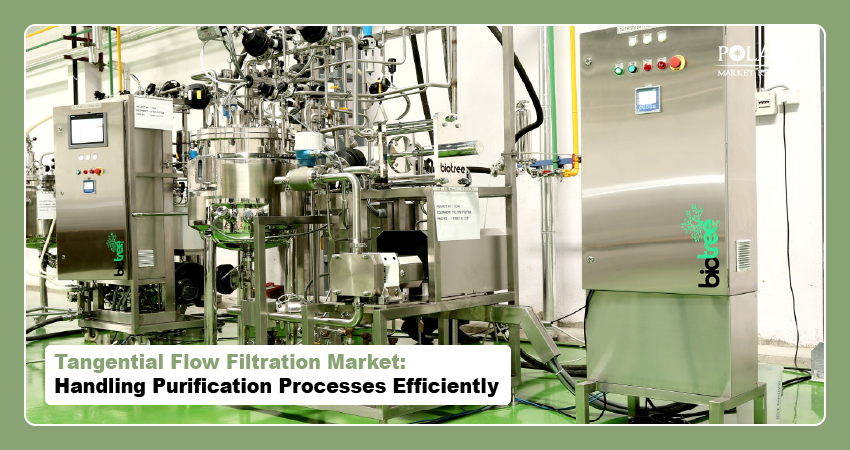
What Are Main Components of TFF System?
Feed Reservoir: The feed reservoir contains the solution that needs to be filtered. The solution commonly takes the form of a cell culture harvest or a protein solution. The feed reservoir in small labs is usually a bag or a beaker. Large systems have it in the form of a feed tank.
Pump: The pump circulates the feed across the entire system. A diaphragm pump, or peristaltic pump, is usually used to push the feed liquid at a controlled rate.
TFF Membrane Module: The filter unit is where the separation takes place. The membrane here can be a hollow fiber cartridge or a cassette. The module comes with an inlet for feed. Then there’s an outlet for retentate and a permanent outlet.
Pressure Control and Monitors: The outlet and inlet of the membrane module has sensors or pressure gauges for monitoring the pressure drop and transmembrane pressure. There’s typically a valve on the retentate line for controlling the back-pressure. Maintaining the correct pressure is highly important. This is because pressure that’s too low can result in slow filtration. On the other hand, high pressure can cause damage to the membrane.
Retentate Loop: The concentrated fluid that exits without passing through the membrane module is called the retentate. The fluid is then made to pass through the feed reservoir for continuous filtration or it makes its way to waste is the process happens to be continuous.
How Does TFF Work?
The working of a TFF system is easy to understand. There’s a pressure difference across the membrane. This pressure results in the passage of the solvent through the membrane pores. At the same time, continuous washing of the membrane is done by the tangential flow of the fluid.
The retained molecules stay in the flowing stream. At this point, recirculation of the molecules can be done for further filtration. This design ensures that the performance of filtration stays consistent over time. It also allows processing to take place until the desired separation or concentration is achieved. Practically, TFF is capable of handling large volumes or higher concentrations than that of a comparable normal flow filter.
Where’s the Market Headed?
The tangential flow filtration market is growing. Our analysis reveals that the market for TFF stood at USD 2.15 billion in 2024. The market is projected to account for a CAGR of 12.7% between 2025 and 2034.
Biologics such as cell therapies and monoclonal antibodies need efficient purification processes to ensure product safety and quality. The increased demand for vaccines and biologics is contributing to the tangential flow filtration market expansion. The market is also benefiting from advances in membrane systems and the rising adoption of single-use systems.
Where is TFF Used?
Virus Purification and Concentration: TFF is used to concentrate viral particles for the gene therapy market and vaccines. It’s also used for the separation of viruses from small impurities. For example, the tangential filtration of a harvest fluid with a virus can retain the virus and allow media and cell debris to pass through. Using TFF for virus filtration is gentler than high-speed centrifugation.
Exosome Isolation: Exosomes are nano-sized vehicles released by cells for communication with one another. They are typically purified from body fluids and cell culture media for therapeutic or research use. TFF offers an efficient method for the isolation and concentration of exosomes. The tangential flow enables the separation of exosomes from smaller proteins and large vesicles.
Cell Harvesting and Clarification: TFF solutions from the tangential flow filtration market are used for harvesting cells or clarifying cell lysates. The use of a TFF system in cell harvest results in the separation of cells from the culture media. Here, cells are retained in the retentate, and the clarified media makes it way through. This is helpful in fermentation processes and perfusion bioreactors where continuous collection or removal of cells is required.
What’s New in Tangential Flow Filtration?
June 2025: Cytiva announced the expansion of its operations across Europe, the US, and the Asia Pacific. With its recent investments in new filtration lines in Florida, the company aims to enhance its membrane production capacity in North America by 20%.
September 2024: Sartorius introduced the Vivaflow SU tangential flow filtration (TFF) cassette. According to Sartorius, the new is engineered for improved flexibility in the laboratory.
Conclusion
The tangential flow filtration market is now widely used in biotechnology, food processing, and pharmaceuticals. Its capability to handle both small and large volumes make it useful for various production types. As industries grow and the use of more advanced processes increase, TFF will continue to be an important tool.