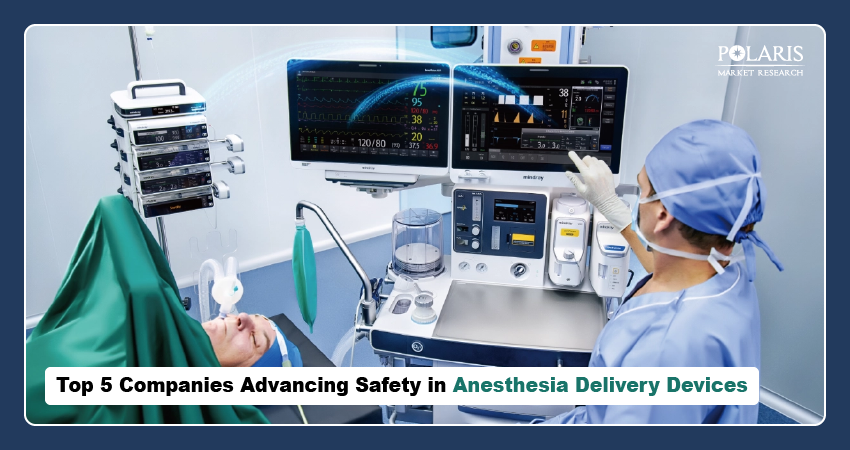
Anesthesia has changed healthcare. It has made surgeries and painful procedures safe and painless for patients. This is possible due to special devices that enable the administration of the right amount of anesthetic medicine at the correct time. These machines make sure that patients stay calm and comfortable during treatment.
Want to know more about the fundamentals and working of anesthesia delivery machines? Our blog post on the anesthesia delivery devices market has it all. We also offer an overview of some of the top anesthesia delivery devices companies changing the market landscape.
What’s Anesthesia?
Let’s start with the basics of anesthesia before moving on to devices used to deliver it. Anesthesia is essentially a drug that blocks pain and sensitivity while medical procedures are being carried out. The role of anesthesia may differ from one procedure to another. It can make a patient fully unconscious or numb only a part of their body. It can also be used to relax the patient while keeping them awake. Anesthesia allows doctors to carry out their work in a safe way. It also ensures that the patient is protected from stress and anxiety.
To achieve this, accurate delivery of the medication is required. Continuous monitoring is also essential. This is where machines from the anesthesia devices market help. The next section explains them in detail.
What Are Anesthesia Delivery Devices?
Anesthesia delivery devices are machines and tools used by doctors for giving anesthesia during surgeries and other medical procedures. They help mix gases and control the flow of oxygen. These devices also transform liquid anesthetic medicines into vapors that can be safely inhaled by patients. Anesthesia delivery devices can keep a check on important vitals such as heart rate and breathing. Some of these devices are used for general anesthesia. Others support regional and local methods.
What Are Anesthesia Delivery Device Types?
Anesthesia Machine
This machine from the anesthesia delivery devices market is used during surgical procedures. It delivers a controlled mix of oxygen and anesthetic gases to keep the patient stable. A modern anesthesia machine has oxygen supply, flow meters, and vaporizers. The main purpose of an anesthesia machine is to make sure that the patient receives enough oxygen while carefully controlling the delivery of anesthetic gases.
Vaporizers
Many anesthesia drugs are in liquid form. Vaporizers convert these liquids into a gas that’s safe for inhalation. They provide accurate dosing and stable vapor levels. Vaporizers also allow for automatic temperature control and safe switching between different agents. The precision of vaporizers makes complex surgeries much safer.
Breathing Circuits and Airway Devices
Breathing circuits are the tubes that carry oxygen and anesthetic gases, available in the inhalation anesthesia market, from the machine to the patient. They also bring exhaled gases back. Common types of breathing circuits include closed circuits and open circuits. The specific type is chosen by considering factors such as the patient’s size and procedure. Airway devices help keep the patient’s breathing passage open. These devices include face masks, endotracheal tubes, and nasopharyngeal and oropharyngeal airways.
Infusion Pumps for Intravenous Anaesthesia
Instead of inhalation, IV is used to give some anaesthetic drugs. Infusion pumps control how much medication goes into the bloodstream. These pumps also control the delivery rate of the medication. Infusion pumps are precise and capable of automated dosing. They can also ensure steady maintenance of anesthesia.
Which Companies Offer Anashetsia Delivery Devices?
Medtronic
Medtronic offers various products used during anesthesia. These include brain monitoring systems, airway management devices, and respiratory products from the respiratory care devices market. The company primarily focuses on monitoring the condition of patients and managing their airways. Medtronic also manufactures implantable drug infusion systems for targeted drug delivery to manage chronic and cancer pain.
GE Healthcare
The anesthesia delivery devices by GE Healthcare are part of its Carestation and Aisys CS² product lines. The Aisys CS² Anaesthesia Delivery System is a digitally controlled system that automates the delivery of oxygen and anesthetic agents. An advanced ventilator engine has been used in the system to have precise control over pressure. The Carestation 750 Anaesthesia Delivery System included advanced clinical tools for low-flow anesthesia and lung protective ventilation strategies.
Philips
Philips offers anesthesia delivery devices market solutions through both its own branded anesthesia machines. The company also has strategic partnerships with other manufacturers to provide integrated patient monitoring systems. The Philips IntelliSave AX700 Anesthesia System functions as a complete anasthesia workstation. It has features that support low-flow and minimal-flow anesthesia. The Philips Siesta i TS Anesthesia System is a compact system with built-in safety features.
Dräger
Dräger offers several advanced machines in the anesthesia devices market. Its machines are precise and safe. They can also be integrated into the operating room and ICU environments. Many models come with a servo-controlled piston that allows ICU-quality ventilation for all patient categories. Features like Fresh Gas Decoupling (FGD) help maintain stable gas delivery during ventilation changes. Furthermore, the machines are designed with ergonomic considerations.
B. Braun
B. Braun provides several devices and sets for regional anasthesia. It focuses on spinal and epidural anesthesia and peripheral nerve blocks. Its epidural anesthesia sets include catheters, filters, and connectors. B. Braun’s spinal anasthesia needles come in various bevel designs to minimize puncture trauma and lower the risk of post-dural puncture headache. Its combined spinal/epidural system integrates both spinal and epidural components into a single kit.
Conclusion
Anesthesia delivery devices are what make surgery safe and comfortable. These devices make sure that patients stay pain-free and unconscious while doctors work. They also ensure that the body remains stable during the entire procedure. With improving medical care, machines in the anesthesia delivery devices market are becoming more automated and safer to use. The leading anesthesia delivery devices companies are expected to focus on strategic partnerships to expand their market reach in the years to come.