
1,4-Butanediol (BDO), PTMEG and Spandex Market Outlook 2027–2034: Size, Growth Drivers and Competitive Landscape
REPORT DETAILS
1,4-Butanediol (BDO), Polytetramethylene Ether Glycol (PTMEG) and Spandex Market Summary
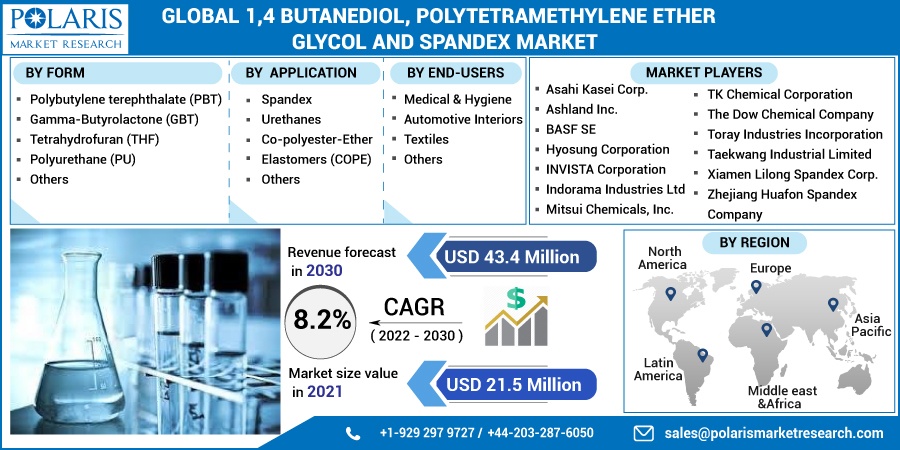
The global 1,4-butanediol (BDO), PTMEG and spandex market is estimated at USD 22.58 billion in 2026 and is projected to reach USD 24.16 billion in 2027, expanding to USD 38.79 billion by 2034 at a CAGR of 6.9% during 2027–2034. Stretch fabrics for athleisure, activewear, intimate apparel and medical textiles are increasing spandex consumption, which pulls through PTMEG and BDO demand. Integrated, bio-based value chains are emerging as apparel brands target lower product carbon footprints.
Market Statistics
Key Takeaways
• 1,4-Butanediol (BDO) is projected to account for the highest product share with 48.97% of the combined market revenue in 2026.
• Conventional Petrochemical-Based Production dominates the market, accounting for an estimated 91.20% share in 2026.
• Textiles & Apparel dominates the combined market, accounting for an estimated 58.40% share in 2026, supported by spandex and elastic fiber consumption.
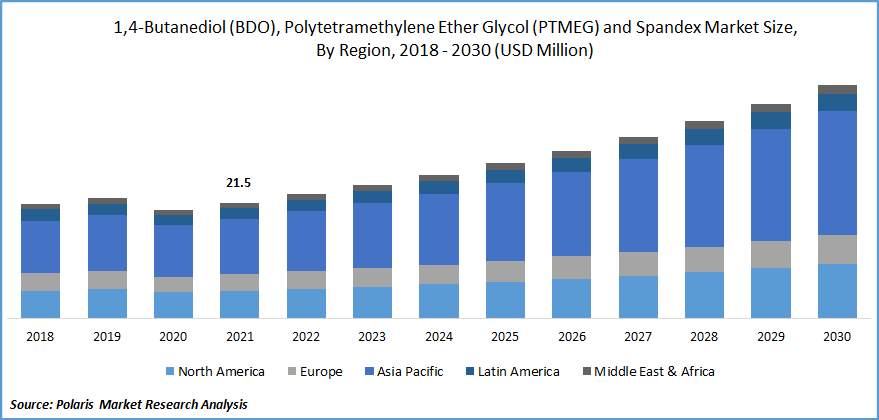
• The Asia Pacific region is the leading force in the combined BDO, PTMEG and spandex market, estimated to hold 65.03% of the revenue share in 2026, boosted by China’s integrated chemical and textile manufacturing infrastructure
• Europe market share in global market is estimated to be around 14.00% in 2026
• Integrated spandex producers with own PTMEG supply have cost advantage.
The market for 1,4-Butanediol (BDO), Polytetramethylene Ether Glycol (PTMEG) is being driven by a rising level of awareness about the advantages of these elevated engineering components that bridge the gap between flexible elastomers and stiff plastics.
For specific applications such as building coatings, synthesized polyurethane fibers, security windows, and lamination sheets, several industry firms have also created high-performance Polytetramethylene Ether Glycol (PTMEG) products.
Polytetramethylene Ether Glycol (PTMEG), also known as 1,4-butanediol (BDO), is a black waxy substance that can soften in ketone, ethanol, and other substances as well as in chlorinated and volatile hydrocarbons. In contrast to ambient temperature, polyoxytetramethylene appears transparent when present at high temperatures. In the process of creating pharmaceuticals, 1,4-butanediol (BDO) is used extensively.
Know more about this report: Download Sample Report
Factors influencing the 1,4-Butanediol (BDO), Polytetramethylene Ether Glycol (PTMEG), and spandex market's expansion include changing lifestyles, an increase in disposable money, and an increase in the need for better quality stretch fabric in various applications.
The fact that thermoplastic polyurethane is made from the biodegradable polymer 1,4-butanediol (BDO) PTMEG is credited as another growing cause. Growth in the targeted market of 1,4-Butanediol (BDO), Polytetramethylene Ether Glycol (PTMEG) would also be aided by the surge in polyurethane use.
However, it is predicted that strict regulatory rules that prohibit the use of toxic and carcinogenic compounds, such as 1,4-butanediol, in the production of Polytetramethylene Ether Glycol (PTMEG), will restrain 1,4-Butanediol (BDO), Polytetramethylene Ether Glycol (PTMEG) market expansion. It is anticipated that unstable raw material prices and the availability of low-cost replacements will impede 1,4-Butanediol (BDO), Polytetramethylene Ether Glycol (PTMEG) and spandex market expansion.
COVID-19 has disrupted almost every industry, but due to the safety purpose, the demand for face masks and gloves was in high demand, which has led to an increase in the demand for the product. Face mask demand has significantly risen worldwide as a result of the new Coronavirus abrupt introduction since spandex is a crucial component in the creation of face masks.
Consequently, the business is anticipated to grow significantly over the forecast period. The ear loops of the mask are mostly made of spandex. An increasing number of consumer apparel and accessory producers in China, where the majority of face mask production is produced, are anticipated to significantly expand the market of 1,4-Butanediol (BDO), Polytetramethylene Ether Glycol (PTMEG) throughout the projection period.
Know more about this report: Download Sample Report
Industry Dynamics
Growth Drivers
The 1,4-Butanediol (BDO) expansion is anticipated to be driven by increasing demands for stretch fabrics of higher quality across a range of textile applications. The textile sector is anticipated to diversify, modernize, and expand its capacity at a faster rate, all of which will benefit the spandex. Consumers' rising disposable income is boosting demand for a variety of textiles.
Additionally, a growing population base is accelerating the need for textiles, which is, in turn, accelerating the 1,4-Butanediol (BDO), Polytetramethylene Ether Glycol (PTMEG) and spandex market expansion of spandex. For instance, according to the United Nations, the population across the world could increase to more than 8.5 billion people in 2030. Also, it is anticipated to reach 9.7 billion in 2050 and then peak at about 10.4 billion during the 2080s.
Nylon, cotton, polyols, and allied brands are still owned by INVISTA. This comprises the 1,4-Butanediol (BDO), Polytetramethylene Ether Glycol (PTMEG) and spandex market-leading nylon 6,6 intermediates business of INVISTA, its expansive range of nylon polymers and fibers, and well-known brands such as CORDURA cloth, ANTRON carpet fibers, and STAINMASTER carpet fibers.
Tetrahydrofuran (THF), polytetramethylene ether glycol (PTMEG), and 1,4-butanediol (BDO) technologies are covered by INVISTA. Thus, the major player's focus on the expansion of the textiles portfolio is boosting the market growth of 1,4-Butanediol (BDO), Polytetramethylene Ether Glycol (PTMEG) over the forecast period.
Report Segmentation
The market is primarily segmented based on form, end-use, application, and region.
| By Form | By Application | By End-Users | By Region |
|
|
|
|
Source: Polaris Market Research Analysis
Know more about this report: Download Sample Report
Textile Industry is Expected to Witness the Fastest Growth
The market expansion of 1,4-Butanediol (BDO), Polytetramethylene Ether Glycol (PTMEG) is being augmented by the clothing and apparel sector's robust growth. Novel use of spandex in denim and rising demand for lingerie, athletics, compression gear, and other items are also predicted to boost the market growth of 1,4-Butanediol (BDO), Polytetramethylene Ether Glycol (PTMEG).
Polytetramethylene Ether Glycol (PTMEG) is used to create high-quality polyurethanes with improved properties like resistance to hydrolysis and microorganisms, great performance at low temperatures, and strong resistance to physical wear.
Further, it is anticipated that rising demand would propel the development of textiles with greater stretch for a variety of textile applications. In June 2020, in conjunction with Kingpins24's virtual denim event, Hyosung introduced innovative creora 3D Max spandex. With the introduction of 3D Max spandex, Hyosung was able to give denim items dual performance characteristics that would last over time, including ultra-stretch and excellent recovery.
With the addition of extra elements like laser surgery and eco-friendly finishing, 3D Max jeans have a natural feeling and appearance. Thus, product launches based on the products in the textile industry are boosting the market growth of 1,4-Butanediol (BDO), Polytetramethylene Ether Glycol (PTMEG).
Tetrahydrofuran (Thf) Accounted for the Highest Market Share in 2021
Due to the increased production of Polytetramethylene Ether Glycol (PTMEG), a polymer widely used to create urethane elastomers and fibers, the THF business has grown during the past few years. It is also a multipurpose solvent with a variety of uses, including in the production of printing inks, vinyl films, cellophane, commercial resins, and synthetic rubber. It serves as a PVC-type cleaner before joint formation and is only utilized in the manufacture of PVC-type concrete.
Spandex Application is Expected to Hold the Significant Revenue Share
The demand for spandex is anticipated to increase throughout the forecast period as a result of new medical uses for the material in the field of protective clothing and wound treatment. Due to the significant demand for the creation of stretchy sports apparel and fabrics, spandex is the most lucrative application sector for PTMEG. Due to their outstanding intrinsic qualities, such as high elasticity, durability, and more flexibility than rubber, these fibers are only employed in this manner.
The Demand in Asia-Pacific is Expected to Witness Significant Market Growth
Increased population, rising spending power, and developing end-user sectors are all predicted to contribute to the Asia Pacific region's 1,4-Butanediol (BDO), Polytetramethylene Ether Glycol (PTMEG) and spandex markets' rapid expansion. A growing number of end-use industries and the accessibility of cheap labor are expected to keep the Asia Pacific from losing its market share. A significant consumer is thought to be China because of rising disposable income.
The Tetrahydrofuran (THF) applications industry held the biggest market share and it is anticipated that this dominance will last during the projected period. The cause for this is the region's growing R&D activities, accessibility of a highly qualified workforce, cutting-edge processing and implementation technologies, and established infrastructure.
Further, it is also expected that government programs in the North American region like the Manufacturing Extension Partnership (MEP), which provides personally tailored assistance to assist industries in increasing their productivity, economic sustainability, and technical capabilities, will make a significant contribution to the market growth of 1,4-Butanediol (BDO), Polytetramethylene Ether Glycol (PTMEG).
List Of Key Companies
- Asahi Kasei Corp.
- Ashland Inc.
- BASF SE
- Hyosung Corporation
- INVISTA Corporation
- Indorama Industries Ltd.
- Jiangsu Shuangliang Company Limited
- Mitsui Chemicals, Inc.
- TK Chemical Corporation
- The Dow Chemical Company
- Toray Industries, Inc.
- Taekwang Industrial Limited
- Xiamen Lilong Spandex Corporation
- Zhejiang Huafon Spandex Company
Recent Developments
In August 2026, Hyosung TNC announced its bio-based 1,4-butanediol plant in Ho Chi Minh City, Vietnam, has begun commercial operations, establishing an integrated manufacturing chain which links renewable feedstocks to PTMG and spandex production. The initial Bio-BDO facility has a stated production capacity of 50,000 metric tons annually, with infrastructure allowing expansion to 200,000 metric tons. Hyosung uses the Bio-BDO to manufacture PTMG at its Dong Nai facility before converting the intermediate into regen BIO spandex. The project strengthens vertical integration and supports the development of lower-fossil-content stretch fibers for apparel manufacturers. (Source: Hyosung)
In March 2026, BASF introduced a reduced-carbon-footprint PolyTHF product variant as part of a wider portfolio launch covering BDO, THF and NMP. PolyTHF is BASF's commercial name for PTMEG, an important intermediate in elastic fibers and polyurethane elastomers. The new product provides at least a 10% reduction in its product carbon footprint compared with the corresponding standard Ludwigshafen-manufactured product, while maintaining existing performance characteristics. This development is relevant to the integrated BDO–PTMEG–Spandex market because it creates an additional lower-carbon sourcing option for producers seeking to reduce their upstream material emissions. (Source: BASF)
1,4-Butanediol (BDO), Polytetramethylene Ether Glycol (PTMEG), and Spandex Market Report Scope
| Report Attributes | Details |
| Market size value in 2027 | USD 24.16 billion |
| Revenue forecast in 2034 | USD 38.79 billion |
| CAGR | 6.9% from 2027 - 2034 |
| Base year | 2026 |
| Historical data | 2022 - 2025 |
| Forecast period | 2027 - 2034 |
| Quantitative units | Revenue in USD million and CAGR from 2027 to 2034 |
| Segments Covered | By Form, By Application, By End-Use, By Region |
| Regional scope | North America, Europe, Asia Pacific, Latin America, Middle East & Africa |
| Key Companies | Asahi Kasei Corp., Ashland Inc., BASF SE, Hyosung Corporation, INVISTA Corporation, Indorama Industries Ltd, Jiangsu Shaungliang Company Limited., Mitsui Chemicals, Inc., TK Chemical Corporation, The Dow Chemical Company, Toray Industries Incorporation, Taekwang Industrial Limited, Xiamen Lilong Spandex Corporation, and Zhejiang Huafon Spandex Company |
Source: Polaris Market Research Analysis
1,4-Butanediol (BDO), Polytetramethylene Ether Glycol (PTMEG) and Spandex Market FAQ's
The 1,4-butanediol (BDO), PTMEG and spandex market is valued at USD 22.58 billion in 2026 and is expected to reach USD 24.16 billion in 2027 and USD 38.79 billion by 2034, according to Polaris Market Research.
The 1,4-butanediol (BDO), PTMEG and spandex market is projected to grow at a CAGR of 6.9% from 2027 to 2034, adding roughly USD 14.63 billion in value over the forecast period.
Stretch fabrics for athleisure, activewear, intimate apparel and medical textiles are increasing spandex consumption, which pulls through PTMEG and BDO demand. Integrated, bio-based value chains are emerging as apparel brands target lower product carbon footprints.
The main applications are spandex/elastane fibres, polyurethane elastomers, TPU, and coatings. Athleisure-driven spandex demand pulls through PTMEG and BDO.

Download Sample Report of 1,4-Butanediol (BDO), Polytetramethylene Ether Glycol (PTMEG) and Spandex Market
Please fill out the form to request a customized copy of the research report.


