
Aircraft Catering Vehicle Market Size, Analysis Report, 2026-2034
REPORT DETAILS
Aircraft Catering Vehicle Market Summary
The global aircraft catering vehicle market was valued at USD 25.35 billion in 2025 and is expected to grow at a CAGR of 6.00% during the forecast period.
Market Statistics
The increasing global air travel is propelling the need for aircraft catering vehicles as they enable travelers to arrange meals and beverages with better storage along with food safety and quality measures. Perishable food items necessitate the need for refrigerators and other requirements, which will facilitate the demand for aircraft catering vehicles as they are built with the capacity to store a wide range of food products. The increasing research studies on finding the interests of air passengers are likely to assist companies in strategic planning.
Source: Polaris Market Research Analysis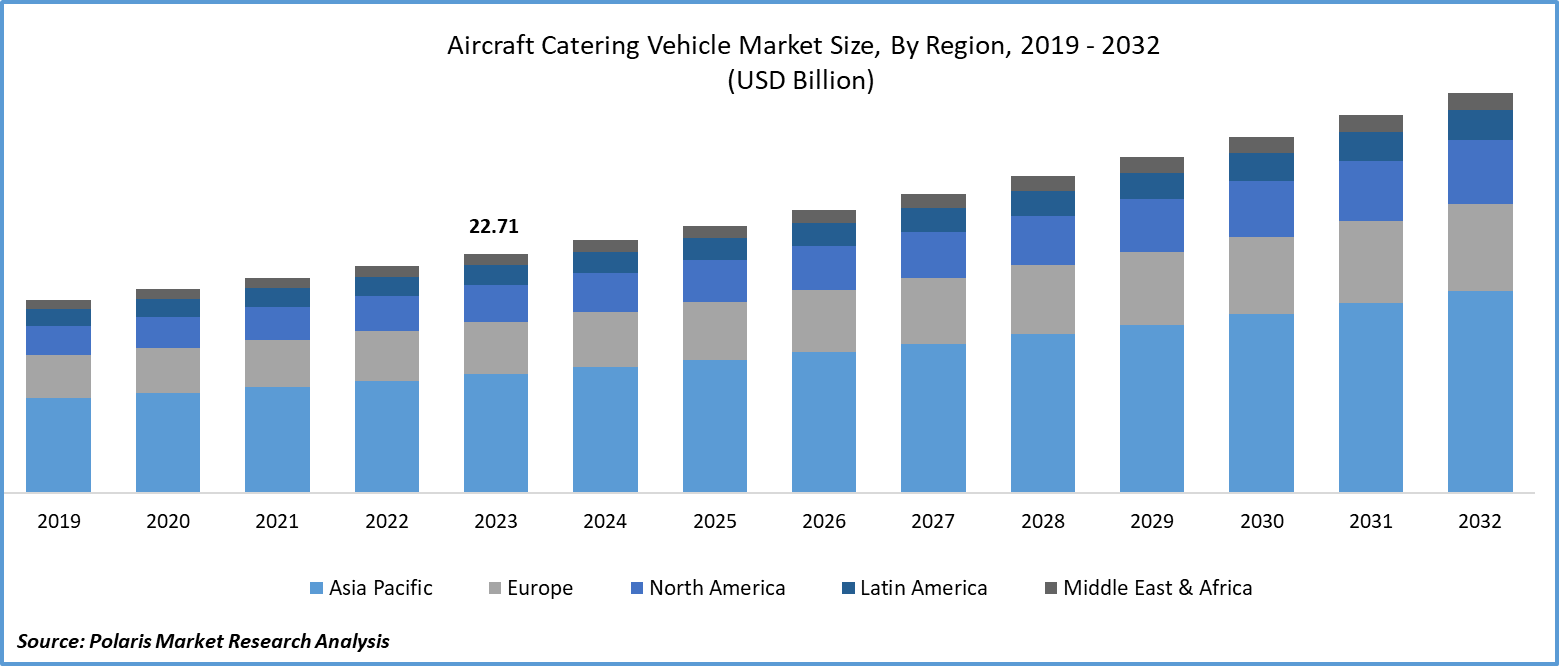
To Understand More About this Research: Download Sample Report
- For instance, in May 2023, a study published in MDPI focused on finding the willingness of air travelers to reserve online in-flight meals and their preference to pay for meal updates among US students. The study findings demonstrated students’ willingness to prefer online reservations and the potential benefits of it in reducing cabin food waste.
Moreover, the growing demand for quality and premium meals by air travelers is forcing management to adopt advanced vehicles to meet ongoing consumer expectations, which will have a significant impact on aircraft catering vehicles. However, the unforeseen pandemic like COVID-19 is limiting air travel, as it created worldwide travel restrictions, which will likely hinder the demand for air travel along with the market.
Growth Drivers
Rising global air travel is likely to positively impact aircraft catering vehicle demand
Global air travel is expected to witness a rapid surge-driven removal of global trade and travel restrictions pertaining to the COVID-19 pandemic. The rising global trade activities are widening the expansion and demand for aircraft and, in turn, aircraft catering vehicles, as they are crucial for managing meal catering services for travelers, which are essential for people with longer journey hours. According to the International Air Travel Association, the total air traffic in August 2023 witnessed a rise of 28.4% compared to August 2022, while domestic traffic increased by 25.4% and 9.2% compared to 2022 and 2019 in August. As this trend is expected to continue, there will be a significant need for airport catering vehicles in the coming years.
Regulatory & Safety Certification Requirements by Region
| Region | GSE / Safety Requirements | Food‑Safety / QMS | Vehicle / OEM Expectations |
| EU (EASA states) | EASA Basic Regulation and draft Ground Handling Regulation (EU 2025/20) treat GSE (incl. catering highloaders) as safety‑related aerodrome equipment; operators must ensure serviceability, safe positioning, training and procedures under GH.OPS. | In‑flight caterers typically certified to ISO 22000 or FSSC 22000 plus ISO 9001 and often ISO 45001 to meet airline and authority expectations. | Highloader OEMs (e.g., DOLL) design and market units as certified for specific aircraft (e.g., A380), aligning with aircraft interface limits and aerodrome safety requirements. |
| United States (FAA) | 14 CFR Part 139 requires certificated airports to control ground vehicles; high‑lift catering trucks must follow airport vehicle rules and OSHA safety expectations; industry “High Lift Truck Fundamentals” guide stresses ramp‑safety training and aircraft‑damage prevention. | Catering units comply with FDA/USDA rules and typically implement HACCP/ISO 22000 and ISO 9001 to secure airline approvals. | No FAA type certificate; vehicles must meet OSHA machine‑safety provisions and airport technical specs (stability, guarding, fall protection, clearances). |
| ICAO‑aligned states | National aviation safety plans and SMS requirements cover ground handling and GSE, including catering trucks, as ramp‑safety risks; airports and handlers must include GSE in hazard analysis, procedures, training, and occurrence reporting. | Major caterers (e.g., Qatar Aircraft Catering Company) hold FSSC 22000 / ISO 22000, ISO 9001 and ISO 45001, used by regulators/airlines as evidence for safe catering operations supplied via vehicles. | Authorities require that all GSE used at aerodromes be suitable, maintained, and safely operated, rather than certifying individual trucks. |
| OEM / Caterer examples | DOLL markets catering highloaders designed to meet airport and aircraft safety criteria, including for “megaliner” aircraft, indicating compliance with interface and load standards. | Emirates Flight Catering and QACC showcase ISO 9001, ISO 22000/FSSC 22000 and ISO 45001 certifications for their catering operations. | OEM designs incorporate guarding, interlocks and stabilisers; operators combine these with SMS and training to satisfy regulator and airport requirements. |
Source: Polaris Market Research Analysis
Source: Polaris Market Research Analysis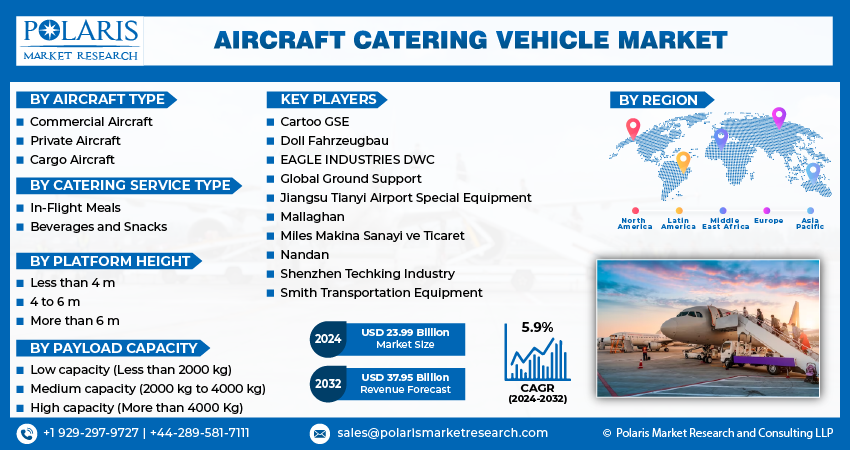
Report Segmentation
The market is primarily segmented based on aircraft type, catering service type, platform height, payload capacity and region.
| By Aircraft Type | By Catering Service Type | By Platform Height | By Payload Capacity | By Region |
|
|
|
|
|
Source: Polaris Market Research Analysis
To Understand the Scope of this Report: Request Customization
By Aircraft Type Analysis
-
Commercial segment is expected to witness the highest growth during the forecast period
The commercial segment will grow rapidly due to the presence of a larger volume of passengers in this aircraft. The more travelers on a plane, the higher the demand for in-flight catering services, which will further create demand for aircraft catering vehicles in the coming years. Furthermore, commercial aircraft are highly focused on revenue generation and higher capacity with predefined routes, driving demand for catering services and, in turn, vehicles driven by longer hours of journey.
The cargo segment garnered a substantial share, largely attributable to the transportation of perishable goods, including pharmaceuticals, which require significant storage and transportation systems to manage the quality and safety of goods, which will fuel the adoption of catering vehicles in the long run.
By Catering Service Type Analysis
-
In-flight meals segment accounted for the largest market share in 2025
The in-flight meals segment accounted for the largest share. Airlines are adopting better catering service agents to meet consumer expectations of quality meals, which will enhance the demand for catering vehicles with advanced technologies.
The beverages & snacks segment is expected to grow at the fastest rate over the next few years, driven by rising demand for convenience foods during travel. Most of the global population is acquainted with snacks and drinks in their free time; this is likely to take place during travel as passengers sit for longer periods. The ongoing snacking culture is stimulating the demand for aircraft catering vehicles to meet consumer needs.
By Platform Height Analysis
-
More than 6m segment held the significant market revenue share in 2025
The more than 6m segment garnered the largest share, which is highly accelerated due to the increasing use of larger aircraft like the Airbus A380, Antonov An-225 Mriya, Boeing 747-8, Hughes H-4 Hercules, and Strato-launch. These aircraft are used for international travel, which requires more than 6 meters to reach the cargo door. This will force companies to innovate vehicles with the capacity to reach higher heights, contributing to the growth of the market.
By Payload Capacity Analysis
-
High-capacity segment held the significant growth in 2025
The high-capacity segment held significant growth in 2025, which is highly accelerated due to its ability to carry a higher payload, which is essential for commercial aircraft meal transportation. This segment can store more than 4000kg. The aircraft with the higher number of travelers will likely adopt this truck rather than others, which will reduce the additional transportation of meals through other vehicles.
Source: Polaris Market Research Analysis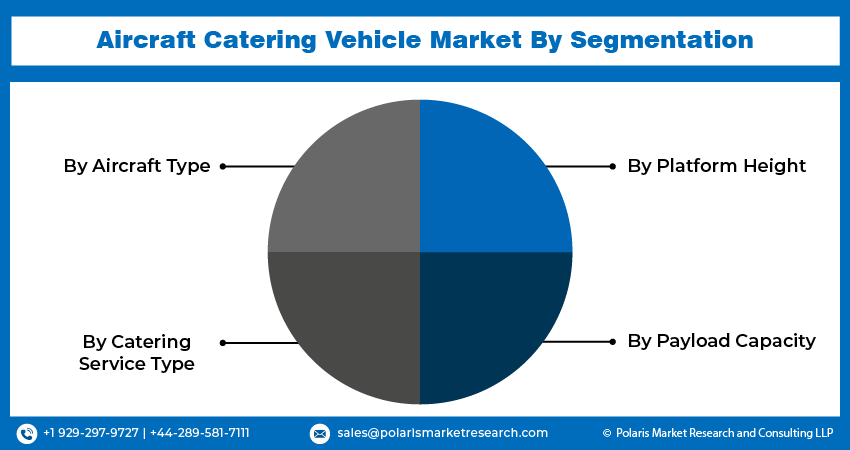
Regional Insights
-
Asia Pacific region registered the largest share of the global market in 2025
The Asia-Pacific region held the global market with the largest market share in 2025 and is expected to continue its dominance over the study period. The growing air travel in this region is expanding the growth of aircraft catering vehicles in the region. Based on the IATA report published in August 2023, Asia-Pacific airlines registered a 98.5% increase in air traffic in 2023 compared to August 2022. Capacity increased by 96.2%, and the load factor climbed 3.9% to 84.5%. This trend demonstrates that there will be a huge demand for catering vehicles in the coming years.
Furthermore, the increasing number of flight kitchen establishments in the region is showing an upward trajectory for in-flight catering services. For instance, TajSATS introduced a flight kitchen in Goa's Manohar International Airport in 2023, which has the capacity to serve 20,000 meals per day. This will likely create demand for aircraft catering vehicles in the coming years.
The Europe region is expected to grow at a rapid pace, owing to the growing air travel in this region. According to the IATA, European carriers saw a 22% increase in air traffic in April compared to the same period in the previous year. Capacity increased by 145.3%, while the load factor increased by 13.2% to 81.6. This trend will strengthen the demand for catering vehicles during the study period in the region.
Source: Polaris Market Research Analysis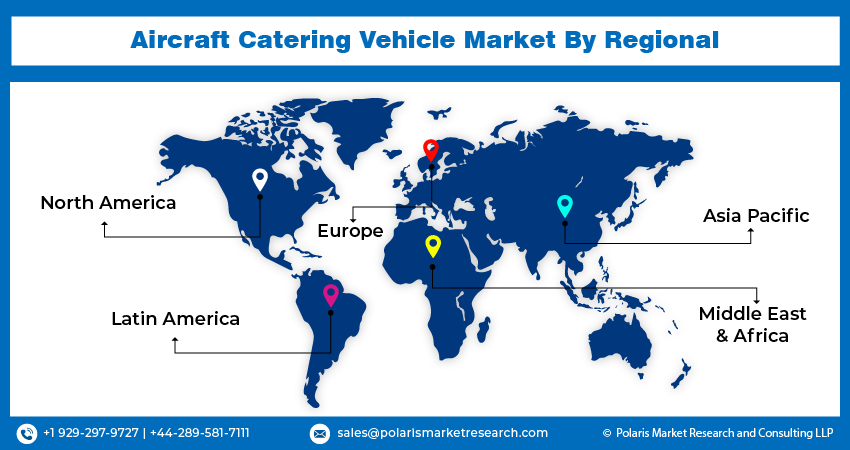
Key Market Players & Competitive Insights
The aircraft catering vehicle market was witnessing rising innovations in the marketplace, driven by growing food safety concerns among aircraft management. The presence of larger players in the market is likely to stimulate research activities, contributing to the development of efficient vehicles for airport catering services. The rising demand for in-flight catering is helping the companies expand their product line and global coverage through acquisitions and partnerships.
Some of the major players operating in the global market include:
- Cartoo GSE
- Doll Fahrzeugbau
- EAGLE INDUSTRIES DWC
- Global Ground Support
- Jiangsu Tianyi Airport Special Equipment
- Mallaghan
- Miles Makina Sanayi ve Ticaret
- Nandan
- Shenzhen Techking Industry
- Smith Transportation Equipment
Recent Developments
May 2025: EKFC upgraded its fleet on the ground, with a USD 16 million order of 53 new aircraft catering trucks from Mallaghan, FAMCO, and Volvo. It's part of a 120-vehicle five-year program to introduce the next-generation vehicles. It will add 92 new catering trucks to its fleet over the coming year.
Report Scope
| Report Attributes | Details |
| Market size value in 2025 | USD 25.35 billion |
| Market size value in 2026 | USD 26.81 billion |
| Revenue forecast in 2034 | USD 42.80 billion |
| CAGR | 6.00% from 2026 – 2034 |
| Base year | 2025 |
| Historical data | 2021 – 2024 |
| Forecast period | 2026 – 2034 |
| Quantitative units | Revenue in USD billion and CAGR from 2026 to 2034 |
| Segments covered | By Aircraft Type, By Catering Service Type, By Platform Height, By Payload Capacity, By Region |
| Regional scope | North America, Europe, Asia Pacific, Latin America, Middle East & Africa |
| Customization | Report customization as per your requirements with respect to countries, region and segmentation. |
Source: Polaris Market Research Analysis
aircraft catering vehicle market FAQ's
key companies in aircraft catering vehicle market are Doll Fahrzeugbau, EAGLE INDUSTRIES DWC, Global Ground Support
The global aircraft catering vehicle market is expected to grow at a CAGR of 6.00% during the forecast period.
The aircraft catering vehicle market report covering key segments are aircraft type, catering service type, platform height, payload capacity and region.
key driving factors in aircraft catering vehicle market rising global air travel is likely to positively impact aircraft catering vehicle demand
The global aircraft catering vehicle market size is expected to reach USD 42.80 billion by 2034.
Download Sample Report of aircraft catering vehicle market
Please fill out the form to request a customized copy of the research report.


