
Alloy Steel Market Research Report, Growth Opportunity, 2026-2034
REPORT DETAILS
Alloy Steel Market Summary
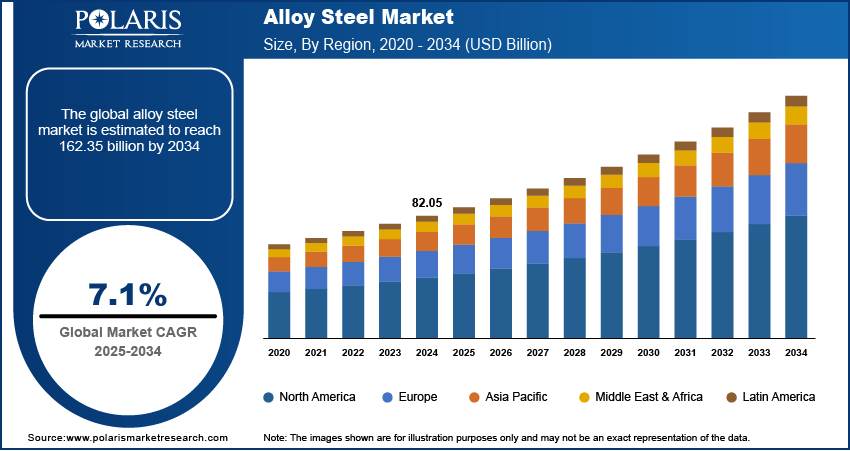
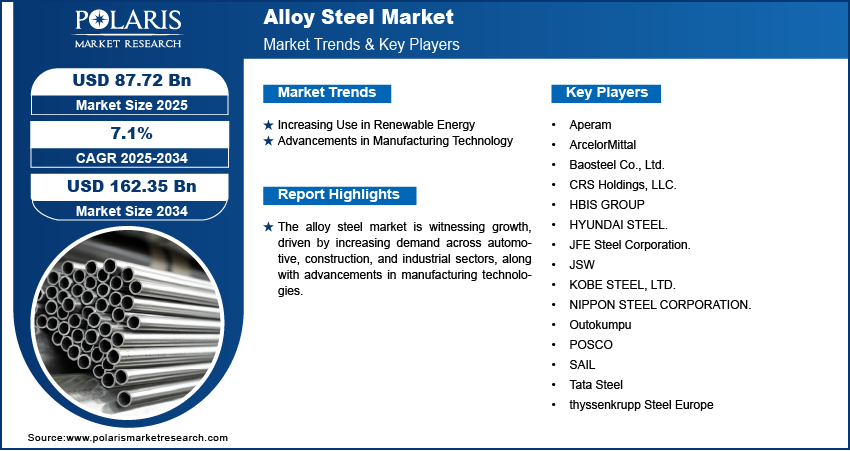
The global alloy steel market size was valued at USD 87.72 billion in 2025. It is expected to grow from USD 93.75 billion in 2026 to USD 163.03 billion by 2034, at a CAGR of 7.1% during 2026–2034.
Market Statistics
Key Takeaways
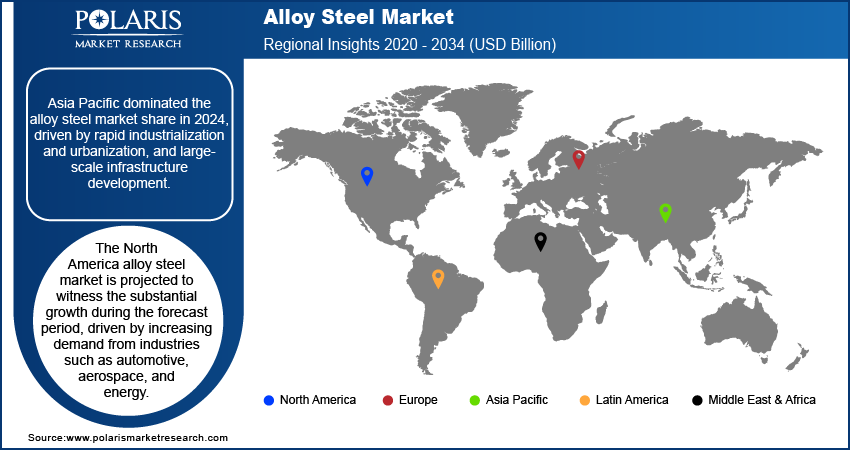
- Asia Pacific dominated with a 66.63% market share in 2025. Rapid industrialization and urbanization contribute to the regional market dominance.
- North America is projected to witness significant growth at a 7.86% CAGR. This is owing to increasing demand from industries such as automotive, aerospace, and energy.
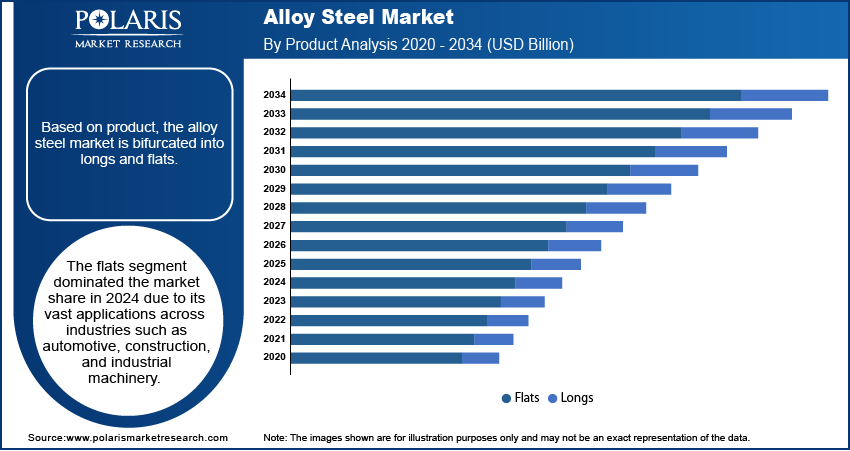
- The flats segment dominated with a 55.67% market share in 2025. This is due to the vast applications of alloy steel across industries such as automotive and construction.
- The high alloy segment is expected to witness the fastest growth at an 8.14% CAGR. The superior strength and corrosion resistance of high alloy steel drive the segment’s growth.
- The building & construction segment led with a 34.83% share in 2025. The high volume requirement of alloy steel in the sector led to the segment’s leading position.
Note: Figures and projections outlined in this report are the result of Polaris Market Research’s proprietary analytical processes, grounded in the latest available datasets and market observations.
Industry Dynamics
- The rising usage of alloy steel in renewable energy applications is one of the major factors contributing to the market development.
- Advancements in manufacturing technology, such as precision alloying and advanced heat treatment processes, is another factor shaping the market landscape.
- Increased emphasis on automotive and electric vehicle (EV) lightweighting is creating several market opportunities.
- High costs of raw alloying elements may present market challenges.
AI Impact on Alloy Steel Market
- Alloy steel manufacturing is assisted by artificial intelligence through the provision of efficient manufacturing processes and the elimination of energy waste and wastage of materials.
- Quality control is assured by detecting any flaws and providing uniformity in the metal strength and hardness.
- Monitoring of the machines and performing maintenance to avoid any breakdown is facilitated by AI.
- Production planning and logistics are improved through AI.
Alloy steel, a type of steel enhanced with various elements to improve its mechanical properties, plays a crucial role in numerous industries due to its superior strength, durability, and resistance to wear. One of the major drivers of the alloy steel market growth is the growing demand from the automotive sector. Automakers are increasingly utilizing alloy steel in vehicle manufacturing to improve fuel efficiency, reduce weight, and improve safety. For instance, in February 2021, Vedanta Limited launched cylinder head alloy, an essential material for automotive components, improving engine efficiency and emission control to meet BS-VI and CAFE norms. Previously, India relied entirely on imports for this alloy. The material’s high strength-to-weight ratio makes it ideal for components such as engine parts, chassis, and transmission systems. Additionally, the shift toward electric vehicles (EVs) has accelerated the demand for advanced alloy steel grades that support lightweight structures without compromising performance.
Source: Polaris Market Research Analysis
To Understand More About this Research: Download Sample Report
Another driver is the expansion of the construction and infrastructure sector, which heavily relies on alloy steel for structural applications. The demand for high-strength steel in bridges, buildings, and transportation networks continues to rise with rapid urbanization and large-scale infrastructure projects. Alloy steel's superior resistance to corrosion and environmental stress makes it a preferred choice for critical construction elements, assuring longevity and structural integrity. Furthermore, government investments in smart cities and sustainable infrastructure development are contributing to the increased adoption of alloy steel, reinforcing its importance in modern engineering and architectural applications.
Alloy Steel vs Carbon Steel
| Points of Comparison | Alloy Steel | Carbon Steel |
| Composition | Comprises additional alloying elements like chromium, nickel, molybdenum, and vanadium | Comprised mainly of iron and carbon, along with few other elements |
| Strength | Provides greater strength, ductility, and durability | Moderate strength for general-purpose applications |
| Resistance to Corrosion and Wear | Has greater resistance to corrosion, heat, and wear | Susceptible to corrosion and requires protection against rust |
| Performance in Harsh Environment | Gives good performance in high-temperature and high-pressure industrial environments | Difficult to use in harsh industrial environments |
| Cost | Higher production costs as compared to that of carbon steel | Lesser cost involved |
| Industrial Uses | Finds application in the automobile industry, aerospace, energy, and construction industry | Found in construction, pipelines, tools, and manufacturing |
Market Dynamics
Increasing Use in Renewable Energy
Rising demand for renewable energy applications is one of the key factors driving the alloy steel market development, owing to the industry’s demand for long-lasting and robust materials. This is backed by government policies for clean energy and sustainable infrastructure. for instance, the Ministry of New and Renewable Energy, India achieved 300.50 GW of non-fossil fuel-based installed electricity capacity as on 31 July 2026, 164.59 GW is contributed by solar power, 58.14 GW by wind power. (Source: pib.gov.in) Such growth in renewable energy capacity entails a growing demand for high-strength steel for use in turbines, support structures, transmission infrastructure, and other energy-related equipment. Wind turbines, solar power, and hydroelectric plants need parts that can resist harsh environmental conditions, alloy steel is a vital raw material in these because of its superior strength, corrosion resistance and durability. In wind energy applications, alloy steel is also common in turbine towers, gears and bearings to improve efficiency and longevity of operation. Similarly, solar panel mounting structures and hydroelectric dam reinforcements depend on advanced steel alloys for strength and durability. Thus, with the global shift towards clean energy gaining momentum, the need for high-quality alloy steel is on the rise to facilitate the development of renewable energy infrastructure.
Advancements in Manufacturing Technology
Innovations in precision alloying, advanced heat treatment processes, and automation in steel manufacturing have enhanced the strength, toughness, and machinability of the material. For example, in August 2026, the U.S. Department of Energy's Oak Ridge National Laboratory and KVA Stainless finished a key validation study of welded Grade 91 alloy steel for high-temperature energy applications. Researchers tested welded steel joints at extreme temperatures and stresses up to 69 MPa, and KVA developed an advanced post-bead induction heat-treatment process to enhance residual stress, toughness and structural integrity. (Source:ornl.gov) These technological advancements enhance production efficiency and increase the range of alloy steel applications in the energy, automotive, aerospace, and heavy engineering industries by enabling higher performance steel grades. Moreover, integration of AI and data-driven quality control systems has enhanced consistency of alloy composition and performance, further accelerating the adoption of alloy steel in modern engineering applications.
Sustainable Steel Manufacturing Trends
The trend toward sustainable manufacturing among steelmakers is growing due to concerns about reducing carbon footprints, improving energy efficiency, and complying with stringent environmental regulations worldwide. Firms are investing in low-carbon steel manufacturing technology, advanced recycling equipment, the use of electric arc furnaces, and green hydrogen-based manufacturing processes to move away from traditional coal-based manufacturing methods. Further, the growing demand for environmentally friendly building products is pushing steel manufacturers to adopt circular-economy principles.
Source: Polaris Market Research Analysis
Market Segment Insights
Alloy Steel Market Assessment by Product Outlook
The global alloy steel market segmentation, based on product, includes longs and flats. The flats segment dominated with a 55.67% market share in 2025 due to its vast applications across industries such as automotive, construction, and industrial machinery. Flat products, such as sheets, plates, and coils, offer superior versatility, strength, and ease of fabrication, making them essential for structural components and high-performance equipment. The growing demand for lightweight and durable materials in the automotive sector, coupled with increased infrastructure development, has driven the adoption of flat alloy steel products. Additionally, advancements in manufacturing processes have allowed the production of high-quality flat steel with improved mechanical properties, further solidifying the dominating segment share.
Alloy Steel Market Evaluation by Type Outlook
The global alloy steel market segmentation, based on type, includes low alloy and high alloy. The high alloy segment is expected to witness the fastest growth at an 8.14% CAGR during the forecast period due to its superior strength, corrosion resistance, and high-temperature performance. High alloy steel, which contains a considerable proportion of elements such as chromium, nickel, and molybdenum, is widely used in industries requiring extreme durability, including aerospace, energy, and chemical processing. The increasing adoption of stainless steel, a high alloy variant, in critical applications such as medical equipment and renewable energy infrastructure is further fueling alloy steel market demand. Additionally, advancements in metallurgical technologies have improved the performance and efficiency of high alloy steels, making them a preferred choice for advanced engineering applications.
Source: Polaris Market Research Analysis
Market Regional Analysis
By region, the report provides the alloy steel market insights into North America, Europe, Asia Pacific, Latin America, and the Middle East & Africa. The Asia Pacific accounted for the largest market share of 66.63% in 2025 owing to the factors such as growing urbanization and industrialization and massive infrastructure activities. China, India and Japan among others have experienced considerable expansion in the building, automotive and manufacturing industries, which heavily depend on alloy steel. The proliferation of steel manufacturers in the area coupled with steady investments in production facilities’ modernisation have further aided the growth of the alloy steel market in the region. JSW JFE Electrical Steel Private Limited (JJ ESL) was incorporated in February 2024, a joint venture between JFE Steel and JSW Steel to manufacture grain-oriented electrical steel in India and to grow output. In addition, increasing demand for high-performance materials in application areas including renewable energy and transportation also pushes Asia pacific to lead in alloy steel consumption. The region’s leading position in the market has also been bolstered by government efforts associated with domestic steel production and infrastructure development. The Ministry of Steel, Government of India plans to raise the domestic steelmaking capacity to 400 million tonnes by 2035–36 by introducing a digital transformation roadmap for the steel sector in February 2026, underlining ongoing initiatives to upgrade with the steel industry of the India to expand. (Source: pib.gov.in)
North America is expected to contribute substantially to the growth of the alloy steel market with a CAGR of 7.86% over the forecast period, owing to the rising demand from industries such as automotive, aerospace, and energy. The focus on advanced manufacturing technologies in the North America region, such as automation and precision alloying, has enabled the production of high-grade alloy steel with enhanced characteristics. This is evident in the recent large investments in more efficient and advanced steel production. U.S. Steel announced an investment of 1.9 billion USD to build a direct reduced iron facility at its Big River Steel Works in Osceola, Arkansas in April 2026. (Source:ussteel.com)This investment will enhance the company's next-generation steelmaking capabilities and domestic production efficiency. These types of initiatives underscore the region's commitment to innovation and advanced manufacturing. Moreover, the transition to electric vehicles and sustainable infrastructure development is fueling the demand for lightweight and high-strength steel components. The prominent aerospace and defense industry players, along with increasing investments in renewable energy projects, are also contributing to the growth of the North America alloy steel market. Significant technological advancements and material innovation from North America are anticipated to contribute significantly to the market growth.
Source: Polaris Market Research Analysis
Key Market Players & Competitive Analysis Report
The competitive landscape combines global leaders and regional players competing to capture alloy steel market share through innovation, strategic alliances, and regional expansion. Global players such as ArcelorMittal, POSCO, Nippon Steel Corporation, and others leverage robust R&D capabilities and extensive distribution networks to deliver advanced high-performance alloys, specialty grades, and value-added steel products. Alloy steel market trends indicate rising demand for solutions, such as high-strength, low-alloy steels, and advanced high-strength steels, reflecting advancements in metallurgical science and manufacturing techniques. According to alloy steel market statistics, the market is projected to grow, driven by increasing applications in the automotive, construction, aerospace, and energy sectors. Regional companies capitalize on localized needs by offering cost-effective and tailored products, especially in emerging markets. Competitive market strategy includes mergers and acquisitions, partnerships with industrial manufacturers, and the introduction of innovative alloy formulations to address the growing demand for lightweight, durable, and high-performance materials. These developments underline the role of technological innovation, market adaptability, and regional investments in driving the alloy steel industry expansion. A few key players are Aperam; ArcelorMittal; Baosteel Co., Ltd.; CRS Holdings, LLC.; HBIS GROUP; HYUNDAI STEEL; JFE Steel Corporation; JSW; KOBE STEEL, LTD.; NIPPON STEEL CORPORATION; Outokumpu; POSCO; SAIL; Tata Steel; and thyssenkrupp Steel Europe.
Nippon Steel Corporation is Japan's steelmaker and steel producer, headquartered in Tokyo, Japan. Founded in 1934, with its roots in the merger of Yahata Steel Works and other steel producers. Nippon Steel operates across four main business segments: steelmaking and steel fabrication, engineering and construction, chemicals and materials, and system solutions. In terms of products, Nippon Steel offers a wide range of steel products, such as flat products, structural steel, bars, wire rods, pipes, and tubes. These products are used in various industries such as automotive, construction, energy, and machinery. Nippon Steel is known for producing high-performance steel products, such as titanium and specialty stainless steel, which are often used in demanding applications requiring high strength and corrosion resistance. The company also focuses on sustainable and environmentally friendly steel production, aligning with global efforts toward carbon neutrality. Nippon Steel is well-positioned to meet global demand for high-quality steel products with manufacturing bases in Japan and over 15 countries worldwide.
ArcelorMittal is a steel manufacturing corporation headquartered in Luxembourg City, Luxembourg. The company operates in 15 countries, with a significant presence in the Americas, Europe, and other regions. ArcelorMittal is renowned for its diverse range of steel products, such as flat steel, long steel, pipes, and tubes, serving various sectors, including automotive, construction, and appliances. In terms of alloy steel, ArcelorMittal produces a wide array of specialized steel grades, such as over 200 unique grades for the automotive industry. These include advanced materials, such as Usibor 2000, which offers improved strength for car manufacturing. The company's focus on innovation and sustainability highlights the development of efficient and environmentally friendly steel production processes. ArcelorMittal is a leader in the steel and mining industry, leveraging its extensive resources and technological advancements to meet evolving market demands, with a presence across more than 60 countries.
List of Key Companies in Alloy Steel Market
- Aperam
- ArcelorMittal
- Baosteel Co., Ltd.
- CRS Holdings, LLC.
- HBIS GROUP
- HYUNDAI STEEL.
- JFE Steel Corporation.
- JSW
- KOBE STEEL, LTD.
- NIPPON STEEL CORPORATION.
- Outokumpu
- POSCO
- SAIL
- Tata Steel
- thyssenkrupp Steel Europe
Industry Development
June 2026: India’s Ministry of Steel announced that 94 steel producers had received green steel certification under the Green Steel Initiative, as of May 2026. It highlighted a major shift towards emission reduction and renewable energy among producers. (source: pib.gov.in)
February 2025: Alleima launched Alleima TD, a high-temperature alloy designed for industries such as aerospace and automotive. The alloy ensures reliable performance in extreme temperatures up to 1,250°C, supporting applications in mineral-insulated cables, measurements, and heating systems. (Source: alleima.com)
February 2025: Nissan adopted NSCarbolexTM Neutral, a green steel from Nippon Steel, for its mass-produced vehicles to reduce CO2 emissions and cut lifecycle emissions by 30%. (Source: nipponsteel.com)
Market Segmentation
By Type Outlook (Volume, Kilotons; Revenue, USD Billion, 2021–2034)
- Low Alloy
- High Alloy
By Product Outlook (Volume, Kilotons; Revenue, USD Billion, 2021–2034)
- Longs
- Flats
By End Use Outlook (Volume, Kilotons; Revenue, USD Billion, 2021–2034)
- Automotive
- Building & Construction
- Energy & Power
- Oil & Gas
- Others
By Regional Outlook (Volume, Kilotons; Revenue, USD Billion, 2021–2034)
- North America
- US
- Canada
- Europe
- Germany
- France
- UK
- Italy
- Spain
- Netherlands
- Russia
- Rest of Europe
- Asia Pacific
- China
- Japan
- India
- Malaysia
- South Korea
- Indonesia
- Australia
- Vietnam
- Rest of Asia Pacific
- Middle East & Africa
- Saudi Arabia
- UAE
- Israel
- South Africa
- Rest of Middle East & Africa
- Latin America
- Mexico
- Brazil
- Argentina
- Rest of Latin America
Market Report Scope
| Report Attributes | Details |
| Market Size Value in 2025 | USD 87.72 billion |
| Market Size Value in 2026 | USD 93.75 billion |
| Revenue Forecast by 2034 | USD 163.03 billion |
| CAGR | 7.1% from 2026 to 2034 |
| Base Year | 2025 |
| Historical Data | 2021–2024 |
| Forecast Period | 2026–2034 |
| Quantitative Units | Volume, Kilotons; Revenue in USD Billion and CAGR from 2026 to 2034 |
| Report Coverage | Revenue Forecast, Market Competitive Landscape, Growth Factors, and Industry Trends |
| Segments Covered |
|
| Regional Scope |
|
| Competitive Landscape |
|
| Report Format |
|
| Customization | Report customization as per your requirements with respect to countries, regions, and segmentation. |
Source: Polaris Market Research Analysis
Alloy Steel Market FAQ's
The market size was valued at USD 87.72 billion in 2025 and is projected to grow to USD 163.03 billion by 2034
The global market is projected to register a CAGR of 7.1% during the forecast period.
Asia Pacific dominated with a 66.63% market share in 2025.
A few of the key players in the market are Aperam; ArcelorMittal; Baosteel Co., Ltd.; CRS Holdings, LLC.; HBIS GROUP; HYUNDAI STEEL; JFE Steel Corporation; JSW; KOBE STEEL, LTD.; NIPPON STEEL CORPORATION; Outokumpu; POSCO; SAIL; Tata Steel; and thyssenkrupp Steel Europe.
The flats segment dominated with a 55.67% market share in 2025.
Alloy steel provides enhanced strength, hardness, wear resistance, corrosion resistance, and high-temperature performance over regular carbon steel. These characteristics make it ideal for applications in the automotive, aerospace, energy, construction, and heavy machinery industries.
Growth in wind, solar, hydroelectric and hydrogen infrastructure is driving demand for high-strength steel parts. Alloy steel is commonly used for turbine shafts, gears, bearings,?towers, mounting structures, and anything else that needs to be tough and withstand abrasive operating conditions.
Advanced manufacturing technologies like precision alloying, automated heat treatment, digital quality control and AI-based process monitoring are helping manufacturers improve the consistency and performance of steel. These technologies also enable the production of specialized alloy grades for high-value industrial applications.
Download Sample Report of Alloy Steel Market
Please fill out the form to request a customized copy of the research report.


