
Brain Machine Interface Market Size, share, Growth Report, 2026-2034
REPORT DETAILS
Brain Machine Interface Market Summary
The brain machine interface market size was valued at USD 3.2 billion in 2025 and is projected to reach USD 16.6 billion by 2034, exhibiting a compound annual growth rate (CAGR) of 20.2% during the forecast period. This market is growing due to advancements in neuroscience, increasing demand for assistive technologies, and rising cases of neurological disorders.
Market Statistics
Key Takeaways
- North America dominated the market in 2025 with a 49.80% share. This was due to strong investments in neurotechnology and advanced healthcare systems
- The U.S. had 78.12% of the North American market, due to high healthcare spending, strong R&D, and early adoption of advanced BMI technologies.
- Asia Pacific is expected to grow at a CAGR of 20.6% due to an aging population, more neurological diseases, and more money being spent on healthcare and neurotechnology
- Based on product type, In 2025, the non-invasive segment of the brain-machine interface market had the largest share, 63.2%. This was because it was safe, easy to use, and becoming more popular in diagnostics and rehabilitation without the need for surgery.
- Based on end use, hospitals accounted for the largest share of 61.2%, owing to a growing need for advanced neurological care, more patients being admitted, and better access to skilled professionals and advanced BMI technologies.
Note: Figures and projections outlined in this report are the result of Polaris Market Research’s proprietary analytical processes, grounded in the latest available datasets and market observations.
Industry Dynamics
- Rising demand for brain-machine interfaces is driven by increasing neurological disorders, advancements in neuroprosthetics, and growing interest in cognitive enhancement and assistive technologies.
- Market expansion is supported by innovations in non-invasive technologies, growing applications in healthcare and gaming, and increased funding in neural engineering research and development.
- Challenges such as high device costs, ethical concerns, regulatory complexities, and limited long-term clinical data may hinder widespread adoption and commercialization of BMI systems.
- Advances in AI-driven signal processing, wireless connectivity, and brain-computer integration are improving device efficiency, real-time performance, and expanding BMI’s use in rehabilitation and neurotherapy.
AI Impact on Brain Machine Interface Market
- AI enhances signal decoding accuracy in brain-machine interfaces by processing complex neural data, enabling faster and more precise control of external devices.
- Integration of AI improves adaptive learning in BMI systems, allowing interfaces to adjust in real time to user intentions and neurological changes.
- AI-driven diagnostics assist in identifying neurological conditions, supporting early intervention and personalized treatment planning using brain-machine interface technologies.
- AI optimizes rehabilitation protocols by analyzing patient progress, customizing therapy exercises, and improving engagement through intelligent BMI feedback systems.
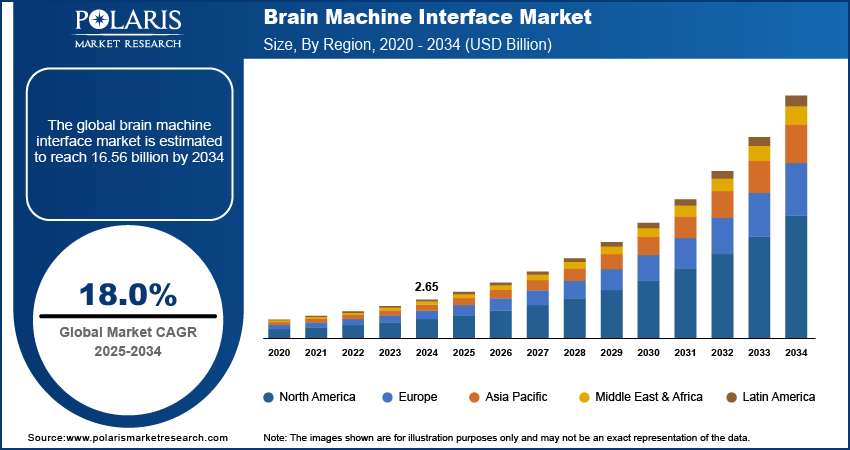
Source: Polaris Market Research Analysis
To Understand More About this Research: Download Sample Report
The brain-machine interface, also known as a brain computer interface, is a technology that enables direct communication between the brain and an external device or system. Major companies around the world with extensive research and development facilities have started focusing on new technological opportunities and current applications and product types, which are expected to drive the market during the forecast period. For Instance, in 2023, Philips introduced a mobile 1.5T MRI unit that signifies a significant advancement in technology, leading to a transformative change in neuroscience research and brain machine interface (BMI) development. This innovative MRI system, known for its lightweight design and helium-free operation, promises reduced costs and increased access to advanced imaging technology. These advancements in neuroscience are expected to drive the industry growth.
The market is expected to grow due to the advancement in artificial intelligence and machine learning. These technologies are revolutionizing BMIs by significantly improving their cost-effectiveness and operational efficiency. AI and ML algorithms improve the accuracy and speed of data interpretation from brain signals, leading to more reliable and real-time communication between the brain and external devices. This efficiency enhances the functionality of BMIs and also reduces the overall cost of development and implementation. AI-driven predictive models are expected to optimize device performance, minimize errors, and tailor interfaces to individual users' needs, making BMIs more accessible and affordable.
Machine learning algorithms enable continuous learning and adaptation, allowing BMIs to evolve and improve over time without substantial increases in cost. Advancement in this technology is anticipated to reduce the need for expensive, manual adjustments and streamline the integration process, thus lowering barriers to entry for both developers and end-users. Consequently, the convergence of AI and ML with BMIs is fostering more dynamic and cost-effective technologies, leading to the BMI market expansion during the forecast period.
Drivers and Trends
Increased in Demand for Neurological Treatment
The increasing prevalence of neurological disorders and neurodegenerative disorders is expected to drive the market growth during the forecast period. According to the American Association of Neurological Surgeons, In the US, there are 60,000 cases of Parkinson’s disease and 1.5 million deaths due to the disorder annually. Similarly, the country recorded 250,000 cases of dystonia as of April 2024. These trends are similar in other major regions, leading to a higher demand for neurological treatment. This surge in demand for effective neurological treatments is anticipated to boost the BMI industry revenue as healthcare providers and researchers seek advanced technologies to address these challenging conditions. Furthermore, investments in the development and deployment of advanced brain-machine interfaces (BMIs) are expected to increase due to growing demand. This is expected to broaden their use in diagnosing and treating underserved neurological disorders. Consequently, the market is projected to grow positively during the forecast period.
Expanding Application in Military and Defense
The growing use of brain machine interfaces in military and defense is expected to drive market growth during the forecast period. Defense agencies are seeking to enhance operational effectiveness and soldier capabilities, and BMIs offer transformative potential. These interfaces facilitate advanced communication systems, enabling soldiers to control devices and systems directly through neural signals, thus improving reaction times and decision-making processes under high-pressure conditions. Additionally, BMIs are being explored for their potential to augment cognitive and sensory functions, providing soldiers with enhanced situational awareness and better integration with advanced technologies. This capability is particularly valuable for tasks requiring precision and rapid information processing, such as in uncrewed aerial vehicles (UAVs) and robotic systems. Moreover, the integration of BMIs has assisted in the development of advanced training simulators that influence combat scenarios with high fidelity, thereby improving training outcomes. Consequently, defense agencies are increasingly investing in BMI research and development to gain a strategic advantage and enhance operational effectiveness. This growing interest and investment in military and defense applications are anticipated to boost the brain machine interface market growth in the forecast period.
Core Brain Machine Interface Components
EEG Devices: The Electroencephalogram (EEG) records brain waves using scalp electrodes. This technology is popular in non-invasive BMI setups. EEG devices are commonly used for research, rehabilitation, and commercial applications.
Neural Implants: The use of implanted electrodes allows for precise measurement of brain signals. The technology is predominantly applied in advanced clinical applications. Such systems have the potential to deliver faster, more reliable control than other methods.
Analysis of Signals: The computer analyzes electrical signals from the brain. After that, they convert those signals into useful instructions. Accuracy is essential while doing so. The latest signal processing techniques aid in minimizing noise.
Neuroprosthetics: Neuroprosthetic devices using BMI technology allow patients suffering from limb loss or paralysis to regain their motor abilities and improve their mobility.
AI Integration: AI enhances pattern detection and accelerates learning. It also facilitates continuous tuning of the system to match the user's performance
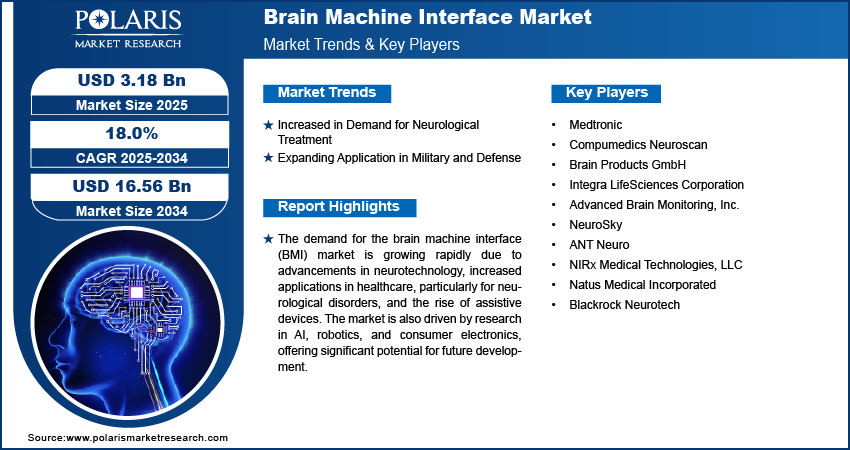
Source: Polaris Market Research Analysis
Segment Insights
Product Insights
The market segmentation based on product type includes invasive, non-invasive, and partially invasive. The non-invasive segment dominated the market share in 2025. This growth is attributed to the increase in demand for minimally invasive and non-invasive medical interventions due to rising awareness about surgical site infection (SSI) and healthcare-associated infections (HAIs). According to the Center for Disease Control and Prevention, the incidence of healthcare-associated infections occurs in every individual in a group of 31 hospital admissions in the United States. Thus, increasing awareness about infections has increased the demand for non-invasive or minimally invasive techniques for treatment, diagnosis, or any assistive devices.
Invasive vs Non-invasive vs Partially BMI
| Type | Description | Advantage | Common Applications |
| Invasive BMI | Inserted inside the brain | Extremely accurate signals | Prostheses, paralysis treatment |
| Non-invasive BMI | Placed outside the brain | More convenient | Research, games, communication |
| Partially invasive BMI | Placed under the skull, but outside the brain | Balance of accuracy and safety | Used for advanced purposes |
Source: Polaris Market Research Analysis
End User Insights
The market segmentation, based on end users, includes hospitals, clinics, rehabilitation centers, home care settings, and other end users. The hospitals segment is expected to register a significant growth rate during the forecast period. This growth is attributed to the increase in the prevalence of neurological diseases and neurodegenerative disorders. Hospitals are mainly in demand for surgeries due to better availability of resources and a skilled workforce. Therefore, the hospital segment is considered a major segment in the BMI market.
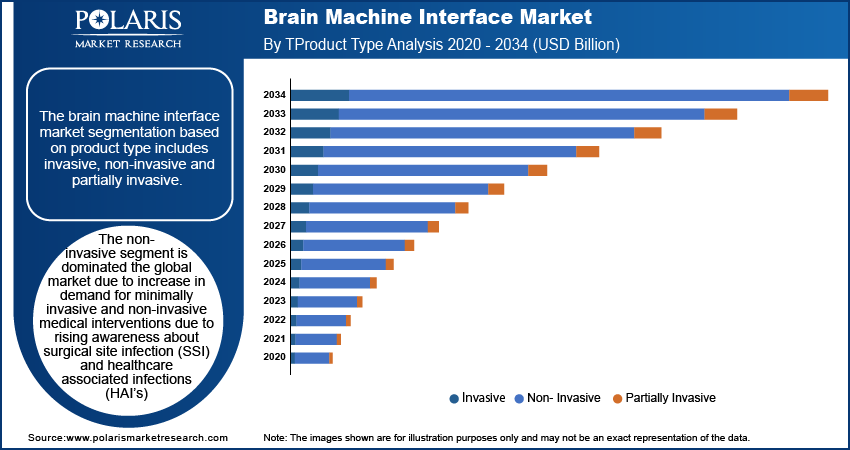
Source: Polaris Market Research Analysis
Regional Insights
North America brain machine interface market held the largest share in 2025, driven by increasing prevalence and investment in neurological disorders. According to the American Medical Association, in the United States, the neurological disorders that contribute most significantly to the total number of Disability-Adjusted Life Years (DALYs) are stroke, Alzheimer's disease, other dementias, and migraines. Stroke alone accounts for 3.58 million DALYs. The increasing burden of these disorders, primarily driven by an aging population, has resulted in a growing demand for advanced treatments and technologies such as BMIs.
Regional disparities also emphasize the varied impact, such as southeastern states experiencing a higher burden from stroke. In contrast, northern states see greater incidences of multiple sclerosis, and eastern states have heightened rates of Parkinson’s disease, epilepsy, and migraine. This geographic variation in neurological disorder prevalence underscores the regional demand for targeted BMI solutions. For instance, regions with a higher prevalence of specific conditions are likely to experience increased investment in BMIs designed to address those particular disorders. Additionally, the overall increase in neurological disorder burden from 1990 to 2020 accelerates BMI market growth during the forecast period as healthcare providers and researchers seek innovative solutions to manage and mitigate these conditions.
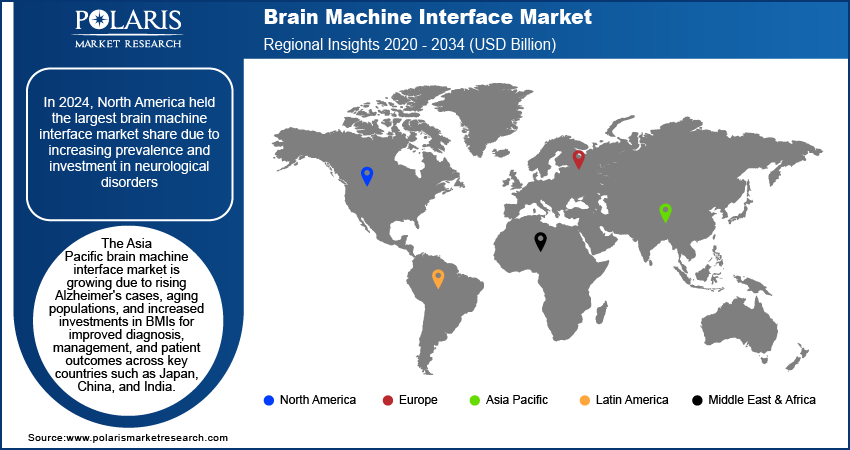
Source: Polaris Market Research Analysis
The Asia Pacific BMI market is expected to register significant growth over the forecast period due to the increasing prevalence of Alzheimer's disease. For instance, the incidence rate of Alzheimer's in Asia-Pacific has grown from 96 per 1,000 people in 1990 to 108 per 1,000 people in 2020, indicating a growing demand for innovative therapeutic solutions. This increase is primarily driven by a rapidly aging population, particularly in countries such as Japan, China, and India, where the elderly population is expanding. This growing burden of Alzheimer's disease has led to a strengthened need for advanced brain machine interfaces (BMIs) to aid in diagnosis, management, and potentially slowing the progression of the disease. Thus, the BMI market is experiencing significant growth as both public and private sectors invest in developing and deploying BMIs to address this critical health challenge, aiming to enhance patient outcomes and improve the quality of life for affected individuals in the region.
India brain machine interface market is expected to grow significantly due to increased investments and the formation of strategic partnerships between global and local companies. This collaboration is creating a vibrant ecosystem that promotes innovation in neurotechnology. International companies are increasingly teaming up with Indian tech firms and research institutions, combining global expertise with local insights. These partnerships bring in vital funding and also facilitate the exchange of technologies and research capabilities, accelerating the development of advanced BMI solutions. India's supportive policy environment and government incentives for technological advancements are further contributing to the brain-machine interface market expansion.
Local startups are reaping the benefits of these international collaborations, gaining access to new technologies and scaling their innovations more rapidly. The influx of investment and the establishment of joint ventures are driving research initiatives, improving product development, and expanding market opportunities. As a result of these factors, the market for BMI is expected to grow during the forecast period.
Key Players & Competitive Insights
The brain machine interface market is always evolving, with numerous companies striving to innovate and distinguish themselves. Leading global corporations dominate the market by leveraging extensive research and development, advanced manufacturing technologies, and significant capital to maintain a competitive edge. These companies pursue strategic initiatives such as mergers, acquisitions, partnerships, and collaborations to enhance their product offerings and expand into new markets.
New companies are impacting the industry by introducing innovative medical devices and meeting the needs of specific market sectors. This competitive environment is amplified by continuous progress in product offerings and new product types, greater emphasis on sustainability, and the rising requirement for tailor-made single-use products in diverse industries. Major players in the industry include Medtronic, Compumedics Neuroscan, Brain Products GmbH, Integra LifeSciences Corporation, Advanced Brain Monitoring, Inc., NeuroSky, ANT Neuro, NIRx Medical Technologies, LLC, Natus Medical Incorporated, and Blackrock Neurotech.
Medtronic, headquartered in Dublin, is a medical technology company. The company’s business line includes developing and manufacturing a diverse range of advanced medical devices, including pacemakers, insulin pumps, spinal implants, robotic surgical systems, and deep brain stimulation systems. Medtronic's deals in treating conditions related to cardiovascular health, diabetes, neurological disorders, and spinal issues. The company has a presence in over 150 countries. In April 2024, Medtronic launched India’s first NeuroSmart Portable Micro Electrode Recording (MER) Navigation system for Parkinson’s treatment. The innovative system was introduced as a significant advancement in the treatment of Parkinson’s disease.
Natus Medical Incorporated is a global provider of medical devices and services focused on the diagnosis, monitoring, and treatment of neurological disorders, hearing impairment, and other medical conditions. The company is headquartered in Pleasanton, California, USA. Natus operates across multiple region,s including North America, Europe, and Asia-Pacific, offering a range of products and solutions to healthcare professionals. The company is deals in neurodiagnostic and neuromonitoring technologies.
Key Companies
- Medtronic
- Compumedics Neuroscan
- Brain Products GmbH
- Integra LifeSciences Corporation
- Advanced Brain Monitoring, Inc.
- NeuroSky
- ANT Neuro
- NIRx Medical Technologies, LLC
- Natus Medical Incorporated
- Blackrock Neurotech
Future of BMI Market
The brain machine interface market is projected to grow due to neural decoding technology driven by AI, increased use in the healthcare sector, and developments in implantable devices. The application of this technology in rehabilitation, assistive communication, and neuroprosthetics is likely to lead to greater demand. Consumer applications like video games and controlling smart devices are expected to present potential areas of growth for the market. Increased investment in the field of neuroscience may aid developments in this market. Comfort, precision, and affordability of devices are also expected to aid commercial growth
Key Industry Developments
- March 2026: China approved the world's first commercially available brain-computer interface medical device. It uses minimally invasive neural implants and wireless technology to help people with paralysis move their hands again. (Source: scientificamerican.com)
- February 2025: Medtronic received U.S. FDA approval for its BrainSense Adaptive DBS and Electrode Identifier. The company stated that the approval marks the first FDA-approved closed-loop DBS/BCI therapy for the treatment of Parkinson’s disease. (Source: news.medtronic.com)
Market Segmentation
By Component Outlook (USD billion, 2021 - 2034)
- Hardware
- Software
By Product Type Outlook (USD billion, 2021 - 2034)
- Invasive
- Non- Invasive
- Partially Invasive
By Technology Outlook (USD billion, 2021 - 2034)
- Electroencephalography (EEG)
- Functional magnetic resonance imaging (fMRI)
- Functional near-infrared spectroscopy (fNIRS)
- Positron emission tomography (PET)
- Magnetoencephalography (MEG)
- Electrocorticography (ECoG)
- Others
By Application Outlook (USD billion, 2021 - 2034)
- Neurorehabilitation
- Assessment and Diagnosis
- Disability Restoration
- Assistive Technology
- Others
By End User Outlook (USD billion, 2021 - 2034)
- Hospitals
- Clinics
- Rehabilitation Centers
- Home Care Settings
- Others
By Regional Outlook (USD billion, 2021 - 2034)
- North America
- US
- Canada
- Europe
- Germany
- France
- UK
- Italy
- Spain
- Netherlands
- Russia
- Rest of Europe
- Asia-Pacific
- China
- Japan
- India
- Malaysia
- South Korea
- Indonesia
- Australia
- Rest of Asia-Pacific
- Middle East & Africa
- Saudi Arabia
- UAE
- Israel
- South Africa
- Rest of Middle East & Africa
- Latin America
- Mexico
- Brazil
- Argentina
- Rest of Latin America
Brain Machine Interface Market Report Scope
| Report Attributes | Details |
| Market size value in 2025 | USD 3.2 billion |
| Market size value in 2026 | USD 3.8 billion |
| Revenue Forecast in 2034 | USD 16.6 billion |
| CAGR | 20.2% from 2026 – 2034 |
| Base year | 2025 |
| Historical data | 2021 – 2024 |
| Forecast period | 2026 – 2034 |
| Quantitative units | Revenue in USD billion and CAGR from 2026 to 2034 |
| Report Coverage | Revenue Forecast, Market Competitive Landscape, Growth Factors, and Trends |
| Segments covered |
|
| Regional scope |
|
| Competitive Landscape |
|
| Report Technology |
|
| Customization | Report customization as per your requirements with respect to countries, region and segmentation. |
Source: Polaris Market Research Analysis
Brain Machine Interface Market FAQ's
The brain machine interface market size was valued at USD 3.18 billion in 2025 and is projected to grow to USD 16.56 billion by 2034.
The global market is projected to grow at a CAGR of 20.2 % during the forecast period, 2026–2034.
North America had the largest share in the global market
The key players in the market are Medtronic; Compumedics Neuroscan; Brain Products GmbH; Integra LifeSciences Corporation; Advanced Brain Monitoring, Inc.; NeuroSky; ANT Neuro; NIRx Medical Technologies, LLC; Natus Medical Incorporated; and Blackrock Neurotech.
The non-invasive segment dominated the global market.
The hospitals segment is expected to experience significant CAGR in the global market during the forecast period.
Download Sample Report of Brain Machine Interface Market
Please fill out the form to request a customized copy of the research report.


