
Contrast Media Market Analysis: What Is Driving Growth Through 2034?
REPORT DETAILS
Contrast Media Market Summary
The global contrast media market is estimated at USD 8.08 billion in 2026 and is projected to reach USD 8.70 billion in 2027, expanding to USD 14.81 billion by 2034 at a CAGR of 7.9% during 2027–2034. More CT, MRI and interventional procedures are being performed as populations age and cancer and heart disease rates rise, and most of these scans need a contrast agent. New low-dose agents and higher-capacity manufacturing plants are improving supply and safety, supporting steady volume growth.
Market Statistics
Key Takeaways
• Iodinated contrast agents hold the largest type share, an estimated 64.3% of revenue in 2026, because CT and interventional X-ray procedures use them at high volume.
• The X-ray and CT modality segment leads with an estimated 69.0% share in 2026, supported by high global CT examination volumes.
• The hospital segment leads by end use with an estimated 57.2% share, supported by institutional diagnostic imaging and interventional procedures.
• Lower-dose agents are the main innovation theme, as radiologists aim to reduce gadolinium exposure and retention concerns.
• North America holds the largest regional share, at an estimated 42.1% in 2026, supported by high imaging volumes.
• Asia Pacific is expected to be the fastest-growing region, currently at an estimated 24.8% share, as CT and MRI scanner installations rise in China and India.
• The market is concentrated among four global imaging pharmaceutical companies, which are investing in capacity and next-generation agents.
The rise in prevalence of long-term complex long-term diseases with high comorbidities led to an increase in imaging tests. It includes ultrasounds, CT scans, X-rays, and other advanced imaging technologies. The basic role of these tests is to identify the need for surgeries in interventional surgical procedures and pre-operative scans before surgeries also boosted the use of contrast media in imaging tests.
Know more about this report: Download Sample Report
Report Segmentation
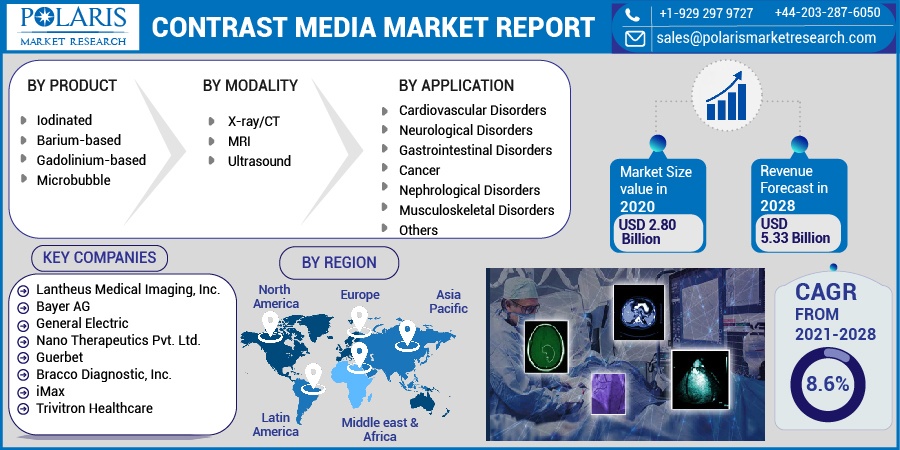
The market is primarily segmented on the basis of product, modality, application, and geographic region.
| By Product | By Modality | By Application | By Region |
|
|
|
|
Source: Polaris Market Research Analysis
Know more about this report: Download Sample Report
Insight by Product
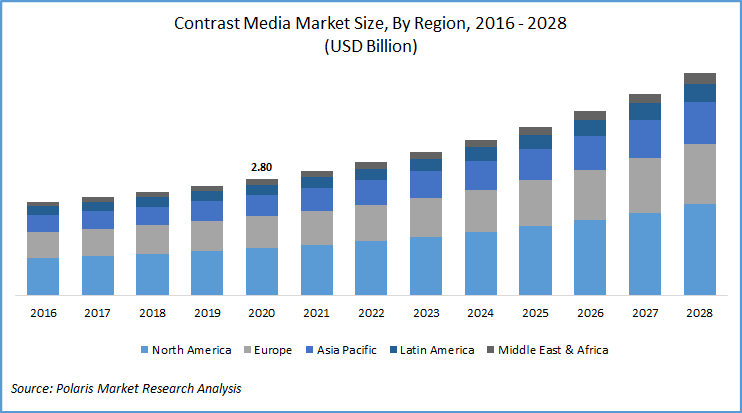
The iodinated media market segment of contrast media industry accounted for the largest market revenue share, in 2020. This high share is attributed to the fact that these kinds of contrast media have excellent radio-opacity and lower toxicity, as compared to other media agents. Mostly, there are iodinated media that are used for radiological examination.
The microbubble market segment is expected to witness a lucrative growth rate over the assessment period. This is attributed to its rising market demand due to its smaller size and can reflect ultrasound waves to a high degree of echogenicity. Moreover, this contrast-enhanced ultrasound is a cheaper alternative to visualize blood flow without the use of any lethal rays. These types of contrast media are mostly useful in patients suffering from kidney disorders.
Insight by Modality
In 2020, the X-ray/CT market segment of contrast media accounted for the largest share. This high share is due to its wide acceptance and cost-efficiency. X-ray-based contrast media primarily comprises iodinated and barium-based contrast agents which are used in diagnostic procedures for numerous long-term chronic diseases and is comparatively less expensive.
MRI market segment of contrast media industry is projected to witness a lucrative market growth rate over the assessment period. During MRI, contrast media reduces relaxation time for the cells within the tissues to modify contrast to produce an image. Gadolinium is the most frequently used contrast media in MRI.
Gadolinium has a 3+ oxidation state, having 7 unpaired electrons, causing the water around to relax quickly, thereby enhancing the quality of the image. This kind of media is extensively used for contrast clearance in between normal and malignant tissues and is administered mostly orally. As a result, the contrast media industry is expected to witness significant market growth.
Know more about this report: Download Sample Report
Geographic Overview
In 2020, North America market for contrast media accounted for a dominant share of the global market. Regional factors contributing to this growth include well-established hospital facilities with equipped diagnostic equipment, patient’s awareness regarding an early diagnosis for cancer, rare diseases, and hereditary disorders.
The rising market demand for the diagnostic procedures as it is necessary first step to decide whether to undergo surgery or any kind of medication/treatment. The aforementioned factors are expected to prosper the market growth for contrast media.
Competitive Insight
The prominent players operating in the market for contrast media are Lantheus Medical Imaging, Inc., Bayer AG, General Electric, Nano Therapeutics Pvt. Ltd., Guerbet, Bracco Diagnostic, Inc., iMax, and Trivitron Healthcare. Companies in the market are introducing new contrast agents to diversify their portfolio of offerings. Recently, Bracco Diagnostics, introduced “Gadoteridol” to image neck and head lesions using MRIs. Similarly, previously GE Healthcare introduced “Clariscan” in European region.
Industry Developments
In June 2026, Bayer received US FDA approval for Ambelvist (gadoquatrane), a macrocyclic MRI contrast agent dosed at 0.04 mmol Gd/kg, about 60% less gadolinium than standard agents. It is approved for adults and children, including term newborns, after approval in Japan in March 2026. (Source: Bayer)
In January 2025, GE HealthCare announced a USD 138 million expansion of its contrast media plant in Cork, Ireland, to add about 25 million patient doses a year by the end of 2027. The company expects global demand for iodinated contrast media to double over the next decade. (Source: GE HealthCare)
Contrast Media Market FAQ'S
The contrast media market is valued at USD 8.08 billion in 2026 and is expected to reach USD 8.70 billion in 2027 and USD 14.81 billion by 2034, according to Polaris Market Research.
The contrast media market is projected to grow at a CAGR of 7.9% from 2027 to 2034, adding roughly USD 6.11 billion in value over the forecast period.
More CT, MRI and interventional procedures are being performed as populations age and cancer and heart disease rates rise, and most of these scans need a contrast agent. New low-dose agents and higher-capacity manufacturing plants are improving supply and safety, supporting steady volume growth.
The main applications are oncology, cardiology, neurology, gastrointestinal imaging, and interventional radiology. Low-dose MRI agents and new CT contrast capacity are the key growth themes.

Download Sample Report of Contrast Media Market
Please fill out the form to request a customized copy of the research report.


