
Esomeprazole Market Size, Share, Global Analysis Report 2026-2034
REPORT DETAILS
Esomeprazole Market Summary
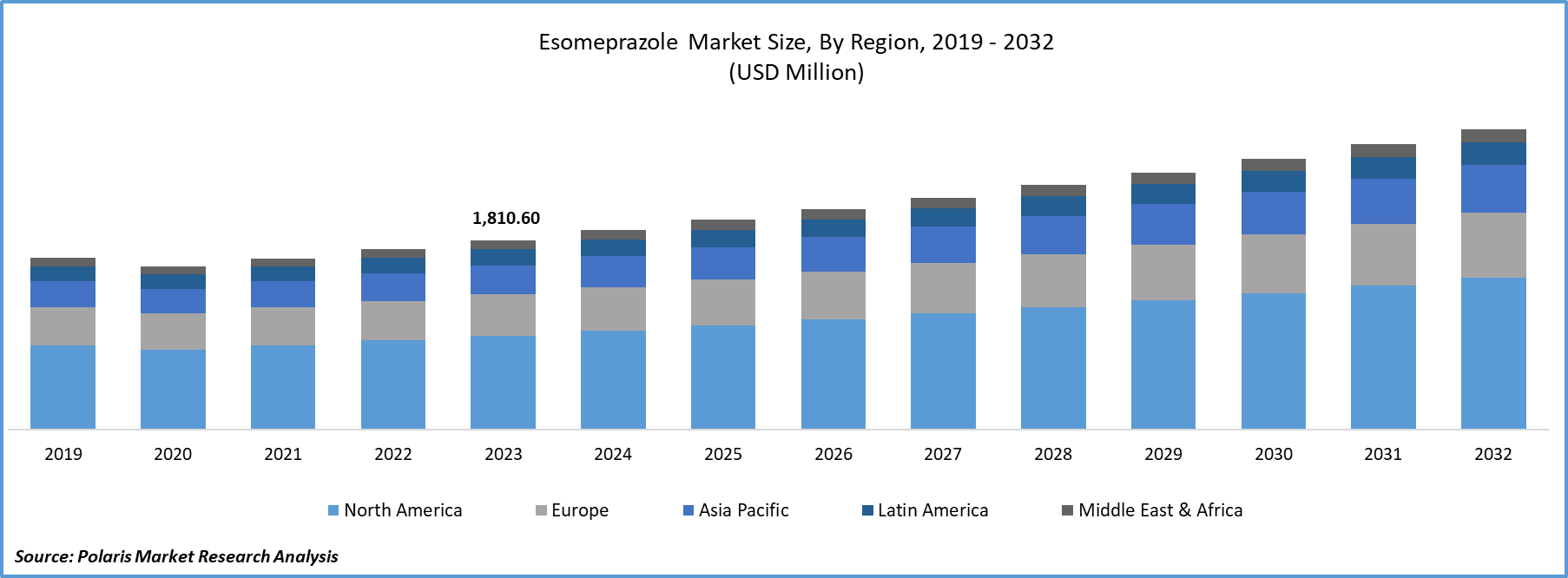
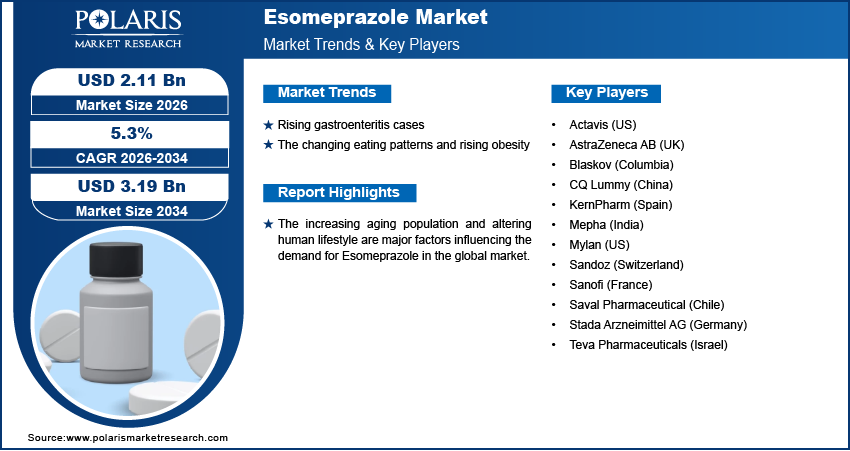
Esomeprazole market size was valued at USD 2.00 billion in 2025 and is anticipated exhibit the CAGR of 5.3% during the forecast period. The growth is driven by rising cases of GERD, ageing population worldwide and improvement in the fast tract approvals of major regulating bodies.
Market Statistics
Market Overview
The increasing aging population and altering human lifestyle are major factors influencing the demand for Esomeprazole in the global market. Most of the working people are following hectic schedules, with the limited or no time for preparing meals and having balanced diet, leading to health complications related to the digestive system and acidity disorders. This is creating the critical need for the medicines that have the potential to reduce acid levels in their stomach by the people. The increasing number of research studies exploring esomeprazole health effects are expected to provide new growth opportunities in the coming years.
For instance, in December 2023, a study published in BMC Gastroenterology focused on evaluating the efficiency and safety of dual delayed-release esomeprazole and delayed-release esomeprazole in treating erosive esophagitis. Results suggested that both are similarly effective in treating the disease.
To Understand More About this Research: Download Sample Report
Moreover, the increasing incidence of acid reflux problems among adults are anticipated to drive demand for effective healthcare medication, including esomeprazole, driven by its tremendous potential in controlling acid burning. According to the Fortune Clinic, Mumbai, in 2023, approximately 20% of the patients in their outpatient department are suffering from acid reflux cases on a weekly basis. There will be a significant demand for esomeprazole in the future, as this trend continues further.
Growth Drivers
Rising gastroenteritis cases
The growing stomach-based health problems are registering new demand for esomeprazole medicine. According to data from city hospitals published by Hindustan Times, in April 2023, there is a 25 to 30% rise in the number of patients taking treatment due to a rise in gastroenteritis cases over the past couple of weeks in India. This is due to the increasing intake of contaminated water and food in the summer. The rising gastroenteritis cases are anticipated to facilitate significant demand for this medicine in the future.
The changing eating patterns and rising obesity
The significant shift in consumer eating habits, mainly towards alcohol and coffee consumption, and smoking are some of the major factors leading to acid reflux cases. The rising obesity cases in the world are expected to fuel the need for esomeprazole in the marketplace. According to a 2022 study, there is a significant correlation between obesity and the symptoms of gastroesophageal reflux disease (GERD). The women with a body mass index 25-29.9, who are considered overweight are more than twice as likely to develop acid reflux compared to those with a normal weight.
Restraining Factors
Rising concerns over esomeprazole side-effects
The increased accessibility to the internet is encouraging patients to research medicines before intake. This provided a platform to learn about the side effects and functioning of medication in the human body. The Indian Pharmacopoeia Commission’s Pharmacovigilance Program of India (PvPI) evaluated the esomeprazole drug and revealed the chance of getting hyperprolactinemia as it can lower the prolactin levels.
According to the 2023 study, the use of proton pump inhibitors, which include esomeprazole, lansoprazole, and omeprazole, for longer periods can increase the risk of dementia among patients. These study outcomes are expected to hinder potential demand for the drug in the future.
Key Trends in Esomeprazole
| Trend | Description | Key Drivers | Examples from Practice |
| Gastroretentive floating tablets | Multiple recent formulations develop esomeprazole magnesium floating tablets using hydrophilic polymers and gas‑generating excipients to prolong gastric residence. | Designing low‑density matrices that remain buoyant in gastric fluid for 8–12 h, giving sustained release and improved bioavailability for acid‑labile esomeprazole. | 2023–2025 formulation studies on esomeprazole floating tablets report good in‑vitro buoyancy, prolonged floating time and controlled release using HPMC, natural gums and other polymers. |
| Floating microbeads / microspheres | Esomeprazole is being loaded into floating microbeads (e.g., zinc‑pectinate–Sesbania gum, sometimes with calcium silicate) as a gastro‑retentive drug delivery system. | Creating porous, low‑density beads that float in gastric fluid and release esomeprazole gradually, aiming for once‑daily dosing and reduced dosing frequency. | A study on esomeprazole‑loaded zinc‑pectinate–Sesbania gum microbeads describes buoyant gastro‑retentive beads with sustained release for oral delivery. Reviews on floating microspheres highlight such systems to extend gastric retention for acid‑labile drugs. |
| Polymeric hydrogels for controlled oral delivery | HPMC–alginate and related polymeric hydrogels have been fabricated as oral carriers for controlled esomeprazole release. | Encapsulating esomeprazole in cross‑linked hydrogels prepared by solution casting to achieve high encapsulation efficiency and extended, pH‑modulated release profiles. | A 2023 hydrogel study reports esomeprazole encapsulation efficiencies above 80%, controlled release in vitro, and favorable in‑vivo performance compared with marketed products in animal models. |
| Fixed‑dose combinations with NSAIDs or aspirin | Esomeprazole is incorporated into fixed‑dose combinations with naproxen or with low‑dose aspirin to provide gastroprotection while maintaining anti‑inflammatory or antiplatelet therapy. | Co‑formulating immediate‑release esomeprazole with NSAIDs in a single tablet to reduce NSAID‑associated upper GI ulcers and symptoms during long‑term treatment. | Phase I–III trials of naproxen/esomeprazole combinations show maintained analgesic efficacy with reduced risk of upper GI ulcers and acceptable long‑term safety in high‑risk patients. Reviews of esomeprazole with low‑dose aspirin demonstrate reduced gastroduodenal ulcer incidence versus aspirin alone. |
| Advanced floating systems using natural polymers | New floating esomeprazole tablets increasingly use natural gums and biopolymers (e.g., xanthan, guar, Sesbania gum) to build gastroretentive matrices. | Replacing purely synthetic matrices with natural polymers to improve biocompatibility, adjust swelling/floatation behavior, and achieve desired sustained‑release kinetics. | Recent formulation papers describe esomeprazole floating tablets with natural gums that show acceptable hardness, friability, drug content and sustained in‑vitro release over 12 h with stable floating properties. |
| Application of nano‑ and solid‑dispersion concepts | While much data are cross‑drug, current oral nano‑delivery research (nanosuspensions, nano‑cocrystals, nanocrystalline solid dispersions) is being generalized to poorly soluble oral drugs such as PPIs including esomeprazole. | Using particle‑size reduction, nano‑encapsulation and nano‑enabled solid dispersions to enhance solubility, stabilize supersaturation and improve oral absorption for acid‑labile, poorly soluble drugs. | Recent reviews on nanoparticle tools for oral drug delivery and on conversion of nanosuspensions to solid dosage forms describe strategies (nano‑cocrystals, nanocrystalline solid dispersions) that are applicable to PPIs like esomeprazole. |
Source: Polaris Market Research Analysis
Report Segmentation
The market is primarily segmented based on product, application, distribution channel, and region.
| By Product | By Application | By Distribution Channel | By Region |
|
|
|
|
Source: Polaris Market Research Analysis
To Understand the Scope of this Report: Request Customization
By Product Analysis
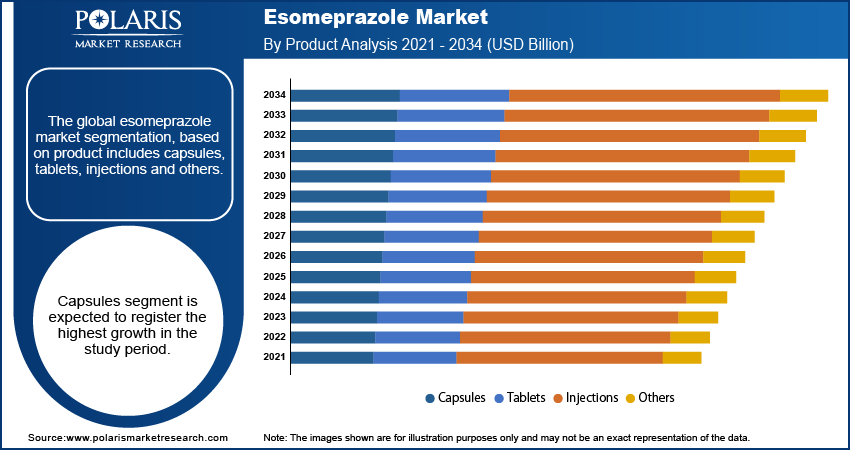
Capsules segment is expected to register the highest growth in the study period
The capsules segment is anticipated to grow at a higher CAGR during the study period, primarily driven by the availability of esomeprazole capsules in the retail space and the rising number of companies offering esomeprazole capsules, which is attributable to the increasing drug production approvals by the US FDA. Furthermore, the ability to act faster than tablets and other product types is contributing to this segmental growth.
By Application Analysis
Gastroesophageal reflux disease segment witnessed the largest market share in 2025
The GERD segment registered the largest market share in 2025 and is likely to retain its market position throughout the forecast period. The rising incidence of GERD in more countries is boosting the expansion of the esomeprazole market. According to a study, it is one of the most highly diagnosed digestive disorders, with a prevalence rate of 20% in the United States. This trend is a major factor contributing to the larger market share of GERD in the esomeprazole market.
The peptic ulcers segment is expected to grow at the fastest rate over the next few years on account of the significant rise in peptic ulcers. The prevalence of peptic ulcer diseases was 10% in 1990, with 500,000 new cases annually in the United States. This in a way facilitates sustainable demand for esomeprazole globally.
By Distribution Channel Analysis
Hospitals & Clinical Pharmacies segment registered a significant market revenue share in 2025
The hospitals and clinical pharmacies segment held a significant market share in revenue in 2025, which is highly accelerated due to the rising number of people having peptic ulcers, GERD, and other disease cases in healthcare settings. The increased accessibility of hospitals in the countries, from rural areas to urban areas, is witnessing significant rise in the doctor consultation, driven by growing government initiatives to promote healthcare infrastructure. This is expected to fuel demand for certain medications, including esomeprazole in the long run.
Regional Insights
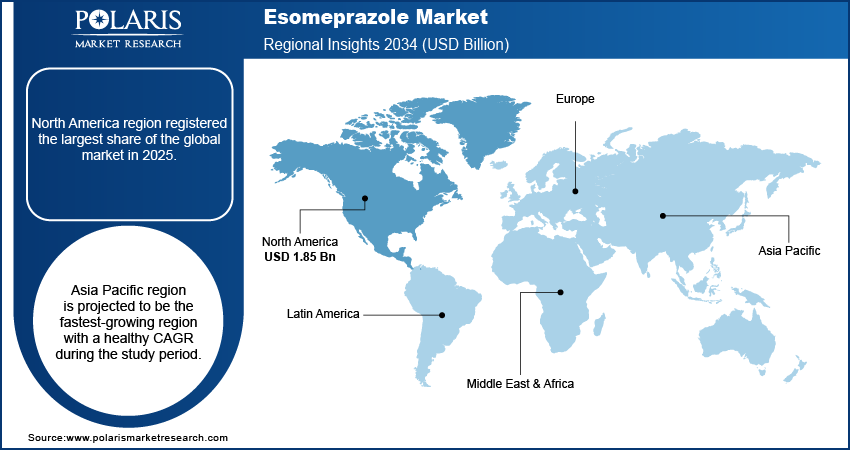
North America region registered the largest share of the global market in 2025
The North America region dominated the global market. This growth is due to rising prevalence of GERD and peptic ulcers in the region. According to the Centre for Disease Control, around 25 billion people in the United States are expected to have peptic ulcer at least one time in their lifetime.
The Asia Pacific region is projected to be the fastest-growing region with a healthy CAGR during the study period, owing to the growing elderly population and rising gastroesophageal reflux cases. The growing companies engaging in the production of this drug in the region is expected to positively impact market growth
Key Market Players & Competitive Insights
The esomeprazole market is moderately fragmented and is expected to witness competition due to the presence of several market players. The key market players are showing enormous interest in strategic collaborations, partnerships, and acquisitions in the market. For instance, in December 2022, LG Chem acquired the patent rights for Vimovo, which was developed by AstraZeneca by utilizing naproxen and esomeprazole as ingredients.
Some of the major players operating in the global market include:
- Actavis (US)
- AstraZeneca AB (UK)
- Blaskov (Columbia)
- CQ Lummy (China)
- KernPharm (Spain)
- Mepha (India)
- Mylan (US)
- Sandoz (Switzerland)
- Sanofi (France)
- Saval Pharmaceutical (Chile)
- Stada Arzneimittel AG (Germany)
- Teva Pharmaceuticals (Israel)
Recent Developments in the Industry
- April 2025, Aurobindo Pharma Limited received FDA approval for Esomeprazole Magnesium for Delayed-Release Oral Suspension, 10 mg. The AB-rated generic equivalent to Nexium addressed GERD, erosive esophagitis, ulcer risk reduction, and Helicobacter pylori treatment in adult and pediatric patient populations nationwide availability
Report Coverage
The esomeprazole market report emphasizes on key regions across the globe to provide better understanding of the product to the users. Also, the report provides market insights into recent developments, trends and analyzes the technologies that are gaining traction around the globe. Furthermore, the report covers in-depth qualitative analysis pertaining to various paradigm shifts associated with the transformation of these solutions.
The report provides detailed analysis of the market while focusing on various key aspects such as competitive analysis, product, application, distribution channel, and their futuristic growth opportunities.
Esomeprazole Market Report Scope
| Report Attributes | Details |
| Market size in 2025 | USD 2.00 billion |
| Market size in 2026 | USD 2.11 billion |
| Revenue forecast in 2034 | USD 3.19 billion |
| CAGR | 5.3% from 2026 – 2034 |
| Base year | 2025 |
| Historical data | 2021 – 2024 |
| Forecast period | 2026 – 2034 |
| Quantitative units | Revenue in USD billion and CAGR from 2026 to 2034 |
| Segments covered |
|
| Regional scope |
|
| Competitive Landscape |
|
| Report Format |
|
| Customization | Report customization as per your requirements with respect to countries, region and segmentation. |
Source: Polaris Market Research Analysis
Esomeprazole Market FAQ's
The Esomeprazole Market report covering key segments are product, application, distribution channel and region.
Esomeprazole Market Size Worth $3.19 Million By 2034
Esomeprazole Market exhibiting the CAGR of 5.3% during the forecast period.
North America is leading the global market
key driving factors in Esomeprazole Market are Rising gastroenteritis cases drives the market
Download Sample Report of Esomeprazole Market
Please fill out the form to request a customized copy of the research report.


