
Landfill Gas Market Demand, Trends, Industry Analysis Report, 2025-2034
REPORT DETAILS
Landfill Gas Market Summary
Landfill gas market size was valued at USD 3,786.23 million in 2024. The market is projected to grow from USD 4,015.84 million in 2025 to USD 6,908.14 million by 2034, exhibiting a CAGR of 6.2% during the forecast period.
Market Statistics
Landfill gas is a mixture of gases, primarily methane and carbon dioxide, produced by the decomposition of organic waste in landfills. It is typically captured and utilized as a renewable energy source or flared to reduce environmental impact.
The world’s shift toward cleaner energy solutions has made landfill gas a valuable renewable energy source. Landfill gas primarily consists of methane, which is captured and converted into electricity or used for heating. This contributes to global efforts aimed at reducing reliance on fossil fuels and cutting carbon emissions. Additionally, governments and businesses are investing in advanced technologies to harness landfill gas more efficiently, driving the demand for infrastructure to capture and utilize this energy, thereby driving the landfill gas market demand.
Source: Polaris Market Research Analysis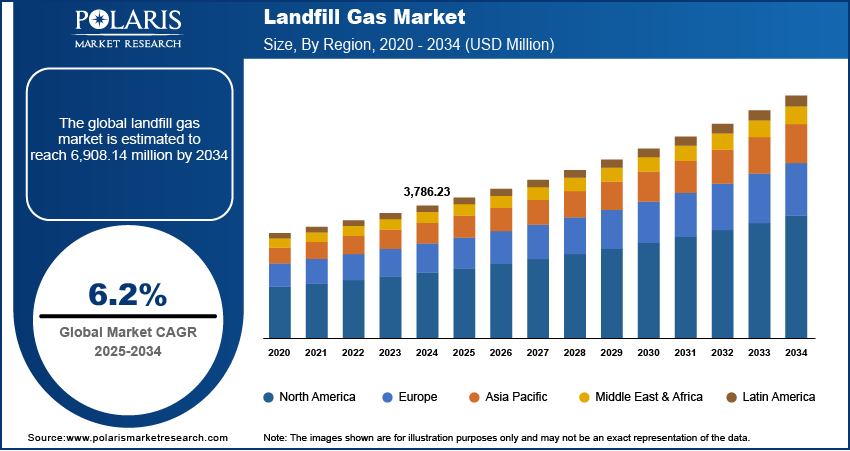
To Understand More About this Research: Download Sample Report
Governments worldwide are tightening regulations to limit greenhouse gas emissions, especially methane, which is released from landfills. Methane is significantly more harmful than carbon dioxide in terms of its contribution to global warming. Landfill gas capture systems help mitigate this environmental impact by capturing and utilizing high purity methane before it escapes into the atmosphere. Compliance with these environmental regulations is driving the landfill gas market.
Market Dynamics
Growing Waste-to-Energy Initiatives
Waste-to-energy programs have gained momentum as a solution to WM Intellectual Property Holdings, L.L.C. and energy generation challenges. These initiatives involve converting the methane produced by landfills into energy, thus addressing two critical issues such as managing waste and producing renewable energy through solar panels and wind turbine. Landfill gas is now being seen as a viable option for electricity generation, especially in areas facing energy shortages. The growing adoption of waste-to-energy programs is accelerating the demand for landfill gas collection and conversion technologies, driving the landfill gas market growth.
Rising Waste Production
Rapid urbanization and population growth have led to an increase in global waste production. More organic waste in landfills results in higher volumes of landfill gas, particularly methane. Landfills remain a significant part of waste disposal systems, making the capture and utilization of this gas more crucial. Additionally, increased waste creates more opportunities for energy generation from landfill gas, prompting investments in gas collection infrastructure. These factors are fueling landfill gas market expansion.
Source: Polaris Market Research Analysis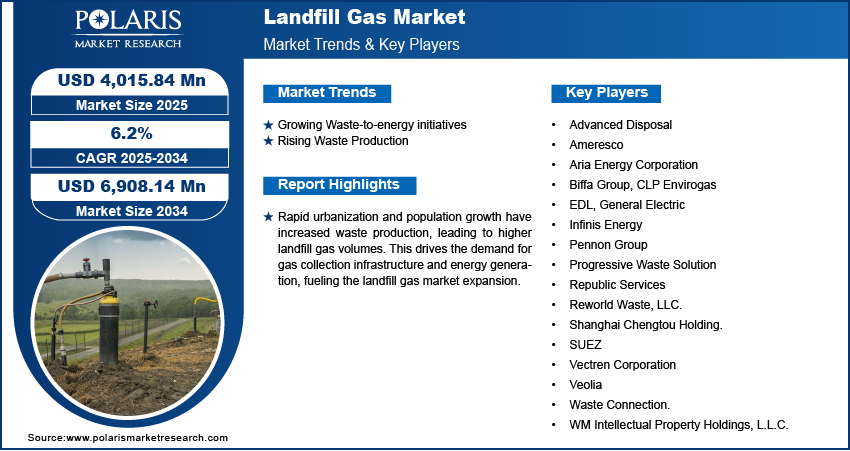
Segment Analysis
Assessment by Type Outlook
The landfill gas market segmentation, based on grade, includes methane, carbon dioxide, and trace gases. The methane segment is expected to witness the fastest growth during the forecast period. Methane, being the primary component of landfill gas, is a significant environmental concern due to its potent greenhouse gas properties. Its capture and utilization are essential for reducing emissions and generating renewable energy. The growing emphasis on sustainable energy and WM Intellectual Property Holdings, L.L.C. is driving investments in methane capture technologies, such as gas collection systems and bioenergy solutions. These technologies enable methane to be converted into electricity or heat, supporting the transition to greener energy and boosting the demand for methane recovery infrastructure and consequently driving the segmental growth in the market.
Evaluation by Application Outlook
The landfill gas market segmentation, based on application, includes electricity generation, heating, combine heat & power, and others. The electricity generation segment dominated the landfill gas market in 2024. Landfill gas, especially methane, is captured and converted into electricity, offering a sustainable energy solution. This method helps reduce greenhouse gas emissions while providing a renewable energy source. Many governments and organizations are focusing on cleaner energy alternatives, leading to the development of landfill gas power plants. These plants generate electricity and supply it to local power grids, benefiting both the environment and the economy. The rising demand for renewable energy and the cost-effectiveness of using landfill gas are driving segmental growth.
Source: Polaris Market Research Analysis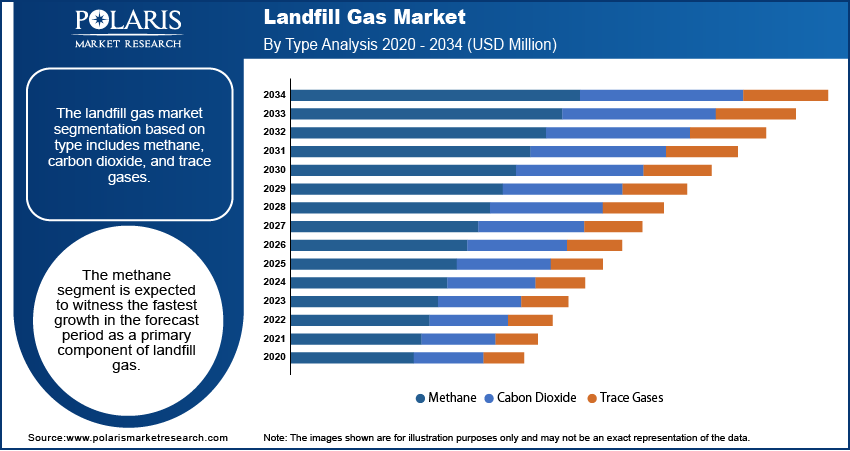
Regional Insights
By region, the study provides the landfill gas market insights into North America, Europe, Asia Pacific, Latin America, and the Middle East & Africa. In 2024, North America dominated the market due to strong government support for renewable energy initiatives and waste-to-energy projects. The US and Canada have implemented policies that encourage the capture and utilization of landfill gas for electricity generation and other applications. Several landfills across the region are adopting advanced technologies to improve gas recovery. Additionally, environmental regulations and incentives for reducing greenhouse gas emissions are further driving the landfill gas market in North America.
Source: Polaris Market Research Analysis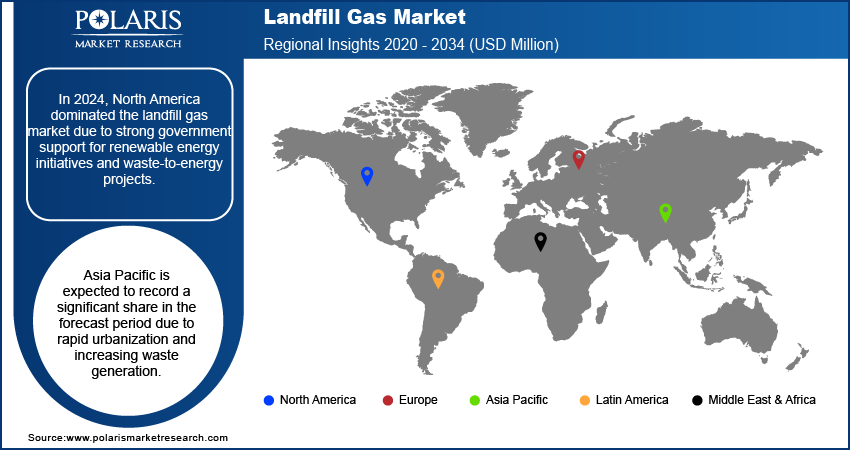
Asia Pacific is expected to record a significant landfill gas market share during the forecast period due to rapid urbanization and increasing waste generation. Countries such as China, India, and Japan are focusing on sustainable WM Intellectual Property Holdings, L.L.C. solutions, including landfill gas recovery. The need for clean energy and waste-to-energy projects is growing, particularly in densely populated areas with high waste production. Additionally, governments are offering incentives and policies to support the development of landfill gas infrastructure, which has increased investments in gas collection and energy production, thereby driving the market in Asia Pacific.
The landfill gas market in India is experiencing substantial growth. The government is focusing on increasing renewable energy capacity and has implemented policies to encourage the utilization of landfill gas for electricity generation. Additionally, growing urbanization, along with increased waste generation, has made landfill gas recovery a viable solution. The government is investing in sustainable WM Intellectual Property Holdings, L.L.C. systems, and waste-to-energy projects, which in turn drives demand for landfill gas infrastructure, thereby fueling the market.
Key Players & Competitive Analysis Report
The landfill gas market is constantly evolving, with numerous companies striving to innovate and distinguish themselves. Major global corporations dominate the market by leveraging extensive research and development, and advanced techniques. These companies pursue strategic initiatives such as mergers, acquisitions, partnerships, and collaborations to enhance their product offerings and expand into new markets.
New companies are impacting the industry by introducing innovative products to meet the demand of specific market sectors. This competitive environment is amplified by continuous progress in product offerings. Major players in the market include Reworld Waste, LLC.; SUEZ, Infinis Energy, Vectren Corporation, and Shanghai Chengtou Holding.; Pennon Group; Aria Energy Corporation; Veolia; Ameresco; Republic Services; Biffa Group; EDL; General Electric; CLP Envirogas; Advanced Disposal; WM Intellectual Property Holdings, L.L.C.; Progressive Waste Solution; and Waste Connection.
Infinis Energy is a British renewable energy company based in Northampton, focusing on electricity generation from landfill gas (LFG) and disused mines. Founded in 2006, Infinis operates over 121 landfill gas sites, contributing to a total generating capacity of approximately 478 MW across various renewable sources, including solar energy. The company's main product, electricity from LFG, is produced through the decomposition of organic waste in landfills. By capturing methane from these sites, Infinis generates energy while addressing some of the environmental issues associated with landfill waste. The company employs monitoring systems to optimize methane extraction and ensure compliance with environmental regulations. In addition to its landfill gas operations, Infinis has diversified into solar energy generation and is exploring battery storage technologies to enhance its renewable energy offerings. Operating primarily in the United Kingdom, Infinis manages a network of 137 operational sites that are strategically located to maximize energy production and meet local demand. The company benefits from government-backed initiatives such as the Renewables Obligations Certificate (ROC), which helps stabilize revenue amid fluctuating market conditions.
SSuez SA is an international company based in Paris, France, that focuses on environmental management, particularly in water and WM Intellectual Property Holdings, L.L.C. Established as a separate entity in 2008 after its spin-off from GDF Suez (now Engie), Suez operates in over 40 countries. The company provides a range of services related to water management, including the supply of drinking water, wastewater treatment, and the overall management of the water cycle. In the WM Intellectual Property Holdings, L.L.C. sector, Suez offers services such as recycling, waste recovery, collection, and landfilling for both hazardous and non-hazardous waste. A significant aspect of Suez's operations involves capturing and utilizing landfill gas (LFG), which is produced from the decomposition of organic waste in landfills. This process involves extracting methane emissions and converting them into energy, which helps reduce greenhouse gas emissions. Suez employs various technologies to optimize methane extraction while adhering to environmental regulations. The company's operations are concentrated primarily in Europe, but it also engages in projects across Asia Pacific, the Americas, Africa, and the Middle East.
List Of Key Companies
- Advanced Disposal
- Ameresco
- Aria Energy Corporation
- Biffa Group
- CLP Envirogas
- EDL
- General Electric
- Infinis Energy
- Pennon Group
- Progressive Waste Solution
- Republic Services
- Reworld Waste, LLC.
- Shanghai Chengtou Holding.
- SUEZ
- Vectren Corporation
- Veolia
- Waste Connection.
- WM Intellectual Property Holdings, L.L.C.
Landfill Gas Industry Development
- June 2025: Veolia Environment SA and Waga Energy inaugurated the upgraded Granges-sur-Vologne landfill RNG plant in northeastern France. The upgrade boosted capacity by 30% to 180 GWh annually and added a second gas purification unit meeting French biomethane standards, expanding Veolia’s RNG portfolio to ten plants and supporting EU decarbonization goals.
- September 2024: A sixth biomethane production unit was launched by Veolia and Waga Energy at the Granges Waste Recovery Center, producing 25 GWh of biomethane annually, benefiting 3,000 households and reducing CO2 emissions.
- March 2024: Waste Management, Inc. announced plans to expand its landfill gas-to-energy projects across North America and implement advanced gas recovery systems to increase renewable energy output at 10 new landfill sites.
- February of 2024, Veolia launched a pilot effort in France focused on converting landfill gas into hydrogen. The project is intended to create alternative energy options while reducing overall methane emissions.
Landfill Gas Market Segmentation
By Type Outlook (Revenue USD Million, 2020–2034)
- Methane
- Carbon Dioxide
- Trace Gases
By Technology Outlook (Revenue USD Million, 2020–2034)
- Thermal Technologies
- Biochemical Reactions
By Application Outlook (Revenue USD Million, 2020–2034)
- Electricity Generation
- Heating
- Combine Heat & Power
- Others
By Regional Outlook (Revenue USD Million, 2020–2034)
- North America
- US
- Canada
- Europe
- Germany
- France
- UK
- Italy
- Spain
- Netherlands
- Russia
- Rest of Europe
- Asia Pacific
- China
- Japan
- India
- Malaysia
- South Korea
- Indonesia
- Australia
- Rest of Asia Pacific
- Middle East & Africa
- Saudi Arabia
- UAE
- Israel
- South Africa
- Rest of Middle East & Africa
- Latin America
- Mexico
- Brazil
- Argentina
- Rest of Latin America
Landfill Gas Market Report Scope:
| Report Attributes | Details |
| Market Size Value in 2024 | USD 3,786.23 Million |
| Market Size value in 2025 | USD 4,015.84 Million |
| Revenue Forecast in 2034 | USD 6,908.14 Million |
| CAGR | 6.2% from 2025–2034 |
| Base Year | 2024 |
| Historical Data | 2020–2023 |
| Forecast Period | 2025–2034 |
| Quantitative Units | Revenue in USD million and CAGR from 2025 to 2034 |
| Report Coverage | Revenue Forecast, Market Competitive Landscape, Growth Factors, and Industry Trends |
| Segments Covered |
|
| Regional Scope |
|
| Competitive Landscape |
|
| Report Format |
|
| Customization | Report customization as per your requirements with respect to countries, regions, and segmentation. |
Source: Polaris Market Research Analysis
Landfill Gas Market FAQ's
The landfill gas market size was valued at USD 3,786.23 million in 2024 and is projected to grow to USD 6,908.14 million by 2034.
The global market is projected to register a CAGR of 6.2% during the forecast period 2025-2034.
North America had the largest share of the global market in 2024.
The key players in the market are Reworld Waste, LLC.; SUEZ; Infinis Energy; Vectren Corporation; Shanghai Chengtou Holding.; Pennon Group; Aria Energy Corporation; Veolia; Ameresco; Republic Services; Biffa Group; EDL; General Electric; CLP Envirogas; Advanced Disposal; WM Intellectual Property Holdings, L.L.C.; Progressive Waste Solution; and Waste Connection.
The electricity generation segment dominated the landfill gas market in 2024 as many governments and organizations are focusing on cleaner energy alternatives.
The methane segment is expected to witness the fastest growth in the forecast period as a primary component of landfill gas.
Landfill gas is a mixture of gases, primarily methane and carbon dioxide, produced by the decomposition of organic waste in landfills, captured and utilized as a renewable energy source or flared to reduce environmental impact.
Key trends include growing waste-to-energy initiatives, rising methane capture investments, stricter greenhouse gas regulations, rapid urbanization increasing waste volumes, and expanding electricity generation and combined heat and power applications globally.
Download Sample Report of Landfill Gas Market
Please fill out the form to request a customized copy of the research report.


