
Military Robots Market Size, Share, Trends And Forecast, 2026–2034
REPORT DETAILS
Military Robots Market Summary
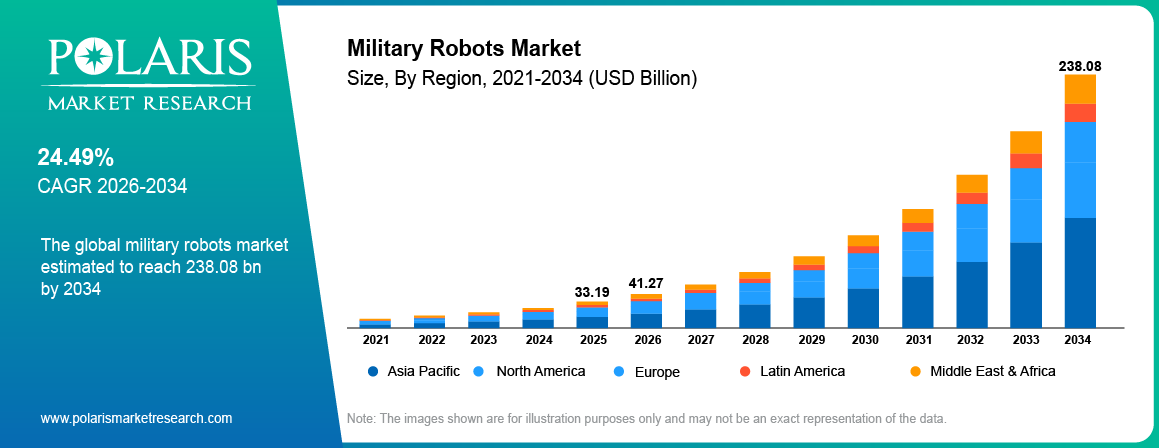
The global military robots market was valued at USD 33.19 Billion in the base year and is projected to reach USD 238.08 Billion by the end of the forecast period, expanding at a CAGR of 24.49%. Growth is supported by increasing military adoption of uncrewed systems for logistics, casualty evacuation, intelligence, surveillance and reconnaissance (ISR), explosive ordnance disposal, and combat support.
Market Statistics
Key Takeaways
- North America accounted for 38.64% of the global military robots industry in the base year, driven by military investment in autonomous ground systems, logistics robotics, and uncrewed platforms.
- Europe is projected to register the significant growth of 25.82% during the forecast period, reflecting accelerating adoption of military ground robots and changing procurement requirements.
- Airborne robots accounted for 45.84% of the military robots industry in the base year, representing the dominant platform segment, driven by persistent surveillance and reconnaissance demand, while land robots are projected to grow fastest on expanding military use of unmanned ground vehicles for logistics, evacuation, and combat support.
- ISR accounted for 44.58% of the military robots industry in the base year, making it the leading application segment.
- Human-in-the-Loop accounted for 55.61% of the military robots industry in the base year, representing the leading autonomy segment.
- Army accounted for 36.72% of the military robots market share in the base year, representing the leading end-user segment, driven by growing requirements for robotic systems in specialized and complex operating environments.
- Ground robots have moved from trials to mass procurement, with Ukraine’s Ministry of Defence targeting 25,000 unmanned ground vehicles in the first half of 2026 and U.S. forces placing new logistics robot contracts with American Rheinmetall in July and September 2026.
- There is a growing number of companies producing military ground robots. Among them, Rheinmetall, Milrem Robotics, and Ghost Robotics can be listed as pioneers. However, Ukraine’s cluster Brave1 contains around 300 domestic manufacturers of ground and drone robots. There are many new companies entering the market, which is affecting the market share of military robots toward established suppliers capable of high volume production.
Note: Figures and projections outlined in this report are the result of Polaris Market Research’s proprietary analytical processes, grounded in the latest available datasets and market observations.
Military Robots Market Definition
The military robots market consists of robotic and uncrewed systems procured by armed forces across land, marine, and airborne environments. The scope includes unmanned ground vehicles, legged robots, uncrewed surface vessels, underwater systems, airborne robots, and autonomy kits that enable these platforms to operate with limited human input. The market covers military applications such as logistics, casualty evacuation, explosive ordnance disposal, combat support, intelligence, surveillance and reconnaissance, and mine countermeasures. These capabilities collectively form a broad range of military robotic systems designed to support personnel across diverse operational environments.
The market differs from commercial and civil security robotics because the systems included in this scope are designed, procured, or adapted for military operations. Commercial security robots, which are covered in the security robots market, are outside the market boundary, while standalone artificial intelligence software that is not tied to a robotic platform is also excluded. Vehicle electronics are treated separately from the robotic systems covered in this analysis. This distinction helps define the scope of the unmanned ground vehicle (UGV) and other robotic platforms included in the military market.
The types of military robots covered include unmanned ground vehicles, legged robots, uncrewed surface vessels, underwater systems, and airborne robots. Ground systems are receiving increasing operational attention because they can perform supply delivery and casualty evacuation in environments where deploying personnel creates additional risk. The operational utility of UGVs is increasing, with Ukraine’s Defense Forces executing logistics and evacuation UGV missions in June 2026 (Source: mod.gov.ua).
The military robot market also has a trend of domestic production and rapid platform development. Around 300 ground drone companies were reported in the Brave1 cluster in Ukraine, with domestic manufacturers providing the UGVs contracted for by Ukraine throughout 2026. This development shows how operational demand is driving the development of local robotic manufacturing ecosystems and is an important consideration in military robots market analysis.
Military robots are used to carry supplies, evacuate the wounded, clear explosives, and scout ahead, which keeps soldiers out of the most dangerous ground. Ukraine’s forces are using ground robots in 2026 at a scale no army has matched, with the Defence Procurement Agency DOT contracting more than 22,000 unmanned ground vehicles by July 2026. This military robots industry report tracks how that battlefield experience is reshaping the wider military robots market.
Military Robots Industry Value Chain
| Stage | Key Activities | Representative Participants |
| Components and Enabling Technologies | Chassis, hybrid power, sensors, communications, and navigation hardware | Harbinger (hybrid chassis); component suppliers, including Chinese inputs used by Ukrainian makers |
| Autonomy and Software | Autonomy kits, voice interfaces, and multi-robot supervision | Forterra; Primordial Labs; Rheinmetall Canada (PATH); Swarmer; Overland AI |
| Platform Manufacturing | Production of ground, legged, marine, and airborne robots | Rheinmetall; Milrem Robotics; Ghost Robotics; Ratel Robotics; ARX Robotics |
| Integration and Payloads | Vehicle integration, remote weapon stations, and amphibious or mission kits | Babcock; Elbit Systems (FUSE); American Rheinmetall |
| Procurement and Fielding | Contracting, trials, deployment, and through-life support | Ukraine’s Defence Procurement Agency DOT; U.S. Army; U.S. Marine Corps |
Source: Polaris Market Research Analysis
Market Dynamics
Driver Impact Analysis
| Factor | Type | Impact Level | Time Horizon |
| Expansion of large-scale ground robot procurement | Driver | High | Short to medium term |
| Shift from robotic trials to funded programs | Driver | High | Medium to long term |
| Autonomous logistics and multi-robot deployment | Opportunity | High | Medium to long term |
| Cross-border investment in established robot technologies | Opportunity | Medium | Medium term |
Source: Polaris Market Research Analysis
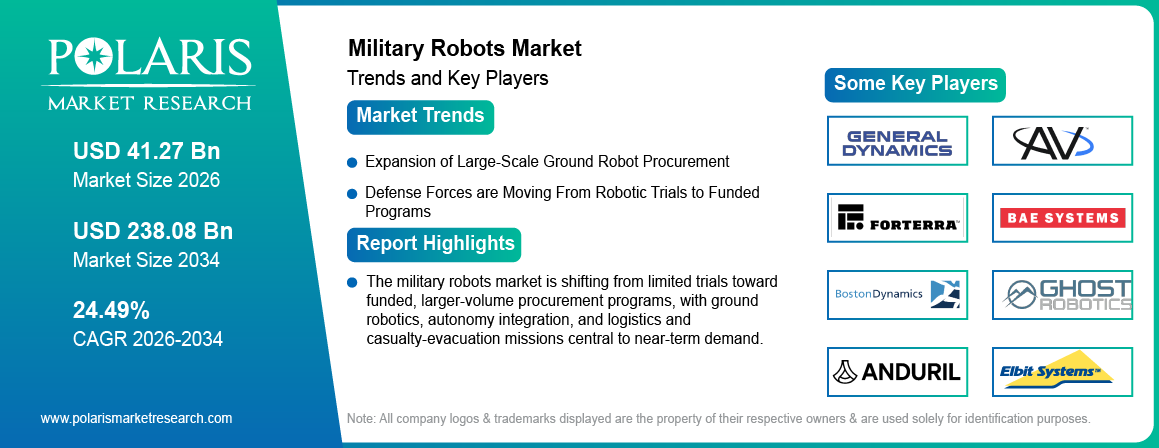
Driver: Expansion of Large-Scale Ground Robot Procurement
Growing use of unmanned ground vehicles to support logistics, evacuation and other frontline operations is driving the demand for military robotic systems. Ukraine’s procurement activity is moving ground robots from limited trials to larger-volume deployments, increasing requirements for vehicle platforms, autonomy systems, communications equipment and mission-specific configurations. This shift is contributing to the larger adoption of robotic platforms as armed forces seek out systems capable of performing repetitive missions and limiting personnel exposure in dangerous environments.
In April 2026, Ukraine’s Ministry of Defense announced their plan to contract 25,000 unmanned ground vehicles in the first half of the year. By July the Defence Procurement Agency DOT had bought more than 22,000 UGVs, all home-grown. The scale of these procurements is an indication of a shift to repeatable production and broader operational use of ground robotic systems, raising demand for manufacturers able to supply platforms in higher volumes (Source: militarnyi.com).
Ground robots are used for tactical resupply and casualty evacuation. In August 2026, the U.S. Army tested the NOMAD uncrewed ground vehicle (UGV) during Project Convergence at Fort Irwin, primarily for tactical resupply missions. The trial is one of a growing use of ground robots to ferry supplies to forward units while reducing soldiers' exposure to battlefield hazards (Source: businessinsider.com).
Driver: Defense Forces are Moving From Robotic Trials to Funded Programs
Demand for autonomous military platforms is fueled by the transition from experimental robotics trials to funded procurement programs. Defense organizations are increasingly seeking to apply robotic systems to perform specific operational functions such as autonomous logistics, amphibious mobility, and multi-vehicle operations. This change provides greater opportunities for suppliers to commercialize technologies that have shown operational relevance and enhances the integration between robotic vehicles, autonomy systems and existing military infrastructure. These developments are boosting the military robots industry forecast by increasing the number of funded applications for robotic platforms.
The U.S. Marine Corps awarded American Rheinmetall a USD 7.28 million contract in September 2026 for 12 Mission Master SP autonomous unmanned ground vehicles and five autonomy kits. Earlier in July, American Rheinmetall was selected as prime contractor for the U.S. Army's Project Sustainment, an 18-month program focused on autonomous hybrid-powered logistics robots. These contracts demonstrate the movement of robotic systems from evaluation programs toward funded defense requirements (Source: rheinmetall.com).
The shift toward funded programs is also increasing demand for systems that support multiple vehicles under manned-unmanned teaming arrangements. Project Sustainment combines a hybrid vehicle platform with Forterra autonomy and Primordial Labs' Anura voice interface, illustrating how vehicle manufacturers and autonomy specialists combine their technologies within military robotic programs. Such integration supports broader deployment of autonomous systems across logistics and other support missions.
Restraint: Supply Chain Vulnerabilities and Electronic Warfare Risks Can Limit Deployment
Military robot manufacturers face supply chain and operational risks impacting production, deployment and availability of systems. Domestic manufacturing of robots does not reduce the reliance on specialized components, and suppliers face physical security risks. These constraints increase the uncertainty of procurement and make it more challenging to ramp up production quickly, particularly when military users require reliable platforms, autonomy kits and enabling technologies in contested operating environments.
Ukraine’s growing defense manufacturing ecosystem remains vulnerable to component supply, including reliance on Chinese inputs. In September 2026, Estonia blamed Russia for an arson attack on Milrem Robotics, a developer of the THeMIS ground robot. These developments highlight the wider security and supply-chain vulnerability of firms involved in military robotics, autonomous systems, and remote weapon station technologies (Source: theguardian.com).
Military robots are also vulnerable to battlefield limitations such as jamming and electronic attack, a risk also tracked in the unmanned electronic warfare market. Such conditions affect communications, navigation, and remote-control functions, particularly when robotic platforms operate in contested environments. The requirement for resilient communications, navigation, and electronic protection therefore increases system complexity and add technical requirements to military robotic systems.
Opportunity: Autonomous Logistics Can Expand Multi-Robot Deployment
The development of autonomous logistics systems creates opportunities for military robot manufacturers and autonomy technology suppliers. Platforms that transport supplies while requiring limited direct control support larger robotic fleets and reduce the personnel required to operate individual vehicles. This creates additional demand for autonomy software, hybrid power systems, voice interfaces, navigation technologies, and vehicle integration capabilities across military robots for logistics programs.
Project Sustainment is designed around autonomous hybrid-powered ground robots for frontline resupply. The American Rheinmetall team combines Harbinger's hybrid chassis, Forterra's autonomy technology, and Primordial Labs' Anura voice interface, enabling a soldier to supervise multiple robotic systems. This approach expands the role of autonomous logistics platforms and supports wider adoption of manned-unmanned teaming in resupply missions (Source: rheinmetall.com).
The opportunity extends beyond transportation because hybrid robotic platforms also provide additional power and support capabilities. Harbinger's platform is reported to offer more than 500 miles of range and 350 kilowatts of exportable power, creating potential utility for military units operating away from fixed infrastructure. These capabilities add to the operational value of autonomous logistics platforms and their role in tactical resupply beyond simply moving cargo (Source: harbingermotors.com).
Opportunity: Cross-Border Investment Is Expanding Access to Established Robot Technologies
The cross-border investment into military robotics firms is creating possibilities for defense groups to extend their footprint in developed robotic technology markets. Acquisitions give investors access to specialized segments without having to develop full robotic capabilities in-house, providing access to existing platforms, engineering capability, autonomy technologies and established customer relationships. This trend also links regional defense companies with global military robot ecosystems and boutique legged robot technologies.
EDGE Group has been a majority owner of Estonia-based Milrem Robotics since 2023 while South Korean LIG Nex1 has acquired a 60% stake in U.S.-based Ghost Robotics in 2024. Such ownership structures help in technology development and expansion to other defense markets, which boosts the development of the military robots market (Source: edgegroup.ae).
Cross-border ownership also supports the expansion of robotic platforms into new defense markets, although technology-transfer requirements, ownership rules, and national security reviews influence the structure of these transactions. This creates opportunities for companies with established robotic technologies to access additional capital, partnerships, and international defense relationships across the broader defense robotics market.
Military Robots Market Segmentation Analysis
The military robots market is segmented by platform, application, level of autonomy, end user, and region. These categories distinguish the physical operating environment, mission requirements, degree of human supervision, military service, and geographic demand for robotic systems.
Platform Insights
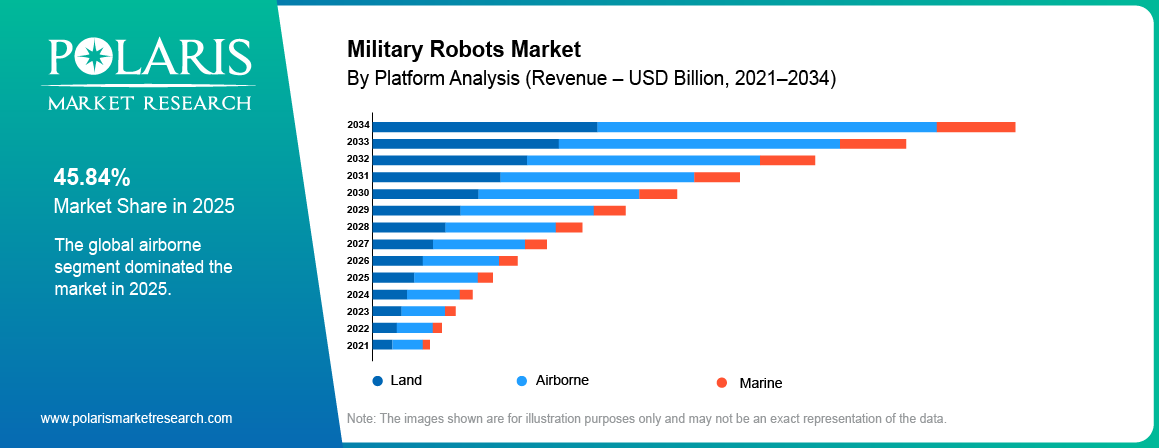
The Airborne segment accounted for 45.84% share of the military robots market in 2025, propelled by established use of airborne robots and uncrewed systems for surveillance, intelligence, reconnaissance, target observation, and other missions requiring persistent aerial coverage. These platforms enable defense forces to collect real-time information across large and difficult-to-access operating areas. Airborne robots also reduce the need to expose crewed aircraft and personnel to certain high-risk environments. Further improvements are due to advances in autonomous navigation, sensors, communication systems and onboard data processing which are improving their operational capabilities. The growing demand for persistent situational awareness and remote sensing is projected to spur adoption in military operations. Armed and surveillance drones are covered in more depth in the military drone market.
The Land segment is anticipated to record 27.42% CAGR over the forecast period, fueled by increasing procurement and deployment of unmanned ground vehicles for logistics, casualty evacuation, explosive ordnance disposal (EOD), surveillance, reconnaissance and other frontline missions. These platforms enable military forces to carry out some tasks in environments that may be highly risky to personnel. Improvements in autonomous mobility, obstacle detection, remote control, navigation, and payload integration are expanding the range of applications for ground robots. Growing operational experience is also encouraging defense organizations to move from limited testing and demonstration programs toward larger-scale deployment, fleet expansion, and repeat procurement of unmanned ground vehicles. Legged robots in the military, such as Ghost Robotics’ Vision 60, form a small but distinct land category built for terrain that wheeled and tracked vehicles cannot cross.
The Marine segment covers uncrewed surface vessels, underwater systems, and other maritime robots used for ISR, mine countermeasures, and coastal security. Adoption is supported by modular autonomy kits that allow existing vessels to operate with limited human input, and by the need to keep crews out of mined or contested waters. Surface platforms are analyzed in more detail in the unmanned surface vehicle market.
Application Insights
The ISR segment contributed 44.58% to the military robots market share in 2025, due to the continuous demand for intelligence, surveillance and reconnaissance capabilities across land, marine and airborne operating environments. Military robotic systems can provide continuous sensing, real-time observation, and information gathering in areas that may be difficult or hazardous for personnel to reach. The combination of electro-optical and infrared cameras, radar, thermal imaging, communications equipment and other sensors increases the capability of robotic platforms to collect operational data. Likewise, advances in autonomous navigation and remote-control systems are expanding ISR use cases, allowing military operators to conduct some observation and reconnaissance activities from somewhat safer locations.
Logistics & casualty evacuation segment is expected to grow at the highest CAGR of 29.18% during the forecast period. The growing adoption of robotic platforms for transporting supplies, equipment, ammunition, food, and medical resources in difficult operational environments is expected to drive the growth of this segment. These systems can reduce personnel requirements for entry into exposed areas during resupply and evacuation operations. Military efforts to improve battlefield logistics, maintain supply continuity and accelerate casualty evacuation under contested conditions also drive demand. Ukraine’s increasing use of ground robots for casualty evacuation and logistics is demonstrating the usefulness of these applications for operations, and providing defense organizations with hands-on experience in fielding unmanned platforms for frontline support missions.
Explosive ordnance disposal (EOD), combat support, and mine countermeasures remain steady, mission-critical applications. EOD robots allow operators to inspect and neutralize explosive threats from a safe distance, combat support robots carry weapons, sensors, and remote weapon stations on platforms such as THeMIS and Mission Master, and mine countermeasures rely on uncrewed surface and underwater vessels to detect and clear mines without placing crews in the hazard area.
Level of Autonomy Insights
The Human-in-the-Loop segment held 55.61% share of the military robots market in 2025, which indicates the continued dependence on human operators to control, monitor, or authorize robotic actions. This operating model allows military personnel to maintain decision making authority while employing robotic platforms for mobility, sensing, transportation, surveillance and other missions. Demand continues to be associated with applications where human judgment is needed for mission critical decisions, target identification, route selection, or changes in operational conditions.
The Human-on-the-Loop segment is forecast to grow at a 26.93% CAGR during the forecast period, as advances in autonomy technologies allow operators to supervise robotic systems rather than control individual movements directly. This transition is being made possible through advances in autonomous navigation, machine perception, voice interfaces and multi-vehicle supervision. This model enables one operator to control multiple robotic platforms thereby increasing operational efficiency and enabling broader deployment of autonomous military systems. The human in the loop vs human on the loop distinction comes down to who approves each action: in the loop, an operator controls or approves every move, while on the loop the robot acts and a human supervises and can intervene.
The Highly Autonomous segment is the smallest today, but it is attracting investment as navigation, perception, and multi-vehicle coordination mature. Adoption is limited by electronic warfare resilience, rules of engagement, and policy debate around autonomy in lethal roles, so most fielded systems still keep a human operator in a supervisory role.
End User Insights
Army
Army segment held 36.72% share in the military robots market in 2025, on account of the rising demand for robotic systems in ground-based military missions. Vehicle electronics that connect these robots to crewed fleets are tracked separately in the military vetronics market. Applications include logistics, reconnaissance, explosive ordnance disposal (EOD), casualty evacuation (CASEVAC), surveillance and combat support. These requirements drive the need for different robotic configurations that can operate across frontline, tactical and support environments. Further expansion of the role of robotic platforms within army operations is achieved by advances in mobility, sensors, communications and autonomous navigation.
Marine Corps & Special Forces
The Marine Corps & Special Forces segment is anticipated to witness a 27.16% CAGR during the forecast period owing to the increasing demand for robotic platforms to support amphibious, expeditionary, reconnaissance and specialized missions. These forces require systems that can operate in difficult terrain, in coastal areas and other complex environments. Autonomous navigation, advanced mobility, remote operation and specialized mission equipment are increasingly being used. Recent US Marine Corps Warfighting Laboratory procurement activity is also contributing to demand for amphibious military robots.
The Navy and Air Force segments are smaller than land-focused demand. Navy demand is expected to center on mine countermeasures, maritime ISR, and uncrewed surface and underwater vessels, while Air Force demand is expected to center on airborne robots, base security, and airfield support. Growth in both will follow broader adoption of modular autonomy and uncrewed platforms across naval and air operations.
Regional Analysis
North America Military Robots Market Trends
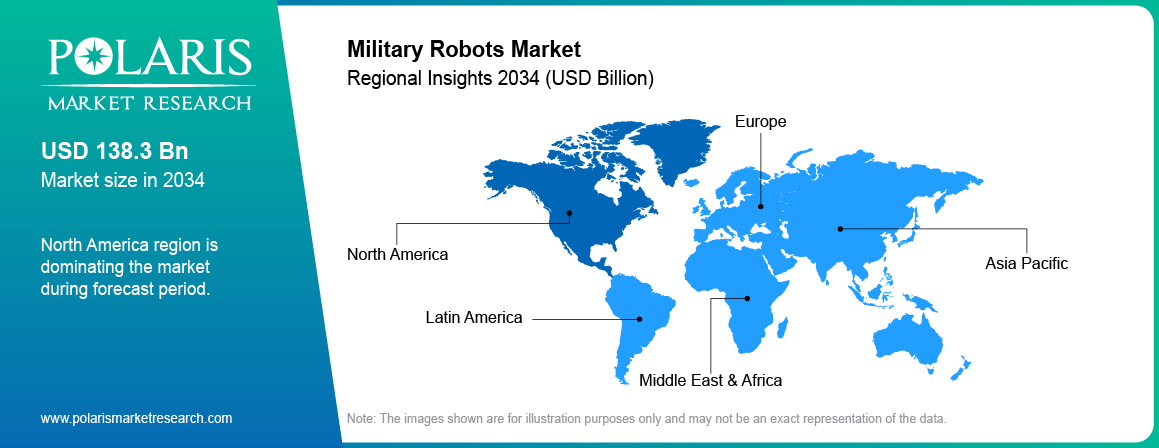
North America accounted for 38.64% share of the global military robots market in 2025, due to defense modernization programs, established defense manufacturers, and investment in autonomous robotic systems. The U.S. Army and Marine Corps are increasing testing and acquisition of autonomous logistics and amphibious robotic platforms, demand for ground vehicles, autonomy technologies and support systems. The Autonomous Warfare Command (AutoWarCom) announced by the Pentagon in September 2026, targeted for stand-up in October 2027, to accelerate the development of autonomous and robotic capabilities throughout the U.S. military demonstrates the increasing institutional focus on autonomous robotic systems. These developments are fueling the regional military robots market growth (Source: reuters.com).
The regional market also benefits from an established ecosystem of defense primes, specialized robotics companies, autonomy providers, and military research organizations. This combination supports development and procurement across airborne, land, and marine robotic platforms while creating opportunities for suppliers involved in vehicle platforms, autonomy systems, sensors, communications, and defense robotics market applications.
Europe Military Robots Market Trends
Europe is projected to register 25.82% CAGR growth during the forecast period. This is driven by Ukraine’s large-scale use of ground robots, growing defense modernization activity and the presence of established military robotics developers. The region is also benefiting from growing domestic production capabilities and increasing interest in unmanned systems for logistics, reconnaissance, evacuation and other military applications. These developments are further fueling the military robots industry outlook.
Ukraine’s domestic ecosystem has been growing rapidly, and by mid-2026 there are about 280 companies producing more than 550 models of ground robots. Military robot companies in Europe include Germany’s Rheinmetall and Estonia’s Milrem Robotics, whose THeMIS platform is among the region’s best-known unmanned ground vehicles. These developments are building up the region’s manufacturing and technology base for ground robotic systems, and also raising the visibility of land-based military robotics programs (Source: newsukraine.rbc.ua).
Asia Pacific Military Robots Market Trends
Asia Pacific accounted for 22.78% share of the global military robots market in 2025, attributed to defense modernization, development of autonomous systems, and increasing interest in robotic platforms. LIG Nex1’s investment into Ghost Robotics, connecting South Korea’s defense technology sector with US legged robot capabilities, makes the country a key player in the regional ecosystem.
The region also hosts large defense and technology markets developing unmanned systems for land, marine and airborne applications. The demand is driven by the need for military modernization, autonomous technology development and growing demand to integrate military robotic systems with extant defense systems. These factors are supporting continued investment in robotic mobility, autonomy, sensing, and communications technologies.
Middle East & Africa Military Robots Market Trends
Middle East & Africa accounted for 5.84% share of the global military robots market in 2025. This is driven by defense modernization and investment in advanced military technologies. The region's participation also extends through ownership and investment in international robotics companies. The UAE’s EDGE Group holds majority ownership of Estonia-based Milrem Robotics, giving the region direct ownership of a leading European ground robot maker.
The regional market is expected to remain connected to developments in autonomous ground systems, surveillance platforms, logistics robots, and other unmanned technologies. Future adoption depends on defense procurement priorities, technology-transfer requirements, local industrial capabilities, and investment in military robotic systems across military and security applications.
Latin America Military Robots Market Trends
Latin America accounted for 4.58% share of the global military robots market in 2025. Adoption remains at an early stage compared with Europe and North America, so the regional outlook will depend on future defense modernization programs, domestic industrial capabilities, and the use of unmanned systems across military applications in the wider military robots market.
The future demand in the region can be assessed on the basis of developments in defense procurements, border and territorial surveillance requirements, modernization of logistics and investment in unmanned technologies. Country-level coverage for Brazil, Mexico, Argentina, and the Rest of Latin America is included in the full report, along with a detailed regional growth outlook for the military robots industry.
Military Robots Trade and Cross-Border Flow Analysis
| Trade Flow | Nature of Flow | Market Implication |
| China to Ukraine | Components and inputs used by Ukrainian ground robot and drone makers | Supply dependence becomes a larger risk as production scales |
| Estonia to Ukraine | THeMIS ground robots supplied to Ukrainian forces | Keeps European platforms in the Ukrainian fleet |
| Canada to United States | Rheinmetall Canada engineering and production support for Mission Master SP | Cross-border engineering supports U.S. Marine Corps programs |
| South Korea to United States | LIG Nex1 acquired a 60% stake in Ghost Robotics with U.S. CFIUS approval | Foreign ownership deals face regulatory review |
| UAE to Estonia | EDGE Group has held a majority of Milrem Robotics since 2023 | Gulf capital backs European ground robot makers |
| Ukraine (domestic supply) | All UGVs contracted by Ukraine in 2026 were domestically made | Local production limits reliance on imported platforms |
| Ukraine to NATO countries | Ratel Robotics is in contract talks with several NATO countries | Ukrainian makers are moving toward export markets |
Source: Company announcements; Polaris Market Research Analysis
Military Robots Market Competitive Landscape
The military robots market includes large defense primes, specialized ground robotics companies, autonomy suppliers, and unmanned systems providers. Competition is shaped by platform capabilities, autonomy, operational testing, procurement relationships, manufacturing scale, and the ability to integrate robotic platforms into existing military systems. Rheinmetall, Milrem Robotics, Forterra, and Ghost Robotics lead named ground robot programs, while defense primes such as General Dynamics, Textron, and Northrop Grumman compete across unmanned and autonomous systems in the military robots industry.
Military Robots Vendor Landscape Snapshot
| Vendor | Headquarters | Positioning | Core Focus |
| Rheinmetall AG | Germany | Leader | Mission Master UGVs; Project Sustainment prime |
| Milrem Robotics AS | Estonia | Leader | THeMIS UGV family; majority-owned by EDGE Group |
| Teledyne FLIR LLC | United States | Leader | Small UGVs, EOD robots, and ISR sensors |
| Elbit Systems Ltd. | Israel | Leader | Autonomy kits and unmanned air and ground systems (FUSE) |
| General Dynamics Corporation | United States | Challenger | Ground vehicles and S-MET unmanned equipment transport |
| Textron Inc. | United States | Challenger | Ripsaw unmanned ground vehicles |
| QinetiQ Group plc | United Kingdom | Challenger | Robotic and autonomous systems, including EOD robots |
| Northrop Grumman Corporation | United States | Challenger | EOD robots and autonomous systems integration |
| Lockheed Martin Corporation | United States | Challenger | Autonomous and unmanned systems integration |
| L3Harris Technologies, Inc. | United States | Challenger | T7 and T4 EOD robots; U.S. Navy and Marine Corps award for 34 T7 robots |
| BAE Systems plc | United Kingdom | Challenger | Defense systems integration and unmanned platforms |
| Thales Group | France | Challenger | Mine countermeasures and unmanned systems |
| Saab AB | Sweden | Challenger | Underwater vehicles and mine countermeasures |
| Israel Aerospace Industries Ltd. | Israel | Challenger | Unmanned ground and aerial systems |
| AeroVironment, Inc. | United States | Challenger | Small unmanned and airborne robotic systems |
| RTX Corporation | United States | Challenger | Sensors and autonomy for unmanned platforms |
| Forterra, Inc. | United States | Specialist | Autonomy kits; autonomy supplier on Project Sustainment |
| Ghost Robotics Corporation | United States | Specialist | Legged robots (Vision 60); 60% owned by LIG Nex1 |
| Boston Dynamics, Inc. | United States | Specialist | Legged robotics |
| Anduril Industries, Inc. | United States | Emerging | Autonomy software and uncrewed systems |
| Overland AI, Inc. | United States | Emerging | Off-road ground autonomy; U.S. Marine Corps production award |
| Ratel Robotics | Ukraine | Emerging | Combat-proven modular UGVs; pending Swarmer acquisition |
| Tencore | Ukraine | Emerging | TerMIT modular UGV; joint ventures with Quantum Systems, Shark Robotics, and Insta (Finland) |
Source: Polaris Market Research Analysis. Positioning reflects platform breadth, program wins, and manufacturing scale.
Rheinmetall has expanded its U.S. autonomous ground vehicle activity through both Project Sustainment and Mission Master SP. The Project Sustainment program focuses on autonomous logistics, while the Mission Master SP award supports continued Marine Corps evaluation and development of autonomous expeditionary mobility (Source: rheinmetall.com).
Milrem Robotics remains a leading European ground robotics company, majority-controlled by EDGE Group since 2023. The company’s THeMIS platform is positioned in the unmanned ground vehicles market while the company’s exposure to the September 2026 arson incident further underscores the security risks facing defense robotics suppliers.
Forterra represents an important autonomy supplier within the competitive landscape as its role in Project Sustainment demonstrates the growing separation between robotic vehicle manufacturing and autonomy technology. This creates a market structure in which vehicle manufacturers, autonomy providers, and human-machine interface specialists can participate in the same military robotics program.
Military Robots Market Technology and Innovation Landscape
Technology and Innovation Landscape Snapshot
| Technology Area | What Is Changing | 2026 Evidence |
| Plug-in autonomy kits | Autonomy is separating from the vehicle and retrofitting onto existing platforms | Rheinmetall PATH on Mission Master SP; Forterra on Project Sustainment; Sea Machines kits for vessels |
| Supervisory control | One operator supervises several robots | Project Sustainment; Elbit FUSE One2Many; Swarmer coordination software |
| Voice interfaces | Soldiers give spoken commands instead of driving each vehicle | Primordial Labs’ Anura interface |
| Hybrid and exportable power | Longer range and mobile power for supported units | Harbinger chassis with 500+ miles of range and 350 kW of exportable power |
| Legged robotics | Mobility on terrain that wheeled platforms cannot cross | Ghost Robotics’ Vision 60 |
| Amphibious mobility | Sea-to-shore logistics for littoral forces | Mission Master SP with five amphibious kits for the U.S. Marine Corps |
| Remote weapon stations | Combat support payloads on logistics platforms | Fieldranger on Mission Master systems |
| GPS-denied operation | Navigation and control in contested environments | Elbit FUSE ground autonomy kits |
Source: Polaris Market Research Analysis
Autonomy is becoming an increasingly important technology layer within military robotic systems. Current development is moving from remotely operated platforms toward systems capable of navigation, task execution, and supervised operation. The transition is particularly visible in logistics applications, where robots can perform predefined transportation missions while human personnel maintain supervisory control. Plug-in autonomy is the main technology shift, as Rheinmetall’s Mission Master SP uses Rheinmetall Canada’s PATH autonomy kit. AI software that is not tied to a robotic platform sits outside this scope and is covered in the artificial intelligence in military market.
Hybrid power and autonomous navigation are also being combined to increase the operational usefulness of UGVs. Project Sustainment uses hybrid-powered autonomous vehicles for company-sized sustainment missions, while Forterra contributes autonomy capabilities and Primordial Labs contributes a natural-language human-machine interface. Mission Master systems have also been fielded with the Fieldranger remote weapon station, extending ground robots from logistics into combat support.
Legged robotics represents another technology area within the military robots market. Legged platforms provide mobility in terrain that is difficult for wheeled systems and the compact form factors facilitate specialized missions. The technology is still a subset of the broader category of land robotics.
The future of military robots points toward supervision rather than driving. Soldiers increasingly control military robots by giving goals and voice commands while autonomy handles movement, which favors suppliers of autonomy software and human-machine interfaces. This shift also supports manned-unmanned teaming, where one soldier oversees several platforms.
Use Case Analysis
Military robots serve different operational requirements across service branches. Current evidence suggests important use cases include frontline resupply, amphibious logistics and casualty evacuation.
Army: Frontline Resupply
Project Sustainment mitigates the risk of traditional resupply lines by employing autonomous hybrid-powered UGVs to carry supplies to frontline company-level units. The U.S. Army awarded the program to American Rheinmetall for an 18-month development and delivery effort.
The program demonstrates how autonomous logistics can support military units without requiring personnel to operate every transport vehicle manually. The use case also creates demand for autonomy, hybrid power, human-machine interfaces, and resilient communications.
Marine Corps: Amphibious Logistics
The U.S. Marine Corps’ Mission Master SP program includes 12 autonomous ground vehicles and five amphibious kits. The systems support operational evaluation and experimentation of autonomous logistics and expeditionary mobility.
The amphibious configuration extends the operational environment of UGVs beyond traditional land missions. It also supports experimentation by the Marine Corps in multi-domain and littoral operations.
Ukraine's Defence Forces: Casualty Evacuation
Ukraine uses its own ground robots for logistics and evacuation of casualties in frontline conditions. In June 2026 over 16,600 logistics and evacuation missions alone were logged, highlighting the significance of UGVs in reducing exposure during mission-critical transport missions.
The use of robots for casualty evacuation demonstrates one of the clearest operational benefits of unmanned ground platforms: performing hazardous transport tasks while keeping personnel farther from exposed routes.
Naval use cases, including mine countermeasures and maritime ISR, are still emerging, with modular autonomy kits widening access to uncrewed surface operations for existing vessels.
Barriers to Market Entry
· Combat validation: Military buyers increasingly need platforms that have been used in real operational environments. Using ground robots extensively in Ukraine provides domestic manufacturers with battlefield experience that can shape future procurement.
· Ownership and export controls: Cross border acquisitions are subject to regulatory scrutiny. LIG Nex1's purchase of 60% of Ghost Robotics needed CFIUS approval, pointing to the regulatory difficulties in foreign investment in defense robotics.
· Supply and physical security: Robotics providers are vulnerable to sabotage and reliance on imported components. Such risks increase in importance with scale of production and strategic importance of supply chains.
· Program access: U.S. military robotics suppliers are required to participate in consortia, experimentation programs, or laboratory-led trials prior to becoming eligible for larger production awards.
The acquisition of robotics companies can also become part of market-entry strategy. The Ghost Robotics deal is an example of how defense companies are acquiring established robotic capability through ownership, rather than just through internally-developed platforms. The deal also shows that how militaries buy robots now includes buying the maker, not just the unmanned ground vehicle.
Military Robots Regulatory and Policy Snapshot
| Jurisdiction | Policy or Mechanism | Market Impact |
| United States | CFIUS review of foreign investment in defense robotics | Adds time and conditions to cross-border deals such as LIG Nex1’s purchase of Ghost Robotics |
| United States | Autonomous Warfare Command (AutoWarCom), slated to stand up in late 2027 | Centralizes development and fielding of autonomous and robotic capabilities across the services |
| United States | Pentagon Drone Marketplace UGV portal and GroundBreaker 1 demonstration | Opens a faster route for vendors to reach military buyers |
| United States | Consortium OTA contracts through the National Advanced Mobility Consortium | Requires early program access through consortia before production awards |
| Ukraine | Defence Procurement Agency DOT and the DOT-Chain Defence marketplace | Lets units order robots directly, supporting volume buying |
| Ukraine | Brave1 defense innovation cluster | Supports around 300 domestic ground drone makers |
Source: Polaris Market Research Analysis
Military Robots Market Premium Insights and Forward Outlook
Industrial Scaling Is Becoming a Key Competitive Factor
Military robotics is moving toward scalable manufacturing and support ecosystems. In June 2026 ARX Robotics and Roboneers formed a joint venture with the aim of industrializing the production of unmanned ground vehicles. The goal was several thousand of Rys Pro units in the first year and tens of thousands in the following years. The development points to the increasing significance of manufacturing capacity and supply-chain readiness when scaling robotic fleets (Source: arx-robotics.com).
Autonomy Can Be Added Through Modular Systems
Modular autonomy solutions offer a different pathway for military organizations to acquire robotic capabilities. Sea Machines Robotics was awarded a five-year contract in September 2026 by U.S. Special Operations Forces to supply rapidly deployable autonomy kits for vessels of opportunity. The development indicates a demand for military robotic systems that accommodate adaptable autonomy and command and control capabilities (Source: sea-machines.com).
As robotic systems are adopted more widely, the outlook for the military robots industry increasingly depends on scalable manufacturing, modular autonomy, interoperability, reliability and through-life support.
Cross-Border Partnerships Are Expanding Production Capacity
Babcock signed an MoU with Ark Robotics in September 2026 to look into UK manufacturing, systems integration and support for unmanned ground vehicles. Babcock provides manufacturing and integration capability, while Ark Robotics has its own autonomous Frontier system, which allows one operator to control multiple vehicles (Source: babcockinternational.com).
Consolidation Is Connecting Autonomy and Robotic Platforms
In September 2026, Swarmer announced an agreement to acquire Ratel Robotics for an aggregate consideration of up to USD 224 million, subject to closing conditions. The deal married Swarmer’s autonomy tech with Ratel’s battle-tested UGV portfolio, a perfect example of how consolidation marries autonomy with proven robotic platforms (Source: sec.gov).
Military Ground Robot Contract Benchmarks
| Development | Value / Scale | Strategic Relevance |
| Swarmer acquisition of Ratel Robotics, September 2026 | Up to USD 224 million | Combines an autonomy platform with a portfolio of combat-proven UGVs |
| Sea Machines Robotics IDIQ contract with U.S. Special Operations Forces, September 2026 | 5-year IDIQ | Supports deployment of modular autonomy systems across vessels |
| ARX Robotics and Roboneers joint venture, June 2026 | Several thousand Rys Pro units targeted in first year, with plans to scale to tens of thousands annually | Expands industrial-scale UGV manufacturing capacity |
| Babcock and Ark Robotics MoU, September 2026 | Value not publicly disclosed | Explores UK manufacturing, systems integration, payload integration, and through-life support for UGVs |
| U.S. Marine Corps contract with American Rheinmetall, September 2026 | USD 7.28 million | Sets a public cost benchmark for 12 Mission Master SP vehicles with kits, support, and training, about USD 607,000 per vehicle |
| Ukraine Defence Procurement Agency DOT UGV contracts, 2026 | About UAH 11 billion (roughly USD 250 million) across 19 contracts | Shows volume buying of lower-cost domestic UGVs |
Source: Company announcements; Rheinmetall; UNITED24 Media; Polaris Market Research Analysis
Contract values provide a more reliable public benchmark than list prices as military procurements often combine vehicles with training, support, testing, integration, and additional equipment. For the cost of a military ground robot, the U.S. Marine Corps award works out to roughly USD 607,000 per Mission Master SP vehicle with kits, support, and training included, while Ukraine’s 2026 unmanned ground vehicle contracts point to much cheaper domestic robots bought at far higher volumes.
Key Players in the Military Robots Market
- AeroVironment, Inc.
- Anduril Industries, Inc.
- BAE Systems plc
- Boston Dynamics, Inc.
- Elbit Systems Ltd.
- Forterra, Inc.
- General Dynamics Corporation
- Ghost Robotics Corporation
- Israel Aerospace Industries Ltd.
- L3Harris Technologies, Inc.
- Lockheed Martin Corporation
- Milrem Robotics AS
- Northrop Grumman Corporation
- Overland AI, Inc.
- QinetiQ Group plc
- Ratel Robotics
- Rheinmetall AG
- RTX Corporation
- Saab AB
- Teledyne FLIR LLC
- Tencore
- Textron Inc.
- Thales Group
Industry Developments
-
October 2026: GM Defense unveiled an unmanned ground vehicle built on the Chevrolet Silverado 3500HD at the AUSA 2026 annual meeting, with a technology demonstrator targeted for June 2027. The truck-based platform highlights growing interest from commercial vehicle makers in military UGVs. (Source: defensedaily.com)
-
September 2026: The Pentagon announced the Autonomous Warfare Command (AutoWarCom), a four-star combatant command intended to scale autonomous and robotic capabilities across the joint force, slated to stand up in late 2027. (Source: twz.com)
-
September 2026: Elbit Systems’ FUSE unit unveiled AI-driven autonomous combat systems and its One2Many capability, which enables centralized real-time coordination of large numbers of autonomous aerial and ground systems. (Source: reuters.com)
-
September 2026: China increased research on humanoid robots for military applications, including perception, manipulation, training and battlefield use. PLA’s procurement and research on humanoid robots show a growing interest in using them alongside troops, although armed operational deployment has not been confirmed. (Source: technology.org)
-
September 2026: Ukraine’s former Defense Minister Mykhailo Fedorov launched the “Army of Robots” initiative to develop and scale humanoid-like and other ground robots for battlefield roles. The initiative relies on robotics, AI, sensors, and private-sector investment, while Ukraine’s forces carried out more than 25,000 logistics and evacuation missions with ground robots in August, 3.3 times the January level, according to the Defense Ministry. (Source: defensenews.com)
-
August 2026: The U.S. Department of Defense scheduled GroundBreaker 1, a joint unmanned ground vehicle demonstration at Camp Grafton, North Dakota, in October 2026 to assess industry-built UGVs and add them to the Pentagon’s Drone Marketplace. (Source: defensescoop.com)
-
July 2026: Indian defense technology company Gridbots announced the launch of Sleuthound and Sleuthound-Stab, AI-enabled systems for drone tracking, surveillance and target acquisition. (Source: thedefensepost.com)
-
June 2026: The U.S. Marine Corps awarded Overland AI a USD 19.7 million contract to produce more than a dozen autonomous ground vehicles for its Marine Air Defense Integrated System (MADIS) program, with deliveries due by early 2027. (Source: defenseone.com)
-
January 2026: L3Harris Technologies received a Navy and Marine Corps award for 34 large T7 explosive ordnance disposal robots, with deliveries beginning in 2026 under a multi-year contract. (Source: defensescoop.com)
Military Robots Market Report Segmentation
By Platform Outlook (Revenue, USD Billion, 2021–2034)
- Land
- Marine
- Airborne
By Application Outlook (Revenue, USD Billion, 2021–2034)
- ISR
- Explosive Ordnance Disposal
- Logistics & Casualty Evacuation
- Combat Support
- Mine Countermeasures
By Level of Autonomy Outlook (Revenue, USD Billion, 2021–2034)
-
Human-in-the-Loop
- Human-on-the-Loop
- Highly Autonomous
By End User Outlook (Revenue, USD Billion, 2021–2034)
- Army
- Navy
- Air Force
- Marine Corps & Special Forces
By Region Outlook (Revenue, USD Billion, 2021–2034)
- North America
- US
- Canada
- Europe
- Germany
- France
- UK
- Italy
- Spain
- Netherlands
- Ukraine
- Rest of Europe
- Asia Pacific
- China
- Japan
- India
- South Korea
- Taiwan
- Australia
- Rest of Asia Pacific
- Latin America
- Brazil
- Mexico
- Argentina
- Rest of Latin America
- Middle East & Africa
- Saudi Arabia
- UAE
- South Africa
- Rest of Middle East & Africa
Military Robots Market Report Scope
| Report Attributes | Details |
| Market Size in 2025 | USD 33.19 Billion |
| Market Size in 2026 | USD 41.27 Billion |
| Revenue Forecast by 2034 | USD 238.08 Billion |
| CAGR | 24.49% from 2026–2034 |
| Base Year | 2025 |
| Historical Data | 2021–2024 |
| Forecast Period | 2026–2034 |
| Quantitative Units | Revenue in USD Billion and CAGR |
| Report Coverage | Revenue Forecast, Growth Factors, Competitive Landscape, Industry Trends, and Strategic Analysis |
| Segments Covered | By Platform, Application, Level of Autonomy, End User, and Region |
| Regional Scope | North America, Europe, Asia Pacific, Latin America, Middle East & Africa |
| Competitive Landscape | Company Profiling, Product Benchmarking, Financial Analysis, Market Developments, and Strategic Initiatives |
| Report Format | PDF + Excel |
| Customization | Available by Country, Region, and Segment |
Source: Polaris Market Research Analysis
Why Choose Polaris Market Research
Polaris Market Research & Consulting, Inc. evaluates the military robots industry across platform, application, autonomy, end-user, and regional dimensions while reconciling competitive coverage with primary-source evidence. The research framework also distinguishes robotics platform providers from autonomy specialists, allowing the analysis to capture companies that may not appear in conventional competitor lists. The research approach places particular attention on unmanned ground vehicles, autonomy kits, procurement programs, and supplier developments because these areas are central to current changes in the defense robotics market.
Research Methodology
The military robots research analysis follows five phases: secondary mapping of government and ministry statements, company announcements, and defense trade sources; primary validation; competitive benchmarking; proprietary reconciliation; and final quality and sourcing review. Secondary mapping draws on ministry and defense department statements, procurement notices, company press releases, and defense trade press, and each figure is tied to a dated, named source. Primary validation then tests the highest-impact claims, such as contract values, order quantities, ownership stakes, and delivery timelines, against company releases and ministry statements before they enter the analysis. The research package gives particular weight to government procurement disclosures and company announcements.
The market is sized across platform, application, level of autonomy, end user, and region. Estimates begin with a bottom-up build of disclosed procurement programs and contract awards, such as the U.S. Marine Corps and U.S. Army orders and the contracts signed by Ukraine’s Defence Procurement Agency DOT, which is then reconciled with a top-down view of defense budgets and uncrewed-systems spending. Where contracts bundle vehicles with kits, training, and support, platform value is separated from services so that segment values stay comparable. Forecasts to 2034 apply scenario assumptions for procurement volumes, unit prices, and the pace of autonomy adoption, and are tested against historical data from 2021 to 2024 using 2025 as the base year.
Company coverage is benchmarked against competitor reports and then verified against primary sources dated within the last 24 months. Ownership is recorded as it stands today, for example EDGE Group’s majority stake in Milrem Robotics and LIG Nex1’s 60% stake in Ghost Robotics. This analysis was compiled and reviewed by the aerospace and defense research team at Polaris, and the model is refreshed as new contracts, programs, and company developments are disclosed.
Source: Polaris Market Research Analysis
| Phase | Focus |
| 1. Secondary Mapping | Ministry statements, press releases, trade press |
| 2. Primary Validation | Rheinmetall releases; Ukraine’s Ministry of Defence statements |
| 3. Competitive Benchmarking | Competitor segmentation and key player coverage matrices |
| 4. Proprietary Reconciliation | Internal Polaris model |
| 5. Quality and Sourcing Review | Final citation check |
Source: Polaris Market Research Analysis
Military Robots Market FAQ's
The Military Robots Market was valued at USD 33.19 Billion in 2025 and is forecast to reach USD 238.08 Billion by 2034.
North America leads in market spending, while Europe is growing fastest due to increased ground robot procurement.
Logistics and casualty evacuation is the fastest-growing application, supported by rising use of ground robots for frontline logistics.
In Ukraine, ground robots are mainly employed for resupply and casualty evacuation, conducting more than 16,600 logistics and evacuation missions in June 2026 and more than 25,000 in September 2026.
Project Sustainment is a U.S. Army program to use autonomous hybrid-powered ground robots to deliver supplies on the front lines.
The UAE’s EDGE Group is the majority owner of Estonia-based Milrem Robotics, which makes the THeMIS ground robot.
Prices differ according to platform, configuration, autonomy, equipment and support requirements. There are significant differences in the prices of public contracts. The U.S. Marine Corps contract for 12 Mission Master SP vehicles, five amphibious kits, and support worked out to roughly USD 607,000 per vehicle with extras included.
Human-in-the-loop systems must be controlled or approved by an operator. Human-on-the-loop systems can operate more autonomously under human supervision.
Military robots are performing dangerous tasks like resupply and casualty evacuation while soldiers are still in control and performing missions that require human judgment.
Military robots are used for logistics, casualty evacuation, ISR, EOD, combat support, and mine countermeasures missions.
Companies include Rheinmetall, Milrem Robotics, Ghost Robotics, Forterra, Teledyne FLIR, Elbit Systems, QinetiQ, General Dynamics, Textron, and other defense and unmanned-systems manufacturers listed in the report.
The research is moving toward greater autonomy, supervisory control, voice-enabled interfaces and more use of robots for logistics and other high-risk missions.
The main types of military robots are unmanned ground vehicles, legged robots, uncrewed surface vessels, underwater systems, and airborne robots. They support missions that range from logistics, casualty evacuation, and explosive ordnance disposal to ISR and mine countermeasures.
Military robots keep soldiers out of exposed areas during resupply, evacuation, reconnaissance, and explosive ordnance disposal. They also provide persistent sensing and can reduce the number of personnel needed to run repetitive missions.
Jamming and electronic attack can disrupt communications and navigation, component supply remains vulnerable, and suppliers face physical security threats, as the September 2026 arson attack on Milrem Robotics showed. Most fielded ground robots also still need a human operator.

Download Sample Report of Military Robots Market
Please fill out the form to request a customized copy of the research report.


