
Nanorobotics Market Size, Share Report 2026-2034
REPORT DETAILS
Nanorobotics Market Summary
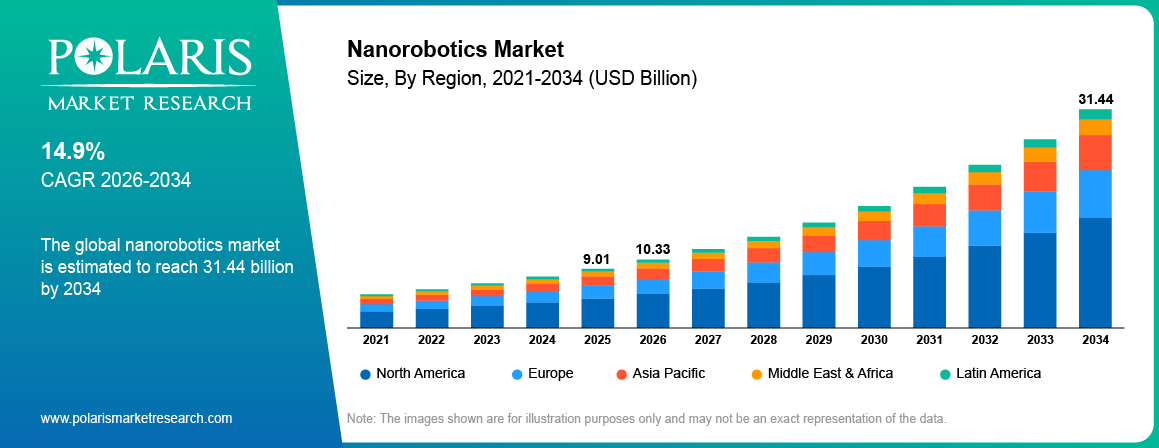
The global Nanorobotics market was valued at approximately USD 9.01 billion in 2025 and is expected to reach USD 31.44 billion by 2034, registering a CAGR of 14.9% during the forecast period Market growth is driven by increasing adoption of precision medicine, rising investments in nanotechnology research, and expanding applications of nanorobots in targeted drug delivery, minimally invasive surgery, regenerative medicine, and cancer treatment. North America dominated the market in 2025 owing to strong research funding, advanced healthcare infrastructure, and increasing commercialization of medical nanotechnology.
Market Statistics
Nanorobotics Market Key Takeaways 2025
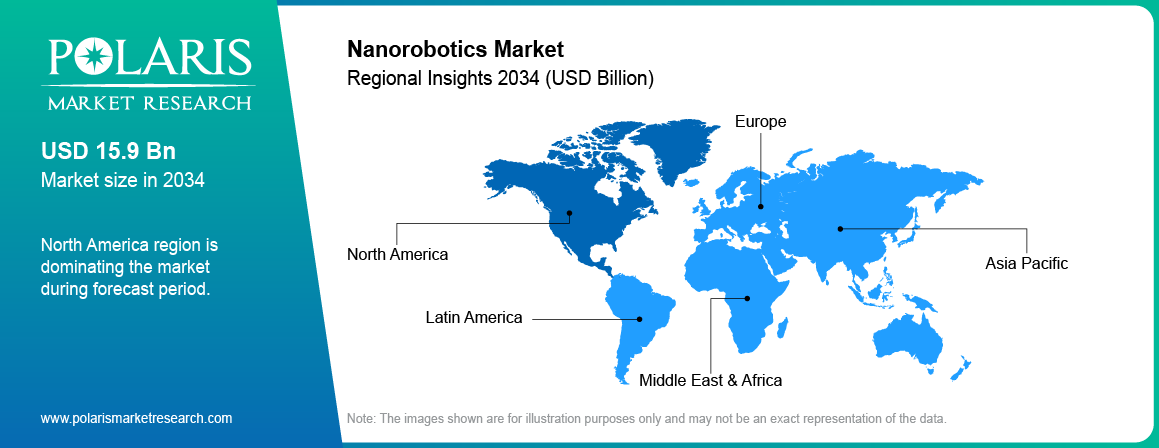
- North America dominated the nanorobotics market with a market share of 40.9% in 2025, driven by increasing investments in nanomedicine research, advanced healthcare infrastructure, and strong funding for medical nanotechnology innovations.
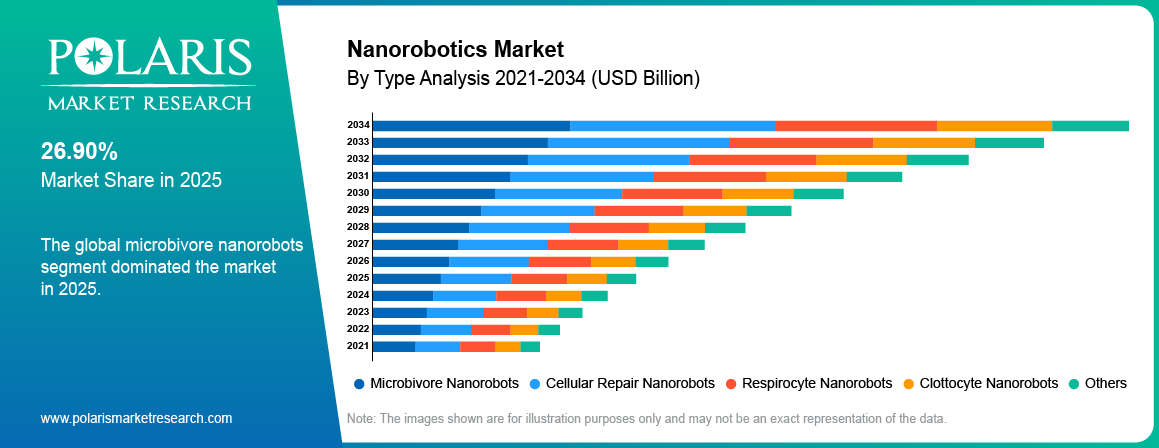
- Microbivore nanorobots accounted for the largest type segment with a market share of 37.8% in 2025, owing to growing research activities focused on targeted disease treatment, infection control, and minimally invasive therapeutic applications.
- Hospitals held the largest end-user share of 46.2% in 2025, supported by the increasing adoption of advanced medical technologies, rising complex surgical procedures, and expanding use of precision medicine.
- Asia Pacific is projected to register the fastest CAGR of 18.7% during the forecast period, fueled by expanding biotechnology research, increasing healthcare investments, and growing government support for nanotechnology-based medical innovations.
- Increasing investments in precision medicine and regenerative therapies are driving the nanorobotics market, supporting a global CAGR of 16.4% during the forecast period.
Note: Figures and projections outlined in this report are the result of Polaris Market Research’s proprietary analytical processes, grounded in the latest available datasets and market observation
What is Nanorobotics?
Nanorobotics refers to the design, development, and application of microscopic robotic devices that perform specific tasks at the molecular or cellular level. These robots are used in healthcare, biotechnology, drug delivery, diagnostics, precision surgery, and environmental monitoring to improve treatment accuracy and operational efficiency.
The market value chain includes raw material suppliers, nanomaterial manufacturers, component developers, research institutions, medical device companies, healthcare providers, distributors, and end users. Advanced manufacturing technologies and continuous research are supporting commercialization across multiple healthcare applications.
Market growth is driven by increasing healthcare investments, advances in nanotechnology, expanding regenerative medicine research, and growing demand for minimally invasive treatment solutions. Rising collaboration between biotechnology companies and research organizations is further creating long-term growth opportunities.
Source: Polaris Market Research Analysis
Nanorobotics Market Industry Dynamics
- Increasing investments in nanomedicine research are driving market growth.
- Precision medicine adoption is expanding commercial applications.
- High development costs remain a major market challenge.
- Regenerative medicine is creating new long-term growth opportunities.
Nanorobotics Market Driver Impact Analysis
Market growth is supported by increasing investments in nanotechnology research, growing adoption of precision medicine, and continuous development of targeted drug delivery systems. Governments, universities, and biotechnology companies are increasing funding for medical nanotechnology to improve treatment outcomes and reduce healthcare costs.
Growing commercialization of regenerative medicine, organoid research, and advanced diagnostics is increasing demand for nanorobotic technologies across healthcare applications. Companies are focusing on product development, clinical research, and strategic collaborations to strengthen commercialization opportunities throughout the forecast period.
Increasing regulatory support for innovative medical devices and improvements in nano-engineering technologies are further expanding market opportunities. Healthcare providers are adopting minimally invasive treatment solutions to improve patient outcomes, which is expected to support long-term market growth.
| Market Driver | Est. CAGR Impact | Geographic Relevance | Impact Timeline |
| Rising investments in nanomedicine research | +2.3% | North America, Europe | Medium term |
| Growing adoption of precision medicine | +2.0% | US, Europe, Japan | Medium to long term |
| Expansion of regenerative medicine | +1.7% | Global | Long term |
| Technological advancements in nano-engineering | +1.4% | US, Europe, Asia Pacific | Short to medium term |
| Increasing clinical research activities | +1.1% | Global | Medium term |
* Indicative estimates based on market context and analyst judgment. Figures reflect relative driver weight, not additive CAGR contributions. Source: Polaris Market Research Analysis.
Nanorobotics Market Drivers, Restraints and Opportunities
How is Precision Medicine Driving Growth in the Market?
Precision medicine is increasing the adoption of nanorobotic technologies across disease diagnosis and targeted treatment applications. Healthcare providers are focusing on personalized therapies that improve treatment accuracy while reducing side effects. The rising amount of investments in cancer research, targeted drug delivery, and diagnostics is creating opportunities for the use of nanorobotics for commercial purposes within healthcare systems around the world. In July 2024, researchers at the Karolinska Institute designed a DNA nanorobot which managed to reduce the growth of tumors in mice by 70% with the help of targeted activation in the tumor microenvironment.
How are Regenerative Medicine Applications Supporting Market Expansion?
There is a growing demand for nanorobotics technologies employed in the field of regenerative medicine, including tissue engineering, stem cell therapy, and organ repairs. There are many investments in treatment platforms in research organizations and biotech companies that facilitate better cellular regeneration and precision of treatment. In July 2024, Nanobots Therapeutics received the first tranche of a USD 1.1 million seed funding for development of its MotionTx nanorobot technology which is intended for targeted treatment of bladder cancer(Source: www.nanobotstx.com).
What Challenges Restrict Market Growth?
Higher cost of conducting research and difficult process of production have been restraining the growth of nanorobotics in large-scale commercialization. Development of products is associated with high expenses on nano-engineering, clinical testing, regulatory requirements, and manufacturing operations. These aspects make it difficult for small enterprises to enter the market due to long development periods.
What Opportunities Exist in the Market?
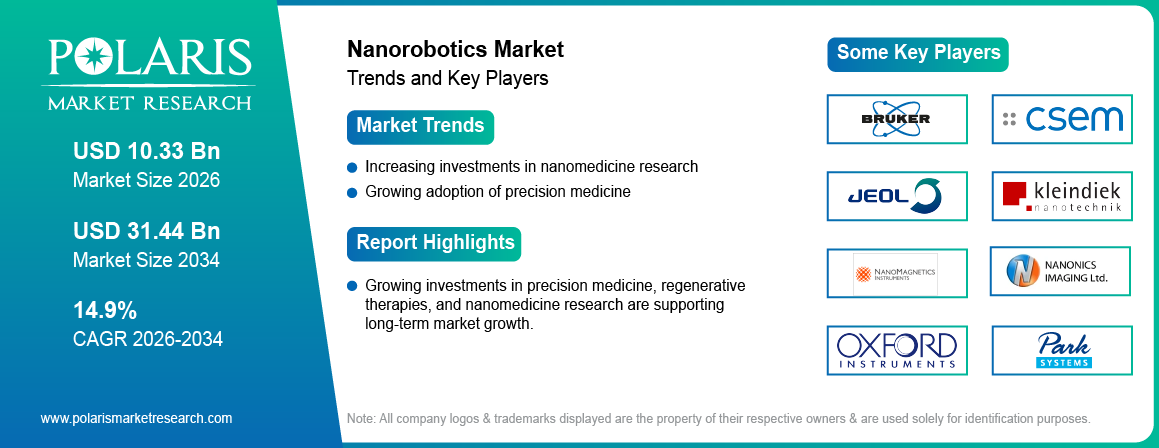
Development of precision medicine, regenerative medicine, and organoids is opening new growth avenues for nanorobotics. In March 2026, IBEC launched a new generation of autonomous therapeutic nanorobots that allow achieving precision drug delivery and shrinking bladder tumors up to 90% during preclinical testing(Source: ibecbarcelona.eu).Hospitals are expanding the application of advanced technologies that can help to achieve better results and shorten recovery time. Continuous investments in biotechnology research and personalized healthcare are expected to support strong market demand over the forecast period.
Source: Polaris Market Research Analysis
Segment and Regional Leaders at a Glance
According to Polaris Market Research, North America leads the market while asia Pacific is the fastest-growing region.
- Dominant Region: North America
- Fastest Growing Region: Asia Pacific
- Largest Type Segment: Microbivore Nanorobots
- Largest End User Segment: Hospitals
Nanorobotics Market Segmentation Analysis
The report provides a comprehensive analysis of the market by type, application, and end user to identify key revenue-generating and high-growth segments.
Nanorobotics Market by Type
Which Type Dominated the Market in 2025?
Microbivore nanorobots dominated the market in 2025 owing to increasing research activities in targeted disease treatment and infection control. Growing investments in nanomedicine and continuous development of medical nanorobots for therapeutic applications are supporting segment growth across the healthcare industry.
Which Type is Growing Fastest in the Market?
Cell repair nanorobots are projected to grow at the fastest CAGR during the forecast period. Rising adoption of regenerative medicine, stem cell research, and tissue engineering is increasing demand for advanced nanorobotic technologies that improve cellular repair and treatment precision.
Nanorobotics Market by Application
Which Application Dominated the Market in 2025?
Drug delivery dominated the market in 2025 due to increasing demand for targeted therapies and personalized medicine. Nanorobots for the delivery of medicines ensure precise delivery while minimizing side effects and thus make a good choice for cancer therapy and chronic diseases.
Which Application is Growing Fastest in the Market?
Regenerative medicine is projected to grow at the fastest CAGR during the forecast period. Increasing commercialization of stem cell therapies, tissue engineering, and organoid research is expanding the use of nanorobotics in advanced healthcare applications.
Nanorobotics Market by End User
Which End User Dominated the Market in 2025?
Hospitals dominated the market in 2025 owing to increasing adoption of advanced medical technologies and growing demand for minimally invasive treatment procedures. Modern hospitals are increasingly adopting novel methods of treatment to enhance their services and clinical results.
Which End User is Growing Fastest in the Market?
Research institutes are projected to grow at the fastest CAGR during the forecast period. Rising government funding, increasing biotechnology research, and expanding collaborations between academic institutions and healthcare companies are supporting rapid segment growth.
Segment Summary Table
| Segment | Category | 2025 Status | Forecast CAGR | Key Driver |
| Microbivore Nanorobots | Type | Largest Share | Moderate | Growing therapeutic applications |
| Cell Repair Nanorobots | Type | Fastest Growing | High | Regenerative medicine research |
| Drug Delivery | Application | Largest Share | Moderate | Precision medicine adoption |
| Regenerative Medicine | Application | Fastest Growing | High | Stem cell therapy expansion |
| Hospitals | End User | Largest Share | Moderate | Advanced healthcare infrastructure |
| Research Institutes | End User | Fastest Growing | High | Rising nanotechnology research funding |
Source: Polaris Market Research Analysis
Source: Polaris Market Research Analysis
Nanorobotics Market Regional Analysis
North America Nanorobotics Market Size and Share
North America dominated the market in 2025 due to increasing investments in nanotechnology research and advanced healthcare infrastructure. The US led the regional market owing to growing government funding, strong biotechnology research, and rising commercialization of nanomedicine. In December 2025, DNA Nanobots secured USD 3.5 million to accelerate its non-viral gene therapy platform based on self-assembling DNA nanotechnology. Canada is also expanding investments in advanced medical technologies.
Europe Nanorobotics Market Analysis
Europe held a significant market share in 2025 owing to increasing biotechnology research and supportive healthcare policies. Germany, the UK, France, Switzerland, and the Netherlands are investing in nanomedicine and regenerative healthcare. In October 2025, The i-NANOSWARMS project supported by the EU develops intelligent, self-powered swarms of nanobots for drug delivery and other advanced medical applications(Source: cordis.europa.eu).Growing collaboration between research institutes and healthcare companies is supporting regional market growth.
Asia Pacific Nanorobotics Market Growth Rate and Forecast
Asia Pacific is projected to grow at the fastest CAGR during the forecast period due to rising healthcare investments and expanding biotechnology industries. China, Japan, South Korea, India, and Singapore are increasing investments in precision medicine and regenerative therapies. In July 2025, Researchers from South Korea have created an AI-enabled bioink for improving the accuracy and effectiveness of 3D bioprinting in tissue engineering. These initiatives are creating new growth opportunities across the region.
Latin America Nanorobotics Market Size and Share
Latin America is witnessing steady growth due to improving healthcare infrastructure and increasing biotechnology research. The countries such as Brazil, Mexico, Argentina, and Chile are enhancing their capability for medical research and fostering innovations in precision medicine. Rising public and private investments are supporting market development.
Middle East & Africa Nanorobotics Market Size and Share
The Middle East & Africa market is growing steadily due to increasing healthcare modernization and biotechnology investments. For instance, the National Biotechnology Strategy of Saudi Arabia has been developed under Vision 2030 to enhance biomanufacturing, genomics, vaccine manufacturing, and innovations, and make Saudi Arabia a regional biotech leader by 2030 and global leader by 2040. Saudi Arabia, the UAE, Israel, and South Africa have enhanced their research capacities and health care facilities. Government policies encouraging medical innovations are expected to fuel future demand.
Source: Polaris Market Research Analysis
Regulatory Heatmap
| Region/Country | Policy Environment | Key Regulations | Market Implication | Trend |
| US | Favorable | FDA regulations for nanotechnology-based medical devices | Supports commercialization and clinical adoption | Expanding |
| Canada | Favorable | Medical device regulatory framework | Encourages innovation and research | Developing |
| Germany | Favorable | EU Medical Device Regulation (MDR) | Supports product quality and patient safety | Expanding |
| UK | Favorable | MHRA medical device regulations | Improves market access for innovative products | Stable |
| China | Developing | National nanotechnology development programs | Expands domestic manufacturing and research | Expanding |
| Japan | Favorable | Medical innovation and regenerative medicine policies | Supports advanced healthcare technologies | Stable |
| India | Developing | Biotechnology and medical research initiatives | Creates long-term market opportunities | Developing |
| Australia | Favorable | Therapeutic Goods Administration (TGA) regulations | Supports commercialization of medical devices | Developing |
Source: Polaris Market Research Analysis
Competitive Landscape and Key Players
The nanorobotics industry has moderate fragmentation owing to the existence of biotechnology companies, medical devices companies, and companies involved in nanotechnology. Competition in the industry is driven by innovation, product quality, and regulatory approvals. Companies are concentrating on research, collaborations, and product development.
Some major companies operating in the nanotechnology industry include Thermo Fisher Scientific Inc., Bruker Corporation, Oxford Instruments plc, JEOL Ltd., Park Systems Corp., Nanonics Imaging Ltd., Kleindiek Nanotechnik GmbH, and Zurich Instruments AG amongst many others. The companies have been concentrating on enhancing research and development of nanotechnology, improved nano-engineering, and advanced imaging technologies.
Competitive Positioning Table
| Company | Est. Market Position | Primary Strength | Geographic Focus | In Report |
| Bruker Corporation | Top 10 | Nanotechnology portfolio | Global | Yes |
| JEOL Ltd. | Top 10 | Advanced instrumentation | Asia Pacific | Yes |
| Kleindiek Nanotechnik GmbH | Regional Leader | Nanomanipulation systems | Europe | Yes |
| Nanonics Imaging Ltd. | Niche Leader | Nano-imaging technologies | Global | Yes |
| Oxford Instruments plc | Top 10 | Nanoengineering solutions | Global | Yes |
| Park Systems Corp. | Top 10 | Atomic force microscopy | Asia Pacific | Yes |
| Thermo Fisher Scientific Inc. | Top 5 | Research and life science portfolio | Global | Yes |
* Estimated market positioning based on revenue scale, geographic reach, and service breadth. Not ranked by precise market share percentage. Source: Polaris Market Research Analysis.
Technology and Innovation Landscape
The market is witnessing continuous advancements in nanomedicine, targeted drug delivery, and regenerative healthcare. Companies are deploying AI, nanoengineering, and precision engineering to boost treatment precision. This is being achieved through advancements that help in facilitating the commercialization in healthcare and research fields.
| Technology | Adoption Stage | Key Development | Market Impact |
| AI-assisted nanorobotics | Growing deployment | Intelligent treatment planning | Improves treatment precision |
| Targeted drug delivery systems | Commercial deployment | Controlled therapeutic delivery | Improves clinical outcomes |
| Smart nanomaterials | Early commercial deployment | Responsive biomaterials | Expands medical applications |
| Nano-imaging technologies | Growing deployment | High-resolution cellular imaging | Improves diagnostics |
| Precision nano-manufacturing | Commercial deployment | Advanced fabrication processes | Supports product commercialization |
Source: Polaris Market Research Analysis
Who Buys Market Research and Why?
The market report assists investors in assessing market opportunities, technological advancement, competitive position, investment opportunities, and regional growth in the field of healthcare and biotechnology.
| Buyer / Investor Type | Primary Use Case | Key Insight Sought | Decision Horizon |
| Corporate Strategy Teams | Market expansion | Regional demand and growth opportunities | 2–5 Years |
| Biotechnology Companies | Product development | Technology trends and commercialization | 2–4 Years |
| Private Equity Investors | Investment evaluation | Market growth and competitive landscape | 3–7 Years |
| Healthcare Providers | Technology adoption | Clinical applications and supplier assessment | 1–3 Years |
| Government & Research Organizations | Policy planning | Research priorities and innovation trends | 3–7 Years |
Source: Polaris Market Research Analysis
What are the Barriers to Entering the Market?
- High research and development investments.
- Complex manufacturing and nano-engineering processes.
- Strict regulatory approval requirements.
- Long clinical validation and commercialization timelines.
- Requirement for advanced technical expertise.
- Limited large-scale manufacturing capabilities.
Premium Insights and Forward Outlook
Growing demand for precision medicine, regenerative therapies, and advanced diagnostics is expected to support long-term market growth. Healthcare providers are adopting innovative treatment technologies to improve patient outcomes. Increasing investments in nanotechnology research and commercialization are expected to create new business opportunities during the forecast period.
Cost Benchmarking Table
| Product | Est. Price Range | Key Cost Driver | Complexity Tier |
| Drug Delivery Nanorobots | USD 75,000–250,000 | Nano-engineering complexity | High |
| Surgical Nanorobots | USD 250,000–1,000,000 | Precision manufacturing | High |
| Cell Repair Nanorobots | USD 150,000–500,000 | Advanced biomaterials | Premium |
| Diagnostic Nanorobots | USD 50,000–200,000 | Sensor integration | Medium to High |
Source: Polaris Market Research Analysis
Key Players
- Bruker Corporation
- CSEM SA
- JEOL Ltd.
- Kleindiek Nanotechnik GmbH
- NanoMagnetics Instruments Ltd.
- Nanonics Imaging Ltd.
- Oxford Instruments plc
- Park Systems Corp.
- Thermo Fisher Scientific Inc.
- Toronto Nano Instrumentation Inc.
- Zyvex Labs
- Zurich Instruments AG
Industry Developments
- June 2026: Researchers at the University of Basel developed a modular self-assembling nanorobot that precisely targets cancer cells and locally produces anticancer drugs, reducing HeLa cell viability to 16% in laboratory tests(source www.unibas.ch).
Market Segmentation
By Type Outlook (Revenue, USD Billion, 2021–2034)
- Microbivore Nanorobots
- Cellular Repair Nanorobots
- Respirocyte Nanorobots
- Clottocyte Nanorobots
- Others
By Application Outlook (Revenue, USD Billion, 2021–2034)
- Drug Delivery
- Regenerative Medicine
- Biomedical Imaging
- Cancer Treatment
- Surgery
- Diagnostics
- Others
By End User Outlook (Revenue, USD Billion, 2021–2034)
- Hospitals
- Research Institutes
- Pharmaceutical & Biotechnology Companies
- Diagnostic Laboratories
- Others
By Regional Outlook (Revenue, USD Billion, 2021-2034)
- North America
- US
- Canada
- Europe
- Germany
- France
- UK
- Italy
- Spain
- Netherlands
- Russia
- Rest of Europe
- Asia Pacific
- China
- Japan
- India
- Malaysia
- South Korea
- Indonesia
- Australia
- Vietnam
- Rest of Asia Pacific
- Middle East & Africa
- Saudi Arabia
- UAE
- Israel
- South Africa
- Rest of Middle East & Africa
- Latin America
- Mexico
- Brazil
- Argentina
- Rest of Latin America
Report Scope
| Report Attributes | Details |
| Market Size in 2025 | USD 9.01 Billion |
| Market Size in 2026 | USD 10.33 Billion |
| Revenue Forecast by 2034 | USD 31.44 Billion |
| CAGR | 14.9% from 2026 to 2034 |
| Base Year | 2025 |
| Historical Data | 2021–2024 |
| Forecast Period | 2026–2034 |
| Quantitative Units | Revenue in USD Billion and CAGR from 2026 to 2034 |
| Report Coverage | Revenue Forecast, Competitive Landscape, Growth Factors, and Industry Trends |
| Segments Covered |
|
| Regional Scope |
|
| Competitive Landscape |
|
| Report Format |
|
| Customization | Report customization as per your requirements with respect to countries, regions, and segmentation. |
Nanorobotics Market FAQ's
• The global nanorobotics market was valued at USD 9.01 billion in 2025 and is projected to witness steady growth during the forecast period.
• The market is projected to reach USD 31.44 billion by 2034, registering a CAGR of 14.9% from 2026 to 2034.
• North America dominated the market in 2025 due to advanced healthcare infrastructure and strong biotechnology capabilities.
• Microbivore nanorobots dominated the market in 2025 owing to increasing research activities and growing applications in targeted disease treatment.
• Major companies operating in the market include Thermo Fisher Scientific Inc., Bruker Corporation, Oxford Instruments plc, JEOL Ltd., Park Systems Corp., Nanonics Imaging Ltd., and Kleindiek Nanotechnik GmbH.
• Innovation in nanomedicine, precision medicine, and nano-engineering is boosting market growth.
• Regenerative therapy, targeted drug delivery, and diagnostics are emerging as growth drivers.
Download Sample Report of Nanorobotics Market
Please fill out the form to request a customized copy of the research report.


