With the exponential growth of digital data, traditional data storage technologies are reaching their limits. Organizations require faster, more efficient, and scalable solutions to store and manage vast amounts of information. This has led to the evolution of next-generation data storage (NGDS) technologies that focus on high-performance, high-capacity, and cost-effective storage solutions. It can help businesses improve decision-making processes, accelerate data analytics, and support real-time data processing. It also helps businesses recover data quickly and reliably.
From cloud storage to DNA-based storage, companies worldwide are pushing the boundaries to meet the ever-growing demands of data-driven industries. This blog explores the emerging trends in the next-generation data storage market, advanced technologies, and the key players driving innovation in this space.
What Is Next-Generation Data Storage?
The next-generation data storage market includes a collection of advanced storage products and services that can handle large amounts of data. These technologies are designed to be more efficient, reliable, and scalable than traditional storage methods. Next-generation data storage technology includes the following main parameters:
Solid-State Drives
Drives from the solid state drive market are faster, more reliable, and more efficient than traditional storage mediums like hard disk drives (HDDs) and magnetic tapes. SSDs use electronic chips instead of magnetic strips, which makes them safer and more secure.
Hybrid Cloud Environments
It is a system that combines on-premises data storage (private cloud) with public cloud storage services, allowing seamless data movement and management between the two environments. This provides flexibility to store and access data based on specific needs like cost, security, and performance requirements.
Software-defined Storage (SDS)
It is a data storage approach where the storage management software is completely separated from the underlying physical hardware. This separation allows for greater flexibility and scalability by enabling the pooling and management of storage resources from different vendors or types of hardware as a single entity.
Quantum Storage
Advances in the quantum computing market have made quantum storage possible. It is a technology that utilizes the principles of quantum mechanics to store data, allowing for significantly increased storage capacity and potential for enhanced security compared to traditional methods by leveraging quantum bits that can exist in multiple states simultaneously.
Who Provides Next-Generation Data Storage Solutions?
Dell Technologies
Dell Technologies was formed in 2016 when Dell merged with EMC Corporation. Dell Technologies is a multinational technology company that provides hardware, software, and services. The company's headquarters are in Round Rock, Texas, USA. Its All-Flash and NVMe storage arrays deliver high-speed performance, making them ideal for enterprise applications. Dell also provides cloud-integrated storage solutions for businesses looking to scale efficiently.
In February 2024, Dell introduced new nodes to its all-flash lineup. These two nodes included the Dell PowerScale F710 and F210. The company stated that the new nodes offer customers the most recent generation of high-performance file storage systems.
International Business Machines (IBM)
IBM is at the forefront of quantum storage, tape storage, and AI-driven storage solutions. It was founded in 1911 as the Computing-Tabulating-Recording Company (CTR) and is headquartered in Armonk, New York, USA. IBM is actively developing and promoting next-generation data storage solutions, particularly focusing on high-performance, scalable storage systems like the "IBM Storage DS8000" series.
Pure Storage
Pure Storage is considered a leader in next-generation data storage technology, primarily due to its all-flash storage arrays offering Evergreen and FlashArray solutions that optimize performance while reducing energy consumption. It is headquartered in Santa Clara, California, USA, and was established in 2009. Its AI-powered storage solutions help enterprises manage data efficiently, improving speed and reliability.
Microsoft (Azure Storage)
Microsoft Azure, including Azure Storage, was first announced in 2008, with its official launch as "Windows Azure" in 2010. Microsoft’s Azure Blob Storage and Azure Files provide cloud-based, scalable, and secure storage solutions for enterprises. With its headquarters in Redmond, Washington, USA, the company is investing in edge computing to strengthen its edge computing market position and in AI-powered storage technologies to enhance real-time data processing.
Google (Google Cloud Storage)
Google Cloud Storage is a service of Google Cloud Platform, which was founded in 2011 and is headquartered in Mountain View, California, USA. Google Cloud’s storage solutions leverage AI and ML for automated data management, tiered storage, and security enhancement. Google is also investing in DNA storage research, aiming to revolutionize archival storage.
What Are Key Technologies Shaping Next-Generation Data Storage?
The key technologies shaping the next-generation data storage market aim to increase storage density, access speed, and efficient data management for the growing volume of digital information. Here are some of them:
Computational Storage: Computational storage allows for some data processing to occur directly at the storage layer, reducing latency by bringing the computer closer to the data.
AI-Driven Storage Management: AI-driven storage management is a specialized technique that uses artificial intelligence (AI) to automate data tiering, migration, optimization, and provisioning for efficient storage utilization.
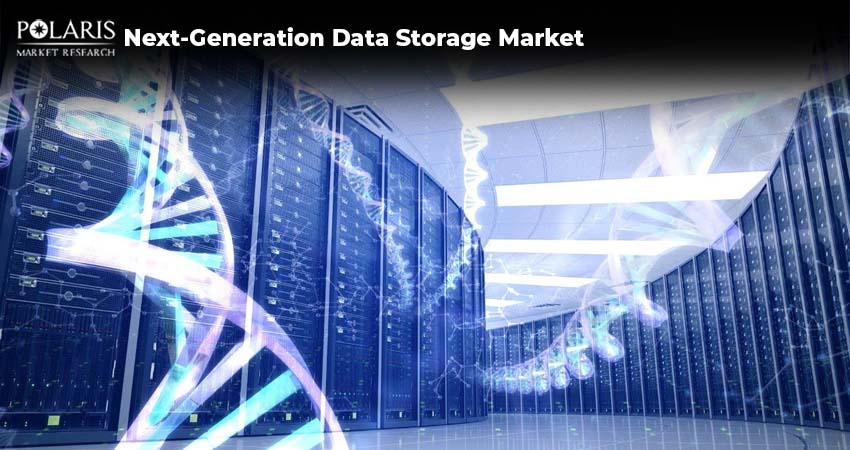
DNA Data Storage: This revolutionary technology encodes digital information into synthetic DNA strands, offering extremely high storage density and long-term stability.
3D Holographic Storage: A potential future technology that stores data in three-dimensional space using laser beams, enabling significantly higher storage densities compared to traditional methods.
Future of Next-Generation Data Storage
Advancements in AI, quantum computing, and molecular storage technologies will shape the future of data storage. The next-generation data storage market is revolutionizing the way businesses store, access, and manage data. From flash storage and AI-driven optimization to futuristic DNA and quantum storage, the industry is witnessing groundbreaking innovations. Leading companies are shaping the future of storage, ensuring businesses can harness the power of data efficiently. As we move forward, the adoption of sustainable, secure, and high-performance storage solutions will become critical for enterprises to thrive in the digital era.