Accuracy is not just a bonus in modern warfare; it's essential. Targeting pods, the new eyes of warplanes, make it possible. Advanced electro-optical and infrared systems help pilots detect, track, and target with unparalleled accuracy, even in low-visibility conditions. From advancing surveillance to directing precision munitions, targeting pods are now critical assets in the modern defense arsenal.
What is Targeting Pod?
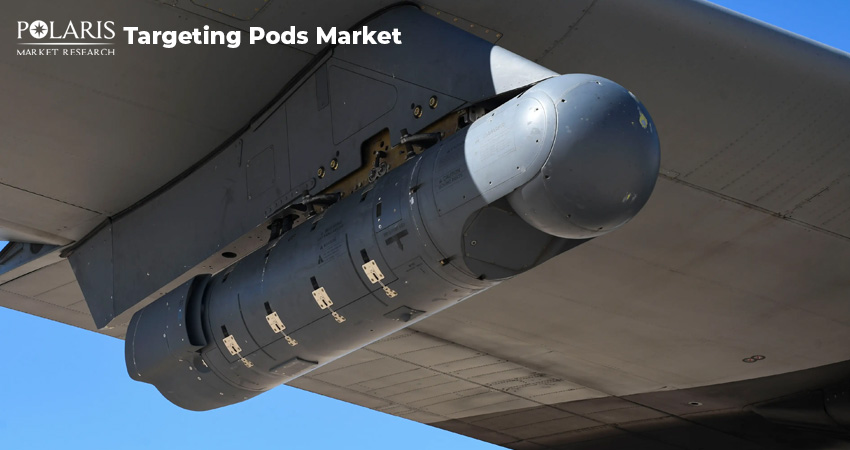
Targeting pods are advanced military systems mounted on combat aircraft that support targeting, reconnaissance, and surveillance. They enable precise targeting and tracking, even under adverse weather conditions, and are usually paired with guided weapons to enhance mission effectiveness.
Interesting Insights
The global targeting pods market was USD 5.33 billion in 2024 and is anticipated to grow at a CAGR of 8.0% from 2025 to 2034. Here are the major driving factors:
- Growing worldwide defense expenditures are spurring demand for advanced targeting and surveillance pods to enhance mission success and reduce collateral damage.
- Increasing cross-border tensions and military modernization are driving increased use of precision-targeting systems on combat and reconnaissance planes.
- Integration with unmanned aerial vehicles (UAVs) is broadening the targeting pods' role in remote, low-risk surveillance and precision strikes.
- Steep development and integration expenses limit use among smaller defense budgets and resource-constrained military forces.
Advancements in Targeting Pods
Advanced Imaging Systems
Nowadays, pods come equipped with EO/IR sensors that can provide high-definition (HD) imaging, allowing pilots to pick out targets even when they are camouflaged, even at night. It also allows the collateral damage to be as low as possible.
Laser Designation and Range Finding
Laser technology ensures precise ammunition delivery and accurate distance measurements, both critical to mission success. It also reduces combat time while making the mission more precise.
Artificial Intelligence (AI) and Automation Integration
These integrations have also effectively reduced civilian casualties. AI-based systems enhance targeting accuracy and reduce pilot workload by automating processes such as target recognition and tracking.
Modular Design
Modular architecture pods are upgradable and customizable to support different aircraft and mission requirements. This trend is stimulating innovation and updating the art of designing targeting aircraft pods.
Stealth and Low Observable Features
Some targeting pods are designed to reduce the cross-section of surveillance radars available in the surveillance radar market, preserving the stealth of advanced aircraft. This feature is making modern-day military missions much more successful and precise.
Who’s Shaping Future of Targeting
Several leading companies are leading innovation in target pod technology. These market leaders develop advanced sensors, tracking, and imaging solutions that enhance precision, reliability, and mission success in defense and aerospace applications.
Lockheed Martin
Lockheed Corporation (1926) and Martin Marietta Corporation (1961) combined in 1995 to create what has become Lockheed Martin. Lockheed Martin is among the world's largest aerospace manufacturers. The company's headquarters are in Bethesda, Maryland. Lockheed Martin's Sniper ATP is well-known for its long-range precision targeting capabilities. It features advanced EO/IR sensors, laser designation, and video datalink capabilities, making it a popular choice among air forces worldwide.
Northrop Grumman
Northrop Grumman is an international security corporation that provides systems and products in modernization, logistics, autonomous systems, and cybersecurity. Northrop Grumman was established in 1994 when Northrop Aircraft bought Grumman Aerospace. Since 2011, Northrop Grumman's corporate headquarters has been located at West Falls Church, Virginia (formerly Jefferson), in unincorporated Fairfax County, USA. Northrop Grumman's LITENING pod is one of the most popular systems in the world.
Boeing
Boeing was founded in 1916. The current corporation is the result of Boeing's 1997 merger with McDonnell Douglas. As of 2023, the Boeing Company's corporate headquarters is in the Crystal City neighborhood of Arlington County, Virginia, USA. Boeing is divided into three major divisions: Boeing Commercial Airplanes (BCA), Boeing Defense, Space, and Security (BDS), and Boeing Global Services (BGS). Boeing's ATP-SE is designed for enhanced precision and is compatible with a variety of legacy and modern aircraft.
Saab Group
Saab was founded in 1937 to develop and produce combat aircraft. The company is headquartered in Stockholm, Sweden, but its development and manufacturing operations are carried out in Linköping, Sweden. Saab's Tern pod has advanced targeting capabilities and was designed specifically for integration with Gripen fighter aircraft.
Thales Group
Thales Group was founded in France in 2000. Thales is a global company that offers a wide range of services and products, including avionics, in-flight entertainment and connectivity, air traffic management, and training and simulation systems. European and Middle Eastern air forces widely use the Thales Damocles targeting pod. Its dual-role capability enables it to conduct both targeting and reconnaissance missions. The company is headquartered in the Paris business district, La Défense, France.
How AI is Shaping Future of Targeting Pods?
- The artificial intelligence market is improving the accuracy and speed of target detection in targeting pods.
- Machine learning technology assists pods in identifying targets more effectively and in following moving or camouflaged targets.
- AI enables real-time data analysis, enhancing operational decision-making.
- AI-driven automation offloads pilot workload and enhances operating efficiency.
- Predictive analytics powered by AI enables maintenance and performance improvements for pod-targeting systems.
Closure
Targeting pods are today a fundamental component of modern defense, with enhanced sensors, laser guidance, AI, and modularity combining to enhance precision and mission effectiveness. The market is rapidly expanding as leading companies such as Lockheed Martin, Northrop Grumman, Boeing, Saab, and Thales push the envelope, and AI and automation further intensify capabilities. Targeting pods will be at the heart of modern military operations.