
AI Assistants Market Size, Share, and Forecast 2027 to 2035
REPORT DETAILS
AI Assistants Market Summary
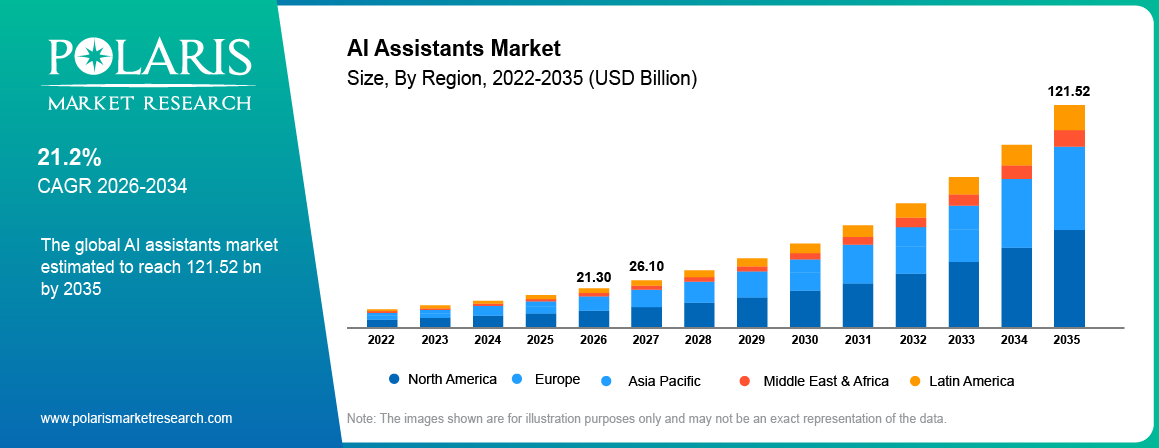
According to Polaris Market Research analysis, the AI assistants market was valued at USD 21.30 Billion in 2026. It is projected to reach USD 121.52 Billion by 2035, growing at a CAGR of 21.2% from 2027 to 2035. Demand comes from chat apps, voice assistants on phones and speakers, workplace copilots, and coding tools that people pay for through subscriptions, seat licenses, and metered usage. Chat and Conversational Assistants hold the largest type share, while Coding Assistants expand quickest. The market tracks revenue earned from assistant software and subscriptions, and it leaves out autonomous agent platforms, chip sales, and cloud infrastructure. North America is the leading market. Asia Pacific is the fastest growing region.
Market Statistics
Key Takeaways
- The 2027 revenue pool placed 37.6% in North America, owing to United States households and employers holding the biggest pool of paid assistant subscriptions and seat licenses.
- Asia Pacific is the quickest riser, with 23.4% yearly growth through 2035, owing to Chinese super apps and Indian telecom bundles.
- Type value in 2027 is led by Chat and Conversational Assistants at 39.8%, supported by free tiers that convert a small share of very large audiences into paying subscribers.
- Coding Assistants post the highest type CAGR, at 28.7% through 2035, owing to software developers paying for tools that generate, review, and test programming code.
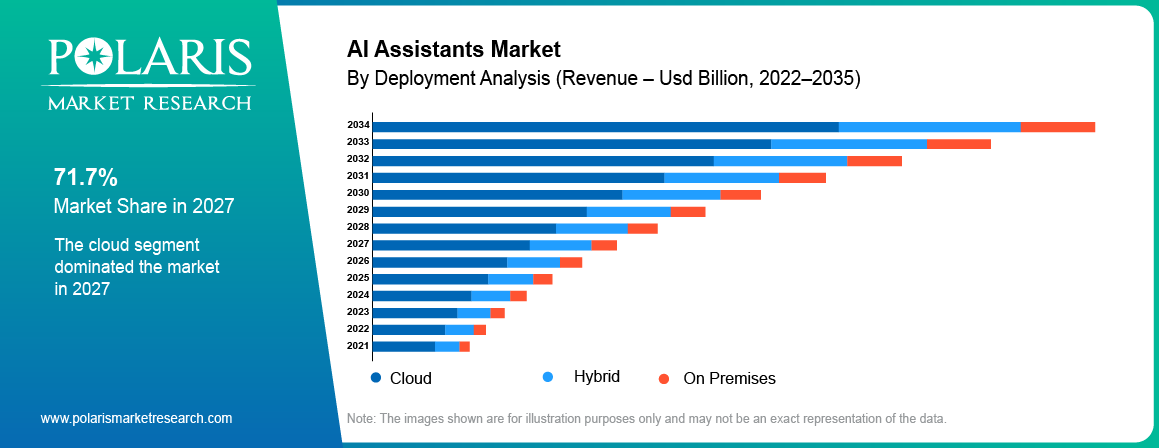
- Cloud holds 71.7% of 2027 deployment value, due to model hosting concentrated among a handful of large infrastructure providers.
- Hybrid grows 24.0% a year to 2035, the fastest deployment rate, owing to regulated buyers that want private data kept close to their own systems.
- Customer Service and Support commands 27.5% of 2027 application revenue, since every large contact center can place an assistant in front of its agents.
- Software Development advances at 26.6% a year, the quickest application rate, as engineering teams move routine drafting and review to assistants.
- Consumer and Individual is the largest end use at 25.6% of 2027 value, while Healthcare and Life Sciences grows fastest, at 24.7% through 2035.
Note: Figures and projections outlined in this report are the result of Polaris Market Research’s proprietary analytical processes, grounded in the latest available datasets and market observations.
AI Assistants Market Definition
The AI assistants market covers software that understands requests in text, voice, or images and then answers or acts for a person or an employee, sold through subscriptions, seat licenses, device bundles, and metered usage. It excludes autonomous agent platforms, speech engines sold alone, raw model access sold to developers, and the hardware that runs them.
Published figures for assistants disagree because each study draws its boundary differently. Some count only speakers and phone voice features, while others add chatbots, agent platforms, or model access sold to developers. Polaris counts what end users and employers pay for assistant products, so the total follows subscriptions, seats, and bundles and leaves data center spending out.
Voice only products and telephony platforms for contact centers sit in the intelligent virtual assistant market, and Polaris keeps those platforms outside this scope. Software that works alone for days or weeks belongs to the AI Agent market, so an assistant counted here still waits for a person to start each task.
Four product families make up most revenue. Chat assistants answer questions and draft text on phones and browsers, voice assistants run on speakers and handsets, workplace assistants sit inside documents, mail, and meetings, and coding assistants write and review software for developers.
Revenue arrives through four routes. Consumers pay monthly subscriptions, employers buy seat licenses, device makers bundle assistants into hardware and carrier plans, and developers or business teams pay for metered usage, so a single vendor often sells through all four at once.
Free tiers complicate any reading of the market. An enormous audience can use an assistant without paying while only a small proportion subscribes, so user counts overstate revenue, and Polaris recognizes only the money that actually reaches vendors.
AI Assistants vs Autonomous AI Agents: Key Differences
| Attribute | AI Assistants | Autonomous AI Agents |
| Starting point | A person asks, and the assistant responds or acts once | A goal is set, and the agent plans and works across many steps |
| Oversight | The person reviews each result | Review happens at checkpoints or after the work is finished |
| Typical pricing | Subscriptions, seat licenses, and device bundles | Outcome fees, usage credits, and platform contracts |
| Typical buyers | Individuals, knowledge workers, and device makers | Operations teams and software platform owners |
| Growth outlook | 21.2% CAGR from 2027 to 2035 | Tracked in a separate Polaris report |
Source: Polaris Market Research Analysis
The line between the two groups is blurring. Many assistants now take actions inside apps, so Polaris counts a product as an assistant while a person still starts and approves its work, and it moves the product to agent tracking once it runs without prompts.
Porter's Five Forces Analysis
| Force | Intensity | Rationale |
| Bargaining power of suppliers | High | A few model builders and chip suppliers control the compute and the models that every assistant depends on. |
| Bargaining power of customers | Moderate | Consumers switch with one download, yet enterprises sign multiyear contracts and face migration effort. |
| Threat of new entrants | Moderate | Open models lower the cost of a first product, while distribution on phones and in office suites stays hard to win. |
| Threat of substitutes | Low | Search boxes and menu driven apps still serve simple tasks, yet they cannot hold a conversation or finish a task. |
| Competitive rivalry | High | Device makers, software suites, and model builders all sell assistants and cut prices or add free tiers to win habits. |
Source: Polaris Market Research Analysis
Distribution matters more than model quality in many contests. An assistant that ships on a phone, sits inside an office suite, or comes with a shopping membership reaches users at almost no acquisition cost. Smaller vendors therefore tend to win through one task or a language that large rivals serve poorly.
Market Dynamics
Driver Impact Analysis
| Driver | Impact on Market Growth | Time Horizon |
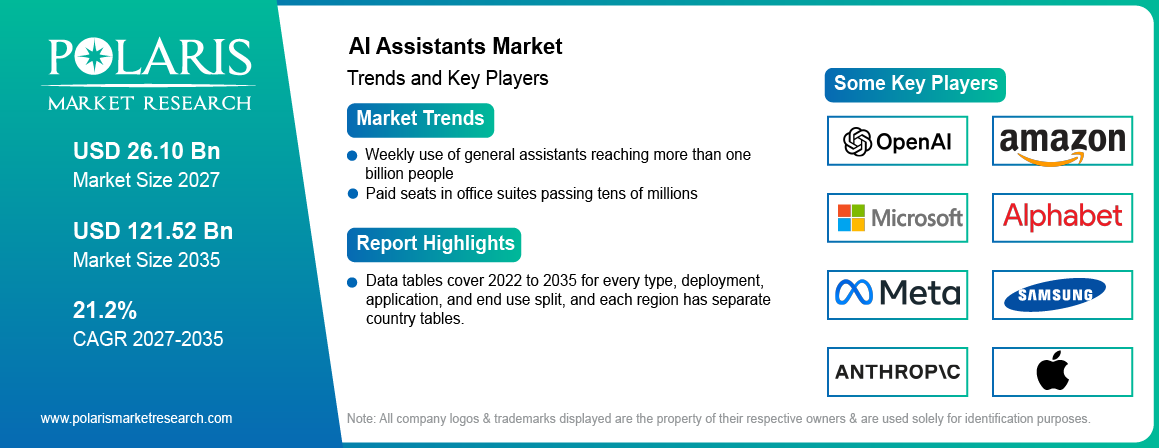
| Weekly use of general assistants reaching more than one billion people | High | Short to Medium Term |
| Paid seats in office suites passing tens of millions | High | Medium to Long Term |
Source: Polaris Market Research Analysis
Driver: Weekly Use of General Assistants Is Reaching More Than One Billion People, Creating Market Demand
A general assistant becomes a daily habit once people trust it with questions about health, money, work, and school. Each new habit enlarges the audience that vendors can later convert to paid plans, and it feeds the training signals that improve answers.
For example, in November 2026, OpenAI introduced Businesses in ChatGPT and said that 1.2 billion people use ChatGPT each week, as it opened the product to companies that want to manage how they appear in answers (Source: OpenAI). A weekly audience of that size gives merchants and service firms a reason to build for the assistant, and it lifts spending on paid tiers.
Revenue from conversational chat apps equals 39.8% of the 2027 type total, and consumer and individual users spend USD 6,687.4 Million in the same year. Knowledge Search and Research adds USD 4,681.1 Million, since long questions replace many web searches.
Habit also changes how vendors compete. A product that opens every day earns a place on the home screen, so rivals spend heavily on free access, memory features, and voice modes in an effort to win that first tap.
Driver: Paid Workplace Seats Are Passing Tens of Millions, Creating Market Demand
Employers buy assistants one seat at a time, and a seat license produces predictable revenue. Large companies now roll assistants out to thousands of staff at once, owing to pilots in finance, legal, and sales that have shown time savings on drafting and meeting follow up.
For example, in July 2026, investors heard from Microsoft that paid Microsoft 365 Copilot seats had reached 30 million after its fiscal year closed in June (Source: No Jitter). A base of that size suggests office suite buyers are moving from trials to company wide licenses, and each added seat brings recurring subscription revenue.
Enterprise and Workplace Assistants reach USD 6,635.3 Million in 2027 and grow at 22.7% a year to 2035. IT and Telecom holds 22.1% of 2027 end use revenue, since technology firms adopt assistants first for support, documentation, and internal search.
Pricing is changing alongside volume. Vendors add premium bundles that pair an assistant with security and identity tools, so the average revenue per seat rises even when the seat count grows slowly.
Restraint: Low Conversion From Free Use to Paid Plans Is Limiting Assistant Revenue
Most assistant use is free. Vendors offer limited access at no charge to build habits, and only a minority of users move to a paid plan, so revenue lags audience growth. The gap also raises the cost of serving users, because every free answer still needs compute.
For example, in February 2026, The Register calculated that 3.3 percent of Microsoft 365 and Office 365 users touching Copilot Chat pay for it, against 15 million paid Microsoft 365 Copilot seats (Source: The Register). Free chat inside an office suite lowers the urgency to buy a paid seat, and that slows revenue conversion.
Others, covering niche assistants for education and public services, reaches only USD 1,288.6 Million in 2027, owing to many such tools being offered free by governments and schools. Household speakers already carry assistants at no added charge, so the slowest type rate, 16.0% a year, belongs to Voice and Smart Speaker Assistants.
Vendors respond with usage based pricing, credit packs, and premium tiers for heavy users. That raises revenue from power users, yet it can also push casual buyers back to free options.
Opportunity: Phone and Computer Makers Are Building Assistants Into Their Operating Systems, Creating Openings for Bundled Revenue
The operating system is the strongest place to meet users. A phone assistant starts with a button press or a wake phrase, reads on screen content with permission, and works across mail, messages, and photos, so it is easier to use than a separate app.
For example, in September 2026, Apple released Siri AI in beta in English and promised five more languages the following month (Source: Apple). Apple also said that expanded access would be offered for a fee in the future. A built in assistant reaches every compatible iPhone owner, and a planned paid level brings a revenue line.
In 2027, voice and smart speaker assistants generate USD 5,522.3 Million. Consumer and Individual users account for 25.6% of end use revenue, and phone manufacturers bundling assistants with premium subscriptions add to that total.
The commercial prize is habitual use at very large scale. A phone manufacturer that positions its assistant at the side button controls the first request of each day, and subsequent requests flow toward partner services that pay for placement.
Opportunity: Shopping Assistants Are Linking Conversation to Checkout, Creating Openings for Transaction Linked Revenue
Shopping questions end in a purchase, so an assistant that can compare products and place an order connects conversation to revenue. Retailers value that link since it replaces search ads and comparison sites with one chat.
For example, in May 2026, Amazon announced Alexa for Shopping, combining Rufus and Alexa+ on its shopping app and website, free to signed in customers (Source: Amazon). Amazon said Rufus helped more than 300 million customers in 2025, and a merged assistant could convert that habit into more completed orders.
Retail and E Commerce holds 16.3% of 2027 end use revenue and grows 20.4% a year to 2035. Related demand sits in shopping specific tools, and Polaris covers those separately outside this scope.
Trust sets the limit. People allow an assistant to purchase for them only after prices, returns, and payment safeguards are plain, so retailers that explain their reasoning and request approval at checkout will capture more of the new demand.
Trend: Assistants Are Moving From Answering Questions Toward Completing Tasks With User Approval
Assistants are progressing from textual replies toward performing the work behind a request. They complete forms, reserve travel, and compose messages inside other applications, and the better implementations pause for confirmation before spending money or transmitting a message.
For example, in September 2026, Meta introduced Muse, a personal AI agent that works inside WhatsApp and asks for approval before sensitive steps such as sending an email or making a purchase (Source: Meta). Approval prompts keep a person in charge, so products of this kind still count as assistants while they depend on that sign off.
Product design follows the same logic. Vendors introduce audit trails, one time payment cards, and permission controls, since trust determines whether people authorize an assistant to act for them.
The shift favors vendors with extensive application connections. A limited assistant capable only of conversation will lose ground to competitors able to finish transactions across email, calendars, payments, and shopping.
Value Chain Analysis
| Stage | Activities | Representative Participants |
| Compute and chips | Supplying the processors and data centers that train and run models | Cloud providers, chip makers, and data center operators |
| Model development | Training language and speech models and tuning them for conversation | OpenAI, Anthropic, Alphabet, Meta Platforms, Alibaba Group, and Baidu |
| Assistant products | Packaging models with interfaces, memory, connectors, and safety controls | Microsoft, Alphabet, Amazon, Apple, Samsung Electronics, Perplexity, and IBM |
| Distribution | Placing assistants in operating systems, office suites, carrier plans, and retail apps | Phone makers, software suites, telecom operators, and retailers |
| End users | Asking questions, drafting, coding, and completing tasks | Consumers, employees, developers, and service teams |
Source: Polaris Market Research Analysis
Value gathers in two layers. Model builders and cloud hosts earn on volume, and distribution owners earn through subscriptions, bundles, and placement fees, whereas thin interface vendors that rent both layers face the narrowest margins.
Cost sits mostly in compute. Every response uses processing time, so vendors tune smaller models for routine questions and reserve large models for hard ones, and that routing decides gross margin on free and low priced plans.
Distribution deserves more attention than it usually receives. Device makers, carriers, and software suites own the customer relationship, and they bargain hard with model builders over price, branding, and data use.
Pricing differs along the chain. Compute is billed by usage, models are licensed by volume, and assistants reach users through monthly plans, seat licenses, and bundles, so a drop in compute cost reaches buyers only when vendors choose to pass it on.
AI Assistants Market Segmentation Analysis
Segmentation follows the kind of assistant a buyer picks, where its models run, the job it performs, and the industry paying for it. Each split changes pricing, switching effort, and the evidence a vendor needs to win a contract.
Type Insights
In 2027, 39.8% of type value sat with Chat and Conversational Assistants, the biggest slice, owing to general purpose apps that people open daily for questions, writing help, and study. Free tiers feed a large paying base through monthly plans, and that conversion path keeps the type ahead of every other.
Enterprise and Workplace Assistants reached USD 6,635.3 Million in 2027, supported by assistants inside documents, mail, meetings, and chat tools that employers license by the seat. Seat contracts renew yearly, so revenue from the type is steadier than consumer subscriptions.
Voice and Smart Speaker Assistants are forecast to post a CAGR of 16.0% through 2035, the slowest type rate, since household speakers and handset voice features are already installed in most target homes. Growth now depends on upgrades from older command based assistants to conversational versions.
Coding Assistants record the quickest type CAGR, 28.7% across 2027 to 2035, as developers pay for tools that complete code, explain errors, and write tests. Related spending is tracked in the generative AI coding Assistants market, a narrower report limited to coding tools. Others, covering education, accessibility, and public service assistants, reached USD 1,288.6 Million in 2027.
For example, in October 2026, Amazon opened early access to Alexa+ in Japan from 29 October, extending its generative voice assistant beyond the United States (Source: Amazon). A voice assistant that arrives through speakers already in homes reaches buyers without new hardware, and that lowers the cost of each added country.
Type also decides how buyers compare products. Chat apps compete on answer quality and memory, workplace assistants on security and integration, voice assistants on device reach, and coding tools on accuracy inside a developer editor.
Boundaries between types are fading. A chat app now speaks, a speaker now holds a conversation, and a workplace assistant now writes code, so Polaris assigns revenue by the main product a customer buys.
Deployment Insights
Cloud carried 71.7% of 2027 deployment value, the top position, due to model hosting that sits in large data centers run by a handful of providers. Updates reach every user at once, and that speed explains why consumer and most business products start there.
Hybrid has the fastest deployment CAGR, at 24.0% through 2035, since regulated buyers keep sensitive records near their own systems while sending general tasks to hosted models. Banks, hospitals, and public bodies drive most orders.
On Premises should advance 15.1% a year through 2035, the lowest deployment rate, since large models in a private data center demand scarce chips and skilled staff. Demand persists in defense, intelligence, and some healthcare settings that cannot use outside hosting.
For example, in August 2025, Google Cloud made Gemini generally available on Google Distributed Cloud for air gapped environments, so that customers with strict isolation needs can run the models inside their own sites (Source: Google Cloud). A managed private option widens the buyer pool, and it moves some demand from pure cloud to hybrid plans.
Deployment choice changes the sales process. Cloud products sell through a card or a click, whereas hybrid and private installs need security review, procurement, and integration work that stretches contracts across several quarters.
Pricing differs as well. Hosted assistants charge per seat or per use, hybrid products add platform fees, and private installs bundle hardware, licenses, and support into a larger upfront contract.
Application Insights
Customer Service and Support drew 27.5% of 2027 application revenue, the biggest single use, since contact centers and help desks face a heavy daily load of questions. Tools that suggest replies to human agents are counted here, whereas fully autonomous service bots belong to the AI for customer service market.
Personal Productivity reached USD 6,145.5 Million in 2027, supported by drafting, scheduling, summarizing, and planning tasks that people hand to an assistant each day. Buyers often start on a free plan, and many upgrade once they depend on memory and file access.
Software Development is forecast to rise 26.6% annually to 2035, the quickest application rate, owing to teams that adopt code completion, review, and test writing across entire engineering groups. Per developer prices are high, so each new team adds meaningful revenue.
Knowledge Search and Research advances at a CAGR of 21.9% through 2035, driven by long questions, cited answers, and document analysis that replace many separate web searches. Content Creation expands 20.0% a year, and Others, covering translation and tutoring, is the slowest at 18.7%.
For example, in March 2026, TechCrunch relayed a Bloomberg report that the coding assistant Cursor had passed USD 2 billion in annualized revenue after doubling its run rate in three months (Source: TechCrunch). Large companies supplied about 60 percent of that revenue. Rapid growth at one vendor shows how fast developers move from trials to paid plans, and it pulls rivals into price and feature contests.
Application mix also shapes margins. Coding and research users run long, compute heavy sessions, so vendors price those tiers higher, whereas casual chat is cheap to serve and relies on volume.
Applications overlap in daily use. A single employee may draft mail, search documents, and fix a spreadsheet formula in one hour, so suppliers sell bundles instead of separate tools.
End Use Insights
Consumer and Individual users produced 25.6% of 2027 spending across end uses, the leading share, supported by subscriptions, phone bundles, and household speakers with very large audiences. Phone makers and carriers increasingly include a premium plan with a handset, adding revenue without a separate purchase.
IT and Telecom reached USD 5,760.0 Million in 2027, supported by early adoption in software firms, carriers, and cloud providers that use assistants for support, documentation, and engineering. Telecom operators also resell assistants to their own customers.
BFSI is projected to grow 20.5% annually to 2035, owing to advisers, analysts, and service teams that use assistants for research, drafting, and client questions under strict record keeping rules. Retail and E Commerce adds shopping help, and its growth is 20.4% a year.
Healthcare and Life Sciences leads end use growth, advancing 24.7% annually to 2035, supported by clinical note writing, coding support, and research search that save clinician hours. Others, covering education and public services, grows 23.3% a year.
For example, in March 2026, Microsoft said at HIMSS that more than 100,000 clinicians use Dragon Copilot every day, and it added multilingual conversation capture in 58 languages and partner apps through its marketplace (Source: Microsoft). Daily use at that scale shows that clinical documentation is becoming a core purchase for health systems, and it brings recurring license revenue.
Purchasing habits differ by end use. Consumers pay monthly, banks buy with risk teams in the room, health systems test with a few departments first, and retailers measure results in completed orders.
Regulation shapes every enterprise end use. Banks must keep records of advice, hospitals must protect patient data, and public bodies must explain automated decisions, so vendors that provide logs and controls win the larger contracts.
AI Assistants Market Regional Analysis
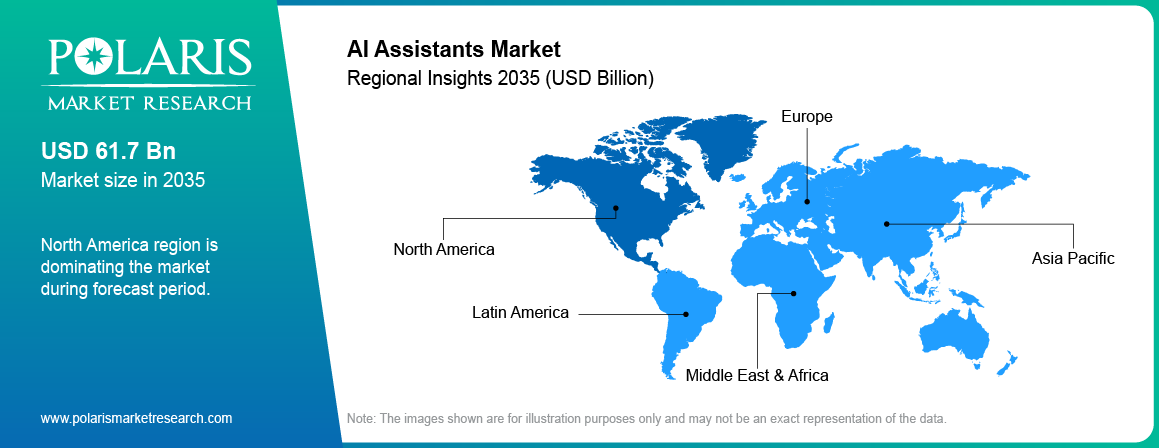
Regional demand rests on the number of paying consumers, enterprise software budgets, device ecosystems, language coverage, and the rules that govern personal data. The largest spending pool is in North America, and the fastest user additions are in Asia Pacific.
North America Market
North America held 37.6% of the 2027 revenue pool, owing to the highest spending per subscriber, the home bases of the largest model builders, and early enterprise rollouts. Its CAGR of 19.9% over 2027 to 2035 is the second slowest of the five regions given the already large base.
Among countries, Canada is expected to post 20.7% yearly growth, ahead of the 19.7% for the United States, as banks, telecom operators, and public bodies widen assistant programs. United States revenue came to USD 8,235.9 Million in 2027.
For example, in February 2026, TechCrunch reported that ChatGPT had reached 900 million weekly active users and 50 million consumer subscribers, announced alongside a USD 110 billion funding round (Source: TechCrunch). A subscriber base of that size shows how many users in the region already pay for assistants, and it funds further product work.
Enterprise buyers also drive the region. Large employers in finance, technology, and professional services sign company wide licenses, and they ask vendors for security reviews, audit logs, and data residency options before approval.
Competition is intense. Device makers, software suites, and model builders all sell to the same households and employers, and that keeps price cuts, free tiers, and bundles common.
Europe Market
Europe represented 22.2% of 2027 revenue and is forecast to expand at a CAGR of 19.6%, the slowest regional rate, due to strict data rules, slower enterprise purchasing, and launches that arrive later than in the United States. Germany leads by value with USD 1,385.7 Million in 2027.
The quickest national rate in Europe belongs to Spain, at 21.0%, owing to rapid consumer adoption and a large Spanish language audience that also links to Latin America. In 2027 the United Kingdom reached USD 870.1 Million, France USD 812.1 Million, Italy USD 754.1 Million, and Rest of Europe USD 1,450.2 Million.
For example, in May 2026, European negotiators reached a provisional agreement to move the compliance date for high risk AI obligations to 2 December 2027, and the changes entered into force on 27 July 2026 (Source: DLA Piper). Extra time lowers near term cost for vendors that sell assistants into hiring, credit, and other covered uses, and it supports steadier investment.
Launch timing is a visible constraint. Apple said that Siri AI will not be available initially in the European Union, so households there wait while rivals add voice and chat features.
Language coverage matters in the region. Buyers expect assistants to work in German, French, Italian, Spanish, and many smaller languages, and suppliers with strong local language quality hold an advantage in public contracts.
Asia Pacific Market
Asia Pacific is the second largest region, holding 28.6% of 2027 revenue, but its 23.4% yearly rate over 2027 to 2035 is the highest of any region. That pace is due to very large smartphone audiences, super apps that bundle assistants with payments and shopping, and telecom plans that include premium access.
China holds the top national position, at USD 2,815.9 Million in 2027, and India advances fastest, with 26.6% annual growth, as low data prices and bundled plans bring new users. Revenue in Japan was USD 1,027.0 Million, in South Korea USD 670.9 Million, and in Australia USD 447.2 Million.
For example, in April 2026, Alibaba opened the agentic features of its Qwen App to outside partners for the first time, starting with China Eastern Airlines (Source: Alibaba Group). Users can search, book, choose seats, and check in within one chat. Opening an assistant to partners turns it into a channel for transactions, and that attracts merchants who pay for access.
Local models and languages shape demand. Chinese, Japanese, Korean, and Indian language assistants compete with global products, and government rules on data and content steer many users to domestic suppliers.
Smaller Asia Pacific markets together reached USD 1,341.7 Million in 2027, helped by Southeast Asian audiences, where messaging apps and low cost phones carry assistants to new users.
Latin America Market
Latin America accounted for 5.6% of 2027 revenue, with 22.4% yearly growth expected over 2027 to 2035, due to large Spanish and Portuguese speaking audiences that rely on messaging apps. Brazil leads the country ranking at USD 663.9 Million, and Mexico has the quickest rate, at 22.9%.
For example, in January 2026, Brazil's competition authority CADE ordered Meta to suspend a WhatsApp policy that barred third party general purpose chatbots (Source: TechCrunch). The policy had taken effect on 15 January with a 90 day grace period. Access to the main messaging channel decides whether independent assistants can reach users in the region, so the ruling protects a route to market for smaller vendors.
Argentina came to USD 145.0 Million in 2027, and the remaining Latin American countries to USD 291.6 Million. Buyers mostly pay in local currency, and weak exchange rates push vendors toward annual plans, local payment methods, and carrier billing.
Messaging is the front door in the region. Businesses already serve customers on WhatsApp, so assistants that work inside chat apps spread faster than those that need a new download.
Price sensitivity is high. Premium plans priced in dollars sit out of reach for many households, and vendors respond with lower priced tiers, bundles with carriers, and ad supported access.
Middle East & Africa Market
Middle East & Africa delivered 6.1% of 2027 revenue, and 22.3% yearly growth is expected, owing to national AI programs in the Gulf, young populations, and rising smartphone use. Saudi Arabia ranks first by size, at USD 414.5 Million, and first by speed, at 23.3%.
For example, in August 2025, HUMAIN launched HUMAIN Chat in Saudi Arabia, an Arabic and English assistant built on its ALLaM 34B model and offered on web, iOS, and Android (Source: Arab News). A state backed assistant in the local language builds a domestic user base, and it gives government and enterprise buyers an option that fits national data goals.
In 2027, South Africa reached USD 314.4 Million, and USD 316.1 Million came from the United Arab Emirates, with the other countries in the region adding USD 535.7 Million. Arabic quality, local hosting, and public sector adoption decide many purchases in the Gulf.
Governments take on roles as both buyers and sponsors. National strategies fund local models and data centers, and public agencies pilot assistants for citizen services before wider rollouts.
African markets start from a modest base. Mobile first users, patchy connectivity, and limited card payments slow paid conversion, so vendors lean on carrier bundles and lightweight apps.
AI Assistants Market Competitive Landscape
Providers fall into three groups. Platform owners such as Apple, Alphabet, Amazon, and Samsung Electronics place assistants in phones, speakers, and operating systems. Software and cloud groups such as Microsoft and IBM sell assistants to employers. Model builders such as OpenAI, Anthropic, Meta Platforms, Alibaba Group, Baidu, and Perplexity sell apps and subscriptions directly.
OpenAI said in November 2026 that ChatGPT has 1.2 billion weekly users. Alphabet reported 950 million monthly active users for the Gemini app in July 2026, and Meta introduced Muse in September 2026 as a personal agent that works inside WhatsApp.
Microsoft sells Microsoft 365 Copilot by the seat and reported 30 million paid seats in July 2026. Amazon made Alexa+ available to all customers in the United States in February 2026, with Prime members paying nothing extra and others paying USD 19.99 a month (Source: TechCrunch).
Apple released Siri AI in beta in September 2026 with a fee for expanded access planned for later. Samsung announced a conversational Bixby beta in One UI 8.5 in February 2026 and added Perplexity to Galaxy AI beside Bixby and Gemini, while Alibaba added shopping features to Qwen in May 2026 for users in China.
Anthropic announced Claude Fable 5.2 and Claude Mythos 5.2 in November 2026 and sells Claude through apps, workplace plans, and developer tools. IBM presented a watsonx Orchestrate AI Gateway in October 2026, and Baidu reported 604 million monthly active users for its Baidu App in September 2026 and unveiled ERNIE 5.5 Flash Preview in November 2026.
Reach and habit settle most contests, and market share tracks distribution, trust, and price. Winners pair a large installed base with steady answer quality, clear privacy controls, and bundles that make the paid plan cheap to accept, whereas buyers expect free access to remain available.
Vendor Landscape Snapshot
| Company | Vendor Positioning | Role |
| OpenAI | Leader | Maker of ChatGPT, which it says reaches 1.2 billion people each week, with Business Agents for eligible US ecommerce and service firms in beta from November 2026 |
| Alphabet (Google) | Leader | Operator of the Gemini app, which had 950 million monthly active users in July 2026, with Gemini offered on air gapped private infrastructure |
| Microsoft | Leader | Seller of Microsoft 365 Copilot with 30 million paid seats in July 2026 and the Dragon Copilot clinical assistant |
| Amazon | Leader | Provider of Alexa+ for all US customers since February 2026 and the Alexa for Shopping assistant announced in May 2026 |
| Apple | Challenger | Released Siri AI in beta in September 2026 across compatible iPhone, iPad, and Mac devices, initially outside the European Union and China |
| Meta Platforms | Challenger | Introduced the Muse personal agent in September 2026 and works inside WhatsApp |
| Anthropic | Challenger | Maker of the Claude assistant, with new Fable 5.2 and Mythos 5.2 models announced in November 2026 |
| Samsung Electronics | Challenger | Announced a conversational Bixby beta in One UI 8.5 in February 2026 and runs several assistants on Galaxy devices |
| Alibaba Group | Challenger | Opened Qwen App to partners from April 2026 and connected it to the Taobao catalog in May 2026 |
| Baidu | Niche Player | Operates the Baidu App, which reached 604 million monthly active users in September 2026, and unveiled ERNIE 5.5 Flash Preview in November 2026 |
| IBM | Niche Player | Sells watsonx Orchestrate for hybrid enterprise deployments and added an AI Gateway in October 2026 |
| Perplexity | Niche Player | Answer engine added to Samsung Galaxy AI beside Bixby and Gemini in February 2026 |
Source: Polaris Market Research Analysis
AI Assistants Market Technology and Innovation Landscape
Technical work follows three aims: answers that are accurate and sourced, actions that work across apps with user approval, and lower cost per conversation. Most gains come from better models, memory, connectors, and routing between small and large models.
Memory is becoming a central capability. An assistant that recalls preferences, earlier projects, and documents spares users from repeated explanation, so vendors compete on what they remember and how transparently users can edit or erase it.
Voice quality has improved substantially. Natural speech, interruptions, and extended context make spoken conversations resemble a telephone call with another person, and that revives commercial interest in speakers, automobiles, and wearable devices.
Actions inside other apps are the next step. Assistants fill forms, draft messages, and book services, and the safer designs ask for approval before payments, add audit trails, and hide stored credentials from the model.
Cost control decides margins. Routers send easy questions to small models and hard ones to large models, caches reuse common answers, and on device models handle private tasks without a server round trip.
Safety and privacy features shape enterprise sales. Buyers ask for data isolation, no training on their content, and logs that show what the assistant did, so vendors that document these controls clear reviews faster.
Open models and specialized processors lower entry costs. Smaller vendors can now construct a competent assistant for a niche language or industry, keeping pressure on the prices of general products.
Technology and Innovation Landscape Snapshot
| Area | Role | Status and Representative Developers |
| Personal agents with approval steps | Complete tasks across apps while asking before sensitive steps | Meta introduced Muse in September 2026 |
| Operating system assistants | Read on screen context and act across apps | Apple released Siri AI in beta in September 2026 |
| Conversational device control | Change phone settings through natural language | Samsung Electronics announced the new Bixby in February 2026 |
| Clinical documentation assistants | Capture patient visits and draft notes in many languages | Microsoft Dragon Copilot supports 58 languages for conversation capture |
| Shopping assistants | Compare products and place orders in a chat | Amazon announced Alexa for Shopping in May 2026 and Alibaba linked Qwen to Taobao the same month |
| Private model hosting | Run assistants inside regulated or disconnected environments | Google offers Gemini on Google Distributed Cloud, and IBM sells hybrid orchestration |
Source: Polaris Market Research Analysis
Use Case Analysis
Everyday Questions and Planning
People ask assistants about health, money, travel, and schoolwork, and they use them to plan trips and meals. The use depends on trust in answer quality, so products that cite sources and admit uncertainty keep users longer.
Meeting and Document Work
Employees ask assistants to summarize meetings, draft replies, and pull facts from long files. Time saved is easy to measure on these tasks, helping buyers justify seat licenses to finance teams.
Writing and Reviewing Code
Developers use assistants to complete lines, explain unfamiliar code, and write tests. Teams measure results in faster reviews and fewer routine tasks, and the strongest tools work inside the editor where developers already spend their day.
Clinical Notes and Coding
Clinicians use assistants to record visits and draft notes, and coding staff use them to check diagnosis detail. Health systems start with a few departments, measure time saved, and expand once security and accuracy checks pass.
Shopping and Customer Questions
Shoppers ask for comparisons, reviews, and delivery times, and merchants use assistants to answer pre purchase questions. The link to checkout makes this use case valuable, yet it needs clear prices and easy returns.
Safety and oversight apply to every use case. Users should check important answers, employers should set rules for sensitive data, and vendors should give logs and controls so mistakes can be traced.
Reliability matters most in regulated work. A wrong answer in banking or medicine carries real cost, so buyers prefer assistants that cite sources, flag doubt, and hand difficult cases to a person.
Buyer Needs and Decision Criteria
| Buyer Need | Decision Criteria | Why It Matters |
| Answer quality | Accuracy, cited sources, and quality in local languages | Wrong answers erode trust and slow adoption |
| Security and privacy | Data isolation, training opt out, and activity logs | Risk teams block products that cannot show controls |
| Integration | Connectors to mail, documents, code editors, and customer systems | An assistant outside daily tools goes unused |
| Total cost | Seat price, usage fees, and free tier limits | Usage pricing can raise bills faster than seat counts |
| Support and governance | Admin controls, audit trails, and service terms | Large rollouts need central management |
Source: Polaris Market Research Analysis
Barriers to entry are access to compute, high quality training data, distribution, and trust. Reported revenue rarely isolates assistant sales from cloud and device income, so any side by side ranking of suppliers is approximate.
Approval often hinges on pilot results, security documents, integration effort, and the delivered price. Vendors that can document all four may cut months from a buying cycle.
Agreements are widening in scope. Initial deals covered a single tool for a single team, whereas current contracts combine assistants with security, identity, and analytics, increasing what each account is worth to vendors with a full product range.
Premium Insights and Forward Outlook
Usage Pricing Will Reshape Assistant Revenue
Vendors are adding credits and metered fees beside seat licenses, so heavy users will pay more and light users will pay less. Pricing that tracks usage also protects vendors from the compute cost of power users.
Commercial terms will evolve alongside pricing. Purchasers will demand spending caps, usage forecasts, and automatic alerts, and vendors that make invoices predictable will win renewals against rivals that surprise customers with unexpected charges.
Programs will start with coding and research, where usage is high and results are easy to measure, and spread to service and finance teams as controls improve.
Device Makers Will Hold the Front Door
Manufacturers of handsets, speakers, and computers that install assistants at the factory control the strongest position. Independent vendors will answer with partnerships, specialist features, and access to messaging platforms instead of competing on installed base.
Regulation Will Favor Vendors With Clear Controls
Privacy rules, audit duties, and postponed high risk deadlines in Europe each increase the value of activity logs, approval steps, and documentation. Vendors already offering such records will pass enterprise reviews sooner.
Asia Pacific Will Bring New Users and Local Rivals
Super apps in China and bundled plans in India will bring in users, and local models will serve them in their own languages. Global vendors must differentiate on quality, trust, and partnerships to defend premium accounts.
More partnerships look likely. Phone makers, carriers, and retailers could combine several assistants in one interface, while smaller vendors may sell to larger ones, so fewer independent assistant brands may remain by 2035.
Expansion will be fed by additional seats, upgrades of free users to paid plans, and a gradual move toward assistants that finish tasks. Suppliers holding large audiences, documented controls, and fair pricing will capture most of the gain.
Key Players in the AI Assistants Market
- OpenAI
- Alphabet (Google)
- Microsoft
- Amazon
- Apple
- Meta Platforms
- Anthropic
- Samsung Electronics
- Alibaba Group
- Baidu
- IBM
- Perplexity
Industry Developments
- November 2026: OpenAI introduced Businesses in ChatGPT in beta, letting companies claim profiles and, for eligible US ecommerce and service firms, deploy Business Agents (Source: OpenAI).
- October 2026: IBM presented new watsonx Orchestrate capabilities, including an AI Gateway that spans cloud, on premises, and hybrid environments (Source: IBM).
- September 2026: Apple opened a Siri AI beta (Source: Apple), and Meta launched its Muse personal agent in the United States (Source: Meta).
- July 2026: Alphabet said the Gemini app passed 950 million monthly active users on its second quarter call (Source: Alphabet).
- May 2026: Amazon announced Alexa for Shopping, joining Rufus and Alexa+ into one assistant (Source: Amazon), and Alibaba connected Qwen App to the Taobao product catalog (Source: Alibaba Group).
- March 2026: Microsoft announced new Dragon Copilot features at HIMSS, including conversation capture in 58 languages (Source: Microsoft).
- February 2026: Amazon made Alexa+ available to all US customers (Source: TechCrunch), and Samsung announced a conversational Bixby beta (Source: Samsung Electronics).
- January 2026: Brazil's competition authority ordered Meta to suspend its WhatsApp policy on third party chatbots (Source: TechCrunch).
AI Assistants Market Report Segmentation
By Type Outlook (Revenue, USD Billion, 2022 to 2035)
- Chat and Conversational Assistants
- Voice and Smart Speaker Assistants
- Enterprise and Workplace Assistants
- Coding Assistants
- Others
By Deployment Outlook (Revenue, USD Billion, 2022 to 2035)
- Cloud
- Hybrid
- On Premises
By Application Outlook (Revenue, USD Billion, 2022 to 2035)
- Customer Service and Support
- Personal Productivity
- Software Development
- Knowledge Search and Research
- Content Creation
- Others
By End Use Outlook (Revenue, USD Billion, 2022 to 2035)
- BFSI
- IT and Telecom
- Retail and E Commerce
- Healthcare and Life Sciences
- Consumer and Individual
- Others
By Regional Outlook (Revenue, USD Billion, 2022 to 2035)
- North America
- United States
- Canada
- Europe
- United Kingdom
- Germany
- France
- Italy
- Spain
- Rest of Europe
- Asia Pacific
- China
- Japan
- India
- South Korea
- Australia
- Rest of Asia Pacific
- Latin America
- Brazil
- Mexico
- Argentina
- Rest of Latin America
- Middle East & Africa
- Saudi Arabia
- United Arab Emirates
- South Africa
- Rest of Middle East & Africa
AI Assistants Market Report Scope
| Report Attribute | Details |
| Market Size in 2026 | USD 21.30 Billion |
| Market Size in 2027 | USD 26.10 Billion |
| Revenue Forecast by 2035 | USD 121.52 Billion |
| CAGR | 21.2% (2027 to 2035) |
| Base Year | 2026 |
| Historical Data | 2022 to 2025 |
| Forecast Period | 2027 to 2035 |
| Quantitative Units | Revenue in USD Billion for the market, USD Million for segments, and CAGR in percent |
| Report Coverage | Revenue Forecast, Growth Factors, Competitive Landscape, Industry Trends, and Strategic Analysis of the AI assistants market |
| Segments Covered | By Type, By Deployment, By Application, By End Use, and By Region |
| Regional Scope | North America, Europe, Asia Pacific, Latin America, Middle East & Africa |
| Competitive Landscape | Company Profiling, Product Benchmarking, Financial Analysis, Market Developments, and Strategic Initiatives |
| Report Format | PDF and Excel |
| Customization | Available by Country, Region, and Segment |
| Research Team | Polaris Market Research & Consulting, Inc. research team |
| Last Updated | 24 November 2026 |
Source: Polaris Market Research Analysis
Why Choose Polaris Market Research
Altogether 22 geographic entries are modeled, with a handful serving as remainder groups. Each carries its own estimate, regions are built by addition, and every segment split is tuned until it matches those totals.
The boundary counts assistant products that people or employers pay for, whether sold as subscriptions, seat licenses, device bundles, or metered usage. Anyone comparing studies should therefore check whether autonomous agent platforms, speech engines, or raw model access were included in a published figure.
Each outside fact names the publisher that stated it and the date on its page. Company pages sit in one group and trade, legal, and news reports in another, letting a reviewer follow any claim back to the page it came from.
Polaris Market Research & Consulting, Inc. publishes this report and accepts custom assignments limited to one country, assistant type, deployment model, application, or end use.
Research Methodology
Research Approach
Scope covers software that responds to spoken, typed, or visual requests and then completes the task, monetized by subscription, seat license, device bundle, or pay per use. Autonomous agent platforms, stand alone speech engines, raw model access, and hardware sit outside the boundary.
Secondary Research
The dated facts rest on 22 sources, with 14 company pages and 8 trade, legal, or news reports, and no government pages among them. Publication dates are recorded for each, and any source older than 24 months would be labeled.
Primary Research
Polaris follows its standard process of primary interviews. These interviews cover manufacturers, distributors and channel partners, and industry experts and consultants. They are used to validate secondary estimates, segment shares, regional trends, and growth drivers.
Data Structuring
Figures are stated in US dollars for calendar years. Scope was fixed before anything else, and each sale was entered one time irrespective of who reported it, while revenue from chips, cloud infrastructure, and agent platforms was kept out of the totals.
Market Size Estimation
Bottom up: country estimates were totaled into regions, and the five regions were totaled into the global figure.
Top down: Polaris placed the 2026 base at USD 21.30 Billion for the scope above and checked it against sizes published elsewhere. Those sizes diverge widely since each publisher defines the market differently, so the comparison informs the estimate without determining it.
Forecasting
Annual growth narrows slightly every year, and compounding that path returns the stated CAGR. Inputs considered were weekly user counts, paid seat counts, subscription prices, device launches, shifts toward usage pricing, and data rules.
Data Triangulation and Validation
Shares inside every segment dimension were summed for each forecast year and required to reach 100%. Country entries were checked against their region, and regions against the global figure. Early forecast years were inspected for a smooth move away from the 2026 base, and the path was compared with outside estimates.
Limitations
Market figures in this report are Polaris estimates. Firms seldom disclose assistant revenue separately from cloud, device, and advertising income, so Polaris derives segment and regional values by modeling rather than reading them from filings. Free use inflates user counts relative to revenue, and plans and prices shift frequently, so figures may be revised as new evidence appears.
Research Methodology Phases
| Phase | Focus | Evidence / Output |
| Scope and Setup | Market boundary, segments, and regions | Fixed scope and segment list |
| Secondary Data Collection | Company pages, legal briefings, and trade news | 22 sourced facts with dates |
| Primary Research | Interviews with manufacturers, channel partners, and industry experts | Validated segment shares, regional trends, and growth drivers |
| Data Structuring | Single currency and calendar year basis | Each sale entered once |
| Bottom Up Estimate | Country and segment estimates | Regional and global totals |
| Top Down Estimate | Global base for 2026 and its segment mix | Base set beside published estimates |
| Forecasting | Annual growth path to 2035 | Stated CAGR |
| Triangulation and Validation | Summation checks and a path review | Checks that passed |
| Output | Report tables and text | One dataset feeding all tables |
Source: Polaris Market Research Analysis
Data Sources by Type
| Type of Source | Named Examples | Used For |
| Company pages and announcements (14) | OpenAI; Apple; Alphabet; Meta; Amazon; Microsoft; Alibaba Group; Samsung Electronics; Anthropic; IBM; Baidu | User counts, product launches, and regional rollouts |
| Trade, legal, and news reports (8) | DLA Piper; TechCrunch; The Register; No Jitter; Arab News | Seat counts, regulatory timing, funding, and market access disputes |
Source: Polaris Market Research Analysis
AI Assistants Market FAQ's
The market covers assistant software that interprets text, voice, or image requests and completes a task for a consumer or employee. Revenue arrives from subscriptions, seats, bundles, and usage fees, and autonomous agent platforms fall outside it.
The Polaris estimate for the 2026 AI assistants market is USD 21.30 Billion, counted as revenue from assistant subscriptions, seats, and bundles. Sales are forecast to climb to USD 121.52 Billion by 2035.
Polaris projects USD 121.52 Billion for the AI assistants market by 2035, a CAGR of 21.2% over 2027 to 2035, supported by growing paid conversion, enterprise seat expansion, and assistants built into devices.
North America is the leading market, with 37.6% of spending in 2027. Large subscriber bases, early enterprise rollouts, and the home bases of major model builders explain the lead.
The highest regional CAGR, 23.4% across 2027 to 2035, belongs to Asia Pacific, since Chinese super apps and Indian carrier bundles add paying users from a smaller base.
In 2027, conversational chat products hold the top type position with 39.8%, and Coding Assistants grow fastest, with a CAGR of 28.7%, as developers pay for tools that write and review code.
Major names include OpenAI, Alphabet, Microsoft, Amazon, and Apple. Meta Platforms, Anthropic, Samsung Electronics, Alibaba Group, Baidu, IBM, and Perplexity complete the list.
Assistants are shifting from replying to questions toward finishing tasks once a user approves them, vendors are adding usage based fees beside seat licenses, and device makers are building assistants into operating systems.
Most users stay on free plans, so audience growth outruns revenue. Serving free users still costs compute, and regulation in some regions delays launches and raises documentation work for vendors.
Cloud leads with 71.7% of 2027 deployment value, while Hybrid grows fastest at 24.0% annually to 2035, as regulated buyers want sensitive records kept on their own systems.
Software Development has the highest application CAGR, 26.6% through 2035, while Customer Service and Support stays the largest application, at 27.5% of 2027 value.
Consumer and Individual is the largest, with 25.6% of 2027 value, and Healthcare and Life Sciences grows fastest, with a CAGR of 24.7% through 2035.
An assistant waits for a person to start and approve each task, whereas an autonomous agent plans and works across many steps with review at checkpoints. Polaris tracks agent platforms in a separate report.
Within countries, the United States ranks first, with USD 8,235.9 Million in 2027, and China follows with USD 2,815.9 Million. Among large markets, India has the highest rate, 26.6% a year.
Weekly audiences above one billion people, paid seats at large employers, assistants built into phones and speakers, and shopping links that turn conversation into orders lift demand and widen the base of paying users.

Download Sample Report of AI Assistants Market
Please fill out the form to request a customized copy of the research report.


