
Ambient Lighting Market Size, Share & Trends Analysis by Product, Application and Region, 2027–2034
REPORT DETAILS
Ambient Lighting Market Summary
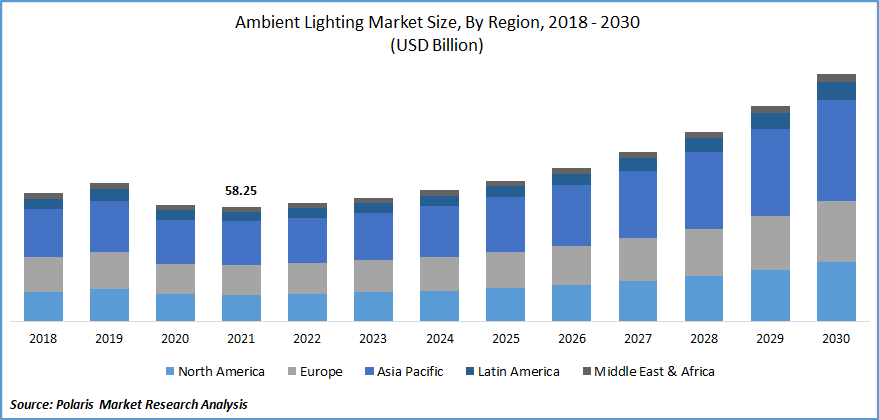
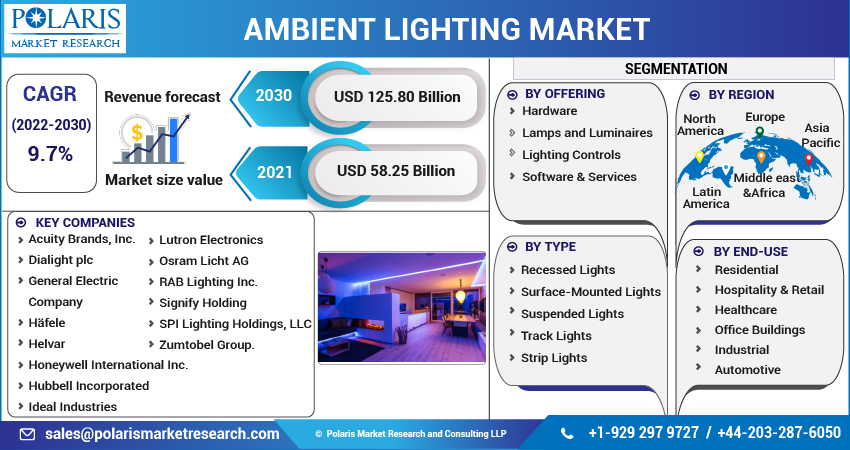
The global ambient lighting market is estimated at USD 91.60 billion in 2026 and is projected to reach USD 100.00 billion in 2027, expanding to USD 191.40 billion by 2034 at a CAGR of 9.7% during 2027–2034. Rapid adoption of LED-based smart lighting that can be dimmed, colour-tuned and controlled through apps and building-management systems is turning ambient lighting from a decorative feature into a core building function. Stricter energy-efficiency codes and falling LED and controller prices make retrofits financially attractive for offices, retail, hospitality and homes.
Market Statistics
Key Takeaways
• LED-based fixtures account for the largest product share, an estimated 64.3% of revenue in 2026, as LEDs replace fluorescent and halogen sources across homes and commercial buildings.
• Controls and connected systems (sensors, dimmers, app/IoT platforms) are the fastest-growing product layer, holding an estimated 29.5% share in 2026 as buyers move from fixtures to managed lighting.
• Commercial spaces (offices, retail, hospitality) lead end use with an estimated 45.6% share in 2026, while residential smart lighting is expanding quickly on the back of voice and app control.
• Automotive interior ambient lighting is emerging as a distinct premium niche, with multi-colour LED strips moving from luxury to mid-segment vehicles.
• Europe and North America together hold the bulk of demand, with North America at an estimated 41.4% in 2026, supported by building-energy codes and retrofit programmes.
• Asia Pacific is expected to be the fastest-growing region, currently at an estimated 12.3%% share, driven by new commercial construction and smart-city projects in China and India.
• The competitive field is led by diversified lighting majors, with 2026 activity centred on connected-lighting ecosystems and trade-fair launches rather than large acquisitions.
The growth of the ambient lighting market is driven by the factors such as rapid urbanization and digitization, demand for aesthetic look, more energy-efficient illuminating solutions, consumer focus on interior design and architecture, development of smart city projects, as well as government initiatives for energy savings.
Know more about this report: Download Sample Report
The term ambient light basically refers to a lighting system that may provide consistent illumination. This system could be natural, such as sunshine, or artificially created, such as room lights. The integration of the latest technologies in a lighting system is expected to accelerate the demand for the industry. Ambient light technology is blending the Red Green Blue (RGB) colors by altering the potential of digitally controlled LED lights. The several configurations are attained by controlling the LEDs using a microcomputer.
Additionally, a number of developed and emerging markets including the Asia Pacific followed by Europe and North America, are responsible for the rapid expansion of the ambient lighting industry as countries present across these regions have established a substantial domestic and global manufacturing base.
The COVID-19 pandemic has had a negative impact on the ambient lighting industry growth owing to the suspension of manufacturing activities in several industries. Since the emergence of COVID-19, several firms have suffered supply chain issues as Chinese countries, which are majorly responsible for supplying a large portion of the raw materials used in the manufacturing process, were under stringent rules and regulations and lockdown.
In addition, several private projects along with the government smart city projects were suspended or postponed after the outbreak of the Covid-19 pandemic as workers employed at production sites where LEDs and other light fixture components are manufactured were ordered to stay at home.
For Specific Research Requirements, Request Customization
Industry Dynamics
One of the primary factors driving the growth of the ambient lighting market is the growing preference for smart ambient light across the globe. Consumer demand for better interior design with energy-efficient light systems is expanding, complemented by the ongoing technological advancements such as smart light systems in commercial or residential buildings, which are propelling the ambient light industry.
Furthermore, the rising consumer awareness regarding the sustainable use of resources along with the increase in concerns for global climate change is projected to drive the growth of the industry over the forecast period. The government of several economies across the globe is coming up with various initiatives and policies for energy saving.
Economic and environmental concerns have led to a worldwide focus on reducing energy consumption. Lighting accounts for major energy consumption in households and commercial buildings, and therefore, reduction in consumption of energy by light has been a major focus. Therefore, the implementation of various rules and regulations pertaining to energy efficiency is likely to boost the industry growth.
Report Segmentation
The market is primarily segmented based on offering, type, end-use, and region.
| By Offering | By Type | By End-Use | By Region |
|
|
|
|
Source: Polaris Market Research Analysis
Know more about this report: Download Sample Report
Insight by Type
Recessed light is expected to account for the largest share in the global ambient light industry. The rising consumer preferences for aesthetic and modern interior design in the household are expected to drive the growth of the market. This type of light is widely used in households to create a wall washing effect to illuminate a wonderful brick texture, a colorful paint design, or display a huge bay window.
Furthermore, ambient track light is likely to witness growth over the forecast period. Since track lights are a great option for illuminating indoor and outdoor spaces perfectly, it is mostly used at the places where the position of the light is needed to be changed frequently and requires different angles. Track lights are available in different options including fixture types and lamp types such as halogen lamps, CFLs, MH lamps, and LEDs. As a result, the demand for the segment is anticipated to grow.
Insight by End-Use
The residential sector is projected to dominate the ambient lighting market over the forecast period. The ever-increasing expenditure of consumers on interior designing of their homes with illuminating light effects is anticipated to accelerate the growth of the market. Since ambient light is responsible for radiating the illumination effect for the interior of a home and creating a comfortable atmosphere, the demand for the market is likely to fuel.
Furthermore, the automotive sector is projected to account for a significant share. The rise in the production of vehicles across the globe is anticipated to drive the growth of the market. Ambient light is widely used in vehicles to enhance the design and provide a soothing experience to the passenger and the driver. They are used to illuminate the door, and dash trim, climate control vents, cupholders, and speaker surrounds.
Geographic Overview
Asia Pacific is likely to hold the largest share in the global ambient lighting market over the forecast period. The large market share is attributed to the increased demand for energy-efficient and innovative light solutions from emerging economies such as China and India. In addition, the increased presence of industry players that manufactures and sells a broad range of cost-efficient solutions for use in commercial, residential, industrial, healthcare, and other applications across the globe is contributing to the market growth.
List Of Major Key Players
- Acuity Brands, Inc.
- Dialight plc
- General Electric Company
- Häfele
- Helvar
- Honeywell International Inc.
- Hubbell Incorporated
- Ideal Industries
- Lutron Electronics
- Osram Licht AG
- RAB Lighting Inc.
- Signify Holding
- SPI Lighting Holdings, LLC
- Zumtobel Group
Recent Developments
- In March 2026, Signify used Light + Building 2026 in Frankfurt to showcase its connected-lighting ecosystem, spanning Interact IoT software, Dynalite controls and the Philips Hue and WiZ smart-home brands, with a clear focus on professional and OEM customers. The showcase reflects how the world's largest lighting company is positioning ambient lighting as a managed, software-led system rather than a stand-alone fixture purchase. For building owners, connected platforms make it easier to tune colour temperature and brightness to occupancy, time of day and energy targets, while OEM partners can embed controls into luminaires at the factory. For the ambient lighting market, this shift matters because value is moving from hardware toward controls, sensors and subscription-style software, which supports higher revenue per installation and stronger customer retention. It also signals that commercial retrofits, not just new construction, will be a key battleground through 2034.(Source: Signify)
- In May 2026, ams OSRAM announced its OSIRE E3731i intelligent RGB LED was integrated into NIO’s new ES9 flagship electric SUV, marking the first time the technology was used in NIO’s vehicle lineup. It enables the individualized and dynamic ambient lighting in the vehicle cabin with individually controllable RGB LEDs and ams OSRAM’s Open System Protocol. As automakers increasingly differentiate premium and electric vehicles through digitally controlled interiors, demand for addressable RGB LEDs, intelligent drivers and integrated lighting-control architectures is expected to rise. (Source: ams-OSRAM AG)
- In September 2026,FORVIA HELLA launches new adaptive RGB interior lighting technology for commercial vehicles at IAA Transportation. The answer was to integrate intelligent RGB LED arrays in the interior walls of the vehicle to offer personalized ambient lighting, dynamic light animations and visual communication features. The technology indicates the evolution of ambient lighting from a mostly decorative feature to an intelligent part of the vehicle's human-machine interface. (Source: HELLA GmbH & Co. KGaA)
Ambient Lighting Market Report Scope
| Report Attributes | Details |
| Market size value in 2027 | USD 100.00 Billion |
| Revenue forecast in 2034 | USD 191.4 Billion |
| CAGR | 9.7% from 2027 - 2034 |
| Base year | 2026 |
| Historical data | 2022-2025 |
| Forecast period | 2027 - 2034 |
| Quantitative units | Revenue in USD Million/Billion and CAGR from 2027 to 2034 |
| Segments covered | By Offering, By Type, By End-Use, By Region |
| Regional scope | North America, Europe, Asia Pacific, Latin America, Middle East & Africa |
| Key companies | Acuity Brands, Inc., Dialight plc, General Electric Company, Häfele, Helvar, Honeywell International Inc., Hubbell Incorporated, Ideal Industries, Lutron Electronics, Osram Licht AG, RAB Lighting Inc., Signify Holding, SPI Lighting Holdings, LLC, and Zumtobel Group. |
Source: Polaris Market Research Analysis
Ambient Lighting Market FAQ'S
The ambient lighting market is valued at USD 91.60 billion in 2026 and is expected to reach USD 100.00 billion in 2027 and USD 191.40 billion by 2034, according to Polaris Market Research.
The ambient lighting market is projected to grow at a CAGR of 9.7% from 2027 to 2034, adding roughly USD 91.40 billion in value over the forecast period.
Rapid adoption of LED-based smart lighting that can be dimmed, colour-tuned and controlled through apps and building-management systems is turning ambient lighting from a decorative feature into a core building function. Stricter energy-efficiency codes and falling LED and controller prices make retrofits financially attractive for offices, retail, hospitality and homes.
The main applications are residential, commercial offices, retail & hospitality, and automotive interiors. Connected, colour-tunable LED systems are shifting spend from fixtures to controls and software.

Download Sample Report of Ambient Lighting Market
Please fill out the form to request a customized copy of the research report.


