
Candle Market Size, Share Global Analysis Report, 2026-2034
REPORT DETAILS
Candle Market Summary
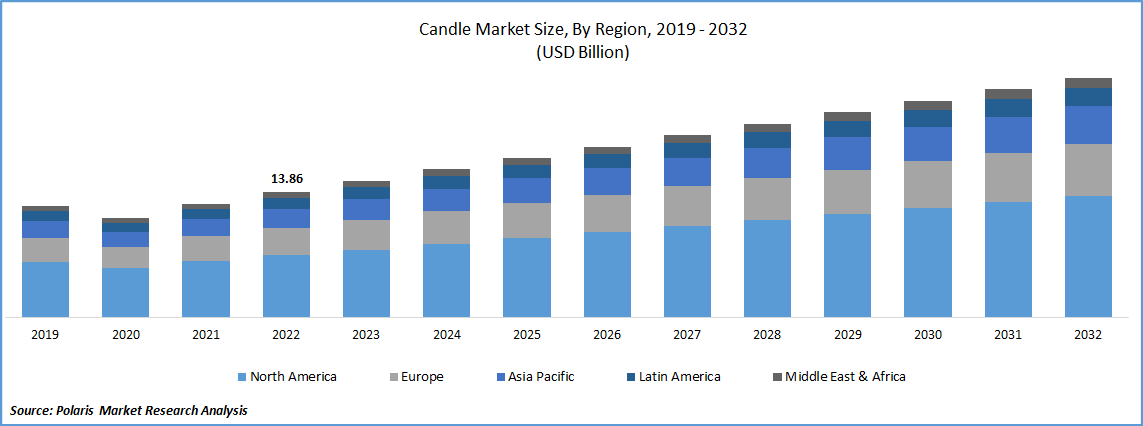
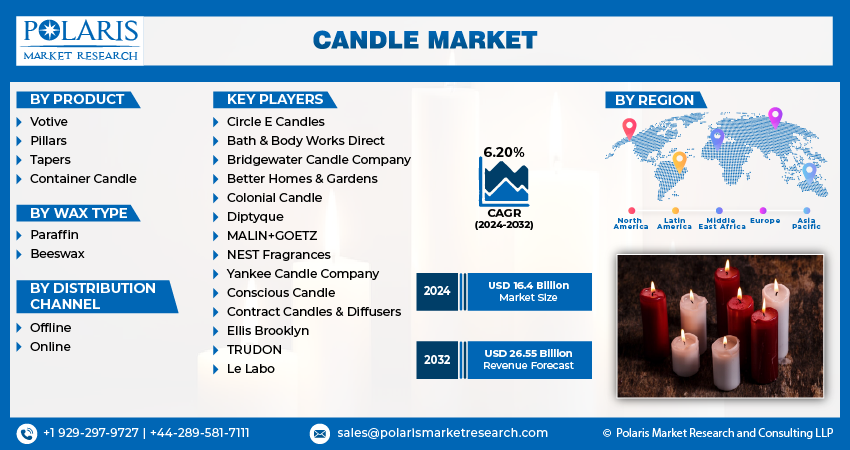
The global candle market is estimated around USD 17.40 Billion in 2025,?with consistent growth anticipated during 2026–2034. Growth is driven by rising demand for candles in home décor and rapid expansion of e-commerce platforms across global retail markets. The market is projected to grow at a CAGR of 6.18% during the forecast period.
Market Statistics
Key Takeaways
- North America accounted for the largest regional share of around 34.9% in 2025, supported by high home décor spending, strong preference for premium scented candles, and well-established retail infrastructure.
- By Product Type, Container Candles segment accounted for the largest share of approximately 38.6% in 2025, driven by enhanced safety, longer burn time, and strong decorative appeal supporting premium pricing.
- By Wax Type, Paraffin Wax segment accounted for the largest share of around 41.7% in 2025, supported by cost efficiency, stable supply chains, and compatibility with diverse fragrances and color variations.
- By Type, Scented Candles segment accounted for the largest share of nearly 62.4% in 2025, driven by aromatherapy trends, seasonal fragrance launches, and growing demand for enhanced home ambiance.
- By Application, Residential segment accounted for the largest share of around 68.3% in 2025, supported by rising home décor expenditure, lifestyle improvements, and increased focus on indoor aesthetics and relaxation.
- By Distribution Channel, Supermarkets segment is projected to grow at a CAGR of 5.7%, driven by strong offline presence, high shelf visibility, and increasing impulse buying behavior among consumers.
Note: Figures and projections outlined in this report are the result of Polaris Market Research’s proprietary analytical processes, grounded in the latest available datasets and market observations.
Industry Dynamics
- Rising demand for candles in home décor increases product adoption across residential and hospitality settings.
- Rapid expansion of e-commerce platforms improve brand visibility and supports direct-to-consumer sales growth.
- Environmental scrutiny on paraffin wax restricts adoption among sustainability-focused consumers.
- Expansion of eco-friendly candle lines creates long term opportunities across the global candle market.
What is included in the candle market?
The candle industry is the term used to describe the organized production and subsequent sale of wax-based lighting and fragrance products. The industry includes suppliers of wax materials, fragrance manufacturers, wick manufacturers, packaging companies, and distribution channels that transform raw materials into finished candles. The market serves residential, commercial, and institutional customers seeking lighting and scented products. Organized manufacturers improve the consistency of burning, fragrance emission, and safety standards for the retail and commercial markets.
The market comprises container candles, pillar candles, votive candles, taper candles, tea lights, and decorative candles. The products combine wax materials, fragrance oils, essential oils, dyes, and wick materials to ensure consistent burning and fragrance emission. The manufacturers offer private labeling, custom fragrance creation, and seasonal product offerings. The distribution channels include supermarkets, specialty retail stores, and e-commerce sites with organized supply chains and quality control processes.
Types of Candles
-
Scented candles: These candles are infused with fragrances. They are used for aromatherapy, ambiance enhancement, and home décor.
- Unscented candles: The candlers are designed without added fragrance. They are ideal for lighting, dining settings, and environments sensitive to scents.
- Taper candles: Long, slender candles typically used in holders. They are commonly seen in formal settings, religious ceremonies, and décor.
- Pillar candles: Thick, freestanding candles that burn for extended periods. The candles are widely used for decorative and ambient lighting.
- Votive candles: Small, short candles placed in holders. They are often used in religious rituals and for soft, decorative lighting.
- Tealight candles: Compact candles encased in metal or plastic cups. These are commonly used for accent lighting, warmers, and decorative arrangements.
Source: Polaris Market Research Analysis
To Understand More About this Research:Download Sample Report
The candle industry differs from room sprays, incense sticks, and electric diffusers in its primary function. Sprays provide instant fragrance dispersion. Incense products focus on traditional aromatic use. Electric diffusers depend on powered vapor systems. In contrast, candles combine illumination, fragrance release, and decorative value in one format. This positioning supports demand in lifestyle, gifting, and home décor segments rather than short term fragrance applications.
Candle Ingredients Breakdown with Safety Considerations
| Ingredient/Component | Description | Safety Considerations |
| Wax (Soy, Beeswax, Paraffin, Palm) | The primary fuel of the candle determines burn quality, scent throw, and sustainability | Prefer natural waxes (soy, beeswax) for low soot; paraffin may emit more pollutants if poorly refined |
| Wick (Cotton, Wood) | The core structure that draws melted wax to sustain the flame | Use lead-free, zinc-free cotton or wood wicks to avoid toxic emissions |
| Fragrance Oils | Synthetic or natural oils that are added to provide scent | Ensure compliance with IFRA standards; low-quality oils may release harmful VOCs when burned |
| Essential Oils | Plant-derived extracts used in aromatherapy candles | Safer alternative but may still cause sensitivities or allergies in enclosed spaces |
| Dyes/Colorants | Added to enhance visual appeal and match décor trends | Use non-toxic, candle-safe dyes to prevent the release of harmful chemicals |
| Additives (UV inhibitors, stabilizers) | Used to improve shelf life, color retention, and burn performance | Should meet regulatory safety standards to avoid toxic byproducts |
| Containers (Glass, Metal, Ceramic) | Housing for candles, especially votive and container types | Must be heat-resistant to prevent cracking, overheating, or fire hazards |
Source: Polaris Market Research Analysis
Drivers & Opportunities
Rising demand for candles in home décor: Growing interest in home decoration is increasing demand for decorative and scented candles. Urban consumers are spending more on products that improve living spaces and create a pleasant atmosphere. Hotels, restaurants, and event organizers are using candles to enhance ambience and customer experience. Seasonal festivals and gifting trends are supporting steady repeat purchases across retail stores.
Rapid expansion of e-commerce platforms: Expansion of online retail platforms is improving product reach for candle brands. Forrester predicts global retail e-commerce sales will reach $6.8 trillion by 2028, accounting for 24% of total retail sales. Digital marketplaces allow manufacturers to showcase wider collections and reach customers beyond physical store locations. Social media marketing and direct consumer websites are also increasing brand visibility. The rise in digital payments and smartphone usage is also fueling increased online sales in the candle market.
Restraints & Challenges
Environmental issues related to paraffin wax: Paraffin wax is petroleum-based and is also experiencing an increase in environmental issues. Consumers are becoming more educated about product ingredients and indoor air quality. Emissions and sustainability are also gaining attention from the regulatory environment. These concerns are also creating pressure on the manufacturers who are using paraffin wax on a large scale.
Opportunity
Increasing adoption of eco-friendly candles: The increasing use of sustainable products is also offering development opportunities for eco-friendly candles. Soy wax, beeswax, and other plant-based waxes are also gaining popularity among consumers. For example, in October 2025, Maddox Candles launched a new collection of handmade soy wax candles with high-quality and eco-friendly candles for contemporary homes. Consumers are also ready to pay higher prices for eco-friendly candles.
Source: Polaris Market Research Analysis
Segmental Insights
This report offers detailed coverage of the candle market by product type, wax type, scent type, application, and distribution channel to help readers identify the fastest expanding and most attractive demand segments.
By Product Type
-
Container candles
Container candles accounted for the highest market share in 2025, owing to the increasing demand for decorative and fragrant candles in residential applications. Enclosed jars enhance safety and burning time, which is a major factor for consumers to opt for them. Higher prices and revenue generation were possible due to premium packaging and a variety of fragrances.
-
Tea light
Tea light candles segment is projected to grow at the fastest CAGR during the forecast period, due to rising demand from hospitality, events, and religious applications. Low unit price and bulk purchase trends are contributing to high volume sales. Growing demand in decorative and commercial areas is fueling the expansion of the segment.
By Wax Type
-
Paraffin wax
Paraffin wax held the largest market share in 2025, due to its cost-effectiveness and widespread availability. Paraffin wax is preferred by manufacturers due to its stable supply chain and burning characteristics. Paraffin wax is compatible with various fragrances and colors, which enabled mass production of candles under various brands.
-
Soy wax
Soy wax segment is projected to grow at the fastest CAGR during the forecast period, due to rising consumer awareness regarding sustainable and clean-burning materials. Plant-based composition improves brand positioning in premium categories. Growing preference for eco-friendly home products is supporting long-term segment growth.
By Scent Type
-
Scented
Scented candles segment led the market in 2025, driven by the growing interest of consumers in home ambiance and aromatherapy products. Fragrance development and seasonal offerings helped in frequent purchases. High-end fragrance combinations enhanced product differentiation and the revenue share.
-
Unscented
Unscented candles segment is expected to register the highest CAGR during the forecast period, driven by the continuous demand from religious and formal sectors. These products cater to the demand where unscented usage is required. Continuous demand from ceremonial and usage applications helps in maintaining stability in the segment.
By Application
-
Residential
Residential segment led the market in 2025, influenced by increasing home decor expenditure and lifestyle improvements in urban settings. People consume candles for relaxation, decoration, and home improvement purposes. Increased time spent at home supported consistent consumption patterns.
-
Gifting
Gifting segment is projected to grow at the fastest CAGR during the forecast period, due to expanding festive and seasonal gifting trends. Attractive packaging and personalization options make the product more desirable. Corporate gifting and luxury gift sets are additional factors that are contributing to the growth of segment expansion.
Use Case & Occasion-Based Analysis of Candle Market Applications
| Use Case/Occasion | Description | Key Candle Types | End-User Benefits |
| Home Décor | Enhances interior aesthetics and ambiance across living spaces, events, and seasonal styling | Pillar, Tealight, Scented | Creates a warm atmosphere, improves visual appeal, and supports mood setting |
| Gifting | Popular as personal and corporate gifts for celebrations and special occasions | Scented, Votive, Decorative Pillar | Offers personalization, premium appeal, and emotional value |
| Aromatherapy | Used for relaxation, stress relief, and wellness through fragrance diffusion | Scented (essential oil-based), Tealight | Promotes mental well-being, enhances relaxation, supports spa-like environments |
| Rituals & Ceremonies | Widely used in religious, spiritual, and cultural practices | Taper, Votive, Unscented | Symbolizes purity and devotion, ensures consistent flame, suitable for traditional use |
Source: Polaris Market Research Analysis
By Distribution Channel
-
Supermarkets
Supermarkets segment led the market in 2025, owing to robust offline retail infrastructure and high foot traffic. Overall shelf space and pricing strategies are other reasons that are fueling impulse purchases.
-
Online
The online retail segment is expected to record the highest CAGR during the forecast period, due to the growing popularity of e-commerce sites and online marketing campaigns. Direct sales to consumers boost brand margins and engagement. Increasing smartphone penetration and digital payment systems are additional factors that are contributing to sustained online growth.
Source: Polaris Market Research Analysis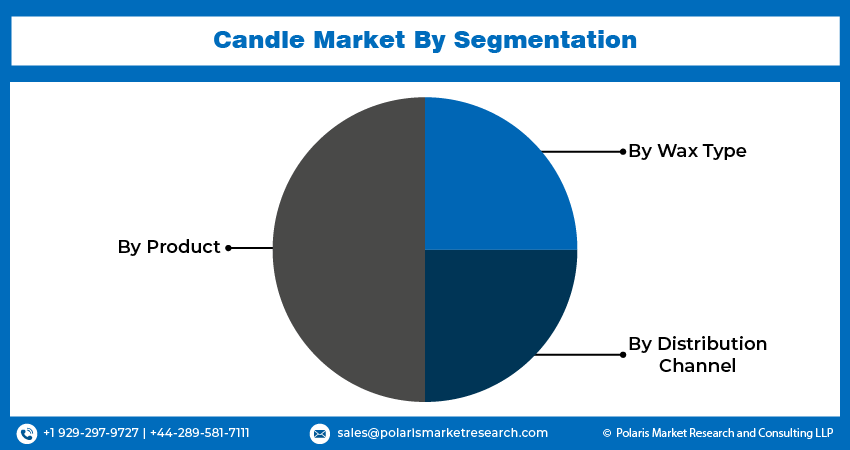
Regional Analysis
North America Market Assessment
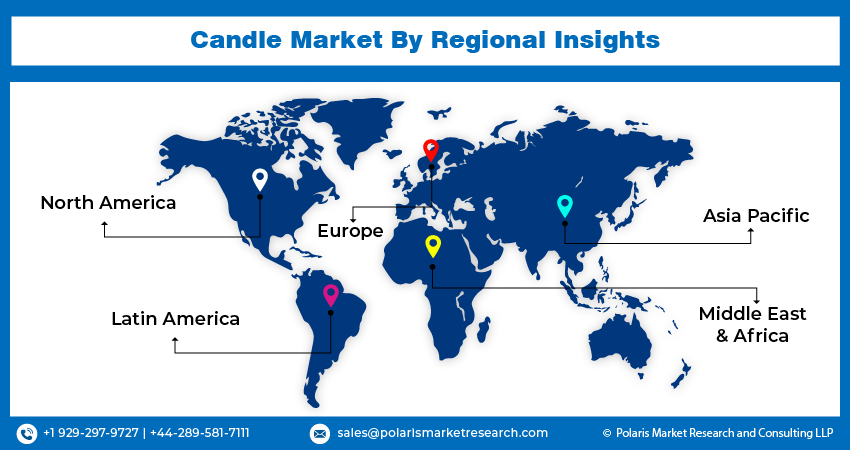
North America candle market dominated in 2025, driven by strong home décor spending across the US and Canada. U.S. Bureau of Labor Statistics’ Consumer Expenditure Surveys report shows that US households spend an average of USD 2,752 yearly on home decor, with Seattle leading regions at USD 3,493 per household, 27% above the national average. In addition, the fact that consumers show a strong preference for scented and container candles with high-quality scents and packaging helps to ensure higher average selling prices. Furthermore, the presence of well-established supermarket chains and retail networks ensures that products are widely available.
Asia Pacific Candle Market Insights
Asia Pacific candle market is projected to grow at the fastest CAGR during the forecast period, driven by rising urbanization and increasing disposable income across China and India. According to the Energy Information Administration (EIA), Asia Pacific disposable income per capita is expected to increase from USD 9,145 in 2025 to USD 11,152 in 2030, registering a growth rate of 21.9% over the five-year period. In addition, the development of e-commerce platforms improves the availability of local and foreign brands of candles.
Europe Candle Market Overview
Europe was the second-largest market for candles, and there was strong demand for decorative and eco-friendly candles in Germany, France, and the UK. In addition, the rising preference for plant-based wax like soy wax and beeswax fuels the growth of premium candles. In January 2026, Lumond introduced Blooming Candles, luxury scents carefully crafted by hand that can be converted into sustainable plant pots after use. This unique product offering caters to the needs of conscious consumers. In addition, the fact that there are well-established specialty stores and home decor retailers helps to improve offline distribution channels.
Source: Polaris Market Research Analysis
Key Players & Competitive Analysis Report
The competitive environment is influenced by product diversification, fragrance creation, and eco-friendly wax materials. Companies focus on high-quality packaging and limited-edition products to create brand recognition. Partnerships with retailers and online shopping platforms contribute to the growth of the candle market worldwide.
Leading companies in the candle market are Yankee Candle Company, Bath & Body Works, Village Candle, Colonial Candle, Bolsius International BV, Candle Bliss, Delsbo Candle AB, Lalique, Diptyque Paris, Jo Malone London, NEST New York, Malin + Goetz, and many more.
Regulatory & Safety Landscape
| Regulatory Area | Key Standards | Impact on Cost | Impact on Packaging | Impact on Fragrance Formulation | Reimbursement Landscape | Impact on International Trade |
| US Safety Standards | ASTM candle safety standards | Testing and certification increase compliance cost. | Fire warnings and burn instructions are mandatory. | Additive limits require quality validation. | Standard compliance improves access to US retail markets. | US Safety Standards |
| EU and UK Labeling | Candle labeling regulations | Documentation and conformity checks increase admin cost. | Ingredient disclosure and hazard symbols are required. | Ingredient transparency affects sourcing decisions. | Compliance supports smoother EU and UK exports. | EU and UK Labeling |
| Fragrance Compliance | IFRA standards, REACH compliance candles | Reformulation and safety checks increase R&D cost. | Allergen labeling updates packaging content. | Restricted compounds require approved substitutes. | Alignment improves entry into regulated European markets. | Fragrance Compliance |
Source: Polaris Market Research Analysis
Key Players
- Bath & Body Works
- Bolsius International BV
- Candle Bliss
- Colonial Candle
- Delsbo Candle AB
- Diptyque Paris
- Jo Malone London
- Lalique
- Malin + Goetz
- NEST New York
- Village Candle
- Yankee Candle Company
Industry Developments
- February 2026: Bath & Body Works introduced its successful 3-wick candles and fragrances on Amazon U.S., making the candle industry more accessible with Prime fast shipping and popular items such as Pistachio Milk & Honey. (Source: bbwinc.com)
- October 2025: Yankee Candle introduced its high-end YC Collection with seven complex fragrances in beautiful containers ranging from USD 32-45, setting a new level of luxury in the candle industry with modern perfumer-created fragrances. (Source: newellbrands.com)
Candle Market Segmentation
By Product Type Outlook (Revenue, USD Billion, 2021-2034)
- Container candles
- Pillar candles
- Taper candles
- Votive candles
- Tea light candles
By Wax Type Outlook (Revenue, USD Billion, 2021-2034)
- Paraffin wax
- Soy wax
- Beeswax
- Palm wax
- Coconut wax
By Scent Type Outlook (Revenue, USD Billion, 2021-2034)
- Scented
- Unscented
By Application Outlook (Revenue, USD Billion, 2021-2034)
- Residential
- Commercial
- Religious
- Gifting
By Distribution Channel Outlook (Revenue, USD Billion, 2021-2034)
- Supermarkets
- Specialty stores
- Online retail
- Direct-to-consumer
By Regional Outlook (Revenue, USD Billion, 2021-2034)
- North America
- US
- Canada
- Europe
- Germany
- France
- UK
- Italy
- Spain
- Netherlands
- Russia
- Rest of Europe
- Asia Pacific
- China
- Japan
- India
- Malaysia
- South Korea
- Indonesia
- Australia
- Vietnam
- Rest of Asia Pacific
- Middle East & Africa
- Saudi Arabia
- UAE
- Israel
- South Africa
- Rest of Middle East & Africa
- Latin America
- Mexico
- Brazil
- Argentina
- Rest of Latin America
Candle Market Report Scope
| Report Attributes | Details |
| Market Size in 2025 | USD 17.40 Billion |
| Market Size in 2026 | USD 18.46 Billion |
| Revenue Forecast by 2034 | USD 29.86 Billion |
| CAGR | 6.18% from 2026 to 2034 |
| Base Year | 2025 |
| Historical Data | 2022–2024 |
| Forecast Period | 2026–2034 |
| Quantitative Units | Revenue in USD Billion and CAGR from 2026 to 2034 |
| Report Coverage | Revenue Forecast, Competitive Landscape, Growth Factors, and Industry Trends |
| Segments Covered |
|
| Regional Scope |
|
| Competitive Landscape |
|
| Report Format |
|
| Customization | Report customization as per your requirements with respect to countries, regions, and segmentation. |
Source: Polaris Market Research Analysis
Candle Market FAQ's
• The global market size was valued at USD 17.40 Billion in 2025 and is projected to grow to USD 29.86 Billion by 2034.
• North America dominates due to high home décor spending and strong presence of organized retail chains.
• Major applications include residential décor, commercial ambience enhancement, religious use, and gifting purposes.
• A few of the key players in the market are Yankee Candle Company, Bath & Body Works, Village Candle, Colonial Candle, Bolsius International BV, Candle Bliss, Delsbo Candle AB, Lalique, Diptyque Paris, Jo Malone London, NEST New York, Malin + Goetz, and others.
• The factors propelling growth are the increasing trends of home decoration and development of e-commerce platforms.
Download Sample Report of Candle Market
Please fill out the form to request a customized copy of the research report.


