
Global Data Collection and Labeling Market Size, Share Analysis Report, 2026-2034
REPORT DETAILS
Data Collection and Labeling Market Summary
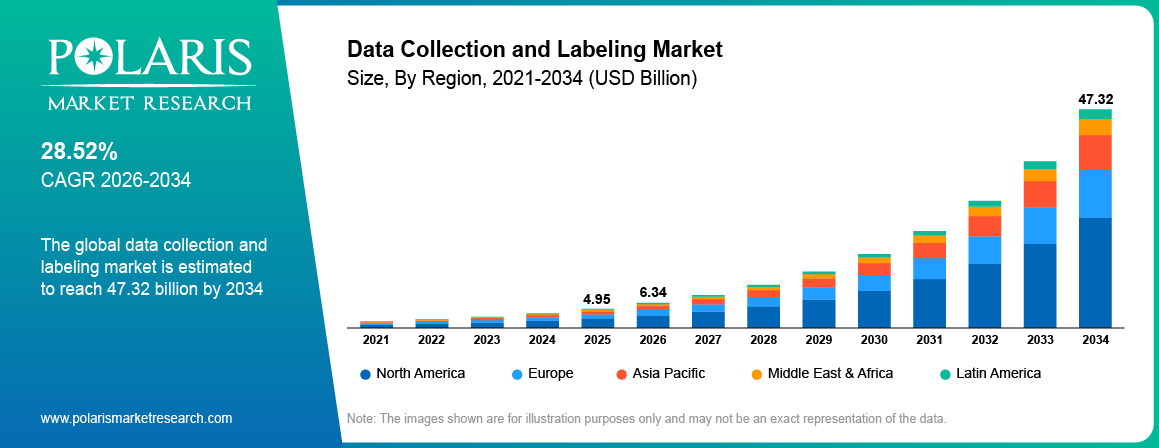
The global data collection and labeling market size was valued at USD 4.95 billion in 2025. The market is projected to grow at a CAGR of 28.52% from 2026 to 2034. The increasing adoption of machine learning across industries along with the rising demand for high-quality labeled data to improve AI and machine learning models is driving the market growth.
Market Statistics
Key Takeaways
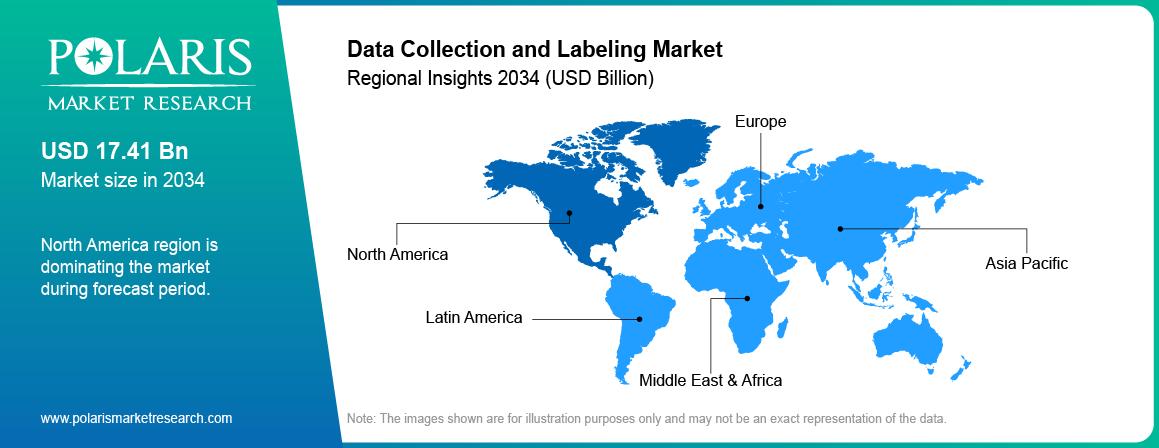
- North America accounted for 36.8% of the global market revenue in 2025. High adoption of AI and machine learning in healthcare, automotive, and e-commerce continues to drive regional demand.
- Asia Pacific is expected to grow at a CAGR of 31.4% during 2026–2034. Expanding e-commerce activities and increasing use of AI-based data annotation services support market growth.
- Europe contributed 27.6% share in the global market revenue in 2025. Increasing demand for data labeling services for autonomous vehicle development is driving regional growth.
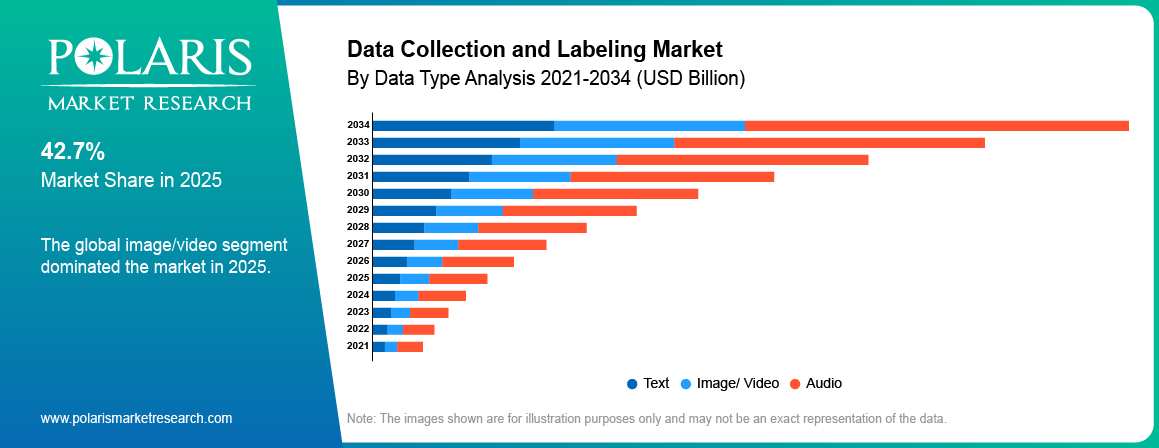
- Image/Video segment accounted for 42.7% of the market revenue share in 2025. The growth of the segment is driven by increasing adoption of computer vision technologies in healthcare, automotive and media industries.
- Text segment is projected to grow at a CAGR of 30.6% during 2026–2034. The demand is driven by rising adoption of natural language processing and AI-based applications in healthcare and e-commerce.
- IT segment accounted for 34.9% of the total market revenue share in 2025. The growth of the segment is driven by increasing adoption of AI applications and need for precisely labeled datasets.
Note: Figures and projections outlined in this report are the result of Polaris Market Research’s proprietary analytical processes, grounded in the latest available datasets and market observations.
Industry Dynamics
- Increasing adoption of artificial intelligence and machine learning in industries is driving the demand for high-quality data collection and labeling services.
- Rising use of data-driven decision-making is increasing the need for accurate and continuous data collection across organizations.
- Rising adoption of social media monitoring, visual analytics, and surveillance technologies is supporting market growth.
- Increasing outsourcing of data collection and labeling services to build and improve AI models is further boosting market demand.
- Data privacy, security and regulatory compliance related issues are acting as a key market restraint.
AI Impact on Data Collection and Labeling Market
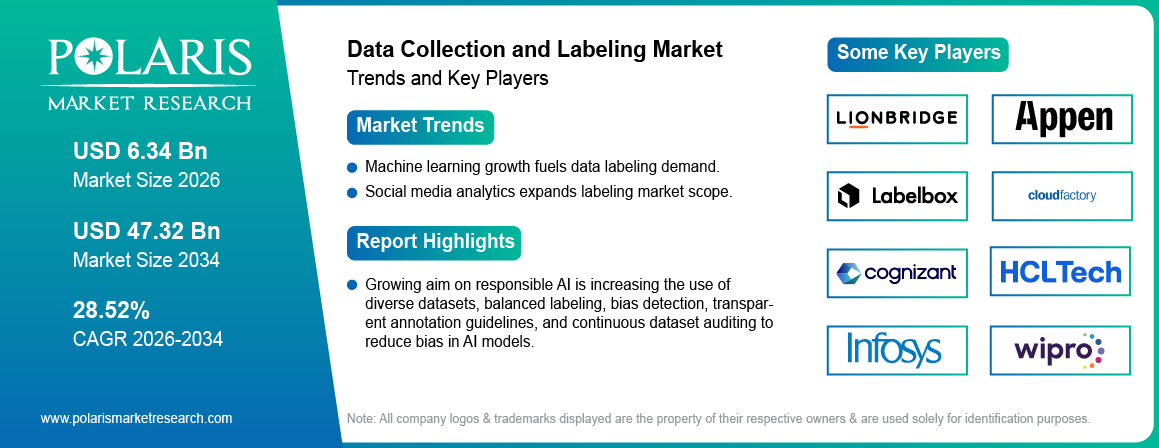
Growing aim on responsible AI is increasing the use of diverse datasets, balanced labeling, bias detection, transparent annotation guidelines, and continuous dataset auditing to reduce bias in AI models.
Rising adoption of AI-assisted data labeling is accelerating the use of auto-labeling, active learning, pre-annotation, model-assisted annotation, and automated quality checks to improve efficiency and accuracy.
Expanding development of generative AI models is driving demand for supervised fine-tuning, preference data, human feedback, prompt-response datasets, safety labeling, and evaluation datasets.
Increasing adoption of speech and voice AI applications is creating demand for speech transcription, speaker identification, emotion tagging, intent detection, language identification and voice command annotation.
The market is expected to grow significantly in the coming years due to several growth drivers such as the increasing adoption of machine learning in various industries such as healthcare, e-commerce, and automotive. One important growth driver is the increasing demand for high-quality labeled data to improve machine learning models. With the rise of artificial intelligence and machine learning, the need for accurate and diverse labeled data has become paramount for businesses to create effective AI applications.
Source: Polaris Market Research Analysis
To Understand More About this Research: Download Sample Report
Data Collection and Labeling Market Definition
Data collection and labeling is the process of gathering raw data and assigning labels, tags, or annotations to make it suitable for training artificial intelligence and machine learning models. It includes image, text, audio, video, and sensor data, supporting applications such as computer vision, natural language processing, speech recognition, and other AI systems.
The Process of Data Collection & Labeling
The process of data collection and labeling starts with determining the data requirements for the particular AI or machine learning application. The data collection process involves obtaining raw data from the source which might be images, videos, text, audio or sensors. The raw data is then cleaned, structured and prepared for annotation. Clear annotation guidelines are established to guide the labeling process to maintain consistency. The data can be labeled manually, automatically or with the help of AI tools. After the data is labeled, it is checked for quality and before it is used to train, test and improve the performance of the model the data is validated.
For example, companies like Scale AI and Appen have capitalized on this demand by providing high-quality data labeling services to businesses across various industries. Scale AI has worked with companies like Lyft, Airbnb, and Toyota to develop their machine learning models, while Appen has partnered with companies like Microsoft, Google, and Facebook to improve their natural language processing algorithms.
Data collection & labeling involve the process of collecting data-sets from the various sources, such as online sources, & labeling them based on their nature, data type, & associated feature. The combination of data gathering and its annotation, along with AI technology, has created several growth opportunities in different verticals, including gaming, social networking, and e-commerce.
At the same time, the accelerated adoption of remote work and cloud-based technologies has fueled the need for remote data collection and labeling services. However, the economic downturn caused by the pandemic has led to budget cuts in various industries, resulting in reduced demand for data labeling services. Retailers, for example, have faced financial challenges and prioritized cost-cutting measures, affecting companies like Appen that primarily serve this sector.
Source: Polaris Market Research Analysis
Key Market Drivers & Restraints
Growth Drivers
The growth of the data collection and labeling market is driven by the increasing adoption of machine learning in various industries such as healthcare, e-commerce, and automotive, as well as the need for a constant flow of data for data-backed decision-making. The market is also propelled by the rise of social media monitoring, visual analytics, and surveillance technology, as well as the development of automatic data processing technologies. Companies are taking strategic initiatives to build solid machine-learning models by outsourcing data collection and labeling services. Additionally, primary data collection methods and data mining solutions are driving market expansion.
Report Segmentation
The market is primarily segmented based on data type, vertical, and region.
| By Data Type | By Vertical | By Region |
|
|
|
Source: Polaris Market Research Analysis
Data Collection and Labeling Market Segment Analysis
Market by Data Type: Text, Image/Video and Audio
The image/video segment is anticipated to hold largest growth in the market throughout the forecast period. This can be attributed to the increasing use of computer vision in various industries, such as healthcare, automotive, media, and entertainment. For example, the healthcare industry relies heavily on image data such as X-rays, MRI scans, and CT scans are being used to develop and train machine-learning models for diagnostic automation, gene sequencing, and treatment prediction.
Another important data type is text, which accounted for a significant share of the market in 2025. The rising demand for AI in e-commerce has led to the development of centralized procurement of labeled data to create better and faster AI retail. For instance, Taskmonk Technology provides an e-commerce data labeling platform that helps enterprises maximize their labeling budget, boost data accuracy, orchestrate labeling projects for any data type, and speed up data labeling.
Moreover, the healthcare industry relies on text data, such as EHRs, to accumulate clinical data sets, including unstructured text documents, for clinical research. To unlock information present in the clinical text, statistical NLP (natural language processing) models have been created. One such example is Centaur Labs, which recently received USD 15 million series A funding to continue labeling the world's clinical data. Centaur Labs' focus on ensuring quality healthcare data is consistent with AI innovator Andrew Ng's push to shift AI development from model-centric to data-centric.
Market by Annotation Task: Classification, Object Detection, Segmentation and NER
Classification, object detection, segmentation, and named entity recognition (NER) are largely used annotation tasks for different types of data. These techniques prepare text, images, videos and audio to be used in machine learning applications. They enable use cases such as object recognition, document analysis, language processing, medical imaging and speech recognition across different industries.
Market by Service Model: Managed Services, Platforms and Crowdsourcing
Businesses leverage different service models depending on the project complexity, data volume and budget. Managed services offer end-to-end support for data collection and annotation, while annotation platforms offer tools for workflow management and quality control. Crowdsourcing allows organizations to label large datasets quickly with a distributed workforce, making it suitable for high-volume projects.
Market by Vertical: IT, Automotive, Healthcare, BFSI, Government and Retail
IT segment holds the largest market share due to increasing adoption of machine learning, computer vision, and speech recognition applications. Healthcare is witnessing robust growth with the increasing demand for medical image and clinical data annotation. Automotive, BFSI, government and retail are also growing the adoption of labeled data to enhance digital services and business operations.
Real-World Applications of Data Collection and Labeling
| Industry/Application | Example of Data Labeling |
| Autonomous Driving | Labeling vehicles, pedestrians, traffic signs, and road lanes for self-driving systems. |
| Healthcare | Annotating X-rays, MRI scans, and CT scans to support disease diagnosis. |
| E-commerce | Tagging product images and descriptions to improve search and product recommendations. |
| Customer Support | Annotating text data to improve chatbots and language processing systems. |
| Voice Technology | Transcribing speech and labeling voice commands for voice-enabled applications. |
| Security & Surveillance | Annotating video footage to identify people, vehicles, and activities. |
| Customer Experience | Labeling customer reviews and feedback to understand customer sentiment. |
| Financial Services | Annotating documents such as invoices, forms, and contracts for faster processing. |
Source: Polaris Market Research Analysis
Source: Polaris Market Research Analysis
Data Collection and Labeling Market Regional Analysis
North America Data Collection and Labeling Market
North America holds a significant share of the data collection and labeling market owing to the massive adoption of AI and ML in healthcare, e-commerce, and automotive industries. The region is experiencing a rise in demand for data annotation as companies are increasing their digital services and automation. Market growth is driven by increasing investments in cloud platforms and advanced data processing technologies.
Europe Data Collection and Labeling Market
The Europe market is growing at a steady pace driven by the increasing demand for data annotation from the automotive industry. The growth of autonomous vehicles has boosted the need for precisely annotated image, video, and sensor data. Growing investments in smart mobility, digital technologies, and industrial automation are further supporting the adoption of data collection and labeling services across the region.
Asia Pacific Data Collection and Labeling Market
Asia Pacific is expected to witness the fastest market growth during the forecast period. Rapid expansion of e-commerce in China, India, and other developing economies is increasing demand for product categorization, image labeling, and text annotation. The growing adoption of digital healthcare, retail technologies, and artificial intelligence solutions is further driving the need for high-quality labeled datasets across the region.
Latin America Data Collection and Labeling Market
Latin America is expected to grow steadily owing to increasing digital transformation in healthcare, retail and financial services. Increasing adoption of cloud technologies and data-driven business operations is creating demand for data collection and labeling services.
Middle East and Africa Data Collection and Labeling Market
The Middle East and Africa market is growing with increasing investments in digital infrastructure, smart city projects, and healthcare technologies. Rising adoption of cloud services and automation is supporting demand for accurate data collection and labeling solutions.
Source: Polaris Market Research Analysis
Competitive Insight
Some of the major players operating in the global market include Lionbridge, Appen, Amazon Mechanical Turk, Labelbox, Scale AI, CloudFactory, Cognizant, HCL Technologies, Infosys, Tech Mahindra, Wipro, iMerit, Playment, SuperAnnotate, and Samasource.
List Of Key Companies:
- Lionbridge
- Appen
- Amazon Mechanical Turk
- Labelbox
- Scale AI
- CloudFactory
- Cognizant
- HCL Technologies
- Infosys
- Tech Mahindra
- Wipro
- iMerit
- Playment
- SuperAnnotate
- Samasource
Manual vs Automated vs AI-Assisted Data Labeling
| Factor | Manual Data Labeling | Automated Data Labeling | AI-Assisted Data Labeling |
| Accuracy | High for complex tasks but depends on human expertise | Moderate and rule-based | High with human review and AI support |
| Scalability | Limited for large datasets | High for large volumes | High and suitable for expanding datasets |
| Annotation Speed | Slow | Very fast | Fast with improved consistency |
| Labor Requirement | High human effort | Low human involvement | Moderate human supervision |
| Cost | High for large projects | Lower after implementation | Balanced cost with better efficiency |
| Quality Control | Manual review required | May require additional validation | AI checks combined with human verification |
| Best Suited For | Complex, sensitive, and specialized datasets | Repetitive and structured datasets | Large, diverse, and continuously updated AI datasets |
Challenges in Data Collection & Labeling
The data collection and labeling industry is faced with a number of operational challenges. Due to high labeling costs and data privacy issues projects are difficult to implement. Maintaining consistent labeling quality is challenging when dealing with large datasets. Companies also face challenges such as bias in datasets, a shortage of skilled annotators, and complex labeling requirements. These challenges can be seen especially in industries like healthcare and automotive. The high accuracy with large datasets is a constant challenge.
Future Outlook
As more organizations adopt generative AI, computer vision, natural language processing, robotics, and autonomous systems the data collection and labeling market is expected to grow steadily. AI-assisted annotation, synthetic data, active learning, and human-in-the-loop workflows will improve labeling speed and efficiency. At the same time, stronger focus on data privacy, quality, and responsible AI practices will increase the demand for accurate, secure, and high-quality training datasets across industries.
Recent Developments
- In January 2026: Encord released new updates to its data annotation platform, offering improved audio annotation, HTML annotation, and faster image and video labeling. These enhancements enable users to label different data types with greater speed and efficiency. Source: (https://encord.com)
- In June 2025, TELUS Digital launched expert-curated, off-the-shelf datasets designed to support the training, evaluation, and fine-tuning of generative AI models. (Source: telusdigital.com)
- In April 2025, Labelbox introduced an interactive Workflow editor that enables users to configure multi-step annotation reviews, routing logic, consensus-based checks, and reusable quality-control processes. (Source: labelbox.com)
- In September 2025, SuperAnnotate launched Agent Hub, which integrates AI agents into data curation, pre-labeling, annotation, quality assurance, and model-evaluation workflows. (source:www.superannotate.com)
Data Collection and Labeling Market Report Scope
| Report Attributes | Details |
| Market size value in 2026 | USD 6.34 billion |
| Revenue forecast in 2034 | USD 47.32 billion |
| CAGR | 28.52% from 2026- 2034 |
| Base year | 2025 |
| Historical data | 2021 - 2024 |
| Forecast period | 2026- 2034 |
| Quantitative units | Revenue in USD billion and CAGR from 2026 to 2034 |
| Segments covered | By Data Type, By Vertical, By Region |
| Regional scope | North America, Europe, Asia Pacific, Latin America; Middle East & Africa |
| Key companies | Lionbridge, Appen, Amazon Mechanical Turk, Labelbox, Scale AI, CloudFactory, Cognizant, HCL Technologies, Infosys, Tech Mahindra, Wipro, iMerit, Playment, SuperAnnotate, Samasource. |
Source: Polaris Market Research Analysis
Data Collection and Labeling Market Frequently Asked Questions
Data collection and labeling is the process of collecting data and adding labels or tags. It prepares data for AI and machine learning applications.
Data Collection and Labeling market Size Worth $47.32 Billion By 2034.
The data collection and labeling market is expected to grow at a CAGR of 28.52% during the forecast period.
North America is leading the global market.
key driving factors in data collection and labeling market are growing need to make text/ image more interactive and engaging.
The Image/Video segment is anticipated to hold the largest growth, driven by increasing use of computer vision in healthcare, automotive, media, and entertainment industries.
The IT segment held the largest market share in 2025, fueled by widespread AI adoption requiring highly accurate labeled datasets for NLP, computer vision, and speech recognition.
Data annotation means adding labels or tags to text, images, audio, or videos. It helps AI systems understand and use the data correctly.
Labeled data helps AI learn from examples and identify patterns. Good-quality labeled data improves accuracy and reduces errors.
Download Sample Report of Data Collection and Labeling Market
Please fill out the form to request a customized copy of the research report.


