
Drug Coated Ballon Catheter Market Insights, Size, Share & Industry Report – 2034
REPORT DETAILS
Drug-Coated Balloon Catheter Market Summary
The global drug-coated balloon catheter market is estimated around USD 1.18 Billion in 2025,with consistent growth anticipated during 2026–2034. Growth is driven by rising cardiovascular disease and growing adoption of minimally invasive procedure. The market is projected to grow at a CAGR of 8.28% during the forecast period.
Market Statistics
Key Takeaways
- Coronary DCB dominated the market in 20205, due to the increasing prevalence of coronary artery disease and rising adoption of minimally invasive cardiac procedures.
- Coronary artery disease was dominant in 2025, due to the increasing burden of cardiovascular diseases and growing number of angioplasty procedures worldwide.
- Specialty cardiac centers is projected to show rapid growth, due to the increasing preference for specialized cardiovascular treatment facilities.
- North America dominated the market driven by the high prevalence of cardiovascular diseases and strong adoption of minimally invasive vascular procedures.
- Major companies operating in the market include Boston Scientific Corporation, Medtronic plc, B. Braun SE, Concept Medical Inc., Abbott, Koninklijke Philips N.V., Teleflex Incorporated, MicroPort Scientific Corporation, and others.
Industry Dynamics
- Rising cardiovascular disease is driving the market growth.
- Growing adoption of minimally invasive procedure is driving DCB catheter demand.
- High device cost is restraining the market growth.
- Expansion in emerging markets to open opportunities for drug-coated balloon catheter market.
What is the Drug-Coated Balloon Catheter Market?
Drug-coated balloon catheters are medical devices used to treat blocked and narrowed blood vessels through minimally invasive surgeries. They combine balloon angioplasty with localized drug delivery to reduce restenosis and improve blood flow. These catheters are widely used in hospitals and cardiac care centers for coronary and peripheral artery disease treatments.
The drug-coated balloon catheter industry operates under changing healthcare environment that focus on treatment efficiency, patient safety, and clinical results. The demand for such medical technology is growing due to rising focus on minimizing repeat procedures and achieving higher success rates with vascular treatments. Cost-effectiveness, and innovation of medical technology are driving the growth of DCB catheter market.
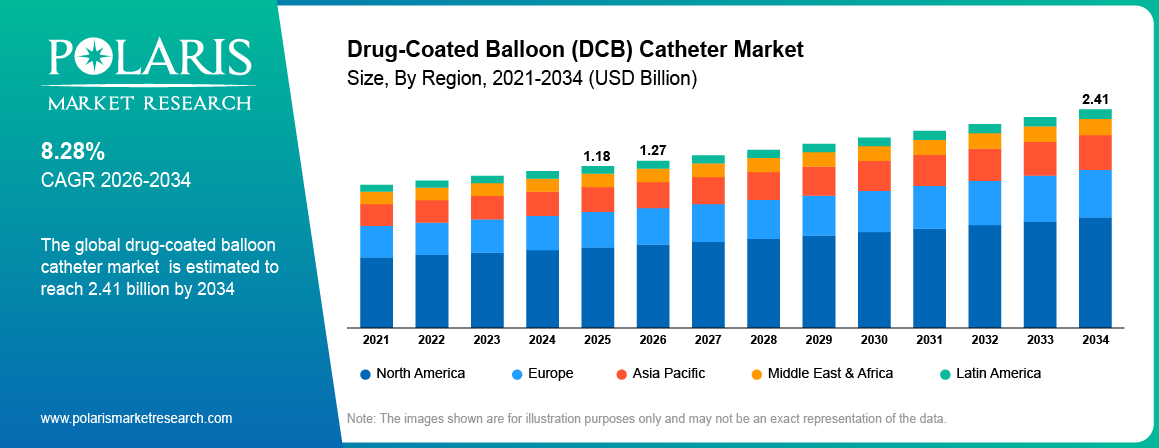
Source: Polaris Market Research Analysis
There is a growing need for drug-coated balloon catheters owing to increasing number of cardiovascular diseases cases and rising adoption of minimal invasive surgery techniques. Advancements in drug coating technology and catheters are leading the growth of the global drug-coated balloon catheters market.
Drivers & Opportunities
Rising cardiovascular disease is driving demand for DCB catheters: Rising cardiovascular disease cases has led to higher demand for minimally invasive vascular treatments across hospitals and cardiac care centers. For instance, in 2024, the US Centers for Disease Control and Prevention stated that about 805,000 people in the US have a heart attack annually, including 605,000 first-time heart attacks, and 200,000 recurrent cases.Drug-coated balloon catheters are widely used to treat blocked arteries and reduce restenosis risks. Healthcare providers are increasingly adopting these technologies to improve patient outcomes. This factor is supporting growth in the drug-coated balloon catheter market.
Growing adoption of minimally invasive procedure to drive market growth: The growing preference for minimally invasive cardiovascular treatments is resulting in the higher use of angioplasty procedures across hospitals and cardiac care centers. For instance, in 2026, as per the National Library of Medicine, minimally invasive cardiac surgery accounts for one-third of total heart surgeries globally that is performed for mitral valve repair, aortic valve replacement devices, and coronary artery bypass.Minimally invasive procedures are associated with lower complication risks and shorter recovery periods. This trend is encouraging the development of the drug-coated balloon catheter market.
Restraints & Challenges
High device cost is limiting market expansion: DCB catheters involves high-cost devices, catheterization machines, and interventional skills. The financial limitations restrain the application of DCB catheters in budget-conscious firms and developing nations. Furthermore, lack of reimbursement policies and expensive procedures are creating barrier to the market.
Risk of restenosis and procedural complications are creating adoption challenges: Drug-coated balloon catheter procedures involve risks including restenosis, vessel dissection, and inconsistent drug delivery during complex procedures. Concerns regarding long-term clinical efficacy and safety are preventing wider usage of DCB catheters by practitioners. Furthermore, problems associated with vascular intervention procedures and follow-up monitoring are hindering the market growth of DCB catheters.
Opportunity
Expansion in emerging markets to create opportunities for drug-coated balloon catheter market: Rising healthcare investments and expansion of cardiovascular care facilities in developing countries are supporting market growth. Improving healthcare infrastructure, and growing awareness regarding minimally invasive vascular treatments are driving the demand for advanced DCB catheter solutions. For instance, the Indian Government allocated USD 11.50 billion in the Union budget 2025-2026, an increase of 9.78% compared to FY25 for the development and maintenance of India’s healthcare sector.In addition, the rising prevalence of cardiovascular diseases and increasing government focus on strengthening cardiac care services are creating significant growth opportunities for the market.
Technological advancements in DCB catheter to open market opportunities: The continuous evolution of drug-coated balloon catheter is enhancing its ability to deliver drugs effectively and improve clinical results for vascular procedures. For instance, Boston Scientific launched AGENT, a new treatment option for patients with in-stent restenosis, designed to provide efficient and effortless drug delivery in complex anatomy.Innovations in balloon coating technologies, catheter flexibility, and drug-transfer mechanisms are reducing restenosis risks and expanding applications. This factor is creating growth opportunities in the drug-coated balloon catheter market.
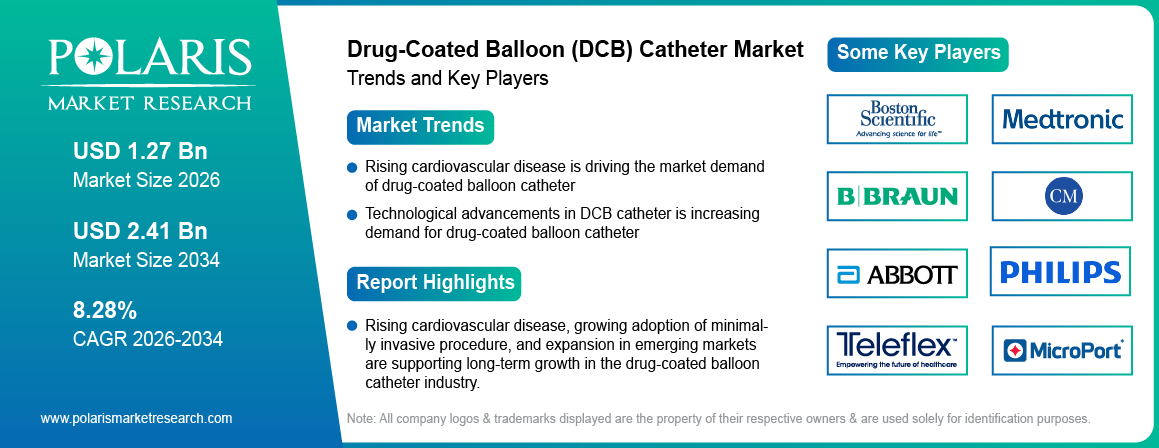
Source: Polaris Market Research Analysis
Segmental Insights
This report offers detailed coverage of the drug-coated balloon catheter market by product type, and by application, and by end-use industry to help readers identify the fastest expanding and most attractive demand segments.
By Product Type
-
Coronary DCB
Coronary DCB segment dominated the market in 2025, driven by the increasing prevalence of coronary artery disease and rising adoption of minimally invasive cardiac procedures. These devices are widely used in the treatment of in-stent restenosis and small vessel diseases due to their ability to deliver anti-proliferative drugs without leaving a permanent implant. Technological advancements in paclitaxel-coated balloons and increasing preference for stent-free interventions are further supporting segment growth.
-
Peripheral DCB
Peripheral DCB segment is projected to grow at the fastest CAGR during the forecast period, owing to the rising incidence of peripheral artery disease and growing demand for effective vascular interventions. For example, in 2024, the American College of Cardiology stated that, the peripheral artery disease accounts for affecting 10-15% of global population aged 50 years and above, and 3-10% of adults in western region.Increasing use of peripheral DCBs in treating femoropopliteal lesions and reducing restenosis rates is driving market expansion. Moreover, growing adoption of advanced endovascular procedures is supporting segment growth.
By Application
-
Coronary Artery Disease
Coronary artery disease segment dominated the market in 2025, due to the increasing burden of cardiovascular diseases and growing number of angioplasty procedures worldwide. Drug-coated balloon catheters are increasingly preferred for treating complex coronary lesions and restenosis cases, owing to their ability to improve vessel patency and reduce repeat interventions.
-
Peripheral Artery Disease
Peripheral artery disease segment is projected to grow at the fastest CAGR during the forecast period, due to the rising geriatric population and increasing prevalence of diabetes and smoking-related vascular disorders. Growing awareness regarding minimally invasive treatment options and rising demand for improved blood flow restoration procedures are supporting segment expansion.
By End-Use Industry
-
Hospitals
Hospitals segment dominated the market in 2025, due to the high volume of cardiovascular and vascular intervention procedures performed in hospital settings. The availability of advanced imaging technology, medical practitioners, and health care facilities are fueling the adoption of drug-coated balloon catheters in hospitals.
-
Specialty Cardiac Centers
Specialty cardiac centers segment is projected to grow at the fastest CAGR during the forecast period, owing to the increasing preference for specialized cardiovascular treatment facilities. Rising focus on advanced interventional cardiology procedures, shorter patient recovery times, and improved treatment outcomes is supporting segment growth.
Pricing Intelligence & Cost Benchmarking
Device Pricing Comparison:
| Product Type | Average Cost (USD) | Clinical Use |
| Standard Balloon | 200–400 | Basic angioplasty |
| Drug-Coated Balloon | 800–1,500 | Advanced therapy |
| Drug-Eluting Stent | 1,200–2,500 | Permanent implant |
Source: Polaris Market Research Analysis
Procedure Cost Analysis:
| Procedure Type | Average Cost (USD) | ROI Consideration |
| DCB Angioplasty | 5,000–8,000 | Lower repeat procedures |
| Stent Placement | 7,000–12,000 | Higher long-term treatment cost |
Source: Polaris Market Research Analysis
ROI Model (Hospitals)
- Reduced repeat interventions leading to long-term cost savings
- Shorter hospital stays improving operational efficiency
- Higher patient throughput supporting revenue growth
- Lower risk of restenosis reducing follow-up treatment expenses
- Improved clinical outcomes enhancing hospital value proposition
Source: Polaris Market Research Analysis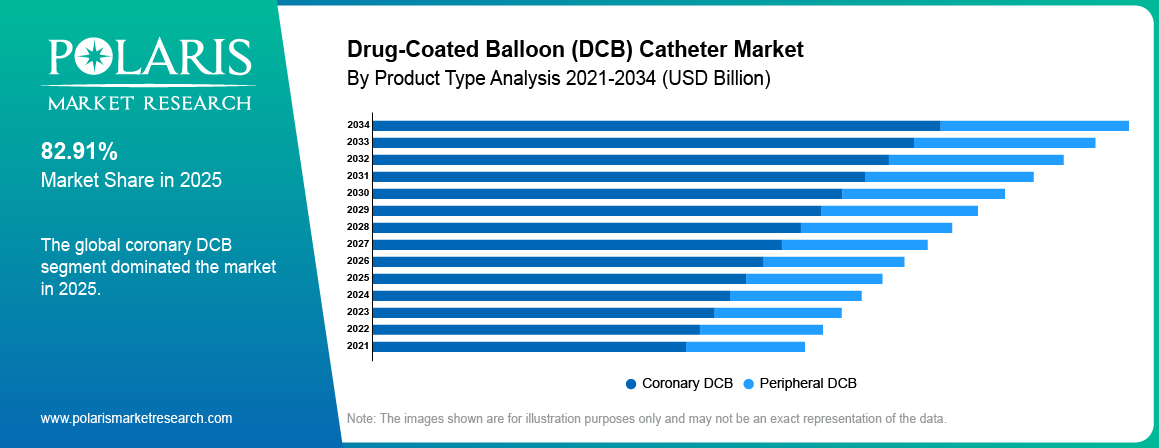
Regional Analysis
North America Market Assessment
North America drug-coated balloon catheter market dominated the global market in 2025, driven by the high prevalence of cardiovascular diseases and strong adoption of minimally invasive vascular procedures. The market in the US leads the region due to rising cases of cardiovascular disease, and high availability of advanced catheterization laboratories. For instance, in 2024, according to the US Centers for Disease Control and Prevention, 919,032 people died from cardiovascular disease in the US in 2023, showing huge demand for DCB catheters.Presence of leading medical device manufacturers and increasing use of drug-coated balloon technologies in restenosis treatment are supporting market growth.
Asia Pacific Drug-Coated Balloon Catheter Market Insights
Asia Pacific DCB catheter market is projected to grow at the fastest CAGR during the forecast period, driven by the growing burden of cardiovascular disorders and expanding healthcare infrastructure. Countries such as China and India are witnessing increasing demand due to growing cases of heart attacks and hypertension. For example, in 2024, CK Birla Hospitals reported that India accounts for 20% of total heart attack deaths globally, showing increasing demand for DCB catheters.Rising government healthcare investments and expansion of cardiac care centers are further supporting regional market growth.
Europe Drug-Coated Balloon Catheter Market Overview
Europe drug-coated balloon catheter market held the second-largest share, driven by advanced healthcare systems and increasing prevalence of vascular diseases. Countries such as Germany, France, and the United Kingdom show strong demand due to high adoption of interventional cardiology procedures and rising heart attack cases. For instance, in 2024, according to World Health Organization, cardiovascular diseases account for 42.5% of all deaths in the European region annually, that is 100000 deaths per day.Growing focus on early diagnosis and increasing use of drug-coated balloon catheters for peripheral and coronary artery interventions are driving market expansion.
Latin America Emerging Market
Latin America and Middle East & Africa drug-coated balloon catheter market is growing steadily, supported by improving healthcare infrastructure and rising incidence of cardiovascular diseases. Countries such as Brazil, Mexico, South Africa, and the UAE are witnessing increasing adoption of minimally invasive vascular procedures. Growth in specialty cardiac centers, expansion of private healthcare providers, and access to advanced catheter-based treatments are supporting market growth.
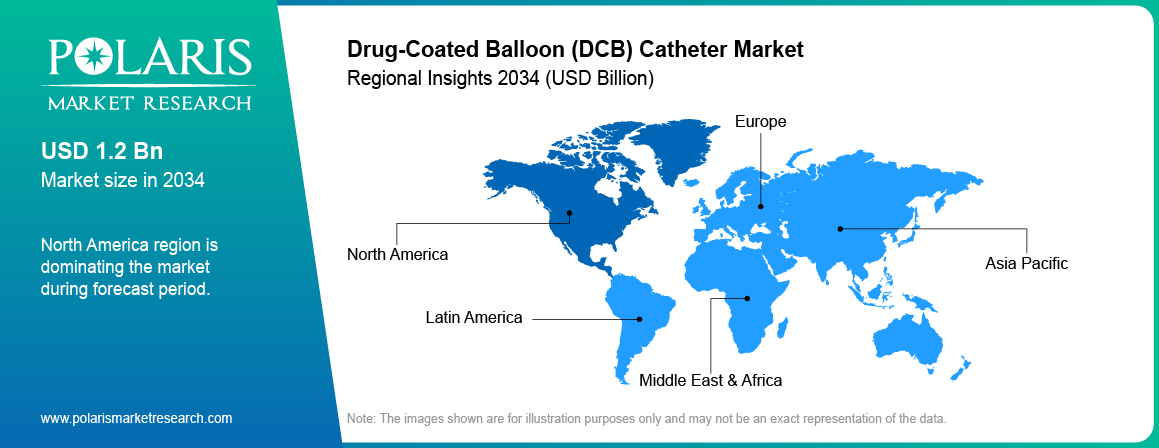
Source: Polaris Market Research Analysis
Competitive Landscape
Key Players & Competitive Strategies
The drug-coated balloon catheter market is moderately fragmented, with global cardiovascular device manufacturing companies competing based on product performance, technology, and pricing. Market players are focusing on advanced drug-delivery technologies and expanding minimally invasive treatment solutions to strengthen market presence.
Some of the notable players in the market include Boston Scientific Corporation, Medtronic plc, B. Braun SE, Concept Medical Inc., Abbott, Koninklijke Philips N.V., Teleflex Incorporated, MicroPort Scientific Corporation, iVascular S.L.U., Meril Life Sciences Pvt. Ltd., Cordis, Translumina Therapeutics, and others.
Company Benchmarking Table:
| Company | Product Portfolio | Market Strength | Strategy |
| Boston Scientific | Strong | Global leader | Innovation-driven product development |
| Medtronic | Broad | High R&D capability | Geographic and product portfolio expansion |
| B. Braun | Specialized | Strong presence in Europe | Strategic partnerships and collaborations |
Source: Polaris Market Research Analysis
Premium Insights
Investment Outlook:
The drug-coated balloon catheter market is witnessing strong investment activity due to the increasing preference for minimally invasive vascular treatments and the growing burden of cardiovascular diseases worldwide. Investors are increasingly investing in companies developing advanced drug delivery systems, superior balloon coatings, and cutting-edge catheter technology that are designed to minimize the incidence of restenosis.
Key Players
- Boston Scientific Corporation
- Medtronic plc
- B. Braun SE
- Concept Medical Inc.
- Abbott
- Koninklijke Philips N.V.
- Teleflex Incorporated
- MicroPort Scientific Corporation
- iVascular S.L.U.
- Meril Life Sciences Pvt. Ltd.
- Cordis
- Translumina Therapeutics
Industry Developments
- February 2025: BrosMed partnered with Cordis to distribute its VaSecure drug-coated balloon catheter in China that achieves zero drug loss and ensures long-term retention. [source: global.brosmed.com]
- February 2025: Microport’s Firelimus drug-eluting balloon catheter received market approval from the National Medical Products Administration (NMPA) of China, designed to ensure rapid drug transfer to the vessel wall while enabling a sustained and controlled release effect. [source: microport.com]
Drug-Coated Balloon Catheter Market Segmentation
By Product Type Outlook (Revenue, USD Billion, 2021-2034)
- Coronary DCB
- Peripheral DCB
By Application Outlook (Revenue, USD Billion, 2021-2034)
- Coronary Artery Disease
- Peripheral Artery Disease
- Renal Artery Disease
- Biliary Tract
By End-Use Industry Outlook (Revenue, USD Billion, 2021-2034)
- Hospitals
- Specialty Cardiac Centers
- Ambulatory Surgical Centers
By Regional Outlook (Revenue, USD Billion, 2021-2034)
- North America
- US
- Canada
- Europe
- Germany
- France
- UK
- Italy
- Spain
- Netherlands
- Russia
- Rest of Europe
- Asia Pacific
- China
- Japan
- India
- Malaysia
- South Korea
- Indonesia
- Australia
- Vietnam
- Rest of Asia Pacific
- Middle East & Africa
- Saudi Arabia
- UAE
- Israel
- South Africa
- Rest of Middle East & Africa
- Latin America
- Mexico
- Brazil
- Argentina
- Rest of Latin America
Drug-Coated Balloon Catheter Market Report Scope
| Report Attributes | Details |
| Market Size in 2025 | USD 1.18 Billion |
| Market Size in 2026 | USD 1.27 Billion |
| Revenue Forecast by 2034 | USD 2.41 Billion |
| CAGR | 8.28% from 2026 to 2034 |
| Base Year | 2025 |
| Historical Data | 2021–2024 |
| Forecast Period | 2026–2034 |
| Quantitative Units | Revenue in USD Billion and CAGR from 2026 to 2034 |
| Report Coverage | Revenue Forecast, Competitive Landscape, Growth Factors, and Industry Trends |
| Segments Covered |
|
| Regional Scope |
|
| Competitive Landscape |
|
| Report Format |
|
| Customization | Report customization as per your requirements with respect to countries, regions, and segmentation. |
Source: Polaris Market Research Analysis
Drug Coated Ballon Catheter Market FAQ's
The global market size was valued at USD 1.18 Billion in 2025 and is projected to grow to USD 2.41 Billion by 2034.
North America dominates the market driven by the high prevalence of cardiovascular diseases and strong adoption of minimally invasive vascular procedures.
Major applications include coronary artery disease, peripheral artery disease, renal artery disease, and biliary tract, and others.
A few of the key players in the market are Boston Scientific Corporation, Medtronic plc, B. Braun SE, Concept Medical Inc., Abbott, Koninklijke Philips N.V., Teleflex Incorporated, MicroPort Scientific Corporation, iVascular S.L.U., Meril Life Sciences Pvt. Ltd., Cordis, Translumina Therapeutics, and others.
Key drivers include rising cardiovascular disease and growing adoption of minimally invasive procedure.
Major demand comes from hospitals, specialty cardiac centers, and ambulatory surgical centers.
The market outlook remains strong due to expansion in emerging markets and technological advancements in DCB catheter.
Download Sample Report of Drug Coated Ballon Catheter Market
Please fill out the form to request a customized copy of the research report.


