
Low Migration Inks Market Trends, Growth and Overview – 2034
REPORT DETAILS
Low Migration Inks Market Summary
The global low migration inks market is estimated around USD 456.5 Million in 2025,with consistent growth anticipated during 2026–2034. Rising regulatory focus on food-contact packaging safety and increasing demand for compliant food-safe printing inks are supporting market expansion. The market is projected to grow at a CAGR of 6.2% during the forecast period.
Market Statistics
Key Takeaways
- UV-curable low migration inks dominated the market in 2025 by holding 42.3% revenue share, due to strong adoption across food packaging and label printing applications.
- Primary food packaging segment dominated the market in 2025 by 31.2% share, driven by rising demand for compliant food contact packaging materials.
- Electron beam (EB) cure inks segment is projected to grow at the fastest CAGR of 6.9% during the forecast period, owing to increasing preference for photoinitiator-free printing technologies.
- Europe dominated the market by 40.6% share in 2025 driven by strict food packaging regulations and strong adoption of Swiss Ordinance compliant inks.
- Asia Pacific low migration inks market is projected to grow at the fastest CAGR of 6.7% during the forecast period, driven by rising packaged food consumption.
Industry Dynamics
- Rising food packaging safety regulations are driving low migration inks market growth.
- Increasing demand for digital food packaging printing is supporting product adoption.
- High compliance and migration testing costs are restraining market expansion.
- Growing adoption of sustainable and bio-based packaging inks is creating new opportunities for the market.
What is the Low Migration Inks Market?
Low migration inks are specially formulated printing inks developed to minimize the transfer of ink components from packaging surfaces into food products. These ink types are predominantly used in food packaging, pharmaceutical packaging, beverage labeling, flexible packaging, and cartonboard printing applications. These products help ensure safe operations in the packaging process through reduced risk of contaminations.
The low migration inks market works according to the value chain that includes raw material providers, resin and pigment producers, ink formulators, packaging converters, distributors, and end-use packaging firms. There is an emphasis on developing new formulations in ink manufacturers, which are compliant to food contact norms and migration test requirements for different regions.
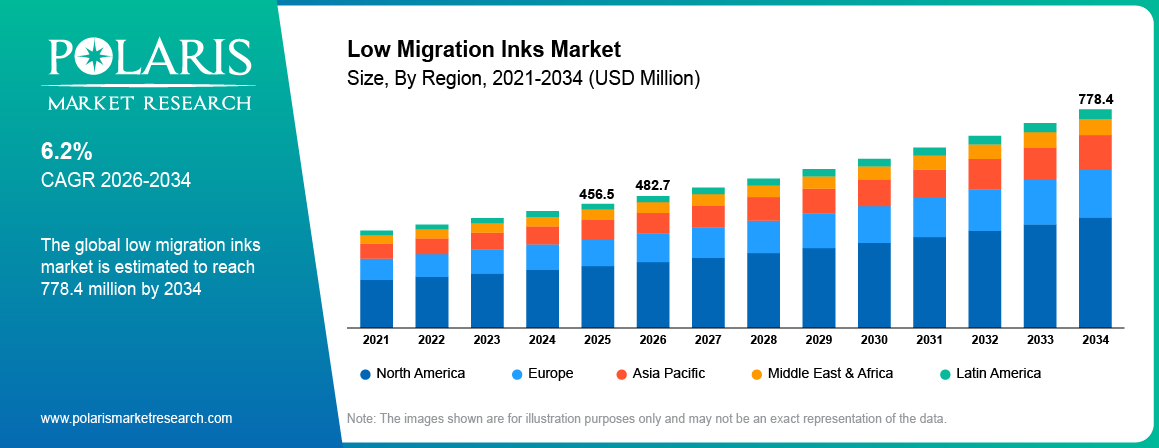
Source: Polaris Market Research Analysis
The low migration inks market is growing fueled by the rising awareness about the safety of food packaging and increasing use of eco-friendly packaging materials. Rising packaged foods consumption, advancements in digital printing techniques, and rising application of safe food contact materials are contributing to the growth of this market.
Drivers & Opportunities
Increasing Regulations Pertaining to Food Packaging Safety is Fueling Market Demand: Rising importance of food packaging safety regulations is boosting the demand for low migration inks among the various packaging segments. The food producers and distributors are opting for food-safe printing inks to minimize the risk of contamination and adhere to the packaging standards. The regulatory standards pertaining to Swiss Ordinance, EuPIA GMP, and FDA food contact are pushing the packaging converters towards advanced low migration ink technology.[European Commission, "Packaging campaign focused on food safety and sustainable packaging practices", food.ec.europa.eu] Under EU food packaging regulations, all food contact materials must remain fully traceable across manufacturing, distribution, and commercial operations, supporting adoption of compliant low migration printing solutions.
Increase in Digital Packaging Printing Adoption Boosting Demand: Growing trend of digital packaging printing is increasing demand for low migration digital inks in food and beverage applications. Packaging manufacturers are opting for short-run or custom print options that offer more branding flexibility and efficiencies. For example, in September 2025, Mondi Group announced the adoption of white digital printing for its corrugated packaging, which cater to customer demands for customised graphics, quicker lead times, and personalised packaging requirements.[Mondi Group, "Mondi introduces white digital printing for corrugated packaging", www.mondigroup.com]
Restraints & Challenges
High Compliance and Migration Testing Costs are Limiting Market Expansion: Rising migration testing cost along with the certification procedure and compliance documentation is adding to the operating expense of ink manufacturers and packaging converters. Various testing procedures are necessary for packaging products and inks for compliance with different regulatory bodies. Financial pressures arise among small and medium packaging firms due to expensive testing procedures and complicated regulatory compliance process. This becomes one of the key reasons for slower adoption of the low migration inks market in price-sensitive geographies.
Opportunity
Increasing Demand for Eco-Friendly Low Migration Inks Creating Market Opportunity: Rising trends towards sustainable packaging solutions are helping low migration inks to gain traction in terms of usage. Manufacturers are investing in eco-friendly inks for ensuring sustainability without compromising the safety of food packaging industry. For instance, in April 2026, Siegwerk Druckfarben AG & Co. KGaA introduced its innovative UniNATURE Leaf ink product for paper and paper board packaging, which is acrylic-free bio-based ink formulation solution.[Siegwerk, "Siegwerk unveils new acrylic-free ink solution UniNATURE for paper and board applications", www.siegwerk.com]
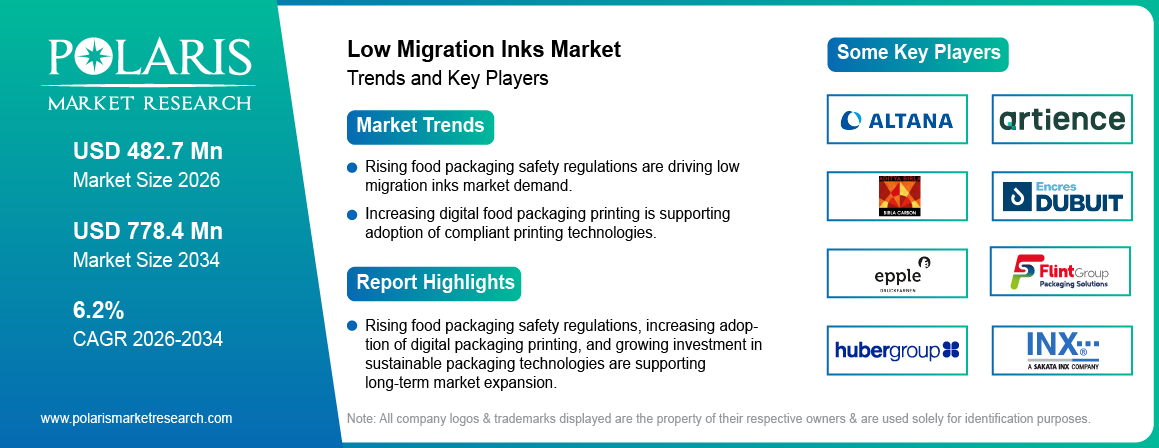
Source: Polaris Market Research Analysis
Segmental Insights
The report offers an in-depth analysis of the low migration inks market based on the cure technology type and application in order to determine the lucrative revenue generators and segments experiencing high growth rates.
By Cure Technology
-
UV-Curable Low Migration Inks
The low migration inks that use UV curing technology had the largest market share in 2025 due to their rising usage in applications related to the printing of flexible packaging, labels, and cartonboard. UV low migration inks benefit from fast curing speed, high-quality prints, and better compatibility with food packaging safety requirements. For instance, in April 2026, BASF SE introduced new ecovio compostable products into its existing portfolio that used for flexible food packaging, thus enabling more companies to adopt environmentally friendly UV low migration printing processes.[BASF, "BASF expands sustainable solutions and material innovations", www.basf.com]
-
Electron Beam (EB) Cure Inks
Electron beam cure ink is projected to witness the highest CAGR during the forecast period due to growing preference for photoinitiator-free inks. These inks are used in low migration packaging due to minimal risks related to contamination caused by conventional UV inks. Growing investments in printing infrastructure for food packaging are driving the segment.
By Application
-
Primary Food Packaging
Primary food packaging dominated the market in 2025, due to increasing demand for compliant direct food contact packaging solutions. The segment includes flexible films, folding cartons, sachets, and food labels used across packaged food and beverage industries. Growing awareness regarding migration testing and food safety standards is supporting segment expansion.
-
Secondary Food Packaging
Secondary food packaging is projected to grow at the fastest CAGR during the forecast period, owing to increasing adoption of low migration inks in corrugated boxes, retail-ready packaging, and transport packaging. Retailers and food processors are increasingly using safer printing techniques for their secondary packaging materials to avoid contamination issues that may arise while storing and transporting their products.
Source: Polaris Market Research Analysis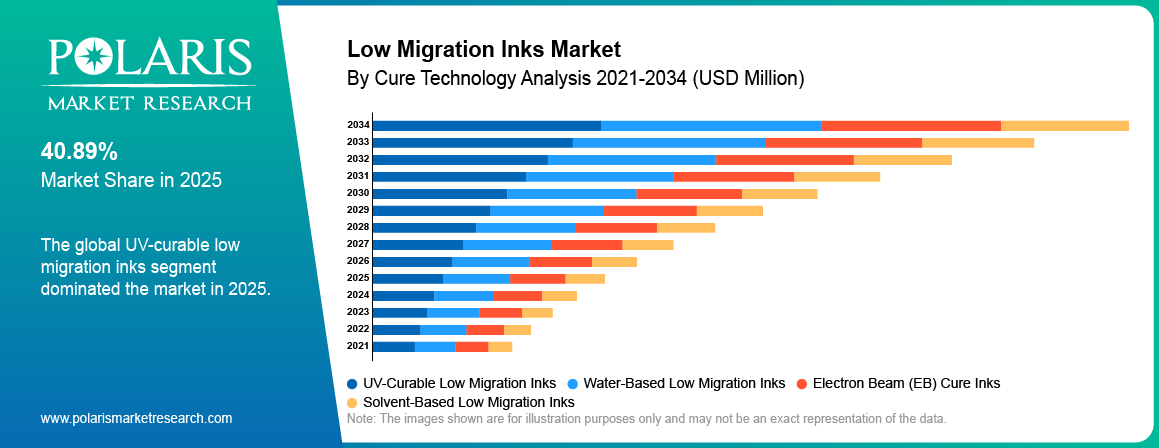
Regional Analysis
Europe Low Migration Inks Market Overview
Europe was leading the low migration inks market globally in 2025 due to stringent regulations governing food packaging safety and high use of printing inks conforming to Swiss Ordinance standards. Major countries include Germany, France, UK, and Switzerland driven by significant packaging industries and regulations. In October 2025, BOBST launched THALIA UV digital inks developed for label converters to support low migration compliance and high-quality food packaging printing applications across Europe.[BOBST, "BOBST THALIA UV digital inks help label converters navigate growing compliance challenges", www.bobst.com]
North America Low Migration Inks Market Insights
North America low migration inks market held a significant share in 2025, driven by increasing demand for compliant food packaging materials and strong presence of packaged food manufacturers. The US leads the regional market due to growing adoption of FDA-compliant packaging inks and expansion of digital food packaging printing technologies. Increasing focus on sustainable packaging and food safety compliance is supporting market demand across the region.
Asia Pacific Low Migration Inks Market Assessment
Asia Pacific low migration inks market is projected to grow at the fastest CAGR during the forecast period, driven by rising packaged food consumption and increasing food packaging manufacturing activities in China and India. Expansion of export-oriented food packaging industries and strengthening food contact regulations are contributing to market growth. According to the Access to Nutrition Initiative (ATNi), India’s food processing industry is projected to reach nearly USD 481 Billion by the end of 2026, supporting long-term demand for compliant food packaging and low migration printing inks across the region.[Access to Nutrition Initiative, "India Context Chapter", accesstonutrition.org]
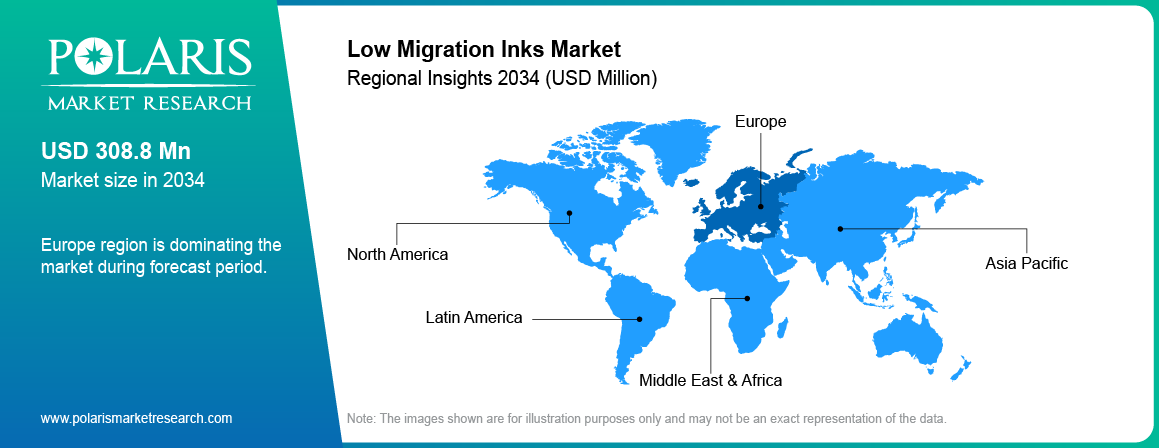
Source: Polaris Market Research Analysis
Competitive Landscape
Key Players & Competitive Strategies
The low migration inks market is moderately fragmented due to the presence of global printing ink manufacturers and regional packaging ink suppliers. The competition is based on regulatory compliance, migration, pricing, quality of the product, and compatibility of packaging. Firms are making efforts for sustainable ink formulation, digitizing printing processes, forming strategic collaborations, and expanding production in different regions to enhance their position in the food packaging sector.
Leading firms in the low migration inks market are Altana AG, Artience Co., Ltd., Birla Carbon, Color-Value, Encres Dubuit, Epple Druckfarben AG, Flint Group, Hubergroup Deutschland GmbH, Huizhou ZhongZhiXing Color Technology Co., Ltd., INX International Ink Co., Kao Collins Corporation, Marabu GmbH, RUCOINX, Siegwerk Druckfarben AG & Co. KGaA, and Sun Chemical Corporation.
Trends & Future Outlook
-
Sustainability trends:
Growth in usage of environmentally friendly packaging materials and biodegradable print processes are increasing the demand for sustainable low migration inks. Companies are producing sustainable water-based inks and low Volatile Organic Compounds (VOCs) inks for food packaging products.
-
Innovation trends:
Companies are adopting digital inkjet printing technology, electron-beam curing process, and sustainable low migration test systems to enhance compliance and performance standards. Development of deinkable UV inks is also supporting market innovation.
Key Players
- Altana AG
- Artience Co., Ltd.
- Birla Carbon
- Color-Value
- Encres Dubuit
- Epple Druckfarben AG
- Flint Group
- Hubergroup Deutschland GmbH
- Huizhou ZhongZhiXing Color Technology Co., Ltd.
- INX International Ink Co.
- Kao Collins Corporation
- Marabu GmbH
- RUCOINX
- Siegwerk Druckfarben AG & Co. KGaA
- Sun Chemical Corporation
Industry Developments
- February 2026: Toyo Ink SC Holdings launched its GIO-UV series of low migration UV inks developed for food, pharmaceutical, and sensitive packaging applications. [source: artiencegroup.com]
- July 2025: Sun Chemical launched SunCure Advance ECO low migration ink range for sustainable packaging and labels print. [source: sunchemical.com]
Low Migration Inks Market Segmentation
By Cure Technology Outlook (Revenue, USD Million, 2021–2034)
- UV-Curable Low Migration Inks
- Water-Based Low Migration Inks
- Electron Beam (EB) Cure Inks
- Solvent-Based Low Migration Inks
By Application Outlook (Revenue, USD Million, 2021–2034)
- Primary Food Packaging
- Secondary Food Packaging
- Beverage Packaging
- Pharmaceutical Packaging
- Labels & Tags
- Flexible Packaging
- Cartonboard Packaging
- Others
By Regional Outlook (Revenue, USD Million, 2021-2034)
- North America
- US
- Canada
- Europe
- Germany
- France
- UK
- Italy
- Spain
- Netherlands
- Russia
- Rest of Europe
- Asia Pacific
- China
- Japan
- India
- Malaysia
- South Korea
- Indonesia
- Australia
- Vietnam
- Rest of Asia Pacific
- Middle East & Africa
- Saudi Arabia
- UAE
- Israel
- South Africa
- Rest of Middle East & Africa
- Latin America
- Mexico
- Brazil
- Argentina
- Rest of Latin America
Low Migration Inks Market Report Scope
| Report Attributes | Details |
| Market Size in 2025 | USD 456.5 Million |
| Market Size in 2026 | USD 482.7 Million |
| Revenue Forecast by 2034 | USD 778.4 Million |
| CAGR | 6.2% from 2026 to 2034 |
| Base Year | 2025 |
| Historical Data | 2021–2024 |
| Forecast Period | 2026–2034 |
| Quantitative Units | Revenue in USD Million and CAGR from 2026 to 2034 |
| Report Coverage | Revenue Forecast, Competitive Landscape, Growth Factors, and Industry Trends |
| Segments Covered |
|
| Regional Scope |
|
| Competitive Landscape |
|
| Report Format |
|
| Customization | Report customization as per your requirements with respect to countries, regions, and segmentation. |
Source: Polaris Market Research Analysis
Low Migration Inks Market FAQ's
The global market size was valued at USD 456.5 Million in 2025 and is projected to reach USD 778.4 Million by 2034 at a CAGR of 6.2%.
Europe dominated the market by 40.6% share in 2025 driven by strict food packaging regulations and increasing adoption of food safe printing inks across the packaging industry.
Major companies operating in the market include DIC Corporation, Flint Group, hubergroup, INX International Ink Co., Siegwerk Druckfarben AG & Co. KGaA, and Sun Chemical Corporation.
The primary growth drivers include the growing food packaging safety regulations, increasing use of digital printing methods in packaging, and rising preference for sustainable food packaging.
UV-curable low migration inks dominated the market in 2025 due to increasing use across flexible packaging, labels, and cartonboard printing applications.
Secondary food packaging is projected to grow at the fastest CAGR of 6.8% during the forecast period owing to rising demand for safe transport and retail-ready packaging solutions.
The market outlook remains positive due to rising adoption of bio-based inks, expansion of digital food packaging printing, and increasing investment in compliant packaging technologies.
Download Sample Report of Low Migration Inks Market
Please fill out the form to request a customized copy of the research report.


