
Earth Observation Small Satellite Market Demand, Industry Trends, 2026-2034
REPORT DETAILS
Earth Observation Small Satellite Market Summary
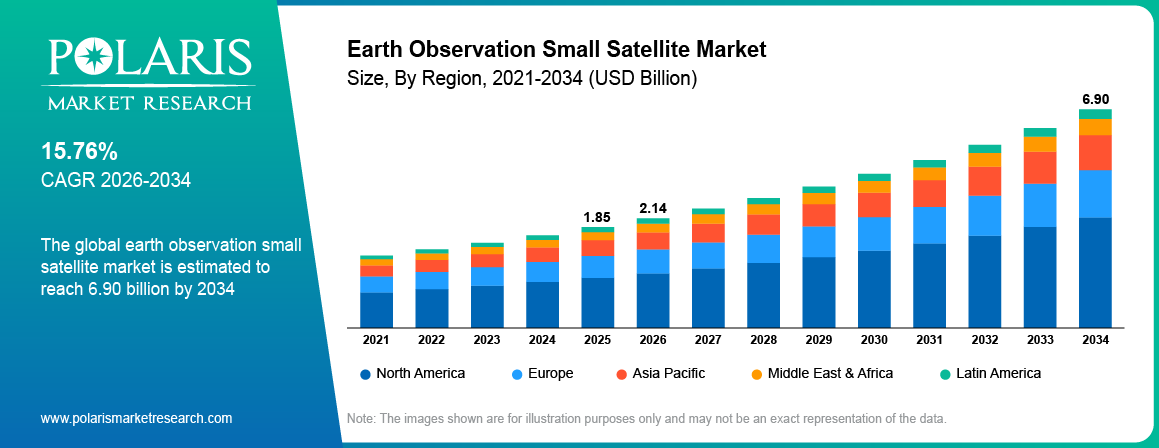
The global market for small satellites for earth observations was estimated to be worth USD 1.85 billion in 2025, and the same is expected to rise to USD 6.90 billion by 2034, recording a CAGR of 15.76% through the forecast period. The global earth observation small satellites market is expected to grow on account of growing adoption of satellites in environmental observations, agriculture, disaster management, and defense purposes.
Market Statistics
Earth Observation Small Satellite Market Key Takeaways
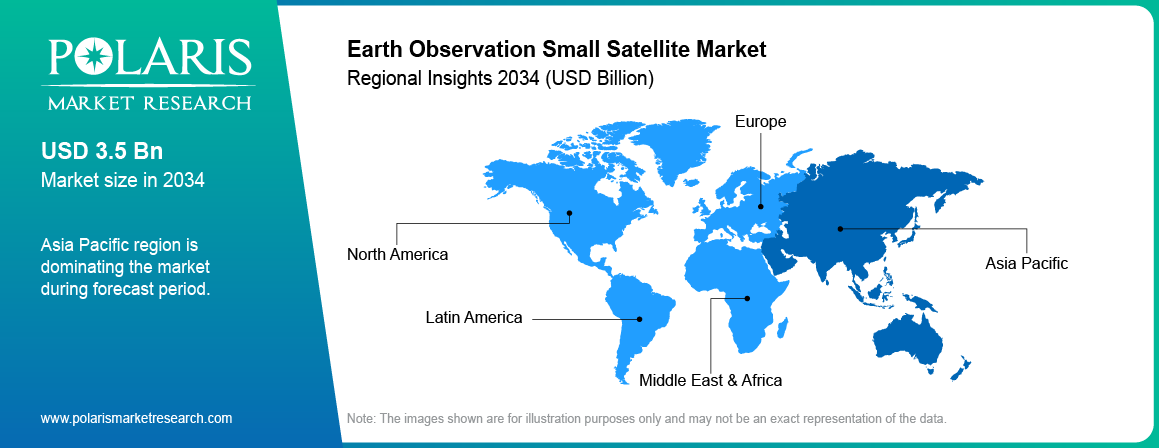
- Asia Pacific dominated the market with 38.0% share in 2025 due to strong government investments in satellite manufacturing and space infrastructure.
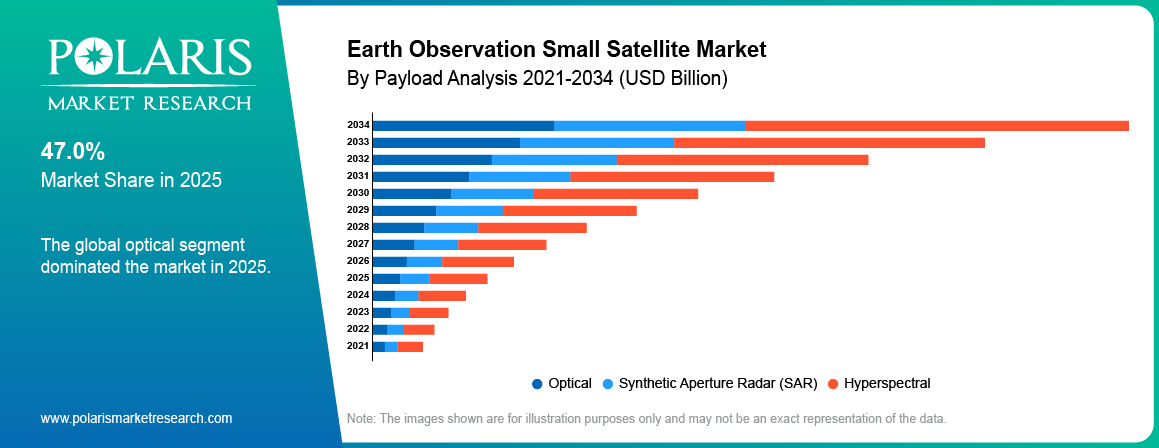
- The optical payload was the most significant revenue generator accounting for 47.0% share in 2025 due to its broad application in imaging and mapping operations.
- In 2025, the government sector was the largest end-user segment accounting for 43.0% share due to its constant spending on defense, environmental monitoring, and national security missions.
- Commercial end users are projected to grow at the fastest CAGR of 17.3% during the forecast period.
- LEO dominated the orbit segment valued at 57.0% share in 2025 because of lower deployment costs and high imaging efficiency.
Note: Figures and projections outlined in this report are the result of Polaris Market Research’s proprietary analytical processes, grounded in the latest available datasets and market observation
What is Earth Observation Small Satellite?
Small earth observation satellites are relatively smaller spacecraft whose main function is to take pictures of the Earth’s surface as well as gather geospatial information. Small earth observation satellites have a wide range of applications which include agricultural purposes, environmental purposes, disaster management, weather prediction, urban planning, maritime and defense activities.
The value chain of the market consists of component suppliers, satellite builders, payload makers, launch services providers, satellite operators, data processing firms and end users. Different components including sensors, communication systems, propulsion system, and imaging payloads are put together to make a spacecraft before being launched. Data from the spacecraft is then analyzed and provided to governments, research institutions, business firms, and defense organizations.
The factors responsible for market expansion include rising demand for high-resolution satellite imagery, fast technological development of miniature satellites, and greater financial involvement in commercial space missions. The government is working towards building national space capabilities, while businesses keep expanding their satellite constellations to increase revisit rates and coverage.
Source: Polaris Market Research Analysis
Earth Observation Small Satellite Market Driver Impact Analysis
Market growth is driven by increasing investments in commercial satellite constellations, rapid improvements in imaging technologies, and rising demand for real-time earth observation data. Space programs of governments around the world are expanding while private entities keep investing in modern satellites and launch vehicles. All these developments have been contributing to greater availability of data in agriculture, defense, environment monitoring, and disaster management applications.
| Market Driver | Est. CAGR Impact | Geographic Relevance | Impact Timeline |
| Government space investments | +2.1% | Asia Pacific | Medium to Long Term |
| Satellite imaging advancements | +1.8% | North America, Europe | Short to Medium Term |
| Commercial constellation expansion | +1.5% | Global | Medium Term |
| Public-private partnerships | +1.2% | Global | Short to Medium Term |
| Rising demand for geospatial intelligence | +1.0% | US, Europe, Asia Pacific | Long Term |
* Indicative estimates based on market context and analyst judgment. Figures reflect relative driver weight, not additive CAGR contributions. Source: Polaris Market Research Analysis.
The investments in launch facilities and satellite production are enhancing the deployment capabilities of the commercial sector. The consumers are opting for service providers that give them high-performing satellites, high-quality imaging, and geospatial analysis capability.
Earth Observation Small Satellite Market Industry Dynamics
- Government investments in their national space programs have increased, resulting in more satellite launches.
- Miniaturization in imaging technology is enhancing satellite operations.
- Expensive launches and strict regulations are hindering the expansion of the market.
- Growing commercial demand for geospatial intelligence is creating new business opportunities.
Earth Observation Small Satellite Market Drivers, Restraints and Opportunities
How Are Government Space Programs Driving Market Growth?
The government's expenditure on earth observation systems is boosting the need for the deployment of small satellites in the areas of environmental surveillance, defense, and disaster management. In June 2026, Canada has spent USD 1.69 million in the development of future satellite technologies, aimed at improving the ability of Canada to observe the earth through satellites(Source: canada.ca). Several countries are working towards improving their satellite constellations in an effort to improve their security, weather, and resource management. The government funding in the manufacture and launching of satellites has spurred commercial interests.
How Are Imaging Technologies Supporting Market Expansion?
Innovation in optical sensing, Synthetic Aperture Radar (SAR), hyperspectral imaging, and onboard data processing have improved the performance of earth observation satellites in recent times. Mission Drishti was launched by GalaxEye in May 2026, and it is the largest earth observation satellite developed privately in India. The goal of Mission Drishti is to improve all weather earth observation capacity by combining optical and SAR image fusion techniques. Increasing image resolutions, quick revisits, and improved data processing capacity are improving the adoption and affordability of satellite monitoring systems.
What Challenges Restrict Market Growth?
The expensive nature of satellite development and deployment, and the process of regulatory clearance, present major difficulties for market competitors. Risks associated with satellite reliability, space debris, spectrum management, and cybersecurity are some of the problems facing companies. Procurement difficulties and big capital requirements might cause delays in adopting the technology in the business environment, particularly for new market entrants.
What Opportunities Exist in the Market?
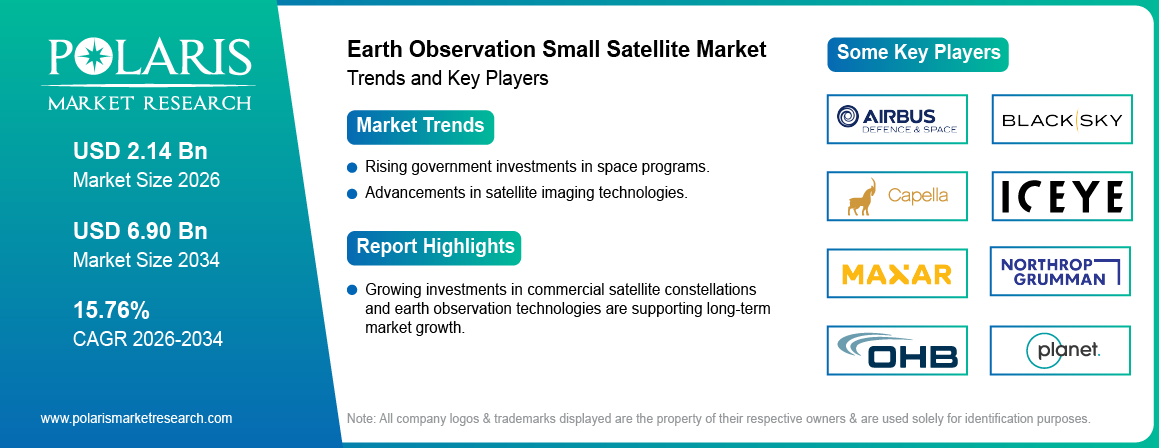
The increasing application of satellite data in the agricultural sector, mining, insurance, infrastructure, climate change, and smart cities industry presents many business opportunities. In August 2025, Blue Canyon Technologies announced that its TROPICS CubeSat system allows for near hourly observations of tropical storms that facilitate weather studies and forecasts through Earth observation(Source: bluecanyontech.com). Expanding private investments in satellite constellations and cloud-based geospatial analytics platforms are expected to generate new revenue opportunities throughout the forecast period.
Source: Polaris Market Research Analysis
Segment and Regional Leaders at a Glance
According to Polaris Market Research, Asia Pacific leads the market while North America is the fastest-growing region.
- Dominant Region: Asia Pacific
- Fastest Growing Region: North America
- Largest Payload Segment: Optical
- Largest End User Segment: Government
Earth Observation Small Satellite Marke Segmentation Analysis
The report provides a comprehensive analysis of the earth observation small satellite market by payload, orbit, and end user to identify key revenue-generating and high-growth segments.
Earth Observation Small Satellite Market by Payload
Which Payload Dominated the Market in 2025?
The optical segment dominated the market with 47.0% share in 2025 owing to its extensive use in environmental monitoring, precision agriculture, urban planning, infrastructure development, and disaster assessment. Optical imaging of high resolution is still largely utilized by governmental institutions and private companies for the purposes of surveying and monitoring. It is anticipated that advancements in imaging and data processing ensures continued expansion of the segment during the projected timeframe.
Which Payload is Projected to Grow at the Fastest CAGR?
The synthetic aperture radar (SAR) segment is anticipated to experience the fastest CAGR of 17.2% during the forecast period. Increasing demand for earth observation capability during all weather and day and night is propelling the usage of SAR technology across defense, maritime surveillance, disaster management, and border security. Ongoing investments in advanced radar imaging technologies are further improving commercial deployment opportunities.
Earth Observation Small Satellite Market by Orbit
Which Orbit Dominated the Market in 2025?
The low Earth orbit (LEO) segment held the largest market share of 57.0% in 2025 owing to its low-cost deployment, high-frequency of imaging, and low revisit time. Most commercial earth observation satellite constellations operate in LEO to deliver high-resolution images and real-time monitoring services. Growing investments in large satellite constellations are expected to maintain the leadership of this segment during the forecast period.
Which Orbit is Projected to Grow at the Fastest CAGR?
The medium Earth orbit (MEO) segment is expected to have the highest CAGR of 13.5% during the forecast period. The growing need for increasing coverage areas and better communication performance is driving the installation of satellites in the medium Earth orbit. Technological advancements in satellite design are also improving mission efficiency and operational performance.
Earth Observation Small Satellite Market by End User
Which End User Dominated the Market in 2025?
The government segment dominated the market with 43.0% share in 2025 owing to rising investments in national security, environmental monitoring, weather forecasting, disaster management, and scientific research. The governments are continuing to develop their satellite networks to enhance their strategic capabilities along with accessing live geospatial data. Long-term procurement programs are supporting stable demand across the segment.
Which End User is Projected to Grow at the Fastest CAGR?
The commercial segment is projected to grow at the fastest CAGR of 17.3% during the forecast period. Greater adoption of satellite images for the use in sectors such as agriculture, mining, insurance, logistics, energy, and infrastructure management is fueling the commercial demand. Organizations are implementing satellite analysis to make decisions.
Segment Summary Table
| Segment | Category | 2025 Status | Forecast CAGR | Key Driver |
| Optical | Largest Share | Moderate | High demand for high-resolution imaging | Optical |
| Synthetic Aperture Radar (SAR) | Fastest Growing | High | Increasing demand for all-weather monitoring | Synthetic Aperture Radar (SAR) |
| Low Earth Orbit (LEO) | Largest Share | Moderate | Commercial satellite constellation expansion | Low Earth Orbit (LEO) |
| Medium Earth Orbit (MEO) | Fastest Growing | High | Wider coverage and specialized missions | Medium Earth Orbit (MEO) |
| Government | Largest Share | Moderate | National security and public sector investments | Government |
| Commercial | Fastest Growing | High | Growing adoption of geospatial analytics | Commercial |
Source: Polaris Market Research Analysis
Source: Polaris Market Research Analysis
Regional Analysis
Asia Pacific Earth Observation Small Satellite Market Growth Rate and Forecast
Asia Pacific was the largest regional market for earth observation small satellite capturing 38.0% share in 2025 and is projected to retain its dominance through the forecast period. This is due to expanding government space programs and increasing investments in satellite manufacturing. China, India, Japan, South Korea, and Australia are accelerating satellite deployment to support agriculture, disaster management, and national security applications. In June 2026, KSAT and Axelspace expanded their strategic partnership to strengthen ground segment capabilities and accelerate the deployment of Axelspace’s next-generation Earth observation microsatellite constellation(Source: ksat.no).
North America Earth Observation Small Satellite Market Size and Share
North American region is registering the highest CAGR growth rate due to strong government investments in space programs and increasing deployment of commercial satellite constellations. In April 2026, NASA launched its latest CubeSat mission to study how natural and human-made radio waves travel from Earth into space, advancing research on the near-Earth space environment and space weather prediction(Source: nasa.org). The US led the regional market, while Canada continued expanding satellite applications for environmental monitoring and resource management.
Europe Earth Observation Small Satellite Market Analysis
Europe held a substantial market share in 2025 owing to growing investments in earth observation programs and rising demand for climate monitoring solutions. Germany, France, the UK, Italy, and the Netherlands are strengthening satellite capabilities through national space initiatives and collaborative projects. In November 2025, the European Space Agency (ESA) launched the twin HydroGNSS satellites alongside Italy’s IRIDE and Greece’s Earth observation missions aboard a SpaceX Falcon 9 rocket to strengthen global Earth observation and climate monitoring capabilities(Source: esa.int).
Latin America Earth Observation Small Satellite Market Size and Share
Latin America is witnessing steady growth at a CAGR of 15.5% owing to rising adoption of satellite imagery for agriculture and increasing investments in environmental monitoring. Brazil, Mexico, Argentina, Chile, and Colombia are expanding satellite applications for resource management and disaster preparedness.
Middle East & Africa Earth Observation Small Satellite Market Size and Share
The Middle East & Africa market is growing due to increasing investments in national space programs and rising demand for satellite-based environmental monitoring. Some of the countries that increases the number of satellites include Saudi Arabia, UAE, Israel, Egypt, and South Africa in order to improve infrastructure planning, water resources management, and defense systems. In February 2026, Remondo launched the PAIS Earth Observation payload, designed to offer satellite imagery below 30 cm with small satellites in order to cut down the cost of satellite earth observation(Source: remondo.com).
Source: Polaris Market Research Analysis
Regulatory Heatmap
| Region/Country | Policy Environment | Key Regulations | Market Implication | Trend |
| US | Favorable | NASA Earth Science Program, NOAA initiatives, Commercial Remote Sensing Regulations | Supports commercial deployment and innovation | Expanding |
| Canada | Favorable | Canadian Space Strategy, CSA Earth Observation Programs | Encourages satellite development and research | Developing |
| Germany | Favorable | ESA Programs, National Space Strategy | Supports industrial collaboration and satellite manufacturing | Expanding |
| UK | Neutral | UK Space Strategy, National Space Innovation Programme | Promotes commercial satellite activities | Stable |
| China | Favorable | National Space Development Plans | Accelerates domestic manufacturing and satellite deployment | Expanding |
| Japan | Favorable | JAXA Earth Observation Programs | Strengthens technology development and international collaboration | Stable |
| India | Developing | Indian Space Policy 2023, ISRO Commercial Initiatives | Expands private participation and satellite deployment | Developing |
| Australia | Neutral | Australian Space Agency Programs | Supports satellite research and commercial partnerships | Developing |
Source: Polaris Market Research Analysis
Competitive Landscape and Key Players
The earth observation small satellite industry is moderately fragmented owing to the existence of satellite manufacturing firms globally. Competition is driven by image quality, satellite capability, pricing, and the size of the satellite constellation. Firms are developing their satellite constellations and making investments in advanced payloads and forging strategic alliances.
The key players in the earth observation small satellite market include Planet Labs PBC, Maxar Intelligence, BlackSky Technology Inc., ICEYE, Capella Space, Satellogic Inc., and Spire Global Inc among others. These companies are focusing on satellite constellation expansion, advanced imaging technologies, strategic partnerships, and government contracts to strengthen their market position.
Competitive Positioning Table
| Company | Est. Market Position | Primary Strength | Geographic Focus | In Report |
| Airbus Defence and Space | Top 10 | Satellite manufacturing | Global | Yes |
| BlackSky Technology Inc. | Top 10 | Real-time geospatial intelligence | North America & Europe | Yes |
| Capella Space | Regional Leader | SAR imaging technology | North America | Yes |
| ICEYE | Top 5 | SAR satellite constellation | Global | Yes |
| Maxar Intelligence | Top 5 | High-resolution satellite imagery | Global | Yes |
| Planet Labs PBC | Top 5 | Large optical satellite constellation | Global | Yes |
| Satellogic Inc. | Regional Leader | Cost-efficient imaging solutions | Latin America & North America | Yes |
| Spire Global Inc. | Top 10 | Satellite data analytics | Global | Yes |
* Estimated market positioning based on revenue scale, geographic reach, and service breadth. Not ranked by precise market share percentage. Source: Polaris Market Research Analysis.
Earth Observation Small Satellite Market Technology and Innovation Landscape
Innovations have been made in the fields of imaging technology, artificial intelligence, and cloud analytics technology in order to enhance the performance and functionality of the satellites and the process of analyzing the data generated by the satellites. Miniaturization of satellite hardware and on-board computing technology have been receiving investments.
| Technology | Adoption Stage | Key Development | Market Impact |
| Artificial Intelligence | Growing Deployment | Automated image interpretation | Improves analytics efficiency |
| Cloud-based Geospatial Platforms | Mainstream Adoption | Faster data delivery | Expands commercial applications |
| Synthetic Aperture Radar (SAR) | Growing Deployment | High-resolution all-weather imaging | Supports defense and disaster management |
| Optical Imaging Systems | Mature Adoption | Improved image resolution | Enhances monitoring capabilities |
| Miniaturized Satellite Components | Early Commercial Deployment | Smaller and lighter satellite systems | Reduces manufacturing costs |
| Onboard Edge Computing | Emerging Adoption | Real-time data processing | Improves mission efficiency |
Source: Polaris Market Research Analysis
Buyer Use Cases and Market Entry Barriers
The market analysis report is used by the organizations to assess growth opportunities, competitive positioning, technology trends, and regional demands in the industry. The high cost of development, regulations, launching costs, and complex engineering are the key entry barriers in the industry.
| Buyer / Investor Type | Primary Use Case | Key Insight Sought | Decision Horizon |
| Corporate Strategy Teams | Market expansion planning | Regional attractiveness | 2–5 Years |
| Private Equity & Venture Capital | Investment evaluation | Growth potential | 3–7 Years |
| Procurement Teams | Supplier selection | Technology comparison | 1–3 Years |
| Product Development Teams | Product roadmap | Customer demand | 1–3 Years |
| Government Agencies | Policy development | Space infrastructure planning | 3–7 Years |
Source: Polaris Market Research Analysis
What are the Barriers to Entering the Market?
- High capital investment for satellite development and launch.
- Complex regulatory approvals across different countries.
- Long product development and testing cycles.
- High technology and engineering requirements.
- Limited launch opportunities and satellite deployment schedules.
- Strong competition from established satellite operators.
- Requirement for advanced data processing and analytics capabilities.
Premium Insights and Forward Outlook
Growing investments in satellite constellations and geospatial intelligence are expected to support long-term market growth. Governments and commercial operators are expanding earth observation capabilities for environmental monitoring, defense, and infrastructure management. Continuous advancements in satellite technologies and data analytics are expected to drive commercial adoption during the forecast period.
Cost Benchmarking Table
| Product | Est. Price Range | Key Cost Driver | Complexity Tier |
| Optical Earth Observation Satellite | USD 300,000 – USD 2.5 Million | Imaging payload and satellite platform | High |
| SAR Earth Observation Satellite | USD 1 Million – USD 5 Million | Radar payload integration | Very High |
| Satellite Imaging Services | USD 500 – USD 10,000 per dataset | Image resolution and coverage | Medium |
| Geospatial Analytics Platform | USD 10,000 – USD 250,000 annually | Software capabilities and data volume | Medium |
| End-to-End Earth Observation Solution | USD 100,000 – USD 2 Million | Customization and integration | High |
Source: Polaris Market Research Analysis
Key Players
- Airbus Defence and Space
- BlackSky Technology Inc.
- Capella Space
- ICEYE
- Maxar Intelligence
- Northrop Grumman Corporation
- OHB SE
- Planet Labs PBC
- Raytheon Technologies Corporation
- Satellogic Inc.
- Spire Global Inc.
- Thales Alenia Space
Industry Developments
- May 2026: Eycore and NanoAvionics launched the Eycore-1 synthetic aperture radar (SAR) satellite aboard SpaceX’s CAS500-2 mission, validating Poland’s first domestically developed SAR satellite and advancing sovereign Earth observation capabilities(source: nanoavionics.com).
- October 2025: Planet introduced its next-generation Owl satellite mission, designed to deliver near-daily 1-meter Earth imagery with AI-enabled onboard processing for faster geospatial intelligence and monitoring(source: planet.com).
Market Segmentation
By Payload Outlook (Revenue, USD Billion, 2021–2034)
- Optical
- Synthetic Aperture Radar (SAR)
- Hyperspectral
By Orbit Outlook (Revenue, USD Billion, 2021–2034)
- Low Earth Orbit (LEO)
- Medium Earth Orbit (MEO)
- Sun-synchronous Orbit (SSO)
By End User Outlook (Revenue, USD Billion, 2021–2034)
- Government
- Commercial
- Defense & Intelligence
By Regional Outlook (Revenue, USD Billion, 2021-2034)
- North America
- US
- Canada
- Europe
- Germany
- France
- UK
- Italy
- Spain
- Netherlands
- Russia
- Rest of Europe
- Asia Pacific
- China
- Japan
- India
- Malaysia
- South Korea
- Indonesia
- Australia
- Vietnam
- Rest of Asia Pacific
- Middle East & Africa
- Saudi Arabia
- UAE
- Israel
- South Africa
- Rest of Middle East & Africa
- Latin America
- Mexico
- Brazil
- Argentina
- Rest of Latin America
Report Scope
| Report Attributes | Details |
| Market Size in 2025 | USD 1.85 Billion |
| Market Size in 2026 | USD 2.14 Billion |
| Revenue Forecast by 2034 | USD 6.90 Billion |
| CAGR | 15.76% from 2026 to 2034 |
| Base Year | 2025 |
| Historical Data | 2021–2024 |
| Forecast Period | 2026–2034 |
| Quantitative Units | Revenue in USD Billion and CAGR from 2026 to 2034 |
| Report Coverage | Revenue Forecast, Competitive Landscape, Growth Factors, and Industry Trends |
| Segments Covered |
|
| Regional Scope |
|
| Competitive Landscape |
|
| Report Format |
|
| Customization | Report customization as per your requirements with respect to countries, regions, and segmentation. |
Earth Observation Small Satellite Market FAQ's
• The global earth observation small satellite market was valued at USD 1.85 billion in 2025 and is projected to witness steady growth during the forecast period.
• The global market is forecast to reach USD 6.90 billion by 2034 at a CAGR of 15.76% during 2026-2034.
• Asia Pacific dominated the market with 38.0% share in 2025 due to increasing investments in satellite manufacturing and space programs.
• The optical segment dominated the market with 47.0% share in 2025 owing to its extensive use in earth imaging and mapping applications.
• In 2025, the government segment accounted for the largest market share of 43.0% due to rising investments in defense, environmental monitoring, and disaster management.
• Major companies include Planet Labs PBC, Maxar Intelligence, ICEYE, BlackSky Technology Inc., Capella Space, Satellogic Inc., and Spire Global Inc.
• Growing investments in satellite constellations, advancements in imaging technologies, increasing government space programs, and rising demand for geospatial intelligence are driving market growth.
Download Sample Report of Earth Observation Small Satellite Market
Please fill out the form to request a customized copy of the research report.


