
Cybersecurity Market Size, Share, Trends and Forecast, 2026–2034
REPORT DETAILS
Cybersecurity Market Summary
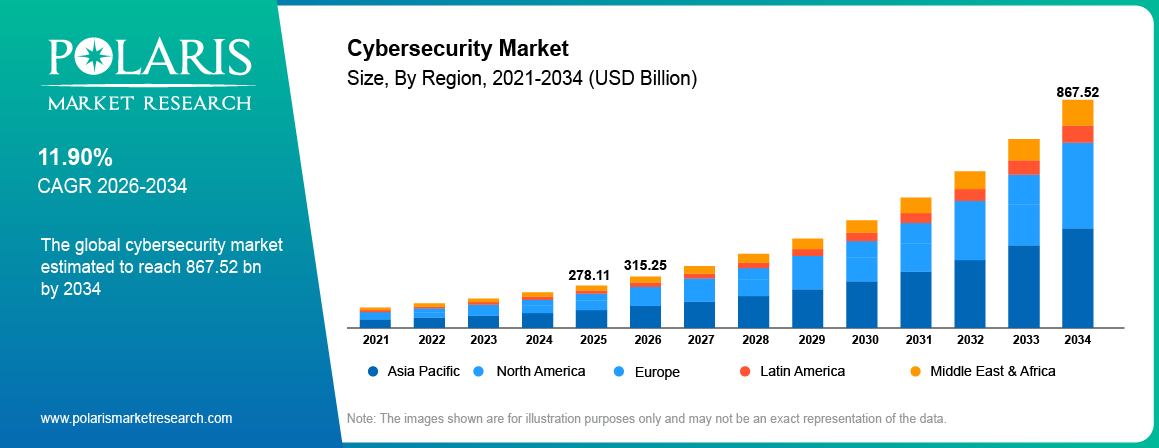
The global cybersecurity market was valued at USD 278.11 billion in 2025 and is expected to grow at a CAGR of 11.90% from 2026 to 2034. Key factors driving demand include increasing adoption of modern technologies such as the Internet of Things and artificial intelligence across numerous domains which is anticipated to boost the cyber security market.
Market Statistics
Key Takeaways
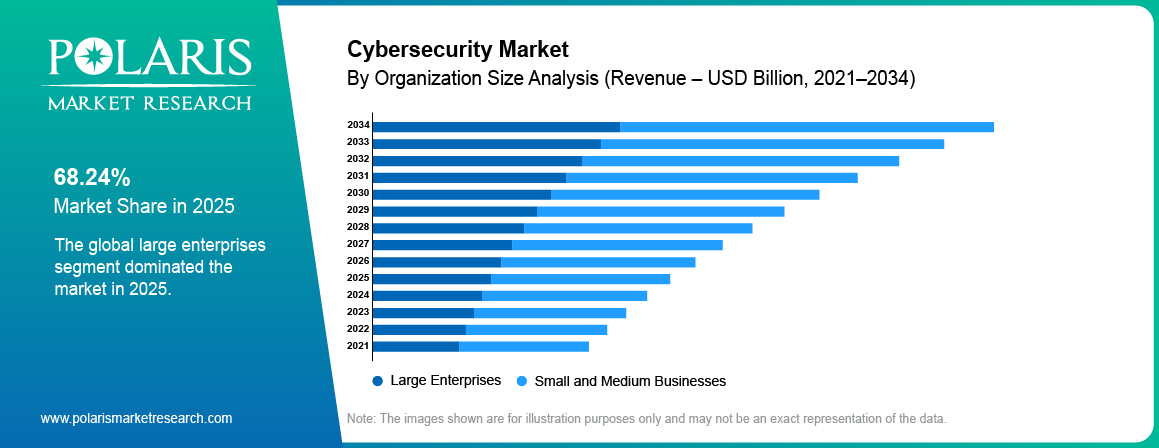
- North America accounted for the largest market share of 38.44% in 2025. This is attributed to the growing use of the web in countries such as the U.S. and Canada.
- Asia Pacific is anticipated to witness the fastest CAGR of 14.58% during the forecast period. This is fueled by rapid industrialization with the rise in adoption of digital transactions.
- The cloud-based segment dominated the cybersecurity market with a market share of 58.36% in 2025. It is propelled by rising storage applications that safeguard data using advanced safety approaches.
- The defense and government segment is expected to grow at a CAGR of 12.42% during the forecast period. This is due to the nature of the sensitive data and information they hold.
- Identity and access management segment was attributed to 29.18% of the cybersecurity market share in 2025, driven by growing adoption of MFA, PAM, ITDR, passwordless authentication, machine identity controls, and zero trust security.
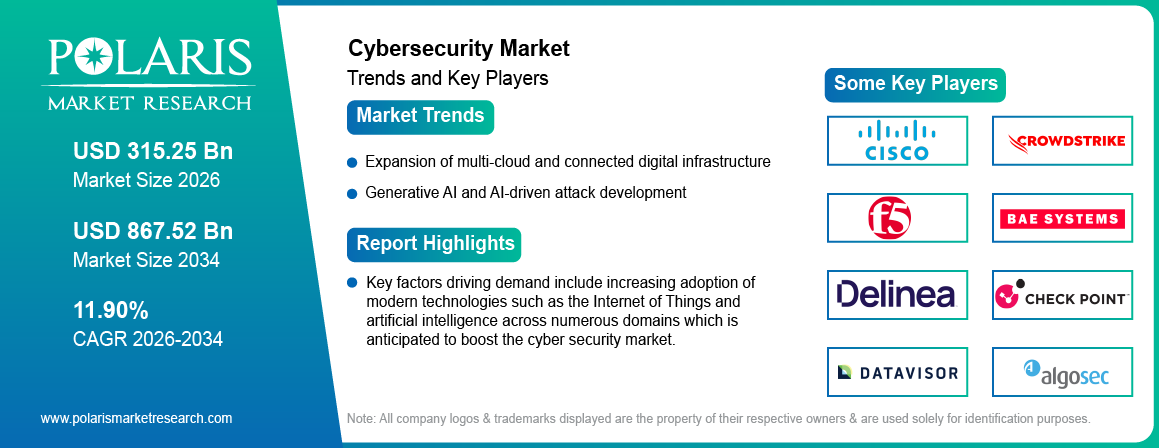
- Large enterprises was attributed to 68.24% of the cybersecurity market share in 2025, supported by complex IT environments, extensive cloud and network infrastructure, higher regulatory exposure, and demand for advanced security solutions.
Note: Figures and projections outlined in this report are the result of Polaris Market Research’s proprietary analytical processes, grounded in the latest available datasets and market observations.
What is Cybersecurity?
Cybersecurity is defined as the application of technologies, software, services, processes and controls to protect digital systems, networks, applications, endpoints, identities, cloud environments, operational technology and data against intrusions, disruptions, manipulation, theft and other cyber attacks. The cyber security market includes preventive, detective, responsive, and disaster recovery capabilities deployed across enterprises, governments, small and medium businesses, and critical infrastructure organizations. According to Microsoft’s 2026 Digital Defense Report, government agencies and services were the most targeted sector, accounting for 27% of observed cyber threat activity in 2026, up from 17% in 2025 (Source: microsoft.com).
Cybersecurity Market Definition
The cybersecurity market includes network security solutions, endpoint security, application security, cloud security, identity and access management, data security, security operations, vulnerability management, threat intelligence, and managed security services. Network security protects connectivity and network traffic. Endpoint security protects computers, mobile devices, servers and other endpoints. Application security is the protection of software, APIs, development environments, and application interfaces. Cloud security helps protect workloads, configurations, identities, applications and data across cloud environments.
The market is also expanding into new classes of security. Zero trust security, attack surface management, exposure management, software supply-chain security, AI security, OT security and post-quantum cryptography are becoming important parts of enterprise security strategies. Organizations are moving from a perimeter-centric protection model to a continuous assessment of identities, devices, applications, workloads, data and network connections.
Security operations are also becoming more integrated. SIEM, SOAR, XDR, EDR, MDR, threat intelligence, and security analytics are increasingly combined into unified platforms. The objective is to improve threat detection, reduce alert overload, accelerate investigation, and automate response. The cybersecurity industry report therefore covers a broad technology and services ecosystem. Market growth is influenced by digital transformation, cloud adoption, AI deployment, connected infrastructure, cyberattack activity, regulatory requirements, security spending, and the increasing financial impact of cyber incidents.
Cybersecurity vs Information Security vs. Network Security
| Dimension | Cybersecurity | Information security | Network security |
| Scope | Digital systems, networks, cloud, endpoints, identities and data | Information in any form, digital or physical | Networks and the traffic on them |
| Primary asset | Systems and data exposed to cyber threats | Confidentiality, integrity and availability of information | Network infrastructure and data in transit |
| Relationship | Broad umbrella for the digital domain | Overlaps heavily; includes non-digital records | One component of cybersecurity |
| Example controls | Endpoint, cloud, identity, application and network controls | Policies, classification, encryption, access control | Firewalls, intrusion prevention, segmentation, VPN |
Source: Polaris Market Research Analysis
AI Impact on the Cybersecurity Market
Artificial intelligence is impacting the cybersecurity market in two directions. AI in cybersecurity applies machine learning and generative AI to detect suspicious activity, correlate security events, prioritize vulnerabilities, automate investigation, and help analysts. AI is capable of analyzing large volumes of endpoint, network, identity, cloud, application, and threat intelligence data faster than manual analysis.
Security operations are increasingly being automated. AI is helping with alert triage, threat correlation, investigation, response recommendations and security workflow creation. In June 2026, Fortinet has announced FortiSOC, a cloud-delivered SOC platform that integrates six security operations capabilities and applies agentic AI to investigate and correlate alerts across assets and identities, with analyst oversight for response actions (Source: fortinet.com).
AI cybersecurity is concerned with securing AI models, AI applications, agents, data, APIs, and connected tools. Prompt injection, unauthorized data access, model manipulation, over-privileged agents and insecure AI integrations are new risks.
Palo Alto Networks announced general availability of its Prisma AIRS AI Gateway in July 2026, calling the platform an AI control plane for enterprise AI infrastructure. The company also highlighted a rise in MCP activity as organizations start to connect more and more artificial intelligence systems to external tools (Source: paloaltonetworks.com).
AI for Cybersecurity vs Cybersecurity for AI
| Factor | AI for cybersecurity | Cybersecurity for AI |
| Purpose | Use AI to detect, investigate and respond to cyber threats | Protect models, training data, AI applications, agents, prompts and AI infrastructure |
| Typical use cases | Alert triage, automated investigation, behavioral analytics, threat hunting | Prompt-injection defense, data-leakage prevention, model-theft and poisoning protection, agent permissions, shadow AI discovery |
| Key risks | False positives, over-automation, adversarial AI | Prompt injection, sensitive data leakage, insecure plugins and tools, AI supply-chain risk |
| Primary buyer | Security operations teams | CISOs, AI governance and platform teams |
Source: Polaris Market Research Analysis
Market Dynamics
Driver: Expansion of Multi-Cloud and Connected Digital Infrastructure
Organizations are increasingly distributing workloads across public cloud, private cloud, SaaS applications, data centers, and edge environments. Fortinet reports that 88% of organizations now operate in hybrid or multi-cloud environments, up from 82% in the year 2025. This configuration leads to an increased number of assets that need continuous security surveillance. Cloud migration changes traditional security boundaries, increasing the need for identity controls, workload protection, configuration monitoring, data security, and centralized visibility (Source: fortinet.com).
Multi-cloud infrastructure is fueling demand for CNAPP, CSPM, CWPP, CIEM, SASE, SSE and CASB technologies. These platforms allow security teams to detect misconfigurations, over-privileged accounts, vulnerable workloads, exposed assets and unauthorized cloud activity. The ever-growing number of connected devices and industrial systems further widens the attack surface, increasing the demand for network, endpoint, OT and IoT security.
Driver: Generative AI and AI-Driven Attack Development
Growing demand for cybersecurity offerings to protect AI applications, models, data, agents, and connected tools is being driven by Generative AI. Organizations are deploying AI assistants, coding tools, autonomous agents, and generative AI applications that can access enterprise information and take actions via APIs. In October 2026, ERMProtect conducted an AI Security Gap Analysis to evaluate the effectiveness of AI security controls in countering emerging threats and to pinpoint vulnerabilities in people, processes, and technology. These systems create new requirements for access control, model governance, data protection, runtime monitoring, and prompt security (Source: prnewswire.com).
Generative AI cybersecurity is also changing offensive cyber capabilities. Threat actors can use AI to accelerate reconnaissance, phishing, social engineering, vulnerability research, malware development, and attack customization. The development is increasing the need for faster threat detection and continuous exposure management.
Driver: Rising Software Supply-Chain and API Risks
Open source libraries, APIs, third-party software, cloud platforms, containers, and external service providers are all critical for modern applications. A vulnerability in one component can cause security exposure for many downstream organizations. This is fueling the demand for SAST, DAST, SCA, DevSecOps, SBOM, application security and software supply-chain monitoring. APIs are also seeing a growing adoption as companies connect applications, monetary systems, cloud services, AI models and external platforms. Weak authentication, too many permissions, vulnerable business logic, exposed data can make big attack paths. To mitigate application and supply-chain risks, organizations thus need API discovery, authentication, authorization, runtime monitoring, vulnerability management and threat detection capabilities.
Driver: Increasing Identity-Based Attacks
As organizations embrace cloud applications, remote access, SaaS platforms, machine identities, service accounts and AI agents, identity has become a significant attack surface. Traditional perimeter defenses can be bypassed by threat actors who use stolen credentials, session tokens, privileged accounts or compromised identities. This trend is fueling demand for identity and access management, PAM, ITDR, MFA, passwordless authentication, least privilege, and machine identity solutions. Zero trust security also puts identity at the heart of access decisions, continuously assessing users, devices, applications and contextual risk. Enterprises are thus moving from perimeter-centric controls to identity-centric security architectures with continuous authentication, authorization, privilege management, and threat detection.
Restraint: Cybersecurity Talent Shortage
The cybersecurity talent shortage remains a major challenge as organizations require specialists in cloud security, threat intelligence, application security, identity, incident response, OT security, AI security, and security engineering. Smaller organizations may lack dedicated teams or 24/7 monitoring capabilities. Security tool fragmentation also creates operational complexity as enterprises use separate platforms for endpoint, network, cloud, identity, application, and security operations. Disconnected systems can generate duplicate alerts, inconsistent policies, limited visibility, and higher costs. Legacy systems, regulatory fragmentation, implementation costs, integration complexity, and difficulty measuring cybersecurity ROI can further delay modernization.
Opportunity: Increasing Cybersecurity Requirements for Connected Infrastructure
Operational systems within manufacturing, energy, transportation, healthcare, automotive, and utilities are connecting to enterprise networks, cloud platforms, and external applications. The convergence creates new exposure across industrial control systems, SCADA environments, industrial IoT, connected vehicles, and smart infrastructure. Thus, the cybersecurity market is expanding across OT security, ICS security, network segmentation, vulnerability management, secure remote access, asset discovery, identity controls, and threat monitoring. Organizations need more visibility across IT and operational environments to discover vulnerable assets and unauthorized activity. As reliance on interconnected infrastructure increases, so too does demand for cybersecurity solutions designed to protect critical systems where operational disruption can pose risks to financial, safety, and service delivery.
Common Cyber Threats and Attacks
- Ransomware: Ransomware can encrypt systems, disrupt operations, steal sensitive information and ask for payment. Increasingly modern campaigns target identities, cloud environments, backups and business critical data.
- Phishing: Phishing is a method used to steal credentials or deceive users using scam emails, websites, messages or documents. Generative artificial intelligence can enhance message quality and personalization, making it harder to identify fraudulent communication.
- Business Email Compromise (BEC): BEC attacks depend on hijacked or impersonated business accounts to deceive employees into moving money, changing payment details, sharing information or providing credentials.
- Credential Theft: Attackers steal passwords, authentication tokens, session cookies, privileged credentials and service accounts. MFA, PAM, ITDR, passwordless authentication & identity security reduce exposure.
- Cloud Account Compromise: Cloud credentials that are compromised can be used to gain access to applications, storage, workloads and sensitive data. Misconfigured permissions and excessive privileges can increase the possible effect.
- DDoS Attacks: DDoS attacks aim to inundate networks, applications, websites and digital services with too much traffic, making them unavailable and their business processes inoperable. Increasing cloud adoption, APIs, and connected digital infrastructure is driving demand for DDoS protection, network security solutions, traffic monitoring, threat detection, and managed security services.
- Supply Chain Attacks: Compromise software vendors, open-source components, development pipelines, service providers, third-party infrastructure. Improving visibility can be helped by SBOMs, software composition analysis, supplier risk management and application security.
- API attacks: APIs may expose sensitive data or business functions when they do not have appropriate authentication, authorization, rate limiting or input validation. API security is thus becoming a critical application protection category.
- Zero-Day Attacks: Zero-day vulnerabilities can be exploited before organizations deploy patches. Exposure management, threat intelligence, vulnerability prioritization and fast remediation can reduce the window of exposure.
- Insider Threat: Malicious or compromised employees, contractors and third party users may misuse legitimate access. Least privilege, behavioral analytics, identity controls and data loss prevention can help reduce risk.
- AI-Powered Social Engineering: AI is able to be leveraged to automate and personalize social engineering campaigns. This trend fuels the need for identity protection, email security, behavioral analytics and employee security controls.
Types of Cybersecurity Solutions
Cybersecurity solutions are designed to protect various layers of an organization’s technology environment.
- Network security solutions safeguard networks, communication channels, traffic, and connectivity. Commonly used controls are firewalls, intrusion prevention, network detection, DNS security and secure gateways.
- Endpoint security protects servers, computers, mobile devices, and other endpoints. EDR offers endpoint telemetry and response. XDR correlates signals across multiple security domains.
- Application security protects software during development and in operation. SAST, DAST, SCA, API security, runtime protection, DevSecOps, and SBOM technologies address different stages in the software lifecycle.
- Cloud security secures cloud workloads, identities, configurations, applications and data. The cloud security market is expanding to encompass CNAPP, CSPM, CWPP, CIEM, SASE, SSE, SWG, and CASB technologies.
- Identity security covers IAM, PAM, ITDR, MFA, passwordless authentication, and machine identity protection. "With the growth of cloud applications and automated systems, controls around identity are becoming more important.
- Data security secures sensitive information using encryption, data classification, control of access, monitoring, backup and data loss prevention .
- Security operations solutions include SIEM, SOAR, XDR, EDR, MDR, threat intelligence and security analytics. They also help security teams consolidate telemetry and better detect threats.
- Cybersecurity services include consulting, implementation, monitoring, incident response, managed security, vulnerability assessment and security testing. The managed security services market benefits from increasing operational complexity and cybersecurity talent shortages.
Key Technology Trends Shaping Cybersecurity Market
The cybersecurity market trends 2026 reflect a shift from perimeter protection toward identity-centric, cloud-native, AI-enabled for AI-driven attacks, and exposure-focused security. Organizations are also consolidating security operations and increasing protection for software, industrial systems, and AI infrastructure.
What Is Zero Trust Security?
Zero trust security assumes that users, devices, applications, and systems should not receive implicit trust based only on network location. The constant review of access decisions is affected by identity, device status, resource sensitivity, context and risk.
ZTNA provides access to specific applications, not wide area network access. The principle of least privilege means that users are given only the permissions they require to perform a task. Microsegmentation divides networks and workloads into smaller security zones to stop lateral movement after a breach.
Zero Trust vs Traditional Security
| Factor | Traditional security | Zero Trust |
| Trust model | Network or perimeter-based | Continuous verification of every user, device and workload |
| User access | Broad once authenticated | Least privilege, evaluated per session |
| Network design | Trusted internal zone | Assume breach; microsegmentation |
| Identity | One layer among several | Central policy control point |
| Monitoring | Periodic review | Continuous, telemetry-driven |
| Typical technologies | Firewalls, VPN, antivirus | ZTNA, IAM and MFA, device posture checks, microsegmentation |
Source: Polaris Market Research Analysis
XDR, MDR, SIEM and SOAR: Security Operations Convergence
SIEM collects and analyzes security events from a variety of sources. SOAR automates defined investigation and response workflows. XDR correlates signals across endpoints, networks, identities, cloud environments and other security layers. EDR is focused on endpoint monitoring and response. MDR marries technology with human expertise to provide continuous threat detection and response.
SIEM vs SOAR vs XDR vs EDR vs MDR
| Technology | Primary function | Data sources | Automation level | Main user |
| SIEM | Collects, correlates and retains log data for detection and compliance reporting | Logs from network, servers, applications, cloud and identity systems | Low to medium | SOC analysts, compliance teams |
| SOAR | Orchestrates and automates incident-response workflows through playbooks | Alerts and cases from SIEM, XDR, ticketing and threat intelligence | High | SOC engineers, incident responders |
| EDR | Detects and responds to threats on endpoints | Endpoint telemetry (processes, files, memory, connections) | Medium | Endpoint security and response teams |
| XDR | Unifies detection and response across endpoint, identity, network, email and cloud | Cross-domain telemetry | Medium to high | SOC analysts, threat hunters |
| MDR | Outsources 24/7 monitoring, detection and response to a provider | Customer telemetry through the provider's EDR, XDR or SIEM | High (provider-led) | Lean security teams, SMEs, CISOs |
Source: Polaris Market Research Analysis
The convergence of these technologies is supporting platform consolidation. AI-enabled security operations can further improve alert triage, investigation, threat correlation, and response.
Identity-Centric Security: IAM, PAM and ITDR
Identity-centric security protects users, administrators, applications, devices, service accounts, and machine identities. IAM handles identity lifecycle and access. PAM locks down privileged accounts. ITDR is built to identify and react to threats to identities.
The increasing use of cloud services, APIs, service accounts, and AI agents is increasing the number of machine identities. MFA, passwordless authentication, adaptive access, behavioral analytics, and least privilege are therefore becoming important components of identity protection.
Cloud-Native Security: CNAPP, SASE and SSE
Cloud-native environments require security controls that cover applications, workloads, configurations, identities, networks, and data. CNAPP combines cloud application and infrastructure security capabilities. CSPM identifies risks in cloud configurations. CWPP secures cloud workloads. CIEM finds too many or the wrong cloud permissions.
SASE delivers networking and security capabilities out of the cloud. SSE is a suite of cloud-delivered security features such as secure web access and zero trust access. CASB provides visibility and policy enforcement across cloud applications.
The expansion of hybrid and multi-cloud infrastructure is therefore increasing demand for integrated cloud security architectures.
Application, API and Software Supply-Chain Security
Application security is becoming a strategic requirement as software becomes central to business operations. Organizations depend on open-source components, APIs, cloud services, containers, and third-party development tools.
SAST identifies vulnerabilities in source code. DAST looks at applications from the outside, or from a run-time perspective. SCA identifies open source dependencies vulnerabilities and risks. DevSecOps combines security controls with development workflows. SBOM technology exposes visibility into software components and dependencies.
API security is also growing as APIs connect business applications, data, cloud services and artificial intelligence (AI) systems. API security functions such as authentication, authorization, runtime monitoring, data protection and abuse detection are becoming important.
Attack Surface and Exposure Management
Attack surface management discovers assets that attackers can discover or reach. Exposure management extends this to include vulnerabilities, identities, misconfigurations, cloud assets, applications, external systems and potential attack paths.
CTEM provides a continuous process to identify, validate, prioritize, and remediate exposures. Vulnerability management is still important, but more and more enterprises want to see prioritization based on exploitability, asset criticality, exposure and business impact.
Threat intelligence enhances this process by providing information about active threat actors, exploited vulnerabilities, attack infrastructure and new attack techniques.
OT and Critical Infrastructure Security
OT security protects industrial systems and operational environments used in manufacturing, energy, utilities, transportation and other critical infrastructure sectors. ICS and SCADA environments have specific protection requirements, driven by both operational needs and long asset lifecycles.
Industrial IoT is connecting physical assets to enterprise networks and cloud systems. This means there is a need for asset visibility, segmentation, secure remote access, identity controls, vulnerability management, anomaly detection and incident response.
IT security vs OT security
| Factor | IT security | OT security |
| Top priority | Confidentiality of data | Availability and safety of physical processes |
| Assets | Servers, endpoints, applications, cloud | PLCs, SCADA, industrial control systems, industrial IoT sensors |
| Patching | Frequent, largely automated | Infrequent; limited by uptime and vendor certification |
| Equipment lifecycle | Short refresh cycles | Often a decade or more |
| Protocols | TCP/IP, HTTP and standard enterprise stacks | Industrial and often proprietary protocols |
| Impact of an incident | Data loss, fraud, downtime | Physical disruption and safety incidents |
| Typical controls | EDR, IAM, SIEM | Network segmentation, passive monitoring, secure remote access |
Source: Polaris Market Research Analysis
Post-Quantum Cryptography Is Creating a New Cybersecurity Upgrade Cycle
Post-quantum encryption is building a long-term technology transition as organizations prepare for future quantum computing cryptographic threats. In 2024, NIST released three post-quantum cryptography standards and chose HQC for further work in standardization in 2025 (ampcuscyber.com).
Organizations must find weak cryptographic systems, evaluate dependencies, plan for migrations, and build crypto agility. Quantum-resistant security will be applicable to financial services, government, telecommunications, cloud platforms, critical infrastructure and other environments where long-term protection of sensitive information is required.
Governance, Regulation and NIST CSF 2.0
Cybersecurity is emerging as a board-level risk management responsibility. NIST CSF 2.0 offers organizations a framework to understand, assess, prioritize, and communicate cybersecurity risk. The updated framework applies to organizations and puts greater emphasis on governance and supply-chain risk (Source: nist.gov).
NIST Cybersecurity Framework 2.0 Functions and Market Relevance
| Function | What it covers | Related solution categories |
| Govern | Cybersecurity risk strategy, expectations and policy | GRC, risk and compliance management |
| Identify | Understanding assets, risks and vulnerabilities | Asset discovery, attack surface management, vulnerability management |
| Protect | Safeguards that reduce likelihood and impact | IAM, encryption, endpoint and network security |
| Detect | Finding possible compromises | SIEM, XDR, network detection |
| Respond | Acting on detected incidents | SOAR, MDR, incident-response services |
| Recover | Restoring operations after an incident | Backup, disaster recovery |
Source: Polaris Market Research Analysis
The framework also offers guidance on how to manage cybersecurity supply chain risk. It can be used by organizations to set supplier requirements, conduct due diligence, measure third-party risk, and integrate supply-chain security into enterprise risk management.
NIS2 is another big regulatory driver in Europe. It increases cybersecurity obligations in critical sectors and raises demands concerning risk management, incident reporting, supply chains and management accountability.
The SEC cyber disclosure rules also increase board-level cyber risk requirements for public companies. A material cybersecurity incident generally requires disclosure through Form 8-K within four business days after the company determines that the incident is material.
Cybersecurity Market Segmentation Analysis
The cybersecurity market segmentation includes type, component, solution, deployment mode, organization size, end user, and region.
Type Insights
The enterprise security segment dominated the cybersecurity market share in 2025, accounting for 25.42% of total revenue. The segment covers integrated protection across organizational networks, endpoints, applications, identities, cloud environments, and data. Growing digital infrastructure and complex enterprise technology environments are increasing demand for centralized security controls. Organizations are also deploying network security solutions, endpoint security, cloud security, identity and access management, SIEM, XDR, and threat intelligence to gain better visibility, improve threat detection, and close security gaps across distributed IT environments and connected business operations.
The application security segment is expected to grow at a 13.54% CAGR during the forecast period, owing to the increasing adoption of cloud-native applications, APIs, mobile platforms, and AI-enabled software. With the increasing reliance on digital applications, application vulnerabilities, API attacks, and software supply chain risks increase. This is driving adoption of SAST, DAST, SCA, DevSecOps, SBOM, API security, vulnerability management and runtime protection. Organizations are also embedding application security into software development processes to find vulnerabilities sooner, protect sensitive data and lower the risks across the software development lifecycle.
Component Insights
In 2025, the solutions segment accounted for the largest share of the cybersecurity market, contributing 63.44% of the total revenue. This segment includes security platforms and software for networks, endpoints, applications, cloud infrastructure, identity and data. Growing cyber risks and expanding enterprise infrastructure is driving demand for integrated cybersecurity solutions such as network security, endpoint security, cloud security, application security and identity security. Organizations are also converging security technologies to improve their ability to see threats, automate detection, improve security operations and close gaps across different technology environments. These are the factors driving the investment in security solutions.
The services segment is estimated to grow at a pace of 13.07% over the forecast period due to increasing cybersecurity complexity and the shortage of skilled security professionals. Organizations are outsourcing monitoring, threat detection, incident response, vulnerability management, consulting, and compliance activities to specialized providers. This trend is increasing demand for the cybersecurity services market, managed security services market, managed detection and response (MDR), managed SIEM, threat intelligence, and incident response services. External providers can help organizations maintain constant monitoring, improve response capabilities and reduce the need for large internal cybersecurity teams.
Solution Insights
The identity and access management segment held the largest market share in 2025, accounting for 29.18% of the total revenue. This segment includes technologies that regulate access to applications, systems, data and digital resources. With cloud adoption, remote access, SaaS applications, machine identities, and service accounts, the number of identities organizations need to protect is increasing. This is fueling demand for IAM, MFA, PAM, ITDR, passwordless authentication, machine identity, least privilege and zero trust security. Organizations are deploying identity-centric controls to help fight credential theft, unauthorized access, account takeover and over-privileged accounts.
The risk and compliance management segment is estimated to grow at 13.42% over the forecast period owing to rising regulatory requirements and heightened board-level cyber risk focus. Organizations must monitor security controls, third-party risks, incident reporting requirements and regulatory obligations across complex technology environments. This is driving increased demand for risk & compliance management, threat intelligence, vulnerability management, exposure management and cybersecurity governance solutions. Organizations are also increasing their documentation, ongoing risk assessment, third party monitoring, and cybersecurity reporting across business operations due to increased regulatory scrutiny.
Cybersecurity by Solutions: Comparison Matrix
| Segment | Primary function | Representative technologies | Demand lens | 2025 share / CAGR |
| Identity and access management | Control who and what can access resources | IAM, PAM, MFA, ITDR | Remote work, machine identities | 29.18% Share |
| Network security / UTM | Protect network traffic and perimeters | Firewalls, IPS, UTM, SSE | Hybrid networks | 23.86% Share |
| Endpoint security | Protect devices and workloads | Antivirus, EDR, XDR | Distributed devices | 12.46% CAGR |
| Cloud security | Secure cloud workloads and configurations | CNAPP, CSPM, CWPP, CIEM | Multi-cloud adoption | 58.36% Share |
Source: Polaris Market Research Analysis
Deployment Mode Insights
Cloud-based segment accounted for the largest share of the market in 2025, with a 58.36% share of the total revenue. Cloud-based deployment offers scalability, centralized policy management, rapid updates and security visibility across distributed environments. Growing need for cloud-native protection as more SaaS applications, public cloud services and hybrid infrastructure are being adopted. Therefore, organizations are embracing cloud security, CNAPP, CSPM, CWPP, CIEM, SASE, SSE and CASB technologies. “These solutions enable organizations to manage security across multi-cloud environments, monitor workloads and identities, find misconfigurations and strengthen protection across applications, data and cloud infrastructure.
The on-premise segment is expected to grow at a CAGR of 8.51% during the forecast period. This is due to data sovereignty requirements, regulatory controls, legacy infrastructure, and the need to have direct control over sensitive systems. BFSI, healthcare, defense and government, manufacturing and critical infrastructure organizations continue to deploy on-premise security solutions, for more control over data, access policies and security operations. On premise cybersecurity adoption in regulated and highly sensitive environments is driven by demand for network security, endpoint security, IAM, PAM, SIEM, SOAR, XDR and data loss prevention.
Cybersecurity Deployment Mode: Comparison Matrix
| Factor | Cloud-based | On-premises |
| Scalability | Scales with workloads and users | Limited by owned capacity |
| Policy management | Centralized across environments | Managed per site or system |
| Deployment speed | Rapid; continuous updates | Slower; scheduled upgrades |
| Data control and residency | Shared-responsibility model | Full control; suited to strict residency rules |
| Typical adopters | Cloud-first enterprises, SMEs | Regulated and legacy-heavy organizations |
Source: Polaris Market Research Analysis
Organization Size Insights
In 2025, the large enterprise segment dominated the market with the 68.24% share of the total revenue. Large enterprises have large networks, cloud environments, applications, endpoints, and data infrastructure they operate across multiple locations. This expansive technology footprint enlarges the attack surface for ransomware, phishing, credential theft, insider threats, and supply-chain attacks. Organizations therefore need advanced SIEM, SOAR, XDR, EDR, IAM, PAM, threat intelligence, cloud security, application security and managed security services. Greater adoption of integrated security platforms among large enterprises is also supported by larger cybersecurity budgets, more complex technology environments and higher regulatory exposure.
The small and medium business category is expected to witness a growth of 14.22% during the forecast period due to the usage of cloud software by smaller businesses, electronic payments, remote work and connected business platforms by smaller businesses. Smaller businesses do not have any security experts in-house as well as their budgets for technology is very small, thereby increasing the requirement of scalable security solutions. Managed security services, MDR, endpoint security, cloud security, subscription-based cybersecurity, and threat automation reduce the dependency on internal resources. This trend is creating opportunities for security solution providers.
End User Insights
The BFSI segment led the cybersecurity market in 2025 with a share of around 20.86% of the overall revenue. Financial institutions run payment systems, customer identities, financial information, trading platforms and digital banking applications, hence cybersecurity is a critical business requirement. Increased digital banking adoption and cyber risks are driving demand for identity security, application security, encryption, data loss prevention, cloud security, SIEM, threat intelligence, and risk and compliance management. Financial institutions are also strengthening protections against phishing, ransomware, credential theft, API attacks, and other threats to financial information, customer data, and connected digital banking infrastructure.
The defense and government segment is expected to record a CAGR of 12.42% during the forecast period owing to rising cyber risks targeting sensitive information, government applications, defense systems, and critical national infrastructure. Public-sector organizations are increasing their investments in zero trust security, network security solutions, endpoint security, identity and access management, encryption, threat intelligence, incident response, and software supply-chain security. Increasing demand for advanced defense cybersecurity controls is also driven by the growing emphasis on national cyber resilience. These requirements are expected to support cybersecurity spending by industry across defense agencies and government organizations facing ransomware, espionage, supply-chain attacks, and advanced persistent threats.
Real-World Cybersecurity Use Cases
- AI Security: Organizations deploying generative AI and autonomous agents need protections against prompt injection, model access, data leakage, agent permissions, API connections and runtime behavior. New AI security platforms are providing centralized visibility and policy enforcement.
- Cloud Security: Organizations that run hybrid and multi-cloud infrastructures use CNAPP, CSPM, CWPP and CIEM to discover vulnerable workloads, misconfigurations, excessive permissions and exposed assets.
- Financial Services: Banks and financial institutions protect digital banking and payment environments by using identity protection, application security, encryption, threat detection, fraud analytics, and data security.
- Critical Infrastructure: Securing operational environments within energy, manufacturing, utilities and transportation organizations with OT security, network segmentation, secure remote access, identity controls and threat monitoring.
- Security Operations: Enterprises use SIEM, SOAR, XDR, EDR, MDR, threat intelligence, and AI-assisted investigation to consolidate security signals, prioritize incidents, and accelerate response.
Cybersecurity Market Regional Insights
Factors influencing the cybersecurity market by region are digital infrastructure, cyber security maturity, technology spending, regulatory requirements, cyberattack exposure and government initiatives. North America was the highest regional market in 2025 and Asia Pacific is expected to register highest growth rate.
North America Cybersecurity Market Trends
North America held the largest share of 38.44% in 2025 in the market due to mature digital infrastructure, high technology spending by enterprises, strong cloud adoption, and presence of major cybersecurity vendors. In August 2026, Horizon3.ai secured USD 20 million to fuel partner-led growth and extend its autonomous cybersecurity platform, driving faster adoption of automated security testing and threat exposure management. Regional organizations are increasing investments in cloud security, network security solutions, endpoint security, identity and access management, application security, SIEM, SOAR, XDR, EDR and managed security services. The growing use of multi-cloud environments, connected infrastructure and digital applications is also spurring demand for zero trust security, threat detection, exposure management and vulnerability management solutions across enterprises (Source: businesswire.com).
The U.S. is the largest cybersecurity market in the region, with strong spending across BFSI, healthcare, technology, manufacturing, defense, government and critical infrastructure. Increasing use of generative AI, cloud platforms, APIs and connected systems is creating other security requirements. NIST CSF 2.0, SEC cyber disclosure requirements, zero trust security, board-level cyber risk management and software supply-chain security are impacting enterprise strategies. Organizations are also beefing up IAM, PAM, MFA, app security, API security, threat intelligence and incident response for ransomware, phishing, credential theft and AI-powered attacks.
Asia Pacific Cybersecurity Market Trends
The Asia Pacific market is expected to register the highest CAGR of 14.58% during the forecast period due to the digital banking, industrialization, cloud adoption, e-commerce, connected devices and industrial digitalization. Important markets are China, Japan, India, South Korea, Malaysia, and Indonesia. Financial services companies are increasing their investment in IAM, application security, data security, fraud prevention and cloud security, while manufacturers are implementing OT security, ICS security, industrial IoT protection, network segmentation and threat monitoring. October 2026 – V-Key makes strategic majority investment in Singaporean CloudsineAI to expand AI cybersecurity, agentic security and digital identity capabilities for the AI economy. These developments are expanding the enterprise and critical infrastructure cybersecurity market (Source: Kyodo News).
Digital payments, e-commerce, cloud adoption, online government services and expanding enterprise technology infrastructure are driving further demand for cybersecurity in India. With increasing digital activity, organizations are increasing adoption of endpoint security, identity security, API security, application security, managed security services, MDR, SIEM and threat intelligence. The rise of AI applications and multi-cloud environments are also driving requirements for generative AI security, exposure management, vulnerability management and software supply-chain security. The growing awareness of cyber risks is anticipated to facilitate the continuous expansion of the cybersecurity market in the region.
Europe Cybersecurity Market Trends
Europe accounted for approximately 26.18% of the cybersecurity market in 2025 owing to the digital transformation, increasing adoption of the cloud, and rising regulatory requirements. In September 2026, the EIB Group made its inaugural ETCI co-investment in the cybersecurity company Exein via a funding round of about USD 262 million, valuing the company at approximately USD 1.63 billion. Organizations are increasing their investments in cloud security, IAM, application security, OT security, vulnerability management, risk and compliance management and zero trust security. Financial services, healthcare, energy, manufacturing, transportation, telecommunications and government still are major demand centers. The increasing use of AI, along with connected infrastructure, is also driving demand for AI security, network security solutions and software supply chain protection (Source: eif.org).
Latin America Cybersecurity Market Trends
In 2025, Latin America accounted for 6.23% of the cybersecurity market, as organizations scale digital banking, cloud adoption, e-commerce and connected services. Brazil is a significant regional market in financial services, telecommunications, retail, manufacturing and technology. More and more companies need identity security, endpoint security, cloud security, application security, API security, and managed security services. The cybersecurity talent shortage is also increasing demand for MDR and outsourced security operations. Growing digital infrastructure and cyber threats are expected to increase demand for threat detection, vulnerability management, data security, and incident response capabilities.
Middle East & Africa Cybersecurity Market Trends
The Middle East & Africa is growing rapidly with an 13.07% CAGR in the cybersecurity market supported by digital transformation, smart city programs, fintech, cloud adoption, energy infrastructure, and national cybersecurity initiatives. The UAE, Saudi Arabia, Israel, and South Africa are important markets. Organizations are increasing spending in cloud security, network security, identity and access management, OT security, application security and critical infrastructure protection. Digital payments, telecommunications, financial services, government digitalization and cloud services are just some of the areas in which markets are developing across Africa. Increasing connectivity is expected to strengthen demand for endpoint security market, identity security, data protection, managed security services, and threat monitoring.
Cybersecurity Market Competitive Insights
The cybersecurity market is highly competitive due to rapid technology development, evolving cyber threats, frequent product launches, acquisitions, partnerships, and platform consolidation. Vendors are increasingly combining network, cloud, endpoint, identity, application, data, and security operations technologies. Vendors are focusing on a competitive intelligence and strategy to take advantage of new markets and growth, especially among small and medium-sized brands. The growth outlook in security markets remains positive, backed up by pent-up demand and potential in both developed and emerging markets, though growth is heavily a function of navigating inflationary economies and geopolitical economic shifts. Moreover, understanding of market trends will be a significant influence on how organizations in the market will articulate effective strategies for developing their organizations in the future. Cybersecurity companies are investing in research & development and are indulging in marketing strategies such as partnerships & collaborations, mergers & acquisitions, product launches, and developments in order to increase their market footprint and acquire more clients.
AI is also becoming a major competitive factor. Vendors are developing AI-assisted detection, autonomous investigation, AI security, agent security, automated remediation, and AI-native security operations. The cybersecurity market key players are competing through integrated platforms, cloud expansion, AI capabilities, managed services, strategic partnerships, acquisitions, and geographic expansion.
Market Positioning Table
| Vendor | Core positioning | Market positioning |
| AlgoSec, Inc. | Application-centric network security and policy management | Niche specialist focused on hybrid-network visibility, security-policy automation, application connectivity, and compliance. |
| BAE Systems, Inc. | Defense, aerospace, intelligence and cyber solutions | Strong mission-critical and government cybersecurity position, differentiated by defense expertise and complex-environment capabilities. |
| Check Point Software Technologies Ltd. | Network, cloud, endpoint, IoT and application security | Established integrated security platform with broad enterprise coverage across network, cloud, endpoint and emerging workloads. |
| Cisco Systems, Inc. | Network security, secure access, XDR and security operations | Leading enterprise security and networking ecosystem, strengthened by integrated security analytics and observability capabilities. |
| CrowdStrike Holdings, Inc. | Cloud-native endpoint security, XDR and threat intelligence | Leading AI-driven, cloud-native security platform with strong endpoint, identity, threat intelligence and security-operations positioning. |
| DataVisor, Inc. | AI-driven fraud, risk and anomaly detection | Specialist in AI-powered detection and risk analytics, with a differentiated position in fraud prevention and real-time anomaly detection. |
| Delinea, Inc. | Privileged access management and identity security | Specialist identity-security vendor focused on privileged access, least privilege, machine identities and AI-agent access governance. |
| F5, Inc. | Application security, API security and application delivery | Strong application and API security position, particularly for hybrid and multi-cloud environments and distributed applications. |
| Fortinet, Inc. | Network security, secure networking and unified security platform | Major network-security vendor with integrated appliances, secure networking and broad enterprise/branch security coverage. |
| F-Secure Corporation | Endpoint, privacy and cyber protection | Established endpoint and cyber-protection provider, with stronger positioning in consumer and selected business security segments. |
| Gen Digital Inc. | Consumer cybersecurity, identity and digital safety | Major consumer cybersecurity platform with broad endpoint, privacy, identity and online-safety offerings. |
| Google LLC | Cloud, threat intelligence, identity and AI security | Strong cloud-security ecosystem combining Google Cloud security, threat intelligence, AI security and Mandiant capabilities. |
| Hewlett Packard Enterprise Company | Hybrid cloud, networking, edge and security infrastructure | Enterprise infrastructure player with security capabilities embedded across networking, hybrid cloud, edge and data-center environments. |
| Intel Corporation | Hardware security, platform security and trusted computing | Security-enabling semiconductor leader, providing hardware-based security features across processors, platforms and data-center infrastructure. |
| International Business Machines Corporation (IBM) | Security operations, identity, data security and hybrid-cloud security | Broad enterprise cybersecurity portfolio combining AI, security operations, identity, data protection and consulting. |
| LogRhythm, Inc. | SIEM and security analytics | Security-operations specialist centered on SIEM, log management and threat detection; positioned as a focused SOC technology provider. |
| Microsoft Corporation | Identity, endpoint, cloud, application and security operations | One of the broadest cybersecurity ecosystems, integrating security across Microsoft 365, Azure, endpoints, identities and security operations. |
| Okta, Inc. | Identity and access management | Leading identity-first security specialist focused on workforce and customer identity, access management and zero-trust enablement. |
| Palo Alto Networks, Inc. | Network, cloud, endpoint and security operations | Leading broad-platform cybersecurity vendor spanning network security, cloud security, SASE, SOC and AI-powered security operations. |
| Proofpoint, Inc. | Email, data, identity and human-centric security | Specialist in protecting people, communications and sensitive information, with strong email, data and insider-risk capabilities. |
| Qualys, Inc. | Cloud security, vulnerability management and compliance | Established cloud-based security and compliance platform with strong asset visibility, vulnerability management and risk assessment capabilities. |
| RevBits, Inc. | Integrated enterprise cybersecurity platform | Emerging cybersecurity provider offering integrated controls across endpoint, identity, email, privileged access and other security domains. |
| SentinelOne, Inc. | AI-native endpoint, cloud and XDR security | Strong AI-driven autonomous security position across endpoint, cloud, identity and security operations. |
| SonicWall Inc. | Network, endpoint, secure access and branch security | Established network-security provider with strong positioning in distributed enterprises, SMBs and managed-security environments. |
| Trend Micro Incorporated | Cloud, network, endpoint, IoT and enterprise security | Broad cybersecurity portfolio with strong cloud and workload security, endpoint protection, network defense and IoT security capabilities. |
| HttpCart Technologies Pvt. Ltd. (WiJungle)
| Unified network and cybersecurity platform | Emerging security vendor focused on unified network-security, gateway and access-control capabilities, particularly for distributed deployments. |
| Zscaler, Inc. | Zero-trust access, SSE and cloud-delivered security | Leading cloud-native security platform centered on zero trust, secure access, SSE and protection for distributed users and applications. |
Source: Polaris Market Research Analysis
Key Players
Some of the major cybersecurity companies include:
- AlgoSec, Inc.
- BAE Systems Inc.
- Check Point Software Technologies Ltd.
- Cisco Systems, Inc.
- CrowdStrike Holdings, Inc.
- DataVisor, Inc.
- Delinea, Inc.
- F5, Inc.
- Fortinet, Inc.
- F-Secure Corporation
- Gen Digital Inc.
- Google LLC
- Hewlett Packard Enterprise Company
- HttpCart Technologies Pvt. Ltd. (WiJungle)
- Intel Corporation
- International Business Machines Corporation
- LogRhythm, Inc.
- Microsoft Corporation
- Okta, Inc.
- Palo Alto Networks, Inc.
- Proofpoint, Inc.
- Qualys, Inc.
- RevBits, Inc.
- SentinelOne, Inc.
- SonicWall Inc.
- Trend Micro Incorporated
- Zscaler, Inc.
Recent Developments
- February 2026, Palo Alto Networks completed the acquisition of CyberArk, making identity security a core pillar of its platform and expanding protection across human, machine and agentic identities. (Source: paloaltonetworks.com)
- March 2026, Google completed its acquisition of Wiz to enhance Google Cloud security across the cloud and AI and bolster hybrid and multi-cloud security. (Source: cloud.google.com)
- March 2026, Cisco launched new security features for AI agents, including agentic identity and access management, AI Defense Explorer, MCP policy enforcement, and new Splunk AI security operations features. (Source: newsroom.cisco.com)
- April 2026, ServiceNow finalized its roughly $7.75 billion acquisition of Armis to strengthen its cybersecurity platform with live asset discovery, cyber exposure management, and protection across IT, OT, IoT, medical devices, and critical infrastructure. (Source: investor.servicenow.com)
- December 2025, NIST issued the final CSWP 39 on how to achieve crypto agility, detailing methods for adapting cryptographic techniques and supporting the transition to post-quantum cryptography. (Source: nist.gov)
Cybersecurity Market Segmentation
By Type Outlook (Revenue, USD Billion, 2021–2034)
- Enterprise Security
- Network Security
- Application Security
- Endpoint Security
- Others
By Component Outlook (Revenue, USD Billion, 2021–2034)
- Solutions
- Services
By Solution Outlook (Revenue, USD Billion, 2021–2034)
- Encryption
- Unified Threat Management
- Identity and Access Management
- Data Loss Prevention
- Antivirus/Anti-Malware
- Risk and Compliance Management
- Disaster Recovery
- Others
By Deployment Mode Outlook (Revenue, USD Billion, 2021–2034)
- On-Premise
- Cloud-Based
By Organization Size Outlook (Revenue, USD Billion, 2021–2034)
- Large Enterprises
- Small and Medium Businesses
By End User Outlook (Revenue, USD Billion, 2021–2034)
- BFSI
- Healthcare
- IT and Telecom
- Retail
- Defense and Government
- Manufacturing
- Energy and Utilities
- Automotive
- Education
- Transportation
- Media
- Travel and Hospitality
- Critical Infrastructure
- Others
By Regional Outlook (Revenue, USD Billion, 2021-2034)
- North America
- U.S.
- Canada
- Europe
- Germany
- France
- UK
- Italy
- Spain
- Netherlands
- Russia
- Rest of Europe
- Asia Pacific
- China
- Japan
- India
- Malaysia
- South Korea
- Indonesia
- Australia
- Vietnam
- Rest of Asia Pacific
- Middle East & Africa
- Saudi Arabia
- UAE
- Israel
- South Africa
- Rest of Middle East & Africa
- Latin America
- Mexico
- Brazil
- Argentina
- Rest of Latin America
Cybersecurity Market Report Scope
| Report Attributes | Details |
| Market Size in 2025 | USD 278.11 Billion |
| Market Size in 2026 | USD 315.25 Billion |
| Revenue Forecast by 2034 | USD 867.52 Billion |
| CAGR | 11.90% from 2026 to 2034 |
| Base Year | 2025 |
| Historical Data | 2021–2024 |
| Forecast Period | 2026–2034 |
| Quantitative Units | Revenue in USD Billion and CAGR from 2026 to 2034 |
| Report Coverage | Revenue Forecast, Competitive Landscape, Growth Factors, and Industry Trends |
| Segments Covered |
|
| Regional Scope |
|
| Competitive Landscape |
|
| Report Format |
|
| Customization | Report customization as per your requirements with respect to countries, regions, and segmentation. |
Source: Polaris Market Research Analysis
Research Methodology
The cybersecurity market report follows a structured four-stage analytical framework covering secondary research, market estimation, validation, and final data review.
Secondary Research & Data Collection: The report uses data from company annual reports, investor presentations, regulatory publications, government sources, cybersecurity agencies, technology documentation, industry associations, company press releases, security reports and other secondary sources that have been verified. Historical market information is available for 2021-2024.
Market Estimation & Modelling: Market estimates are derived through Top down and Bottom up approaches. The model considers cybersecurity technology and service revenues across the categories of network security, endpoint security, application security, cloud security, identity security, data security, security operations, managed services and others. Regional estimates factor in things like the adoption of technology, enterprise spending, digital infrastructure, regulatory requirements and the maturity of cybersecurity.
Primary Validation: Market assumptions can be validated by talking to cybersecurity vendors, technology providers, managed security service providers, enterprise security teams, financial institutions, government organizations, cloud providers, and industry experts. Adoption patterns, technology priorities, competitive positioning and emerging market developments are studied through primary inputs.
Data Triangulation & Final Review: The market estimates are validated through a comparison with company disclosures, cybersecurity spending trend, regulatory developments, technology adoption, industry developments and regional indicators. The analyst team weighs the relevant evidence and market dynamics to reach the final market estimate.
Cybersecurity Market FAQ's
The global cybersecurity market size is estimated at USD 315.25 billion in 2026.
The global cybersecurity market is projected to reach USD 867.52 billion by 2034.
The global cybersecurity market is projected to grow at a 11.90% CAGR from 2026 to 2034.
North America accounted for the largest market share of 38.44% in 2025, owing to increased enterprise investments, cloud adoption, and mature digital infrastructure.
Asia Pacific is expected to register the highest growth at a 14.58% CAGR during 2026-2034. Increasing digitalization, connected infrastructure, and adoption of cloud will boost the market growth.
The cloud-based segment to dominate the market with a 58.36% share in 2025, fueled by multi-cloud adoption, scalability, centralized security management, and distributed operations.
The defense and government segment is expected to grow at a CAGR of 12.42% due to increasing protection needs for sensitive information, government systems and critical infrastructure.
The main trends are generative AI security, zero trust security, identity threat detection, cloud-native security, API security, CTEM, OT security, post-quantum cryptography and AI-powered security operations.
The major restraints are the shortage of cybersecurity talent, high implementation cost, fragmentation of security tools, legacy infrastructure, complexity of integration, regulatory requirements, and difficulty in measuring cybersecurity ROI.
Risks of ransomware, phishing, business email compromise, credential theft, cloud account compromise, supply-chain attacks, API attacks, zero-day vulnerabilities, insider threats, and AI-enabled social engineering are among the greatest threats.
A few major players include Palo Alto Networks, Fortinet, CrowdStrike, Microsoft, Cisco Systems, IBM, Broadcom, Check Point Software Technologies, Zscaler, Okta, CyberArk, SentinelOne, Cloudflare, F5, Proofpoint, Qualys, Rapid7, Tenable, Trend Micro, Sophos, Gen Digital, Akamai, and BAE Systems.
Cybersecurity encompasses the wider protection of networks, applications, endpoints, identities, cloud infrastructure, and data. Network security is specifically concerned with the protection of network infrastructure, connectivity, traffic, and control of access.

Download Sample Report of Cybersecurity Market
Please fill out the form to request a customized copy of the research report.


