
Identity and Access Management in Healthcare Market Size, Share, Trends & Forecast, 2026–2034
REPORT DETAILS
Identity and Access Management in Healthcare Market Summary
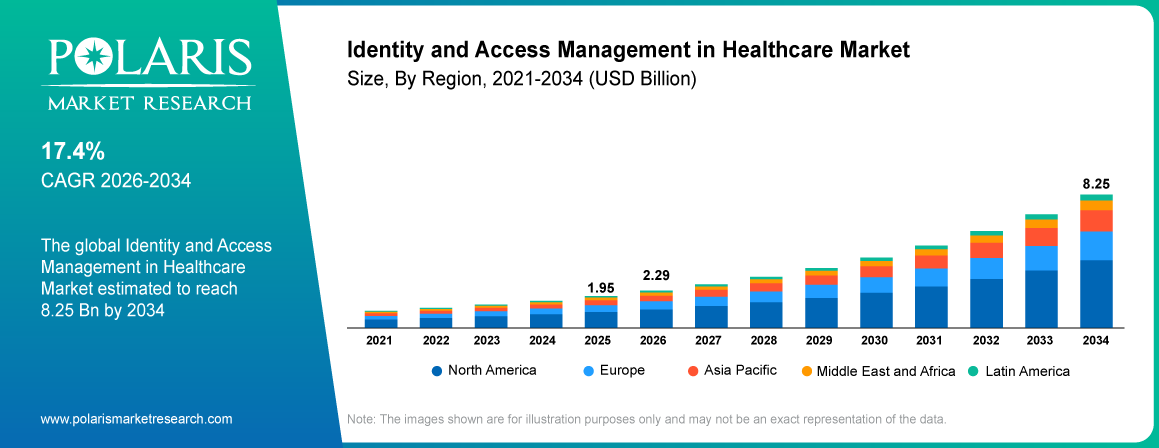
The global identity and access management in healthcare market size was valued at USD 1.95 billion in 2025. The market is projected to account for a 17.4% CAGR from 2026 to 2034. Surging cyberattacks on electronic health records and stringent legal mandates for patient privacy are driving the demand for identity and access management solutions in healthcare.
Market Statistics
Identity and Access Management in Healthcare Market Key Takeaways
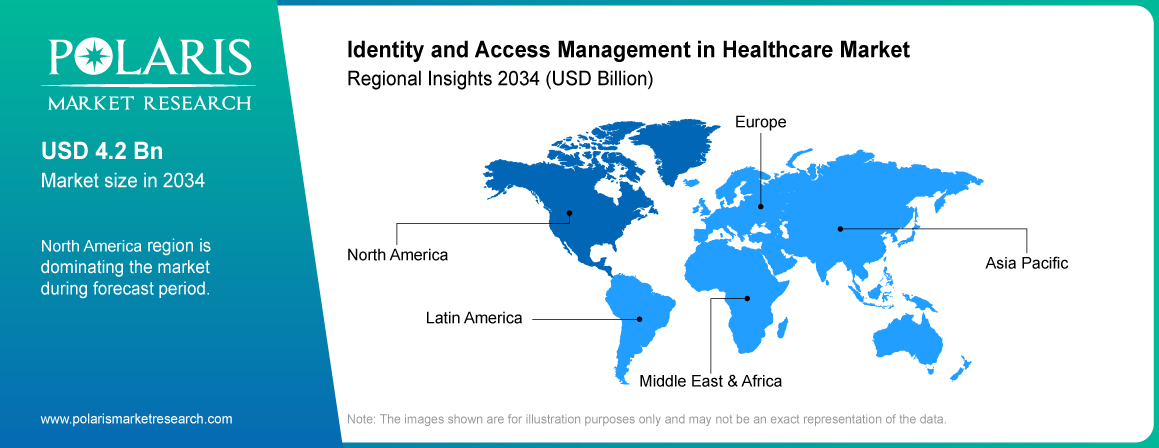
- North America accounted for an 39.20% healthcare IAM market share in 2025. This is owing to the presence of advanced healthcare infrastructure in the region.
- Asia Pacific is projected to grow at a 14.65% CAGR. The increasing adoption of telemedicine in emerging economies contributes to the regional market growth.
- The software segment accounted for a 65.40% identity and access management in healthcare market share in 2025. This is due to the increasing need for comprehensive security solutions in healthcare settings.
- The services segment is projected to grow at a 13.25% CAGR. The increased recognition and importance of managed services contribute to the segment’s rapid growth.
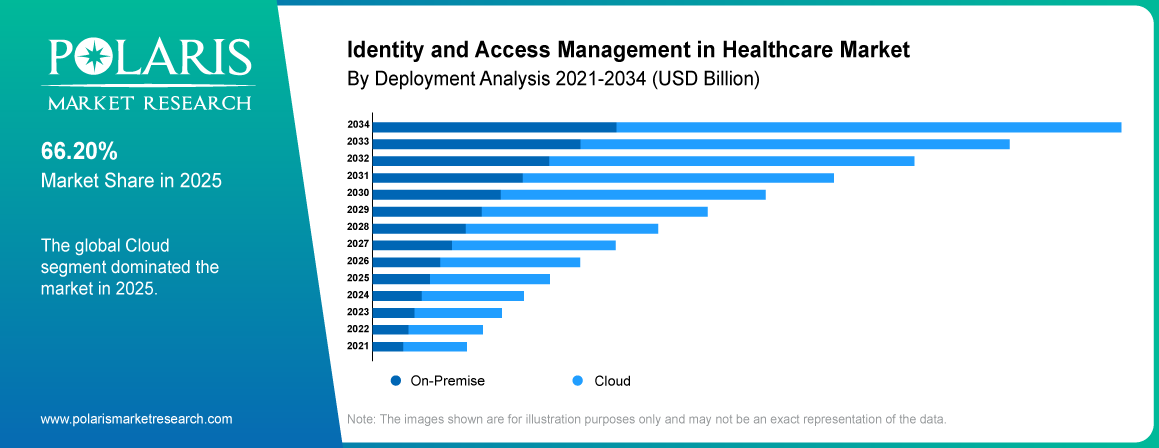
- The cloud segment held a 66.20% share in 2025. The segment’s leading position is due to the growing preference for scalable solutions.
Note: Figures and projections outlined in this report are the result of Polaris Market Research’s proprietary analytical processes, grounded in the latest available datasets and market observations.
What Is Identity and Access Management in Healthcare?
Identity and access management (IAM) in healthcare refers to the process of controlling access to healthcare applications, systems, and patient data. Identity and access management involves authenticating users’ identities and controlling access depending on the privileges accorded to them. Healthcare identity and access management allows healthcare organizations to safeguard their sensitive data while enabling access to the appropriate personnel.
How Does Identity and Access Management Work in Healthcare?
User Login: The user who wants to access the healthcare system logs into the system using their credentials.
Identification Process: The IAM system identifies the user based on password, MFA, biometrics, and other forms of authentication.
Role-Based Access: The access control process is done based on the role of the user and the information the user needs to view or edit.
Access to Systems: Authorized users gain access to the EHR systems and other systems utilized by them in the hospital.
Continuous Monitoring: The IAM system monitors the activities of the user continuously.
Audit Logging: The activities performed by the users within the hospital environment are monitored and logged for auditing purposes.
Source: Polaris Market Research Analysis
Market Dynamics
The identity and access management in healthcare market is driven by the growing number of cybersecurity risks as well as the increasing adoption of digital health systems. The demand for such solutions is on the rise due to the growing volume of patient information managed through interconnected platforms. The need for compliance has contributed to the adoption of IAM solutions. Costs and limited staff may limit adoption. New security models present market opportunities.
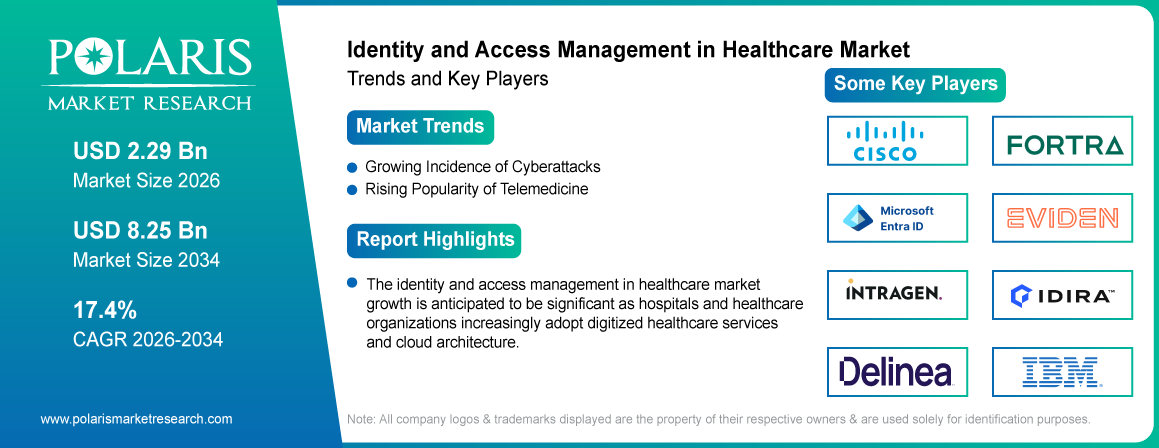
Driver: Growing Incidence of Cyberattacks
Cyberattacks are becoming increasingly common among healthcare organizations. These attacks may expose confidential patient information. These types of attacks could potentially affect the day-to-day operations of health care organizations. Ransomware has become a major concern for cybersecurity in health care providers. Hackers can exploit the use of passwords to access the system, thus highlighting the need to authenticate users. Providers are also focusing on improving user access controls. For example, Imprivata made new additions to the Enterprise Access Management solutions in February 2026. They include passwordless authentication, multi-factor authentication, and artificial intelligence-enabled behavioral analytics (source: imprivata.com). These advancements provide healthcare facilities with more ways to secure their users' identities and limit access.
Driver: Rising Popularity of Telemedicine
Telemedicine is contributing to the increased need for the security of healthcare service access in digital form. Patients can use telemedicine through online platforms to interact with healthcare professionals in distant places. Hence, identity management becomes essential while patients conduct their interactions remotely. Healthcare organizations also have the need to secure access to patient information when using digital platforms for providing healthcare services. Authentication technology can be utilized by organizations to ensure proper access to the correct healthcare accounts. At the same time, it also helps in reducing the chances of unauthorized access. In February 2026, LexisNexis Risk Solutions introduced an identity management solution aimed at the healthcare sector. The identity management solution enables identity verification in digital enrollment and virtual care, as well as managing the identities of patients and members on digital healthcare platforms (source: lexisnexis.com). This development underscores the increasing importance of identity management as healthcare delivery becomes more digitized.
Driver: Regulatory Compliance & HIPAA Modernization
Increasing regulatory requirements are driving the demand for robust identity and access management in healthcare market solutions. Organizations are required to secure their electronic health data from any unauthorized access. For instance, according to HIPAA, it is mandatory for healthcare organizations to implement certain safeguards to protect health information. Additionally, changes in technology used in the healthcare industry encourage organizations to assess their existing security systems. This has increased the demand for IAM solutions that are capable of managing identities and access control through permissions. IAM systems provide means of verifying the identity of an individual and access monitoring capabilities. With many health care organizations moving their services and records to digital platforms, it has become crucial to have the correct access control measures in place. This is prompting the need for IAM systems to meet security requirements.
Driver: Growth of AI, Big Data & IoT in Healthcare
The deployment of AI, big data, and IoT is also increasing the number of digital systems in healthcare organizations. AI applications need access to healthcare data for various purposes. Big data solutions involve processing large volumes of patient and operational data. Connected devices in healthcare environments are also creating new access points. This is increasing the importance of managing identities for users, applications, and devices. IAM solutions allow organizations to control who can access certain data and systems. IAM can also support authentication in connected environments. Identity management is therefore becoming increasingly important for healthcare access security.
Restraints : Implementation Costs and Cybersecurity Skills Shortage
Implementation costs may limit the use of identity and access management in healthcare market solutions by healthcare providers. Costs involved may include procurement of software, integration of the systems, training of employees, and maintenance of the systems. Integration with the healthcare systems can take time and effort. It may prove challenging for smaller healthcare organizations to have enough budget allocations for such costs. A lack of qualified cybersecurity experts is another constraint. Healthcare organizations require qualified experts to manage user access and implement security policies. The shortage of such experts can hinder the deployment of IAMs and make organizations rely on external experts.
Opportunities : Zero-Trust and AI-Driven Identity
The implementation of zero-trust security models opens up new growth opportunities for the IAM market in healthcare. Healthcare entities are switching from allowing universal access to focusing on validating users before providing access. The zero-trust architecture enable organizations to implement access controls according to user roles and specific requirements. This is important as healthcare services can be accessed from various locations and devices. Another growth opportunity is provided by artificial intelligence in healthcare identity solutions. These solutions can be utilized to implement flexible policies and access decisions. Demand for these solutions is expected to rise as healthcare organizations strengthen security across digital environments.
Opportunities : Managing Third-Party Healthcare Access
Healthcare organizations have external users who require access to certain systems or information. Such users can include contractors, temporary employees, and business partners. Managing such access is challenging in cases where the permissions are dynamic. This requirement can be met by IAM solution providers by offering solutions with the ability to manage temporary access and revoke permissions at the right time. Better management of external users enables organizations to minimize unnecessary access to healthcare information. This also presents an opportunity for IAM vendors to provide IAM solutions to healthcare organizations that have a large number of dynamic users. The interconnectedness of healthcare networks will make it necessary for organizations to manage third-party access.
Trend: Cloud-Based IAM Adoption
Healthcare organizations are increasingly moving IAM workload to the cloud as part of their broader shift towards cloud-based healthcare technology. IAM software vendors are responding through increased adoption of hosted solutions and subscription-based solutions. These solutions may allow healthcare organizations to avoid purchasing IAM infrastructure. The solutions may even allow smaller healthcare organizations to use IAM solutions without having to make substantial initial investments. Identity and access management in healthcare market vendors are increasingly providing both cloud and other deployment options in response to varying needs among customers. This has allowed for greater flexibility in purchasing and deploying IAM solutions in healthcare organizations. The ongoing shift towards cloud-based healthcare solutions is expected to further drive adoption of cloud IAM solutions.
Trend: IAM in Telehealth Growth
Continued use of telehealth is driving up the demand for digital identity management. Patients require safe access to virtual visits and online healthcare accounts. Physicians require safe access to their systems, even when they practice remotely. IAM solutions can assist in managing these access needs without depending on the organization's geographical location. Patient identity verification is vital during account creation and access to health services remotely. Providers are also utilizing digital means to schedule appointments and communicate with patients. This increases interactions outside the walls of traditional healthcare organizations. IAM solutions can assist in maintaining consistent access policies across these different platforms. Telehealth identity verification will therefore create business prospects for IAM solutions in healthcare organizations with growing digital patient offerings.
Source: Polaris Market Research Analysis
Segment Insights
By Component
The software segment accounted for an 65.40% identity and access management in healthcare market share in 2025. The demand for IAM software can be attributed to the necessity of having proper control over user identities in various healthcare applications. Using software can facilitate the process of assigning appropriate access permissions to users depending on their needs. The IAM software facilitates the process of managing accounts for individuals who become employees, move between jobs, or leave the organization. This supports the need for IAM software in identity management activities in the healthcare sector. The use of IAM software helps organizations maintain uniform access controls among various user groups. IAM software offers a unified way of managing identity-based activities within the digitalization of healthcare operations. The market segment will remain in demand as healthcare providers continue improving user access controls.
The services segment is projected to account for an 13.25% CAGR. The demand for IAM services is driven by the need for external expertise in solution implementation and management. Healthcare organizations may need help with system configuration, integration, maintenance, and user access management. Assistance from service providers can also help organizations modify IAM solutions in response to any changes in their needs. These services can prove especially valuable for healthcare organizations lacking internal technical expertise. Support services can help organizations maintain IAM solutions once they have been deployed. With the increasing adoption of IAM solutions among healthcare organizations, the requirement for such services is expected to grow during the forecast period.
| Comparison Parameter | Software | Services |
| Primary Role | Provides core IAM capabilities | Supports deployment and ongoing management |
| Key Functions | Manages identities, authentication, and permissions | Covers implementation, integration, and maintenance |
| Main Users | IT teams and system administrators | Healthcare organizations and IT teams |
| Deployment | Cloud or on-premise | Implementation and support-based |
| Integration | Connects with healthcare applications | Helps integrate IAM with existing systems |
| Access Management | Controls user access and permissions | Supports access management processes |
| Maintenance | Requires updates and administration | Provides technical support and maintenance |
| Revenue Model | Licenses or subscription fees | Project-based or recurring service fees |
Source: Polaris Market Research Analysis
By Deployment
The cloud segment accounted for an 66.20% identity and access management in healthcare market share in 2025. Its market share indicates the increasing inclination towards flexible deployment of IAM by healthcare providers. Cloud-based solutions can be easily scalable depending on the needs of the users. They can also provide rapid deployment as compared to solutions where extensive on-premises infrastructure is required. This market segment is becoming popular among providers looking to simplify the process of identity management in their growing digital landscape. Cloud deployment can help eliminate the necessity of having any IAM-specific hardware in-house for organizations. Further development in cloud infrastructure is expected to fuel the demand for cloud IAM solutions.
The on-premise segment is projected to account for an 9.85% identity and access management in healthcare market CAGR. The need for on-premise IAM solutions remains important for healthcare organizations that want more control over their systems and data. These solutions can help providers leverage their existing internal IT infrastructure. They may also suit organizations with specific needs for system and data management. This deployment type gives IT departments control over system configurations and access policies. Existing investments in internal infrastructure can also support the use of these solutions. Therefore, the segment is likely to experience demand throughout the forecast period.
| Comparison Parameter | Cloud | On-Premise |
| Deployment Location | Hosted on cloud infrastructure | Installed on the organization's own infrastructure |
| Infrastructure | Managed through cloud resources | Requires internal hardware and infrastructure |
| Access | Accessible through authorized internet-connected environments | Typically accessed through the organization's internal network |
| Scalability | Can be scaled based on changing requirements | Expansion may require additional infrastructure |
| Maintenance | Generally managed by the cloud provider | Managed by the healthcare organization or service provider |
| Implementation | Typically supports faster deployment | May require more planning and installation |
| Cost Structure | Often based on subscription or usage | Usually involves upfront infrastructure and licensing costs |
| Control | Provider manages much of the underlying infrastructure | Organization has greater direct control over the deployment |
Source: Polaris Market Research Analysis
By Type
The provisioning segment accounted for an 29.70% identity and access management in healthcare market share in 2025. This segment is supported by the requirement of managing access for users at all stages of their employment lifecycle. Provisioning allows enterprises to create access when new employees are onboarded and update permissions when there is any change in role. It can even enable prompt removal of access when employees depart from the organization. Such solutions can lead to faster provision of the required access. They can also help prevent inactive or unnecessary accounts. Provisioning is a key feature for healthcare organizations that have a large number of employees and frequent changes in their staff. Provisioning makes it easy for the IT teams to handle the regular account management activities.
The single sign-on segment is projected to account for an 11.70% CAGR. In single sign-on (SSO), users are able to gain access to various applications through one login. This means that the need to keep track of separate authentication data for accessing multiple applications can be avoided. The ease of access for users who access multiple applications can be enhanced as well. Healthcare providers can use SSO to facilitate access while retaining user permissions. The system can be especially useful in cases where switching between administrative and clinical systems takes place. The use of digital applications is expected to drive the demand for SSO solutions during the forecast period.
By End User
The hospitals & clinics segment led with an 42.10% identity and access management in healthcare market share in 2025. Many users within hospitals and clinics access various applications and patient health record data. IAM systems help these institutions manage access by considering each user's roles and responsibilities. They can also provide account management for both clinical and administrative staff. The growing demand for digital tools in hospitals increases the requirement for access to such applications in the process of everyday activities. In addition, healthcare establishments could have several departments with unique access needs. The segment is expected to hold its leading position due to the increasing focus on digital access control in hospitals and clinics.
The life sciences companies segment is projected to account for an 13.45% CAGR. These organizations deal with confidential data during their research and development process as well as in their operational functions. This creates a requirement for access control to digital data. IAM solutions can be used by organizations for managing access control for both internal and external individuals. Collaboration with research partners and other third parties may create an additional requirement for access control. With the increasing usage of digital technology in the operations of life sciences organizations, the demand for IAM solutions is anticipated to grow during the forecast period.
Market Segmentation Snapshot
| Category | Segments |
| Component | Software, Services |
| Deployment | Cloud, On-Premise |
| Type | Single Sign-On (SSO), Multi-Factor Authentication (MFA), Provisioning, Directory Services, Audit & Compliance Management |
| End User | Hospitals & Clinics, Healthcare Payers, Life Sciences Companies, Others |
| Region | North America, Europe, Asia Pacific, Latin America, Middle East & Africa |
Source: Polaris Market Research Analysis
IAM vs Traditional Access Control Healthcare
| Feature | Healthcare IAM | Traditional Security Systems |
| Security Approach | Identity-centric healthcare access control systems | Network and perimeter security approach |
| Access control | Role and individual-based access | Broad access rights or permissions |
| Authentication | Multi-factor authentication, SSO and biometric verification | Username and password |
| Monitoring | Ongoing identity monitoring | Limited security monitoring |
| Compliance | Supports HIPAA compliance and other health care compliance requirements | Limited compliance capabilities |
| Protection Against Insider Threats | Detects malicious actions of insiders | Prevention from external threats |
Source: Polaris Market Research Analysis
Source: Polaris Market Research Analysis
Regional Insights
North America
North America accounted for an 39.20% identity and access management in healthcare market share in 2025. The region's position is supported by the growing adoption of digital health care systems and the need to secure access to confidential health information. Healthcare organizations are spending on identity management products to improve access control to ensure their digital business process run smoothly. The availability of leading healthcare IT solution providers is also a contributing factor for market development in the region. Healthcare players, including hospitals and others, are also securing access for a larger and more diverse user base. This is driving demand for identity management processes. The growing usage of connected healthcare applications is another factor that is contributing to the demand for identity management solutions across North America.
Asia Pacific
Asia Pacific is projected to account for an 14.65% CAGR. There is an increased implementation of digital health services and information systems in the region. Healthcare institutions are utilizing digital means for the management of patient activities and operations. This calls for better access controls for healthcare systems and data. The development of health care infrastructure in developing countries is driving the adoption of digital technology. Health care organizations are adopting digital records and connected applications. There is an increased user base that needs access controls to health care systems. IAM solutions would enable organizations to manage access as the digital platform grows. Growing cybersecurity threats are also driving interest in identity management solutions. This shift is expected to drive market development in Asia Pacific during the forecast period.
Europe
The Europe identity and access management in healthcare market accounted for an 27.10% share in 2025. The regional market is driven by the growing implementation of digital healthcare solutions among hospitals, clinics, and other healthcare providers. There has been an increased emphasis from providers on managing access to patient data and applications within healthcare facilities. Increasing usage of digital solutions, including electronic health record systems, is contributing to the rising need for identity management solutions. Similarly, European healthcare providers are increasingly implementing digital security solutions as their services migrate online. Such developments are fueling the demand for IAM solutions in Europe. Increasing investments in healthcare IT solutions are expected to sustain market growth in Europe during the projection period.
Latin America
Latin America is projected to grow at an 13.10% CAGR. Digital health technologies and services are gradually becoming widespread in the region. The number of digital systems used by healthcare organizations for management of healthcare information and processes is on the rise. As a result, the demand for the management of access to healthcare applications and data is rising. The increasing awareness of security concerns is driving healthcare organizations to improve the management of identities and access control in the organization. IAM solutions help healthcare organizations better manage user access to digital systems. These factors are expected to drive market growth in Latin America.
Middle East & Africa
The Middle East & Africa identity and access management in healthcare market is projected to grow at an 12.80% CAGR. Healthcare organizations in the region are increasingly adopting digital technology and online services. This has created a growing need to control access to patient information and healthcare applications. Investment in healthcare infrastructure has also contributed to the adoption of digital technology. The providers have been focusing more on data protection due to the growing digitization of healthcare information. Organizations can use IAM technologies to manage user access and permissions. The increasing use of digital health care services offers even more opportunities for identity management solutions.
Source: Polaris Market Research Analysis
Role of AI in Healthcare IAM
AI is reshaping the identity and access management in healthcare market by creating new classes of digital identities that do not belong to actual individuals. AI applications and agents might be used without any input from a person, and thus, they might need credentials, permissions, and separate identity accounts. The healthcare industry must differentiate such digital identities from those belonging to employees and patients. At the same time, it is vital to know who owns the identity when AI systems are dealing with any healthcare application or sensitive data.
IAM solutions offer means to register these new identities and assign necessary permissions to them. Moreover, they can help companies keep track of applications or agents using particular resources. This way, it becomes necessary to extend the scope of identity management. With the growing popularity of AI applications in healthcare, managing digital identities of this type may become a crucial component of IAM practices.
Real-World Use Cases
| Real World Use Case | IAM in Healthcare Usage | Benefits Provided |
| EHR Access Management | Controls access to electronic health records by role and authorization level | Patient data protection |
| Telemedicine Authentication | Authenticate users, including patients and healthcare practitioners, prior to access to telemedicine platform | Secure telemedicine access |
| Medical Device Access Management & IoT | Identity and access management to connected medical devices | Unwanted access to devices limitation |
| Insurer Data Access Management | Controls access to data of policyholders, claims and healthcare data | Protection of sensitive insurance data |
| Telepharmacy Access Management | Verifies access of authorized users to pharmacy-related services and information | Secure telepharmacy services |
| Healthcare Applications Access Management | User access management in different healthcare applications | Limitation of unauthorized access |
| Patient Portal Access Management | Authentication of patients before their access to personal data and services | Protection of patient accounts |
| External Providers Access Management | Access to different systems and data for approved physicians and other healthcare organizations' representatives | Supports secure collaboration |
Source: Polaris Market Research Analysis
Technological Innovations
| Technology | Healthcare IAM Application | Key Value |
| Passwordless Authentication | Replaces passwords with methods such as security keys or authentication apps | Fewer password-related issues |
| Biometric Authentication | Uses fingerprints or facial recognition to confirm user identity | More convenient identity verification |
| Mobile Authentication | Uses mobile devices for user authentication and account access | Supports access through mobile devices |
| Single Sign-On | Gives users access to multiple approved applications through one login | Fewer separate login credentials |
| Identity Lifecycle Management | Manages user accounts when staff join, change roles, or leave | Keeps account records up to date |
| Identity Governance | Provides tools to review user accounts and existing permissions | Helps identify unnecessary access |
Source: Polaris Market Research Analysis
Key Players and Competitive Insights
The identity and access management in healthcare market includes existing technology vendors and dedicated IAM vendors. Competition in the market is characterized by product capabilities, healthcare integration, security functionalities, and support services. Companies are concentrating on developing their IAM solutions to meet the access needs of hospitals, clinics, and other healthcare organizations. Additionally, vendors are expanding their partnerships with healthcare technology providers to enhance product integration.
Organizations are now implementing methods of authenticating, governing identities, managing access, and managing privileged access. Some vendors are providing cybersecurity products that include identity management as an additional offering within their security solutions portfolio. Others are concentrating more on identity management and healthcare access solutions. These differences lead to variations in product scope and target customer groups.
Product development activities are also influencing competition. Companies are incorporating passwordless login, biometric verification, and other identity management technologies into their products. Collaborations with healthcare technology platforms are another key activity. These partnerships can help identity and access management in healthcare market companies reach healthcare customers and support integration with existing technology.
Healthcare Identity and Access Management Vendors
| Vendor | Primary Focus Area | Deployment Model | Notable Healthcare-Specific Move |
| Veritis Group Inc. | IAM consulting and services | Cloud, on-premise | IAM consulting and implementation services for healthcare organizations. |
| Fortra, LLC | Identity and access security | Cloud, on-premise | IAM and access security solutions for healthcare environments. |
| LexisNexis Risk Solutions | Healthcare identity management | Cloud | March 2026: Expanded its relationship with Epic to bring identity verification capabilities into Epic workflows. (source: lexisnexis.com) |
| Ping Identity | Workforce and customer identity | Cloud, hybrid | July 2026: Ping Identity Verification and Fraud Protection was listed in the Epic Toolbox for MyChart. (source: pingidentity.com) |
| Imprivata, Inc. | Healthcare access management | Cloud, on-premise, hybrid | March 2026: Introduced Agentic Identity Management for securing and governing AI agents in healthcare environments. (source: imprivata.com) |
| IBM | Enterprise identity management | Cloud, on-premise, hybrid | Enterprise IAM and security capabilities for healthcare and other regulated industries. |
| Okta | Workforce and customer identity | Cloud | Identity management solutions for healthcare organizations and digital healthcare applications. |
| Delinea | Privileged access management | Cloud, on-premise, hybrid | Privileged access management for healthcare organizations and sensitive healthcare systems. |
| SailPoint Technologies, Inc. | Identity governance | Cloud, hybrid | Identity governance and access management solutions for healthcare organizations. |
| Oracle | Enterprise identity and access | Cloud, on-premise, hybrid | Enterprise IAM capabilities covering authentication, SSO, and identity lifecycle management. |
| One Identity LLC (Quest Software) | Identity governance & PAM | Hybrid | Broadening healthcare-sector identity governance deals via channel partners |
Source: Polaris Market Research Analysis
List of Key Companies
- Cisco Systems, Inc.
- CloudIBN
- Delinea
- Eviden / Bull (Formerly Evidian S.A., Atos)
- Fortra, LLC
- IBM
- Idira (Formerly CyberArk Software Ltd.)
- Imprivata, Inc.
- Intragen
- LexisNexis Risk Solutions
- Microsoft Entra ID (Formerly Azure AD)
- Okta
- One Identity LLC (Quest Software)
- Optimal IdM
- Oracle
- Ping Identity
- SailPoint Technologies, Inc.
- symplr
- Veritis Group Inc.
Industry Developments
- May 2026: Palo Alto Networks announced the launch of its next-gen identity security platform, Idira. The company stated that the platform delivers modern privileged access management by democratizing security controls for every human, machine and agentic identity. (source: paloaltonetworks.com)
- March 2026: Oasis Security announced $120 million in Series B funding led by Craft Ventures. The participation from existing investors Sequoia Capital, Cyberstarts, and Accel brought the total funding to $195 million. With the funding, the company intends to expand and deepen the R&D behind the Oasis Agentic Access Management (AAM) platform. (source: accessnewswire.com)
Future Outlook
The identity and access management in healthcare market growth is anticipated to be significant as hospitals and healthcare organizations increasingly adopt digitized healthcare services and cloud architecture. Cyberattacks, strict regulations, and the use of telemedicine services are some of the factors that will encourage spending on new and improved IAM technologies. In the next few years, it is expected that the platforms will use technology such as artificial intelligence, biometrics, and a zero trust approach to security. The systems will be able to manage identity better and identify threats faster.
Research Methodology
The identity and access management in healthcare market is forecasted through the use of both the top-down and bottom-up methods. This involves using industry-wide healthcare IT spending data and vendor revenues to estimate market size. Paid databases, annual reports, and vendor regulatory filings, along with healthcare IT industry association data, are used to develop the base-year estimate and analyze market structure.
Primary research involves structured interviews with IAM vendor executives, hospital IT & security executives, and channel partners. These help validate segment shares and market trends. Secondary research includes HIPAA/HHS documentation, company financial disclosures, healthcare cyberattack documentation, the HHS OCR breach site, and peer-reviewed healthcare IT journals.
Primary and secondary research findings are benchmarked against the results of the top-down and bottom-up approaches. Such a triangulation enables identifying inconsistencies between the sources of information and further improving the market estimates. The analysts examine the findings before the report release for consistency with other Polaris healthcare IT and cybersecurity reports.
Market Segmentation
By Component Outlook (Revenue, USD Billion, 2021–2034)
- Software
- Services
By Deployment Outlook (Revenue, USD Billion, 2021–2034)
- On-Premise
- Cloud
By Type Outlook (Revenue, USD Billion, 2021–2034)
- Single Sign-On (SSO)
- Multi-Factor Authentication (MFA)
- Provisioning
- Directory Service
- Audit & Compliance Management
By End User Outlook (Revenue, USD Billion, 2021–2034)
- Hospitals & Clinics
- Healthcare Payers
- Life Sciences Companies
- Other
By Regional Outlook (Revenue, USD Billion, 2021–2034)
- North America
- US
- Canada
- Europe
- Germany
- France
- UK
- Italy
- Spain
- Netherlands
- Russia
- Rest of Europe
- Asia Pacific
- China
- Japan
- India
- Malaysia
- South Korea
- Indonesia
- Australia
- Rest of Asia Pacific
- Middle East & Africa
- Saudi Arabia
- UAE
- Israel
- South Africa
- Rest of Middle East & Africa
- Latin America
- Mexico
- Brazil
- Argentina
- Rest of Latin America
Report Scope
| Report Attributes | Details |
| Market Size Value in 2025 | USD 1.95 billion |
| Market Size Value in 2026 | USD 2.29 billion |
| Revenue Forecast by 2034 | USD 8.25 billion |
| CAGR | 17.4% from 2026 to 2034 |
| Base Year | 2025 |
| Historical Data | 2021–2024 |
| Forecast Period | 2026–2034 |
| Quantitative Units | Revenue in USD billion and CAGR from 2026 to 2034 |
| Report Coverage | Revenue Forecast, Market Competitive Landscape, Growth Factors, and Industry Trends |
| Segments Covered |
|
| Regional Scope |
|
| Competitive Landscape |
|
| Report Format |
|
| Customization | Report customization as per your requirements with respect to countries, regions, and segmentation. |
Source: Polaris Market Research Analysis
Identity and Access Management in Healthcare Market FAQ's
The identity and access management in healthcare market was valued at USD 1.95 billion in 2025. The market is projected to grow to USD 8.25 billion by 2034.
The market is projected to account for an 17.4%CAGR from 2026 to 2034.
North America accounted for an 39.20% share in 2025. This is due to the presence of advanced healthcare infrastructure in the region.
A few of the key market players include Cisco Systems, Inc.; CloudIBN; Delinea; Eviden / Bull (Formerly Evidian S.A., Atos); Fortra, LLC; IBM; Idira (Formerly CyberArk Software Ltd.); Imprivata, Inc.; Intragen; LexisNexis Risk Solutions; Microsoft Entra ID (Formerly Azure AD); Okta; One Identity LLC (Quest Software); Optimal IdM; Oracle; Ping Identity; SailPoint Technologies, Inc.; symplr; and Veritis Group Inc.
The software segment accounted for an 65.40% share in 2025. Demand for IAM software stems from the need to properly control user identities across various healthcare applications.
Identity and access management (IAM) in healthcare is defined as systems that are used to identify and control access to healthcare applications and information. This includes employees, patients, contractors, and any other users authorized to access information.
Before accessing any healthcare application or information, IAM verifies the user's identity and grants access based on their permissions. These permissions can be modified when the user's status or role changes.
The reason for IAM implementation in healthcare organizations lies in the need to control access to patient information and digital resources. IAM gives a way for IT teams to manage users' access rights.
Implementation may be costly, especially when an organization has outdated infrastructure. Integration of IAM with existing healthcare applications may require some time. Lack of specialized personnel is another challenge that may arise.
The demand for healthcare IAM is anticipated to grow as more providers use digital applications and services. Cloud computing and remote healthcare services have created demand for IAM. Healthcare organizations are likely to place more emphasis on the security of their identity management as they adopt these technologies.
Download Sample Report of Identity and Access Management in Healthcare Market
Please fill out the form to request a customized copy of the research report.


