
North America Technical Textile Market Size Report, 2026-2034
REPORT DETAILS
Market Statistics
What is North America Technical Textiles Market Size?
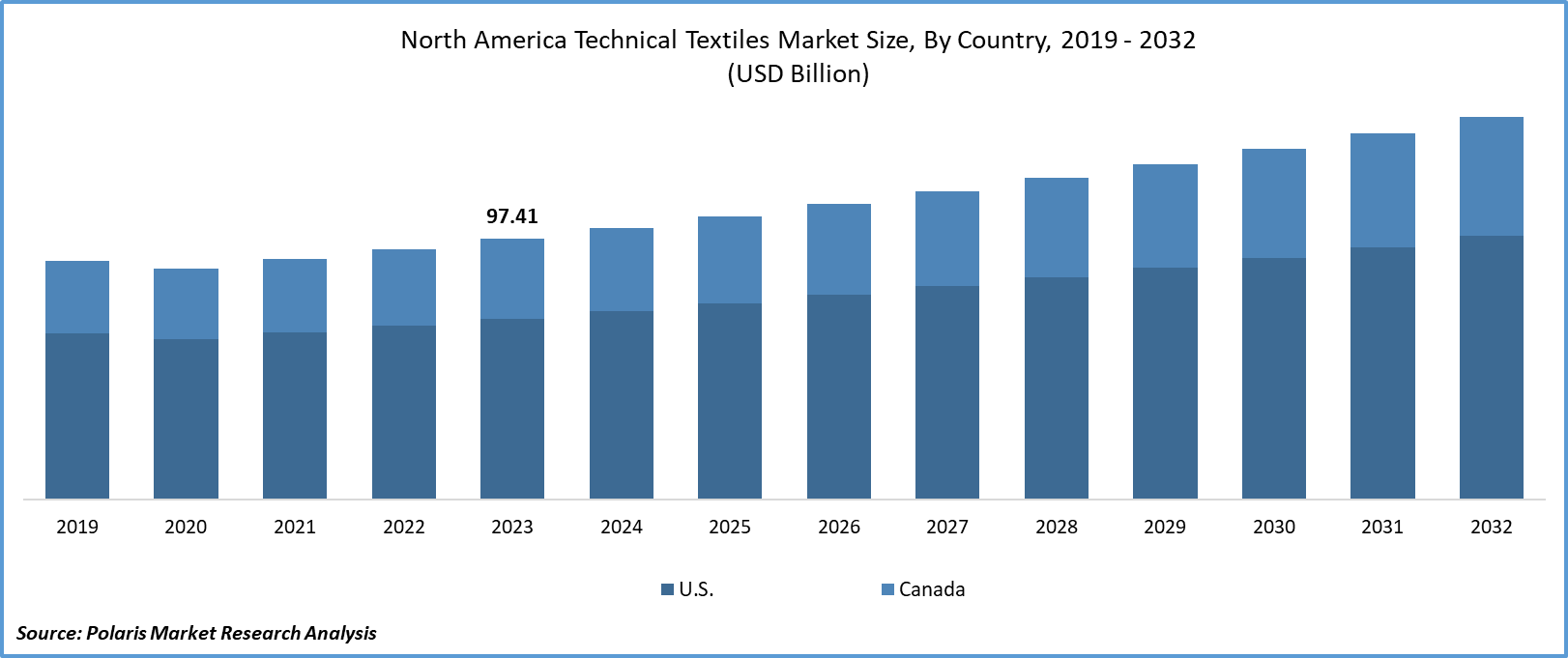
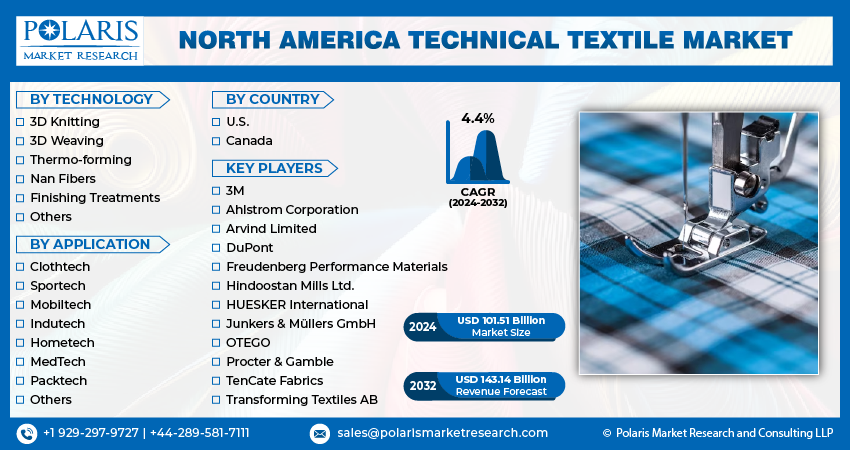
North America Technical Textiles Market size was valued at USD 105.42 billion in 2025 and is anticipated to exhibit the CAGR of 4.3% during the forecast period. The growth is driven by rise in demand for major end use industries, rise in investment by major players, and technological advancement.
Market Statistics
- 2025 Market Size: USD 105.42 Billion
- 2034 Projected Market Size: USD 153.98 Billion
- CAGR (2026-2034): 4.3%
- Largest Market: U.S.
Industry Trends
North America is the dominating region in the global technical textiles market, with the U.S. being the largest market in the region. Various factors, such as increasing demand from end-use industries and technological advancements, drive the market. For instance, in May 2023, Svegea and Sewn Products Equipment Company (SPEC)of Sweden were awarded the “Innovation Award 2023” for their introduction of the Svegea EC-450XF collarette cutter at Techtextil North America.
Source: Polaris Market Research Analysis
To Understand More About this Research: Download Sample Report
One of the primary drivers of the market is the increasing demand from end-use industries such as automotive, aerospace, and construction. These industries require high-performance materials that can withstand harsh conditions and provide improved functionality, which drives the demand for advanced technical textiles. Also, the growing trend towards lightweight materials in these industries propels the growth of the technical textiles market.
The development of new materials and production processes has enabled manufacturers to produce high-quality technical textiles with improved properties such as strength, durability, and resistance to heat and chemicals. This has expanded the range of applications for technical textiles, thereby driving the growth of the market.
However, the market is hindered by the high cost of raw materials and production processes. The use of advanced materials and production techniques increases the cost of production, making it difficult for small and medium-sized enterprises to compete with larger players in the market.
The market research report offers an in-depth analysis of the industry to support informed decision-making. It offers a meticulous breakdown of various market niches and keeps readers updated on the latest industry developments. Along with tracking the North America Technical Textile Market on the basis of SWOT and Porter’s Five Forces models, the research report includes graphs, tables, charts, and other pictorial representations to help readers understand the key insights and important data easily.
Key Takeaways
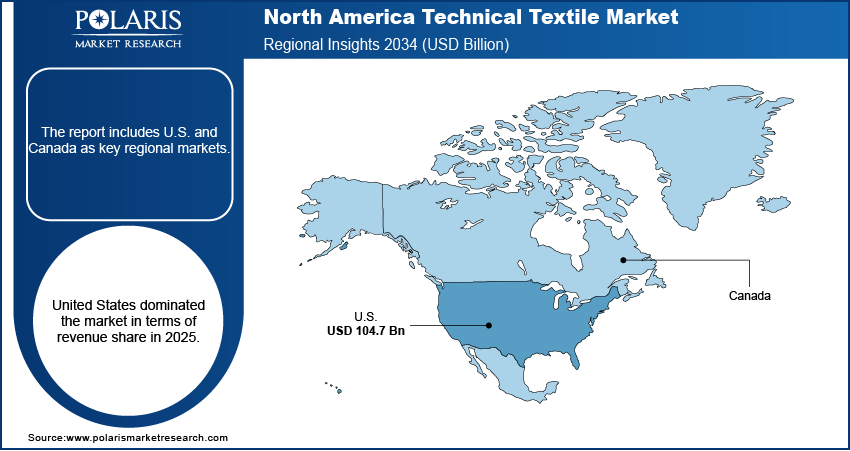
- The U.S. dominated the market and contributed over 65% of the share in 2025
- By technology category, the 3D weaving segment accounted for the largest market share in 2025
- By application category, the medtech segment led the North American market in 2025
What are the market drivers driving the demand for North America technical textiles market?
Technological developments in the technical textile industry are driving market growth.
Technological advancements in the technical textile industry have played a crucial role in driving the growth of the market. The development of innovative materials and production processes has enabled manufacturers to create high-performance fabrics with improved properties, such as durability, strength, and resistance to heat, chemicals, and UV radiation. These advanced materials are increasingly being used in various industries, including automotive, aerospace, construction, and healthcare, replacing traditional materials like wood and plastics.
In addition, technological advancements have also led to the creation of smart textiles, which have integrated electronic or digital components that can provide functions such as temperature regulation, energy harvesting, and data monitoring. These smart textiles have numerous applications in wearable technology, medical devices, and industrial equipment, further expanding the scope of the technical textiles market.
Which factor is restraining the demand for technical textiles?
The high cost of raw materials and production processes hinder the market.
The high caffeine content in technical textiles has been a major concern for consumers and health professionals alike, and this has acted as a restraining factor for the North America technical textiles market. Excessive caffeine consumption leads to negative side effects such as jitteriness, anxiety, insomnia, rapid heartbeat, and digestive problems. In extreme cases, it may even result in more serious health issues like cardiovascular diseases, stroke, and seizures. This has led to a growing awareness among consumers about the potential health risks associated with technical textiles, which in turn has slowed down their adoption rate.
Moreover, several countries in the North America region have implemented strict regulations regarding the amount of caffeine that can be added to technical textiles, further limiting their appeal. As a result, manufacturers are facing challenges in terms of balancing consumer demand for energy boosts with the need to ensure safety and regulatory compliance, thereby hindering the growth of the technical textiles market in the region.
Key Trends in Technical Textiles
| Trend | Description | Technical / application focus | Examples from Practice |
| Smart e‑textiles with sensors | Electronic textiles (e‑textiles) embed conductive threads, printed inks, and nanomaterials for capacitive/piezoresistive/triboelectric sensing. | Health monitoring, sports performance, human‑machine interfaces; flexible electronics for motion, strain, temperature detection. | Reviews detail printing (screen/inkjet/3D) for e‑textile sensors; nanomaterials boost conductivity/flexibility. |
| Bio‑based nanofibers via electrospinning | Electrospun nanofibers from biopolymers (cellulose, PLA, chitin) for protective/smart fabrics with biodegradability. | Sustainable protective clothing (antimicrobial, UV, flame); medical textiles, filtration with low carbon footprint. | Electrospinning + bio‑polymers reduces GHG emissions; applications in healthcare/sports/industrial safety. |
| MXene‑based 3D‑printed textiles | MXenes enable conductive, EMI‑shielding smart fabrics via 3D printing. | Wearables with electrical/thermal/mechanical multifunctionality. | MXene 3D‑printed textiles advance flexible electronics. |
| Aerospace high‑performance textiles | Lightweight, flame‑retardant, high‑strength fabrics (glass/carbon/aramid/Dyneema) for aircraft/shuttles. | Fuel efficiency, heat/UV resistance, composites; nanoweb for protection. | Technical textiles enable aerospace innovation; synthetic development for non‑fiber nations. |
| Plant‑based/glass fiber textiles | Emerging bio‑fibers and glass textiles for sustainable composites. | Industrial replacement for synthetics; eco‑friendly high‑performance apps. | Top trends include plant‑based materials, glass fiber textiles. |
Source: Polaris Market Research Analysis
Source: Polaris Market Research Analysis
Report Segmentation
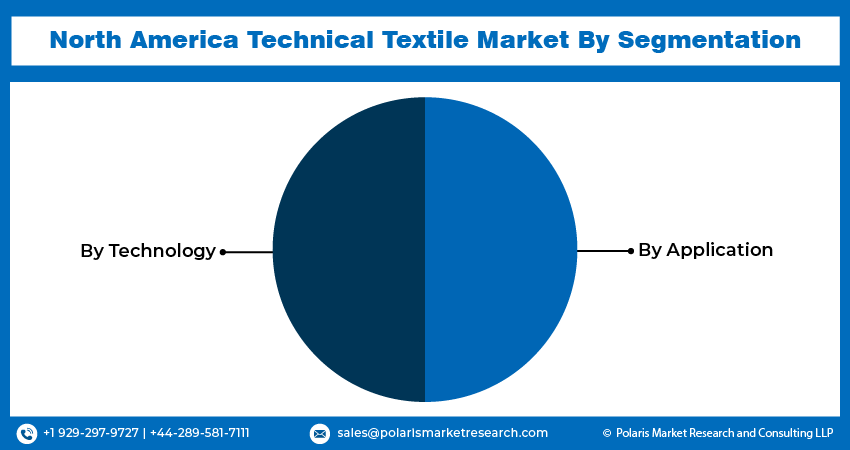
The market is primarily segmented based on technology, application, and country.
| By Technology | By Application | By Country |
|
|
|
Source: Polaris Market Research Analysis
To Understand the Scope of this Report: Request Customization
Category Wise Insights
By Technology Insights
Based on technology analysis, the market is segmented on the basis of 3D knitting, 3D weaving, thermo-forming, nan fibers, finishing treatments, and others. The market was dominated by 3D weaving technology-based textiles in 2025 due to their superior properties and increasing demand from various industries. 3D weaving technology allows for the creation of complex, multi-layered structures that offer improved strength, durability, and flexibility compared to traditional woven fabrics and knitted fabrics. This makes them ideal for applications such as composites, medical implants, and protective gear, which require high levels of performance and customization.
Also, 3D woven textiles have better resistance to wear and tear and can withstand harsh environments, making them suitable for several applications. The ability to create altered materials with specific properties has also led to increased adoption of sportswear and wearable technology.
By Application Insights
Based on application analysis, the market has been segmented on the basis of clothtech, sportech, mobiltech, indutech, hometech, medtech, packtech, and others. The Medtech application segment, which includes medical textiles and biomaterials, led the market in 2025 due to several factors. In North America, there is a growing demand for advanced wound care products, such as antimicrobial dressings, surgical meshes, and wound closure strips, which are made from high-performance technical textiles.
Also, there is an increasing use of medical textiles for implantable devices, such as cardiac-supporting devices, artificial joints, and bone grafts, which are also made from technical textiles. Technological advancements in medical textiles have enabled the development of innovative products, such as bioabsorbable materials, nanofibers, and smart fabrics, which have improved the efficacy and safety of medical treatments, further contributing to the dominance of the Medtech segment in the market.
Source: Polaris Market Research Analysis
Country-wise Insights
United States
The United States dominated the market in terms of revenue share in 2025 due to the country's well-established manufacturing industry, which enables it to produce high-quality technical textiles that cater to various industries such as automotive, aerospace, and construction. In addition, the U.S. has a strong research and development sector that continuously innovates and develops new technologies, leading to the creation of advanced technical textiles with improved properties.
Furthermore, the U.S. has a large industrial customer base, which creates a significant demand for technical textiles, especially in the medical textiles and protective clothing segments. Also, the U.S. government's support for the development of technical textiles through initiatives such as the Textile Innovation Fund contributes to the country's dominant position in the North American market.
Source: Polaris Market Research Analysis
Competitive Landscape
Manufacturers in the market are engaged in research and development to create innovative products that meet specific requirements of different industries. They use advanced materials like polyester, nylon, Kevlar, and carbon fibers, among others, and employ cutting-edge techniques such as weaving, knitting, and coating to produce fabrics with desired properties.
Some of the major players operating in the North American market include:
- 3M
- Ahlstrom Corporation
- Arvind Limited
- DuPont
- Freudenberg Performance Materials
- Hindoostan Mills Ltd.
- HUESKER International
- Junkers & Müllers GmbH
- OTEGO
- Procter & Gamble
- TenCate Fabrics
- Transforming Textiles AB
Recent Developments
- October 2023, Otego, one of the leaders in the technical textile market, launched a marketplace, Oteplace. This online platform is designed to meet the growing needs of industries, with a focus on the safety and protection of workers worldwide.
- March 2022, Milliken & Company, a company that specializes in textiles, chemicals, and performance solutions, launched a brand campaign dubbed "Anything Everywhere" under its textile business division.
Report Coverage
The North America Technical Textiles market report emphasizes on key countries across the region to provide better understanding of the product to the users. Also, the report provides market insights into recent developments, trends and analyzes the technologies that are gaining traction around the globe. Furthermore, the report covers in-depth qualitative analysis pertaining to various paradigm shifts associated with the transformation of these solutions.
The report provides detailed analysis of the market while focusing on various key aspects such as competitive analysis, technology, application, and their futuristic growth opportunities.
Technical Textiles Market Report Scope
| Report Attributes | Details |
| Market size in 2025 | USD 105.42 billion |
| Market size in 2026 | USD 109.57 billion |
| Revenue forecast in 2034 | USD 153.98 billion |
| CAGR | 4.3% from 2026 – 2034 |
| Base year | 2025 |
| Historical data | 2021 – 2024 |
| Forecast period | 2026 – 2034 |
| Quantitative units | Revenue in USD billion and CAGR from 2026 to 2034 |
| Segments covered | By Technology, By Application, By Country |
| Regional scope | U.S., Canada |
| Customization | Report customization as per your requirements with respect to countries, region and segmentation. |
Source: Polaris Market Research Analysis
North America Technical Textile Market FAQ's
The North America Technical Textile Market report covering key segments are technology, application, and country.
The North American technical textiles market size is expected to reach USD 153.98 Billion by 2034
North America Technical Textiles Market is CAGR of 4.3% during the forecast period.
United States regions is leading the global market.
Technological developments in the technical textile industry are driving market growth are the key driving factors in North America Technical Textile Market.
Download Sample Report of North America Technical Textile Market Size Report, 2026-2034
Please fill out the form to request a customized copy of the research report.


