
Micro Battery Market Size & Trends, Forecast 2026-2034
REPORT DETAILS
Micro Battery Market Summary
The global micro battery market is estimated around USD 791.27 million in 2025,?with consistent growth anticipated during 2026–2034. This growth is driven by rising adoption of wearable devices and increasing deployment of connected IoT systems across consumer, industrial, and healthcare applications. The market is projected to grow at a CAGR of 23.78%during the forecast period.
Market Statistics
Key Takeaways:
- Primary (non-rechargeable) micro battery segment dominated in 2025, accounting for nearly 38.40% market share due to strong use in low-power and disposable electronic devices.
- Wearables segment led in 2025, contributing approximately 34.70% market share owing to rising adoption of smartwatches, fitness trackers, and connected health devices.
- Secondary (rechargeable) micro battery segment is projected to grow at a CAGR of around 12.80% due to increasing demand for reusable power solutions in IoT and wearable devices.
- Asia Pacific dominated the market, accounting for nearly 41.80% market share in 2025 due to large-scale electronics manufacturing and increasing production of consumer electronic devices.
- Key players operating in the market includes CAP-XX Ltd.,Cymbet Corporation, Duracell Inc., Energizer Holdings Inc., Enfucell Oy, Ilika Plc, ITEN, Maxell, Ltd., Molex, LLC and others.
Industry Dynamics
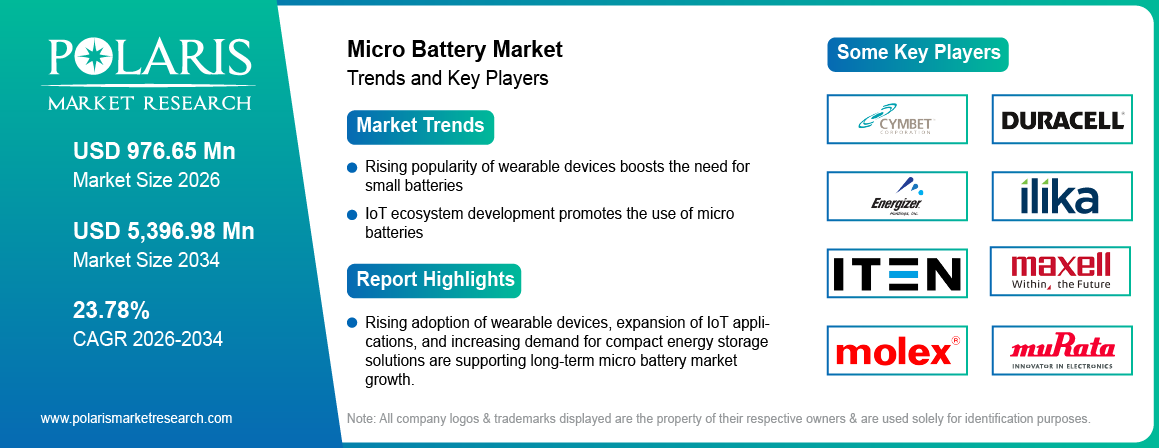
- Rising adoption of wearable devices increases demand for compact battery solutions.
- Expansion of IoT ecosystems supports demand for long-life micro batteries.
- Limited energy capacity due to miniaturization impacts performance efficiency.
- Growth in medical and bioelectronic devices creates new growth opportunities.
What are Micro Battery?
Micro-batteries are small energy-storage systems developed to provide power to miniaturized electronic equipment that requires low energy. Such batteries are commonly used in miniature electronic systems, which require efficient space utilization. Applications of micro-batteries include wearable systems, medical devices, smart cards, wireless sensors, and many others. Growth in the wearables market along with increasing demand for IoT batteries has broadened the applications of such batteries.
Increasing demand for micro-batteries is attributed to their growing usage in various electronic gadgets, including wearables and IoT devices. Rising shipments of wearables such as smartwatches and medical wearable devices has consistently driven demand for wearable batteries. Additionally, growth in connected IoT devices and edge devices is boosting the importance of batteries in IoT systems.
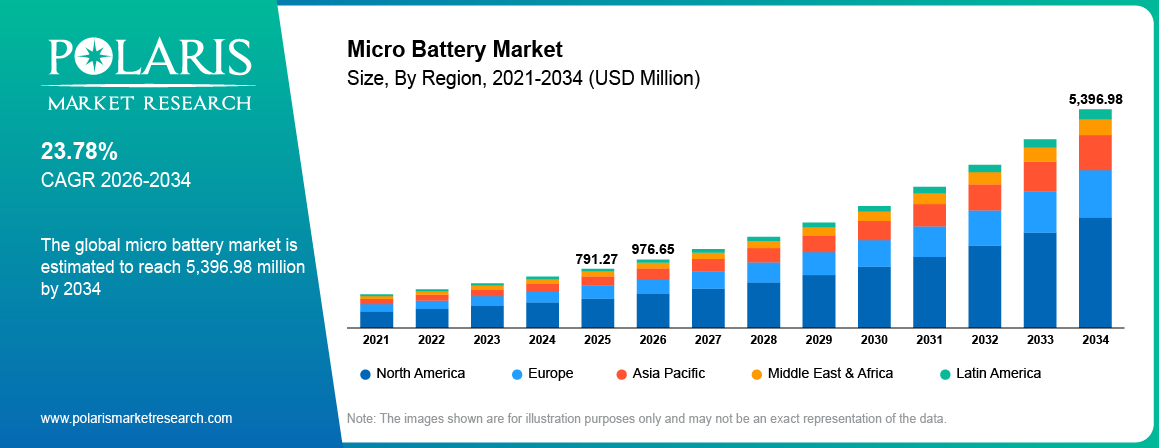
Source: Polaris Market Research Analysis
To Understand More About this Research:Download Sample Report
Medical applications are playing a significant role in driving growth in the micro-batteries market, as adoption is increasing in implants, diagnostic equipment, and remote patient monitoring devices. There is a need for manufacturers to make small and energy-efficient batteries, with increasing demand for small and efficient electronics. Constant innovations in battery technology continue to improve their efficiency, while keeping their size small. Growing emphasis on portability, efficiency, and longevity continues to drive the micro-batteries market.
Drivers & Opportunities
Growth of Wearable Devices Increases Demand for Compact Batteries: Rise in adoption of wearable medical devices, is boosting the need for micro batteries in wearables. According to IDC, there was an increase in worldwide wearable device shipments by 9.1%, bringing the total to 611.5 million units in 2025. Devices such as smartwatches, hearables, and smart rings require low-profile battery designs that support continuous usage. This shift toward compact and feature-rich devices is increasing miniaturized battery demand and supporting growth in the wearable electronics battery market.
Expansion of IoT Strengthens Demand: The rise in connected sensors and edge devices is increasing the need for long-life battery solutions. As per IoT Analytics, the number of connected devices reached 18.5 billion in 2024, and it is projected to grow approximately 39 billion by 2030..[Source: iot-analytics.com]Applications in the area of industrial IoT and asset tracking require battery for wireless sensor nodes that operate for extended periods without battery replacement.
Medical Miniaturization Drives Biocompatible Battery Demand: Miniaturization process in the development of medical technology is increasing the market requirement for smaller and more efficient batteries. In March 2026, Boraycon Medical Technology launched its coin cell brain-computer interface for clinical purposes. Such advancements are increasing the demand for batteries in remote patient monitoring and biosensing applications.
Restraints & Challenges
Miniaturization Limits Energy Availability and Performance: Miniaturization of battery size reduces energy availability in the batteries, impacting the autonomy and reliability of such devices. There are volume limitations on sustained long-term operation, thus constraining micro battery performance and hindering market growth.
Opportunity
Medical and Bioelectronic Devices Create High-Value Growth Opportunities: Bioelectronics technology advancements are increasing the need for micro batteries and bioresorbable batteries in various applications. Flexible bioelectronic devices were fabricated by CNIR and Sungkyunkwan University in December 2025, which feature real-time sensing capability..[Source: www.eurekalert.org]Pacemakers and therapy devices are projected to open up the premium medical battery market, providing significant micro battery market opportunities.
Source: Polaris Market Research Analysis
Segmental Analysis
This report provides a detailed assessment of the micro battery market across battery type, product type, capacity, and application to highlight leading revenue pockets and fast-growing demand areas.
By Battery Type
-
Primary (Non-Rechargeable) Micro Batteries
Primary (non-rechargeable) micro battery segment dominated in 2025, accounting for nearly 38.40% market share owing to the use of intermittent-use electronics and disposable devices. This type of batteries is highly stable on the shelves, making them ideal for smart cards, disposable medical patches, and other electronic IDs. The growth in the use of small and maintenance-free devices is fueling the development of the primary micro batteries market.
-
Secondary (Rechargeable) Micro Batteries
Secondary (rechargeable) micro battery segment is projected to grow at a CAGR of around 12.80%. Rechargeable configurations support repeated usage cycles, which increases their suitability for smart wearables and wireless sensors. Advancements in energy density and miniaturization improve performance across compact electronics, thereby accelerating growth of secondary micro batteries.
By Product Type
-
Thin-Film Micro Batteries
Thin-film micro battery segment accounted for a leading share in 2025 owing to increasing use in ultra-thin and compact devices. These batteries are extensively utilized in medical devices, smart cards, and wearables owing to their thinness and ease of integration. Increasing need for ultrathin rechargeable batteries is expected to drive the adoption of these batteries in upcoming electronic devices and high-end electronic devices.
-
Solid-State Chip Batteries
Solid-state chip batteries is expected to grow rapidly due to rising demand for safe and compact batteries. Solid electrolyte-based batteries are more secure and stable compared to other batteries, leading to higher adoption in Internet of Things devices and embedded systems. Increasing incorporation of chip-scale solid-state batteries in surface mount device configuration enables integration in compact electronic devices.
By Capacity
-
Below 10 mAh
Below 10 mAh held the dominant position in the market in 2025 owing to wide utilization in low-power applications and compact electronics. High shelf life and burst power capabilities make them suitable for intermittent-use electronics, which supports segment growth.
-
10–100 mAh
The 10–100 mAh category is projected to witness rapid growth propelled by high demand from wearable sensors and wearable devices. These batteries strike a balance between power generation and optimal sizing, making them ideal for smart patches, wireless sensors, and wearable devices.
By Application
-
Wearables
Wearables segment led in 2025, contributing approximately 34.70% market share owing to the rising adoption of smartwatches, fitness trackers, and smart rings. Micro batteries are widely used in hearables and compact wearable electronics due to their lightweight and rechargeable characteristics. Increasing consumer demand for connected health and fitness devices continues to drive the wearable device battery market.
-
Wireless Sensors
The wireless sensors segment is projected to grow at a rapid pace due to increasing deployment of IoT and industrial monitoring systems. Micro batteries are used in low-power nodes, BLE sensors, and building automation systems where long operational life is required. The extension of use cases for Industrial IoT fuel the growth of this category.
Source: Polaris Market Research Analysis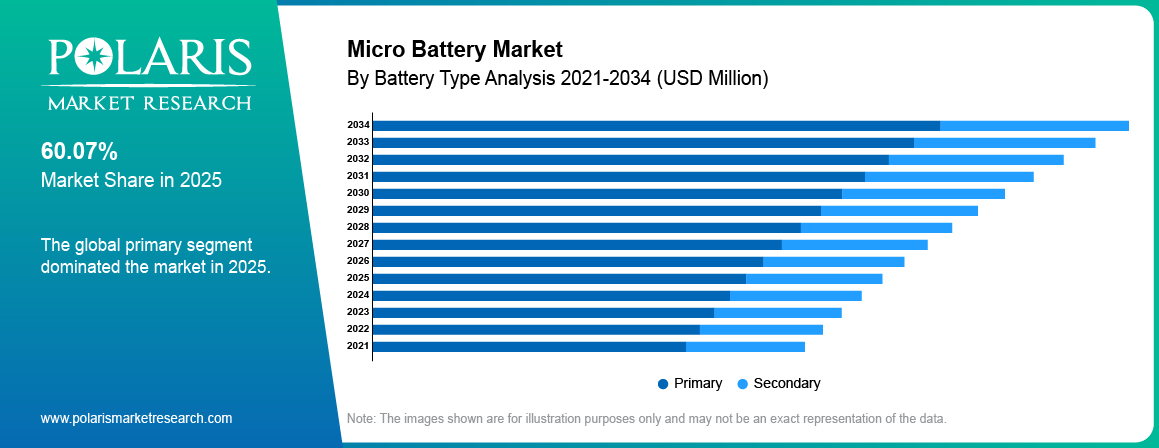
Regional Analysis
Asia Pacific Micro Battery Market Insights
Asia Pacific dominated the market, accounting for nearly 41.80% market share in 2025, driven by dominance in electronics manufacturing and growing preference for portable consumer products. The region has an integrated supply chain that includes packaging and assembly services. According to the Semiconductor Industry Association, China produces a total of around 36% of the global electronics production..[source:www.semiconductors.org] The rise in wearable, smartphone, and internet-connected device production spurs high consumption rates of micro batteries in Asia Pacific.
North America Micro Battery Market Assessment
North America possesses a prominent position in the micro-battery market due to innovations and robust development of electronics-based research and development. The demand is steady due to growing adoption of medical equipment, implantable devices, and wearable health monitoring devices. As per the Centers for Medicare & Medicaid Services, the total health care expenditure in the US rose by 7.2% to reach USD 5.3 trillion in 2024.[Source: www.cms.gov] Biomedical research and development, along with increasing commercialization, continues to provide continuous OEM demand for micro batteries in the region.
Europe Micro Battery Market Overview
Europe represents a stable market, due to its robust industrial sector and growing demand for solutions that cater to the healthcare technology sector. There are growing application of micro battery use in industrial sensors, medical instruments, and precision engineering in Europe. Also, growing emphasis on the development of superior quality materials used in the construction of batteries are further propelling the market growth.
Latin America Micro Battery Market Outlook
The region of Latin America is demonstrating slow but steady growth due to advancements in healthcare infrastructure as well as the increasing trend of using connected devices. Demand stems from the requirement of imported medical electronics and consumer devices, which need smaller sources of power. Limited adoption in urban regions ensures the steady application of microbatteries in the healthcare and monitoring sectors.
Middle East & Africa Micro Battery Market Trends
Middle East and Africa region is considered a developing market and has shown growth due to the development of healthcare infrastructure and early-stage deployments of smart infrastructure. Demand for micro batteries is observed for applications like asset tracking, surveillance systems, and identification devices. Government efforts for investment in smart healthcare and infrastructure are contributing to market growth. According to the World Economic Forum report, in 2023, the Saudi government invested more than USD 50 billion towards various initiatives, including smart healthcare services to improve efficiencies, access, and transparency in the healthcare sector.[Source:www.weforum.org]

Source: Polaris Market Research Analysis
Competitive Landscape & Key Players
The micro battery market reflects a moderately consolidated structure, characterized by well-known battery suppliers and innovative technology providers competing for business through various uses in such devices as wearable and medical devices and IoT sensors. The improvement of their energy density and safety performance, along with miniaturization, is critical in meeting their needs. Competition in the industry depends on parameters like innovation, flexibility in product design, compatibility with other devices, and commercialization of batteries. The qualifications of suppliers and performance in different duties of each gadget are essential in purchasing.
The key players in the market include CAP-XX Ltd., Cymbet Corporation, Duracell Inc., Energizer Holdings Inc., Enfucell Oy, Ilika Plc, ITEN, Maxell, Ltd., Molex, LLC, Murata Manufacturing Co., Ltd., Panasonic Holdings Corporation, Renata SA, Seiko Instruments Inc., STMicroelectronics N.V., and VARTA AG.
Premium Insights
-
Regulatory Framework
Regulation in the micro battery market revolves around ensuring safety, small-sizing specifications, and biocompatibility regulations. Authorities such as the U.S. Food and Drug Administration and International Organization for Standardization define guidelines for implantable micro battery and biocompatible battery usage in medical and electronic applications. Manufacturers are required to demonstrate safety and chemical stability of their micro batteries, especially for implantable and wearable products.
-
Key Risks Associated with Micro Battery Market
The micro battery market is at risk due to its limited energy capacity and high cost involved in manufacturing the next generation of micro batteries. Implantable micro batteries demand rigorous safety testing, prolonging development cycles. Furthermore, integrating on-chip power sources with electronic devices is a challenge that limits scaling. Additionally, bioabsorbable batteries are not yet fully developed and pose uncertainties in performance.
-
Strategic Insights
Market trends suggest growing consumer interest in micro batteries and bio-compatible batteries. There is increasing usage of implantable products, smart card products, and IoT technology which requires compact power source technologies. Growing in investments in research to develop bioresorbable batteries, allow the production of temporary medical implants, which dissolve once consumed. The future of this industry depends on technological innovations in terms of energy density and flexibility of batteries.
Key Players
- CAP-XX Ltd.
- Cymbet Corporation
- Duracell Inc.
- Energizer Holdings Inc.
- Enfucell Oy
- Ilika Plc
- ITEN
- Maxell, Ltd.
- Molex, LLC
- Murata Manufacturing Co., Ltd.
- Panasonic Holdings Corporation
- Renata SA
- Seiko Instruments Inc.
- STMicroelectronics N.V.
- VARTA AG
Industry Developments
- April 2025: ITEN announced that it has invented a new micro battery technology that is capable of offering a 200C charge at least 100 times faster than regular lithium-ion batteries. [source: www.iten.com]
Micro Battery Market Segmentation
By Battery Type Outlook (Revenue, USD Million, 2021-2034)
- Primary
- Secondary
By Product Type Outlook (Revenue, USD Million, 2021-2034)
- Thin-Film
- Printed
- Solid-State Chip
- Button / Other Compact Formats
By Capacity Outlook (Revenue, USD Million, 2021-2034)
- Below 10 mAh
- 10–100 mAh
- Above 100 mAh
By Application Outlook (Revenue, USD Million, 2021-2034)
- Wearables
- Portable Electronics
- Wireless Sensors
- Medical Devices
- Others
By Regional Outlook (Revenue, USD Million, 2021-2034)
- North America
- US
- Canada
- Europe
- Germany
- France
- UK
- Italy
- Spain
- Netherlands
- Russia
- Rest of Europe
- Asia Pacific
- China
- Japan
- India
- Malaysia
- South Korea
- Indonesia
- Australia
- Vietnam
- Rest of Asia Pacific
- Middle East & Africa
- Saudi Arabia
- UAE
- Israel
- South Africa
- Rest of Middle East & Africa
- Latin America
- Mexico
- Brazil
- Argentina
- Rest of Latin America
Micro Battery Market Report Scope
| Report Attributes | Details |
| Market Size in 2025 | USD 791.27 Million |
| Market Size in 2026 | USD 976.65 Million |
| Revenue Forecast by 2034 | USD 5,396.98 Million |
| CAGR | 23.78% from 2026 to 2034 |
| Base Year | 2025 |
| Historical Data | 2021–2024 |
| Forecast Period | 2026–2034 |
| Quantitative Units | Revenue in USD Million and CAGR from 2026 to 2034 |
| Report Coverage | Revenue Forecast, Competitive Landscape, Growth Factors, and Industry Trends |
| Segments Covered |
|
| Regional Scope |
|
| Competitive Landscape |
|
| Report Format |
|
| Customization | Report customization as per your requirements with respect to countries, regions, and segmentation. |
Source: Polaris Market Research Analysis
Micro Battery Market FAQ's
The global market size was valued at USD 791.27 million in 2025 and is projected to grow to USD 5,396.98 million by 2034.
Asia Pacific dominated the market, accounting for nearly 41.80% market share in 2025 due to high electronics production and increasing demand for compact consumer devices.
The key applications of the market include wearables, portable electronics, wireless sensors, and other uses.
Key players include CAP-XX Ltd., Cymbet Corporation, Duracell Inc., Energizer Holdings Inc., Enfucell Oy, Ilika Plc, ITEN, Maxell, Ltd., Molex, LLC, Murata Manufacturing Co., Ltd., Panasonic Holdings Corporation, Renata SA, Seiko Instruments Inc., STMicroelectronics N.V., and VARTA AG.
The growth is fueled by rising demand for wearable devices, IoT ecosystem development, and growing need for small-sized batteries.
Limited energy capacity due to miniaturization creates performance constraints and affects long-duration device operation.
Primary sources of demand include consumer electronics, health care equipment, industrial IoT applications, and wearables industry.
The market outlook remains strong due to continuous innovation in battery design and increasing adoption of miniaturized electronic devices.
The growing use of connected sensors and edge devices increases the demand for small yet long-life batteries.
Download Sample Report of Micro Battery Market
Please fill out the form to request a customized copy of the research report.


