
Plastic Extrusion Machine Market, Opportunity, Business Insights, 2026-2034
REPORT DETAILS
Plastic Extrusion Machine Market Summary
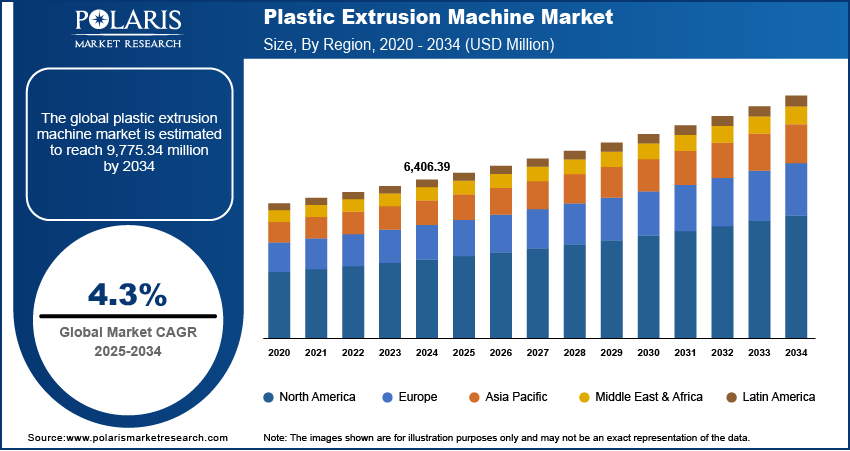
The global plastic extrusion machine market size was valued at USD 7.76 billion in 2025, at a CAGR of 4.49% during 2026–2034. The global market growth is driven by increasing demand for sustainable products, rapid industrialization, and technological advancements in extrusion machinery.
Market Statistics
Key Takeaways
-
Asia Pacific led the market with a 44.63% share in 2025 driven by strong industrialization, urbanization, and investments in extrusion technologies, particularly in China, India, and Japan.
-
North America is expected to grow at the fastest 6.14% CAGR during 2026–2034, driven by innovations in sustainable manufacturing and demand for advanced plastic components in various industries.
-
Single-screw extruders dominated the market with a 58.73% share in 2025 due to cost-effectiveness, simplicity, and energy efficiency, and are widely used for pipes, films, and sheets.
-
The building & construction sector is projected to grow at a 5.34% CAGR during 2026–2034 due to high demand for extruded plastic components, such as pipes, profiles, and insulation, in modern infrastructure.
Industry Dynamics
- Increasing demand for eco-friendly and energy-efficient products is driving the plastic extrusion machine market.
- Technological advancements in automation and real-time monitoring are enhancing efficiency and sustainability in production processes.
- Rapid urbanization and industrial development in emerging economies are boosting demand for extruded plastic components.
- Growing investments in automation, IoT, and sustainable production methods further fuel market expansion.
- Market challenges include competition from advanced machinery and fluctuations in raw material prices.
Source: Polaris Market Research Analysis
To Understand More About this Research: Download Sample Report
What is Plastic Extrusion Machines?
A plastic extrusion machine is a manufacturing device used to process and shape plastic materials into continuous profiles, such as pipes, sheets, and films, through a high-pressure extrusion process. The global plastic extrusion machine market growth is driven by the increasing demand for sustainable and eco-friendly products. Manufacturers are focusing on biodegradable and recycled plastic extrusion solutions as industries shift toward environmentally responsible practices. Stricter regulations on plastic waste management and consumer preference for sustainable packaging further contribute to this demand. Additionally, advancements in extrusion technologies are enabling higher efficiency and reduced energy consumption, aligning with sustainability goals across various industries.
Another key factor boosting the plastic extrusion market demand is the rapid infrastructure development and industrialization across emerging economies. Expanding urbanization, growing construction activities, and increasing investments in industrial manufacturing drive the demand for plastic extrusion machines for producing pipes, profiles, and insulation materials. The need for cost-effective and durable plastic components in sectors such as construction, automotive, and electronics further accelerates expansion opportunities. In January 2025, Guill launched its next-generation Series 800 extrusion tooling, designed for 2-to-6 layer tubing production. (Source: plasticstoday.com)This innovation ensures high-quality, material-efficient tubing for automotive, medical, and industrial applications, featuring precision adjustments and advanced polymer processing capabilities. Such advancements highlight how technological innovations in extrusion machinery are enhancing production capabilities, supporting large-scale industrial applications, and reinforcing the role of plastic extrusion in modern infrastructure development.
Difference Between Plastic Extrusion vs Injection Molding
| Aspect | Plastic Extrusion | Injection Molding |
| Manufacturing Process | Produces continuous plastic profiles by forcing molten plastic through a die. | Injects molten plastic into a mold cavity to create discrete parts. |
| Product Type | Used for continuous products such as pipes, tubes, sheets, films, and profiles. | Used for individual components with specific shapes and dimensions. |
| Production Efficiency | Highly efficient for continuous, high-volume production runs. | Efficient for mass production of identical molded parts. |
| Design Complexity | Best suited for simple and uniform cross-sectional designs. | Ideal for complex geometries, intricate details, and customized shapes. |
| Tooling Requirements | Requires extrusion dies, generally lower tooling complexity and cost. | Requires precision molds, often involving higher tooling investment. |
| Material Utilization | Generates minimal material waste during continuous processing. | May produce some waste from runners, sprues, and trimming operations. |
| Production Flexibility | Easily produces products of varying lengths without changing tooling. | Each product design typically requires a dedicated mold. |
| Key Market Applications | Construction pipes, packaging films, wire coatings, window profiles, and sheets. | Automotive components, consumer goods, medical devices, electronics housings, and packaging containers. |
Market Dynamics
Advancements in Manufacturing Technologies
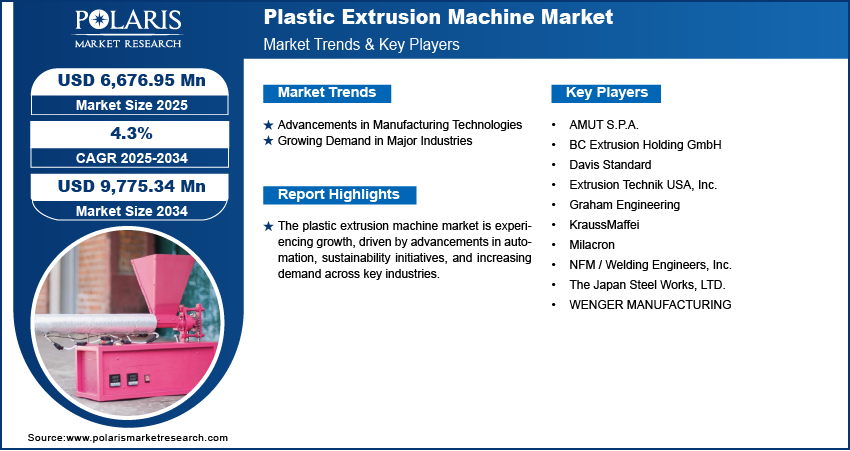
Modern extrusion machines integrate automation, real-time monitoring, and energy-efficient mechanisms to optimize output while reducing material waste, enhancing efficiency, precision, and sustainability in production processes. Innovations such as multi-layer extrusion and high-speed processing improve product quality and expand application possibilities across industries. Additionally, the adoption of Industry 4.0 technologies, such as IoT and AI-driven systems, allows predictive maintenance and process optimization, ensuring higher productivity and lower operational costs. In March 2025, UltiMaker launched the UltiMaker S8 3D printer, a next-generation solution offering speeds up to 500mm/s and 4x productivity gains. (Source: ultimaker.com)This advancement exemplifies how innovative technologies are enabling fast, precise, and reliable production, supporting diverse industrial needs. These technological advancements strengthen the market by meeting evolving industry requirements for precision, consistency, and environmental compliance.
Growing Demand in Major Industries
The growing demand in major industries such as construction, packaging, automotive, and healthcare drives the plastic extrusion machine market development. These industries increasingly rely on extruded plastic components. In construction, extruded profiles, pipes, and insulation materials are essential for infrastructure projects, while the packaging industry depends on high-quality films and sheets for flexible and rigid packaging solutions. The automotive sector benefits from lightweight, durable plastic parts that enhance fuel efficiency and performance. Additionally, the medical industry’s need for precision-extruded tubing and components continues to rise. For instance, in March 2024, MAS launched the MAS 110, a next-generation extruder designed for modern recycling challenges. Compact yet powerful, it processes up to 6 tonnes of PET per hour, offering high-quality melt and flexibility for various plastics and applications, including chemical recycling. This innovation exemplifies how extrusion technologies are advancing to address the complex needs of diverse industries. Such developments ensure sustained market growth and the continuous evolution of extrusion technologies to meet industrial demands.
Source: Polaris Market Research Analysis
Segment Insights
Market Assessment by Type Outlook
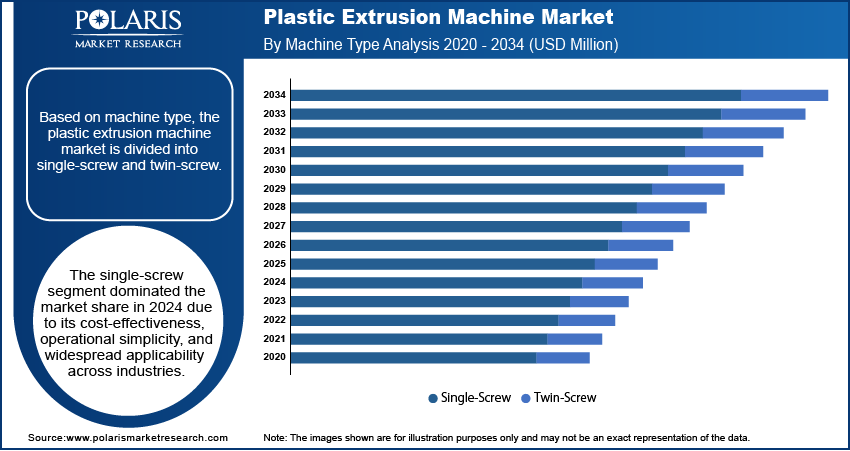
The global plastic extrusion machine market segmentation, based on type, includes single-screw and twin-screw. The single-screw extruders dominated the market with a 58.73% share in 2025 due to its cost-effectiveness, operational simplicity, and widespread applicability across industries. Single-screw extruders are preferred for their efficiency in processing a wide range of thermoplastic materials, making them ideal for manufacturing pipes, films, and sheets. Their lower maintenance requirements and ease of operation make them a viable choice for both small-scale and large-scale production facilities. Additionally, technological advancements in single-screw extruders have improved their throughput and energy efficiency, further solidifying their market dominance. These factors collectively contribute to their strong adoption across various end-use sectors.
Market Evaluation by Application Outlook
The global plastic extrusion machine market segmentation, based on application, includes building & construction, medical, transportation, consumer goods, and others. The building & construction sector is projected to grow at a 5.34% CAGR during 2026–2034, driven by the increasing demand for extruded plastic components in infrastructure projects. Plastic extrusions, such as pipes, profiles, window frames, and insulation materials, play a crucial role in modern construction due to their durability, cost-effectiveness, and resistance to corrosion. Rapid urbanization and large-scale residential and commercial developments are fueling the need for advanced construction materials. Additionally, the shift toward sustainable and energy-efficient building solutions is driving the adoption of plastic extrusion technologies, ensuring continued expansion in this segment.
Comparison Matrix: Single Screw vs Twin Screw Extruder
| Aspect | Single-Screw Extrusion Machines | Twin-Screw Extrusion Machines |
| Machine Design | Utilizes one rotating screw to convey and melt plastic material. | Uses two intermeshing or non-intermeshing screws for material processing. |
| Initial Cost | Lower capital investment and maintenance costs. | Higher equipment and operational costs due to advanced design. |
| Processing Capability | Suitable for straightforward extrusion processes and standard polymers. | Designed for complex formulations, compounding, blending, and reactive extrusion. |
| Mixing Performance | Provides moderate mixing and homogenization capabilities. | Delivers superior mixing, dispersion, and material uniformity. |
| Production Efficiency | Efficient for conventional, high-volume extrusion applications. | Offers higher throughput, process control, and production efficiency. |
| Material Flexibility | Best suited for processing single-material formulations. | Handles additives, fillers, reinforcements, recycled plastics, and specialty compounds effectively. |
| Operational Complexity | Easier to operate and maintain. | Requires greater technical expertise and process control. |
| Typical Applications | Pipes, sheets, films, wire coatings, and standard plastic products. | Engineering plastics, masterbatches, bioplastics, PVC compounding, and specialty materials. |
| Market Preference | Dominates conventional extrusion applications due to affordability and simplicity. | Preferred for advanced manufacturing requiring precise mixing and formulation control. |
Source: Polaris Market Research Analysis
Regional Analysis
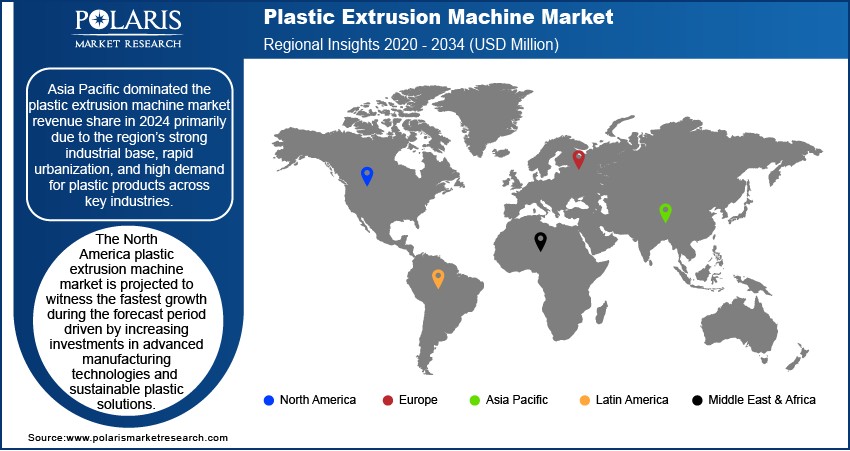
By region, the report provides the plastic extrusion machine market insights into North America, Europe, Asia Pacific, Latin America, and the Middle East & Africa. Asia Pacific led the market with a 44.63% share in 2025 primarily due to the region’s strong industrial base, rapid urbanization, and high demand for plastic products across key industries. Countries such as China, India, and Japan are major manufacturing hubs, contributing to substantial investments in extrusion technologies for applications in the packaging, construction, and automotive sectors. The availability of low-cost raw materials and labor further improves production capabilities, attracting global manufacturers to set up facilities in the region. Additionally, government initiatives promoting industrial expansion and infrastructure development continue to drive demand for advanced extrusion machinery, reinforcing Asia Pacific’s market leadership. In March 2025, Orbetron Extrusion and Technovel Corporation formed a strategic partnership to expand their market reach. Orbetron will distribute Technovel’s products in North America, while Technovel will distribute Orbetron’s solutions in Japan and Asia, improving global access to advanced extrusion technologies. (Source: orbetronextrusion.com)This collaboration highlights the growing importance of Asia Pacific as a hub for innovation and expansion opportunities in the extrusion industry.
North America is expected to grow at the fastest 6.14% CAGR during 2026–2034, driven by increasing investments in advanced manufacturing technologies and sustainable plastic solutions. The region's strong focus on innovation, automation, and energy-efficient extrusion systems is accelerating market expansion. Additionally, the growing demand for high-performance plastic components in industries such as healthcare, automotive, and packaging is fueling the adoption of advanced extrusion machines. Strict environmental regulations are also prompting manufacturers to invest in eco-friendly and recyclable plastic processing solutions, further driving the North America plastic extrusion machine market expansion.
Source: Polaris Market Research Analysis
Key Players & Competitive Analysis Report
The competitive landscape features global leaders and regional players competing for plastic extrusion machine market share through innovation, strategic alliances, and regional expansion. Global players utilize strong R&D capabilities, technological advancements, and extensive distribution networks to deliver advanced solutions, meeting the growing demand for disruptive technologies and sustainable value chains. Plastic extrusion machine market trends highlight rising demand for emerging technologies, digitalization, and business transformation driven by economic growth, geopolitical shifts, and macroeconomic trends. Global players focus on strategic investments, mergers and acquisitions, and joint ventures to strengthen their market position. Post-merger integration and strategic alliances are key strategies to improve competitive positioning and expand regional footprints. Regional companies, meanwhile, address localized needs by offering cost-effective solutions and leveraging economic landscapes. Competitive benchmarking includes market entry assessments, expansion opportunities, and partnership ecosystems to meet the demand for innovative products and future-ready solutions. The market is experiencing technological advancements, such as disruptive technologies and digital transformation, reshaping industry ecosystems. Companies are investing in supply chain management, procurement strategies, and sustainability transformations to align with plastic extrusion machine market demand, trends, and future development strategies. Pricing insights, revenue growth analysis, and competitive intelligence are critical for identifying opportunities and driving long-term profitability. In conclusion, the plastic extrusion machine industry's growth is driven by technological innovation, market adaptability, and regional investments. Major players focus on strategic developments, market penetration, and competitive benchmarking to address economic and geopolitical shifts, assuring sustained growth in a hypercompetitive global market. A few key major players are AMUT S.P.A.; BC Extrusion Holding GmbH; Davis Standard; Extrusion Technik USA, Inc.; Graham Engineering; KraussMaffei; Milacron; NFM / Welding Engineers, Inc.; The Japan Steel Works, LTD.; and Wenger Manufacturing.
KraussMaffei is a German manufacturing company specializing in machinery and systems for producing and processing plastics and rubber. Founded in 1838 as Maffei and later merged with Krauss & Co. in 1931, the company has evolved, focusing on cutting-edge technologies in injection molding, extrusion, reaction process machinery, and additive manufacturing. In the plastic extrusion machine sector, KraussMaffei offers a wide range of solutions, including high-performance profile extrusion systems for processing PVC, PE, and other materials. They also provide advanced pipe extrusion systems capable of producing pipes from 5 mm to 2,000 mm in diameter, catering to PVC and PO processing. Their twin-screw extruders are particularly noted for their efficiency in producing U-PVC, M-PVC, and foam core PVC pipes, with features such as modular designs and cost-effective production processes. KraussMaffei supports industries such as automotive, packaging, medical, and construction with a global presence through over 30 subsidiaries and 570 commercial partners.
Graham Engineering Company, LLC, established in 1960, is into plastic extrusion machine technology. Known for introducing the Graham Wheel in 1964, the company has maintained its position as a standard-setter in the industry. Graham Engineering specializes in providing innovative, modular machinery solutions tailored to specific manufacturing needs, offering reliable and replicable parisons, single screw extrusion, and complete downstream systems. Their product range includes blow molding, extrusion, sheet extrusion, industrial, and healthcare tubing solutions, all equipped with advanced Navigator control systems. The company has integrated brands such as American Kuhne, Welex, and Navigator Controls to improve its offerings. Graham Engineering's expertise extends to various applications, such as the automotive, medical, and packaging industries. They offer customized extrusion systems, such as the Co-Extrusion Profile System for automotive trim profiles, and have recently introduced new medical extruders designed for clean-room environments.
List of Key Companies
- AMUT S.P.A.
- BC Extrusion Holding GmbH
- Davis Standard
- Extrusion Technik USA, Inc.
- Graham Engineering
- KraussMaffei
- Milacron
- NFM / Welding Engineers, Inc.
- The Japan Steel Works, LTD.
- WENGER MANUFACTURING
Plastic Extrusion Machine Industry Developments
May 2026: BlueAlp and Germany-based KraussMaffei Extrusion announced a partnership. At the Plastics Recycling Show Europe (PRSE) in Amsterdam, they revealed their focus on BlueAlp’s technology using KraussMaffei’s ZE BluePower twin-screw extruder. KraussMaffei stated that the twin-screw extruders will be installed at BlueAlp’s facilities across Italy and Belgium. (Source: recyclingtoday.com)
Plastic Extrusion Machine Market Segmentation
By Machine Type Outlook (Revenue, USD Billion, 2021–2034)
- Single-Screw
- Twin-Screw
By Process Type Outlook (Revenue, USD Billion, 2021–2034)
- Blown Film Extrusion
- Sheet/Film Extrusion
- Tubing Extrusion
- Others
By Solution Outlook (Revenue, USD Billion, 2021–2034)
- New Sales
- Aftermarket
By Application Outlook (Revenue, USD Billion, 2021–2034)
- Building & Construction
- Medical
- Transportation
- Consumer Goods
- Others Source
By Regional Outlook (Revenue, USD Billion, 2021–2034)
- North America
- US
- Canada
- Europe
- Germany
- France
- UK
- Italy
- Spain
- Netherlands
- Russia
- Rest of Europe
- Asia Pacific
- China
- Japan
- India
- Malaysia
- South Korea
- Indonesia
- Australia
- Vietnam
- Rest of Asia Pacific
- Middle East & Africa
- Saudi Arabia
- UAE
- Israel
- South Africa
- Rest of Middle East & Africa
- Latin America
- Mexico
- Brazil
- Argentina
- Rest of Latin America
Plastic Extrusion Machine Market Report Scope
| Report Attributes | Details |
| Market Size Value in 2025 | USD 7.76 billion |
| Market Size Value in 2026 | USD 8.10 billion |
| Revenue Forecast in 2034 | USD 11.53 billion |
| CAGR | 4.49% from 2026 to 2034 |
| Base Year | 2025 |
| Historical Data | 2021–2024 |
| Forecast Period | 2026–2034 |
| Quantitative Units | Revenue in USD Million and CAGR from 2026 to 2034 |
| Report Coverage | Revenue Forecast, Market Competitive Landscape, Growth Factors, and Industry Trends |
| Segments Covered |
|
| Regional Scope |
|
| Competitive Landscape |
|
| Report Format |
|
| Customization | Report customization as per your requirements with respect to countries, regions, and segmentation. |
Source: Polaris Market Research Analysis
plastic extrusion machine market FAQ's
The global plastic extrusion machine market size was valued at USD 7.76 billion in 2025 and is projected to grow to USD 11.53 billion by 2034.
The global market is projected to register a CAGR of 4.49% during the forecast period.
Asia Pacific led the market with a 44.63% share in 2025.
A few of the key players in the market are AMUT S.P.A.; BC Extrusion Holding GmbH; Davis Standard; Extrusion Technik USA, Inc.; Graham Engineering; KraussMaffei; Milacron; NFM / Welding Engineers, Inc.; The Japan Steel Works, LTD.; and Wenger Manufacturing.
Single-screw extruders dominated the market with a 58.73% share in 2025 due to cost-effectiveness, simplicity, and energy efficiency.
The building & construction sector is projected to grow at a 5.34% CAGR during 2026–2034 due to high demand for extruded plastic components
Automation, IoT-enabled monitoring and advanced control systems are enhancing extrusion precision, reducing material wastage and allowing real-time process optimization. These technologies are also helping manufacturers increase productivity and ensure consistent product quality.
The increasing use of recycled and bio-based plastics is driving demand for extrusion equipment that can handle a wide range of inconsistent and variable feedstocks. As a result, manufacturers are investing in more energy-efficient, flexible, and high-performance extrusion systems.
Automation, IoT-enabled monitoring and advanced control systems are enhancing extrusion precision, reducing material wastage and allowing real-time process optimization. These technologies are also helping manufacturers increase productivity and ensure consistent product quality.
The increasing use of recycled and bio-based plastics is driving demand for extrusion equipment that can handle a wide range of inconsistent and variable feedstocks. As a result, manufacturers are investing in more energy-efficient, flexible, and high-performance extrusion systems.
Download Sample Report of plastic extrusion machine market
Please fill out the form to request a customized copy of the research report.


