
Polyethylene Glycol Market Demand, Growth Opportunity, 2026-2034
REPORT DETAILS
Polyethylene Glycol Market Summary
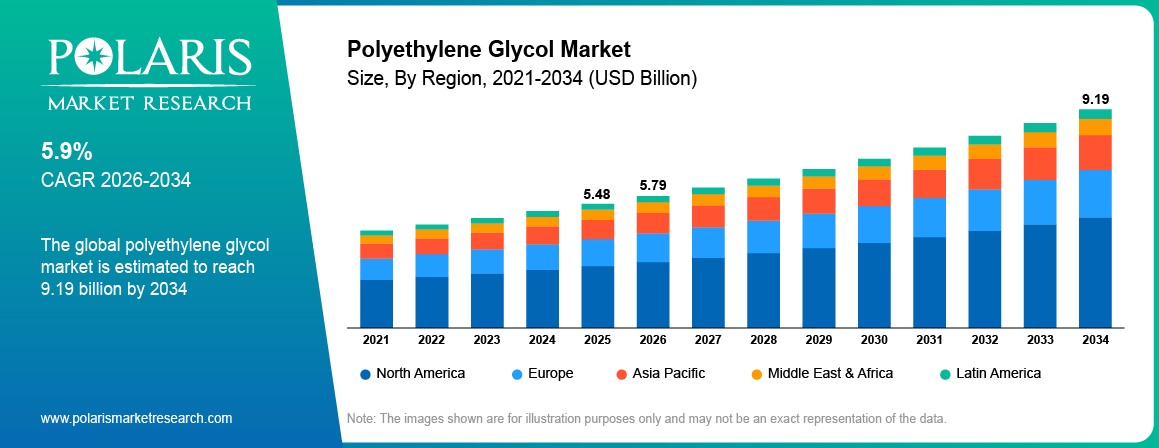
The global polyethylene glycol market size was valued at USD 5.48 billion in 2025, growing at a CAGR of 5.9% from 2026–2034. Key factors driving demand for polyethylene glycol include rising demand for personal care and cosmetics, growth in the textile industry, growing pharmaceutical industry, expansion of the construction sector, and advancements in drug delivery systems
Market Statistics
Polyethylene Glycol Market Key Takeaways
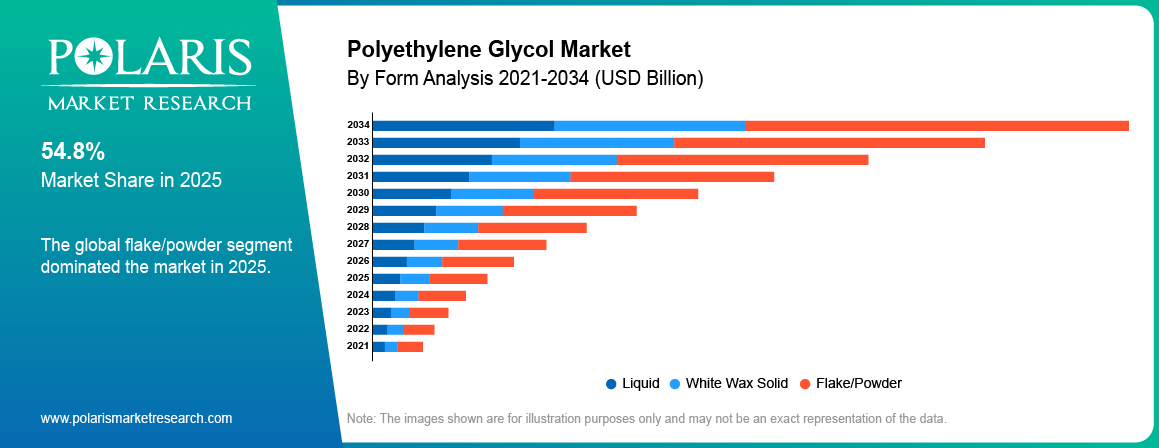
- The flake/powder category held the largest share of 54.8% revenue in 2025. This is due to their wide applicability across industries such as pharmaceuticals, personal care, adhesives, and textiles.
- The PEG 200 is expected to witness the fastest growth of CAGR 6.4% during the forecast period. This is driven by their use in personal care, pharmaceutical, lubricants, and chemical processing industries where low-viscosity carriers and solvents are required.
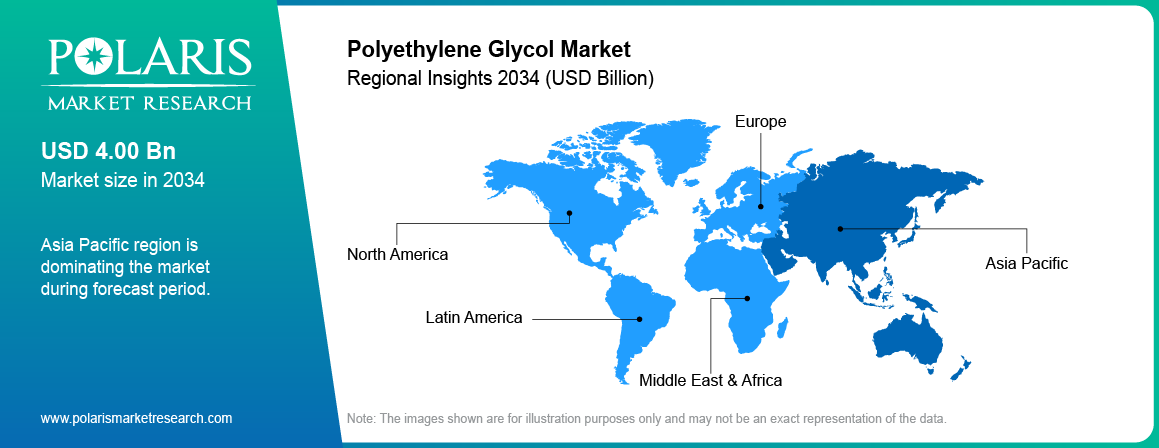
- In 2025, Asia Pacific dominated the global market with 43.6% share. This is driven by the presence of high-volume production and the growing application of PEG-based materials.
- North America is expected to witness significant growth of 6.1% CAGR, driven by its strong focus on product performance, regulatory compliance, and technological innovation.
Note: Figures and projections outlined in this report are the result of Polaris Market Research’s proprietary analytical processes, grounded in the latest available datasets and market observations.
What is Polyethylene Glycol?
Polyethylene glycol (PEG) is a hydrophilic polymer with extensive application as a solid dispersing agent for poorly soluble drugs. The market is driven by the multi-functional characteristics of PEG. This makes it a necessary component in many industries such as personal care, pharmaceutical, textile, and industrial treatment. Growth trends are being shaped by an increasing demand for personal, care and make-up products. While PEG is prized in this category for its high solubility, hydrating properties, and formulation-stabilizing effects, the ingredient is also common in cream, lotion, shampoo, other hair care and skin care products. Manufacturers have continued to turn to PEG-based ingredients to enhance the texture, spreadability, and overall consistency of their products, as consumers continue to desire advanced, high-quality product that fulfill multiple needs in their personal care routines. Thus, with a growing focus on the manufacture of effective formulations, PEG continues to become an essential part of the development of personal care and cosmetics.
Source: Polaris Market Research Analysis
The market is also driven by rising demand from the textile industry. According to a June 2024 Cotton Textiles Export Promotion Council report, the global textile market reached USD 125.6 billion in 2023. Polyethylene glycol is also used widely in the textile industry where it acts as a lubricant, antistatic agent to soften fibers, and a binder to uniform the dye before application, among other uses in textiles. Chemicals for facilitating weaving, finishing, dyeing etc., are also required in increasing quantity, which means that PEG is becoming more important in this area as textile processing develops. Moreover, its universal applicability with different types of fibres and dyes makes it a reliable process aid to enhance process efficiency as well as the quality of the final fabric. PEG continues to be a major facilitator in producing premium quality textile materials owing to ongoing innovations in textile production techniques, and enhancing focus on the performance of materials.
Difference Between: Polyethylene Glycol vs Other Polymers
Polyethylene glycol (PEG) differs from many conventional polymers. PEG has various properties such as excellent water solubility, biocompatibility, and low toxicity profile. Unlike hydrophobic polymers such as polypropylene (PP) and polyethylene (PE), PEG is highly hydrophilic. This makes it suitable for pharmaceutical, cosmetic, and biomedical formulations. PEG also offers greater formulation flexibility. It is available in multiple molecular weights and physical forms ranging from liquids to waxy solids. Compared to polymers such as polyvinyl alcohol (PVA) and polylactic acid (PLA), PEG demonstrates superior lubrication, moisture-retention, and drug-delivery capabilities. Its broad compatibility with active ingredients and solvents enhances its application versatility. It is used across different sectors such as healthcare, personal care, industrial processing, and chemical manufacturing.
| Parameter | Polyethylene Glycol (PEG) | Other Conventional Polymers |
| Solubility | Highly water-soluble | Often hydrophobic or partially soluble |
| Safety & Biocompatibility | Low toxicity and biocompatible | May require stabilizers or additives |
| Flexibility | Available in various molecular weights and forms | Limited formulation adaptability |
| Application Versatility | Used in pharma, cosmetics, lubricants, and industrial applications | Often application-specific |
| Moisture Retention | Excellent humectant properties | Generally lower moisture affinity |
| Drug Delivery Capability | Widely used in drug formulations and PEGylation | Limited biomedical compatibility |
Source: Polaris Market Research Analysis
Market Dynamics
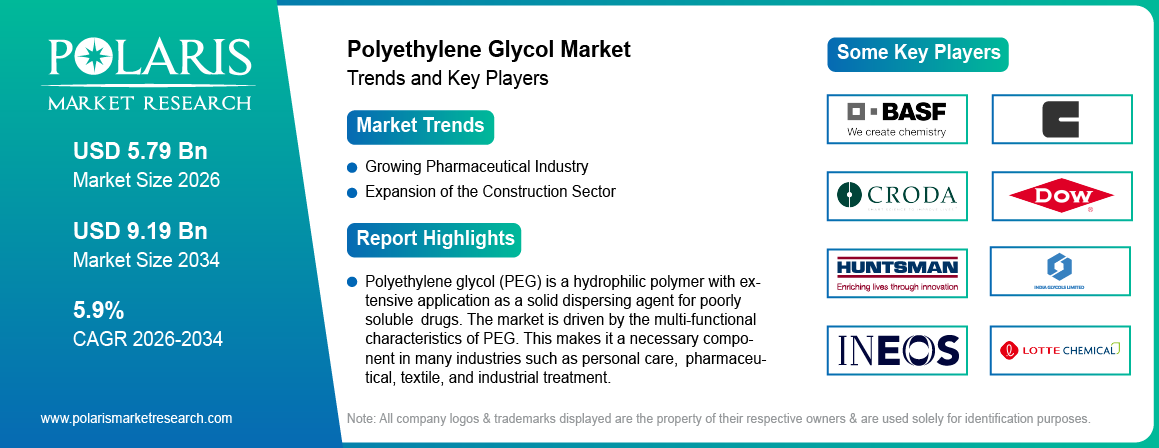
Driver: Growing Pharmaceutical Industry
The expansion of pharmaceutical industry contributes to the market growth. This is due to their vital role in drug formulation and delivery. The IFPMA 2025 report stated that in 2021, the global pharmaceutical R&D spending reached USD 276 billion. This highlights a 27% increase in R&D spending as a share of revenue. PEG has become an important ingredient in tablets, ointments, capsules, and injectable preparations as an excipient, binder, solubilizer, and stabilizing agent. Its biocompatibility, along with its drug solubilizing effect, facilitates the creation of pharmaceutical products which are effective as well as easy on the patients. Furthermore, PEGylation, that is, the conjugation of PEG chains to drug molecules, provides increased drug stability, decreased immunogenicity, and prolonged circulation time, further highlighting its significance in today’s therapeutics. Therefore, as pharma companies are increasingly innovating and expanding their product pipelines, the need for quality PEG grades is growing, making it an essential material among the industry.
Driver: Expansion of the Construction Sector
The growth of the construction industry is also a major factor in the polyethylene glycol market growth, as PEG is widely utilized in construction and construction materials. A global status report for buildings and construction 2024/2025 stated that, the global building construction grew by 2.2% from 2020 to 2023. It is an important ingredient in concrete admixtures to improve workability, water retention, and performance of cement-based products. It contributes to the workability and strength of the material in industrial and home building applications, and acts as a plasticiser and dispersing agent. PEG-based substitutes are widely used in coatings, sealants, and adhesives to add flexibility and consistency, with ease of application. PEG’s versatility as a functional agent makes it a major player in futuristic construction systems as the increasing demand of the construction sector for high-performance materials with proven reliability over extended periods of time.
Source: Polaris Market Research Analysis
Segmental Insights
Form Analysis
Based on form, the segmentation includes liquid, white wax solid, and flake/powder. The flake/powder category held the largest share of 54.8% in 2025. This is because flake or powder antifoam agents are easier to handle and store, and powder antifoam agents can also be mixed with other agents during processing on the industry. This form is applied in many industries including pharmaceuticals, personal care, adhesives and textiles applications as it allows uniform purity and higher compatibility with dry formulations. Moreover, manufacturers prefer flake and powder PEG for its longer shelf life and the convenience of transport over the liquid forms. The Brand's accurate dosing helps in a smooth production process, especially in applications where ingredients need to be dispersed in a controlled manner. Thus, these benefits continue to dominate the market.
Grade Analysis
In terms of grade, the segmentation includes PEG 200, PEG 400, PEG 1000, PEG 3350, PEG 8000, and other grades. The PEG 200 is expected to witness the fastest growth of CAGR 6.4% during the forecast period. Attributed to its low molecular weight and high solubility which allows it to be used in a variety of formulations. PEG 200 is increasingly being used in personal care, pharmaceuticals, lubricants and chemical processing industries where low-viscosity carriers and solvents are required. Its increasing adoption is attributed to its capacity to make products more consistent, easier to spread and blend efficiently. Therefore, as sectors shift towards multifunctional and high-performing ingredients, there is an increasing demand for PEG 200, thus making it a growth avenue for the market.
Technological Advancements in PEG
| Technological Advancement | Description | Key Benefits | Major Application Areas |
| PEGylation Technology | Attachment of PEG molecules to drugs, proteins, or biologics to improve pharmacological performance | Enhances drug stability, solubility, and circulation time | Biopharmaceuticals, injectable drugs |
| High-Purity PEG Production | Advanced purification and synthesis processes improving PEG quality and consistency | Reduces impurities and improves safety compliance | Pharmaceuticals, cosmetics |
| Multi-Arm PEG Structures | Development of branched and multi-arm PEG molecules for targeted functionality | Improves drug loading capacity and controlled release | Drug delivery systems, tissue engineering |
| Smart PEG-Based Hydrogels | Stimuli-responsive PEG hydrogels reacting to temperature or pH changes | Enables targeted and controlled therapeutic delivery | Regenerative medicine, wound care |
| Nano-PEG Formulations | Integration of PEG into nanoparticle-based delivery systems | Enhances bioavailability and targeted drug transport | Oncology, gene therapy |
| Bio-Based PEG Development | Production of PEG using renewable and sustainable feedstocks | Supports sustainability goals and reduces environmental impact | Green chemistry, personal care products |
| PEG Surface Modification Technologies | PEG coatings applied to medical devices and implants to improve compatibility | Minimizes immune response and protein adhesion | Medical devices, implants |
| Advanced PEG Blending Techniques | Improved blending and formulation technologies for industrial applications | Enhances lubrication, viscosity control, and formulation stability | Industrial lubricants, coatings, cosmetics |
Source: Polaris Market Research Analysis
Source: Polaris Market Research Analysis
Regional Analysis
Asia Pacific Polyethylene Glycol Market Assessment
The Asia Pacific dominated the global market with 43.6% share in 2025. This is due to the strong industrial base and increasing manufacturing activities in pharmaceutical, personal care, textile, chemical, and other end-user industries. The region is also characterized by the presence of high-volume production, growing application of PEG-based materials, and the increasing use of refined formulation materials. The Chemical & Petrochemical Statistics at a Glance 2024 report stated that the production of major Chemicals and petrochemicals grew at CAGR of 3.0% by 2023. Moreover, growing investments for the development of new industries and diverse end-use industries further strengthen the position of Asia Pacific. Thus, this broad application landscape continues to drive strong demand for polyethylene glycol.
North America Polyethylene Glycol Market Insights
North America is expected to witness significant growth of 6.1% CAGR. The growth in the North America market is due to the growing use of premium quality formulation ingredients in pharmaceutical, cosmetic, and industrial manufacturing, among others. The region has a strong focus on product performance, regulatory compliance and technological innovation, which supports a higher penetration of specialized PEG grades. Increasing penetration of innovations in drug delivery systems and a consistent demand for high quality personal care formulations fuel the expanding role of PEG. In addition, developed industrial base along with continuous technology development in application of materials also propel the market growth in the region of North America.
Source: Polaris Market Research Analysis
Competitive Analysis Report
The industry is dominated by large corporations such as BASF and Dow Chemical. These companies have implemented joint venture and strategic investment strategies in their pursuit of securing supply chains and increasing market share in underdeveloped countries. Small and medium PEG companies have the ability to derive their highest potential revenue growth from product entry strategies that emphasize high purity pharmaceutical grade (HPPG) and sustainable value chains (SVC), as these represent a tremendous source of latent demand. The development of improved drug delivery technologies will be a major contributor to the growth of the PEG industry over the next several years, creating many opportunities for future expansion. However, successfully creating these new opportunities requires an understanding of vendor strategies and their pricing strategies, coupled with an understanding of the effects that global/geo-economic events will have on the PEG industry’s future demand and outlook. In order for companies to successfully adapt their future development strategies to changes in the PEG industry's competitive landscape, it is imperative that they are able to obtain an in-depth understanding of the dynamics surrounding each of these trends.
Major companies operating in the polyethylene glycol industry include BASF, Clariant, Croda, Dow Chemical Company, Huntsman Corporation, India Glycols, Ineos, LOTTE Chemical, Rimpro India, and Shree Venkatesh Chemicals.
Key Players
- BASF
- Clariant
- Croda
- Dow Chemical Company
- Huntsman Corporation
- India Glycols
- Ineos
- LOTTE Chemical
- Rimpro India
- Shree Venkatesh Chemicals
Industry Developments
- March 2026: Clariant announced the expansion of its pharmaceutical-grade PEG manufacturing into North America with Texas Facility. With this, the company is expanding reach to Latin America. (Source: clariant.com).
Polyethylene Glycol Market Segmentation
By Form Outlook (Revenue, USD Billion, 2021–2034)
- Liquid
- White Wax Solid
- Flake/Powder
By Grade Outlook (Revenue, USD Billion, 2021–2034)
- PEG 200
- PEG 400
- PEG 1000
- PEG 3350
- PEG 8000
- Other Grades
By Package Size Outlook (Revenue, USD Billion, 2021–2034)
- Drums
- Bulk Containers
- Glass Bottles
- Others
By End Use Outlook (Revenue, USD Billion, 2021–2034)
- Pharmaceutical
- Cosmetics & Personal Care
- Food & Beverage
- Industrial
- Others
By Regional Outlook (Revenue, USD Billion, 2021–2034)
- North America
- US
- Canada
- Europe
- Germany
- France
- UK
- Italy
- Spain
- Netherlands
- Russia
- Rest of Europe
- Asia Pacific
- China
- Japan
- India
- Malaysia
- South Korea
- Indonesia
- Australia
- Vietnam
- Rest of Asia Pacific
- Middle East & Africa
- Saudi Arabia
- UAE
- Israel
- South Africa
- Rest of Middle East & Africa
- Latin America
- Mexico
- Brazil
- Argentina
- Rest of Latin America
Polyethylene Glycol Market Report Scope
| Report Attributes | Details |
| Market Size in 2025 | USD 5.48 Billion |
| Market Size in 2026 | USD 5.79 Billion |
| Revenue Forecast by 2034 | USD 9.19 Billion |
| CAGR | 5.9% from 2026 to 2034 |
| Base Year | 2025 |
| Historical Data | 2021–2024 |
| Forecast Period | 2026–2034 |
| Quantitative Units | Revenue in USD Billion and CAGR from 2026 to 2034 |
| Report Coverage | Revenue Forecast, Competitive Landscape, Growth Factors, and Industry Trends |
| Segments Covered |
|
| Regional Scope |
|
| Competitive Landscape |
|
| Report Format |
|
| Customization | Report customization as per your requirements with respect to countries, regions, and segmentation. |
Source: Polaris Market Research Analysis
Polyethylene Glycol Market FAQ's
The global market size was valued at USD 5.48 billion in 2025 and is projected to grow to USD 9.19 billion by 2034.
The global market is projected to register a CAGR of 5.9% during the forecast period.
Asia Pacific dominated the market in 2025 with 43.6% share.
A few of the key players in the market are BASF, Clariant, Croda, Dow Chemical Company, Huntsman Corporation, India Glycols, Ineos, LOTTE Chemical, Rimpro India, and Shree Venkatesh Chemicals.
The flake/powder category held the largest share of 54.8% in 2025.
The PEG 200 is expected to witness the fastest growth of CAGR 6.4% during the forecast period.
Download Sample Report of Polyethylene Glycol Market
Please fill out the form to request a customized copy of the research report.


