
Quantum Computing Software Market Size, Share, Trends and Forecast, 2026–2034
REPORT DETAILS
Quantum Computing Software Market Summary
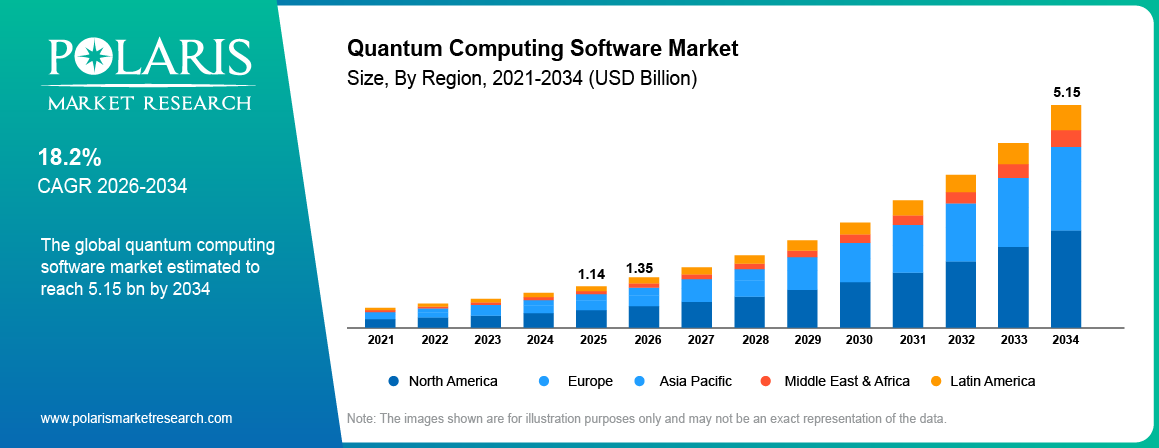
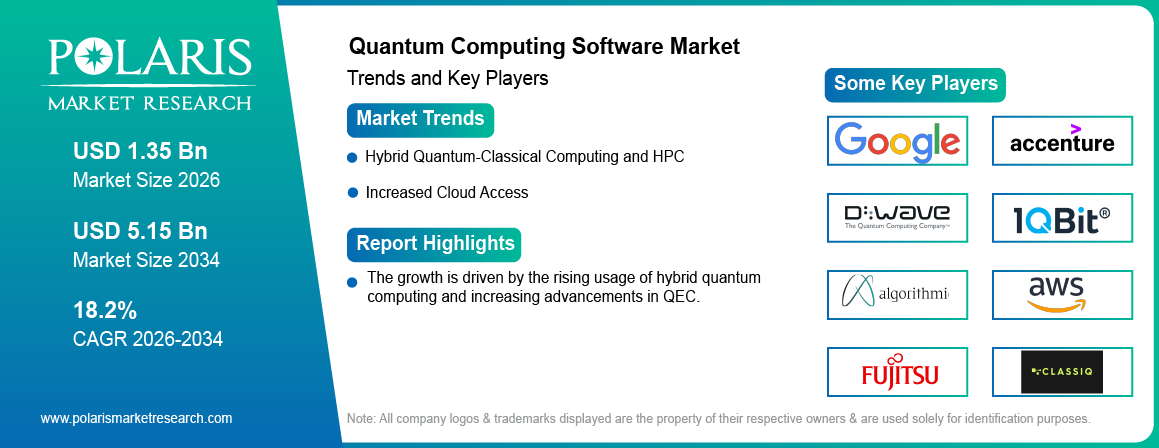
The global quantum computing software market size was valued at USD 1.14 billion in 2025. The market is projected to record a CAGR of 18.2% from 2026 to 2034. The growth is driven by the rising usage of hybrid quantum computing and increasing advancements in QEC.
Market Statistics
Key Takeaways
- North America accounted for the largest quantum computing software market share of 33.9% in 2025. This is attributed to the strong presence of leading technology companies, quantum computing start-ups, and research institutions in the region.
- As per our quantum computing software market forecast, the Europe market is expected to witness a CAGR of 17.6% during 2026–2034. This is attributed to strong government aid, research funding, and increasing collaboration between universities, start-ups, and technology firms.
- The quantum computing software industry in Asia Pacific is anticipated to show significant growth at a 21.4% CAGR during the forecast period. This is attributed to increasing government investment in quantum research.
- Solutions segment is expected to record a CAGR of 19.1% during the forecast period. This is due to increasing demand for quantum software platforms, development tools, simulators, and development frameworks.
- The cloud segment accounted for the largest share of 58.6% in 2025. The growth can be attributed to the growing demand for affordable and flexible access to quantum computing software.
Note: Figures and projections outlined in this report are the result of Polaris Market Research’s proprietary analytical processes, grounded in the latest available datasets and market observations.
What is Quantum Computing Software?
Quantum computing software refers to the programming languages, software development kits (SDKs), compilers, simulators, error correction and orchestration tools. These tools allow users to design, simulate, and optimize algorithms. Essentially, it converts a quantum computer from a hardware device into something programmable. Users can write programs using quantum languages, then run them on a classical simulator to verify their functionality. The programs can then be compiled to a specific processor’s instruction set and run on a local or cloud quantum system.
The market includes solutions, with many quantum programming languages available, both open source and commercial. These include IBM Qiskit, Google Cirq, Microsoft’s Quantum Development Kit, NVIDIA CUDA-Q and Quantinuum TKET. Compilers, quantum circuit simulators, quantum error correction, and application libraries are also available. Services include cloud access, consultancy, and integration to help enterprises find use cases.
In 2026 the market is being driven by three trends. Firstly, more software is being used for hybrid quantum-classical solutions, rather than stand-alone experimentation, and running these solutions within HPC environments. Secondly, vendors are providing tools for fault tolerant computing. This includes resource estimation, logical qubits compilation, and error correction decoding. Finally, there has been increased consolidation. Intel has agreed to buy Classiq and IQM has bought Quantistry’s simulation software. Hardware companies are looking to add software capabilities to provide end-to-end platforms.
Quantum Computing Software Stack
The quantum computing software stack consists of six main layers. Each layer performs a specific role in developing, running, and managing quantum applications.
- Application Layer: This is the top layer of the stack. It includes software used to solve real-world problems in areas such as healthcare, finance, drug discovery, and materials science.
- Algorithm Layer: This layer contains quantum algorithms. These algorithms define the steps a quantum computer follows to solve a particular problem.
- Programming Language and SDK Layer: This layer provides tools and programming languages to develop quantum programs. Popular tools include Qiskit, Cirq, and PennyLane.
- Compiler and Intermediate Representation Layer: This layer converts quantum programs into instructions that a quantum computer can understand. OpenQASM and Quantum Intermediate Representation (QIR) are important standards used at this stage.
- Quantum Operating System and Control Layer: This layer manages the execution of quantum programs. It connects software with quantum hardware and controls how instructions are sent to the machine.
- Hardware Interface and Execution Layer: This is the bottom layer of the stack. It connects the software to quantum processors and helps execute quantum instructions on the hardware.
Market Dynamics
Driver: Hybrid Quantum-Classical Computing and HPC
Hybrid quantum computers can be combined with classical computers such as CPUs/GPUs & high-performance computing (HPC). This means that classical computers can be used for processing data & analyzing results. Quantum computers can be used to complete complex tasks. This means quantum computing can be used more effectively despite some limitations. Hybrid computing has been gaining popularity in areas such as drug discovery, material development, and quantum optimization & AI. Quantum systems are increasingly being used in supercomputing centers & therefore there is a higher demand for quantum software.
Driver: Increased Cloud Access
Quantum computers are increasingly becoming easier to utilize by businesses & researchers. With cloud computing, users can access quantum computers through the Internet. Many cloud platforms allow customers to pay flexibly. They can pay based on usage or subscription. This gives users access to software, simulators & various quantum hardware systems. This reduces costs for businesses. Therefore, more businesses are trying out quantum applications.
Driver: Progress in Quantum Error Correction and Fault-Tolerant Computing
Quantum computers are very sensitive to errors. They can cause inaccurate results. Quantum Error Correction (QEC) can be used to detect & correct these errors. Fault tolerant computing aims to keep the quantum computer running accurately. Investment is being put into this area to create more powerful & reliable quantum systems. For instance, in May 2026, SpinQ received RMB 1 billion (USD 0.149 billion) Series C funding for quantum hardware and collaboration with Hong Kong University of Science and Technology for advancement in quantum error correction. Advancements in this area could mean quantum computing can be used in drug discovery, material development & financial analysis. This is driving demand for more advanced quantum software (Source: spinq.com).
Driver: Increasing Capital Investments
Investments within the industry are helping drive the industry forward. Government, private investors, & big tech companies are providing funding and investing heavily in the industry. On June 2026, IBM announced USD 10 billion investment in quantum computing. This funding is being used to improve quantum processors, create software & build advanced systems. This reduces errors in computing. Increased investment means companies can employ skilled employees & build partnerships with research institutions & technology providers. This drives innovation & increases the growth of the market (Source: ibm.com).
Restraint: Limited QPU Access
Access to Quantum Processing Units (QPUs) remains limited because of high costs and complex infrastructure. Many firms rely on the cloud to make use of quantum hardware. This can delay software development and testing because access is limited.
Restraint: Quantum Software Fragmentation
There are many quantum software platforms, programming languages, and tools available within the market. This can cause issues with compatibility between platforms. This can increase software development costs and create more issues when integrating software.
Restraint: Lack of Skilled Developers
The quantum computing industry needs professionals with knowledge in physics, mathematics, and software development. There are limited skilled individuals, causing challenges for companies to recruit. This can also cause delays to software development, research and can create delays in quantum computing solutions.
Restraint: Lack of Benchmarking
It can be difficult to determine how well quantum software works because results vary across platforms and hardware. Due to this, there is no standard for testing. This can make it hard for businesses to find the right solution.
Restraint: Unclear ROI
Quantum computing software requires a large investment in research, development, and skilled individuals. Many applications are still in the testing phase, causing businesses to struggle to see the financial benefits.
Restraint: High Costs to Correct Quantum Errors
Quantum computers are prone to errors, which can impact results. Extra resources are needed to correct the errors and more physical qubits are required. This causes increased costs to develop software and can cause increased complexity.
Restraint: API Changes: Quantum software platforms often have updates to tools and APIs. This can cause issues with current programs and can cause developers to need to update their code. This can cause increased maintenance costs, extra work and make it difficult to plan software for the future.
Opportunity: Quantum Resource Estimation
Quantum Resource Estimation tools help companies and researchers understand what computational resources and time are required to make the most of quantum applications. Estimating costs can help users to determine if their problem can be solved using quantum hardware. With growing interest into quantum computing, there will be opportunities for software companies to develop tools to help increase planning and lower costs.
Opportunity: Hardware-Agnostic Tools
Developers can use Hardware-Agnostic tools to develop quantum applications. This means they aren’t tied to a specific quantum hardware provider. This makes it easier to run programs on different quantum computers and cloud services. As more companies get involved with quantum computing, there will be increased demand for software solutions, which can be used on any hardware.
Opportunity: Use of Quantum Error Correction (QEC)
Quantum Error Correction (QEC) tools help identify and correct errors within quantum computing. This increases the accuracy and reliability of the system. As companies move toward creating more powerful quantum computers, there will be an increased need for error correction tools. This opens up opportunities for software developers to create tools to help ensure accurate calculations can be made and relied upon in a commercial setting.
2026 M&A, Funding & Capital Markets Activity
| Date | Company | Deal type | Value | Software relevance |
| January 2026 | D-Wave ← Quantum Circuits | Acquisition (completed) | USD 250 mn cash + 10.43 mn shares | Adds gate-model systems to an annealing-led software stack |
| February 2026 | Infleqtion | SPAC listing (NYSE: INFQ) | >USD 550 mn raised | Owner of Superstaq performance software |
| March 2026 | Xanadu | SPAC listing (Nasdaq/TSX: XNDU) | ≈USD 302 mn gross | PennyLane developer ecosystem |
| March 2026 | Horizon Quantum | SPAC listing (dMY Squared) | - | Quantum software developer |
| March 2026 | UKRI | Public funding | Part of £65 mn package | Funds a national Quantum Software Lab |
| April–May 2026 | Zapata Quantum | Private placement | USD 15 mn | Relaunch of hardware-agnostic software firm |
| June 2026 | Quantinuum | IPO (Nasdaq: QNT) | USD 1.68 bn raised | Largest quantum IPO; TKET and system software |
| July 2026 | IQM ← Quantistry assets | Asset acquisition | Undisclosed | quantum chemistry software and materials simulation software |
| July 2026 | BTQ ← QPerfect | Acquisition (completed) | Undisclosed | MIMIQ emulator and digital-twin software |
| July 2026 | IonQ ← SkyWater | Acquisition (completed) | ≈USD 1.8 bn equity value | Hardware foundry |
| October 2026 | Intel ← Classiq | Definitive agreement | ≈USD 2.2 bn (reported) | Largest quantum-software acquisition to date; close expected H1 2027 |
Source: Polaris Market Research Analysis
Quantum Computing Software Market Segmentation
By Component
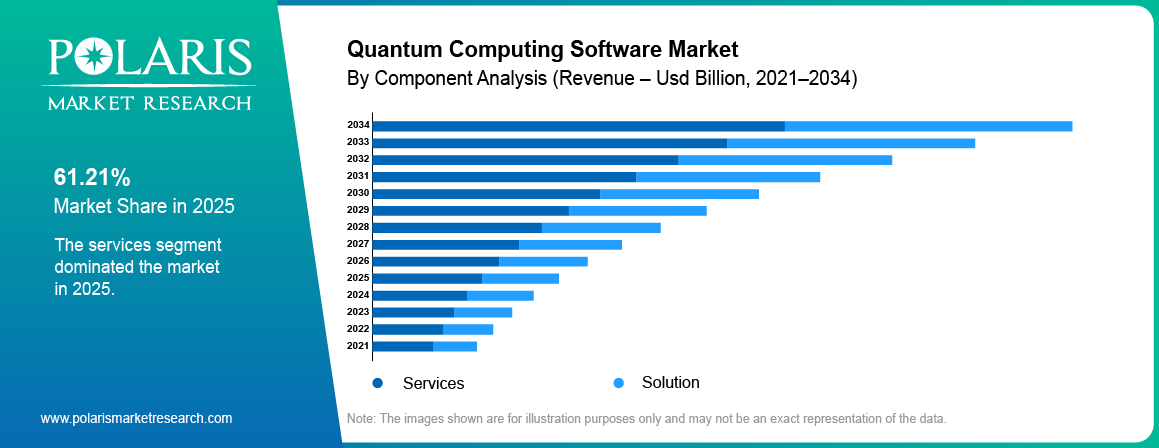
Solutions segment is expected to grow at a CAGR of 19.1% during the forecast period due to increasing demand for quantum software platforms, development tools, simulators, and development frameworks. Organizations are increasingly adopting these solutions for developing, testing, and executing quantum applications. These tools help make complex computations easier and improve software development. Increasing investments in quantum research and its increasing use in various industries such as healthcare, finance, and material science are further providing an impetus to this segment.
The services segment dominated the quantum computing software market size with 61.21% due to increasing demand for technical support, software integration, consulting, and training. Many organizations lack skilled staff to adopt quantum computing. Therefore, there is a demand for third party service providers. Quantum computing as a service (QaaS) provides users with quantum computing resources through cloud based platforms, meaning they don’t have to invest in expensive hardware. Consulting services help organizations identify suitable applications for quantum computing, develop strategies, and incorporate quantum computing within their systems.
Component Segment Comparison
| Sub-segment | Includes | Key Buyer | Revenue Model | Maturity | Example Vendors |
| SDKs & frameworks | Languages, circuit libraries, notebooks, debuggers | Developers, researchers | Mostly open source; monetized via cloud and support | Mature | IBM, Google, Microsoft, NVIDIA, Xanadu |
| Compilers & transpilers | Gate decomposition, qubit mapping, routing, optimization | Platform vendors, advanced users | Embedded or licensed | Growing | Quantinuum, IBM, Classiq |
| Simulators & emulators | State-vector and tensor-network simulators, digital twins | R&D teams, HPC centres | Licence or cloud compute | Growing | NVIDIA, IBM, BTQ/QPerfect |
| QEC & control software | Decoders, syndrome processing, error suppression | Hardware makers | B2B licence, often hardware-bundled | Emerging | Riverlane, Q-CTRL |
| Application platforms | Optimization, chemistry, ML libraries and workflows | Enterprises | Subscription | Early | QC Ware, Zapata Quantum, IQM (Quantistry) |
| QaaS / cloud access | Remote QPU and simulator access | Enterprises, academia | Pay-per-use / subscription | Growing | AWS, Microsoft, IBM, D-Wave |
| Consulting & integration | Use-case discovery, benchmarking, integration | Enterprises, government | Project fees | Steady | Accenture, 1QBit |
Source: Polaris Market Research Analysis
By Deployment Mode
The cloud segment accounted for the largest share of 58.6% in 2025. This growth can be attributed to rising demand for affordable, flexible access to quantum computing software. Cloud-based platforms enable businesses and researchers to access quantum computing resources, using an internet connection without having to purchase expensive hardware. They also provide access to software tools, simulators, and various quantum processors. Increasing adoption of cloud-based computing and increased investment by technology companies are further driving growth of this segment.
The on-premises segment is expected to grow at a CAGR of 16.8% during the forecast period. The growth can be attributed to the increasing demand for secure, private, and more control over computing systems. On-premises solutions are preferred by large enterprises, government agencies, and research institutions for managing sensitive data. They also give users the flexibility to customize software to their requirements. Growing concerns around data security and the need for more secure computing environments are driving demand for on-premises quantum software.
By Supported Hardware Modality
The superconducting qubits segment is the dominant segment, with the largest share of 38.7% in 2025. This is due to increasing investments and improvements in quantum processors. Superconducting qubits allow rapid computation and are extensively used in quantum research. There is an increasing demand for software, simulation, and error correction tools.
The trapped ions segment is expected to record a CAGR of 20.4% during the forecast period. This is attributed to its high accuracy and stability. It can store quantum information for longer periods of time and is therefore useful for complex computations. Increasing research and demand for dependable quantum software is creating new growth opportunities.
Quantum annealing segment is expected to grow at a CAGR of 17.6% during the forecast period due to increasing demand for solutions to complex optimization issues. The technology is primarily used within areas such as logistics, supply chain management, scheduling, and financial planning. Increasing interest from businesses to improve efficiency is encouraging the adoption of this software.
By Application
Optimization accounted for the largest share of 32.8% in 2025. The increasing need for solving complex problems in business and making better decisions with optimization software drive this segment. With the help of quantum computing, businesses can identify various options and solutions to optimize. The optimization software helps plan routes, manage supply chains, allocate resources, and schedule. This segment is also seeing increased adoption in logistics, quantum computing in finance, and manufacturing.
Machine learning is expected to grow at a CAGR of 21.3% during the forecast period. There is an increased interest in using quantum computing to enhance data analysis and pattern recognition. Quantum machine learning software is being explored to classify, predict, and create models for data. Increased investment in AI and research is presenting new opportunities for this segment.
Simulation is expected to register a CAGR of 18.9% during the forecast period. Quantum computing is increasingly being used to research complex molecules, materials, and chemical reactions. Quantum software can help to create models that allows researchers to understand how they behave. There is an increased demand for high-level research within drug discovery, healthcare, chemistry, and material science.
By End Use
The BFSI segment accounted for largest share of 21.6% in 2025 due to rising demand for quick risk analysis, fraud detection, and financial modeling. Quantum computing software is being used to enhance investment planning, portfolio management and financial forecasting. Increasing investment in advanced computing and digital banking are also contributing to market growth.
The aerospace and defense segment is projected to grow at a CAGR of 19.8% during the forecast period. This is propelled by increasing demand for sophisticated simulation, complex mission planning, and secure communication. Quantum computing software enables better aircraft design, optimize defense, and complex engineering problems. Increasing government investment in defense and research are also fueling the market growth.
The healthcare and life sciences segment is projected to grow at a CAGR of 20.6% during the forecast period due to increasing demand for rapid drug discovery, molecular research and medical. Quantum computing software can be used to research complex molecules and chemistries. Increasing investment in biotech, pharmaceuticals and personalized medicine are also driving demand for quantum computing.
The energy and utilities segment is projected to grow at a CAGR of 18.9% during the forecast period. This is driven by increasing demand for improved energy management, power generation and resources. Quantum computing software can be used to optimize energy grid, battery development and renewable energy. Increasing investment in clean energy is also driving market growth.
The chemical segment is projected to grow at a CAGR of 19.4% during the forecast period driven by increasing demand for advanced simulation software for researching chemistries. Quantum computing software can be used to research material properties and improve chemical development. Increasing demand for new materials, efficient production and advanced research is also driving market growth.
The transportation and logistics segment is projected to grow at a CAGR of 18.7% during the forecast period due to increasing demand for improved routing, traffic, and supply chain. Quantum computing software can be used to manage complex scheduling and transportation. Increasing demand for quicker delivery, cheaper operational costs, and more efficient logistics is also driving market growth.
The government segment is projected to grow at a CAGR of 17.8% during the forecast period. This is driven by increased public investment into quantum research, national security and advanced computing. Governments are investing in developing quantum software through research programs and partnerships with tech companies. Increased interest in secure communication, defense and research is also driving demand.
The education segment is projected to grow at a CAGR of 16.9% during the forecast period. This is due to increased interest in quantum computing research. Universities are offering quantum computing courses, research programs and practical training. Increasing adoption of quantum software development tools and simulators are enabling students and researchers to gain practical experience, driving market growth.
Key Technology Comparisons
Quantum SDKs and Frameworks Compared
Quantum Software Development Kits (SDKs) and frameworks provide tools to develop, test, and run quantum programs. Popular options include Qiskit, Cirq, and PennyLane. Each platform offers different features, programming support, and hardware connections. Qiskit is widely used for quantum programming and research, while Cirq supports circuit development. PennyLane focuses on combining quantum computing with machine learning applications.
| Platform | Owner | Languages | Hardware Reach | Simulation | Compilation / Differentiator | Best For |
| Qiskit | IBM | Python; C API | IBM Quantum systems; others via provider plug-ins | Qiskit Aer (local) | Transpiler; v2.5 (Jul 2026) adds multi-IR pipelines and fault-tolerant presets | Gate-model research and pilots on IBM hardware |
| Cirq | Google Quantum AI | Python | Google processors; others via third-party providers | qsim | Device-aware circuit construction | NISQ algorithm research |
| QDK / Q# | Microsoft | Q#, Python; accepts Qiskit, Cirq, OpenQASM programs | Multiple providers via Azure Quantum | Local and cloud simulators | Resource Estimator for fault-tolerant planning | Fault-tolerant algorithm design |
| CUDA-Q | NVIDIA | C++, Python | Hardware-agnostic; multiple QPU vendors | GPU-accelerated | QPU-GPU-CPU programming model | Hybrid HPC workflows; QEC research |
| TKET / pytket | Quantinuum | Python | Hardware-agnostic via extensions | Via back-ends | Circuit optimization and routing across platforms | Cross-platform compilation |
| Ocean SDK | D-Wave | Python | D-Wave annealers; hybrid solvers via Leap | Classical samplers | QUBO/BQM problem formulation | Optimization |
| Amazon Braket SDK | AWS | Python | Multiple third-party QPUs | Managed and local simulators | Single API across vendors | Multi-vendor access |
| Classiq | Classiq (Intel deal pending) | Python SDK; Qmod | Hardware-agnostic | Via back-ends | Automated algorithm synthesis from high-level models | High-level algorithm design |
Source: Polaris Market Research Analysis
NISQ vs. Fault-Tolerant Software: Error Mitigation vs. Error Correction
NISQ software is designed for current quantum computers, which are more sensitive to errors. It uses error mitigation methods to reduce the impact of errors without fully correcting them. Fault-tolerant software focuses on future quantum computers and uses quantum error correction to detect and correct errors. This helps improve calculation accuracy and supports more complex and reliable computing tasks.
Quantum Error Mitigation vs Quantum Error Correction
| Attribute | Error Mitigation (NISQ) | Error Correction (Fault-Tolerant) |
| Goal | Reduce the effect of noise on results | Detect and correct errors during computation |
| How | Extra circuit runs and post-processing (e.g., zero-noise extrapolation) | Encode logical qubits across many physical qubits; measure syndromes; decode in real time |
| Main overhead | More shots and runtime | More physical qubits plus fast classical decoders |
| Software needed | Mitigation libraries, error-aware quantum compiler | Decoders, logical-circuit compilers, resource estimators |
| Limitation | Cost rises steeply with circuit size | Needs hardware below the error threshold |
| Status in 2026 | Standard in production SDKs | Roadmap stage; IBM targets fault tolerance by 2029 |
Source: Polaris Market Research Analysis
Quantum Annealing vs. Gate-Based Software
Quantum annealing software is mainly designed to solve optimization problems, such as route planning, scheduling, and resource allocation. Gate-based quantum software supports a wider range of applications by using quantum operations to perform calculations. While annealing focuses on finding suitable solutions to specific problems, gate-based systems support tasks such as simulation, machine learning, and complex algorithm development.
| Attribute | Quantum Annealing | Gate-Based (Circuit Model) |
| Computational model | Finds low-energy states of an optimization problem | Universal sequence of quantum gates |
| Problem types | Combinatorial optimization, sampling | Simulation, optimization, ML, factoring (long term) |
| Software stack | Problem formulation (QUBO/BQM), hybrid solvers | SDK → compiler → runtime → QPU/simulator |
| Example tooling | D-Wave Ocean, Leap | Qiskit, Cirq, QDK, CUDA-Q, TKET |
| Developer skill | Modelling the problem as an energy function | Circuit design and algorithm theory |
Source: Polaris Market Research Analysis
Cloud Quantum Access vs. Local Simulation
Cloud quantum access allows users to run quantum programs on real quantum computers through internet-based platforms. It removes the need to purchase expensive hardware. Local simulation allows users to test quantum programs on traditional computers without connecting to quantum hardware. Cloud access provides real hardware testing, while local simulation offers an affordable and convenient way to develop and test programs.
| Attribute | Cloud QPU access (QaaS) | Local / HPC simulation |
| Hardware | Real QPUs from one or many vendors | Classical CPUs/GPUs emulating qubits |
| Scale | Limited by available qubits and fidelity | Limited by memory; full state-vector simulation becomes impractical beyond a few dozen qubits |
| Latency | Queue times; network round trips | Immediate; tight loop for debugging |
| Setup | Account and SDK | SDK plus local or HPC compute |
| Cost model | Per task, per shot or subscription | Own compute or cloud GPU hours |
| Best for | Validating on real noise; benchmarking | Algorithm development, testing, education |
Source: Polaris Market Research Analysis
Quantum Computing Software vs. QKD vs. Post-Quantum Cryptography
Quantum computing software helps users develop and run programs on quantum computers for applications such as optimization, simulation, and machine learning. Quantum Key Distribution (QKD) uses quantum principles to securely share encryption keys. Post-Quantum Cryptography (PQC) uses advanced mathematical methods to protect data against future attacks from quantum computers. All three serve different purposes in the growing quantum technology industry.
| Attribute | Quantum computing software | Quantum key distribution (QKD) | Post-quantum cryptography (PQC) |
| Purpose | Program and run quantum computers | Share encryption keys using quantum physics | Classical algorithms resistant to quantum attacks |
| Runs on | QPUs, simulators, hybrid HPC | Dedicated optical hardware and networks | Existing classical computers |
| Main buyers | R&D, enterprises, governments | Telecoms, government, finance | Every organization migrating encryption |
| Polaris report | This page | Quantum Key Distribution Market | Quantum Cryptography Market |
Source: Polaris Market Research Analysis
How Enterprises Adopt Quantum Computing Software
1. Identify the Use Case: Businesses first identify problems where quantum computing may offer better results, such as supply chain optimization, drug discovery, and financial modeling.
2. Build a Classical Baseline: Companies use traditional computers to solve the selected problem. This provides a reference point for comparing quantum computing performance.
3. Select a Quantum SDK: Businesses choose suitable software development tools, such as Qiskit, Cirq, or PennyLane, to develop quantum applications.
4. Run Simulations: Developers test quantum programs using simulators on traditional computers. This helps identify errors and improve the program before using real quantum hardware.
5. Test on QPU: The developed program is tested on a real Quantum Processing Unit (QPU) to understand its performance and practical limitations.
6. Evaluate Results: Businesses compare quantum computing results with traditional computing methods. They assess accuracy, speed, cost, and overall performance.
7. Integrate Hybrid Systems: Companies combine quantum computers with traditional systems, such as CPUs and GPUs, to handle different parts of a business problem.
8. Scale Based on Proven Value: Businesses expand the use of quantum software when testing shows clear benefits. This helps control costs and supports wider adoption across business operations.
Regional Insights
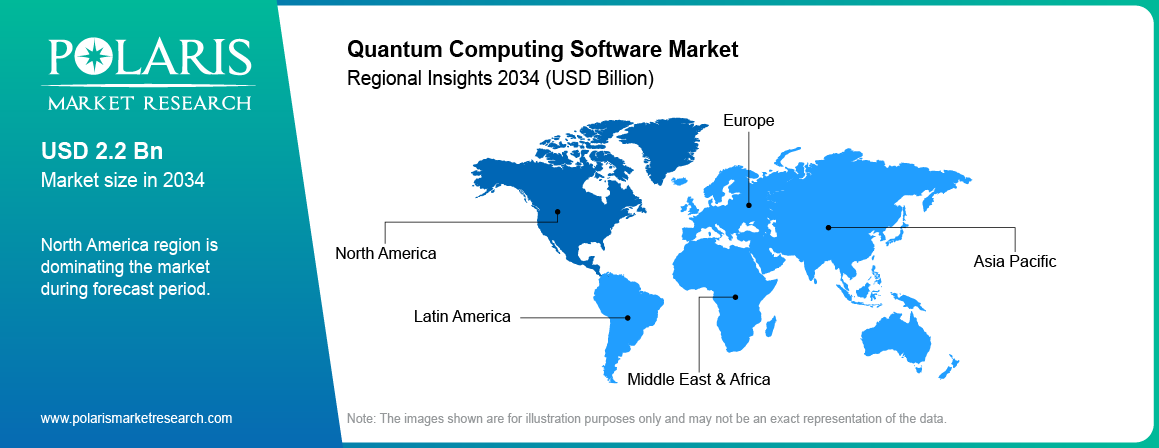
North America accounted for the largest quantum computing software market share of 33.9% in 2025. This is attributed to the strong presence of leading technology companies, quantum computing start-ups, and research institutions in the region. The U.S. region is investing significantly in quantum research and development. Government aid and the collaboration between technology firms with university institutes are boosting innovation in the region. Moreover, increasing adoption of cloud-based quantum platforms and growing investment in quantum AI, and advanced computing are expected to propel market growth.
The Europe quantum computing software market is expected to witness a 17.6% CAGR during the forecast period. This is attributed to strong government aid, research funding, and increasing collaboration between universities, start-ups, and technology firms. Germany, the UK, and France are investing in quantum research and software. Hence, initiatives in the region are promoting the development of quantum technologies along with a skilled workforce. Moreover, increasing demand for advanced computing solutions in healthcare, automotive, financial, and manufacturing industries are aiding the market growth.
The Asia Pacific quantum computing software market is anticipated to show significant growth of 21.4% CAGR during the forecast period. This is attributed to increasing government investments in quantum research. Countries such as China, Japan, India, and South Korea are investing in growing quantum research activities. Increasing investment by technology firms and academic institutes, are promoting the development of software. Moreover, increasing adoption of artificial intelligence, cloud computing, and advanced technologies in various industries is creating demand for quantum computing solutions.
The Latin America quantum computing software market accounted for a 7.2% share in 2025 due to growing interest in adopting advanced computing technologies. Countries such as Brazil and Mexico are increasing their research activities and collaborating with global technology firms and universities. Increasing adoption of quantum cloud computing and artificial intelligence is creating awareness about quantum technologies in the region. Moreover, increasing demand for better data processing, financial modeling, and optimization solutions is aiding the market growth of region.
The Middle East & Africa quantum computing software market is expected to record growth rate of 19.6% during the forecast period, driven by increasing government investment in advanced technologies and digital transformation. Countries such as the UAE and Saudi Arabia are promoting research activities and innovation along with technology collaborations. Increasing investment in artificial intelligence, cloud infrastructure, and smart cities are creating opportunities for quantum computing software. Moreover, increasing collaboration with global technology firms and research institutions is aiding market growth.
Competitive Insights
The Quantum Computing Software market is competitive industry with medium fragmentation. IBM, Google, Microsoft, AWS, and NVIDIA have significant lead due to their large software ecosystems, extensive cloud platforms, and developer tools. However, many are combining hardware capabilities with software development such as Quantinuum, IonQ, Rigetti, D-Wave, Fujitsu, and Xanadu. A number of niche companies are also offering various services, including Classiq, Q-CTRL, Riverlane, QC Ware, Phasecraft, and Algorithmiq. The industry is becoming increasingly competitive with companies looking to provide scalable, interoperable solutions for enterprise and fault-tolerant quantum computing.
Vendor positioning
| Company | Positioning | Flagship software |
| IBM | Full stack: hardware, SDK, cloud | Qiskit; IBM Quantum Compute Service |
| Google Quantum AI | Full-stack research | Cirq |
| Microsoft | Software and cloud; topological hardware R&D | QDK / Q#, Azure Quantum |
| Amazon Web Services | Multi-vendor cloud access | Amazon Braket |
| NVIDIA | Accelerated hybrid computing | CUDA-Q |
| Quantinuum | Trapped-ion full stack | TKET |
| D-Wave Quantum Inc. | Annealing plus gate model | Ocean SDK, Leap |
| IonQ | Trapped-ion hardware, expanding stack | Platform via major clouds |
| Classiq | Software pure-play (synthesis) | Classiq platform |
| Riverlane | QEC software and decoders | Deltaflow |
| Q-CTRL | Error suppression and performance software | Fire Opal |
| Zapata Quantum | Hardware-agnostic software pure-play | Orquestra |
| Xanadu | Photonic hardware plus software | PennyLane |
| Infleqtion | Neutral-atom hardware plus software | Superstaq |
| IQM | Superconducting full stack | Quantistry simulation assets |
Source: Polaris Market Research Analysis
List of Key Quantum Computing Software Companies
- 1QB Information Technologies Inc.
- Accenture plc
- Algorithmiq Oy.
- Amazon Web Services, Inc.
- Classiq Technologies Ltd.
- D-Wave Quantum Inc.
- Fujitsu Limited
- Google LLC
- Huawei Technologies Co., Ltd.
- Infleqtion, Inc.
- Intel Corporation
- International Business Machines Corporation
- IonQ, Inc.
- Microsoft Corporation
- NVIDIA Corporation
- Phasecraft Ltd.
- QC Ware Corp.
- Q-CTRL Pty Ltd
- Quantinuum Ltd.
- Rigetti Computing, Inc.
- Riverlane Ltd.
- Xanadu Quantum Technologies Inc.
- Zapata Quantum, Inc.
Recent Developments
- October 2026, Intel acquired Classiq, a quantum-computing software provider, to build a full-stack quantum platform. The deal combines Intel’s silicon spin-qubit technology and manufacturing expertise with Classiq’s automated quantum algorithm synthesis software, subject to regulatory approvals and expected to close in the first half of 2027. (Source: intc.com)
- October 2026, IBM launched IBM Quantum Safe, a unified software suite that automates enterprise migration to post-quantum cryptography. The platform combines code scanning, cryptographic-asset discovery, and network mediation to help organizations address “harvest now, decrypt later” risks and meet federal migration deadlines beginning in 2030. (Source: quantumcomputingreport.com)
- September 2026, IonQ announced it would install its Superion 256 quantum computer at NVIDIA’s Accelerated Quantum Research Center, making it the center’s first on-premises quantum processor. The system will connect to NVIDIA’s GB200 NVL72 supercomputing infrastructure through NVQLink to advance hybrid quantum-AI research and quantum supercomputing. (Source: ionq.com)
Future Outlook
The future of the quantum computing software market is expected to be shaped by rising investments, technological advancements, and growing enterprise adoption. Increasing demand for quantum algorithms, cloud-based platforms, and error correction tools will create new growth opportunities. Hybrid computing, artificial intelligence, and improved quantum hardware are expected to support wider adoption across industries, driving long-term market growth.
Research Methodology
- Market estimates are derived using a blend of primary and secondary research, validated through weighted-average and combined top-down/bottom-up modeling approaches.
- Secondary research covers vendor filings, quantum research publications, national quantum initiative funding data, patent databases, industry journals, and paid third-party databases to build baseline estimates.
- Primary research includes interviews with key industry participants such as quantum software developers, quantum hardware providers, cloud platform vendors, and enterprise R&D teams, to validate accuracy and capture forward-looking insights.
- Base year considered is 2025, with a forecast provided through 2034; revenues are expressed in USD Billion.
- Parent market is identified as the global quantum computing market; the addressable segment is narrowed using software and Quantum-as-a-Service adoption rates across enterprise and research users.
- Bottom-up model aggregates regional quantum computing software demand across component, deployment, supported hardware modality, application, and end use, validated against vendor revenue disclosures from IBM, Microsoft, Amazon Web Services, D-Wave, IonQ, and others.
- Regional coverage spans North America, Europe, Asia Pacific, Middle East & Africa, and Latin America, further segmented by major countries.
- Projected 18.2% CAGR (2026–2034) reflects weighted analysis of growing government and private quantum investments, expanding cloud-based quantum access, rising demand for optimization and simulation use cases, and increasing enterprise experimentation in finance, life sciences, and logistics.
- Findings are cross-validated across multiple estimation methods to ensure consistency, accuracy, and reliability of the final market sizing.
Quantum Computing Software Market Report Segmentation
By Component Outlook (Revenue – USD Billion, 2021–2034)
- Solution
- Services
- Quantum as a Service
- Consulting Service
By Deployment Outlook (Revenue – USD Billion, 2021–2034)
- Cloud
- On-Premise
By Supported Hardware Modality Outlook (Revenue – USD Billion, 2021–2034)
- Superconducting Qubits
- Trapped Ions
- Quantum Annealing
- Others
By Application Outlook (Revenue – USD Billion, 2021–2034)
- Optimization
- Machine Learning
- Simulation
- Others
By End Use Outlook (Revenue – USD Billion, 2021–2034)
- Aerospace &Defense
- BFSI
- Healthcare & Life Sciences
- Energy & Utility
- Chemical
- Transportation & Logistics
- Government
- Education
- Others
By Regional Outlook (Revenue – USD Billion, 2021–2034)
- North America
- U.S.
- Canada
- Europe
- Germany
- France
- UK
- Italy
- Spain
- Netherlands
- Russia
- Rest of Europe
- Asia Pacific
- China
- Japan
- India
- Malaysia
- South Korea
- Indonesia
- Australia
- Vietnam
- Rest of Asia Pacific
- Middle East & Africa
- Saudi Arabia
- UAE
- Israel
- South Africa
- Rest of the Middle East & Africa
- Latin America
- Mexico
- Brazil
- Argentina
- Rest of Latin America
Quantum Computing Software Market Report Scope
| Report Attributes | Details |
| Market Size in 2025 | USD 1.14 Billion |
| Market Size in 2026 | USD 1.35 Billion |
| Revenue Forecast in 2034 | USD 5.15 Billion |
| CAGR | 18.2% from 2026 – 2034 |
| Base Year | 2025 |
| Historical Data | 2021 – 2024 |
| Forecast Period | 2026 – 2034 |
| Quantitative Units | Revenue in USD Billion and CAGR from 2026 to 2034 |
| Segments Covered | By Component By Deployment By Supported Hardware Modality By Application By End Use |
| Regional Scope | North America, Europe, Asia Pacific, Latin America, Middle East & Africa |
| Customization | Report customization as per your requirements with respect to countries, region, and segmentation |
Source: Polaris Market Research Analysis
Quantum Computing Software Market FAQ's
The market size was USD 1.14 billion in 2025 and is expected to reach USD 5.15 billion by 2034.
The quantum computing software market is growing at a CAGR of 18.2% during the forecast period.
Market growth is driven by rising investments, cloud access, hybrid computing, software innovation, growing research activities, and increasing enterprise adoption.
A quantum Software Development Kit (SDK) provides programming tools, libraries, and simulators that help developers build and test quantum applications.
Qiskit is IBM's quantum software framework, Cirq is developed by Google, while Q# is Microsoft's programming language for quantum applications.
Yes, quantum software can run on simulators using traditional computers, allowing developers to create, test, and improve programs without quantum hardware.
Hybrid quantum computing combines quantum computers with traditional computers, allowing both systems to work together and solve complex business problems.
Error mitigation reduces the impact of errors, while error correction detects and fixes errors to improve quantum computing accuracy and reliability.
Post-quantum cryptography is a related but separate market focused on developing security methods that can protect data against future quantum attacks.
The solutions segment holds a major share of the quantum computing software market, supported by growing demand for development platforms and programming tools.
North America leads the quantum computing software market, supported by strong technology companies, government funding, research activities, and growing commercial adoption.
Key companies include IBM, Microsoft, Google, AWS, IonQ, D-Wave, and Rigetti. In 2026, commercialization increased, with stronger enterprise adoption and continued software innovation.

Download Sample Report of Quantum Computing Software Market
Please fill out the form to request a customized copy of the research report.


