
Quantum Key Distribution (QKD) Market Size, Share & Growth Report, 2026–2034
REPORT DETAILS
Quantum Key Distribution Market Summary
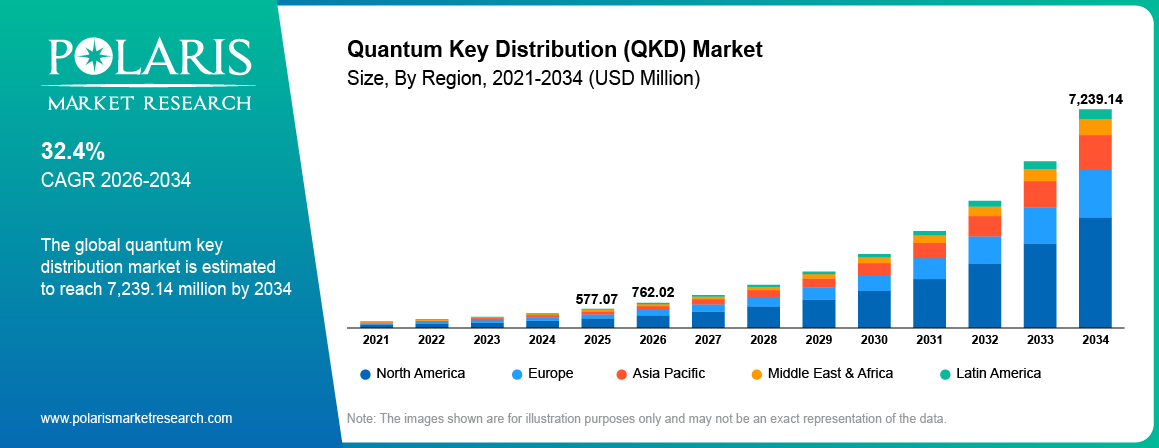
The quantum key distribution market size was valued at USD 577.07 million in 2025. The market is expected to account for a CAGR of 32.4% from 2026 to 2034. The urgent need to neutralize harvest now, decrypt later cyberattacks is one of the key factors driving market growth.
Market Statistics
Key Takeaways
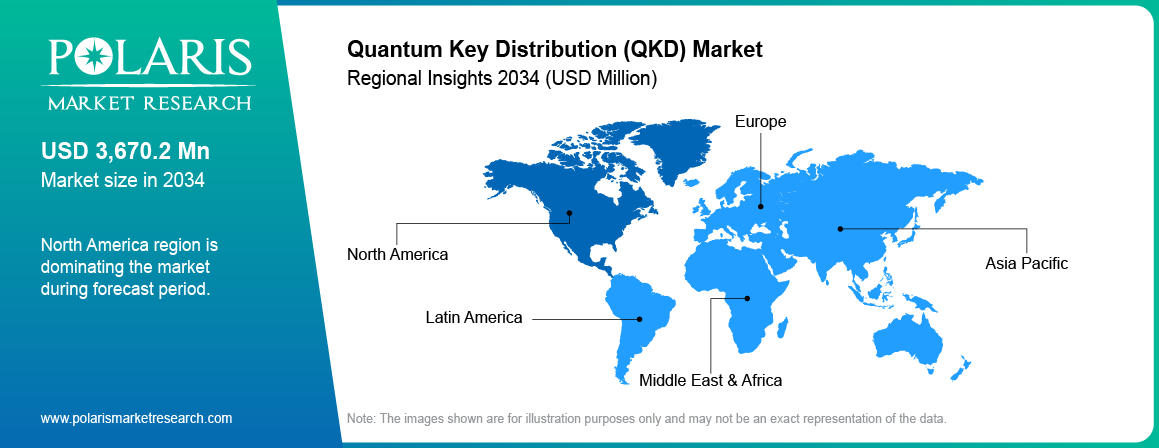
- North America accounted for the largest market share of 38.0% in 2025. This is owing to the region's strong technological infrastructure and significant investments in quantum research.
- Asia Pacific is expected to witness the fastest growth at a 36.08% CAGR. Rapid technological advancements and growing investments in quantum communication infrastructure are driving market growth.
- The fiber-optic cable transmission segment accounted for the largest market share of 82.0% in 2025. This is due to its ability to provide high-speed and secure communication over long distances.
- The healthcare segment is expected to witness the highest CAGR of 33.12%. The increasing need for secure transmission of sensitive medical data drives the segment’s growth.
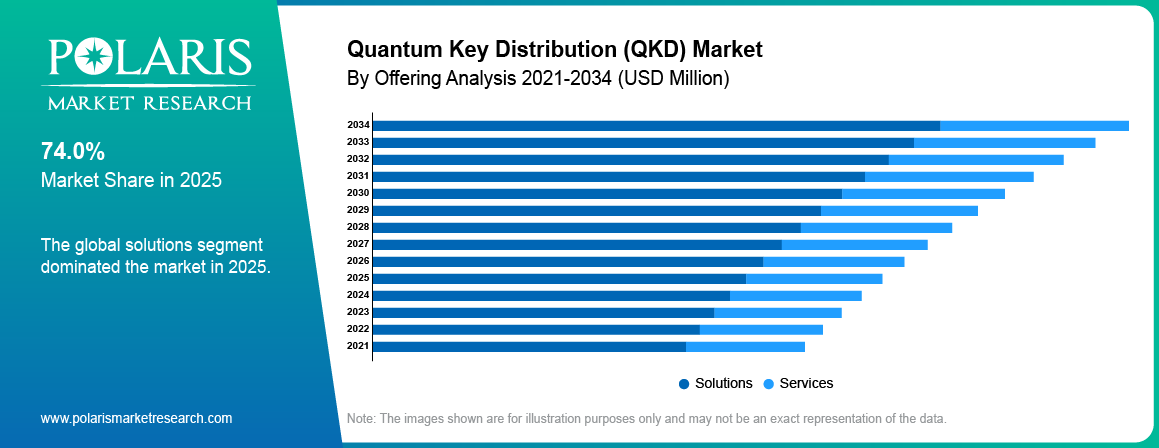
- The solutions segment led with a 74.0% share in 2025. This is primarily because quantum key distribution (QKD) solutions provide intrinsic, hardware-based security using photons.
Note: Figures and projections outlined in this report are the result of Polaris Market Research’s proprietary analytical processes, grounded in the latest available datasets and market observations.
What is Quantum Key Distribution (QKD)?
Quantum key distribution (QKD) is a technique of quantum cryptography that enables two legitimate parties to generate and share a secure cryptographic key over a quantum channel. The main advantage is to expose wire-tapping attempts because observing quantum states alters their properties and introduces detectable anomalies. It can be deployed via optical fiber networks and terrestrial free-space optical channels, as well as satellite-based systems. The technology is especially suited for organizations that need to manage sensitive information, such as financial institutions, governments, telecommunications providers, critical infrastructure operators, and any environment where security is a paramount concern.
How Quantum Key Distribution Works?
The first step is the generation of a stream of quantum signals, consisting of several quantum bits (qubits). Depending on the technique used, the signals can be generated as single photons or emitted using a laser and sent as very low-intensity light pulses. The transmission system then prepares the signals and assigns random bit values to them. Once the channel is set, the transmitting and receiving stations compare the measurement bases used during signal preparation and reception via a secure communication method, without revealing the actual bit values. Incompatible measurements are discarded, while the compatible ones are used to create a raw key. Next comes the quality evaluation phase, where the receiving party checks a selected subset of the results to calculate the quantum bit error ratio. This analysis establishes whether the integrity of the channel was at an acceptable level.
When the outcome is at the expected levels of safety, the remaining data is subjected to information reconciliation to fix any inconsistencies due to data loss, detector imperfections, or other technical issues. This is then followed by privacy amplification, which reduces the length of the key and minimizes the possible information leakage. Finally, the two parties perform a key verification to confirm if the derived sequences are identical. Once verified, the key is forwarded to the encryption layer for use in secure communication. Also note that you can generate new keys again and again. This means you can rotate keys frequently and not rely so heavily on longer-lived encryption keys.
Comparison Between QKD vs. Post-Quantum Cryptography (PQC)
| Attribute | Quantum Key Distribution (QKD) | Post-Quantum Cryptography (PQC) |
| Security basis | Laws of quantum physics—measuring a quantum state disturbs it, making eavesdropping detectable. | Mathematical hardness of new algorithm families (lattice, hash, code-based) believed to be resistant to quantum attacks |
| Infrastructure required | Dedicated quantum channel (fiber or free-space) plus specialized hardware (single-photon detectors, QRNGs) | Runs on existing classical computers and networks—no new hardware |
| Distance limitation | ~150 km over fiber without trusted nodes/repeaters; satellite links extend reach | None—works over any classical network distance |
| Standardization status | No single global standard yet; ITU-T FG-QIT4N is working on interoperability. | NIST finalized initial standards (incl. ML-KEM) as part of its post-quantum migration timeline. |
| Typical adopters (2025–2026) | Government/defense, BFSI trading desks, national quantum-network pilots | Broad enterprise IT, cloud providers, browser/TLS ecosystem |
| Relationship to the other | Often deployed together—PQC is increasingly used to authenticate the classical channel QKD relies on | Complementary to QKD, not a replacement; most guidance treats it as the primary path for most organizations. |
Source: Polaris Market Research Analysis
Source: Polaris Market Research Analysis
To Understand More About this Research: Download Sample Report
AI Impact on Quantum Key Distribution Market
- AI improves quantum key distribution systems through enhanced data transmission and better network performance.
- It assists in identifying the possibility of any threat or unusual activities that occur within the secure network of communications.
- AI controls the automated quantum communication networks through data analysis.
- It assists in improving cybersecurity and efficiency through the advanced key management system.
Quantum Key Distribution Market Dynamics
Driver: Rising Cybersecurity Threats
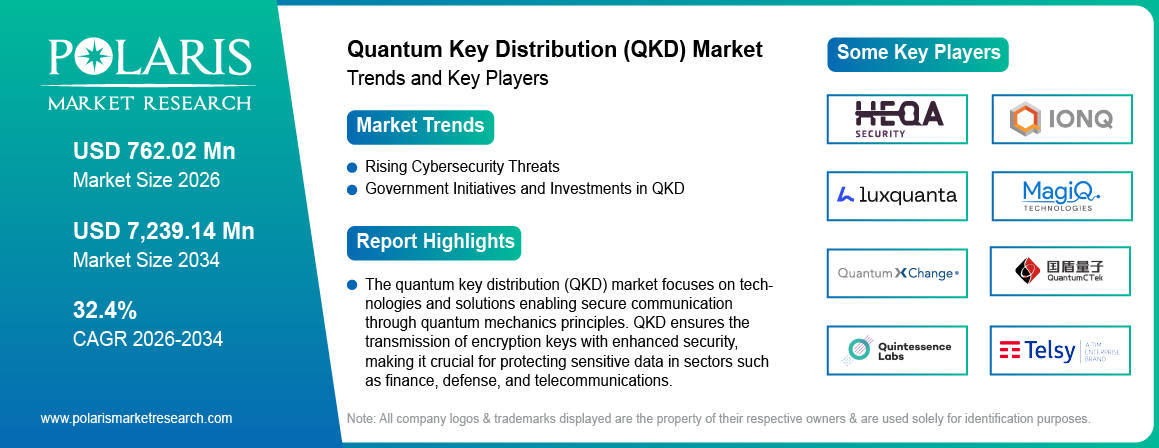
Increasing complexity and the number of cyberattacks is boosting the need for quantum-safe encryption, which in turn is making quantum key distribution (QKD) more essential in uncovering sensitive communications. The ENISA Threat Landscape report for October 2025 examined a total of 4,875 cybersecurity incidents captured, revealing the ongoing volume of malicious activity targeting organizations and the digital fabric of Europe. In particular, the broadening threat landscape is putting governments, financial institutions, telcos, and critical infrastructure providers under pressure to adopt long-term data protection strategies. The increasing power of quantum computing also threatens traditional public-key systems and is giving rise to more concern about harvest-now-decrypt-later attacks, in which encrypted data is harvested for potential decryption in the future. This is leading organizations to consider QKD as well as post-quantum security techniques for protecting their most valuable data and communications. Thus, increasing cybersecurity spending, upgrading of secure network infrastructure, and proliferation of secure communication quantum key distribution products are driving overall commercial deployment (Source: enisa.europa.eu).
Driver: Government Initiatives and Investments in QKD
Quantum communication infrastructure is the top priority for governments around the world, and support is expanding for quantum-secure networking projects. For instance, in September 2025, the European Space Agency (ESA) and Honeywell brought forward the QKDSat project to the next phase of development for provision of satellite-based quantum key distribution services from space. The strategy focuses on enhancing the security of critical infrastructure such as power plants, water systems, hospitals, and banks from advanced cyber attacks. It is particularly important, as satellite QKD is able to distribute secret keys securely beyond the range limits of terrestrial fiber networks, enabling secure communications over a larger region and across national borders. As well as ESA, space-based quantum communication is being developed by the wider European strategy to build a resilient, sovereign infrastructure for connectivity through the Quantum Flagship program. The funding is fostering public-private collaboration, technology demonstration, and the integration of QKD into communications networks. Thus, with governments demanding higher levels of critical infrastructure protection and long-term sustainability from quantum-enabled cyber risks, such programs are boosting the commercial growth of QKD technologies (Source: esa.int).
Opportunity: Rising Emphasis on 5G, Satellite Constellations & Data Center Interconnects
5G networks, satellite constellations, and data center interconnects now require constant guarding for high-value data in motion across dispersed, high-speed systems. QKD offers an opportunity to improve the security of the 5G network as well as the data center interconnect with a tamper-evident exchange of cryptographic keys. For instance, in June 2026, ID Quantique and IonQ released Clavis XG Multiplex, which allows quantum and classical signals to co-exist over the established metropolitan fiber network. This reduces the necessity for dedicated fiber lines and reduces deployment hurdles for telecommunications, enterprises, and data centers. Satellite-based QKD is also a viable method for extending secure key distribution over long distances, where terrestrial fiber networks are unavailable. In addition, with telecom operators, cloud providers, and governments rolling out next-generation connectivity, demand for future quantum network security solutions may also increase, offering new deployment potential through the QKD market (Source: idquantique.com).
Challenges: Cost, Distance Limits & Interoperability
Cost and distance limitations, as well as compatibility issues, are the main reasons why QKD cannot be implemented with greater diffusion. QKD systems generally require the use of custom hardware, proprietary optoelectronic components, and network modifications, resulting in increased costs for installation and maintenance. In contrast, the performance of fiber-based QKD reduces with distance because of photon loss, and trusted nodes or repeaters add complexity and security threats. Also, due to the absence of standards, it is difficult to make QKD devices from different vendors work together or be integrated with existing telecom, cloud, and encryption infrastructures. Such concerns could hinder large-scale deployment, particularly for cost-sensitive organizations and those with widely distributed networks.
QKD vs. Traditional Encryption
| Aspect | QKD | Traditional Encryption |
| Security Foundation | Laws of quantum mechanics | Mathematical models |
| Detection of Interception | Tamper-proof and intrusion-detection | Difficulties in detection of interception |
| Resistance to Quantum Attacks | Quantum attack resistance | Susceptible to quantum attacks in future |
| Transmission of Keys | Through secure quantum channels | Regular digital transmission |
| Method of security provision | Real-time security assessment | Based on computational hardness |
Source: Polaris Market Research Analysis
Source: Polaris Market Research Analysis
Quantum Key Distribution Market Segmentation Analysis
By Transmission Medium
Fiber-optic cable transmission held the leading position in the market in 2025, capturing 82.0% share, as the majority of commercial QKD deployments have been tailored to run over established terrestrial telecom and enterprise fiber networks. In the case of banks, government networks, data centers, and telecom operators, the presence of existing optical infrastructure made the deployment based on fiber more feasible. Fiber links also create a controlled transmission environment, since their performance is more consistent and predictable, and network security systems are more easily applied to these links. Their use in metro and regional networks has enabled a wider deployment in practice. In December 2025, Quantum Corridor and Toshiba collaborated for quantum-secured communication via QKD over a live 21.8km fiber network from Chicago’s ORD 10 Data Center (350 Cermak) to Hammond’s Digital Crossroad Data Center (100 Digital Crossroad Drive), enabling secure key generation and encryption. Moreover, vendors have also created more mature hardware, network management, and interoperability solutions for fiber optic QKD. These elements have led fiber transmission to become the preferred pathway for those looking towards early deployment of quantum-secure communication systems (Source: toshiba.eu).
The demand for the satellite-based transmission segment at a 40.13% CAGR during 2026-2034 is driven by the necessity to extend the geographical constraints of terrestrial fiber networks to realize quantum-secure communication. The requirement for a secure distribution over larger coverage areas arises from long-haul links connecting cities, countries, isolated facilities, and highly sensitive locations. Cross-border connectivity are supported in satellite-based architectures, as well as connecting areas where laying dedicated fiber is prohibitively expensive or complicated. The growth of this segment is also attributed to increasing demand for secure government communications, defense connectivity, and reliable national communications networks. Furthermore, with the development of quantum communication infrastructure, satellite links will be able to serve as a complementary/backup system to terrestrial QKD networks to enhance the coverage of the networks. Therefore, this increased coverage capability is also boosting the importance of satellite transmission in the next-generation quantum-secure communication system.
Transmission Medium Comparison
| Deployment Mode | Advantages | Limitations |
| Fiber-Optic | High bandwidth, low signal loss over metro distances, immune to electromagnetic interference, integrates with existing telecom fiber | Practical range capped near 150 km without trusted nodes or mature quantum repeaters |
| Satellite-Based | Overcomes fiber distance limits; enables intercontinental and diplomatic-grade links; LEO constellations and GEO payloads in active development | Weather and atmospheric-loss sensitivity; higher per-link cost; fewer commercially operational systems to date |
Source: Polaris Market Research Analysis
By Vertical Outlook
The global quantum key distribution market segmentation, based on vertical, includes BFSI, government & defense, healthcare, IT & ITES, automotive, energy & utilities, and other verticals. The healthcare segment is expected to witness the highest CAGR of 33.12% due to the increasing need for secure transmission of sensitive medical data, such as patient records, research data, and telemedicine communications. QKD offers robust encryption, ensuring that healthcare organizations protect confidential information from cyber threats. The increasing digital integration of healthcare systems and the growing volume of sensitive data are driving the importance of quantum key distribution in safeguarding data privacy and ensuring compliance with regulatory standards. This critical role of QKD is expected to lead to its rapid adoption within the healthcare sector.
By Offering
The market, by offering, is bifurcated into solutions and services. The solutions segment led with a 74.0% share in 2025. The dominance is driven by rising demand for quantum-secure communication hardware, encryption appliances, key management systems, and integrated network security platforms. Organizations across government, banking, and telecommunications sectors invest in complete QKD infrastructure. It helps them protect sensitive data against future quantum-enabled cyber threats.
The services segment is expected to register a higher CAGR during the projected period. Enterprises require consulting, deployment, system integration, network optimization, and managed security services. These services help implement quantum-safe communication networks. Service providers support interoperability with existing fiber infrastructure and regulatory compliance requirements. QKD deployments are becoming more complex. Thus, demand for maintenance, monitoring, and lifecycle management services is expected to increase in the coming years. Demand is particularly rising among organizations adopting hybrid classical-quantum security architectures.
Solutions vs. Services in Quantum Key Distribution
| Feature | Solutions | Services |
| Primary purpose | Deliver quantum-secure communication infrastructure. | Support deployment, integration, and ongoing management. |
| Core components | QKD hardware, encryption appliances, key management systems, network software | Consulting, system integration, installation, maintenance, and managed services |
| Deployment model | On-premises or integrated network infrastructure | Project-based or recurring service contracts |
| Customization | Product configuration for specific network needs | Tailored implementation and optimization services |
| Primary customers | Government, telecom, BFSI, and defense organizations | Enterprises adopting or expanding QKD deployments |
| Revenue model | One-time product sales with software licenses | Subscription, support, or professional service fees |
| Key benefit | Provides long-term quantum-safe security infrastructure | Simplifies implementation and improves operational efficiency |
| Market outlook | Largest market share due to hardware adoption | Fast-growing segment driven by increasing deployment complexity |
Source: Polaris Market Research Analysis
By Protocol Type
DV-QKD based on the BB84 protocol accounted for the largest share of the market, valued at 55.0% in 2025, which is attributed to a higher level of technological maturity and broader commercial acceptance in secure communication environments. The protocol is well tried and supported by a relatively mature ecosystem of optical modules, key management systems, and network integration tools. It’s also more practical to deploy for telecom providers, financial institutions, government agencies, and data centers because it is compatible with current fiber-optic infrastructure. DV-QKD enables a high level of security through single-photon or weak-pulse transmission techniques, which are familiar to system developers and users. The existence of such implementation frameworks has also made the deployment less uncertain. Also, BB84 continues to serve as a major reference design for agency quantum-secure networking efforts, ensuring its dominance within the protocol category.
The entanglement-based QKD market size is projected to grow, witnessing 35.39% CAGR in the forecasted period due to growing interest in more sophisticated quantum communication paradigms capable of enabling very high secure key exchange on future quantum networks. These utilize correlated quantum states to check the integrity of the communication channels, providing long protection against the presence of an eavesdropper or a manipulator. The segment is also becoming more relevant as research and industrial development turn toward quantum repeaters, distributed quantum networks, and the longer-term quantum internet infrastructure. Increasing demand for high assurance security in defense, government, financial, and critical infrastructure applications is also boosting adoption. Entanglement-based methods are especially well suited for scenarios where stronger trust models are desired and fewer intermediate nodes are needed. Advances in photon sources, detectors, synchronization, and network management are contributing to improved system performance. Thus, with the quantum communication infrastructure evolving, entanglement-based QKD will hold more significance in facilitating the security of future networks in next-generation secure network architecture.
QKD Protocol Type Comparison
| Protocol | How It Works | Best Suited For | Key Trade-Off |
| Discrete-Variable (DV-QKD) — BB84 / SARG04 | Encodes key bits in discrete quantum states (e.g., photon polarization) using single-photon detectors | High-security government, defense, and financial networks; longest deployment track record | Most mature and best security proofs; requires costly single-photon detector hardware |
| Continuous-Variable (CV-QKD) | Uses standard coherent optical detection instead of single-photon detectors | Telecom operators integrating QKD into existing dense-wavelength-division-multiplexing (DWDM) fiber backbones | Lower hardware cost and easier telco integration; shorter proven range than DV-QKD |
| Entanglement-Based (E91 / Ekert) | Uses correlated entangled-photon pairs distributed to both endpoints | Foundational research, provable device-independent security, next-generation quantum-repeater networks | Strongest theoretical security guarantees; highest operational complexity, least commercially mature |
Source: Polaris Market Research Analysis
By Organization Size
The large enterprises segment dominated the market with a share of 78.0% in 2025. This is because they have enormous amounts of sensitive data on complex and geographically dispersed networks. The institutions, telecom operators, technology companies, and infrastructure providers can afford to invest in the specialized quantum security hardware and network modifications needed to be compliant. As stated by UK Research and Innovation (UKRI) in a 2025 report, the government awarded approximately USD 26.99 million to develop a set of prototype components for enabling commercial quantum networking, bridging the gap to scale and interoperability for advancing a functional quantum-secure infrastructure by 2035. They depend on high-value communications; long-term protection from quantum-enabled threats is a top cybersecurity concern. It also let large enterprises integrate QKD with traditional encryption, key management, and fiber-optic networks. In addition, complex quantum-secure solutions require greater technical knowledge of how to internally deploy and operate. Security-centric regulations and compliance requirements also compel these organizations to take advantage of cutting-edge protection technologies earlier, which further solidifies their leading position in the market (Source: gov.uk).
Growth in the SMEs segment at a 36.0% CAGR during the forecast period is also anticipated to be driven by the increase of quantum-secure technology enabling managed service, cloud-connected security platforms, and easy network integration. Harvest-now-decrypt-later risks awareness are raising up pressure on smaller organizations (holding valuable financial, customer, and intellectual property data) to invest in layered long-term encryption strategies. Reduced infrastructure barriers and service-based deployment models can help to offset the upfront investments associated with QKD adoption. SME suppliers within regulated supply chains are also subject to increased demand from their own larger customers and partners to comply with more rigorous cybersecurity. Moreover, the integration of QKD into wider quantum-safe encryption solutions also help make adoption more feasible for organizations that have little in the way of internal security resources. These factors contribute to further development of the market among small- and medium-scale enterprises in the forecast period.
By Application
In 2025, the network security segment held the largest market share. Organizations are deploying QKD to protect critical communication infrastructure against increasingly sophisticated cyber threats. Telecom operators and government agencies are investing in quantum-secure networks. It helps them safeguard sensitive information and ensure long-term resilience.
The data encryption segment is expected to witness the fastest growth during the forecast period. Enterprises seek stronger protection for confidential financial records, healthcare data, and intellectual property. Meanwhile, the secure communication segment is projected to witness robust growth. It is supported by rising adoption across defense communications, diplomatic networks, financial transactions, and cloud-based communication platforms. Rising awareness of future quantum computing risks is encouraging organizations to strengthen encryption strategies through QKD-enabled secure key exchange.
By Vertical
The BFSI segment dominated the market share in 2025. Financial institutions prioritize secure transactions, fraud prevention, and protection of highly sensitive customer data. Banks increasingly explore quantum-safe communication to strengthen long-term cybersecurity strategies against emerging quantum threats. Thus, the BFSI industry is one of the largest adopters of QKD technology.
The government & defense segment witnesses a significant market demand. This is due to the rising investments in national security, military communications, intelligence operations, and critical infrastructure protection. Governments across the world are funding quantum communication initiatives. It will secure classified information and build resilient sovereign communication networks.
The healthcare segment is expected to register the fastest growth during the projected period. The growth will be supported by expanding digital health ecosystems, electronic medical records, connected medical devices, and strict patient data privacy regulations. Hospitals and research organizations are increasingly evaluating quantum-secure communication for protecting clinical and genomic data.
Source: Polaris Market Research Analysis
Quantum Key Distribution Market Regional Analysis
North America
North America dominated the market with 38.0% of the total market share in 2025. The North America quantum key distribution market id driven by the highly advanced technological infrastructure in the country. The higher amount of quantum research funding and the presence of leading technology companies also drive the growth. Increasing active defense against cyber threats in defense, finance, health care, and critical infrastructure is increasing the demand for secure communication, such as QKD. For instance, in April 2026, the University of Maryland (UMD) and IonQ expanded their National Quantum Lab partnership with the deployment of a quantum memory node under a USD 7.5M agreement that advances quantum networking infrastructure for secure, scalable communication in North America. The region has a time-tested fiber-optic infrastructure, as well as established centralized data center resources, which are perfect prerequisites for building quantum-secure communication networks. The ecosystem is further boosted by government-performed research and funding related to quantum technologies. Furthermore, harvest-now-decrypt-later risks—such as those exploited by the China-backed APT10—are raising awareness, and this is influencing organizations to explore options for quantum-safe encryption solutions to safeguard long-term sensitive data. Therefore, the introduction of telecoms and research labs, whose reputation already precedes them in the QKD community, as well as established vendors and cloud providers, further pushes grace periods for technology validation/commercialization (Source: ionq.com).
Europe
Europe accounted for 29.0% share in 2025, attributable to the fact that the region has received strong institutional support for building a quantum communication infrastructure and that cross-border cooperation on cybersecurity has been well coordinated. The Europe quantum key distribution market also has a mature fiber-optic network infrastructure, making QKD practical for use in governmental, telecom, financial, and critical infrastructure areas. As organizations in Europe are becoming more and more aware of the need to protect data for the longer term and remain crypto-agile, security threats related to quantum will increase in importance. The established quantum technology providers and the dynamic public-private synergy in the region also contribute to an enhanced ecosystem for commercialization. Demand is also supported by the need to protect sovereign digital infrastructure and sensitive communications transmission over linked national networks.
Asia Pacific
The Asia Pacific quantum key distribution market is expected to register 36.08% CAGR during the forecast period. It is driven by rising investment from governments and telecom providers in the region to build quantum communication infrastructure and other next-generation cybersecurity solutions. The development of fiber networks, data centers, 5G infrastructure, and satellite connectivity is speeding up to offer more space for QKD application. In February 2026, the Ministry of Science & Technology reported that QuNu Labs demonstrated a 500 km QKD network with eavesdropping detection, marking an achievement in the National Quantum Mission to construct a practical quantum communication infrastructure. The region is also supported by vibrant research programs on quantum technologies through national initiatives in countries such as China, Japan, South Korea, India, and Singapore. Rising concerns over long-term security of financial, defense, government, and critical infrastructure data is fostering demand for quantum-safe security solutions. Increasing digitalization in banking, healthcare, cloud services, and industrial networks is resulting in more high-value communication links requiring strong protection. Against this backdrop, commercial deployment of QKD from both terrestrial and satellite-based networks is expected to increase in the Asia Pacific (Source: pib.gov).
Latin America
The Latin America quantum key distribution market is in an early development stage. Rising investments in cybersecurity and digital banking are supporting the market growth. Also, it is driven by government-led quantum technology initiatives. Brazil, Chile, and Mexico are focusing on exploring quantum-secure communication for financial services, research institutions, and critical infrastructure. Increasing fiber-optic network expansion and growing interest in protecting sensitive government data will create lucrative opportunities for QKD deployment.
Middle East & Africa
The Middle East & Africa QKD market is gaining momentum. Governments of the region are prioritizing national cybersecurity and digital transformation programs. Saudi Arabia, the UAE, South Africa, and Qatar are investing in quantum research, smart city projects, and secure communications for defense, telecommunications, and financial institutions. The region's focus on critical infrastructure protection and next-generation telecom networks is expected to accelerate QKD adoption over the forecast period.
Source: Polaris Market Research Analysis
Competitive Analysis Report
The competitive landscape comprises three distinct tiers. Established QKD infrastructure vendors Toshiba and QuantumCTek have robust real-world deployments, Toshiba in finance/government networks worldwide and QuantumCTek in China’s 12,000+ km national backbone. QuintessenceLabs and IonQ are developing platform plays beyond QKD hardware: QuintessenceLabs as a full-stack quantum security company and IonQ as an integrated quantum computing-plus-networking company post its 2025 ID Quantique acquisition. Quantum Xchange sets itself apart as a U.S. quantum network provider offering QKD and PQC. LuxQuanta (CV-QKD) and HEQA Security (low-cost, easy-to-deploy QKD with PQC overlay) are the second-tier European and Israeli challengers, respectively. MagiQ, a QKD pioneer, has diversified into sensing. Through its QTI stake, Telsy brings classic telco security credentials, while S-Fifteen Instruments continues to be a photonics instrumentation company.
Key Players
- HEQA Security
- IonQ
- LuxQuanta
- MagiQ Technologies
- Quantum Xchange
- QuantumCTek
- QuintessenceLabs
- S-Fifteen Instruments
- Telsy
- Toshiba Digital Solutions Corporation
Vendor Positioning Comparison
| Company | HQ | Founded | Positioning |
| IonQ | College Park, Maryland, USA | 2015 | Publicly traded trapped-ion quantum computing leader expanding into integrated quantum solutions across computing, networking, sensing, and security via its 2025 ID Quantique acquisition. |
| QuantumCTek | Hefei, Anhui, China | 2009 | China's leading quantum security firm and first quantum tech stock on the Shanghai STAR Market; core hardware supplier for China's 12,000+ km national QKD backbone, now under China Telecom Quantum Group. |
| Toshiba Digital Solutions Corporation | Kawasaki, Kanagawa, Japan | Toshiba Corp. 1875; QKD research 1999 | Commercial QKD pioneer with R&D heritage since 1999; achieved first QKD over 100 km (2003) and key rates >10 Mbit/s (2017); offers QKD variants and a Q-KMS software platform for finance, telecom, and government. |
| QuintessenceLabs | Canberra, Australia (offices in San Jose, USA) | 2008 | Full-stack quantum cybersecurity vendor offering QRNG, key/policy management, and CV-QKD solutions—positioned beyond QKD hardware alone. |
| MagiQ Technologies | Somerville, Massachusetts, USA | 1999 | First to commercialize QKD (Navajo, 2003); now diversified into RF interference mitigation and fiber-optic sensing alongside quantum cryptography. |
| Quantum Xchange | Bethesda, Maryland, USA | 2018 | Operator of the first U.S. quantum fiber network; offers the Phio Trusted Xchange platform and CipherInsights, supporting both NIST PQC algorithms and QKD. |
| LuxQuanta | Barcelona (Castelldefels), Spain | 2021 | European CV-QKD developer, spin-off from ICFO; launched NOVA LQ Gen 2 with 100 km reach; deployed links connecting Madrid hospitals via Telefónica. |
| HEQA Security | Modi'in, Israel | 2018 (as QuantLR) | Cost-effective, easy-to-integrate QKD solution combined with PQC overlay for defense-in-depth. |
| Telsy | Turin, Italy | 1971 | TIM Group's cybersecurity competence center expanded into quantum via stake in QTI (Quantum Telecommunications Italy)—a legacy telecom-security incumbent adding quantum-safe capability. |
| S-Fifteen Instruments | Singapore | 2017 | Academic spin-off specializing in photonic quantum technologies; offers QKD, QRNG, and photon-detection instruments—an instrumentation specialist rather than a carrier-grade vendor. |
Source: Polaris Market Research Analysis
Quantum Key Distribution Market Future Outlook
It is predicted that the quantum key distribution market will experience a significant growth rate in the coming years due to increased cybersecurity threats, quantum computing technology developments, and investments in secure communications infrastructure. More organizations are considering implementing quantum-safe cryptography technologies to safeguard their sensitive information against future cyber attacks using quantum computing technology. Developments in satellite-based quantum key distribution systems, the introduction of quantum communications networks, and attempts at developing international standards are predicted to drive the commercial application of QKD. Moreover, governments, defense organizations, telecom companies, and financial institutions are making significant investments in secure communications technology, which will help them to improve their data and network security.
Market Developments
- June 2026: SEALSQ Corp revealed a confirmed QSAT payload launch aboard a SpaceX Falcon 9 in Q4 2026. The company stated that this will allow it to extend hardware-rooted post-quantum key distribution into low Earth orbit. (Source: globenewswire.com)
- March 2026: Quantum Computing Inc. and Ciena jointly demonstrated next-generation quantum secure communications at OFC 2026. The live demonstration highlighted a comprehensive security architecture that integrates quantum authentication, classical authentication, quantum key distribution, and high-performance AES-256-GCM optical encryption. (Source: ciena.com)
- March 2025: Toshiba Europe Limited launched a commercial QKD system integrated with post-quantum cryptography using NIST’s ML-KEM standard, delivering enhanced quantum-safe security through a software upgrade for existing systems. (Source: toshiba.eu)
- January 2025: Thales Alenia Space and Hispasat have initiated the development of a pioneering quantum key distribution (QKD) system specifically designed for operation from geostationary orbit. This innovative project aims to leverage the unique attributes of geostationary satellites to enhance secure communication by implementing advanced quantum cryptographic techniques. (Source: thalesaleniaspace.com)
Market Segmentation Outlook
By Offering Outlook (Revenue USD Million 2021 - 2034)
-
Solutions
-
Services
By Protocol Outlook (Revenue USD Million 2021 - 2034)
-
DV-QKD (BB84)
-
CV-QKD
-
Entanglement-Based QKD
By Transmission Medium Outlook (Revenue USD Million 2021 - 2034)
-
Fiber-Optic Cable Transmission
-
Satellite-Based Transmission
By Organization Size Outlook (Revenue USD Million 2021 - 2034)
-
SMES
-
Large Enterprises
By Application Outlook (Revenue USD Billion 2021 - 2034)
-
Network Security
-
Data Encryption
-
Secure Communication
-
Others
By Vertical Outlook (Revenue USD Million 2021 - 2034)
-
BFSI
-
Government & Defense
-
Healthcare
-
IT & ITES
-
Automotive
-
Energy & Utilities
-
Other Verticals
By Regional Outlook (Revenue USD Million 2021 - 2034)
-
North America
-
US
-
Canada
-
-
Europe
-
Germany
-
France
-
UK
-
Italy
-
Spain
-
Netherlands
-
Russia
-
Rest of Europe
-
-
Asia Pacific
-
China
-
Japan
-
India
-
Malaysia
-
South Korea
-
Indonesia
-
Australia
-
Vietnam
-
Rest of Asia Pacific
-
-
Middle East & Africa
-
Saudi Arabia
-
UAE
-
Israel
-
South Africa
-
Rest of Middle East & Africa
-
-
Latin America
-
Mexico
-
Brazil
-
Argentina
-
Rest of Latin America
-
Quantum Key Distribution Market Report Scope
| Report Attributes | Details |
| Market Size Value in 2025 | USD 577.07 million |
| Market Size Value in 2026 | USD 762.02 million |
| Revenue Forecast in 2034 | USD 7239.14 million |
| CAGR | 32.4% from 2026 to 2034 |
| Base Year | 2025 |
| Historical Data | 2021–2024 |
| Forecast Period | 2026 – 2034 |
| Quantitative Units | Revenue in USD Million and CAGR from 2026 to 2034 |
| Report Coverage | Revenue Forecast, Market Competitive Landscape, Growth Factors, and Industry Trends |
| Segments Covered |
|
| Regional Scope |
|
| Competitive Landscape |
|
| Report Format |
|
| Customization | Report customization as per your requirements with respect to countries, regions, and segmentation. |
Source: Polaris Market Research Analysis
Quantum Key Distribution (QKD) Market FAQ's
The global quantum key distribution market size was valued at USD 577.07 million in 2025 and is projected to grow to USD 7239.14 million by 2034.
The global market is projected to register a CAGR of 32.4% during the forecast period.
North America accounted for the largest market share of 38.0% in 2025, driven by strong technological infrastructure, significant investments in quantum research, and the presence of leading tech companies.
Some of the key players in the market are HEQA Security, ID Quantique, Kloch, LuxQuanta, MagiQ Technologies, QuantumCtek, Quintessence Labs, S-Fifteen Instruments, Telsy, Toshiba Digital Solutions Corporation.
The fiber-optic cable transmission segment accounted for the largest market share of 82.0% in 2025, driven by its ability to provide high-speed, secure communication over long distances.
The healthcare segment is expected to witness the highest CAGR of 33.12%. over the forecast period due to the increasing need for secure transmission of sensitive medical data, such as patient records, research data, and telemedicine communications.
Quantum key distribution (QKD) is a cybersecurity technology. The technology uses quantum mechanics to securely exchange encryption keys. It enables highly protected communication against future quantum computing threats.
QKD detects any interception during key exchange because measuring quantum particles changes their state. It enables communicating parties to identify potential eavesdropping attempts immediately.
QKD is widely used across industries such as BFSI, government, defense, telecommunications, healthcare, energy, aerospace, and research, where secure communication and protection of sensitive information are critical.
Encryption protects data using mathematical algorithms. However, QKD securely distributes encryption keys through quantum mechanics. QKD enhances overall communication security against interception.
Major QKD system types are Discrete Variable QKD (DV-QKD), Continuous Variable QKD (CV-QKD), and Entanglement-Based QKD, each serving different network and security requirements.
The market for QKD is expected to expand in the coming years. This is due to rising emphasis on satellite communication, quantum internet development, and wider telecom integration. Also, growing adoption across critical infrastructure and national cybersecurity programs will boost the market expandion.
Download Sample Report of Quantum Key Distribution (QKD) Market
Please fill out the form to request a customized copy of the research report.


