
Quantum Networking Market Size, Share, Trends & Forecast, 2026-2034
REPORT DETAILS
Quantum Networking Market Size, Share & Growth Outlook, 2026-2034
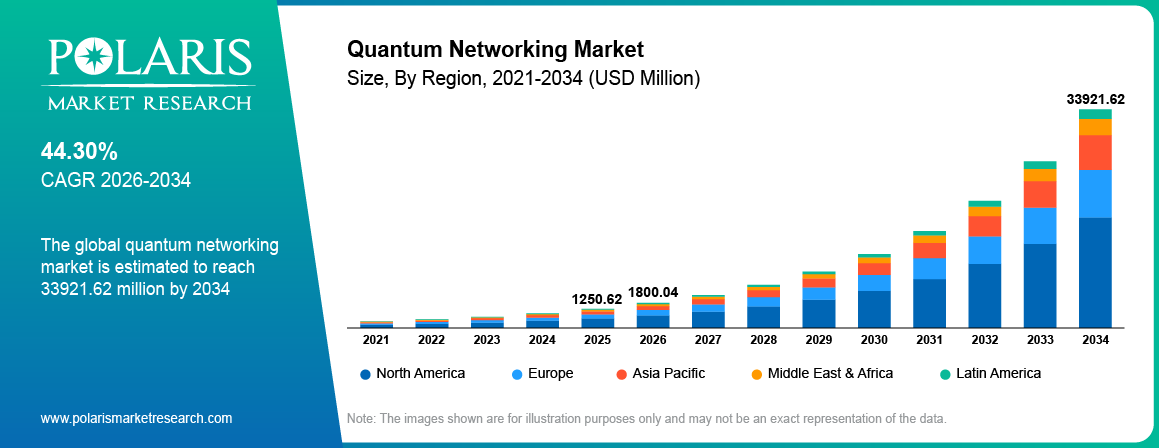
The quantum networking market size was valued at USD 1250.62 million in 2025. The market is projected to grow at a CAGR of 44.30% from 2026 to 2034. Rising cybersecurity threats and heavy government funding are a few of the key factors driving market growth.
Market Statistics
Quantum Networking Market Key Takeaways: Share, Growth & Leading Segments
- North America held the largest 41.8% market share in 2025. The heavy investments in R&D are a key factor that has made the region dominant in the market.
- Asia Pacific is expected to grow at a 28.6% CAGR. The rising partnerships between academia and technology firms are contributing to the growth of the regional market.
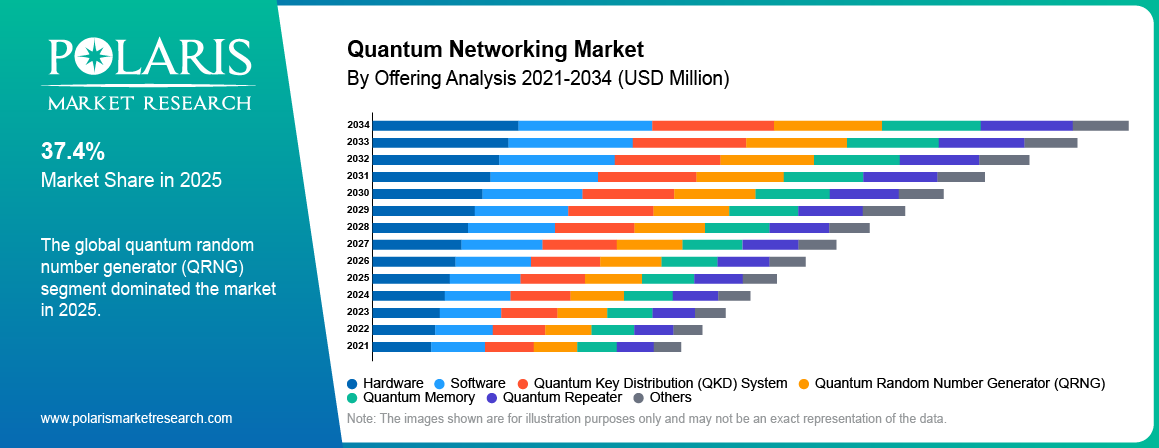
- The quantum random number generator (QRNG) segment held the leading 37.4% market share in 2025. This is because of its importance in boosting security levels.
- The quantum key distribution (QKD) system segment is expected to grow at a 29.3% CAGR. This is due to the increased focus on secure communication channels to mitigate cybersecurity threats.
- The government & defense segment held the leading 31.8% market share in 2025. Quantum networking capabilities appeal to the government and defense sectors.
Note: Figures and projections outlined in this report are the result of Polaris Market Research’s proprietary analytical processes, grounded in the latest available datasets and market observations.
What Is Quantum Networking? Definition, Market Role & Quantum Internet Use
Quantum networking is a field that utilizes the principles of quantum mechanics to offer computation and secure communication across distributed systems. This emerging technology is used to enable the transmission of quantum information, or qubits, over long distances, creating a "quantum internet."
The rising government investment in quantum technology is driving the quantum networking market. Governments worldwide are increasingly recognizing the strategic importance of quantum technologies for national security, economic competitiveness, and technological leadership, which encourages them to allocate funds to quantum research programs. This financial support fills the gap between theoretical research and practical applications, making it easier for companies and institutions to develop and deploy quantum networking solutions. The U.S. National Science Foundation made an announcement in February 2026 regarding a $100 million National Quantum and Nanotechnology Research Infrastructure Program. This program emphasizes the development of a national network of open-access research infrastructure dedicated to quantum and nanoscale technologies(source: nsf.gov).
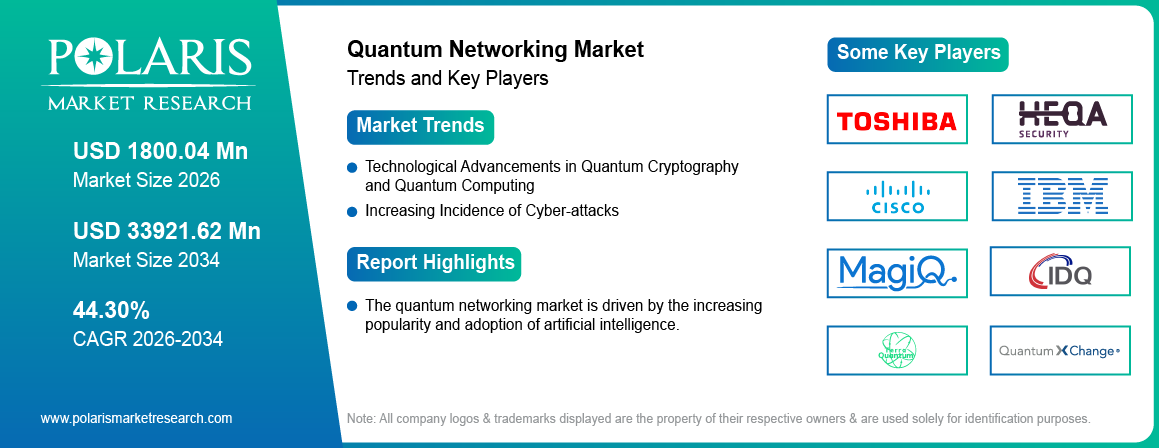
The quantum networking market is driven by the increasing popularity and adoption of artificial intelligence. AI applications generally involve processing and analyzing vast amounts of data to train models and make predictions. This data-intensive nature of AI requires high computational power and efficient data-handling capabilities. Quantum computing, with its potential to perform complex calculations at faster speeds, significantly accelerates AI model training and data analysis. Quantum networks play a crucial role in facilitating these advanced computations by enabling distributed quantum computing. Thus, the rising popularity and adoption of artificial intelligence are expanding the global market.
How Does Quantum Networking Work? Qubits, Entanglement, Repeaters & QKD
Quantum Information Generation – Quantum information is generated by using quantum particles like photons.
Entangled Photons Generation – Entangled pairs of photons are created to facilitate safe communication.
Transmission of Data – The quantum information is sent via optical fibers or satellite links.
Extension of Distance – Quantum repeaters amplify and expand the range of communication.
Quantum Key Distribution – Encryption keys are shared through Quantum Key Distribution (QKD).
Data Verification – Any kind of interception of the communication is instantly detectable.
Secure Communication – The communicating devices exchange data through a highly secure quantum network.
Source: Polaris Market Research Analysis
To Understand More About this Research: Download Sample Report
AI Impact on the Quantum Networking Market: Routing, Monitoring & Optimization
- Artificial intelligence is enhancing quantum networking by optimizing network routing, resource allocation, and communication efficiency in complex quantum networks.
- Machine learning algorithms assist in identifying anomalies within the network, predicting problems, and ensuring stability of the quantum communication links.
- AI-based analytics speed up the process of developing and testing quantum networking technologies owing to the high volume of data that needs to be processed.
- The technology also contributes to network management and monitoring as well as performance optimization.
Quantum Networking vs. Traditional Networking: Security, Data Transfer & Computing
| Feature | Quantum Networking | Traditional Networking |
| Mode of Communication | Uses quantum bits for data transmission | Employs electrical or optical signals |
| Security | Highly secure due to quantum encryption | Secure through traditional encryption processes |
| Protection of Data | Makes it possible to detect any interception | Prone to cyberattacks |
| Key Exchange | Uses Quantum Key Distribution (QKD) | Depends on classical encryption techniques |
| Support of Computing | Easily connects quantum computers | Supports classical computing systems only |
| Future Uses | Quantum internet and communication | Standard internet and enterprise networking |
Source: Polaris Market Research Analysis
Quantum Networking Market Dynamics
Market Driver: Advances in Quantum Cryptography and Quantum Computing
The market CAGR for quantum networking is being driven by technological advancements in quantum cryptography and quantum computing. Advancements in quantum cryptography and quantum computing enhance the capabilities and applications of quantum networks, driving innovation and addressing new challenges in data security and computational power. These advancements create a need for robust, high-performance quantum networks that support and leverage the benefits of these emerging technologies.
Market Driver: Government Funding Accelerating Market Growth
Government funding and national quantum strategies are also driving the establishment of quantum networking infrastructure. Governments across the United States, China, India, and Europe are making more investments in quantum technologies and pilot projects. Such investments enable companies to overcome the expenses related to research and infrastructure, as well as the development of quantum networking technologies from the research stage to implementation. As the number of government-sponsored projects grows, opportunities for quantum networking companies will expand and drive the growth of the market.
Market Restraint: High Infrastructure and Deployment Costs
High investment in quantum networking infrastructure continues to pose a major constraint to the market’s development. Quantum networking involves the deployment of unique technologies that include quantum repeaters, quantum memories, photonics equipment, and advanced communication infrastructure using fiber or satellites. Furthermore, companies may need to make significant investments in research and development, as well as testing, integration of the network, and a qualified workforce. This poses financial constraints on many organizations, including small companies and countries with limited resources.
Market Restraint: Lack of Universal Standards and Interoperability
Inadequate standards and interoperable frameworks might slow down the evolution of quantum networking. Different vendors might utilize various hardware systems, communication protocols, network architectures, and mechanisms of transferring quantum information. It may not be easy to interconnect quantum networking infrastructures developed by different vendors or across different geographic locations. Moreover, interoperability issues might increase the integration cost and the expansion difficulties for such networks. Quantum networking is a relatively new technology; the absence of standards might slow down its implementation and practical usage.
Market Opportunity: Development of the Quantum Internet and Distributed Quantum Computing
Increasing incidence of cyber-attacks across the globe is estimated to expand the market in the coming years. Cyber-attacks highlight the urgent need for more secure and resilient communication systems. This encourages organizations to seek advanced technologies that offer enhanced protection against data breaches, interception, and unauthorized access. Quantum networking, with its tight security through quantum key distribution (QKD) and other quantum encryption methods, directly addresses these growing concerns. Therefore, as the number of cyberattacks rises, the demand for quantum networking also increases.
Quantum networking is paving the way for the future quantum internet through secure communication between quantum devices at a distance. Different from the current internet, the quantum internet would rely on the science of quantum mechanics for transmitting information in a highly secure manner. A lot of funding has been going into the research and development of such a communication network of the future. It is already possible to transmit information in a secure manner using quantum mechanics over fiber-optic networks as well as satellites. Future developments in quantum technologies would see the emergence of a quantum internet technology facilitating distributed quantum computing and advanced scientific research.
Market Trends: Quantum Networking Technology Trends: Repeaters, Memory, Photonic Chips & Satellite Links
The rising number of cyberattacks and data breaches has resulted in a need for advanced communication technology, making quantum networking crucial. Traditional encryption techniques can be vulnerable as quantum computing becomes more advanced, creating the need for better solutions. Quantum networking relies on quantum mechanics to ensure that information is well-protected and that all unauthorized attempts to access information are detected. Government agencies, financial firms, health care providers, and defense firms are working on developing quantum-secure networks for protecting their information. QKD is gaining popularity for its effectiveness in providing highly secure encryption key exchange. In view of future cybersecurity challenges, quantum networking is expected to play an important role in this regard.
Technological Advancements in Quantum Networking
| Technology | Description |
| Quantum Repeater Technology | Increase the distance over which quantum information can be communicated by decreasing losses over long distances. |
| Quantum Memory Systems | Provide temporary storage of quantum information, thus enhancing the efficiency of quantum communication. |
| Entanglement Distribution Networks | Make it possible for entangled quantum bits to be shared among devices that are linked for quantum communication purposes. |
| Photonic Quantum Chip | Increases the processing and transmission of quantum information through the use of optical chips. |
| Quantum Routers and Switches | Transfer quantum information from one node of the network to another. |
| Satellite-based Quantum Communications | Facilitate quantum communications over large distances through satellites between ground stations. |
Source: Polaris Market Research Analysis
Source: Polaris Market Research Analysis
Quantum Networking Market Segmentation Analysis
Market by Offering & Technology: QRNG, QKD, Memory, and Repeaters
Based on the offering, the global quantum networking market is categorized into hardware, software, quantum key distribution (QKD) systems, quantum random number generators (QRNG), quantum memory, quantum repeaters, and others. The QRNG Segment Led with 37.4% Market Share in 2025. It holds the largest share due to its critical role in enhancing security, improving computational processes, and supporting advancements in various technology sectors such as information technology, telecommunications, consumer electronics, cybersecurity, and others. Additionally, the rising popularity of quantum computing and the associated need for advanced cryptographic techniques further fuels the demand for QRNGs. Quantum computers potentially break classical encryption algorithms, necessitating new approaches to secure data transmission and storage. QRNGs offer a solution by enabling the generation of cryptographic keys that are secure against quantum attacks.
QKD System Segment to Grow at 29.3% CAGR
The quantum key distribution (QKD) system segment is also expected to grow at a robust pace in the coming years, owing to the increasing emphasis on secure communication channels against evolving cybersecurity threats. QKD systems offer superior security by utilizing quantum principles to create encryption keys that are difficult to duplicate and intercept. Moreover, the development of cost-effective and scalable QKD solutions is driving the segment growth.
Market by End User: Government & Defense Segment Led with 31.8% Market Share in 2025
In terms of end-user industry, the global quantum networking market is divided into aerospace & defense, banking & finance, government & defense, healthcare & life sciences, IT & telecom, energy & utilities, manufacturing, and others. The government & defense segment accounted for a largest market share in 2025. Quantum networking offers wide security features that are highly attractive to government and defense organizations. It utilizes quantum key distribution (QKD), which enables the secure transmission of encryption keys based on the principles of quantum mechanics. This level of security encourages the government & defense sector to adopt quantum networking for protecting classified information and sensitive national security data from cyber threats.
The IT & telecom segment is projected to grow at a significant CAGR during the forecast period owing to the critical need for advanced communication technologies to support its vast and growing infrastructure. The IT and telecom industries benefit from the advanced security features provided by quantum communication technologies, such as quantum key distribution, which offers a high level of protection against data breaches and cyber threats.
Market by Application: Secure Communication, Distributed Computing & Sensing
| Application | Description |
| Government Data Security | Protects sensitive communications of government and confidential information. |
| Financial Transactions | Ensures safe transaction of finances and secure encryption keys from any cyberattack. |
| Military Operations and Defense | Provides extremely secure communications for military operations. |
| Healthcare Industry | Protects patient information when the data is being transferred. |
| Distributed Quantum Computing | Links several quantum computers to solve complicated problems jointly. |
| Satellite-based Communication | Basis of secure long-range communication through quantum satellites. |
Source: Polaris Market Research Analysis
Source: Polaris Market Research Analysis
Quantum Networking Market by Region
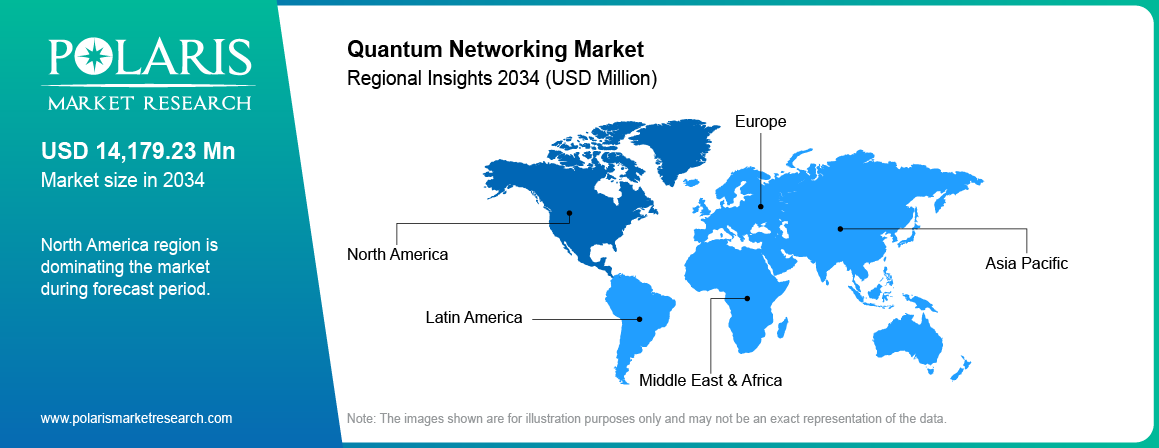
North America held the largest 41.8% market share in 2025.
By region, the study provides the quantum networking market insights into North America, Europe, Asia Pacific, Latin America, and the Middle East & Africa. North America dominated the market in 2025 due to the robust investment in research and development, advanced technological infrastructure, and large funding from both government and private sectors. The US emerged as the dominant country in the region owing to its major role in developing quantum technologies, bolstered by significant contributions from both Silicon Valley-based tech giants and prestigious research institutions such as MIT and Harvard. Additionally, a highly skilled workforce has propelled rapid advancements and implementations of quantum networking solutions in the region.
Asia Pacific to Grow at 28.6% CAGR
The market in Asia Pacific is estimated to grow at a rapid pace in the coming years owing to the presence of skilled scientists, strong technological infrastructure, and increasing collaborations among academic institutions and tech companies. China’s aggressive quantum technology strategy, represented by its national plan to lead in quantum research and its substantial financial commitments, positions it as a key player in the evolving landscape. Additionally, the growing interest and investments in quantum technologies from both government and private sectors across several countries, such as India, Japan, and Australia, are expected to enhance the region's market share. For instance, in July 2025, the Union Cabinet of India approved the Research Development and Innovation (RDI) Scheme. The RDI scheme has a corpus of INR 1 lakh crore. It intends to scale up R&D and innovation in strategic and sunrise domains (source: pib.gov.in).
Source: Polaris Market Research Analysis
Quantum Networking Competitive Landscape & Leading Companies
Key market players are investing heavily in research and development in order to expand their offerings, which will help the quantum networking market grow even more. These market participants are also undertaking a variety of strategic activities to expand their global footprint, with important market developments including innovative launches, international collaborations, higher investments, and mergers and acquisitions between organizations. To expand and survive in a more competitive and rising market environment, the quantum networking industry must offer innovative solutions.
The quantum networking market is fragmented, with the presence of numerous global and regional market players. The players are leveraging extensive resources and customer bases to enhance quantum networking capabilities. Major players in the quantum networking market include TOSHIBA CORPORATION; QuantumCTek Co., Ltd.; HEQA Security; Cisco Systems Inc.; IBM, MagiQ Technologies; ID Quantique; Terra Quantum; Quantum Xchange; Qunnect Inc.; Crypta Labs Limited; Aliro Technologies, Inc.; Qubitekk, Inc.; Arqit, Miraex; Aegiq Ltd; and QuBalt GmbH.
HEQA Security, formerly known as QuantLR, is an Israel-based cybersecurity company that specializes in securing data communication using quantum key distribution (QKD) technology. The company operates at the intersection of quantum computing and cybersecurity, aiming to provide robust defenses against both current and emerging cyber threats. In June 2025, HEQA Security and Korea Telecom (KT) announced a collaboration on quantum key distribution (QKD) technologies. The collaboration aims to enhance KT’s secure communication capabilities (source: heqa-sec.com).
TOSHIBA CORPORATION, founded in 1939 through the merger of Shibaura Seisaku-sho and Tokyo Denki, is a Japan-based multinational conglomerate headquartered in Minato, Tokyo. Toshiba started research into quantum cryptography in 1999 at its Cambridge research laboratory in the UK. The company was the first to announce successful quantum key distribution over 100 km of fiber. In March 2026, Toshiba Corporation and LQUOM Inc. entered into a joint research agreement. The research agreement focuses on exploring the extension of quantum key distribution (QKD) over long distances.
Leading Quantum Networking Companies
- TOSHIBA CORPORATION
- QuantumCTek Co., Ltd.
- HEQA Security
- Cisco Systems, Inc.
- IBM
- MagiQ Technologies
- ID Quantique
- Terra Quantum
- Quantum Xchange
- Qunnect Inc.
- Crypta Labs Limited
- Aliro Technologies, Inc.
- Qubitekk, Inc.
- Arqit
- Miraex
- Aegiq Ltd
- QuBalt GmbH
Future Outlook
It is anticipated that there will be rapid growth in the quantum networking market owing to increasing investments in the field of quantum technologies globally. Governments, research organizations, telecommunication firms, and technology firms are collaborating in order to design quantum communication networks that are highly secure. Progress in QKD, quantum repeaters, and satellite communication networks is anticipated to boost the performance of the network and increase the range of commercial applications. The increasing concerns about cybersecurity issues, along with the increasing development of quantum computers, will contribute to increasing demand.
Industry Developments
- June 2026: Boeing announced a major milestone in its effort to help build a future global quantum internet. The company revealed the successful demonstration of a key quantum networking capability on compact and space-qualified flight hardware. It also highlighted that the Q4S quantum satellite cleared a key test milestone and moved into final spacecraft integration ahead of the 2027 launch. (source: boeing.com)
- April 2026: Cisco announced the launch of the Cisco Universal Quantum Switch. Cisco stated that the switch will ensure the routing of quantum information from one system to another while preserving it. This is a huge step for the company towards overcoming a key limitation of building a quantum network.(source: cisco.com)
Quantum Networking Market Segmentation, 2021-2034
By Offering Outlook (Revenue, USD billion, 2021 - 2034)
- Hardware
- Software
- Quantum Key Distribution (QKD) System
- Quantum Random Number Generator (QRNG)
- Quantum Memory
- Quantum Repeater
- Others
By End-user Industry Outlook (Revenue, USD billion, 2021 - 2034)
- Aerospace & Defense
- Banking & Finance
- Government & Defense
- Healthcare & Life Sciences
- IT & Telecom
- Energy & Utilities
- Manufacturing
- Others
By Application Outlook (Revenue, USD billion, 2021 - 2034)
- Secure Communication
- Distributed Quantum Computing
- Quantum Sensing and Metrology
- Quantum Clock Synchronization
- Secure Voting
- Secure Financial Transaction
By Regional Outlook (Revenue, USD billion, 2021 - 2034)
- North America
- US
- Canada
- Europe
- Germany
- France
- UK
- Italy
- Spain
- Netherlands
- Russia
- Rest of Europe
- Asia Pacific
- China
- Japan
- India
- Malaysia
- South Korea
- Indonesia
- Australia
- Rest of Asia Pacific
- Middle East & Africa
- Saudi Arabia
- UAE
- Israel
- South Africa
- Rest of Middle East & Africa
- Latin America
- Mexico
- Brazil
- Argentina
- Rest of Latin America
Report Scope
| Report Attributes | Details |
| Market Size Value in 2025 | USD 1250.62 million |
| Market Size Value in 2026 | USD 1800.04 million |
| Revenue Forecast in 2034 | USD 33921.62 million |
| CAGR | 44.30% from 2026 to 2034 |
| Base Year | 2025 |
| Historical Data | 2021 – 2024 |
| Forecast Period | 2026 – 2034 |
| Quantitative Units | Revenue in USD million and CAGR from 2026 to 2034 |
| Report Coverage | Revenue Forecast, Market Competitive Landscape, Growth Factors, and Trends |
| Segments Covered |
|
| Regional Scope |
|
| Competitive Landscape |
|
| Report Format |
|
| Customization | Report customization as per your requirements with respect to countries, regions, and segmentation. |
Source: Polaris Market Research Analysis
Quantum Networking Market FAQ's
The global quantum networking market size was valued at USD 1250.62 million in 2025 and is projected to grow to USD 33921.62 million by 2034.
The global market is expected to exhibit a CAGR of 44.30% during the forecast period.
Quantum Networking Market by Region: North America held the largest 41.8% market share in 2025
The key players in the market are TOSHIBA CORPORATION; QuantumCTek Co., Ltd.; HEQA Security; Cisco Systems, Inc.; IBM, MagiQ Technologies; ID Quantique; Terra Quantum; Quantum Xchange; Qunnect Inc.; Crypta Labs Limited; Aliro Technologies, Inc.; Qubitekk, Inc.; Arqit; Miraex; Aegiq Ltd; and QuBalt GmbH.
The quantum key distribution (QKD) system segment is expected to grow at a 29.3% CAGR.
The government & defense segment held the leading 31.8% market share in 2025.
Quantum networking is primarily used for secure communication via quantum key distribution (QKD), distributed quantum computing, and quantum cryptography. Key sectors adopting this technology include defense, banking, healthcare, and government, where data security and tamper-proof communication are critical priorities.
A quantum network refers to a communication network that employs quantum mechanics for transferring information between interconnected devices. This method is much more secure compared to the current networks and will assist in the creation of quantum internet in the future.
Quantum key distribution refers to a technique where quantum mechanics is used for transferring encryption keys. Any attempt to intercept the communication channel will be detected easily, making QKD one of the most secure technologies.
Download Sample Report of Quantum Networking Market
Please fill out the form to request a customized copy of the research report.


