
Large Molecule Drug Substance CDMO Market Size, Share, Trends & Forecast, 2026-2034
REPORT DETAILS
Large Molecule Drug Substance CDMO Market Size & Forecast, 2025-2034
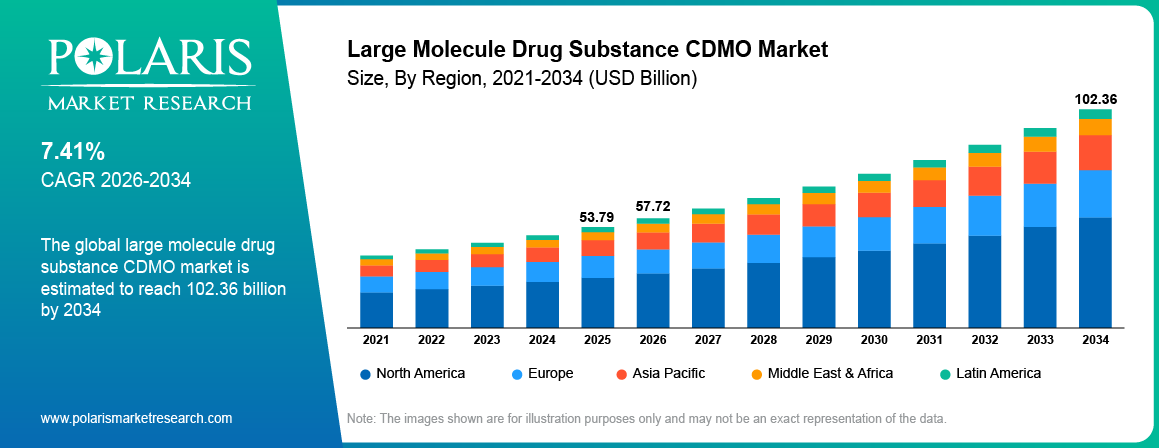
The global large molecule drug substance CDMO market size was valued at USD 53.79 billion in 2025. The market is projected to grow at a CAGR of 7.41% from 2026 to 2034. Rising global approvals of biologic drugs, coupled with increasing healthcare expenditure and a higher share of biologics in total pharmaceutical spending, are driving market growth.
Market Statistics
Large Molecule Drug Substance CDMO Market Key Takeaways: Size, Share, Service & Region
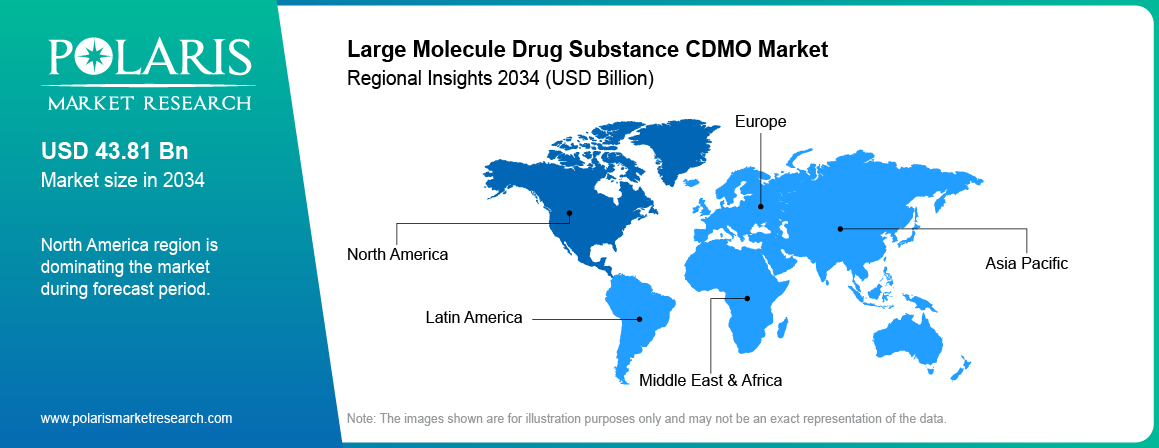
- North America held the largest share of 42.8% in 2025. This is due to the strong presence of established biopharmaceutical companies in the region.
- Asia Pacific is projected to grow at a 10.9% CAGR. Rising biologics manufacturing investments are driving the regional market growth.
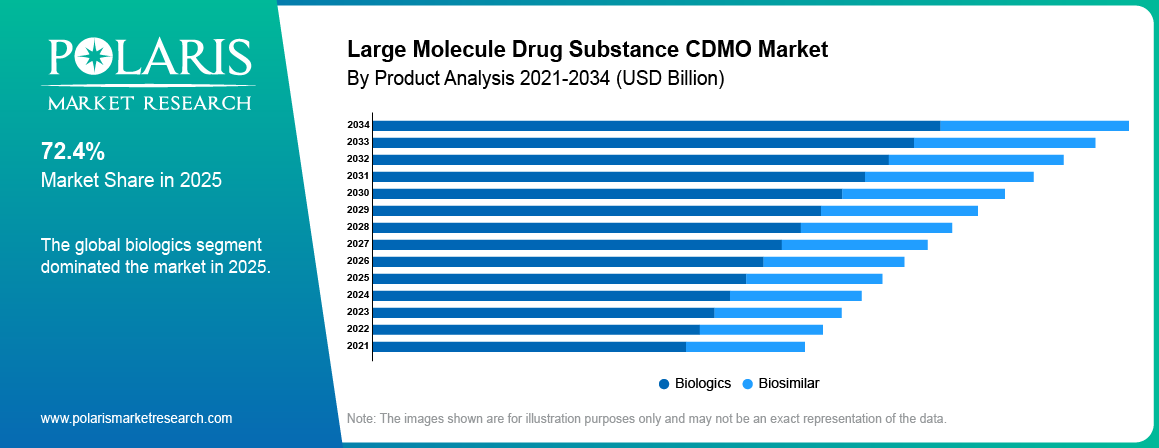
- The biologics segment led with a 72.4% share in 2025. The segment’s leading position is fueled by high demand for monoclonal antibodies and recombinant proteins.
- The contract development segment is expected to grow at a 11.5% CAGR. The segment’s growth is driven by increasing demand for early-stage process development and analytical support.
- The mammalian segment led with a 58.7% share in 2025. This is due to its adaptability towards developing complicated biologics like monoclonal antibodies and recombinant proteins.
Note: Figures and projections outlined in this report are the result of Polaris Market Research’s proprietary analytical processes, grounded in the latest available datasets and market observations.
Large Molecule Drug Substance CDMO Market Dynamics: Drivers, Opportunities, Restraints & Challenges
- Rising global approvals of biologic drugs are driving market growth as pharmaceutical companies expand large molecule production pipelines.
- Increasing healthcare expenditure and higher biologics share in total pharmaceutical spending are supporting greater outsourcing to CDMOs.
- Advancements in single-use and continuous bioprocessing technologies are expected to create new opportunities during the forecast period.
- High operational and setup expenses of biologic manufacturing plants restraint small and mid-sized CDMOs from participating.
AI in Large Molecule Drug Substance Manufacturing: Process Optimization, PAT & Quality Control
- AI is revolutionizing large molecule drug substance manufacturing by facilitating optimization of process development, manufacturing parameters, and quality control.
- ML algorithms use manufacturing data to increase yields, decrease process variability, and increase batch uniformity.
- AI-based systems enable predictive maintenance and process monitoring, which helps manufacturers to increase efficiency and minimize downtime.
What Is a Large Molecule Drug Substance CDMO?
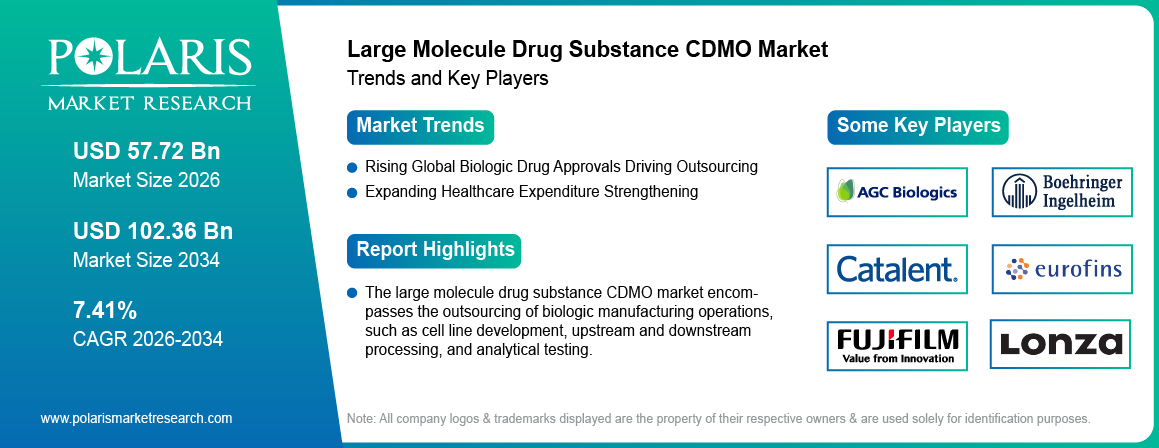
The large molecule drug substance CDMO market encompasses the outsourcing of biologic manufacturing operations, such as cell line development, upstream and downstream processing, and analytical testing. CDMOs offer advanced infrastructure and expertise to pharmaceutical and biotechnology firms to produce complex biologics like monoclonal antibodies, recombinant proteins, and vaccines. This outsourcing model enables firms to curtail capital investment and shorten time-to-market for large molecule drugs.
Increasing worldwide approvals of biologic medicines and growing healthcare spending are fueling market growth as pharmaceutical firms increasingly turn to biologics to treat chronic and rare diseases. The World Health Organization stated that, if current trends continue, chronic diseases such as heart disease, cancer, diabetes, and respiratory illnesses could cause 86% of the 90 million deaths each year by 2050. Increasing biologics' portion of overall pharmaceutical spending showcases rising demand for quality large molecule manufacturing capabilities, which further solidifies the position of CDMOs in the worldwide biopharmaceutical supply chain.
Source: Polaris Market Research Analysis
Ongoing advances in continuous and single-use bioprocessing technology are increasing production scalability and efficiency, opening up new possibilities for CDMOs. However, the high cost of setup as well as operations for biologic manufacturing facilities remains to restrict the involvement of small and mid-size contract manufacturers in this business.
How Large Molecule Drug Substance CDMO Services Work: Cell Line to Commercial Manufacturing
CDMO Selection – A pharma/biotech firm selects the CDMO based on its manufacturing and experience capacity.
Cell Line Development – Experts design and develop the cell line that is capable of producing the biologic drug substance.
Upstream Processing – The cells are cultivated in the bioreactor where they will yield the biological substance.
Downstream Processing – Purification of the biologic drug substance takes place here to fulfill quality criteria.
Quality Testing – The substance will then be tested analytically to ascertain its safety and purity.
Commercial Manufacturing – When all the criteria are fulfilled, the commercial manufacturing of the substance begins.
Large Molecule CDMO vs In-House Biologics Manufacturing: Cost, Capacity, Control & Speed
| Feature | Large Molecule CDMO | In-House Manufacturing |
| Infrastructure | Dependent on specialized outsourced manufacturing facilities | Dependent on company-owned manufacturing facilities |
| Initial Investment | Less initial investment | High initial investment due to infrastructure requirements |
| Technical Expertise | Access to expert biologics manufacturing personnel | Internal development and nurturing of expertise |
| Time to Market | Faster time to market due to use of established infrastructure | Longer time to market due to development of infrastructure |
| Production Capacity | Can vary the production capacity according to needs | Capacity limited by company-owned manufacturing capability |
| Ideal For | Companies that desire rapid development and less infrastructural cost | Companies with long-term manufacturing capabilities |
Source: Polaris Market Research Analysis
Upstream vs Downstream Bioprocessing in Large Molecule Drug Substance Manufacturing
Upstream processing and downstream processing are the two primary phases of large molecule drug manufacturing. Upstream processing starts by cultivating cells in bioreactors in a controlled environment where the desired biological molecule is produced. The quality of this phase determines the yield and performance of the end product. In downstream processing, there is purification and preparation of the biological molecule to comply with standards. This includes processes such as filtration and concentration, among others. Consistency in the process is vital for the production of consistent results. Developments in these two processes have been assisting CDMOs in meeting increasing demands for biologics.
Large Molecule Drug Substance CDMO Market Drivers & Growth Opportunities
Rising Global Biologic Drug Approvals Driving Outsourcing Demand: The global rise in biologic drug approvals is fueling the need for large molecule drug substance CDMOs as pharmaceutical firms increase their pipeline of biologics. Increasing regulatory support for innovative biologic therapies and the growing number of approvals for monoclonal antibodies, recombinant proteins, and gene therapy are boosting outsourcing needs for advanced manufacturing and process development capabilities.
Expanding Healthcare Expenditure Strengthening Biologics Manufacturing Outsourcing: Expanding healthcare expenditure and the rising share of biologics in total pharmaceutical spending are supporting consistent growth of the CDMO market. According to U.S. Centers for Medicare and Medicaid Services (CMS) projections, health spending is expected to hit USD 5.6 trillion in 2025, with hospitals taking the lead at USD 1.8 trillion, and climb to USD 8.6 trillion in 2033. Higher budgets are spent by governments and private healthcare systems on biologic therapies for chronic and rare conditions, which is stimulating pharma companies to collaborate with CDMOs for cost-effective and scalable biologic manufacturing.
Single-Use Bioprocessing, Perfusion and Process Intensification Are Expanding Flexible Capacity
Single-use bioprocessing has emerged as a major technology in biologic manufacturing due to the increased flexibility and efficiency that it provides. Use of disposable bioreactors, tubing, and storage allows for decreased necessity of cleaning and sterilization between different batches of manufacture. This not only ensures a reduction of risks related to cross-contamination but also contributes to the faster production process. Single-use technology proves to be particularly valuable for smaller batch production and manufacturing of multiple biologic drugs in one facility. In some cases, the implementation of single-use technology is associated with less consumption of water and energy as opposed to traditional manufacturing. With increasing demands for biological drugs, the adoption of these technologies is expected to grow further.
Source: Polaris Market Research Analysis
GMP, Process Validation and Regulatory Compliance in Biologic Drug Substance Manufacturing
Compliance with regulations is an integral aspect in the manufacture of large molecules since biologic drugs need to conform to specific requirements in terms of safety and quality. Contract development and manufacturing organizations adhere to good manufacturing practices (GMPs) in all stages of manufacturing to guarantee that there is consistency in the quality of their products. Process validation, sterilization, product characterization, and quality control of products are conducted by CDMOs prior to the release of products. The documentation process is followed to ensure regulatory compliance. Compliance with such standards makes it possible for drug companies to be approved in different countries. As a result of changing regulations, the CDMOs have been keen on ensuring that they improve their quality management systems.
Large Molecule Drug Substance CDMO Market Segmentation & Segment Insights
Large Molecule Drug Substance CDMO Market by Product: Biologics & Biosimilars
The market is divided into biologics and biosimilar. The biologics segment led the market in 2025, fueled by huge demand for monoclonal antibodies and recombinant proteins. Additionally, growing approvals of new biologics and expanding therapeutic uses are driving continued outsourcing to CDMOs worldwide.
The biosimilar segment is expected to grow at the highest CAGR throughout the forecast period, as a result of patent expirations of blockbuster biologics and greater adoption of lower-cost biosimilars.
Large Molecule Drug Substance CDMO Market by Service: Contract Manufacturing & Development
The market is categorized into contract manufacturing and contract development. The contract manufacturing segment dominated the market in 2025, supported by large-scale production requirements of biologics and robust infrastructure in established CDMOs. Moreover, pharmaceutical companies prefer outsourcing manufacturing to reduce capital investment and operational risks.
The contract development segment is expected to grow at the fastest CAGR during the forecast period, driven by increasing demand for early-stage process development and analytical support. In addition, small and mid-sized biotech firms rely on CDMOs for development services.
Large Molecule Drug Substance CDMO Market by Source: Mammalian, Microbial & Other Platforms
Based on source, the market is segmented into mammalian, microbial and others. The mammalian segment led the market in 2025 due to its adaptability towards developing complicated biologics like monoclonal antibodies and recombinant proteins.
The microbial segment is expected to have the highest CAGR growth during the forecast period, as it is cost-effective and has quicker production cycles for enzymes and recombinant proteins.
Large Molecule Drug Substance CDMO Market by End User: Biopharma, Biotech & Research Institutes
Based on end user, the market is segmented into biopharmaceutical companies, biotechnology companies and academic and research institutes. The biopharmaceutical companies segment dominated the market in 2024, owing to large-scale biologics production and strong pipeline development. Moreover, pharmaceutical companies prefer outsourcing manufacturing to reduce capital investment and operational risks.
The biotechnology companies segment is anticipated to expand with the highest CAGR through the forecast period, fueled by higher biologics and biosimulation development by new biotech companies. In addition, collaboration with CDMOs accelerates time-to-market.
Large Molecule Drug Substance CDMO Use Cases: mAbs, Biosimilars, Recombinant Proteins & Vaccines
| Use Case | Role of CDMOs |
| Monoclonal Antibodies Manufacturing CDMO | Enables manufacturing of biological drugs that are used for treating cancers, autoimmunity, and other diseases. |
| Biological Similar Manufacturing | Helps in developing and producing cost-efficient biosimilar drugs. |
| Clinical Trial Manufacturing | Produces biological substances that are required for carrying out clinical trials. |
| Recombinant Proteins Manufacturing | Produces complex proteins for various pharmaceutical applications. |
| Vaccines Manufacturing | Enables production of biological products for the development of vaccines. |
| Commercial Biological Drugs Manufacturing | Enables commercial manufacture of biological drugs. |
Source: Polaris Market Research Analysis
Source: Polaris Market Research Analysis
Large Molecule Drug Substance CDMO Market Regional Analysis: North America, Europe & Asia Pacific
North America led the market for large molecule drug substance CDMO in 2025
Due to the strong presence of established biopharmaceutical companies and advanced CDMO infrastructure. Moreover, high R&D investment and regulatory support for biologics further drive market growth.
U.S. Large Molecule Drug Substance CDMO Market: Biologics Capacity, Reshoring & Commercial Manufacturing
The U.S. led the North America market with its high density of leading biopharmaceutical firms and advanced CDMO facilities. For example, Hans Scientific in September 2025 announced to invest USD 2 billion to enhance U.S. biologics CDMO capacity, such as injectable and lyophilization plants, for reshoring and local drug production.
Europe Large Molecule Drug Substance CDMO Market: Biologics Hubs, Biosimilars & GMP Capacity
Europe is held the substantial market share by 2034, owing to strong biosimilar adoption and well-established biopharma hubs in the UK and Germany. Additionally, robust regulatory environments promote CDMO collaborations. In addition, Germany remains the key contributor with advanced biologics manufacturing capabilities in this region.
Asia Pacific Large Molecule Drug Substance CDMO Market: Capacity Expansion in China, India & South Korea
Asia Pacific is expected to demonstrate the highest growth rate owing to increasing biologics manufacturing investments in China and India. In March 2025, Shilpa Medicare introduced a hybrid CDMO at DCAT 2025, offering full outsourcing along with pre-formulated ready-to-use formulations for oncology, biologics, and peptide development. Furthermore, government support policies for pharmaceutical outsourcing facilitate increasing adoption of CDMO.
China Large Molecule Drug Substance CDMO Market: Mammalian, Microbial & Commercial DS Capacity
China is the leading contributor in Asia Pacific, driven by increasing investments in biologics production and growth of local CDMOs. Additionally, government policies favoring pharmaceutical outsourcing boost market adoption. Furthermore, rising domestic biologics pipeline development accelerates demand for contract manufacturing and development services.
Source: Polaris Market Research Analysis
Large Molecule CDMO Supply Chain Role: Dual Sourcing, Capacity Flexibility & Resilience
Large molecule CDMOs are vital in the pharmaceutical supply chain due to their manufacturing capabilities and specialized expertise. They help pharmaceutical manufacturers prevent delays in the production process through flexible manufacturing of products for clinical and commercial use. Large molecule CDMOs assist in global supplies through manufacturing of biologic drug substance at different locations when necessary. Having already developed facilities enables pharmaceutical manufacturers to react fast to any changes in demand in the market. Proper collaborations also aid in increasing the availability of such biologic drugs.
Large Molecule Drug Substance CDMO Competitive Landscape & Leading Companies
The large molecule drug substance CDMO market is competitive as companies develop biologics and biosimilar manufacturing capacity, providing pharmaceutical and biotechnology companies with contract development and manufacturing services. Moreover, partnerships with international biopharma companies and research institutes drive market growth and adoption globally.
Some of the key companies in the large molecule drug substance CDMO market include Thermo Fisher Scientific Inc., Eurofins Scientific SE, Wuxi Biologics, Samsung Biologics Co., Ltd., Catalent, Inc., AGC Biologics, Boehringer Ingelheim International GmbH, FUJIFILM Diosynth Biotechnologies, Lonza Group, Recipharm AB, Siegfried Holding AG, and Rentschler Biopharma SE.
Leading Large Molecule Biologics CDMOs
- AGC Biologics
- Boehringer Ingelheim International GmbH
- Catalent, Inc.
- Eurofins Scientific SE
- FUJIFILM Diosynth Biotechnologies
- Lonza Group
- Rentschler Biopharma SE
- Recipharm AB
- Samsung Biologics Co., Ltd.
- Siegfried Holding AG
- Thermo Fisher Scientific Inc.
- Wuxi Biologics
Large Molecule Drug Substance CDMO Market Future Outlook to 2034
The large molecule drug substance CDMO market is anticipated to experience steady growth due to the rising demand for biologic medicines across the globe. An increase in the number of approvals for biologic medicines, development of biosimilars, and large molecule manufacturing outsourcing by biopharma companies have been driving the growth of the market. Developments in single-use technology, automation, and digitization are helping manufacturers improve manufacturing processes. Rising investments in advanced therapy medicines such as cell therapy and gene therapy are offering new business prospects to the CDMOs.
Recent Large Molecule CDMO Capacity Expansions, M&A & Partnerships, 2025-2026
- July 2026: Lonza confirmed that its new large-scale mammalian manufacturing asset in Visp, Switzerland, successfully commenced active commercial operations during the first half of the year.(source: lonza.com)
- June 2026: Samsung Biologics announced its entry into the U.S. market with the $353 million acquisition of GSK's Rockville, MD manufacturing facility. Samsung Biologics stated that the acquisition will add 60,000 liters of capacity and bring the total global capacity of the company to 845,000 liters. The move is a part of its '3D Expansion Strategy.(source: samsungbiologics.com)
- October 2025: Cambrex is investing USD 120 million to expand its U.S. manufacturing capacity, strengthening large-scale production of APIs and peptide therapeutics and supporting a more resilient domestic drug supply chain.
- September 2025: Rezon Bio has launched two European facilities to provide end-to-end biologics CDMO services, from cell line development to commercial-scale manufacturing using advanced single-use and bioreactor technologies.
Large Molecule Drug Substance CDMO Market Segmentation by Product, Service, Source, End User & Region
By Product Outlook (Revenue, USD Billion, 2021–2034)
- Biologics
- Biosimilar
By Service Outlook (Revenue, USD Billion, 2021–2034)
- Contract Manufacturing
- Clinical
- Commercial
- Contract Development
- Cell Line Development
- Process Development
By Source Outlook (Revenue, USD Billion, 2021–2034)
- Mammalian
- Microbial
- Others
By End User Outlook (Revenue, USD Billion, 2021–2034)
- Biopharmaceutical Companies
- Biotechnology Companies
- Academic and Research Institutes
By Regional Outlook (Revenue, USD Billion, 2021–2034)
- North America
- U.S.
- Canada
- Europe
- Germany
- France
- UK
- Italy
- Spain
- Netherlands
- Russia
- Rest of Europe
- Asia Pacific
- China
- Japan
- India
- Malaysia
- South Korea
- Indonesia
- Australia
- Vietnam
- Rest of Asia Pacific
- Middle East & Africa
- Saudi Arabia
- UAE
- Israel
- South Africa
- Rest of Middle East & Africa
- Latin America
- Mexico
- Brazil
- Argentina
- Rest of Latin America
Large Molecule Drug Substance CDMO Market Report Scope, Segmentation & Forecast Period
| Report Attributes | Details |
| Market Size in 2025 | USD 5.79 Billion |
| Market Size in 2026 | USD 57.72 Billion |
| Revenue Forecast by 2034 | USD 102.36 Billion |
| CAGR | 7.41% from 2026 to 2034 |
| Base Year | 2025 |
| Historical Data | 2021–2024 |
| Forecast Period | 2026–2034 |
| Quantitative Units | Revenue in USD Billion and CAGR from 2026 to 2034 |
| Report Coverage | Revenue Forecast, Competitive Landscape, Growth Factors, and Industry Trends |
| Segments Covered |
|
| Regional Scope |
|
| Competitive Landscape |
|
| Report Format |
|
| Customization | Report customization as per your requirements with respect to countries, regions, and segmentation. |
Source: Polaris Market Research Analysis
Large Molecule Drug Substance CDMO Market FAQ's
The global market size was valued at USD 53.79 billion in 2025 and is projected to grow to USD 102.36 billion by 2034.
The global market is projected to register a CAGR of 7.41% during the forecast period.
North America held largest market in 2025 driven by the strong presence of established biopharmaceutical companies and advanced CDMO infrastructure.
A few of the key players in the market are Thermo Fisher Scientific Inc., Eurofins Scientific SE, Wuxi Biologics, Samsung Biologics Co., Ltd., Catalent, Inc., AGC Biologics, Boehringer Ingelheim International GmbH, FUJIFILM Diosynth Biotechnologies, Lonza Group, Recipharm AB, Siegfried Holding AG, and Rentschler Biopharma SE.
The biologics led market in 2025 due to high demand for monoclonal antibodies, recombinant proteins, and other complex biologics.
The biotechnology companies growing steadily led by increasing biologics and biosimilar development by emerging biotech firms.
Large molecule drug substance CDMOs refer to firms that assist pharmaceutical and biotechnology companies in developing and producing biologic drug substances. They offer services like cell line development, process development, manufacturing, purification, and testing of biologic drugs.
Pharmaceutical firms outsource biologic production to CDMOs in order to obtain expert knowledge, advanced manufacturing facilities, and regulatory assistance without constructing their own manufacturing plants. This helps to cut down costs, increase development speed, and increase flexibility of production.
The market is experiencing growth due to high demand for biologics, increased outsourcing activities, expansion of biosimilar manufacturing market, and investment in manufacturing technology. The requirement for specialized production capability is also propelling market growth.
Download Sample Report of Large Molecule Drug Substance CDMO Market
Please fill out the form to request a customized copy of the research report.


