
Quantum AI Market Size, & Trend Analysis Report, 2026-2034
REPORT DETAILS
Quantum AI Market Summary
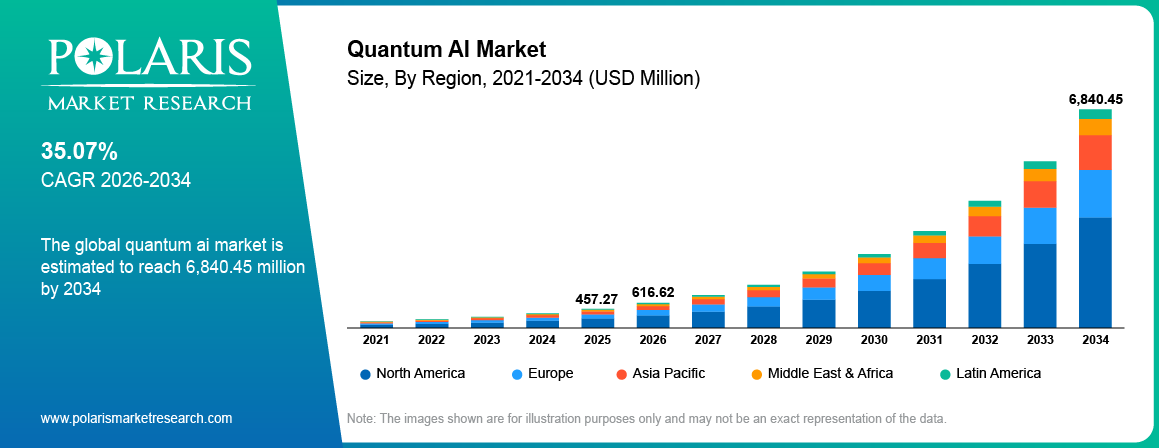
The global quantum AI market size was valued at around USD 457.27 million in 2025 and is projected to reach USD 6,840.45 million by 2034, registering a CAGR of 35.07% during the forecast period. The market growth is attributed to growing investments in quantum computing, rising usage of hybrid quantum and classical computing methods, and rising need for optimization and machine learning applications. Government spending, quantum computing platforms in the cloud, and continuous advancements in quantum computing technology have been further driving the market growth.
Market Statistics
Quantum AI Market Key Takeaways 2025
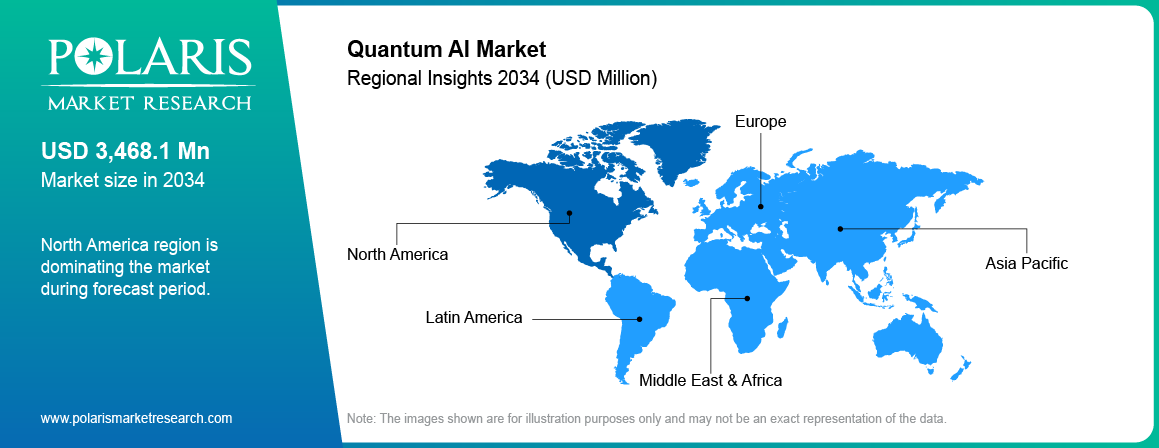
- North America held the dominant position in the Quantum AI Market in 2025, accounting for approximately 38.42% of global revenue, driven by extensive investments in quantum computing, cloud infrastructure, AI research, and the strong presence of major technology companies.
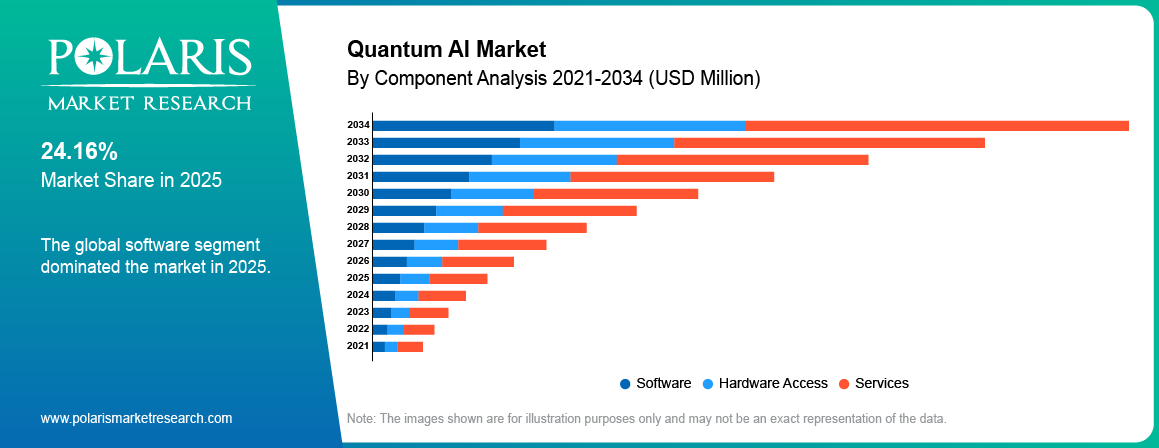
- The software segment dominated the market in 2025 with a 46.35% share, supported by rising demand for quantum software development kits, quantum workflow orchestration platforms, optimization tools, and quantum machine-learning frameworks.
- The cloud-based deployment segment accounted for 68.75% of the market in 2025, owing to lower infrastructure requirements, scalable computing capacity, and easier enterprise access to quantum computing resources.
- The machine learning application segment is projected to register the fastest CAGR of 38.65% during 2026–2034, driven by increasing integration of quantum algorithms with AI models for pattern recognition, predictive analytics, drug discovery, financial modeling, and complex data processing
Note: Figures and projections outlined in this report are the result of Polaris Market Research’s proprietary analytical processes, grounded in the latest available datasets and market observation
What is Quantum AI?
Quantum AI is a form of artificial intelligence that incorporates the features of quantum computing in order to address computational challenges. It uses quantum processors, quantum-classical computing technology, and artificial intelligence algorithms to enhance optimization, simulation, and machine learning. Quantum neural networks and optimization methods have become popular recently due to their effectiveness in addressing business issues.
This value chain consists of quantum hardware manufacturers, cloud infrastructures, quantum software vendors, AI platforms, consultancy firms, system integrators, and enterprises. In particular, software vendors supply quantum software development kits, while cloud providers provide secure access to QPUs using Quantum-as-a-Service platforms. Enterprises use those technologies to create, test, and implement quantum AI applications in the commercial world.
Market growth is attributed to the rapid advancements in quantum processors, availability of cloud-based quantum computing, and increasing spending on research and innovation. Developments in quantum error correction, integration of hybrid quantum and classical computing, and rising government funding are expected to contribute to the commercialization process. Increasing demand for various quantum algorithms, and fault-tolerant computing is projected to drive market growth in the coming years.
Quantum AI Market Driver Impact Analysis
The market is expected to witness strong growth during the forecast period due to increasing commercialization of quantum computing technologies and rising enterprise investments in advanced computing. Organizations are evaluating such AI to solve optimization, simulation, and machine learning problems that require higher computing performance than conventional systems. Growing enterprise pilot programs are also accelerating technology adoption.
The quantum computing systems that are available on the cloud are growing in popularity, enabling businesses of any size to access quantum computing systems. It becomes unnecessary for companies to spend money on purchasing expensive computing devices, resulting in reducing the cost of implementation. More cloud providers are offering quantum computing technologies that allow organizations to utilize quantum computing for their commercial purposes. In July 2026, OP Pohjola and Qutwo introduced the Quantum and Artificial Intelligence Research Center (QARC) to use quantum technologies in AI development for banks and insurance companies(Source: www.fairedih.fi).
| Market Driver | Est. CAGR Impact | Geographic Relevance | Impact Timeline |
| Government quantum investments | +2.5% | Global | Short to Medium Term |
| Hybrid quantum-classical computing | +2.1% | North America, Europe | Medium Term |
| Cloud-based quantum platforms | +1.8% | Global | Medium Term |
| Quantum machine learning adoption | +1.4% | Global | Long Term |
| Enterprise optimization demand | +1.2% | North America, Asia Pacific | Long Term |
* Indicative estimates based on market context and analyst judgment. Figures reflect relative driver weight, not additive CAGR contributions. Source: Polaris Market Research Analysis.
Quantum AI Industry Dynamics
Driver - Growing investments in quantum computing infrastructure
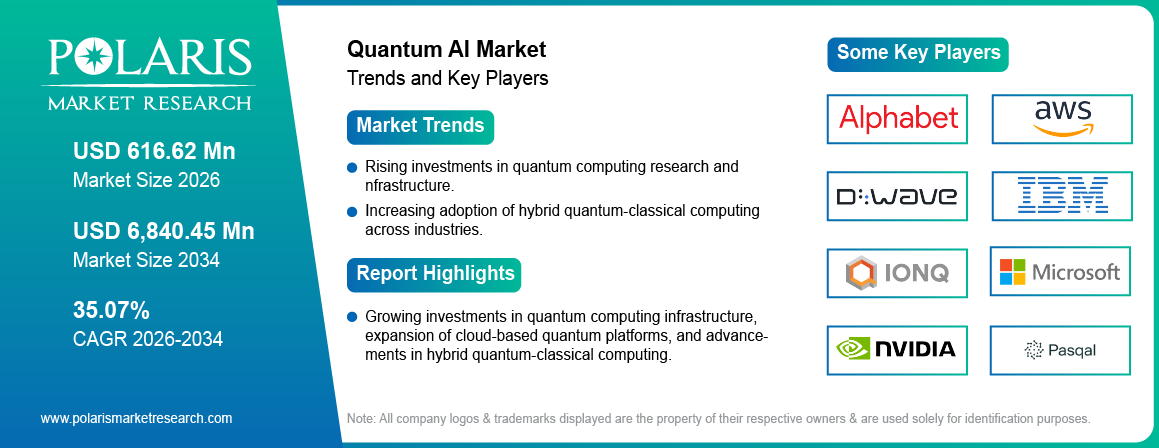
The increasing investments by governments, tech firms, and private investors are contributing to the commercialization of quantum AI technologies. These investments are made in quantum processors, quantum software development kits, and quantum clouds to ease their application within businesses. In May 2026, the US Department of Commerce granted an incentive worth USD 2.013 billion for nine companies under the CHIPS Act to speed up the development of fault-tolerant quantum computing, to enhance quantum manufacturing, and to further develop quantum R&D(Source: www.nist.gov). Companies are investing in Variational Quantum Algorithms, Quantum Optimization, and Quantum Neural Networks in order to improve their commercial applications in finance, healthcare, logistics, and science.
Driver - Rising adoption of hybrid quantum-classical computing
The increasing application of quantum-classic computer systems is paving the way for quantum AIs that are efficient and feasible for corporate utilization. Organizations are integrating the technology of the classical computer with that of the quantum computer to make them more efficient and easier to implement. In June 2026, HPE enhanced collaboration with leading quantum organizations by adding artificial intelligence, high-performance computing (HPC) technology, and quantum computing, hence accelerating the development of scalable hybrid quantum systems(Source: www.hpe.com).The provision of QPU access and Quantum as a Service on cloud platforms is allowing organizations to evaluate quantum AI without using any specific devices.
Restraints - Limited Quantum Hardware Scalability
Quantum hardware has just begun its journey towards commercialization, leading to certain difficulties for enterprises while adopting it on a large scale. Quantum hardware possesses certain limitations in terms of number of qubits, error rate, and processing stability, making commercialization difficult. Enterprises need to have certain expertise in order to design and implement quantum-based artificial intelligence solutions.
Opportunities - Growing Enterprise Adoption of Quantum-as-a-Service
The availability of Quantum-as-a-Service (QaaS) platforms is driving tremendous opportunities for the market. In July 2026, Classiq and QAI launched the first indigenous Quantum as a Service (QaaS) platform in South Korea, enabling enterprises to have quantum computing and quantum application development through cloud services, driven by AI.[Source: www.classiq.io] Companies that operate on the cloud are making it possible for businesses to use quantum computing infrastructure without spending too much money. Companies are able to test algorithms and develop artificial intelligence models using subscription services. The increasing need of enterprises for flexible and affordable quantum computing is anticipated to drive market growth in the long run.
Segment and Regional Leaders at a Glance
According to Polaris Market Research, North America leads the market while Asia Pacific is the fastest-growing region.
- Dominant Region: North America
- Fastest-Growing Region: Asia Pacific
- Largest Component Segment: Software
- Largest Deployment Segment: Cloud-Based
- Largest Application Segment: Optimization
Quantum AI Market Segmentation Analysis
This report gives an in-depth review of the market based on component, deployment, application, and end use to determine high-growth segments.
Market by Component
Which Component Dominated the Market?
The software segment dominated the market in 2025 with a 46.35% share owing to the rising demand for quantum software development kits, quantum workflow orchestration systems, and quantum machine learning platforms. In June 2026, Microsoft used agentic AI to develop the Majorana 2 quantum chip, which increased the reliability of qubits by a factor of 1,000 and helped Microsoft get closer to scaling quantum computing(Source: news.microsoft.com).The software segment is benefiting from enterprises that are developing quantum solutions through software tools. The demand for variational quantum algorithms and quantum development platforms is adding more strength to the market position of the segment.
Which Component is Projected to Grow at the Fastest CAGR?
The services segment is anticipated to register the highest CAGR of 36.47% over the forecast period. There is an increasing requirement for consultation, implementation, integration, training, and managed services for the efficient adoption of quantum AI solutions. Rising enterprise pilot programs and increasing demand for technical expertise are supporting segment growth.
Market by Deployment
Which Deployment Segment Dominated the Market?
The cloud-based deployment segment accounted for 68.75% of the market in 2025 due to reduced infrastructure expenditure and availability of quantum computing solutions. Cloud-based quantum computing enables businesses to utilize different quantum computers on the cloud without installing any hardware. The rapid increase in quantum cloud services has enabled business growth.
Which Deployment Segment is Projected to Grow at the Fastest CAGR?
The on-premises segment is estimated to have the highest CAGR of 35.35% over the forecast period. This is due to companies, governments, and research organizations making substantial investments in quantum infrastructure to secure data, enhance system control, and increase computing performance. Growing demand for sovereign quantum capabilities is supporting segment growth.
Market by Application
Which Application Dominated the Market?
The optimization segment dominated the market in 2025 due to increasing adoption of quantum optimization for financial modeling, logistics optimization, manufacturing planning, and supply chain management. Organizations have been utilizing quantum algorithms for solving their business issues in a much faster manner as compared to conventional computing techniques. The rising investments by enterprises in optimization software solutions have helped to fuel the market growth.
Which Application is Projected to Grow at the Fastest CAGR?
The machine learning application segment is projected to register the fastest CAGR of 38.65% during 2026–2034. Growing investment in quantum neural networks, variational quantum algorithms, and hybrid AI approaches are driving enterprise adoption of such tools in many sectors such as healthcare, finance, and research. Continuous innovation in quantum machine learning technologies is expected to accelerate commercial deployment.
Market by End Use
Which End Use Dominated the Market?
The BFSI segment dominated the market in 2025, accounting for approximately 20.84% of the market share. This is due to increasing adoption of quantum AI for portfolio optimization, fraud detection, financial risk analysis, and algorithmic trading. Financial institutions are focusing on incorporating advanced computing techniques that can help them increase operational efficiency and data-backed decision-making. Increasing investments in digital transformation are also driving the market growth.
Which End Use is Projected to Grow at the Fastest CAGR?
The pharmaceutical & healthcare segment is projected to grow at the fastest CAGR of 37.95% during the forecast period. Organizations are implementing quantum AI in drug discovery, molecular modeling, precision medicines, and clinical research. Higher investments in innovations in the life sciences and computing technologies are anticipated to create high demand in the healthcare sector.
Segment Summary Table
| Segment | Category | 2025 Status | Forecast CAGR | Key Driver |
| Software | Component | Largest Share | High | Growing quantum software adoption |
| Services | Component | Fastest Growing | Highest | Increasing consulting demand |
| Cloud-Based | Deployment | Largest Share | High | Easy access to quantum resources |
| On-Premises | Deployment | Fastest Growing | Highest | Data security requirements |
| Optimization | Application | Largest Share | High | Complex problem-solving |
| Machine Learning | Application | Fastest Growing | Highest | Hybrid AI adoption |
| BFSI | End Use | Largest Share | High | Financial optimization |
| Pharmaceutical & Healthcare | End Use | Fastest Growing | Highest | Drug discovery applications |
Source: Polaris Market Research Analysis. Segment share and CAGR reflect Polaris proprietary sizing methodology.
Regional Analysis
North America Quantum AI Market
North America dominated the market in 2025 owing to strong investments in quantum computing, advanced cloud infrastructure, and the presence of leading technology companies. In March 2026, IBM updated its Quantum Roadmap, which highlights the road map milestones to achieve quantum advantage by leveraging hybrid quantum-classical computation, optimizing workflows using AI, and developing fault-tolerant quantum computing by 2029(Source: www.ibm.com).The US is leading the regional market owing to constant investments made by companies like IBM, Google, Microsoft, Amazon Web Services, and IonQ in the development of quantum computing hardware and software.
Europe Quantum AI Market
The Europe region held a considerable market share in 2025 owing to growing investments by governments into quantum technology and supportive regulations. Germany, the UK, France, and Switzerland are some countries that are investing in infrastructure development for quantum research and quantum business innovations. In July 2025, The European Commission launched the Quantum Europe Strategy to boost Europe’s position in quantum technologies via investments in research and quantum skills(Source: eur-lex.europa.eu).
Asia Pacific Quantum AI Market
The Asia Pacific region is estimated to have the highest CAGR during the forecast period due to increasing government spending and quantum research projects. In March 2026, QpiAI launched a new technology that allows for real-time correction of errors in its 64-qubit Kaveri processor, marking a breakthrough in fault-tolerant quantum computing(Source: www.businesswireindia.com).China, Japan, India, South Korea, and Australia are improving their quantum computing capacity by developing national strategies in collaboration with industries. Increasing investment in artificial intelligence, cloud computing, and scientific research is driving the development of quantum AI technology.
Latin America Quantum AI Market
The Latin America region is anticipated to experience a steady rise in the growth rate owing to increasing adoption of cloud quantum computing services and research. The countries such as Brazil and Mexico are significantly investing in digital transformation and advanced computing technology. Rising collaborations among universities, technology firms, and governmental institutions are providing opportunities for expansion in the market.
Middle East & Africa Quantum AI Market
The Middle East & Africa region is expected to have a stable growth rate in the coming years due to increasing investments in digital infrastructure and quantum research projects. Countries such as the UAE, Saudi Arabia, Israel, and South Africa are promoting quantum development via governmental technology programs. Enhanced efforts in science research, cybersecurity, and computing are boosting market growth in the region.
Regulatory Heatmap
| Country | Policy Environment | Key Regulations | Market Implication | Trend |
| US | Favorable | National Quantum Initiative | Encourages quantum innovation | Expanding |
| Canada | Developing | National Quantum Strategy | Supports commercialization | Growing |
| Germany | Favorable | EU Quantum Strategy | Promotes enterprise adoption | Expanding |
| UK | Favorable | National Quantum Strategy | Supports research investments | Expanding |
| China | Favorable | National Quantum Programs | Accelerates technology development | Expanding |
| Japan | Developing | National Quantum Research Programs | Encourages industrial adoption | Growing |
| India | Favorable | National Quantum Mission | Expands domestic ecosystem | Expanding |
| Australia | Developing | National Quantum Strategy | Supports startup ecosystem | Growing |
Source: National Quantum Initiative (US), Government of Canada, European Commission, GOV.UK, Ministry of Education, Culture, Sports, Science and Technology (MEXT), India Department of Science & Technology (DST), Australian Government Department of Industry, Science, and Resources (DISR)
Market Competitive Landscape
The quantum AI industry is moderately fragmented due to the presence of competition between quantum hardware manufacturers, cloud service providers, software vendors, and technology companies. The market-leading players are concentrating on the development of quantum processors, cloud computing, hybrid computing systems, and quantum software to enhance their market position.
Strategic partnerships, acquisitions, product launches, and investment in research and development continue to be the key growth strategies that have been adopted by leading firms. Collaborations among technology companies, research institutions, and government agencies are projected to boost commercialization and increase enterprise adoption throughout the forecast period.
Competitive Positioning Table
| Company | Est. Market Position | Primary Focus | Geographic Focus | In Report |
| IBM Corporation | Top Tier | Quantum Computing Platform | Global | Yes |
| Alphabet Inc. | Top Tier | Quantum AI Research | Global | Yes |
| Microsoft Corporation | Top Tier | Hybrid Quantum Computing | Global | Yes |
| Amazon Web Services | Market Leader | Quantum Cloud Services | Global | Yes |
| IonQ | Leading Innovator | Trapped-Ion Quantum Systems | North America, Europe | Yes |
| Quantinuum | Strong Player | Quantum Hardware & Software | Global | Yes |
| D-Wave Quantum Inc. | Strong Player | Quantum Annealing | Global | Yes |
| Rigetti Computing | Major Vendor | Superconducting Quantum Systems | North America | Yes |
Source: Company filings and press release
Technology and Innovation Landscape 2025-2026
Quantum AI technology is evolving rapidly with continuous advancements in hybrid quantum-classical computing, quantum processors, and AI-powered software platforms. The industry is adopting technologies such as quantum error correction, AI-driven calibration, fault tolerance computing, and variational quantum algorithms to increase computing precision and hardware stability. These advancements are helping in making enterprise quantum AI solutions commercially viable.
Increasing investment in cloud-based platforms is making it easier to gain QPU access for enterprises and research institutions. Enterprises are building software development kits, workflows, and Quantum-as-a-Service offerings to make application development and deployment simpler. This is expected to boost system performance and minimize operational complexity.
| Technology | Adoption Stage | Key Development | Market Impact |
| Hybrid Quantum-Classical Computing | Growing | Integrated computing platforms | Improves computational efficiency |
| Quantum Machine Learning | Early Commercial | Advanced learning algorithms | Expands AI applications |
| Quantum Error Correction | Growing | Improved hardware reliability | Enhances system stability |
| AI-Assisted Calibration | Early Commercial | Automated quantum optimization | Improves hardware performance |
| Quantum Software Development Kits | Mainstream | Developer frameworks | Accelerates application development |
| Quantum-as-a-Service | Growing | Cloud-based quantum access | Expands enterprise adoption |
Source: Polaris Market Research Analysis, press release, and IP & patent filings
Buyer Use Cases and Entry Barriers
Quantum AI market research report assists the technology firms, enterprises, investors, and government agencies to analyze the commercial potential, technology preparedness, and competitive position. It includes market size analysis, regional demand analysis, industry trend analysis, technology advancements, and competitive strategy analysis.
The report is useful for cloud service companies, quantum computer makers, AI software companies, consultancy companies, venture capitalists, universities, research institutions, and innovation groups within enterprises. It is expected to assist them to find growth industries, assess investment prospects, learn about technology trends, and devise business strategies.
| Buyer / Investor Type | Primary Use Case | Key Insight Sought | Decision Horizon |
| Corporate Strategy Teams | Market expansion | Growth opportunities | 2–5 Years |
| Technology Companies | Product development | Technology roadmap | 1–3 Years |
| Venture Capital Firms | Investment analysis | Market attractiveness | 3–7 Years |
| Enterprise CIOs | Vendor selection | Platform capabilities | 1–3 Years |
| Research Institutions | Technology evaluation | Innovation trends | 2–5 Years |
Source: Polaris Market Research Analysis
High Development and Infrastructure Costs
Developing quantum AI products necessitates large investments in quantum computers, cloud technology, software platforms, and engineering capabilities. Investments are required continuously to upgrade hardware as well as conduct research to enhance system performance. High capital costs become a major hurdle for start-ups and newcomers in the market.
Limited Availability of Skilled Professionals
Quantum AI draws on knowledge from quantum computing, AI, mathematics, and software engineering. The scarcity of specialists that possess these diverse skills complicates both product development and commercialization. Businesses have been raising their stakes in education and research collaboration initiatives to solve this problem.
Technology Maturity Challenges
The quantum hardware technology continues to develop, and the majority of commercial applications are at the pilot stage due to limited qubit stability, scalability, and error correction capabilities. The implementation of quantum AI into business processes needs time-consuming testing by enterprises.
Integration Complexity
The integration of quantum AI into an organization's present computing setup will demand certain software and cloud connectivity and the optimization of workflow processes. Many businesses are still depending on traditional computers, and hence it is not easy to integrate them. There are many vendors developing hybrid computing technologies for enterprise use.
Data Security and Regulatory Concerns
Use cases of quantum AI often include working with private business or research data, which presents concerns for cybersecurity, privacy, and regulation. There must be a secure computational environment, effective encryption methods, and appropriate governance systems before implementing quantum AI systems in critical applications.
Premium Insights and Forward Outlook
Hybrid Computing Will Drive Near-Term Adoption
Hybrid quantum-classical computing is anticipated to be the dominant form of commercial adoption in the forecast period. Organizations have started using classical computing in combination with quantum processors for optimization, simulation, and machine learning to enhance the performance of these applications. Hybrid quantum computing helps reduce implementation costs and allows organizations to test quantum AI solutions through their applications.
Government Programs Will Accelerate Commercialization
Governments around the world continue to allocate more money into quantum research, infrastructure, and education. These national quantum programs facilitate technology commercialization and collaboration between academic organizations, technology companies, and research centers. This will positively impact the development of quantum AI ecosystems in the future.
Enterprise Software Will Create New Revenue Opportunities
The increasing need for quantum software development tools, workflow management solutions, and managed quantum computing services is creating immense business opportunities in the coming years. The software companies are now focusing on improving usability, compatibility, and cloud access in order to expedite enterprise adoption in different sectors.
AI-Assisted Quantum Operations Will Improve System Efficiency
There has been an increasing use of artificial intelligence to improve the performance of quantum hardware through AI-driven calibration, circuit optimization, and quantum error correction. Continuous progress toward fault-tolerant computing is expected to improve hardware stability and enable more reliable commercial quantum applications. Growing availability of cloud-based QPU access will further support enterprise adoption during the forecast period.
Cost Benchmarking Table
| Product | Est. Price Range | Key Cost Driver | Complexity Tier |
| QPU task fee | $0.30 per task | Task count | Metered access |
| Gate-based QPU shots | $0.000425 to $0.080 per shot | Device and shot volume | Metered access |
| Dedicated QPU reservation | $2,500 to $7,000 per hour | Hardware modality and access window | Enterprise tier |
| Hybrid QML experiment | $40 to $500+ per run | Iterations, shots, and GPU instances | Pilot tier |
| Quantum AI consulting engagement | Project-based | Team size and use-case complexity | Custom enterprise |
Source: Polaris Market Research Analysis, public pricing sources, and company filings
Key Players
- Alphabet Inc.
- Amazon Web Services
- D-Wave Quantum Inc.
- IBM Corporation
- IonQ
- Microsoft Corporation
- NVIDIA Corporation
- Pasqal
- Quantinuum
- Rigetti Computing
- SandboxAQ
- Xanadu
Industry Developments
- August 2026: Pasqal's Form F-4 registration for its business combination with Bleichroeder Acquisition Corp. II was declared effective by the SEC, clearing the path to trade on Nasdaq as PSQL.(source: quantumcomputingreport.com)
- July 2026: Classiq and QAI launched South Korea's first indigenous Quantum-as-a-Service platform.(source: www.classiq.io)
- June 2026: HPE expanded its hybrid quantum computing collaborations, integrating AI and HPC technology with quantum systems.(source: www.hpe.com)
- June 2026: Microsoft used agentic AI to develop the Majorana 2 quantum chip, improving qubit reliability by a factor of 1,000.(source: microsoft.com)
- April 2026: NVIDIA launched Ising, the world's first open quantum AI model to accelerate quantum processor calibration and error correction for scalable quantum computing.(source: nvidianews.nvidia.com)
- March 2026: IBM updated its Quantum Roadmap, targeting quantum advantage by 2029 through hybrid quantum-classical computation and AI-optimized workflows.(source: www.ibm.com)
- February 2025: Quantinuum developed a new Generative Quantum AI (GenQAI) framework that uses quantum data to train AI models in various applications such as drug discovery, finance, and supply chain management.(source: www.quantinuum.com)
Market Segmentation
By Component Outlook (Revenue, USD Million, 2021–2034)
- Software
- Hardware Access
- Services
By Deployment Outlook (Revenue, USD Million, 2021–2034)
- Cloud-Based
- On-Premises
By Application Outlook (Revenue, USD Million, 2021–2034)
- Optimization
- Machine Learning
- Simulation
By End Use Outlook (Revenue, USD Million, 2021–2034)
- BFSI
- Pharmaceutical & Healthcare
- Automotive
- Aerospace & Defense
- Energy & Utilities
- Manufacturing
- Government & Research Institutions
- Others
By Regional Outlook (Revenue, USD Million, 2021-2034)
- North America
- US
- Canada
- Europe
- Germany
- France
- UK
- Italy
- Spain
- Netherlands
- Russia
- Rest of Europe
- Asia Pacific
- China
- Japan
- India
- Malaysia
- South Korea
- Indonesia
- Australia
- Vietnam
- Rest of Asia Pacific
- Middle East & Africa
- Saudi Arabia
- UAE
- Israel
- South Africa
- Rest of Middle East & Africa
- Latin America
- Mexico
- Brazil
- Argentina
- Rest of Latin America
Report Scope
| Report Attributes | Details |
| Market Size in 2025 | USD 457.27 Million |
| Market Size in 2026 | USD 616.62 Million |
| Revenue Forecast by 2034 | USD 6,840.45 Million |
| CAGR | 35.07% from 2026 to 2034 |
| Base Year | 2025 |
| Historical Data | 2021–2024 |
| Forecast Period | 2026–2034 |
| Quantitative Units | Revenue in USD Million and CAGR from 2026 to 2034 |
| Report Coverage | Revenue Forecast, Competitive Landscape, Growth Factors, and Industry Trends |
| Segments Covered |
|
| Regional Scope |
|
| Competitive Landscape |
|
| Report Format |
|
| Customization | Report customization as per your requirements with respect to countries, regions, and segmentation. |
Quantum AI Market FAQ's
The global market size was valued at USD 457.27 million in 2025 and is projected to grow to USD 6,840.45 million by 2034.
Increasing investment in quantum computing, hybrid computing, and government funding is fueling market growth.
North America held the dominant position in the Quantum AI Market in 2025, accounting for approximately 38.42% owing to high investments in technology and quantum infrastructure.
The software segment dominated the market in 2025 with a 46.35% share due to rising demand for quantum AI platforms.
The machine learning application segment is projected to register the fastest CAGR of 38.65% during the forecast period.
Major players include Alphabet Inc., Amazon Web Services, D-Wave Quantum Inc., IBM Corporation, IonQ, Microsoft Corporation, NVIDIA Corporation, Pasqal, Quantinuum, Rigetti Computing, SandboxAQ, Xanadu..
BFSI, healthcare, automotive, aerospace, manufacturing, energy, and government sectors are adopting quantum AI solutions.
Growing Quantum-as-a-Service (QaaS) adoption and expanding cloud-based quantum platforms are creating significant growth opportunities.
Download Sample Report of Quantum AI Market
Please fill out the form to request a customized copy of the research report.


