
Neuromorphic Industrial Vision Market Size, Share, Trends and Forecast, 2026–2034
REPORT DETAILS
Neuromorphic Industrial Vision Market Summary
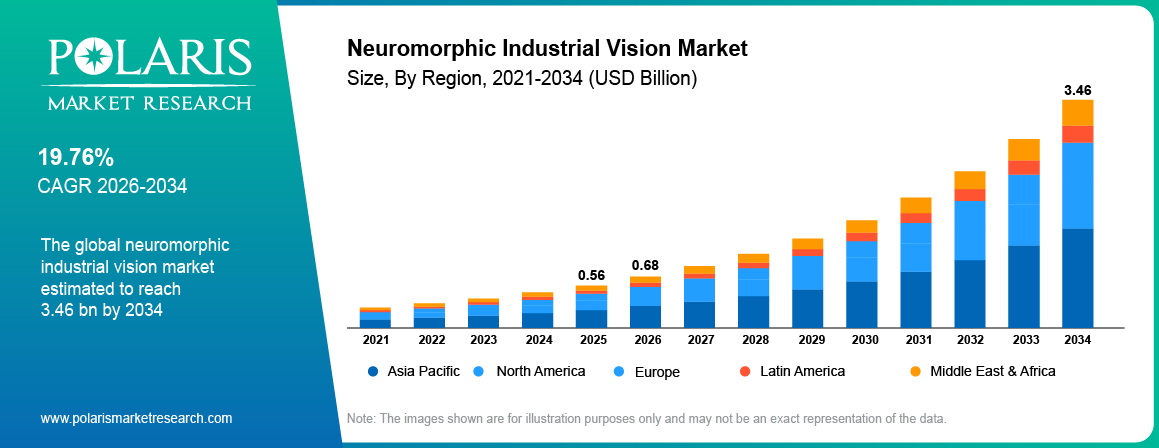
Neuromorphic industrial vision market size was valued at USD 0.56 billion in 2025. The market is expected to grow at a CAGR of 19.76% from 2026 to 2034. Market growth is driven by motion blur and latency failures in conventional machine vision, and Sony and Prophesee's commercial rebuild.
Market Statistics
Key Takeaways
- The Asia Pacific neuromorphic industrial vision market accounted for 37.64% of the global share in 2025. The dominance is supported by strong adoption of industrial automation, robotics, and advanced machine vision technologies.
- The market in Asia Pacific is expected to exhibit a 20.68% CAGR during the forecast period. The growth is driven by strong electronics manufacturing, semiconductor production, and industrial automation across the region.
- The sensor segment accounted for a major market share of 36.18% in 2025. The leading share is fueled by the growing adoption of event-driven imaging for industrial inspection and automation.
- The hybrid frame-event segment is projected to record a 22.84% CAGR during the projected period, owing to the growing need to combine conventional image information with event-based sensing.
- Quality inspection segment dominated the market with a share of 29.84% in the base year due to the growing need for fast and accurate defect detection across manufacturing processes.
Note: Figures and projections outlined in this report are the result of Polaris Market Research’s proprietary analytical processes, grounded in the latest available datasets and market observations.
Neuromorphic Industrial Vision Market Definition
The neuromorphic industrial vision market comprises vision sensing and dedicated processing technologies that detect changes in a scene at the pixel level rather than capturing fixed image frames. Event-based sensors respond asynchronously when changes in brightness exceed a defined threshold. The event-based vision market therefore differs from conventional machine vision based on frame-by-frame image capture. A dynamic vision sensor follows the same change-driven approach for fast industrial visual sensing.
The market includes neuromorphic vision sensors, event-based industrial cameras, dedicated vision processors, and related hardware designed to process event-driven visual data. It covers technologies used for industrial inspection, motion analysis, object tracking, and machine monitoring. The scope is limited to vision sensing and its dedicated processing capabilities. General purpose neuromorphic computing platforms are not considered unless they are specifically designed for industrial vision workloads. These technologies are used by industrial buyers where there are limitations of traditional cameras such as fast moving objects or changing illumination. Event-based sensing reduces motion blur since pixels respond to changes and do not wait for the next frame. High dynamic range also supports operation across variable factory lighting conditions.
Growth in neuromorphic industrial vision is supported by the development of low-latency sensing and processing technologies. Nature Communications notes that early commercial progress in neuromorphic technology occurred on the sensory side through non-frame-based imaging systems. This development highlights the distinct commercialization path of neuromorphic vision. Industrial applications increasingly focus on fast visual decisions where timing, data efficiency, and lighting conditions affect performance. The event camera market overlaps with neuromorphic computing but remains a distinct technology scope. This distinction is important when defining industrial vision sensors and processors.
Event-Based Vision vs Conventional Machine Vision
| Parameter | Event-Based Vision | Conventional Frame-Based Vision |
| Data capture | Asynchronous, per-pixel brightness changes | Full frames at fixed intervals |
| Temporal resolution | Microsecond-level event timing | Limited by frame rate |
| Motion blur | Minimal on fast-moving objects | Exposure-dependent blur |
| Dynamic range | High; suited to variable factory lighting | Lower; sensitive to lighting changes |
| Data volume | Sparse; changes only | Redundant data in static scenes |
| Image detail | Limited absolute detail | Full spatial and color detail |
| Typical use | High-speed tracking, vibration, robot guidance | Dimensional gauging, OCR, color inspection |
| Hardware cost | Higher per unit | Lower per unit |
Source: Polaris Market Research Analysis
Market Dynamics
Driver Impact Analysis
| Factor | Type | Impact Level | Key Segments Affected | Impact Timeline |
| Motion blur and latency failures in conventional machine vision | Driver | High | Sensor; Quality inspection | Short term |
| Sony and Prophesee commercial rebuild | Driver | High | Sensor; Pure event-based | Short to medium term |
| Predictive maintenance beyond inspection | Opportunity | High | Predictive maintenance; Software | Long term |
| Automotive design wins entering industrial robotics | Opportunity | Medium | Robotic guidance; Automotive manufacturing | Medium to long term |
Source: Polaris Market Research Analysis
Driver: Motion Blur and Latency Failures in Conventional Machine Vision are Driving Demand for Neuromorphic Vision
Motion blur and latency limitations in conventional machine vision are increasing demand in the event-based vision market. Conventional cameras can lose information when objects move rapidly or lighting changes. Conventional vision is sensitive to lighting and high-speed motion, limiting production-line reliability and work rate. This creates a risk of missed defects on fast-moving inspection lines where products must be inspected without slowing production. For instance, Prophesee's event-based vision technology Metavision supports industrial inspection at speeds above 10 m/s, with 5 µs time resolution and blur-free asynchronous event output, addressing motion-blur and latency limitations in conventional machine vision (Source: macnica.com).
The need for ultra-low latency imaging is supporting neuromorphic industrial vision. Event-based sensors respond to changes in a scene instead of capturing complete frames at fixed intervals. This helps preserve visual information during rapid movement and changing illumination. Such capabilities are relevant to semiconductor inspection lines where fast visual feedback is required for precise defect detection. As inspection processes operate at higher speeds, reducing motion-related image loss becomes increasingly important for maintaining automated quality control.
Driver: Sony and Prophesee's Commercial Rebuild is Expanding Industrial Neuromorphic Vision
The commercial expansion of event-based imaging is supporting the neuromorphic vision sensor market. Sony and Prophesee developed the Sony IMX636 as a stacked event-based vision sensor for industrial equipment. The sensor combines Sony’s CMOS technology with Prophesee’s event-based sensing approach. It offers 1280 × 720 resolution and pixel latency below 100 microseconds at 1,000 lux. This combination is helping move neuromorphic vision toward industrial machine vision applications (Source: prophesee.ai).
The commercial ecosystem is expanding through Prophesee Metavision and industrial camera partnerships. Prophesee provides software tools for developing applications with event-based sensors. The platform supports the development of industrial vision applications by combining event-based sensing with software for processing and interpreting visual information. This growing commercial ecosystem is increasing access to neuromorphic vision technology for industrial users. It is also supporting the integration of event-based cameras into machine vision systems across industrial applications.
Restraint: Financial Fragility Among Neuromorphic Hardware Vendors is Slowing Down the Market Growth
Financial constraints among neuromorphic hardware vendors are slowing the development of vision solutions. A neuromorphic processor requires specialized design and manufacturing capabilities. Smaller vendors face high research costs, but they are working at low production volumes. Such conditions can restrict investment in product development and delay expansion. Financial pressure can also lead to increased dependence on funding. This can restrict hardware availability to customers and make adoption more challenging.
Limited financial capacity can also affect customer support and development. SynSense develops neuromorphic processors and sensing solutions for edge applications. Sustained investment is required to improve hardware and software tools. High development expenses can create challenges in maintaining products. Industrial buyers often require stable suppliers before adopting vision architectures. Vendor financial pressure can therefore slow pilot-to-production conversion and extend adoption timelines for vision systems.
Restraint: High Hardware Cost and Integration Complexity are Limiting Wider Adoption
High unit cost and integration effort are restraining the neuromorphic industrial vision market. Event-based cameras are generally priced above conventional machine vision cameras, with published reviews indicating several thousand dollars per unit. In applications where frame-based cameras already meet inspection needs, the performance gains are difficult to justify against this cost premium. Evaluation kits and camera housings are also priced separately from the underlying sensor, which raises the entry cost for pilot projects.
Integration complexity adds to the burden. Event data is a sparse stream of timestamped changes rather than complete images, so existing inspection software, algorithms and operator skills often need to be adapted. Limited standardization across event-based software tools can extend pilot timelines. Buyers therefore tend to begin with hybrid frame-event systems and clearly defined use cases before scaling across production lines.
Opportunity: Predictive Maintenance Beyond Vision-as-Inspection to Open Market Opportunity
Predictive maintenance beyond visual inspection is a key opportunity in the neuromorphic industrial vision market. Neuromorphic sensors can support predictive maintenance vibration sensing by capturing rapid changes in machine movement and operating conditions. This can help identify abnormal patterns in motors, robotic joints and production equipment. Combining event-based vision with maintenance data can provide continuous machine monitoring. It can also support early fault detection while equipment remains in operation.
The biggest opportunity is linking neuromorphic vision with robotic control and maintenance systems. A single platform can monitor machine movement and support faster maintenance decisions. It can also improve robotic visual servoing by providing rapid visual feedback during robotic operations. Event-based cameras have been studied for high-speed robotic control because their low latency supports faster responses to changing visual information. This extends neuromorphic vision beyond conventional inspection applications.
Opportunity: Automotive Design Wins Spilling Into Industrial Robotics
Automotive adoption of neuromorphic vision is creating opportunities for industrial robotics. Vehicle systems require fast visual processing for automated driving and inspection. These developments are supporting demand for the neuromorphic processor, which can process visual changes with very low latency. For instance, Xperi developed a neuromorphic driver monitoring system powered by Prophesee’s Metavision event-based vision sensor to enhance in-cabin safety and occupant monitoring (Source: xperi.com).
The biggest opportunity is transferring these automotive design wins into industrial robotics. Neuromorphic vision can support robotic visual servoing by enabling robots to respond quickly to changes in their surroundings. This is useful for precision assembly and automated handling. Integration with existing robotic control systems can further support faster responses and lower vision-processing requirements.
Market Segmentation Analysis
The report provides a comprehensive analysis of the neuromorphic industrial vision market by component, technology, application, end use industry, and region to identify the leading revenue-generating segments and emerging growth opportunities.
Component Insights
Sensor dominated the market with 36.18% share in the base year due to the growing adoption of event-driven imaging for industrial inspection and automation. Increasing demand for low-latency visual processing is further supporting the neuromorphic vision sensor market. These sensors detect changes in a scene instead of capturing complete frames. This helps reduce motion blur and supports faster response in high-speed production environments. Growing use of event-based cameras in robotics and automated inspection is further supporting demand for neuromorphic vision sensors.
Processor is projected to record the significant CAGR of 19.62% during the forecast period due to the growing need for faster processing of event-based visual data. Increasing adoption of edge-based industrial vision systems will further drive segment growth. Neuromorphic processors can process visual events with low latency while reducing unnecessary data processing. This supports faster decision-making in robotic systems and automated inspection. Growing demand for real-time vision processing is further increasing the use of dedicated processors in industrial applications. Neuromorphic processors also compete with the edge AI accelerator category on power efficiency and latency.
Technology Insights
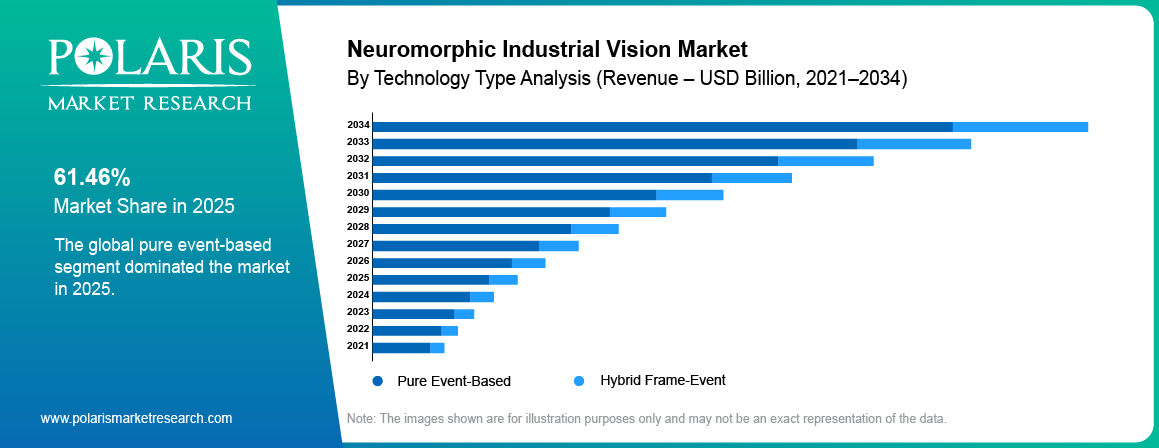
Pure event based dominated the market with 61.46% share in the base year as it can capture the change in the scenes with low latency and less data processing requirement. Growing demand for high-speed industrial inspection is further supporting adoption of pure event-based vision. These systems process changes in brightness rather than complete image frames. This enables faster responses in applications involving moving objects and changing production conditions. Integration with spiking neural network architectures further supports efficient processing of event-based data. Demand is also supported by the need to reduce motion blur and improve real-time machine vision performance.
The hybrid frame-event segment is projected to record the highest CAGR of 22.84% during the forecast period due to the growing need to combine conventional image information with event-based sensing. Such systems provide detailed images on a per-frame basis and also capture fast dynamics in the form of events. This is suitable for applications which require both image quality and low latency response. Also, the dynamic vision sensor technology adoption is supporting the hybrid solutions. Hybrid systems may improve the visual information provided for robotic inspection and automation tasks, while still maintaining the faster reactions to dynamic events.
Application Insights
The quality inspection segment held the highest share of 29.84% in the base year, due to the increasing demand for quick and precise defect detection across the manufacturing processes. Growing demand for automated inspection and edge AI vision processing is supporting growth of the segment. These capabilities help manufacturers to find defects and inconsistencies in products, while improving the accuracy of inspections and the quality of products.
During the forecast period, the robotic guidance segment is expected to witness the highest CAGR of 22.04%, due to the increasing adoption of vision-enabled robots in manufacturing. The segment is experiencing growth on account of rising need for precise positioning and quick robotics. Neuromorphic vision allows quick visual responses to robot motion and object manipulation. These capabilities are aiding the industrial machine vision AI market with improved real-time robot guidance. Event-based guidance also complements 3D machine vision, which supplies the depth information needed for precision picking and placement.
End Use Industry Insights
The Electronics and Semiconductor Manufacturing industry had the largest share of 26.18% in the base year, driven by increasing demand for high-speed inspection of electronic products and semiconductor components. The increasing production complexity and the need for accurate defect detection are driving the adoption of neuromorphic vision systems. For instance, Tata Electronics is setting up a semiconductor fab in Dholera, Gujarat, India, with a planned investment of up to INR 91,000 crore (about USD 11 billion), indicating strong future demand for neuromorphic industrial vision systems. Automated inspection is further supported by low-latency imaging and high-speed motion detection (Source: tataelectronics.com).
The automotive manufacturing is expected to grow with the highest CAGR of 20.86% during the forecast period owing to the increasing use of automated inspection and robotic systems. Automotive production needs fast detection of component defects and accurate visual guidance for robots. Neuromorphic vision can support these requirements through low-latency image processing. Growing integration of advanced vision systems in automotive manufacturing is further supporting segment growth.
Regional Analysis
The neuromorphic industrial vision market regional analysis comprises North America, Europe, Asia Pacific, Latin America, and Middle East and Africa. This segmentation is based on the growing adoption of industrial automation, machine vision, robotics, semiconductor manufacturing, and advanced imaging technologies across these regions. Regional demand is also influenced by investments in smart manufacturing, and the availability of neuromorphic vision technology providers and industrial automation solutions.
North America Neuromorphic Industrial Vision Market Trends
North America held the significant market share of 28.46% in 2025, owing to the high adoption of industrial automation, robotics, and advanced machine vision technologies. The US is the region’s leader with a market share of 65.85%, it has a large manufacturing base and big semiconductor, automotive and technology firms. The increasing demand for low power consumption and low latency imaging is also driving the adoption of neuromorphic vision systems across industrial applications. For example, San Jose-based NuMorph AI is developing ERN-AI, a patent-pending software layer that brings event-driven processing to existing digital CMOS cameras for factory automation, machine inspection and robotics, with a roadmap target of 100–1000× lower power and latency (Source: numorph.ai).
Growing investments in artificial intelligence, robotics and next generation vision technologies are expected to help the region to retain its leading position over the forecast period. With the increasing adoption of automated manufacturing, there is growing demand for faster inspection and real-time visual processing. Manufacturers are also utilizing advanced vision systems with industrial robots to enhance production accuracy and response times. Developments like these are allowing neuromorphic vision technology to be used in areas like industrial inspection, robotic control and automated manufacturing.
Europe Neuromorphic Industrial Vision Market Trends
In the base year, Europe held a major share of 24.22% in the neuromorphic industrial vision market, due to the increasing adoption of industrial automation, robotics, and advanced machine vision in the manufacturing industries. For instance, in 2024, Innatera raised EUR 15 million in a Series A round for scaling production and expanding its customer base for sensor-based edge AI applications (Source: innatera.com).
It is projected that this region will continue to grow due to increasing development of event-based vision for industrial and automotive applications. Increasing investment in smart manufacturing and automated production is driving demand for advanced vision technologies. Combining neuromorphic cameras with industrial robots and inspection systems is taking application possibilities even further. Increasing focus on high-speed manufacturing and precision inspection is expected to encourage greater adoption of neuromorphic industrial vision solutions across Europe.
Asia Pacific Neuromorphic Industrial Vision Market Trends
Asia Pacific is expected to witness the highest CAGR of 20.68% during the forecast period owing to strong electronics manufacturing, semiconductor production, and industrial automation across the region. China, Japan, South Korea and India are accelerating investment in robotics and high-tech manufacturing. For example, in 2024, China had 295,000 industrial robots installed, representing 54% of the global installations. The growing automation base is driving demand for sophisticated machine vision technologies that support high-speed inspection and robotic applications (Source: ifr.org).
In addition, the region is seeing the benefits of the expansion of automated manufacturing and high speed inspection systems. With the growth of electronics and semiconductor production, the need for accurate defect detection and real-time visual processing is increasing. Robotics is being used more and more by automotive manufacturers for assembly, inspection and material handling. These developments are creating opportunities for neuromorphic industrial vision systems that can support low-latency imaging, high-speed motion detection and automated visual inspection in production environments.
Middle East and Africa Neuromorphic Industrial Vision Market Trends
The Middle East and Africa holds a developing share of 5.36% in the neuromorphic industrial vision market due to growing industrial automation and investments in advanced manufacturing. Demand is supported by the expansion of automotive, electronics, food processing, and pharmaceutical production across the region. Partnerships between technology companies are further driving the market growth. For instance, in 2025, Kumrah AI and iniVation, a SynSense Group company, signed an MoU to establish a global joint venture to develop and commercialize advanced neuromorphic vision-based inspection and autonomy systems. These developments are creating demand for high-speed vision technologies that can support real-time industrial applications (Source: ku.ac.ae).
The regional market is expected to benefit from increasing investments in smart manufacturing and industrial robotics. Manufacturers are looking for vision systems to allow for fast detection of defects, tracking of objects and robotic operations. The growing adoption of automated production lines will open up opportunities for neuromorphic vision systems in inspection and robotic applications. Demand will also depend on industrial digitalization, technology availability, and integration with existing automation infrastructure.
Latin America Neuromorphic Industrial Vision Market Trends
The Latin America neuromorphic industrial vision market is growing at a rate of 19.94% owing to increasing industrial automation, automotive production, and adoption of advanced inspection technologies. Countries such as Brazil and Mexico are increasing manufacturing activity and adding robotics to production. The growing number of automotive, electronics and food processing facilities is driving demand for faster machine vision systems. Neuromorphic vision enables these applications with low-latency imaging and fast motion detection.
The further development of automated manufacturing will create opportunities for neuromorphic industrial vision solutions throughout the region. The manufacturers want vision systems that can better detect defects and help run robots in real time. Event-based imaging can be used for high-speed inspection and robotic guidance in automotive and electronics facilities. Adoption across Latin America will continue to be supported by increasing investment in smart manufacturing, local system integration and compatibility with existing automation infrastructure.

Neuromorphic Industrial Vision Market Competitive Landscape
Vendor Landscape Snapshot
| Vendor | Headquarters | Market Position | Core Focus |
| Sony Semiconductor Solutions Corporation | Japan | Leader | Stacked event-based sensors (IMX636, IMX637) |
| Prophesee S.A. | France | Leader | Metavision sensors, SDK, Hearth and Mantara software |
| iniVation AG | Switzerland | Challenger | Dynamic vision and hybrid frame-event cameras |
| IDS Imaging Development Systems GmbH | Germany | Challenger | Industrial event-based cameras on IMX636 |
| LUCID Vision Labs Inc. | Canada | Challenger | Triton2 EVS industrial cameras |
| SynSense AG | Switzerland / China | Niche Player | Speck vision SoC and Xylo processors |
| BrainChip Holdings Ltd | Australia / US | Niche Player | Akida neuromorphic processors and IP |
| CenturyArks Co., Ltd. | Japan | Niche Player | SilkyEvCam modules on IMX636 |
| FRAMOS GmbH | Germany | Niche Player | Event-based sensor modules and integration |
| Intel Corporation | United States | Emerging | Loihi 2 research processors, Hala Point systems |
| Samsung Electronics Co., Ltd. | South Korea | Emerging | Dynamic vision sensor development |
Source: Polaris Market Research Analysis. Market position is a qualitative assessment of each vendor's role in industrial neuromorphic vision.
The neuromorphic industrial vision competitive landscape is mainly focused on event-based cameras, neuromorphic sensors, low-latency imaging, edge processing and industrial automation integration. High speed inspection, robotics and machine vision applications are seeing event-based vision solutions developed by leading companies. Competition is also moving toward compact sensors and processing platforms that reduce data processing needs and allow real time industrial decisions. Vendors are working to improve image quality, latency, dynamic range and power efficiency. These advances are making it possible to incorporate neuromorphic vision into automated manufacturing and robotic systems in industrial settings.
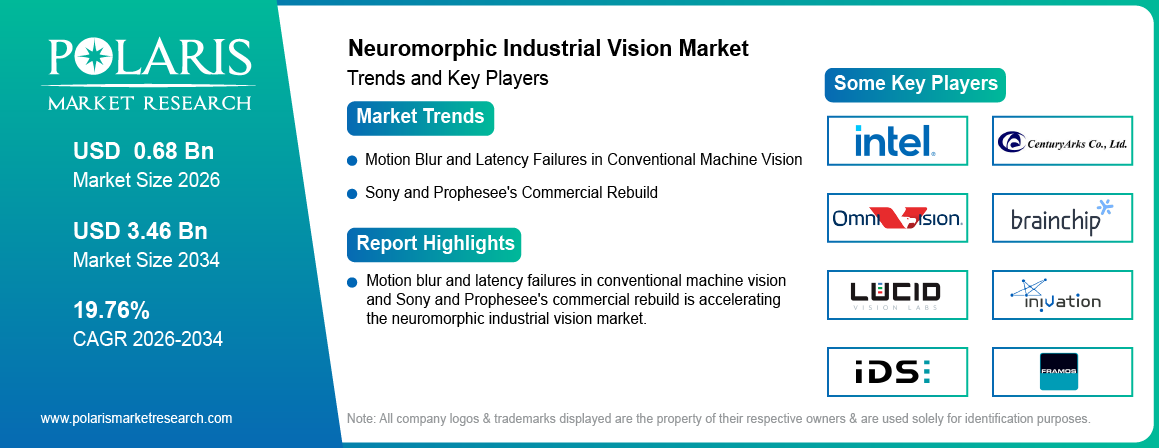
Companies such as Sony, Prophesee, SynSense and iniVation offer event-based vision technologies for industrial and robotic applications. Industrial camera makers such as IDS Imaging and LUCID Vision Labs package these sensors into factory-ready cameras, while Intel and BrainChip focus on the neuromorphic processing layer. Sony develops event-based image sensors and Prophesee is developing event-based sensing solutions for high-speed industrial vision. SynSense develops neuromorphic sensing and processing technologies and iniVation develops event-based cameras for machine vision and robotics. These companies are also developing partnerships and software ecosystems to help accelerate industrial adoption. Product development is increasingly focused on improving sensor performance and ease of integration with robotic controllers, industrial cameras, edge computing platforms and existing machine vision systems.
A key differentiating factor is the ability to capture fast moving objects with low latency, while maintaining reliable performance under changing lighting conditions. Critical factors for deployment in industrial environments are sensor resolution, dynamic range, processing efficiency, power consumption, software compatibility and system integration. Vendors also compete on real-time processing capabilities and support for robotic visual servoing, automated inspection and high-speed manufacturing applications. Flexible software tools and development support can help facilitate deployment for industrial users. Scalability is also important as manufacturers seek solutions across multiple production lines and different inspection and robotic applications.
Value Chain Analysis
| Stage | Key Activities | Representative Participants |
| Sensor design and fabrication | Event-pixel design, stacked CMOS manufacturing | Sony, Prophesee, iniVation, Samsung, OmniVision |
| Processing hardware and IP | Neuromorphic processors, spiking neural network IP | BrainChip, SynSense, Intel |
| Camera and module manufacturing | Industrial housings, interfaces, optics | IDS, LUCID, CenturyArks, FRAMOS |
| Software and SDKs | Event-processing libraries, AI models, drivers | Prophesee, iniVation, NuMorph AI |
| System integration | Integration with robots, MES and inspection lines | Automation integrators, machine vision suppliers |
| End-use deployment | Inspection, robotic guidance, monitoring | Electronics, automotive, food and pharma manufacturers |
Source: Polaris Market Research Analysis
Technology and Innovation Landscape
Technology and Innovation Landscape Snapshot
| Technology Area | Innovation Focus | Industrial Benefit | Maturity | Representative Players |
| Stacked event-based sensors | 4.86 µm pixels, 1280 × 720 resolution (IMX636) | High-speed capture, wide dynamic range | Commercial | Sony, Prophesee |
| Hybrid frame-event sensors | Simultaneous frame and event output | Image detail with low latency | Early commercial | iniVation |
| Neuromorphic processors | Spiking, event-driven inference at the edge | Low-power, low-latency decisions | Early commercial | BrainChip, SynSense, Intel |
| Event-processing software | Metavision SDK, DV toolkit, Hearth platform | Faster application development | Commercial | Prophesee, iniVation |
| Industrial camera integration | IP-rated cameras built on IMX636 | Drop-in use with existing vision stacks | Commercial | LUCID, IDS, CenturyArks |
| Application-level platforms | Turnkey perception such as Mantara | Faster path from pilot to deployment | Emerging | Prophesee, NuMorph AI |
Source: Polaris Market Research Analysis
Event-based sensing is becoming an important technology in the neuromorphic industrial vision market as manufacturers require faster image capture for moving objects. Neuromorphic sensors detect changes in a scene rather than capturing complete frames. This reduces redundant data and supports rapid motion detection. Embedded AI processing is also improving local image analysis by allowing vision systems to process visual information closer to the sensor. These developments are supporting applications such as high-speed inspection, robotics, and automated production lines and factory automation applications worldwide. These developments mirror the wider AI sensor trend of moving inference closer to the point of capture.
The neuromorphic vision technology development is driven by the enhanced dynamic range and low-latency imaging. Event-based sensors are capable of capturing rapid variations in changing lighting conditions and can help resolve the motion blur issue in traditional camera systems. They are being increasingly integrated into manufacturing, combined with industrial cameras and robotic platforms. These capabilities matter to AI vision systems that require rapid visual responses. Neuromorphic sensors are being explored by manufacturers for robotic guidance, defect detection, object tracking and automated quality inspection in high-speed production environments in demanding industrial manufacturing applications across sectors.
Neuromorphic vision is entering industrial environments and software and system integration is becoming a key innovation area. Developers are refining event-processing algorithms, AI models and interfaces that connect vision sensors to robotic controllers and manufacturing systems. Processing at the edge means less data needs to be transferred and decisions can be made faster. Deployment flexibility is also improving with integration underway with existing machine vision infrastructure. These developments are helping neuromorphic vision systems support real-time industrial tasks while reducing processing demands across automated production environments and improving responsiveness in complex industrial workflows.
Use Case Analysis
Electronics and Semiconductor Manufacturing
Neuromorphic industrial vision is increasingly relevant for electronics and semiconductor manufacturing where high-speed inspection is required for finding defects in small and complex parts. Event-based imaging can capture fast changes with low latency while minimizing redundant image data in inspection. This supports quality inspection automation in semiconductor production lines and electronic component assembly. Neuromorphic vision systems can detect surface defects, misalignments, and manufacturing irregularities in products at high speeds. Integration with automated inspection equipment can also enable faster processing, reducing delays in production. Neuromorphic vision is well suited for demanding semiconductor manufacturing environments due to its capabilities.
Automotive Manufacturing
The automotive manufacturing process requires fast visual processing for assembly, component inspection and robotic handling. Neuromorphic vision allows the detection of changes in moving objects with low latency, enabling robots that need instant visual feedback in production. This links the technology with robotic visual servoing in which a robot uses camera input to change its actions and to track its position accurately. Neuromorphic system supported applications include component placement, assembly verification and automated inspection. They can also help to reduce the limitations of motion blur in conventional cameras in capturing fast motion. These capabilities allow more responsive robotic operations across automotive production environments.
Food and Beverage
Food and beverage manufacturing requires continuous inspection of products moving through high-speed production and packaging lines. Neuromorphic vision can support the detection of changes in product appearance, position, and packaging with low latency. This offers opportunities for the neuromorphic vision sensor market in the area of automated food inspection. Event-based sensors can help detect damaged packaging, misplaced products and other irregularities in production, while removing redundant visual data. Their ability to work under varying lighting conditions can also contribute to providing inspection consistency. Integration with existing conveyor systems and automated sorting equipment can improve real-time monitoring and enable faster production decisions across food processing facilities.
Pharmaceuticals
Pharmaceutical manufacturing requires precise inspection of products, packaging, labels, and production processes. Neuromorphic vision can support high-speed visual monitoring where rapid detection of changes is important. The event-based vision market is gaining relevance for applications that require low-latency imaging and continuous motion detection. Neuromorphic systems can be utilized for detection of packaging defects, mispositioning, damaged containers and irregularities in labeling in automated production. They are capable of capturing changes rather than whole image frames and can thus cut down on unnecessary data processing. Integration with pharmaceutical inspection equipment can allow for real-time quality monitoring and improve the responsiveness of automated production and packaging systems.
Buyer Analysis and Market Entry Barriers
| Buyer Persona | Primary Driver | Typical Deployment Choice |
| Quality engineering, electronics manufacturing | Defect detection speed and accuracy | Hybrid frame-event, integrated with existing MES |
| Maintenance engineering, heavy industry | Predictive failure detection | Pure event-based, vibration-focused |
| Robotics integration, automotive | Precision positioning under variable lighting | Event-based with SDK-level customization |
Source: Polaris Market Research Analysis
Key buyers in the neuromorphic industrial vision market include electronics manufacturers, semiconductor producers, automotive companies, food processors, pharmaceutical manufacturers, and industrial automation providers. Buyers evaluate vision systems based on detection speed, image quality, latency, integration, and operating costs. Electronics and semiconductor companies require accurate defect detection and high-speed inspection. Car makers emphasize robotic guidance and production accuracy. Other industrial buyers desire dependable visual monitoring alongside automated lines. The industrial vision market forecast also influences investment decisions, as buyers assess the future growth and adoption of advanced vision technologies. The neuromorphic sensor market share for these applications also impacts vendor selection and technology adoption.
Purchasing usually plays a number of roles in the organization. Production teams define the requirements for inspection and automation, engineering teams define the performance of the sensor and its integration into the system. IT staff assess software compatibility, data processing and cyber security requirements. Procurement teams benchmark the costs of support and lifecycle costs, and the pricing of vendors. Buyers also look at latency, dynamic range, event processing capability and installation and maintenance requirements. Integration with existing cameras, robots and manufacturing control systems is also important, since replacing established infrastructure can increase deployment costs and operational complexity for industrial users.
The most important barriers to entry for neuromorphic industrial vision are lack of industrial experience, complexity of integration, technology validation and customer concerns about replacing traditional machine vision systems. New vendors must be able to demonstrate reliable production performance and measurable inspection benefits. Compatibility with industrial cameras, robots and control platforms is equally important. Rivals can fight using specialized sensors, edge processing, low-latency imaging and application-specific software. Automation integrators and machine vision suppliers can help to tackle integration challenges and accelerate adoption across manufacturing operations.
Premium Insights and Forward Outlook
Vendor Consolidation Will Reshape the Sensor Layer Faster Than the Application Layer
Vendor consolidation is expected to transform the neuromorphic vision sensor layer as manufacturers look for compatible hardware, processing platforms and software. Large vendors can combine sensors, embedded processing and industrial interfaces. This can make procurement and integration easier for industrial buyers. However, software and inspection solutions that are specific to an application are unlikely to become as homogeneous across different manufacturing requirements and use cases.
Predictive Maintenance Will Become the Larger Opportunity Than Inspection
Predictive maintenance is expected to create a broader opportunity as neuromorphic vision moves beyond conventional inspection tasks. Continuous monitoring can help identify abnormal motion, equipment changes, and early signs of component failure. Industrial users can use these capabilities to support maintenance decisions before production disruptions occur. This expands the technology's role from defect detection toward continuous equipment monitoring across factories.
Key Players in the Neuromorphic Industrial Vision Market
- BrainChip Holdings Ltd
- CenturyArks Co., Ltd.
- FRAMOS GmbH
- IDS Imaging Development Systems GmbH
- Intel Corporation
- iniVation AG
- LUCID Vision Labs Inc.
- OmniVision Technologies, Inc.
- Prophesee S.A.
- Samsung Electronics Co., Ltd.
- Sony Semiconductor Solutions Corporation
- SynSense AG
Industry Developments
- October 2026: IDS Imaging Development Systems showcases event-based imaging developed with Prophesee, alongside new uEye camera platforms, at VISION 2026 in Stuttgart. (Source: i40today.com)
- August 2026: BrainChip joins forces with Orama.AOI to optimize Akida neuromorphic AI models for industrial defect detection such as tire production and semiconductor packaging inspection. (Source: brainchip.com)
- July 2026: BrainChip receives its first production batch of 2,000 AKD1500 neuromorphic processor units, moving the Akida platform from development to commercial-scale manufacturing. (Source: kalkine.com.au)
- June 2026: Prophesee launched Mantara, a fully integrated drone detection and tracking system built natively on event-based vision and AI, alongside its Hearth software platform and a EUR 20 million fundraise led by Critical Path Ventures, widening its suite of neuromorphic vision solutions for industrial and security applications. (Source: image-sensors-world.blogspot.com)
- April 2026: Sony AI's autonomous system Ace, featured in Nature, adopts Sony Semiconductor Solutions' IMX636 event-based vision sensor for real-time sensing and control. (Source: sony-semicon.com)
- March 2026: Prophesee and IDS Imaging Development Systems sign a Letter of Intent to develop next generation industrial vision systems integrating event-based sensing, extending their collaboration in industrial machine vision. (Source: ids-imaging.com)
- October 2025: CenturyArks launched new SilkyEvCam BothView models and an HD sensor module incorporating Sony's IMX636 event-based vision sensor, expanding event-based vision hardware for robotics, AGVs and other applications. (Source: centuryarks.com)
Neuromorphic Industrial Vision Market Report Segmentation
By Component (Revenue, USD Billion, 2021–2034)
- Sensor
- Processor
- Software
By Technology (Revenue, USD Billion, 2021–2034)
- Pure Event-Based
- Hybrid Frame-Event
By Application (Revenue, USD Billion, 2021–2034)
- Quality Inspection
- Predictive Maintenance and Vibration Monitoring
- Robotic Guidance
- Safety and Anomaly Detection
By End Use Industry (Revenue, USD Billion, 2021–2034)
- Electronics and Semiconductor Manufacturing
- Automotive Manufacturing
- Food and Beverage
- Pharmaceuticals
- Others
By Regional Outlook (Revenue, USD Billion, 2021-2034)
- North America
- US
- Canada
- Europe
- Germany
- France
- UK
- Italy
- Spain
- Netherlands
- Russia
- Rest of Europe
- Asia Pacific
- China
- Japan
- India
- Malaysia
- South Korea
- Indonesia
- Australia
- Vietnam
- Rest of Asia Pacific
- Middle East & Africa
- Saudi Arabia
- UAE
- Israel
- South Africa
- Rest of Middle East & Africa
- Latin America
- Mexico
- Brazil
- Argentina
- Rest of Latin America
Report Scope
| Report Attributes | Details |
| Market Size in 2025 | USD 0.56 Billion |
| Market Size in 2026 | USD 0.68 Billion |
| Revenue Forecast by 2034 | USD 3.46 Billion |
| CAGR | 19.76% from 2026 to 2034 |
| Base Year | 2025 |
| Historical Data | 2021–2024 |
| Forecast Period | 2026–2034 |
| Quantitative Units | Revenue in USD Billion and CAGR from 2026 to 2034 |
| Report Coverage | Revenue Forecast, Competitive Landscape, Growth Factors, and Industry Trends |
| Segments Covered |
|
| Regional Scope |
|
| Competitive Landscape |
|
| Report Format |
|
| Customization | Report customization as per your requirements with respect to countries, regions, and segmentation. |
Source: Polaris Market Research Analysis
Why Choose Polaris Market Research
Polaris Market Research & Consulting, Inc. combines company data with demand analysis, technology mapping, and industry research. The approach evaluates sensor technologies, processing capabilities, industrial applications, and competitive developments. This supports detailed neuromorphic vision market report analysis. Research also examines adoption trends across major manufacturing industries. This helps clients understand technology demand, application development, and factors influencing the adoption of neuromorphic industrial vision solutions across different production environments and regional markets.
Additionally, clients can receive customized analysis based on end-use industry, sensor type, application, technology, country or deployment model. Further analysis may include event based sensors, neuromorphic processors, embedded AI processing, robotic vision and high speed inspection. The research can also evaluate product launches, partnerships, industrial deployments and vendor developments.
Research Methodology
The neuromorphic vision market analysis uses five phases: market definition and scope control, secondary evidence collection, primary validation, model construction and triangulation, and analyst review. Secondary sources prioritize government agencies, company disclosures, technical publications, and industry standards. The methodology covers event-based imaging and excludes syndicated market sizing firms as figure sources.
Primary research includes machine vision specialists and industrial automation providers. It also covers robotics manufacturers and sensor developers. Interviews validate technology performance, deployment requirements, buying criteria, integration challenges, replacement cycles, and adoption trends. Neuromorphic processors are assessed across key industrial applications. The final analysis uses data triangulation to validate market estimates.
Market Definition and Scope Control
The research begins by fixing the boundaries of the neuromorphic industrial vision market. Event-based sensors, event-based industrial cameras, dedicated vision processors and the supporting software are included. General-purpose neuromorphic computing platforms, frame-based machine vision cameras and consumer or automotive-only event sensors are excluded unless they are sold for industrial vision workloads. The market is then mapped by component, technology, application, end use industry and region, so that every revenue figure rolls up to a single taxonomy.
Secondary Research
Secondary research builds the evidence base on technology, vendors and demand. Sources include company annual reports, investor presentations, product datasheets and press releases, patent filings, peer-reviewed technical literature, standards bodies, trade association statistics and government data on manufacturing output and automation. Trade fair disclosures and distributor price lists are used to track product launches and unit pricing. Each source is logged by date and type so that older or promotional material can be weighted accordingly.
Data Sources and Their Role
| Source Type | Examples | Used For |
| Company disclosures | Annual reports, investor decks, datasheets, press releases | Vendor revenue, product specifications, partnerships |
| Technical literature | Peer-reviewed papers, patents, conference proceedings | Technology maturity and performance benchmarks |
| Government and trade bodies | Manufacturing output, robot installation and trade statistics | Demand sizing by end use industry and region |
| Standards and regulatory bodies | Machine vision interface and industrial safety standards | Integration requirements and adoption barriers |
| Trade events and distributors | VISION and embedded world exhibits, distributor price lists | Product launches and unit pricing |
Source: Polaris Market Research Analysis
Primary Research Approach
Primary research is carried out through structured interviews with machine vision specialists, automation providers, robotics manufacturers, sensor developers, system integrators and quality or maintenance engineers at end user plants. Interview guides cover sensor and processor performance, price points and volume discounts, integration effort with existing inspection software, adoption barriers and replacement cycles. Responses are compared against secondary data, and conflicting inputs are followed up with additional respondents before they are used in the model.
Market Estimation and Forecasting
The market is sized with a bottom-up approach. Vendor-level revenue from event-based sensors, processors and software is built from product shipments, average selling prices and disclosed segment revenue. This is cross-checked with a top-down view that applies neuromorphic adoption rates to installed industrial vision demand in each end use industry and region. The base year is 2025, historical data covers 2021–2024, and the forecast runs from 2026 to 2034. Forecast drivers include inspection volumes, robot installations, sensor price declines, hybrid frame-event adoption and processor availability.
Data Triangulation and Validation
Estimates from the bottom-up model, the top-down model and primary interviews are reconciled until they fall within an acceptable range of each other. Where gaps remain, the analyst team revisits the underlying assumptions on unit volumes, pricing and adoption rates. Segment shares and regional splits are tested for consistency against the total market, and growth rates are checked against adjacent technology markets for reasonableness. The final figures are validated against the internal Polaris market model.
Key Assumptions and Limitations
Neuromorphic industrial vision is an early-stage market, and many vendors are privately held with limited financial disclosure. Estimates for these companies rely on product pricing, partner announcements and interview inputs, and they carry a wider margin of error than figures for listed companies. Customs data does not report event-based products separately, so trade flows are indicative and drawn from broader electronics and camera classifications. Software and SDK licensing revenue is estimated from vendor pricing models. The forecast assumes no major disruption to semiconductor supply and a continued fall in event sensor prices.
Quality Assurance and Analyst Review
Every figure, company statement and source link is checked by a second analyst before publication. Data points are traced to their original source, units and currency are standardized to USD Billion, and company names are verified against official disclosures. The report is refreshed when a material development changes the competitive position, such as a new sensor launch, a major partnership or a vendor funding event.
Research Methodology Phases
| Phase | Focus |
| Market Definition and Scope Control | Taxonomy and scope boundaries; segmentation by component, technology, application, end use industry and region |
| Secondary Evidence Collection | Company disclosures, technical literature, government and trade data, standards, product datasheets and sector analyst commentary |
| Primary Validation | Interviews with machine vision specialists, automation providers, robotics manufacturers and sensor developers |
| Model Construction and Triangulation | Bottom-up and top-down models reconciled with interview inputs; segmentation comparison against adjacent reports; internal Polaris market model validation |
| Analyst Review | Second-analyst check of figures, units, company names and source links; final editorial and citation check |
Source: Polaris Market Research Analysis
Neuromorphic Industrial Vision Market FAQ's
The neuromorphic industrial vision market was valued at USD 0.56 billion in 2025 and is projected to reach USD 3.46 billion by 2034. Motion blur and latency failures in conventional machine vision is driving the market growth.
The market is expected to grow at a CAGR of 19.76% from 2026 to 2034. The growth will be driven by predictive maintenance beyond vision-as-inspection.
North America dominated the market in 2025, supported by strong adoption of industrial automation, robotics, and advanced machine vision technologies.
Sensor segment dominated the market during the base year owing to the growing adoption of event-driven imaging for industrial inspection and automation.
A neuromorphic vision sensor is an event-based imaging device that detects changes in a scene rather than taking full frames, allowing for low-latency and high-speed visual processing.
An event camera detects changes in light at each pixel individually, not like a traditional industrial camera which takes full images at fixed frame rates.
A neuromorphic vision sensor typically costs several thousand US dollars per unit, depending on the sensor, resolution, integration, and evaluation or production configuration.
Sony Semiconductor Solutions Corporation, Prophesee S.A., iniVation AG, IDS Imaging Development Systems GmbH, LUCID Vision Labs Inc., SynSense AG, BrainChip Holdings Ltd, and Intel Corporation are among the leading neuromorphic vision companies.
Industrial event-based cameras are made by companies such as Sony Semiconductor Solutions, Prophesee, iniVation, IDS Imaging, LUCID Vision Labs, FRAMOS, and CenturyArks.
Neuromorphic vision is used in industrial applications such as high-speed inspection, robotic visual servoing, predictive maintenance, object tracking, quality control, and automated sorting.
Yes, neuromorphic vision sensors can support neuromorphic vision predictive maintenance by continuously detecting abnormal motion, vibration, and visual changes in industrial equipment.
High hardware cost, integration complexity with existing machine vision systems, limited standardization of software tools, and financial fragility among smaller hardware vendors are the key challenges slowing adoption.
The hybrid frame-event segment is projected to record the highest CAGR from 2026 to 2034, as buyers combine detailed frame images with low-latency event sensing.
Each pixel in an event-based camera works independently and reports a signal only when its brightness changes beyond a set threshold. The output is a stream of timestamped events rather than full frames, which cuts data volume and reduces motion blur.
Not in the near term. Event-based cameras suit high-speed tracking, vibration monitoring and robot guidance, while conventional cameras remain better for detailed color and dimensional inspection. Hybrid frame-event systems are emerging as the bridge between the two.
Download Sample Report of Neuromorphic Industrial Vision Market
Please fill out the form to request a customized copy of the research report.


