Single-Use Technology for Biopharmaceuticals Market Size, Share, and Forecast 2026 to 2034
REPORT DETAILS
Single-Use Technology for Biopharmaceuticals Market Summary
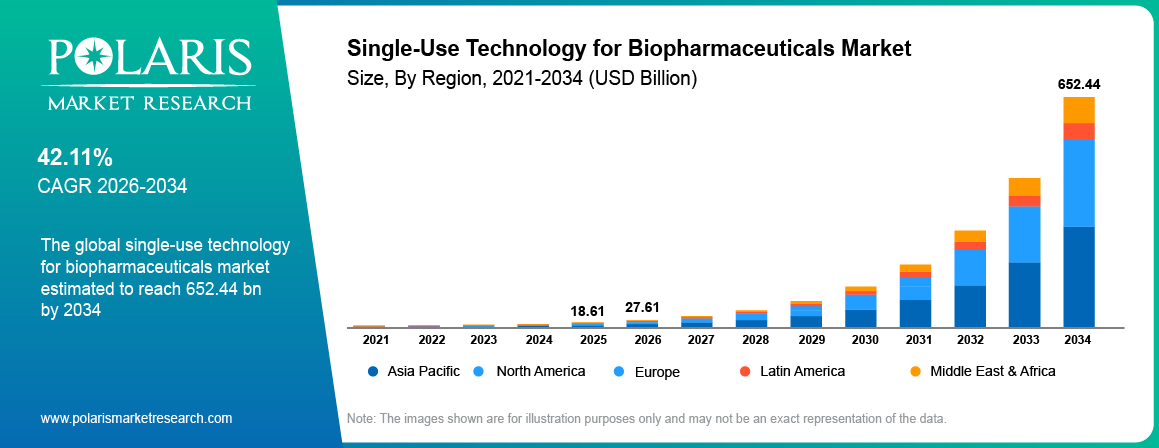
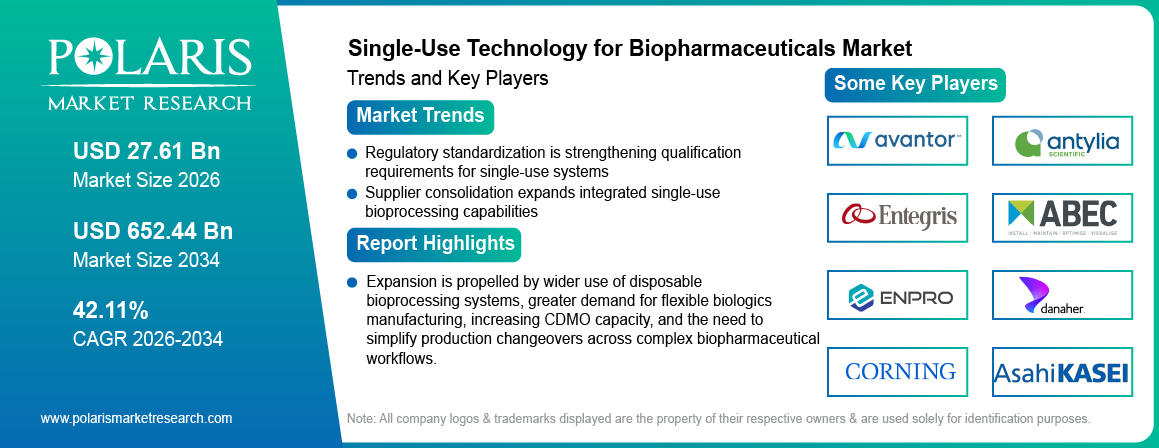
The single-use technology for biopharmaceuticals market was valued at USD 18.61 billion in 2025, registering a CAGR of 42.11% from 2026 to 2034. Expansion is propelled by wider use of disposable bioprocessing systems, greater demand for flexible biologics manufacturing, increasing CDMO capacity, and the need to simplify production changeovers across complex biopharmaceutical workflows.
Market Statistics
Key Takeaways
- North America held the leading market share of 34.62% in 2025. It is supported by its established biopharmaceutical manufacturing base, strong research activity, and mature supplier ecosystem.
- The market in Asia Pacific is projected to record the highest CAGR of 47.83% during the forecast period. It is fueled by expanding biopharmaceutical capacity and new scale-up infrastructure.
- In 2025, single-use bioreactors held the largest share of 38.42%. It is due to their crucial role in upstream biologics production and recurring consumable requirements.
- The filtration systems segment is anticipated to record the highest CAGR of 43.17% during the forecast period. This is owing to the increasing downstream processing capabilities and supplier consolidation.
- The cell and gene therapies segment is expected to exhibit the highest CAGR of 49.86% during the projected period. The dominance is attributed to manufacturing models that require flexible, and smaller scale production configurations.
Note: Figures and projections outlined in this report are the result of Polaris Market Research’s proprietary analytical processes, grounded in the latest available datasets and market observations.
Single-Use Technology for Biopharmaceuticals Market Definition
The single-use technology for biopharmaceuticals market provides an analysis of disposable bioprocessing equipment and components used in biopharmaceutical manufacturing such as single-use bioreactors, bags, filters, tubing, connectors, and assemblies. These systems are designed for single or limited use and can reduce the need for cleaning and sterilization between production runs. The market primarily serves biologics manufacturing processes that require flexible, scalable production infrastructure.
The market forms part of the broader bioprocessing equipment industry and is closely linked to the expansion of biologics manufacturing. Single-use systems are used across processes involving monoclonal antibodies, vaccines, recombinant proteins, therapeutic peptides, and cell and gene therapies. Their application across upstream and downstream operations allows manufacturers and contract development and manufacturing organizations to adapt production capacity without relying entirely on fixed stainless steel infrastructure.
Single-use technology differs from conventional stainless steel bioprocessing mainly through its disposable processing architecture. Manufacturers use preassembled or disposable components for individual production runs instead of cleaning and sterilizing fixed equipment time after time. This simplify changeovers and allow for flexible manufacturing models, but regulatory concerns about extractables, leachables, material compatibility and component risk remain critical factors in system selection and qualification.
Single-Use vs Stainless-Steel Bioprocessing Comparison
| Parameter | Single-Use Systems | Stainless-Steel Systems |
| Upfront Capital | Lower; reported 50–66% below reusable systems | Higher; requires CIP/SIP skids and clean utilities |
| Changeover and Cleaning | Preassembled and discarded after each run; minimal cleaning | CIP/SIP cycles and cleaning validation required |
| Recurring Cost per Batch | Higher; bags, tubing, and filters replaced every batch | Lower; mainly utilities and maintenance |
| Labor Requirement | Reported 30–50% lower | Higher due to cleaning and validation |
| Best-Fit Use Case | Multi-product, clinical-scale, and CDMO operations | Large-scale, steady-state, single-product manufacturing |
| Environmental Profile | Generates plastic waste | Higher water and energy use for cleaning |
Source: Polaris Market Research Analysis; CellBase
Market Dynamics
Single-Use Technology for Biopharmaceuticals Market Driver Impact Analysis
| Factor | Type | Impact Level | Impact Timeline | Most Affected Segment / Region |
| Rising biologics and biosimilar manufacturing demand | Driver | High | Short to long term | Monoclonal antibodies; all regions |
| Regulatory standardization (USP <665>/<1665>) | Driver | High | Short term (2026–2028) | North America, Europe |
| CDMO expansion and outsourcing | Opportunity | High | Medium term (2–5 years) | CDMOs & CROs |
| Supplier consolidation in filtration and purification | Driver | Medium | Medium term (2–5 years) | Filtration systems |
| Cell and gene therapy flexible manufacturing | Driver | Medium | Medium to long term | Cell & gene therapies |
| Regional biomanufacturing infrastructure | Opportunity | Medium | Long term (5+ years) | Asia Pacific, emerging regions |
Note: Impact level reflects Polaris assessment of influence on 2026–2034 market growth (High = core growth lever; Medium = meaningful influence; Low = limited or emerging influence). Source: Polaris Market Research Analysis;
Driver: Regulatory Standardization Is Strengthening Qualification Requirements for Single-Use Systems
Regulatory standardization of extractables and leachable testing is improving the qualification framework of the single-use technology for biopharmaceuticals market. More clearly defined testing expectations can help reduce uncertainty during supplier qualification and can help biopharmaceutical manufacturers develop consistent criteria for product-contact components. This is becoming increasingly relevant as complex biomanufacturing processes employ disposable bioreactors, bags, tubing, filters, and other polymer-based systems.
The implementation of USP General Chapter <665> in May 2026 standardizes extraction procedures for plastics used in pharmaceutical manufacturing, and USP <1665> offers a risk-based approach for the assessment of single-use components. The framework more heavily emphasizes documented testing and qualification support by suppliers and gives buyers a clearer reference point when evaluating materials for single-use systems (Source: United States Pharmacopeia (USP).
Regulatory change also impacts the way manufacturers evaluate product-contact materials before they enter production workflows. Regulatory documentation is becoming more relevant in single-use system selection as extractables and leachable data, material compatibility, and component risk may impact qualification decisions.
Driver: Supplier Consolidation Expands Integrated Single-Use Bioprocessing Capabilities
Supplier consolidation is strengthening the downstream side of the single-use bioprocessing market as bigger providers expand their filtration and purification portfolios. Manufacturers take advantage of more integrated process capabilities with access to broader product coverage and established specialty suppliers can be attractive acquisition targets with their technical expertise and existing customer relationships.
The consolidation effect is not limited to a single product category as manufacturers are increasingly judging suppliers on their ability to support different steps in a process. Broader portfolios can ease sourcing and supplier management, and existing filtration, purification, and component capabilities can bolster integrated bioprocessing providers' position.
Restraint: Validation and Testing Requirements Raise Adoption Costs
Higher validation and testing requirements slow down the single-use technology for biopharmaceuticals market growth, particularly for smaller suppliers and CDMOs that lack extensive in-house analytical capabilities. Extractables and leachable documentation, material qualification, and product-contact risk assessment can add technical and compliance work before a component is accepted for manufacturing use.
The implementation of USP <665> and the risk-based approach described in USP <1665> increases the importance of structured evaluation of product-contact materials. The framework offers greater consistency, but suppliers need to be ready to support qualification with relevant testing and documentation. For buyers, this lengthens supplier evaluation and qualification activities before a new single-use component enters a validated process.
The burden can be more significant when manufacturers introduce new materials, suppliers, or customized assemblies into established processes. Testing requirements may therefore influence supplier selection, qualification timelines, and the cost structure associated with adopting new disposable bioprocessing components.
Opportunity: Regional Biomanufacturing Infrastructure to Create New Deployment Opportunities
Expansion of regional biomanufacturing infrastructure is creating opportunities for single-use technology suppliers by providing emerging manufacturers with access to scale-up capabilities without requiring the same level of standalone infrastructure investment. This model is relevant for startups and smaller CDMOs that need flexible production capacity before committing to dedicated facilities or larger fixed assets.
In November 2025, the Government of Telangana launched the “1 Bio” facility at Genome Valley, Hyderabad. The 150,000 square foot facility includes bioreactors of up to 500 liters and received approximately USD 15.7 million in state investment alongside approximately USD 9.4 million from technology partner Thermo Fisher Scientific. The development illustrates how public-private infrastructure programs can support bioprocess design and scale-up capabilities in emerging manufacturing hubs (Source: biospectrumindia.com).
The infrastructure model also creates an opportunity for suppliers to engage with manufacturers earlier in the development cycle. Access to flexible bioreactor capacity and related process equipment can help emerging facilities evaluate production requirements while building relationships with technology providers and component suppliers.
Opportunity: CDMO Expansion Is Increasing the Need for Flexible Bioprocessing Systems
The expansion of outsourcing models in biopharmaceutical manufacturing creates an additional opportunity for suppliers of scalable single-use systems. CDMOs and CROs are handling programs across the whole range of development stages, product types and production volumes and this is creating the need for equipment and consumables that are configurable to meet changing process requirements, not locked into a single fixed manufacturing set-up.
Single-use systems enable this operating model by enabling manufacturers to design individual programs into their production workflows. Bioreactors, bags, filters, tubing, connectors, and other disposable assemblies can be incorporated into process designs according to the scale and requirements of a specific manufacturing campaign.
The opportunity is particularly relevant to service providers managing multiple client programs because flexible equipment configurations can help accommodate different production requirements. Supplier capabilities in scalable assemblies, filtration, process components, and qualification documentation can therefore become important when CDMOs evaluate single-use bioprocessing platforms.
Single-Use Technology for Biopharmaceuticals Market Value Chain Analysis
| Value Chain Stage | Key Activities | Representative Participants | Value Capture |
| Raw Materials | Medical-grade polymer resins, films, and membrane materials | Specialty polymer, film, and membrane suppliers | Medium |
| Component Manufacturing | Tubing, connectors, filters, sensors, and bag films | Saint-Gobain Life Sciences, Parker Hannifin, Nordson, Enpro, Freudenberg | Medium |
| System Assembly and Sterilization | Preassembled bags, flow-path kits, gamma sterilization, and validation documentation | Sartorius, Danaher (Cytiva/Pall), Thermo Fisher, Merck KGaA, Avantor | High |
| Distribution and Technical Support | Supply agreements, process support, and qualification documentation | Direct sales teams and specialty distributors | Medium |
| End Users | Upstream and downstream biologics production and process development | Biopharmaceutical manufacturers, CDMOs & CROs, research institutes | High (recurring consumables demand) |
Source: Polaris Market Research Analysis; BioProcess International
Single-Use Technology for Biopharmaceuticals Market Segmentation Analysis
The single-use technology for biopharmaceuticals market is segmented by product type, application, and end user. These dimensions distinguish the disposable processing equipment used across biomanufacturing, the therapeutic products supported by these systems, and the organizations purchasing and operating single-use technologies.
Product Type Insights
The single-use bioreactors segment dominated the single-use technology for biopharmaceuticals market share with 38.42% share in 2025. The leading share is supported by its central role in upstream biologics manufacturing. Bioreactors provide controlled environments for cell cultivation while disposable vessels reduce dependence on fixed stainless steel infrastructure and associated cleaning procedures. Their use also creates recurring demand for bags, tubing, connectors, sensors, and other components linked to individual production campaigns. The ability to deploy bioreactors across development and commercial production makes this category an important part of flexible biomanufacturing facilities.
The filtration systems segment is projected to grow at 43.17% CAGR during the forecast period, owing to the increasing use of disposable filtration technologies across downstream processing and purification. Filtration systems are used at multiple stages of bioprocessing, making validated product availability, compatibility, and supply continuity key procurement considerations. The strategic importance suppliers are attaching to filtration and purification capabilities. In February 2025, Thermo Fisher Scientific announced an agreement to acquire Solventum’s Purification & Filtration business for approximately USD 4.1 billion in cash. The deal expands Thermo Fisher’s footprint in filtration and purification and highlights the strategic importance of downstream capabilities in bioprocessing workflows (Source: Thermo Fisher Scientific).
Application Insights
The monoclonal antibodies segment held 40.84% market share in 2025, owing to the established use of single-use systems in monoclonal antibody manufacturing. Production workflows require bioreactors, filtration systems, bags, tubing, connectors, and other disposable components across upstream and downstream processing. Commercial-scale manufacturing also creates repeat requirements for consumables as production campaigns progress. The established manufacturing base for monoclonal antibodies therefore provides a substantial application area for single-use equipment and associated components.
The cell & gene therapies segment is anticipated to register 49.86% CAGR during the forecast period, supported by manufacturing requirements that favor smaller production scales and flexible process configurations. These therapies can require production environments capable of handling different batches and development programs without depending on large fixed manufacturing systems. Single-use equipment is suited to this model because bioreactors, fluid handling assemblies, filtration systems, and other components can be configured around specific process requirements.
End User Insights
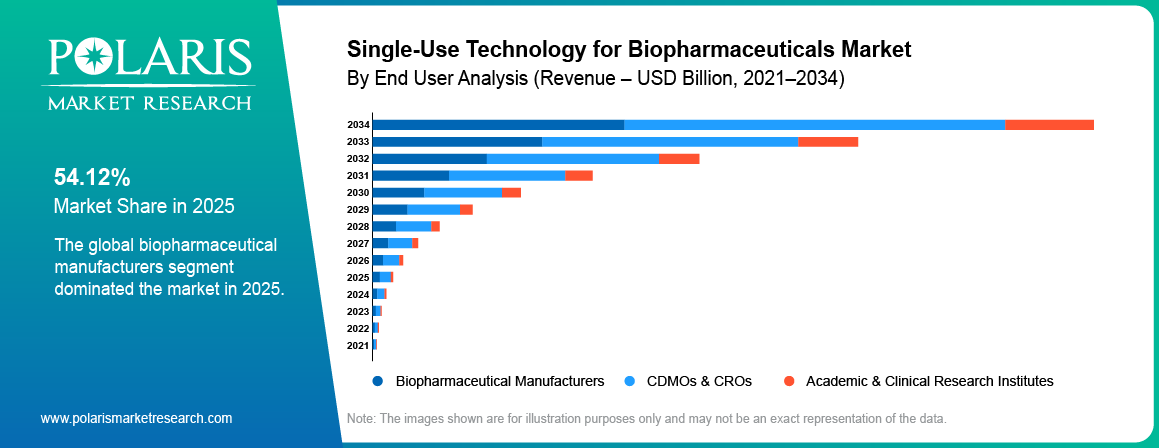
The biopharmaceutical manufacturers segment held 54.12% share of the market in 2025, owing to the direct use of single-use equipment across development and commercial manufacturing operations. In-house facilities need bioreactors, filtration systems, mixing equipment, bags, fluid management assemblies and associated consumables during production. Repeat manufacturing campaigns create ongoing component needs. For established manufacturers, there is also a greater emphasis on validated performance, supplier reliability, material documentation and continuity of supply.
The CDMOs & CROs segment is expected to witness a CAGR of 46.92% during the forecast period, driven by the outsourcing of biopharmaceutical development and manufacturing activities. They often run programs for a variety of sponsors, which means the manufacturing infrastructure has to be able to cope with different products, production volumes and process configurations. Single-use systems allow contract research organizations (CRO) to adapt processing equipment around individual programs without requiring dedicated fixed infrastructure for every client or therapeutic product.
Regional Analysis
North America Single-Use Technology for Biopharmaceuticals Market Trends
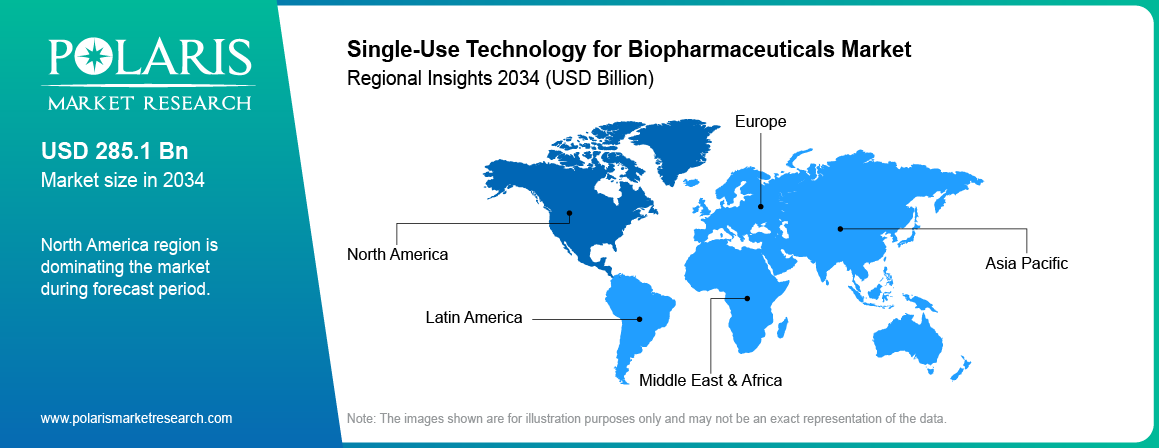
North America dominated the single-use technology for biopharmaceuticals market share with 34.62% in 2025, supported by an established biopharmaceutical manufacturing base, strong R&D concentration, and a mature supplier ecosystem. The region has significant activity across bioreactors, fluid management systems, filtration, and engineered single-use assemblies, creating a broad commercial base for suppliers. The region’s concentration of specialized industry activity is also underscored by the International Single-Use Summit, hosted by the Bio-Process Systems Alliance and set for Boston in July 2026. Validation, extractables, and material documentation are becoming more critical procurement requirements for manufacturers evaluating disposable systems. Suppliers with established quality infrastructure and the ability to provide documented product-contact data can therefore have an advantage when serving North American biopharmaceutical production facilities (source: www2.bpsalliance.org).
Europe Single-Use Technology for Biopharmaceuticals Market Trends
Europe accounted for 28.16% share of the single-use technology for biopharmaceuticals market in 2025, supported by established biotechnology clusters and a mature pharmaceutical manufacturing base. The regional environment places a high value on materials that contact the product, leachables, supplier qualification, and process compatibility. This makes technical documentation an important aspect when purchasing single-use systems. The EMA guidance on leachable provides a benchmark to assess the risks of materials used in pharmaceutical manufacturing. Industry activity also remains focused on key trade and procurement events, such as CPHI Europe in Milan in October 2026. Regulatory needs and existing manufacturing infrastructure drive demand for single-use suppliers that can offer qualification, documentation and integration support across bioprocessing workflows (source: cphi.com).
Asia Pacific Single-Use Technology for Biopharmaceuticals Market Trends
Asia Pacific is projected to register a 47.83% CAGR during the forecast period. The growth is attributed to expanding biopharmaceutical manufacturing capacity across China, India, South Korea, and Singapore. Regional manufacturers are increasing their requirements for single-use bags, assemblies, bioreactors, filtration systems, and other disposable processing technologies as biologics and vaccine production capabilities expand. India’s biopharmaceutical manufacturing agenda is also strengthened with biopharma SHAKTI, with a proposed funding of about USD 1.05 billion over five years. The initiative aims to boost domestic capabilities in biologics and biosimilars and help India achieve its bigger dreams in the global biopharmaceutical industry. These developments provide a stronger infrastructure base for suppliers of flexible single-use bioprocessing technologies (Source: Union Budget 2026–27).
Latin America Single-Use Technology for Biopharmaceuticals Market Trends
The market in Latin America represented a 6.42% share in 2025, with the regional opportunity linked to developing biosimilar manufacturing capacity and increasing interest in outsourced biopharmaceutical production. Compared with mature bioprocessing markets, demand is more closely connected to the development of new and flexible production infrastructure. Single-use systems can provide manufacturers and CDMOs with a way to configure processing capacity without relying entirely on large fixed infrastructure investments. This creates opportunities for suppliers offering modular bioreactors, filtration systems, bags, assemblies, and fluid management components. The current regional evidence does not identify a specific Tier A or Tier B sourced country-level single-use development comparable with the initiatives identified in North America, Europe, or Asia Pacific. The outlook is therefore best assessed through infrastructure development and manufacturing capacity expansion.
Middle East and Africa Single-Use Technology for Biopharmaceuticals Market Trends
Middle East and Africa accounted for 5.32% share in 2025, representing an earlier-stage opportunity shaped by developing healthcare and biomanufacturing infrastructure. Gulf markets provide a broader context through healthcare localization and investment in domestic production capabilities, while other markets in the region remain at earlier stages of biopharmaceutical manufacturing development. Single-use systems can support this environment because flexible processing infrastructure can be deployed without requiring the same scale of fixed manufacturing assets associated with traditional stainless steel facilities. Supplier partnerships, local manufacturing relationships, and technology transfer can therefore become important routes for market development. The available Blueprint sources do not identify a specific Tier A government program dedicated to single-use bioprocessing in the region, so the regional outlook is framed around infrastructure development and future manufacturing capacity rather than a specific national initiative.
Single-Use Technology for Biopharmaceuticals Market Regulatory and Standards Landscape
| Standard / Regulation | Issuing Body | Scope | Relevance to Single-Use Systems |
| USP <665> | United States Pharmacopeia | Standardized extraction testing of plastic components and systems | Sets baseline extractables documentation for product-contact materials |
| USP <1665> | United States Pharmacopeia | Risk-based characterization and qualification of plastic components | Guides supplier qualification and material risk assessment |
| 21 CFR 211.65 | U.S. FDA | Equipment must not be reactive, additive, or absorptive | Governs product-contact material compatibility in U.S. cGMP |
| EU GMP Annex 1 | European Commission | Manufacture of sterile medicinal products | Requires validated sterilization and integrity assurance for single-use systems |
| BPSA Best-Practice Guides | Bio-Process Systems Alliance | Industry guidance on single-use systems, including extractables and leachables | Voluntary benchmark for supplier and user qualification |
Source: Polaris Market Research Analysis; U.S. eCFR; European Commission
Single-Use Technology for Biopharmaceuticals Market Competitive Landscape
The top single-use technology for biopharmaceuticals companies include a limited number of large, vertically integrated suppliers alongside specialty component manufacturers. Sartorius AG, Thermo Fisher Scientific Inc., Danaher Corporation through Cytiva/Pall, and Merck KGaA through MilliporeSigma combine broad portfolios with established customer relationships, while companies such as Enpro Inc. and Avantor, Inc. provide more specialized component and assembly capabilities.
The competitive landscape among single-use bioprocessing market key players in 2026 is increasingly shaped by breadth, validation capability, supply reliability, and the ability to integrate multiple components into a qualified manufacturing workflow. Large suppliers can use M&A to close portfolio gaps, while specialty firms can create strategic value through differentiated components, engineered assemblies, or strong positions in high-value niches.
Vendor Positioning Landscape
| Company | Market Position | Core Single-Use Portfolio | Key Differentiator | Geographic Focus |
| Sartorius AG | Market Leader | Bioreactors, bags and fluid management, filtration, cell culture media | Integrated upstream-to-downstream consumables portfolio | Global (Europe-headquartered) |
| Danaher Corporation (Cytiva/Pall) | Market Leader | Bioreactors, chromatography, filtration, single-use assemblies | Large installed base across upstream and downstream workflows | Global |
| Thermo Fisher Scientific Inc. | Market Leader | Bioproduction containers, bioreactors, filtration, media | Scale and end-to-end bioproduction portfolio | Global |
| Merck KGaA (MilliporeSigma) | Strong Challenger | Filtration, single-use assemblies, process-safety consumables | Material-science and filtration expertise | Global |
| Avantor, Inc. | Challenger | Engineered assemblies, flow-path kits, fluid management | Customized assemblies and distribution reach | North America, global |
| Repligen Corporation | Challenger | Filtration, chromatography, single-use sensors and analytics | Specialist downstream and process-analytics depth | North America, Europe |
| Eppendorf SE | Niche Specialist | Benchtop and process-development single-use bioreactors | Strength at lab and pilot scale | Europe, global |
| Corning Incorporated | Niche Specialist | Cell culture vessels, fixed-bed bioreactors | Cell culture surface and vessel expertise | Global |
| Enpro Inc. | Niche Specialist | Engineered single-use components | Specialized component manufacturing | North America |
| W. L. Gore & Associates, Inc. | Niche Specialist | Membranes, venting and filtration components | Fluoropolymer membrane technology | Global |
| PBS Biotech, Inc. | Emerging Player | Vertical-wheel single-use bioreactors | Low-shear mixing for cell-based processes | North America |
Note: Positioning reflects relative portfolio breadth, installed base, and revenue scale in single-use bioprocessing. Source: Polaris Market Research Analysis;
Single-Use Technology for Biopharmaceuticals Market Porter's Five Forces Analysis
| Force | Intensity | Key Considerations |
| Threat of New Entrants | Low | GMP validation, extractables and leachables testing capability, switching costs, and platform IP deter entry |
| Bargaining Power of Suppliers | Medium to High | Medical-grade resin, film, and membrane inputs are concentrated; resin price swings affect the cost base |
| Bargaining Power of Buyers | Medium | Large biopharma and CDMO buyers negotiate volume contracts, but qualification effort limits supplier switching |
| Threat of Substitutes | Low to Medium | Stainless-steel systems remain viable for large-scale, high-batch, single-product plants; hybrid facilities are common |
| Competitive Rivalry | High | Leaders compete on portfolio breadth, validation support, and supply reliability; specialists compete on niche performance |
Source: Polaris Market Research Analysis; CASRAI
Single-Use Technology Innovation Landscape
Material performance is becoming an important technical consideration in single-use technology material innovation involving gamma-stable polymers, as disposable biomanufacturing systems are exposed to sterilization and demanding process conditions. Single-use sensor integration in bioprocessing is also moving deeper into disposable workflows. pH, dissolved oxygen, and pressure sensors can provide real-time process information while preserving closed-system integrity, reducing the need to interrupt production for measurement. Automation and analytics are developing alongside this trend.
Single-Use Technology for Biopharmaceuticals Market Innovation Landscape Snapshot
| Technology | Adoption Stage | Key Development | Market Impact |
| Single-use extractables/leachables analytical testing platforms | Growing deployment | USP <665>/<1665> mandate effective 2026 | Raises baseline documentation standard |
| Large-scale filtration/purification single-use systems | Growing deployment | Thermo Fisher–Solventum integration, 2025–2026 | Expands downstream processing capability |
| Regional scale-up bioprocess design facilities | Early commercial deployment | Telangana "1 Bio" facility, Nov. 2025 | Lowers capital barriers for emerging-market manufacturers |
| Single-use sensor integration | Growing deployment | Ongoing | Enables real-time monitoring within closed systems |
| Gamma-stable polymer materials | Early commercial deployment | Ongoing | Reduces material-degradation risk during sterilization |
Source: Polaris Market Research Analysis.
Buyers and Market Entry Barriers
The primary single-use technology market buyers and decision-makers include large supplier strategy teams evaluating acquisition targets, biopharmaceutical and CDMO procurement organizations assessing qualified suppliers, investors evaluating consolidation, government bodies designing regional manufacturing infrastructure, and specialty component companies considering partnerships or acquisition positioning.
Market entry remains difficult because single-use system validation and GMP requirements involve specialized analytical capabilities for GMP-grade validation and extractables/leachables testing. Established supplier relationships and validated supply agreements raise switching costs, while technical barriers in bioreactor and sensor design favor incumbents with established platforms and intellectual property.
Single-Use Technology for Biopharmaceuticals Market Cost and Pricing Snapshot
| Cost Component | Basis | Indicative Cost (USD) | Price Pressure, 2026 | Key Cost Driver |
| 2,000 L single-use bioreactor system | Per unit | 0.2–0.4 million | Medium | Automation, sensors, and scale |
| 2,000 L biocontainer (bag) | Per batch | 2,000–5,000 | High | Film and resin cost, gamma sterilization |
| Tubing, connectors, and sensors | Per batch | 1,000–3,000 | Medium | Component complexity |
| Filters (0.2 µm and depth) | Per batch | 1,500–4,000 | High | Membrane materials; resin shortages reported to lift filter costs by about 15% |
| Reinforced high-performance films | Premium | 20–30% above basic bags | Medium | Shear resistance for extended runs |
| Annual consumables, 100 batches (2,000 L) | Per year | 0.5–1.5 million | High | Scales linearly with batch count |
| Facility: 4 × 2,000 L single-use | Capex | 50–100 million | Medium | Building, downstream equipment, validation |
| Facility: 4 × 10,000 L stainless steel (reference) | Capex | 200–500 million | Reference | CIP/SIP/WFI systems, piping, validation |
| Polyethylene / polypropylene resin | Raw material | Up 30%+ since February 2026 | High | U.S. import tariffs, Middle East energy disruption |
Note: Indicative ranges, latest available as of Q3 2026; actual pricing varies by vendor, volume, and contract. Price pressure reflects Polaris assessment. Source: Polaris Market Research Analysis; Bioprocess Tools; Astute Analytica; Plastics Technology; ProPacks
Single-Use Technology for Biopharmaceuticals Market Outlook
The single-use bioprocessing market outlook for the next three to five years is likely to be shaped by supplier consolidation in filtration and purification, government-backed infrastructure development in emerging biomanufacturing hubs, and compliance-driven standardization following USP <665>/<1665>. The single-use technology market trends in 2026 indicate an increasing focus on supplier qualification, analytical documentation, manufacturing scale and portfolio breadth in addition to product performance. Smaller vendors that don’t have the extractables-testing infrastructure could face more qualification pressure, which can benefit larger, vertically integrated suppliers in the near term and make validated supplier capabilities more critical for buyers.
Key Players in the Single-Use Technology for Biopharmaceuticals Market
- ABEC, Inc.
- Antylia Scientific (Cole-Parmer)
- Asahi Kasei Corporation
- Avantor, Inc.
- Corning Incorporated
- Danaher Corporation
- Enpro Inc.
- Entegris, Inc.
- Eppendorf SE
- Freudenberg SE
- Getinge AB
- Lonza Group Ltd.
- Meissner Filtration Products, Inc.
- Merck KGaA
- Nordson Corporation
- Parker Hannifin Corporation
- PBS Biotech, Inc.
- Repligen Corporation
- Saint-Gobain Life Sciences
- Sartorius AG
- Thermo Fisher Scientific Inc.
- Tosoh Corporation / Tosoh Bioscience
- W. L. Gore & Associates, Inc.
Industry Developments
- July 2026: Repligen Corporation announced a definitive agreement to acquire BioLife Solutions, a supplier of cell processing and biopreservation tools for the cell and gene therapy market, at a total enterprise value of approximately USD 1.5 billion. (Source: sec.gov)
- July 2026: CPC Biotech launched RevolveSD Series, a one-inch, single-use product. It enables sterile disconnection of bioprocess tubing in fewer steps. RevolveSD disconnects enable bioprocessors to complete sterile disconnections in seconds. It also reduces setup time. (Source: investors.dovercorporation.com)
- June 2026: Single Use Support launched the next-generation RoSS.BLST, a blast freezing and thawing platform for biologics that offers recipe-driven freeze-thaw control down to -80°C and 30% greater usable capacity across single-use bioprocess container formats. (Source: biopharmaapac.com)
- February 2026: Accumax Lab Devices launched BioMax, a single-use bioprocess brand covering upstream, downstream, storage, and fluid transfer applications, manufactured in ISO Class 7 cleanrooms with US FDA-compliant materials. (Source: accumaxlab.com)
- January 2026: Sartorius expanded its bio-circular product offering by extending ISCC Plus certification to its Göttingen, Germany, and M'Hamdia, Tunisia, sites, making bio-circular filters and additional single-use fluid management technologies available to biopharma manufacturers. (Source: sartorius.com)
Market Segmentation
By Product Type Outlook (Revenue, USD Billion, 2021–2034)
- Bioreactors
- Filtration Systems
- Mixing Systems
- Bags & Containers
- Chromatography Systems
- Sensors & Probes
By Application Outlook (Revenue, USD Billion, 2021–2034)
- Monoclonal Antibodies
- Vaccines
- Cell & Gene Therapies
- Therapeutic Proteins & Peptides
By End User Outlook (Revenue, USD Billion, 2021–2034)
- Biopharmaceutical Manufacturers
- CDMOs & CROs
- Academic & Clinical Research Institutes
By Regional Outlook (Revenue, USD Billion, 2021–2034)
- North America
- U.S.
- Canada
- Europe
- Germany
- France
- UK
- Italy
- Spain
- Netherlands
- Rest of Europe
- Asia Pacific
- China
- Japan
- India
- South Korea
- Taiwan
- Australia
- Rest of Asia Pacific
- Latin America
- Brazil
- Mexico
- Argentina
- Rest of Latin America
- Middle East & Africa
- Saudi Arabia
- UAE
- South Africa
- Rest of Middle East & Africa
Single-Use Technology for Biopharmaceuticals Market Report Scope
| Report Attributes | Details |
| Market Size in 2025 | USD 18.61 Billion |
| Market Size in 2026 | USD 27.61 Billion |
| Revenue Forecast by 2034 | USD 652.44 Billion |
| CAGR | 42.11% from 2026–2034 |
| Base Year | 2025 |
| Historical Data | 2021–2024 |
| Forecast Period | 2026–2034 |
| Quantitative Units | Revenue in USD Billion and CAGR |
| Report Coverage | Revenue Forecast, Growth Factors, Competitive Landscape, Industry Trends, and Strategic Analysis |
| Segments Covered |
|
| Regional Scope |
|
| Competitive Landscape | Company Profiling, Product Benchmarking, Financial Analysis, Market Developments, and Strategic Initiatives |
| Report Format | PDF + Excel |
| Customization | Available by Country, Region, and Segment |
Source: Polaris Market Research Analysis
Why Choose Polaris Market Research
Polaris Market Research & Consulting, Inc. provides structured market intelligence to help biopharmaceutical companies, technology providers, investors, and industry stakeholders understand the single-use technology market and identify emerging opportunities.
Comprehensive Market Coverage
The report combines market sizing, segmentation, regional analysis, competitive intelligence, technology developments, and industry trends across the biopharmaceutical single-use ecosystem.
Detailed Segment and Regional Analysis
The study covers single-use bioreactors, filtration systems, mixing systems, bags and containers, chromatography systems, sensors and probes, and major applications, end users, and geographic markets.
Industry and Competitive Intelligence
The analysis covers strategic developments, acquisitions, infrastructure investments, regulatory changes, and technology advances of leading companies such as Sartorius, Thermo Fisher Scientific, Danaher, Merck KGaA, Avantor, and Enpro.
Actionable Market Insights
The findings give stakeholders a way to assess investment opportunities, competitive positioning, regional expansion, product priorities, and growth opportunities in biopharmaceutical manufacturing.
Research Methodology
The single-use technology for biopharmaceuticals market research combines targeted secondary research with primary validation and quantitative triangulation. Secondary research draws on Tier A regulatory sources such as USP General Chapters <665> and <1665>, FDA 21 CFR 211.65, and Bio-Process Systems Alliance materials, together with Tier B company and trade sources including Thermo Fisher Scientific's Solventum acquisition announcement, Enpro's SEC filing, and coverage of the Telangana "1 Bio" facility.
Primary research supports the single-use bioprocessing industry analysis through structured interviews with suppliers, biopharmaceutical manufacturers, and CDMOs, supported by validation calls with subject-matter experts. Survey and panel inputs are used to support the proprietary sizing model and test the assumptions derived from secondary research.
The single-use technology market size analysis uses top-down and bottom-up approaches that are cross-checked against each other and against company revenue disclosures where available. The objective is to develop an internally consistent market estimate rather than rely on a single extrapolation method.
The single-use bioprocessing market forecast incorporates identified industry milestones. The inputs that are explicitly forecasted are the timeline for compliance with USP <665> and the regional infrastructure build-out pattern as exemplified by the Telangana facility, allowing the forward view to mirror regulatory and capacity changes rather than just historical growth.
The single-use technology market research methodology applies a final validation layer through cross-checks and analyst sign-off. Lower-confidence source items are escalated, replaced, or excluded before publication to ensure that load-bearing claims are supported by appropriate evidence.
Research Methodology Overview
| Research Phase | Key Activities | Data Sources Used | Purpose / Output |
| Secondary Research | Review regulatory chapters, government publications, company filings, and industry association materials | USP chapters, FDA regulations, SEC filings, company releases, BPSA publications | Establish market context, regulatory backdrop, and competitive landscape |
| Primary Research | Structured interviews and validation calls with value-chain stakeholders | Suppliers, biopharmaceutical manufacturers, CDMOs, subject-matter experts | Validate secondary findings and calibrate sizing assumptions |
| Market Sizing & Triangulation | Top-down and bottom-up estimation cross-checked against each other | Company revenue disclosures, primary inputs, secondary research | Produce a triangulated market size |
| Forecasting | Forward projection tied to regulatory and infrastructure milestones | USP <665> timeline; regional investment patterns | Produce an evidence-linked forecast |
| Data Validation | Cross-check and analyst sign-off | Internal review process; Source Log confidence ratings | Ensure claims and figures meet Polaris quality standards |
Source: Polaris Market Research Analysis
Single-Use Technology for Biopharmaceuticals Market FAQ's
The single-use technology for biopharmaceuticals market was valued at USD 18.61 billion in 2025 and is projected to reach USD 652.44 billion by 2034. It is expected to register a CAGR of 42.11% from 2026 to 2034, with the market reaching USD 27.61 billion in 2026.
North America dominated the market in 2025, supported by its established biopharmaceutical manufacturing base, strong R&D concentration, and mature supplier ecosystem. Asia Pacific is projected to record the highest CAGR during the forecast period, driven by expanding biomanufacturing capacity.
Single-use bioreactors led the product type segment in 2025, monoclonal antibodies led the application segment, and biopharmaceutical manufacturers led the end user segment. These segments benefit from recurring consumable demand and established large-scale biologics production.
Filtration systems are expected to be the fastest-growing product type, cell and gene therapies the fastest-growing application, and CDMOs and CROs the fastest-growing end user. Growth is tied to downstream processing needs, flexible small-batch production, and outsourcing.
Key players include Sartorius AG, Thermo Fisher Scientific Inc., Danaher Corporation (Cytiva/Pall), Merck KGaA (MilliporeSigma), Avantor, Inc., Repligen Corporation, Eppendorf SE, Corning Incorporated, and Enpro Inc. Sartorius, Danaher, and Thermo Fisher are positioned as market leaders in the vendor positioning landscape.
Growth is driven by rising biologics and biosimilar manufacturing, USP <665>/<1665> compliance requirements, CDMO expansion, and supplier consolidation in filtration and purification. Investment in regional biomanufacturing infrastructure adds further momentum.
The main challenges are validation and testing costs, resin and supply-chain price volatility, recurring consumable expense, and plastic waste concerns. Smaller suppliers and CDMOs with limited in-house analytical capability face the highest qualification burden.
USP <665> standardizes the testing of extracts from plastic components used in pharmaceutical manufacturing, and it became mandatory in May 2026. USP <1665> provides a risk-based framework for assessing these components, raising the documentation standard for suppliers.
Single-use technology refers to disposable bioprocessing equipment such as bioreactors, bags, filters, tubing, and connectors that are used for one batch or a limited number of runs. It reduces cleaning and sterilization between production runs and supports flexible biologics manufacturing.
Single-use systems reduce upfront capital and changeover time because disposable components replace cleaned and sterilized fixed equipment. Stainless-steel systems have lower per-batch costs and tend to suit large-scale, steady-state, single-product manufacturing.
The main disadvantages are higher recurring consumable costs, plastic waste, extractables and leachables risk, and dependence on a limited number of qualified suppliers. Scale limits also mean very large production volumes often favor stainless steel.
A 2,000 L single-use bioreactor system typically costs about USD 0.2 million to USD 0.4 million, while a 2,000 L bioreactor bag costs about USD 2,000 to USD 5,000 per batch. Actual pricing varies by vendor, volume, and automation level.
Thermo Fisher announced the acquisition of Solventum's Purification & Filtration business in February 2025 for approximately USD 4.1 billion and completed it in September 2025 for about USD 4.0 billion in cash. The deal strengthened its downstream filtration and purification capabilities.
India is emerging as a regional scale-up hub, supported by lower operating costs and government initiatives for biopharmaceutical expansion. The Government of Telangana launched the "1 Bio" facility in Hyderabad in November 2025, with bioreactors of up to 500 L.
Download Sample Report of Single-Use Technology for Biopharmaceuticals Market
Please fill out the form to request a customized copy of the research report.


