
Document AI Market Size, Share, Trends & Forecast, 2026–2034
REPORT DETAILS
Document AI Market Summary
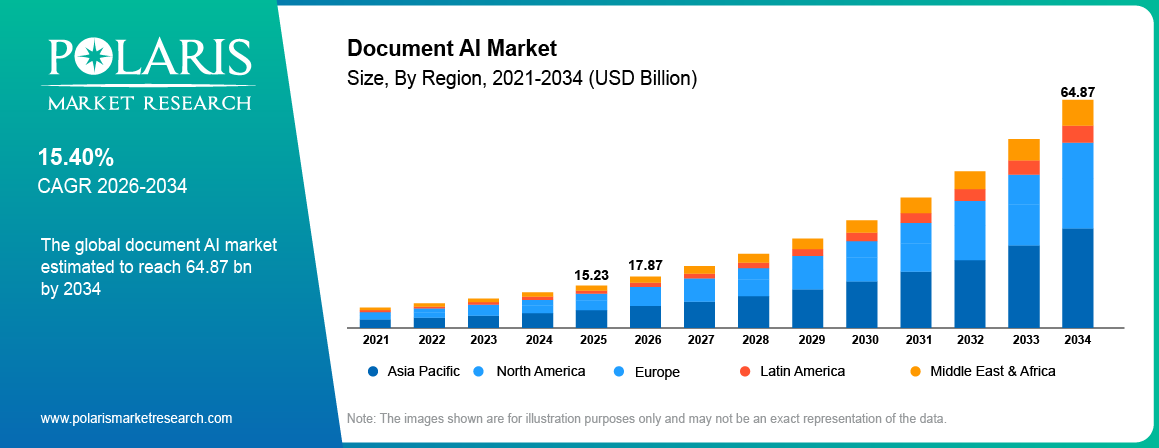
The global document AI market was valued at USD 15.23 Billion in 2025 and is projected to reach USD 64.87 Billion by 2034, expanding at a CAGR of 15.40%. Increasing adoption of vision language model parsers that decompose complex documents into structured, machine-readable information for large language models, retrieval-augmented generation systems and AI agent pipelines is fueling growth.
Market Statistics
Key Takeaways
- In 2025, North America accounted for 36.12% of the global Document AI market, driven by specialist document parsers, hyperscale services, and enterprise AI companies.
- Asia Pacific region is anticipated to register a CAGR of 18.73% during the forecast period, due to the rising popularity of open-weight document AI models and the presence of prominent AI developers.
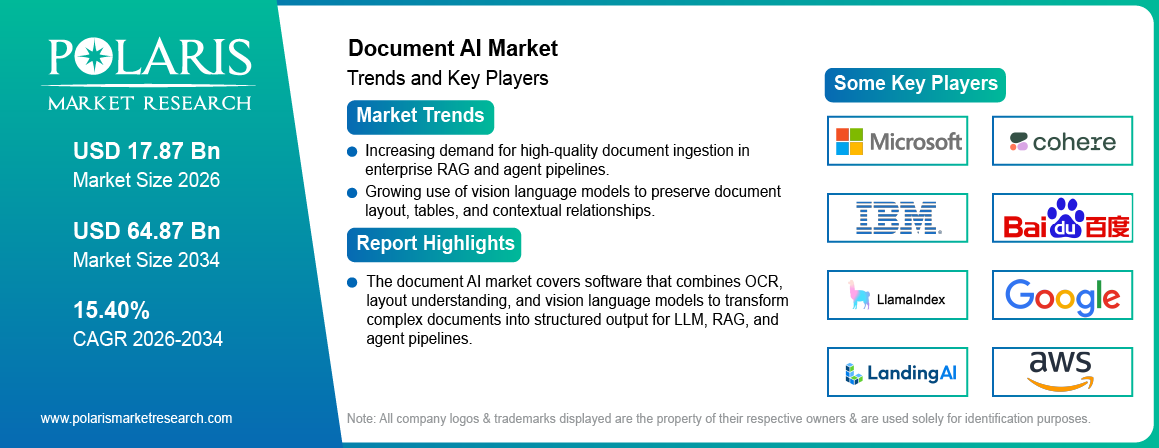
- OCR based extraction dominated with 43.18% in the parsing architecture segment in 2025, demonstrating the broad acceptance of this technology in document processing.
- Workflow automation accounted for 39.28% of the downstream use segment in 2025, driven by the ongoing need to convert documents into structured information for business processes.
- Cloud API had a 68.42% share in the deployment segment in 2025, owing to the availability of API-based document processing.
- BFSI accounted for 25.14% of the end use segment in 2025 owing to the large volume of structured and unstructured financial documents.
Note: Figures and projections outlined in this report are the result of Polaris Market Research’s proprietary analytical processes, grounded in the latest available datasets and market observations.
Document AI Market Definition
The document AI market covers software that combines vision language models, layout detection, and optical character recognition to convert PDFs, scanned documents, spreadsheets, presentations, and other complex content into structured, machine-readable output for downstream AI systems. End-to-end document workflow platforms are covered in intelligent document processing market, while standalone character recognition is covered under the optical character recognition market. This document parsing approach prepares complex files for downstream AI systems.
Third-party estimates for the broader document AI category are considerably higher because they include end-to-end intelligent document processing, workflow automation, and content management platforms. This report sizes only the parsing layer that prepares documents for AI systems, so its figures are not directly comparable with wider category estimates.
Document AI vs. IDP vs. OCR: Scope Comparison
| Dimension | Document AI | Intelligent Document Processing | OCR |
| Core function | Parses documents into AI-ready structured output | Automates end-to-end document workflows | Converts images of text into characters |
| Primary buyer | AI engineering teams | Operations and business process owners | Teams digitizing paper and scans |
| Key technologies | Vision language models, layout detection, OCR | OCR, NLP, machine learning, RPA | Character recognition |
| Typical output | Markdown or JSON with layout, tables, and citations | Validated data routed into business systems | Plain text |
Source: Polaris Market Research Analysis
The category is defined by the shift from extracting characters to understanding the structure of a document. Vision-first parsers can use vision language models to interpret page layout and correct limitations associated with conventional OCR, allowing tables, multi-column content, and other structural elements to be retained in the resulting output. This vision language model OCR approach extends conventional text recognition by interpreting document structure (Source: nutrient.io).
The buyer profile also differs from traditional intelligent document processing. AI engineering teams evaluate these tools based on whether parsed documents improve retrieval, question answering, and downstream agent performance. Poorly extracted content can undermine retrieval results even when the underlying language model is capable, because tables, section boundaries, and contextual relationships may be lost during ingestion (Source: redmondmag.com).
Market Dynamics
Driver Impact Analysis Snapshot
| Driver | Impact Level | Geographic Relevance | Impact Timeline |
| Enterprise RAG accuracy requirements | High | North America, Europe | Short to Medium Term |
| Model labs bundling OCR into AI platforms | Medium to High | Global | Short Term |
| Declining cost per page | Medium | Global | Medium Term |
| Growth of agentic workflows needing structured inputs | High | North America, Asia Pacific | Medium to Long Term |
| Data residency and self-hosted deployment demand | Medium | Europe, Middle East & Africa | Medium to Long Term |
Source: Polaris Market Research Analysis
Driver: Parsing Quality Is Increasingly Important for Enterprise RAG Accuracy
Demand in the document AI market is driven by growing use of retrieval and AI agent systems that depend on high-quality document ingestion. Poor parsing disrupts reading order, removes table relationships, and separates information that is necessary for accurate retrieval and question answering. This is increasing the importance of document parsers that preserve page structure while preparing content for downstream AI applications. LLM ready document parsing is therefore becoming important for enterprise retrieval and agent applications.
Reducto has developed a hybrid pipeline that routes different page regions to different vision language models, OCR engines, and layout models. The company reports higher accuracy than AWS Textract, Microsoft Azure Document Intelligence, and Google Cloud OCR on its internal benchmarks. The approach reflects the increasing focus on document-level parsing quality rather than basic text extraction alone (Source: zenml.io).
Founded in 2023, Reducto has raised a total of USD 108 million in funding, including a USD 75 million Series B round led by Andreessen Horowitz in October 2025. The company also states it has processed over a billion pages of data. These developments show a growing amount of commercial activity around specialized document parsing infrastructure (Source: hpcwire.com, zenml.io).
Driver: Model Labs Are Using OCR as an Entry Point into Enterprise AI
Model labs are also growing document parsing capabilities, which is further boosting market demand. Mistral launched OCR 3 in December 2025 and OCR 4 in June 2026, followed by OCR 4.1 in July 2026. OCR 4 supports 170 languages and can be deployed as a single container in a customer’s own infrastructure. The service is also available through the Mistral API, Amazon SageMaker, and Microsoft Foundry, with Snowflake support announced (Source: aiweekly.co, venturebeat.com).
The strategy behind document OCR extends beyond document extraction itself. Industry coverage of the OCR 4 launch positioned document processing as an entry point for Mistral into enterprise AI spending, linking the product to the company's broader enterprise growth strategy. This is increasing competition between specialist document parsers and model providers that can bundle document understanding with their broader generative AI platforms (Source: venturebeat.com)
Restraint: Hallucination Risk Limits Adoption in High-Stakes Documents
Vision language models can generate plausible but incorrect information, creating a significant limitation for document processing in high-stakes applications. Extraction accuracy can fall on complex layouts, such as dense tables, handwritten forms, and charts. This creates a need for document AI systems that combine multiple processing approaches instead of just one vision model. The accuracy of document extraction is very important when the output is used in high-stakes applications.
Reducto identifies hallucination as a core production challenge and uses a combination of models and OCR components while maintaining a pixel-level map of extracted elements. This architecture is intended to improve traceability and reduce the risk that generated output becomes disconnected from the underlying document (Source: zenml.io).
Opportunity: Self Hosted Deployment Supports Regulated Enterprise Adoption
Organizations handling sensitive documents are creating demand for deployment models that provide greater control over data and processing environments. Self-hosted and private deployment can reduce concerns associated with sending sensitive documents to public APIs and support requirements around data residency, retention, and internal governance. This document AI market report therefore considers private deployment as an important enterprise requirement.
Mistral OCR 4 can operate as a single container inside an organization's own environment, while Reducto offers cloud, VPC, and on-premises deployment options on its enterprise tiers. These deployment choices expand the addressable customer base to organizations that may have restrictions on public cloud document processing (Source: venturebeat.com, dev.to).
The opportunity extends across banks, insurers, government agencies, and healthcare organizations that require controlled document processing environments. Vendors capable of combining AI-based parsing with private deployment can therefore address requirements that are not fully served by API-only document processing models.
Opportunity: Lower Processing Costs Support Large-Scale Archive Digitization
The declining cost of document parsing is creating opportunities in large document archives. Lower per-page processing costs make it more practical to process document collections that were previously difficult to digitize economically, particularly when the objective is to prepare historical content for search, retrieval, and AI applications.
Mistral OCR 4 offers batch processing at USD 2 per 1,000 pages. At this listed rate, processing a 100,000-page corporate archive would cost approximately USD 200 before other infrastructure or project expenses. The economics create an opportunity for organizations to apply AI-based parsing across larger document repositories. Lower processing costs also increase competitive pressure across the market because basic extraction becomes less differentiated. Providers increasingly need to demonstrate additional value through layout preservation, citations, complex-document handling, and downstream AI readiness (Source: venturebeat.com).
Document AI Market Segmentation Analysis
The document AI market is segmented by parsing architecture, downstream use, deployment, and end use. These dimensions distinguish the underlying document processing approach, the purpose of extracted information, the deployment environment, and the industries adopting document AI technologies for AI-driven document processing.
Parsing Architecture Insights
The OCR Based Extraction segment accounted for 43.18% of the document AI market in 2025. This is due to current use of optical character recognition to transcribe scanned and digital documents to machine-readable text. OCR-based approaches still provide a fundamental extraction layer for enterprise document processing, and are still widely used over large volumes of documents. Traditional OCR is heavily oriented around character and text recognition. Newer document AI architectures are increasingly combining OCR with layout detection and other processing abilities. This established technology base underpins the ongoing adoption of OCR-based extraction across the enterprise document environment. The document AI market analysis also considers how established OCR capabilities compare with newer parsing architectures (Source: nutrient.io).
The Vision Language Model Parsing segment is projected to register a CAGR of 17.30% during the forecast period, supported by the use of vision language models that read page images directly instead of relying on character recognition alone. Cohere's Parse 5, launched in August 2026, is a 2.3-billion-parameter vision language model that converts PDFs, slides, and images into Markdown with HTML tables and bounding boxes at USD 1.50 per 1,000 pages. Mistral OCR 4 similarly returns bounding boxes, typed blocks, and confidence scores. Hallucination risk and the need for traceable output remain the main factors limiting standalone use of vision-only approaches in high-stakes documents (Source: marktechpost.com, venturebeat.com).
The Hybrid Agentic Parsing segment is projected to register a CAGR of 20.40% during the forecast period, driven by increasing demand for document processing systems that can combine OCR, layout analysis, and vision language models. Hybrid approaches can route different document regions through specialized processing methods and use multiple passes to handle complex structures. Reducto and LlamaParse provide examples of approaches designed for dense tables, multicolumn layouts, charts, and other challenging document elements. This combination of conventional extraction reliability and vision-based document understanding is supporting the adoption of hybrid architectures for AI and retrieval applications (Source: nutrient.io, usefulai.com).
Downstream Use Insights
The Workflow Automation segment held 39.28% of the document AI market in 2025, owing to the continued use of structured document information in enterprise processes. Document AI systems can convert information from PDFs, forms, reports, and other files into structured outputs that can be used by downstream applications. Workflow automation represents an established use of document processing technology, particularly where extracted information needs to move into existing business processes. The segment therefore continues to represent an important application area for document AI, although newer AI-native applications are increasingly expanding demand beyond conventional workflow processing (Source: nutrient.io).
The RAG & Agent Pipelines segment is expected to grow at a CAGR of 18.12% during the forecast period, driven by increasing use of enterprise documents as inputs for retrieval-augmented generation and AI agent applications. Document parsers are increasingly evaluated according to their ability to preserve document structure and produce outputs suitable for retrieval, question answering, and downstream AI systems. Buyer evaluations in 2026 increasingly compare parsing solutions according to their suitability for RAG pipelines rather than relying only on conventional OCR performance. This shift is driving demand for document AI solutions purpose-built for LLM-ready document processing (Source: vstorm.co).
The Archive Digitization segment is expected to grow at a CAGR of 10.64% during the forecast period, as falling per-page costs make large historical repositories practical to process. Governments and enterprises hold records in paper files, microfilm, and legacy systems that are difficult to search. At Mistral OCR 4's batch rate of USD 2 per 1,000 pages, parsing a 100,000-page archive costs about USD 200 before infrastructure and project expenses. Platforms such as Kofile's Kleio, launched in April 2026, add AI-powered classification, natural-language search, and multilingual access to make preserved records usable (Source: venturebeat.com, kofile.com).
Deployment Insights
The Cloud API segment accounted for 68.42% of the document AI market in 2025, supported by the ability of cloud document AI services to provide document parsing capabilities without organizations needing to manage the underlying processing infrastructure. Cloud APIs enable AI engineering teams to integrate document extraction into retrieval systems, applications and agent pipelines with their existing development environments. This deployment model allows providers to update parsing capabilities and models in one central location. Specialist providers and major technology companies are making cloud-based document processing services available, driving demand for API-based deployment across enterprise AI applications (Source: vstorm.co).
The Self Hosted / VPC segment is expected to grow at 12.41% CAGR during the forecast period due to increasing need for data residency, privacy, security and more control over the document processing environments. Mistral OCR 4 can be deployed as a single container in the organization’s own environment. Reducto also supports VPC and on-premises deployment. These capabilities are especially relevant to regulated companies that handle sensitive financial, legal, healthcare or government documents. This means that increasing availability of private deployment architectures is helping drive adoption of document AI among enterprises that are unable to rely on public cloud processing alone (Source: venturebeat.com, dev.to).
End Use Insights
BFSI segment accounted for 25.14% share in the document AI market in 2025. This is attributed to the large volumes of financial documents, reports, filings, statements and other structured and unstructured information processed by financial institutions. Financial institutions are increasingly seeking document processing systems that maintain the structure of the document and make the information available for downstream AI applications. Complex financial documents, such as filings and statements, are also evaluated for document parsing. The preservation of structure impacts the relevance of retrieval and the accuracy of the answer. These requirements enable continued adoption of document AI across banking and financial services, in line with the wider AI in banking market. (Source: marketsandmarkets.com, intuitionlabs.ai)
Legal segment is projected to grow at a CAGR of 14.86% during the forecast period, owing to the complexity and volume of contracts, filings and other legal documents. Legal documents typically have long text, tables, multiple columns and information that needs to be traceable to its original place. As such, document AI solutions that preserve page structure and provide source-level citations are valuable for retrieval and analytics applications in legal environments. There’s growing demand for advanced parsing technologies for legal use cases, driven by increasing focus on auditable extraction and document-level traceability, mirroring adoption across the wider legal AI software market. (Source: polarismarketresearch.com, dev.to)
The Healthcare segment is projected to grow at a CAGR of 17.42% during the forecast period, driven by the volume of patient records, claims, referral letters, and clinical forms that combine handwriting, dense tables, and mixed layouts. Healthcare buyers place particular weight on privacy controls, and vendors such as Landing AI publish HIPAA support with business associate agreements and zero data retention options. Accurate extraction from clinical and claims documents is a prerequisite for applying retrieval and agent applications to patient and payer data (Source: landing.ai).
The Government segment is expected to expand at a CAGR of 16.71% during the forecast period, supported by the digitization of land records, court documents, vital records, and historical archives. These records require legal defensibility, chain of custody, and audit trails, which favors parsing tools that provide traceable output and controlled deployment. Kofile's Kleio platform, built exclusively for government agencies, pairs AI-driven classification and extraction with encrypted data pipelines, role-based access, and full audit trails (Source: kofile.com).
The Others segment, including insurance, logistics, and other document-intensive industries, is expected to register a CAGR of 11.92% during the forecast period, as organizations outside financial services, legal, healthcare, and government adopt parsing APIs to prepare contracts, claims, invoices, and shipping documents for AI applications.
Regional Analysis
North America Document AI Market Trends
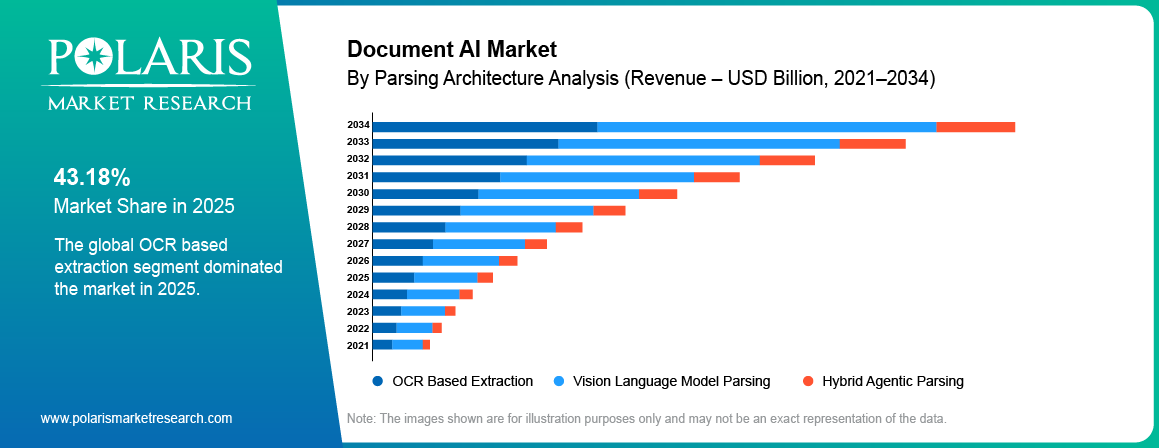
North America led the global market for document AI in 2025, accounting for 36.12%, fueled by the presence of specialist document parsing companies, major hyperscaler document processing services, and mature enterprise AI development capabilities. Reducto, LlamaIndex, and Unstructured all operate within specialist document parsing and AI infrastructure applications. Document processing solutions are also offered by major technology companies such as Google, Microsoft, and Amazon Web Services. These companies are present across specialist parsers and hyperscaler platforms in North America. This ecosystem enables document AI to be embedded into retrieval systems, LLM applications and enterprise AI workflows. The document AI industry forecast underscores the prevalence of specialist vendors and enterprise AI infrastructure in the region (Source: vstorm.co).
The regional market is further boosted by ongoing investments in document parsing technologies for enterprise AI use cases. Reducto processed more than 1 billion pages through its document parsing platform, and raised USD 75 million in a Series B round in October 2025, bringing its total funding to USD 108 million. This development reflects continued investment in specialist document AI infrastructure in the US, and supports the region’s position across AI-native document processing applications (Source: hpcwire.com).
Europe Document AI Market Trends
Europe held 26.54% of the global document AI market in 2025, driven by increasing demand for multilingual and privately deployable AI tools. Mistral’s OCR 4 offers support for 170 languages and can run as a single container in an organization’s own infrastructure. The deployment model provides organizations with more control over document processing environments, and supports applications where data residency and private infrastructure are important considerations. Thus, Mistral’s work on document processing gives Europe a strong presence in the nascent ecosystem of document AI. The region’s focus on controlled AI deployment and multilingual processing is supporting the document AI market share (Source: venturebeat.com).
The region's document AI activity is also connected to the broader development of enterprise AI platforms that require multilingual document understanding and controlled deployment. Mistral OCR 4 is available through the Mistral API and has also been made available through platforms including Amazon SageMaker and Microsoft Foundry. The combination of multilingual document processing and self-hosted deployment supports applications where organizations require document extraction capabilities while maintaining greater control over infrastructure and data handling (Source: mistral.ai).
Asia Pacific Document AI Market Trends
Asia Pacific is projected to grow at a 18.73% CAGR during the forecast period, supported by increasing development of AI models, semiconductor and computing capabilities, and the emergence of open document processing technologies. China represents an important source of activity in the regional document AI landscape. Baidu open-sourced Unlimited-OCR, a free, MIT-licensed model with 3 billion parameters, on June 22, 2026, one day before Mistral launched OCR 4. The move was expected to increase competition in commercial document parsing services and highlight the growing availability of lower cost and open document processing models in the region (Source: docupath.ai, venturebeat.com).
Markets in Asia Pacific, including China, are leading the way in the development and availability of AI models that handle complex documents for downstream applications. Free, open-weight OCR models are emerging that increases access to document processing capabilities and put pressure on commercial pricing. This environment further develops document parsing technologies for AI applications and boosts the growing contribution of the region in the worldwide document AI ecosystem.
Middle East and Africa Document AI Market Trends
The Middle East and Africa document AI market is estimated to account for 6.00% share of the global market in 2025, supported by accelerating digital transformation across government, banking, financial services, and other document-intensive sectors. Government digitization initiatives have forced organizations to update records, automate document classification and enhance information retrieval. Financial institutions are also using AI-powered document processing to manage forms, statements, compliance records and customer documentation more efficiently. The increasing adoption of cloud and investments in artificial intelligence are further pushing demand for document parsing, automated extraction and intelligent document workflows, supporting the document AI industry forecast.
Latin America Document AI Market Trends
The AI market for documents in Latin America held 6.47% of the global market in 2025, supported by the increasing digitization of companies, adoption of cloud computing and demand for automated document processing. Financial institutions and insurance companies are using AI-based solutions to process customer records, applications, claims documents and regulatory information more efficiently. Government agencies are also moving ahead with digital document management and automation projects. Rising adoption of artificial intelligence across Brazil, Mexico, and other major markets is creating additional opportunities for document extraction, classification, search, and workflow automation. These trends are expected to support wider adoption of solutions covered in the document AI market analysis.
Document AI Market Competitive Landscape
The Document AI market is divided among specialist document parsers, model laboratories, hyperscaler document services, and open-source toolkits. Competition is increasingly shaped by table and layout accuracy, traceable citations, deployment flexibility, language coverage, and price per page rather than basic OCR capability alone.
Vendor Landscape Snapshot
| Vendor | Headquarters | Vendor Type | Market Positioning | Key Differentiator |
| Google LLC | US | Hyperscaler | Leader | Google Document AI with prebuilt processors and native Google Cloud integration |
| Microsoft Corporation | US | Hyperscaler | Leader | Azure Document Intelligence with container and disconnected deployment options |
| Amazon Web Services, Inc. | US | Hyperscaler | Leader | Amazon Textract with native AWS integration for transactional workflows |
| Mistral AI | France | Model Lab | Challenger | Structured output, self-hosted deployment, and low price per page |
| Reducto Inc. | US | Specialist Parser | Challenger | Agentic parsing with source citations for complex documents |
| LlamaIndex Inc. (LlamaParse) | US | Specialist Parser | Challenger | Agentic parsing for complex tables and charts, with an open-source option |
| IBM Corporation (Docling) | US | Open-Source Toolkit | Challenger | Open-source Docling toolkit backed by enterprise reach |
| Landing AI | US | Specialist Parser | Niche Specialist | Page-level visual grounding for regulated, auditable extraction |
| Unstructured Technologies, Inc. | US | Open-Source Toolkit | Niche Specialist | Multi-format ingestion for RAG pipelines |
| Cohere Inc. | Canada | Model Lab | Emerging Player | Compact, low-cost vision language model parser |
| Baidu, Inc. | China | Model Lab | Emerging Player | Free open-weight OCR model |
Source: Polaris Market Research Analysis.
The competitive environment is also shaped by price compression. Open-weight models and low-cost commercial OCR services reduce the scope for undifferentiated document extraction offerings. Specialist providers therefore need to differentiate through accuracy guarantees, source citations, complex-document handling, deployment options, and integration with downstream AI pipelines.
Document AI Market Technology and Innovation Landscape
Technology and Innovation Landscape Snapshot
| Innovation | What It Enables | Example |
| Region-based model routing | Sends each page region to the best-suited model or OCR engine | Reducto hybrid pipeline |
| Grounded, traceable output | Links extracted data to its source location for audit | Mistral OCR 4; Reducto; Cohere Parse 5; Landing AI |
| Compact vision language models | Lowers cost per page for high-volume parsing | Cohere Parse 5 (2.3B parameters); Baidu Unlimited-OCR (3B parameters) |
| Self-hosted and open-weight deployment | Keeps sensitive documents inside the customer environment | Mistral OCR 4 container; Docling; Granite-Docling |
| Open standards and benchmarks | Makes parsed output portable and accuracy comparable | DocLang working group (June 2026); LlamaIndex and Kaggle leaderboard (September 2026) |
| Agent-ready integrations | Connects parsers directly to agent frameworks | LlamaParse agent skills and MCP; LiteParse (March 2026) |
Source: Polaris Market Research Analysis; company announcements
Region-based model routing is an important architectural development in document parsing. Rather than processing every page region through a single model, hybrid systems can use different vision language models, OCR engines, and layout models according to the complexity of individual regions. Reducto describes this type of architecture as a way to balance processing accuracy and cost (Source: zenml.io).
Grounded output represents another technology development. Mistral OCR provides page-level Markdown together with bounding boxes, typed blocks, and confidence information, while Reducto maintains a pixel-level map of extracted elements. These approaches aim to make extracted information traceable to its source location (Source: usefulai.com, zenml.io).
The technology landscape is therefore moving beyond the question of whether text can be extracted. Developers increasingly need to know whether the resulting data retains enough structure and provenance to support retrieval, reasoning, and audit-oriented enterprise applications.
Document AI Market Use Case Analysis
Financial Services
Scanned 10-K filings provide an important use case for document AI, as financial information can be spread across tables, narrative sections, footnotes, and other page structures. When tables and section boundaries are lost during ingestion, retrieval quality suffers even if the underlying language model is capable (Source: redmondmag.com).
Legal
Legal documents require extracted clauses and information to remain connected to their source context. Long contracts and filings can contain complex layouts, making traceability an important evaluation factor for enterprise document parsers. The buyer guidance reviewed auditable extraction and source citations as relevant considerations for legal document workflows (Source: usefulai.com).
Enterprise Archives
Enterprise archives are a major application area as organizations seek to turn historical records into searchable and AI-ready data. In April 2026, Kofile Technologies introduced Kleio, an AI-enabled document intelligence and engagement platform built exclusively for government agencies. The platform brings together AI-powered classification and extraction with natural-language search, summarization, multilingual interaction and agentic workflows to help agencies modernize and access public records (Source: Kofile Technologies).
Barriers to Market Entry
- Price compression: Open-weight models and low-cost APIs place pressure on providers without a clear accuracy, deployment, or integration advantage.
- Hyperscaler bundling: Google, Microsoft, and AWS can package document services within broader cloud relationships.
- Accuracy proof on difficult documents: Buyers need to evaluate performance on dense tables, handwriting, charts, and other difficult document structures.
- Deployment breadth: Regulated customers may require VPC or on-premises processing rather than public API delivery.
Document AI Market Premium Insights and Forward Outlook
Raw OCR Is Under Increasing Price Pressure, While Traceability Creates Differentiation
Open-weight OCR models and low-cost commercial services are placing pressure on basic text extraction economics. The differentiation opportunity increasingly lies in preserving page structure, providing source-level citations, handling complex layouts, and producing output that can be directly consumed by enterprise AI applications.
The value proposition therefore shifts from simple text recognition toward reliable, traceable document understanding. This is particularly relevant to regulated buyers that need to review where extracted information originated.
Document AI Is Likely to Remain Closely Connected to IDP
The boundary between Document AI and Intelligent Document Processing is likely to remain fluid. Established IDP providers can add vision language model parsing capabilities, while specialist document parsers can add workflow functionality.
The distinction used in this report is based on the downstream buyer and product layer: Document AI focuses on parsing documents into AI-ready structured output, while IDP covers broader end-to-end document workflows. This distinction should be retained for analytical purposes even as product capabilities overlap.
Document AI Market Cost and Pricing Benchmarking Analysis
Published document parsing prices span a wide range, reflecting differences in processing architecture, table handling, citations, deployment options, and service positioning.
Mistral OCR 4 pricing ranges from USD 2 per 1,000 pages for batch processing to USD 4 per 1,000 pages through the standard API, with annotated pages priced at USD 5 per 1,000. Cohere Parse is listed at USD 1.50 per 1,000 pages. Google Enterprise Document OCR is listed at approximately USD 1.50 per 1,000 pages for the first 5 million pages per month, while LlamaParse and Reducto occupy higher price points for more specialized parsing and auditable extraction (Source: digitalapplied.com, marktechpost.com).
Document AI Pricing Benchmarks
| Product | List Price | Notes |
| Mistral OCR 4, Batch | USD 2 per 1,000 pages | Self-hostable |
| Mistral OCR 4, Standard | USD 4 per 1,000 pages | Annotated pages: USD 5 per 1,000 |
| Google Enterprise Document OCR | USD 1.50 per 1,000 pages | First 5 million pages per month |
| Cohere Parse 5 | USD 1.50 per 1,000 pages | Vision language model; API |
| LlamaParse | USD 12.50 per 1,000 pages | Agentic parsing |
| Reducto | USD 47.60 per 1,000 pages | Auditable extraction with citations |
Source: Polaris Market Research Analysis
The listed prices represent published service pricing and should not be interpreted as directly comparable total enterprise processing costs. Infrastructure, document complexity, deployment requirements, storage, and downstream integration can affect the final cost of a production deployment.
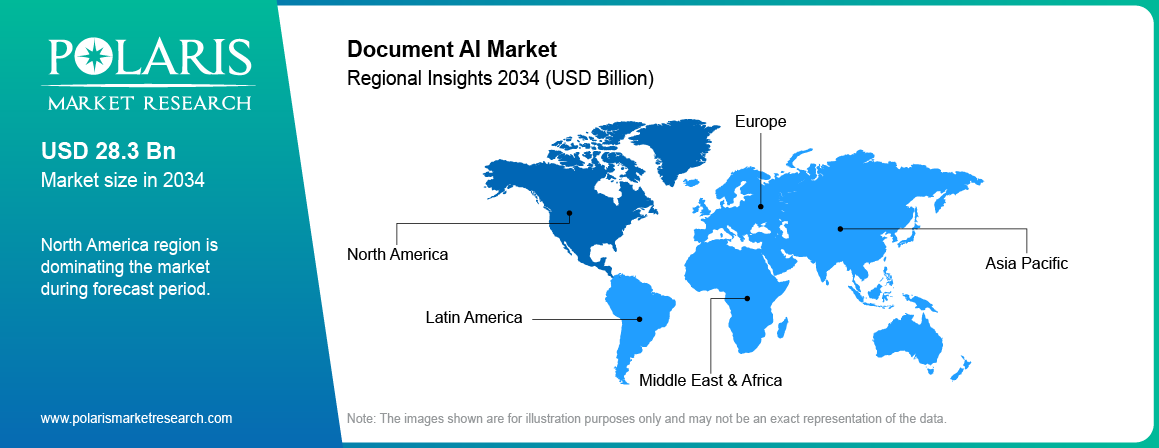
Key Players in the Document AI Market
- Amazon Web Services, Inc.
- Baidu, Inc.
- Cohere Inc.
- Google LLC
- IBM Corporation
- Landing AI
- LlamaIndex Inc.
- Microsoft Corporation
- Mistral AI
- Reducto Inc.
- Unstructured Technologies, Inc.
Industry Developments
- September 2026: LlamaIndex and Kaggle launched a document extraction leaderboard for AI agents to benchmark document extraction performance. (Source: llamaindex.ai)
- August 2026: Cohere launched Parse 5 (parse-v5.0), a 2.3-billion-parameter vision language model that converts PDFs, slides, and images into Markdown with bounding boxes, priced at USD 1.50 per 1,000 pages. Microsoft added the model to Foundry. (Source: marktechpost.com, redmondmag.com)
- August 2026: Mistral AI made OCR 4.1 generally available on August 31, following a July 16 preview release. (Source: intuitionlabs.ai)
- June 2026: Mistral AI launched OCR 4 with support for 170 languages, structured output with bounding boxes and confidence scores, and single-container self-hosted deployment. (Source: venturebeat.com)
- June 2026: Baidu open-sourced Unlimited-OCR, a 3-billion-parameter, MIT-licensed model that parses dozens of pages in a single forward pass. (Source: docupath.ai)
- June 2026: LF AI & Data Foundation formed the DocLang Specification Working Group to develop an open standard for AI-native documents, complementing the Docling project, which reached Graduate-tier status in August 2026. (Source: linuxfoundation.org, lfaidata.foundation)
- April 2026: Kofile Technologies launched Kleio, an AI-driven document intelligence and engagement platform built for government agencies. (Source: morningstar.com)
- October 2025: Reducto raised a USD 75 million Series B round led by Andreessen Horowitz, bringing its total funding to USD 108 million. (Source: hpcwire.com)
- July 2025: Nutrient released an updated Document AI SDK with AI-powered redaction, document comparison, multi-document assistance, and tools for building agentic document workflows. (Source: prnewswire.com)
- August 2025: Xerox launched EveryDoc IDP App, using AI models and GenAI prompts to extract and verify information from contracts, invoices, legal records, and other documents. (Source: xerox.com)
- May 2025: SAP launched SAP Document AI as a unified business document processing solution, replacing its earlier Document Information Extraction offering. (Source: sap.com)
Document AI Market Report Segmentation
By Parsing Architecture Outlook (Revenue, USD Billion, 2021–2034)
- OCR Based Extraction
- Vision Language Model Parsing
- Hybrid Agentic Parsing
By Downstream Use Outlook (Revenue, USD Billion, 2021–2034)
- RAG & Agent Pipelines
- Workflow Automation
- Archive Digitization
By Deployment Outlook (Revenue, USD Billion, 2021–2034)
- Cloud API
- Self Hosted / VPC
By End Use Outlook (Revenue, USD Billion, 2021–2034)
- BFSI
- Healthcare
- Legal
- Government
- Others
By Region Outlook (Revenue, USD Billion, 2021–2034)
- North America
- US
- Canada
- Europe
- Germany
- France
- UK
- Italy
- Spain
- Netherlands
- Rest of Europe
- Asia Pacific
- China
- Japan
- India
- South Korea
- Taiwan
- Australia
- Rest of Asia Pacific
- Latin America
- Brazil
- Mexico
- Argentina
- Rest of Latin America
- Middle East & Africa
- Saudi Arabia
- UAE
- South Africa
- Rest of Middle East & Africa
Document AI Market Report Scope
| Report Attributes | Details |
| Market Size in 2025 | USD 15.23 Billion |
| Market Size in 2026 | USD 17.87 Billion |
| Revenue Forecast by 2034 | USD 64.87 Billion |
| CAGR | 15.40% from 2026–2034 |
| Base Year | 2025 |
| Historical Data | 2021–2024 |
| Forecast Period | 2026–2034 |
| Quantitative Units | Revenue in USD Billion and CAGR |
| Report Coverage | Revenue Forecast, Growth Factors, Competitive Landscape, Industry Trends, and Strategic Analysis |
| Segments Covered | By Parsing Architecture, Downstream Use, Deployment, End Use, and Region |
| Regional Scope | North America, Europe, Asia Pacific, Latin America, Middle East & Africa |
| Competitive Landscape | Company Profiling, Product Benchmarking, Financial Analysis, Market Developments, and Strategic Initiatives |
| Report Format | PDF + Excel |
| Customization | Available by Country, Region, and Segment |
Source: Polaris Market Research Analysis
Why Choose Polaris Market Research
Polaris Market Research & Consulting, Inc. analyzes the Document AI market with a focus on the document parsing layer that connects enterprise content with modern AI applications. The defined scope separates vision language model document parsing from broader intelligent document processing and standalone optical character recognition.
The research framework evaluates the document AI market across parsing architecture, downstream use, deployment, end use, and region. Competitive assessment covers specialist parsers, model providers, hyperscalers, and open-source toolkits, while source validation retains only documented market participants.
The document AI market analysis also places emphasis on specification and pricing normalization. Published per-page pricing is treated as a service benchmark rather than a direct measure of total enterprise deployment cost, while technical claims are retained according to the source's stated methodology.
Research Methodology
Document AI market research begins with a defined scope focused on vision language model document parsers used to prepare PDFs, scans, spreadsheets, presentations, and related content for downstream AI applications. End-to-end document workflow platforms and standalone OCR are excluded from the defined market boundary.
The research process combines vendor documentation, product announcements, buyer guidance, funding disclosures, competitive evidence, and published pricing. Primary validation focuses on documented company developments and product capabilities, while competitive benchmarking is used to distinguish specialist parsers, model laboratories, hyperscaler services, and open-source toolkits.
Document parsing services publish list pricing, public pricing and product documentation form an important part of the evidence base. The research also distinguishes vendor-reported capabilities from independently measured performance and avoids treating published benchmark results as universal performance outcomes.
Research Methodology Phases
| Phase | Focus |
| 1. Secondary Mapping | Vendor documentation, buyer guides, funding disclosures, and competitive evidence |
| 2. Primary Validation | Company announcements, product information, and published pricing |
| 3. Competitive Benchmarking | Scope separation against IDP and OCR categories |
| 4. Proprietary Reconciliation | Validation against the Polaris internal market model |
| 5. Quality and Sourcing Review | Final editorial, evidence, citation, and scope review |
Source: Polaris Market Research Analysis
Document AI market forecast construction applies the validated market structure across parsing architecture, downstream use, deployment, end use, and region. Vendor-reported pricing and product specifications are retained according to their source context rather than being presented as independent performance measurements.
Document AI Market FAQ's
The Document AI Market covers software that converts documents into structured, machine-readable information for downstream AI applications.
The market was valued at USD 15.23 Billion in 2025 and is forecast to reach USD 64.87 Billion by 2034, at a CAGR of 15.40%.
North America leads the market, accounting for 36.12% of the global market in 2025.
OCR Based Extraction accounted for 43.18% of the market in 2025, while Hybrid Agentic Parsing is the fastest-growing architecture at a CAGR of 20.40%.
IDP focuses on complete document workflows, while Document AI focuses on structured outputs for downstream AI applications.
OCR extracts text, while Document AI also understands document layout, tables, reading order, and structure. Newer vision language model parsers read the page image directly, and hybrid approaches combine both to improve accuracy and traceability.
LlamaParse, Reducto, Unstructured, Docling, and Mistral OCR are among the evaluated options. The right choice depends on accuracy on complex layouts, deployment control, and cost, because poor parsing breaks reading order and table relationships and reduces retrieval relevance. Docling and Unstructured are open-source options.
Yes. Mistral OCR 4 supports self-hosting, while Reducto offers VPC and on-premises deployment.
Key players include Amazon Web Services, Inc.; Baidu, Inc.; Cohere Inc.; Google LLC; IBM Corporation; Landing AI; LlamaIndex Inc.; Microsoft Corporation; Mistral AI; Reducto Inc.; and Unstructured Technologies, Inc.
Growth is driven by rising demand for high-quality document ingestion in enterprise RAG and AI agent pipelines, and by model labs expanding into document parsing. Declining per-page costs and demand for self-hosted deployment add to adoption.
Hallucination risk in high-stakes documents, price compression from open-weight and low-cost services, and the need to prove accuracy on difficult layouts limit adoption.
Asia Pacific is projected to register a CAGR of 18.73% during 2026-2034, supported by AI model development and the availability of open-weight OCR models.
Published prices start at about USD 1.50 per 1,000 pages for Google Enterprise Document OCR and Cohere Parse, and USD 4 per 1,000 pages for the Mistral OCR 4 standard API. Agentic parsing services are priced higher. Final cost depends on document complexity, deployment, and integration.
Recent developments include Cohere Parse 5 (August 2026), Mistral OCR 4 and OCR 4.1 (June and August 2026), Baidu's open-weight Unlimited-OCR (June 2026), and the DocLang open-standard working group (June 2026).
Download Sample Report of Document AI Market
Please fill out the form to request a customized copy of the research report.


