
Artificial Intelligence In Banking Market Demand, Industry Trends, 2026-2034
REPORT DETAILS
Artificial Intelligence in Banking Market Summary and Key Insights
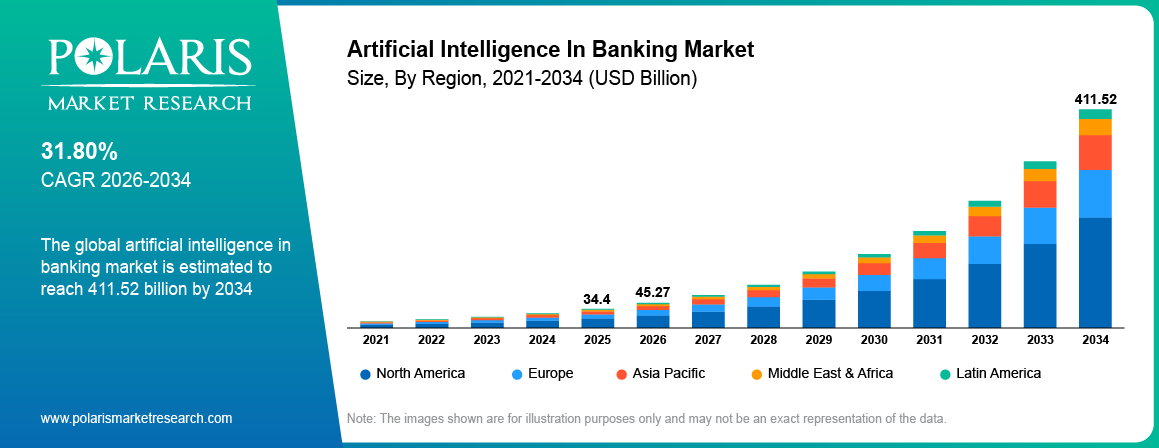
Artificial Intelligence in Banking Market size was valued at USD 34.40 billion in 2025. The market is anticipated to grow from USD 45.27 billion in 2026 to USD 411.52 billion by 2034, exhibiting the CAGR of 31.80% during the forecast period
Market Statistics
Key Takeaways
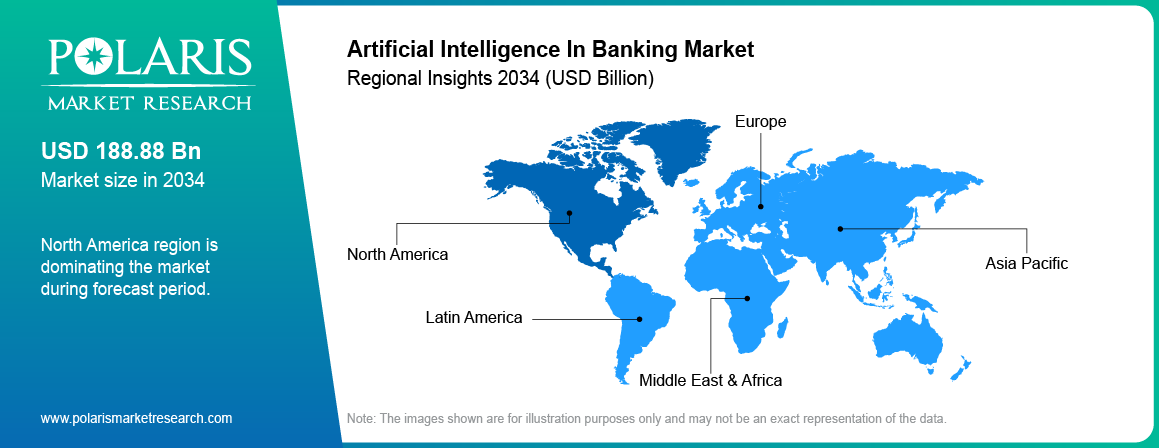
- North America dominated the global market by holding 45.9% revenue share in 2025. Expanding digitization of banking processes and high presence of fintech companies boost the dominance.
- The Asia Pacific Artificial Intelligence in Banking market is expected to register the highest CAGR of 27.3% during the forecast period. The growth is propelled by the growing fintech industry and rapid digitalization efforts.
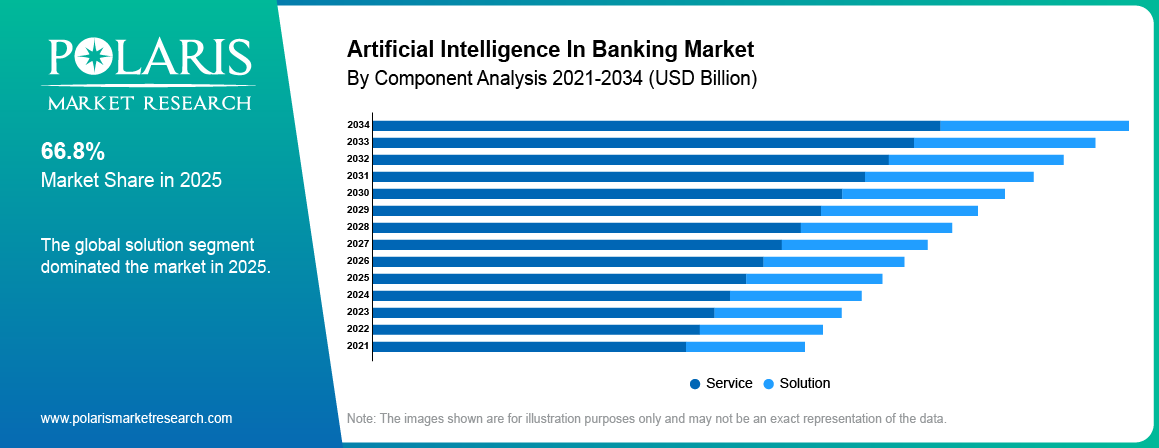
- The Solution segment held the largest market share of 66.8% in 2025. It is attributed to the upsurging demand for AI-enabled tools in the banking sector.
- The Natural Language Processing (NLP) segment led the market with 32.7% revenue share in 2025. Increasing deployment of data management tools and NLP-driven chatbots fuel the segment growth.
- The Risk Management segment dominated with 29.8% share in 2025. Evolving nature of cybersecurity threats and financial fraud propels the segment growth.
Note: Figures and projections outlined in this report are the result of Polaris Market Research’s proprietary analytical processes, grounded in the latest available datasets and market observations.
What Is Artificial Intelligence in Banking?
Artificial intelligence (AI) in banking refers to the use of smart computer systems in banking operations. In banking, AI technologies are used to analyze data and automate tasks. They help detect suspicious activities and provide personalized financial services. Banks adopt AI solutions to make faster decisions and improve security. It helps them offer better customer experiences.
Industry Dynamics
- Increasing investments in AI solutions from banks and fintech companies is driving the growth of the market.
- High demand for AI-enabled fraud detection software fuels the market expansion.
- Concerns related to data security and safety is hindering the adoption of AI in the banking sector.
- Rising emphasis on technological advancements is projected to offer lucrative opportunities in the market.
- Growing preference for personalized financial services is expected to become a key trend in the coming years.
The evolution in data collection technology amidst the bank and financial institutions and the advancement of AI in the banking industry is driving the growth of the market. Furthermore, the market is growing owing to a surge in the investment of banks in AI and an increase in the consumer desire for personalized financial services.
Source: Polaris Market Research Analysis
To Understand More About this Research: Download Sample Report
Artificial Intelligence (AI) is a branch of computer science committed to creating intelligent machines that can imitate human behavior. AI plays a crucial role by employing sophisticated data analytics to identify and prevent fraudulent transactions while enhancing compliance measures. A significant advancement in the banking sector involves the integration of AI, revolutionizing the customer experience through the application of advanced capabilities in contactless interactions. Leveraging extensive datasets, banks utilize AI to redefine the way businesses engage with customers and establish connections between various data points.
How AI Works in Banking
- Customer data collection: AI gathers data from transactions, customer profiles, digital banking activities, and financial records.
- AI model processing: Machine learning algorithms process and analyze large volumes of structured and unstructured banking data.
- Pattern recognition and prediction: AI identifies spending patterns, fraud risks, credit behavior, and future financial trends.
- Automated decision-making: AI supports instant decisions for loan approvals, fraud alerts, and customer service requests.
- Personalized banking action: AI delivers customized product recommendations, financial advice, and targeted customer engagement.
- Continuous learning and optimization: AI continuously improves its accuracy by learning from new data and customer interactions.
For instance, In May 2023, Kasisto, a U.S.-based company specializing in conversational artificial intelligence solutions for the finance sector, launched KAI-GPT, a large language model designed specifically for banking purposes.
Chatbots powered by artificial intelligence can analyze customer data and provide tailored recommendations and services to improve the overall banking experience. These systems facilitate operations, reducing costs by increasing productivity and leveraging data insights that outperform human decision-making abilities. Furthermore, sophisticated algorithms quickly detect fraudulent activity, significantly improving security measures in a matter of seconds. This technology marks an influential point in banking services, which prioritize efficiency and security.
The increase in day-to-day digital transactions, which consists of bill payments, online deposits, and withdrawals, requires banks to improve their fraud detection techniques. This growing demand drives the adoption of artificial intelligence in the banking industry. The importance of artificial intelligence, when combined with machine learning, lies in its ability to detect fraud, mitigate risks, uncover vulnerabilities in banking systems, and secure online financial transactions.
Banks are incorporating artificial intelligence (AI) into middle-office functions to detect, evaluate, and prevent payment fraud. They are additionally upgrading anti-money laundering (AML) procedures and carrying out regulatory checks to ensure know-your-customer (KYC) compliance. The use of artificial intelligence allows banks to create a more informed banking environment, providing clients with not only support and insights but also greater control over their financial assets and security. Many financial institutions are using AI to transform the client experience, enabling seamless and round-the-clock consumer interactions. The integration of AI bots, biometric fraud detection techniques, and digital payment advisors all contribute to higher service quality and a larger consumer base.
The incorporation of artificial intelligence in banking has been highlighted by ongoing advancements driven by rapid technological progress. This includes advances in machine learning algorithms, the availability of large amounts of big data, and increased computing power. This improvement opens up new AI applications, disrupting traditional banking methods and encouraging the development of innovative financial services and solutions.
For instance, In September 2023, Temenos, a Swiss-based software company, has unveiled an innovative and secure banking solution. This innovative solution uses Generative Artificial Intelligence (AI) to automate the categorization of customers' banking transactions.
Traditional Banking vs. AI-powered Banking
| Factor | Traditional Banking | AI-Powered Banking |
| Decision Making | Manual processes | Automated, data-driven analytics |
| Customer Support | Human-driven service | AI assistants and automation |
| Fraud Detection | Rule-based monitoring | Predictive AI detection models |
| Personalization | Limited product recommendations | Personalized, data-driven insights |
| Processing Speed | Slower, manual workflows | Real-time decisions and processing |
Source: Polaris Market Research Analysis
AI-Driven Fraud Detection and Prevention in Banking
Fraud detection remains one of the strongest catalysts for AI adoption in banking. As digital transactions, real-time payments, and cross-border transfers scale up, financial institutions are turning to machine learning models that flag anomalies in milliseconds rather than hours. This shift is reducing false positives while catching sophisticated fraud patterns that rule-based systems typically miss.
Key capabilities driving this segment include:
- Real-time transaction monitoring that scores every transaction against behavioral baselines
- Behavioral biometrics and anomaly detection to flag unusual account activity before losses occur
- Payment fraud prevention across card, wire, and digital wallet channels
- AML and KYC automation to meet compliance checks without slowing onboarding
- Reduction in financial losses through earlier intervention and fewer manual reviews
Citigroup's 2024 acquisition of Feedzai, a leading AI-based fraud prevention platform, reflects how seriously banks are investing in this capability to stay ahead of evolving financial crime.
Artificial Intelligence in Banking Market Dynamics
Market Growth Drivers and Key Challenges
| Growth Drivers | Key Challenges |
| Rising digital banking adoption and transaction volumes | Data privacy and security concerns among customers and regulators |
| Exponential growth in financial data generation | Evolving regulatory compliance requirements across regions |
| Increasing demand for real-time fraud prevention | High costs of implementation and system upgrades |
| Growing consumer expectation for personalized banking services | Shortage of skilled AI and data science professionals |
| Expansion of fintech ecosystems and embedded finance | Integration challenges with legacy banking infrastructure |
| Rising adoption of cloud-based banking platforms | Bias and transparency concerns in automated decision-making |
Source: Polaris Market Research Analysis
Market Drivers
Rising Bank Investment in AI Drives Market Growth
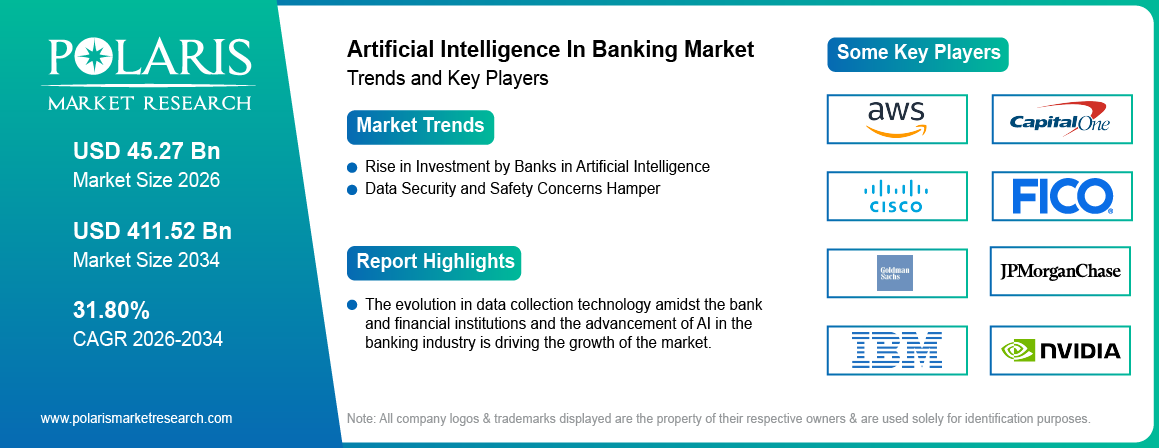
Banks are increasing investment in artificial intelligent solutions to transmute the management process of FinTech and to deliver superior services to their users. Furthermore, as the banking industry becomes more complex and competitive, there is a greater demand for specialized solutions tailored to its goals. As a result, in order to meet customer demands, many banking institutions and FinTech companies are investing in AI solutions, accelerating the growth of AI in the banking market. Furthermore, AI plays a crucial role in assisting financial institutions throughout the risk management process, including risk identification, measurement, estimation, and impact assessment.
Furthermore, the growth of the Artificial intelligence market in banking is being driven by increased investment from FinTech companies and banks. These investments aim to improve automation processes and offer customers a more efficient and personalized experience. Furthermore, major financial institutions are investing heavily in AI technology to develop automated investment advisors and train systems for detecting activities like money laundering. This proactive financial monitoring helps to prevent illegal techniques, which contributes to the overall growth of artificial intelligence in the banking sector.
Source: Polaris Market Research Analysis
Market Restraints
Data Security and Safety Concerns Hamper on the Growth of the Market
Banking professionals claim that privacy and security concerns are the main barriers to the adoption of AI technologies. Financial institutions are more vulnerable to cyber threats due to the use of AI platforms and solutions that extensively analyze customer data to extract valuable insights for informed decision-making and operational efficiency. Protecting data integrity for deep learning and machine learning algorithms presents a significant challenge. Nonetheless, governments' increasing efforts to enact AI-specific legislation and establish dedicated AI regulators charged with overseeing ethical and security issues are expected to address these challenges in the forecast period.
Artificial Intelligence in Banking Market Segment Analysis
The market is primarily segmented based on component, technology, enterprise size, application, and region.
| By Component | By Technology | By Enterprise Size | By Application | By Region |
|
|
|
|
|
Source: Polaris Market Research Analysis
Market Segmental Analysis
By Component Analysis
The solution segment held the largest market share in 2025, owing to the rising demand od AI-powered tools in the market. These tools include automated customer service, personalized financial recommendations, and fraud detection. Furthermore, ongoing advancements in AI technology are resulting in more precise and tailored solutions that cater to specific banking needs, increasing accuracy and efficiency. Furthermore, as banks aim to modernize their operations, there is an increasing trend of investment in AI-based solutions. This investment is intended to streamline processes, improve decision-making capabilities, and provide superior customer experiences. The widespread use of AI solutions across various banking functions is driving the growth of the solution segment in the AI banking market.
The service segment witnessed for the fastest growth during the forecast period. Banks are increasingly acknowledging the significance of specialized guidance and assistance in the incorporation and assimilation of AI solutions into their current frameworks. As AI technology becomes more complex and specific, the demand for tailored consulting, training, and maintenance services has risen. Additionally, numerous financial institutions need to possess in-house proficiency in AI technologies, leading to a need for external services to navigate intricacies and enhance AI systems to meet specific banking needs.
By Technology Analysis
The natural language processing (NLP) accounted for the largest market share in 2025. The growing reliance on digital platforms for banking operations has resulted in a significant increase in unstructured textual data, such as customer inquiries, reviews, and social media interactions. Natural language processing (NLP) is critical for banks to extract valuable insights from unstructured data. This makes it easier to conduct customer sentiment analysis, provide personalized service, and gain a better understanding of customer needs and preferences. Furthermore, NLP-driven chatbots and virtual assistants help to improve conversational capabilities, resulting in more natural and effective interactions with customers and, ultimately, higher overall customer satisfaction.
The computer vision segment is witnessed for the fastest growth in the market. Computer vision is widely used in the field of security, with facial recognition and video analytics used to monitor and protect ATMs, branches, and online transactions. This application significantly improves fraud detection and prevention capabilities. Furthermore, Computer Vision optimizes document verification procedures by extracting and analyzing data from IDs, checks, and forms, reducing manual errors and speeding up administrative tasks. Its integration with mobile banking apps improves customer experiences by enabling features like image recognition for remote check deposits.
By Application Analysis
Based on application analysis, the market has been segmented on the basis of risk management, customer service, virtual assistant, financial advisory, and others. The evolving nature of financial fraud and cybersecurity threats necessitates advanced risk management tools driven by artificial intelligence. These tools play a crucial role in swiftly identifying and addressing fraudulent activities as banks expand their services and participate in increasingly complex transactions. The inherent risks associated with such activities are heightened. AI-driven risk management tools offer in-depth analysis and modeling features, aiding banks in effectively managing risks across a diverse range of intricate financial products and services.
The customer service segment is witnessed for the fastest growth in the market. The banking industry is increasingly emphasizing the delivery of personalized and efficient customer interactions. AI-powered solutions enable automated but highly personalized customer service via customized chatbots, virtual assistants, and voice recognition systems. This method effectively addresses individual customer requirements. With changing customer expectations, there is a greater need for 24-hour support and quick query resolution, and AI-powered customer service tools are well-equipped to meet these demands efficiently.
Real-World Applications of AI in Banking
- AI-Enabled Banking Chatbots: AI chatbots are used for 24/7 customer support. These bots answer customer queries and assist them with account management. Adoption of these chatbots helps banks improve digital banking experiences of their customers.
- Fraud and Transaction Monitoring: AI tools help detect suspicious transactions in real time. They use machine learning (ML) to prevent fraud and reduce/avoid financial losses.
- Credit Risk Assessment: The technology evaluates borrower creditworthiness. AI-driven predictive analytics is used to improve lending accuracy. It reduces default risks.
- Customer Behavior Analysis: AI systems analyze customers’ transaction patterns and preferences. This helps banking organizations enhance marketing strategies and boost customer engagement and retention.
- Regulatory Compliance Automation: The technology enables automation in KYC, AML, transaction monitoring, and regulatory reporting. It helps enhance compliance and reduces operational costs.
Source: Polaris Market Research Analysis
Artificial Intelligence in Banking Market Regional Analysis
Regional Market Trends in AI in Banking Market
| Region | Market Position | Key Trends |
| North America | Largest Market |
|
| Europe | Mature Market |
|
| Asia Pacific | Fastest-Growing Market |
|
| Latin America & Middle East & Africa | Emerging Market |
|
Source: Polaris Market Research Analysis
North America Artificial Intelligence in Banking Market
North America dominated the artificial intelligence in banking market, North America boasts a strong technological framework and extensive digitization of its banking processes, creating an ideal environment for the widespread adoption of AI technologies. Banks have led the way in adopting AI solutions, using them to improve customer experiences, provide tailored services, and perform sophisticated analytics. The involvement of major AI technology providers has also accelerated the early adoption of AI in the North American banking sector, hastening its integration and expansion.
Asia Pacific has witnessed for the fastest growth in the market. The AI in the Asia-Pacific banking sector is expanding, fueled by a thriving fintech industry, rapid digitalization efforts, and a sizable population gaining access to digital banking services. Primarily, China and India, among other emerging economies in the region, are rapidly integrating AI into their banking systems. The efforts of innovative fintech startups and strategic investments from well-established financial institutions are driving this growth. Furthermore, the increasing prevalence of smartphones, as well as a growing demand for streamlined and convenient banking services among a diverse consumer base, contribute to the widespread adoption of AI technologies across Asia-Pacific markets.
Source: Polaris Market Research Analysis
Competitive Landscape
The market is characterized by intense competition, with established players relying on advanced technology, high-quality products, and a strong brand image to drive revenue growth. These companies employ various strategies such as research and development, mergers and acquisitions, and technological innovations to expand their product portfolios and maintain a competitive edge in the market.
Some of the major players operating in the global market include:
- Amazon Web Services, Inc.
- Capital One
- Cisco Systems, Inc.
- FAIR ISAAC CORPORATION (FICO)
- Goldman Sachs
- International Business Machines Corporation
- JPMorgan Chase & Co.
- NVIDIA Corporation
- RapidMiner
- SAP SE
Recent Developments
- July 2026: Visa introduced AI Financial Assistant, a new value‑added service. Financial institutions can use this service to evolve their apps for an AI‑driven era. It will help banks bring AI-enabled financial insights to cardholders under their brand.(Source: investor.visa.com)
- In January 2025: Bank of America bought Zest AI, a top firm for AI credit tools. This deal helps the bank make better loan choices using AI risk models. With Zest AI, Bank of America wants to improve loan approvals, cut bias, and give more custom credit options.
- In November 2024: Citigroup bought Feedzai, a major AI platform for stopping fraud. The deal helps Citigroup fight financial crime using real-time AI tracking. By using Feedzai tech, Citigroup builds better security to protect users from new fraud threats.
- In May 2024, the Ministry of Industry and Advanced Technology partnered with Emirates Development Bank to provide AED 370 million in funding to support the launch of a new AI Innovation Program in the UAE.
- In May 2024, Sterling Bank partnered with AI in Nigeria to launch the Nigeria AI Landscape and Startup Report, offering insights into the country’s AI ecosystem and startup environment.
Generative AI in Banking: Emerging Use Cases
Generative AI (GenAI) is opening a distinct layer of banking innovation beyond traditional machine learning, moving from pattern detection into content and conversation generation. Banks are piloting large language models to automate tasks that previously required significant human effort, from advisory support to internal documentation.
Emerging applications include:
- Automated financial advisory support, offering personalized guidance at scale
- AI-generated customer communications, including query responses and account summaries
- Document processing automation for loan applications, compliance filings, and KYC documentation
- Improved employee productivity through AI copilots for research and reporting
- Enhanced knowledge management, surfacing internal policy and product information instantly
Kasisto's 2023 launch of KAI-GPT, a large language model purpose-built for banking, signals how quickly generative AI is moving from experimentation to deployment across the sector.
Future Outlook of Artificial Intelligence in Banking Market
The AI in banking market is expected to grow significantly in the coming years. Growing adoption of AI-driven automation, predictive analytics, and intelligent customer service solutions across financial institutions will fuel the market development. Rising integration of generative AI (GenAI), ML, and cloud technologies will bring transformation in banking operations. Future market growth will be supported by secure AI implementation and regulatory compliance. Continued innovation in digital financial services would become a key future industry trend.
Artificial Intelligence in Banking Market Report Coverage
The Artificial Intelligence in Banking Market report emphasizes on key regions across the globe to provide better understanding of the product to the users. Also, the report provides market insights into recent developments, trends and analyzes the technologies that are gaining traction around the globe. Furthermore, the report covers in-depth qualitative analysis pertaining to various paradigm shifts associated with the transformation of these solutions.
The report provides detailed analysis of the market while focusing on various key aspects such as competitive analysis, component, technology, enterprise size, application, and their futuristic growth opportunities.
Artificial Intelligence in Banking Market Report Scope
| Report Attributes | Details |
| Market size value in 2025 | USD 34.40 billion |
| Market size value in 2026 | USD 45.27 billion |
| Revenue forecast in 2034 | USD 411.52 billion |
| CAGR | 31.80% from 2026 – 2034 |
| Base year | 2025 |
| Historical data | 2021 – 2024 |
| Forecast period | 2026 – 2034 |
| Quantitative units | Revenue in USD billion and CAGR from 2026 to 2034 |
| Segments Covered | By Component, By Technology, By Enterprise Size, By Application, By Region |
| Regional scope | North America, Europe, Asia Pacific, Latin America, Middle East & Africa |
| Customization | Report customization as per your requirements with respect to countries, region, and segmentation |
Source: Polaris Market Research Analysis
In today’s hyper-connected world, running a business around the clock is no longer an option. And at Polaris Market Research, we get that. Our sales & analyst team is available 24x5 to assist you. Get all your queries and questions answered about the Artificial Intelligence In Banking Market report with a phone call or email, as and when needed.
Artificial Intelligence in Banking Market Frequently Asked Questions
The Artificial Intelligence In Banking Market report covering key segments are component, technology, enterprise size, application, and region.
The artificial intelligence in banking market size is expected to reach USD 411.52 Billion by 2034
Artificial Intelligence in Banking Market exhibiting the CAGR of 31.80% during the forecast period
North America regions is leading the global market
Rise in investment by banks in Artificial Intelligence will drive the growth of the market are the key driving factors in Artificial Intelligence In Banking Market.
AI tools improve operational efficiency and accelerate decision-making. The technology helps enhance customer experiences and reduces costs. It strengthens fraud prevention and enables personalized financial services using data-driven insights.
AI-powered banking uses the following technologies: machine learning (ML), natural language processing (NLP), generative AI (GenAI), predictive analytics, computer vision, robotic process automation (RPA), and cloud-based AI platforms.
AI analyzes transaction patterns in real time. It identifies unusual activities and detects anomalies using ML algorithms. This helps financial institutions prevent potential fraud before losses.
Download Sample Report of Artificial Intelligence In Banking Market
Please fill out the form to request a customized copy of the research report.


