
AI In Network Market Size, Share, Trends & Forecast, 2026–2034
REPORT DETAILS
AI In Network Market Summary
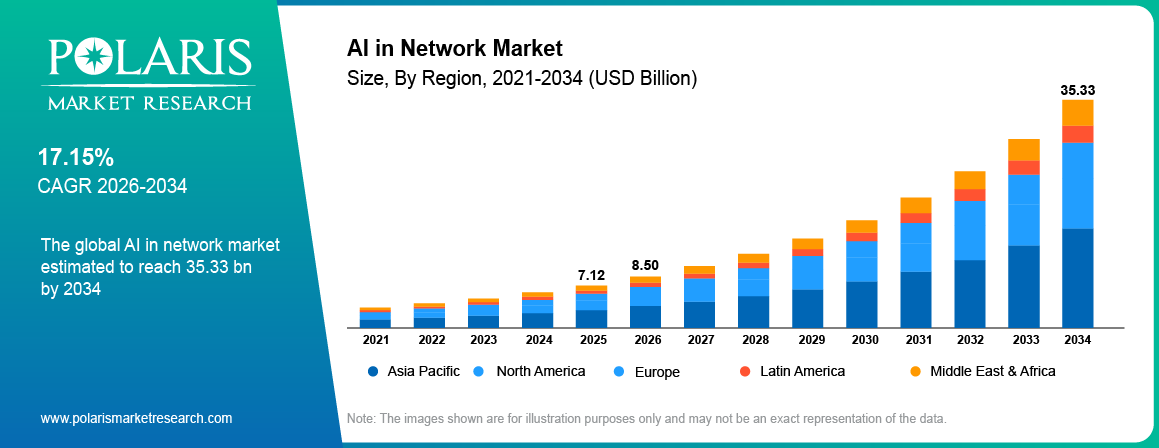
The global AI in network market, also referred to as the AI in networks market, was valued at USD 7.12 Billion in 2025. The market is expected to grow at a CAGR of 17.15% from 2026 to 2034, with revenue forecast to reach USD 35.33 Billion by 2034. Growth is propelled by rising network complexity, demand for faster fault resolution, and the shift from AI-assisted recommendations toward governed agents that can diagnose and execute network actions.
Market Statistics
Key Takeaways
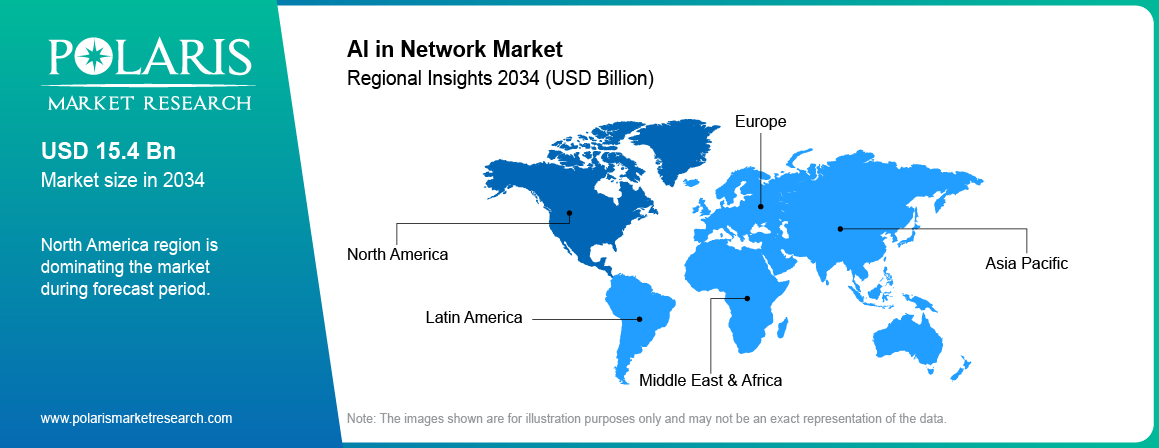
- North America accounted for 41.68% share of the AI in network market in 2025, driven by a concentration of networking vendors, enterprise management platforms, and developers of AI-led network operations software.
- Asia Pacific is expected to witness a 19.80% CAGR during the forecast period, driven by the modernization of telecommunications, Open RAN activity, and the advancement of autonomous network capabilities in the region.
- Solutions is the dominant component segment in 2025 with 64.28% market share, driven by rising demand for software platforms, analytics, assurance and AI agents.
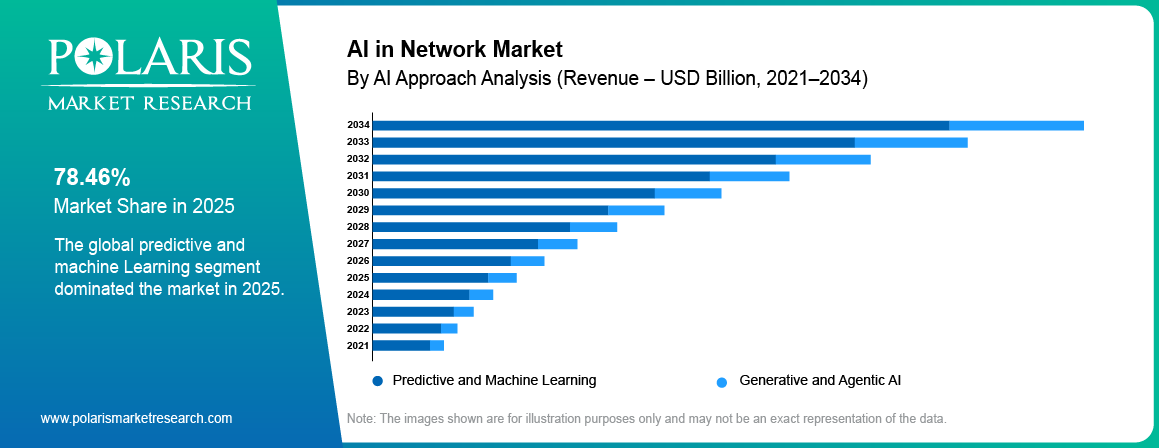
- Predictive and Machine Learning are leading AI approach segment, with a 2025 market share of 78.46%.
- Network optimization is currently identified as the leading application segment, with a 2025 market share of 25.64%.
Note: Figures and projections outlined in this report are the result of Polaris Market Research’s proprietary analytical processes, grounded in the latest available datasets and market observations.
AI in Network Market Definition
The AI in network market covers software platforms, analytical tools, autonomous network capabilities, and professional services that apply artificial intelligence to network operation and management. These technologies ingest network telemetry, configuration records, alarms, performance metrics, and service context to identify anomalies, diagnose faults, recommend remediation, and, where governance permits, execute a corrective action. The market spans telecommunications, data center and cloud networks, enterprise campus and branch infrastructure, and government networks. Its commercial scope is the intelligence and operations layer, rather than the physical networking equipment itself.
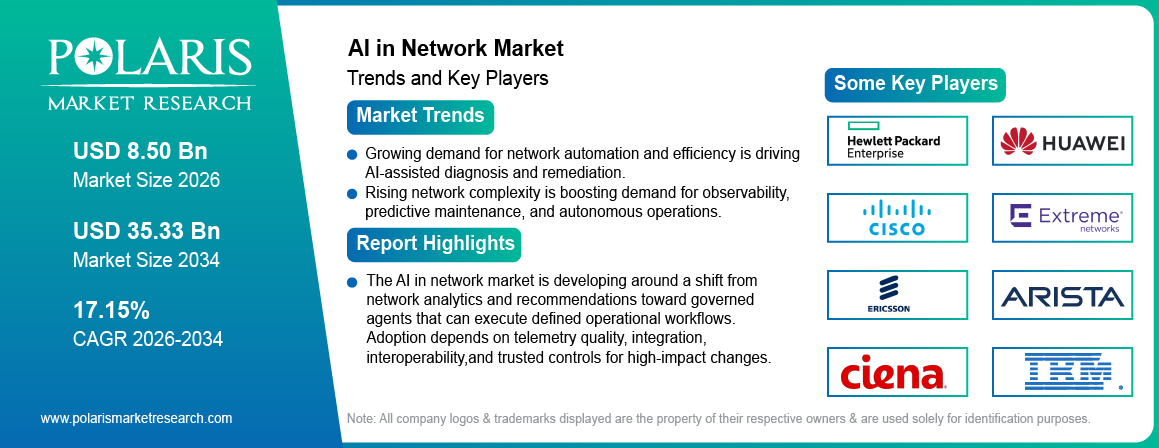
Network management systems increasingly combine machine learning with workflow automation and generative or agentic capabilities, commonly described as agentic AIOps. Predictive models detect performance deviations and estimate potential faults, while reasoning agents can correlate signals across tools, explain likely causes, and assemble a remediation plan. Vendors are adding controls such as permission boundaries, change validation, audit trails, and human approval because a mistaken action can interrupt network service. IBM Network Intelligence, for example, pairs time-series foundation models with reasoning agents for network-aware analysis, while Cisco's AgenticOps approach emphasizes guided or automated workflows with operational oversight (Source: ibm.com; cisco.com).
The market is closely related to the AI in Telecommunication Market, but this report focuses on network operations capabilities across the broader buyer landscape of the AI network management market and separates software and services from network hardware. AI applied to networks is different from networks for AI: the former uses intelligence to manage infrastructure, while the latter includes switches, optics, and silicon built to connect GPU clusters. This distinction is important because product portfolios increasingly span both domains, and some competitor pages combine network automation with AI data-center fabrics. This report excludes hardware whose primary role is carrying AI compute traffic.
Autonomy frameworks for autonomous networks provide a way to separate assistive analytics from operations where a system acts on a human-defined intent. Telefónica had 12 Level 4 use cases at the end of 2025, with an average level of the group’s overall autonomy at 3.42, indicating that the automated use cases are developed faster than the whole network domain. The difference determines which products and services are counted as revenue from AI-native operations when estimating the market. Security analytics also overlap with cybersecurity platforms and market models need to avoid double-counting the same software revenue in both markets (Source: operatorwatch.com).
Market Dynamics
Driver Impact Analysis
Driver | Impact Level | Key Regions | Timeline |
Demand for network automation and operational efficiency | High | North America, Europe | Short term |
Rising network complexity and reliability requirements | High | Global | Short to medium term |
Shift from assistive AI to governed agentic AIOps | High | North America, Asia Pacific | Medium term |
Expansion of Open RAN, intent-based networking, and service orchestration | Medium | Asia Pacific, Europe | Medium to long term |
Growth of multi-vendor network intelligence and agent interoperability | Medium | North America, Europe | Medium to long term |
Source: Polaris Market Research Analysis
Driver: Growing Demand for Network Automation and Operational Efficiency
Demand in the AI in network market is gaining traction as telecom operators, data center providers and enterprises try to reduce manual network monitoring and troubleshooting. AI-powered platforms analyze alarm, configuration and performance data to detect anomalies, prioritize incidents and suggest corrective actions. These capabilities result in better operational consistency and allow network teams to manage more complex infrastructure with less repetitive work.
The market is moving toward agentic AIOps and product development in the AI network automation market is accelerating. In February 2026, Cisco expanded AgenticOps to networking, security and observability. Extreme Networks unveiled Agent ONE in May 2026 with Coworker and Operator modes to be rolled out in stages. The developments indicate growing automation potential but buyers need to verify real productivity gains, remediation accuracy and protections before scaling up autonomous operations (Source: investor.extremenetworks.com).
Driver: Rising Network Complexity and Requirements for Reliability
The demand for network reliability is increasing and investments are made in AI-based monitoring, fault management and proactive optimization. Telecom networks are a convergence of radio access, transport, core, and cloud native systems and enterprises are managing more and more distributed campus, branch, and data center environments. Artificial intelligence helps correlate signals across these systems, distinguish abnormal behavior from normal variation, and help identify potential faults before they cause service disruption.
Telefónica announced 12 Level 4 use cases by the end of 2025 and its overall network autonomy level was 3.42. In August 2026, Ericsson and Mobily announced a collaboration to advance network autonomy. These initiatives highlight the interest of the industry in autonomous networks. Predictive network maintenance can help predict congestion, identify degrading components, and assist in capacity planning. Adoption is dependent on demonstrable improvements in availability, repair time and successful remediation.
Restraint: Integration Complexity, Governance Requirements, and Operational Risk
The complexity of integrating systems inhibits the adoption of AI, as networks have devices from multiple vendors, legacy interfaces and fragmented management systems. Inconsistent network telemetry limits the context available to AI models. Integration with platforms with inventory, ticketing, orchestration and change-management tools also increases implementation effort. Organizations also need to consider data access, security and compliance requirements before AI tools are deployed across operational environments.
Risks increase as artificial intelligence systems shift from providing recommendations to executing direct configuration changes. Extreme Networks’ Agent ONE separates Coworker and Operator modes. Cisco emphasizes controlled workflows and risk-aware validation. Arista also builds AI assistance into its CloudVision platform. Zero touch operations, therefore, require strong permissions, audit trails, supervision by humans, and rollback capabilities to prevent errors that could impact network availability or security (Sources: investor.extremenetworks.com; investor.cisco.com, arista.com).
Opportunity: Expansion of Open RAN, Intent-Based Networking, and Service Orchestration
New opportunities for AI-driven network orchestration, optimization and service assurance are opened up by Open RAN and programmable architectures. Open interfaces enable applications to coordinate network functions. Service management and orchestration support workflows across multiple domains. Intent-based networking builds on these capabilities by mapping desired service outcomes to policies and configurations to reduce manual intervention while remaining within defined operational boundaries.
In June 2026 portfolio update, Nokia showcased its Autonomous Networks Agent Library, MantaRay SMO and collaboration with NTT DOCOMO on SMO-driven autonomy. Ciena’s Blue Planet AI Studio enables the creation of network agents, and NEC showed an agent-based approach to managing the 5G User Plane Function lifecycle, with AWS. These developments present opportunities in the AI network automation market for service activation, fault resolution, capacity optimization and intent-based networking but wider adoption relies on validated outcomes and reliable integration (Source: intelligentcio.com, ciena.com; nasdaq.com).
Opportunity: Growth of Multi-Vendor Network Intelligence and Agent Interoperability
Organizations with mixed-vendor networks require intelligence platforms that are capable of correlating information across equipment, cloud environments and applications. Individual vendor tools are effective within their own ecosystem, but limited in visibility across the entire service path. Network observability and network monitoring platforms can correlate telemetry, logs, configuration data and application signals to identify cross-domain faults, leading to more consistent operational decisions.
Selector focuses on correlating network, cloud and application data. Selector reportedly raised USD 32 million in February 2026. Network automation and analysis are the focus of Ciena’s Blue Planet AI Studio and IBM Network Intelligence. Such developments underscore competition in delivering cross-domain intelligence, but commercial success will depend on reliable agentic AIOps interoperability, secure permissions, and auditable remediation. Platforms that reduce integration effort without creating additional operational risk could strengthen their position in the AI network management market.
AI in Network Market Segmentation Analysis
The AI in network market report is segmented by component, deployment, application, AI approach, end user, and region.
Component Insights
The Solutions segment accounted for 64.28% share of the AI in network market in 2025, reflecting demand for network operations software, AI-enabled assurance platforms, analytics, and automation engines. These solutions enable network optimization, fault management, performance monitoring, security analytics and orchestration. Examples of how vendors embed AI into network operations software in the AI network management market include Cisco AgenticOps, IBM Network Intelligence and Arista CloudVision AVA. Hardware is excluded to distinguish AI-enabled network operations from AI infrastructure equipment (Sources: investor.cisco.com; ibm.com; arista.com).
In the AI network management software vs services comparison, the Services segment is estimated to have a 18.55% CAGR during the forecast period due to the demand from organizations for integration, telemetry normalization, policy configuration, and operational support. Consulting and implementation services assist buyers in validating AI recommendations, establishing performance baselines and implementing controlled automation. Managed services also benefit companies that don’t have internal expertise. Nokia’s portfolio of autonomous networks shows potential for improvements in operational productivity, although customers will need to independently validate the vendors’ claims (Source: intelligentcio.com).
Deployment Insights
The Cloud segment accounted for 54.38% share of the AI in network market in 2025, supported by centralized management, simplified updates, and analytics across distributed networks. Cloud-based platforms also support network-as-a-service models and allow enterprises to manage campus and branch infrastructure without the need to maintain separate software environments at each site. The adoption depends on data sensitivity, connectivity, latency and operational control requirements. The neighboring AI in Telecommunication Market’s cloud leadership provides the context, but does not determine this market’s deployment share.
The On Premises segment of AI in network deployment is expected to register a 15.26% CAGR during the forecast period as some buyers prefer data residency, local system integration, and direct control over sensitive network telemetry. Telecom operators and public sector organizations prefer local deployments where security policies or continuity requirements do not allow dependency on external services. Nokia’s 2026 portfolio update included expanding deployment options, such as on-premises. Depending on operational and regulatory requirements, hybrid architectures involve centralized model development with local inference or policy enforcement (Source: intelligentcio.com).
Application Insights
Network optimization represented 25.64% of AI in network market share in 2025, with applications in capacity planning, congestion management and traffic steering and service-level optimization. Artificial intelligence systems analyze network telemetry to identify performance gaps and evaluate potential configuration changes. Among Telefónica’s reported autonomous network progress are capacity-related use cases and transport-network digital twins, examples of the move to more automated optimization workflows (Source: operatorwatch.com).
Automation and Orchestration is projected to grow at a 19.30% CAGR during the forecast period as organizations move toward coordinated workflows across monitoring, configuration, and service assurance. Network Security also represents an important application, including anomaly detection and AI-assisted firewall policy recommendations. However, security revenue overlapping with the AI in Cybersecurity Market must be excluded to avoid double counting. Other applications include traffic and performance management, predictive network maintenance, and fault management (Sources: investor.cisco.com).
AI Approach Insights
The Predictive and Machine Learning segment accounted for a 78.46% share of the AI in network market in 2025. This is due to the use of anomaly detection, time-series analysis, pattern recognition, and predictive models on network telemetry. These techniques enable predicting congestion, detecting performance anomalies, prioritizing alarms, and forecasting possible service failures. Their efficiency depends on the quality of the historical data and the telemetry coverage. The IBM Network Intelligence demonstrates the application of time-series foundation models and reasoning agents to show how predictive analysis can be integrated into the wider workflows of network operations (Source: ibm.com).
The Generative and Agentic AI market is estimated to grow at a 24.85% CAGR over the forecast period. Vendors are launching agentic AIOps systems that understand operational context, explain incidents, recommend remediation and execute approved actions. Generative artificial intelligence can help with analysis and explanation. Agents can coordinate tasks across tools. The Extreme Networks' Agent ONE has two modes, Coworker and Operator, which are the difference between help and more autonomous execution (Source: investor.extremenetworks.com).
End User Insights
Telecom Operators held 46.12% share of the AI in network market in 2025, driven by the need to manage radio, transport, IP, and core networks, where service disruptions can affect large subscriber bases. Operators are extending existing analytics and automation investments to support cross-domain workflows, improve service reliability, and advance network autonomy. Telefónica's autonomous network program and the Ericsson-Mobily collaboration highlight growing adoption of AI-driven network management solutions, supporting the development of the autonomous network market (Sources: operatorwatch.com; ericsson.com).
Enterprises are projected to register a 17.70% CAGR during the forecast period as IT teams seek more efficient ways to manage campus, branch, wireless, private 5G, and data center networks. Many organizations operate complex environments with limited specialist resources, making faster troubleshooting and routine maintenance important priorities. AI-based management tools can help identify network problems, eliminate repetitive manual tasks, and increase visibility across interconnected systems. Cloud Service Providers and Data Centers demand detailed performance analytics, traffic monitoring and quick fault identification to ensure quality of service in an increasingly complex network fabric.
Regional Analysis
The AI in network market is segmented into North America, Europe, Asia Pacific, Latin America, and Middle East and Africa. Demand in these regions is influenced by factors such as the maturity of the network infrastructure, telecommunications investment, enterprise digitalization, and the availability of AI-enabled management platforms.
AI in Network Regional Snapshot
| Region | Market Position | Key Demand Drivers | Vendors Active |
| North America | Leading region | Vendor concentration, enterprise adoption, and demand for efficient network operations | Cisco, HPE, Extreme Networks, Arista Networks |
| Europe | Established | Telecom modernization and autonomous network programs | Nokia, Ericsson, Telefónica |
| Asia Pacific | High-growth | Telecom investment, Open RAN activity, and autonomous operations | Huawei, ZTE, NEC |
| Latin America | Emerging | Network modernization and mobile service requirements | ZTE, Telefónica |
| Middle East & Africa | Emerging | Network expansion and digital transformation programs | Ericsson, Mobily |
Source: Polaris Market Research Analysis
North America AI in Network Market Trends
North America held an AI in network market share of 41.68% in 2025, driven by the presence of established networking vendors, adoption of enterprise technology, and demand for efficient network operations. Cisco extended AgenticOps, Extreme Networks launched Agent ONE and Arista pushed CloudVision AVA. HPE further strengthened its networking portfolio with the acquisition of Juniper Networks. Together, these developments illustrate how incumbent suppliers are embedding AI capabilities into network management and operational workflows (Source: investor.cisco.com, investor.extremenetworks.com, arista.com, theregister.com).
Regional market growth, central to the AI in network industry forecast, is driven by demand for network observability, automated troubleshooting, and operational efficiency. Agentic AI is an element of IBM’s Network Intelligence initiative, which is designed for complex network environments in which teams have to analyze vast amounts of operational data to identify the root causes of service disruptions. There is a growing need from enterprises and service providers for tools that will help them in fault detection, automate routine tasks and provide a clearer picture of performance across disparate network domains (Source: newsroom.ibm.com).
Europe AI in Network Market Trends
AI in network market analysis shows that Europe represented 26.74% of the market in 2025 due to the telecommunications modernization, existing infrastructure providers, and need for more autonomous network management. Nokia and Ericsson are continuing to develop automation capabilities for telecommunications operators while Telefónica has reported Level 4 use cases in Spain, Germany and Brazil. These examples illustrate how artificial intelligence can be applied to specific operational workflows, such as fault resolution and network optimization, instead of making the whole network autonomous from day one. (Source: operatorwatch.com, huawei.com).
Demand for automated service assurance, efficient fault resolution and coordinated network management is expected to underpin the European autonomous network market. Legacy infrastructure has to be balanced by operators with cloud-native systems, which can make manual troubleshooting a lengthy process. Tools powered by AI may help spot common problems, prioritize incidents and coordinate responses across network domains. These operational requirements are creating opportunities for solutions that enhance service performance and reduce the need for repetitive manual intervention.
Asia Pacific AI in Network Market Trends
Asia Pacific is projected to grow at 19.80% CAGR during the forecast period, due to telecommunications investments, enterprise digitalization, and the development of AI-enabled networking technologies. NEC showcased agentic AI for 5G core network operations with AWS, Huawei announced AN L4 Phase 2 and ZTE launched its AIR MAX solution in 2026. These initiatives are indicative of activity across network lifecycle automation, autonomous operations and AI-supported mobile network management. The combination of network operators and technology vendors in the region provides opportunities for both adoption and product development. (Source: nasdaq.com, huawei.com, zte.com.cn).
Mobile network expansion, 5G infrastructure rollouts, and the need to manage growing operational complexity are expected to drive demand across Asia Pacific. Operators are exploring automation across radio, transport, and core network functions to improve service performance and streamline routine tasks. AI-based monitoring, traffic optimization, and predictive fault management can help teams respond to network issues more efficiently. Adoption will depend on local investment priorities, infrastructure readiness, and the operational requirements of individual markets.
Middle East & Africa AI in Network Market Trends
The Middle East and Africa region accounted for 3.46% share of the AI in network market in 2025, owing to network expansion, digital transformation programs and interest in more automated telecommunications operations. In August 2026, Ericsson and Saudi operator Mobily signed an MoU to explore AI-enabled network operations including self-healing, optimization and energy management. The initiative fits with Saudi Arabia’s Vision 2030 agenda and highlights operators’ interest in using AI to enhance network performance and operational efficiency. (Source: ericsson.com).
Demand for improved network performance and more efficient operations is expected to create opportunities throughout the region. AI-based monitoring can help operators spot faults, while automated maintenance and energy optimization can help use network resources more efficiently. Operators will need management tools to deal with the increasing complexity of networks as telecommunications infrastructure grows, without the accompanying increase in manual workload. The degree of adoption will be a function of the investment in infrastructure, the priorities for digitalization and the readiness of current systems.
Latin America AI in Network Market Trends
Latin America held an AI in network market share of 4.26% in 2025, owing to network modernization, mobile service requirements, and the need to improve operational efficiency. In May 2026, ZTE demonstrated AI and network integration at GSMA M360 LATAM in Mexico City and announced deployments in Chile, Ecuador, Bolivia, Brazil and Peru. Telefónica’s autonomous network initiatives have also reached Brazil, pointing to regional activity in workflow automation and AI-enabled network operations. (Source: kyodonewsprwire.jp, operatorwatch.com).
The need for improved traffic management, faster fault resolution and dependable connectivity will drive market growth across Latin America. AI-driven monitoring and automation can help operators manage geographically dispersed infrastructure and catch service problems before they become widespread. Providers looking for efficiencies without replacing whole networks might like solutions that play with existing equipment. Adoption rates will depend on modernization budgets, system compatibility and the ability to fold AI tools into existing operational workflows.
AI in Network Market Competitive Landscape
Vendor Landscape Snapshot
Vendor | Headquarters | Market Position | Core Focus in Scope |
Cisco Systems, Inc. | United States | Leader | AgenticOps across networking, security, and observability |
Hewlett Packard Enterprise Company | United States | Leader | Juniper Mist and Aruba Central AI operations platforms |
Nokia Corporation | Finland | Leader | Autonomous network suites for telecom operators |
Telefonaktiebolaget LM Ericsson | Sweden | Leader | Operator autonomy and multi-vendor network automation |
Huawei Technologies Co., Ltd. | China | Leader | Autonomous network operations and domain AI agents |
International Business Machines Corporation | United States | Challenger | Network-native AI and operational analytics |
Extreme Networks, Inc. | United States | Challenger | Enterprise network operations and agent-led management |
Arista Networks, Inc. | United States | Challenger | CloudVision and multi-domain network intelligence |
Ciena Corporation | United States | Challenger | Network automation for service-provider operations |
ZTE Corporation | China | Challenger | AI-enabled mobile network operations |
Samsung Electronics Co., Ltd. | South Korea | Specialist | O-RAN-compliant network operations suite |
NEC Corporation | Japan | Specialist | Core-network lifecycle automation and autonomous operations |
Adtran Holdings, Inc. | United States | Specialist | AI agents for telecom network management |
Selector Software, Inc. | United States | Emerging Innovator | Cross-domain observability and agentic NetOps |
Forward Networks, Inc. | United States | Emerging Innovator | Digital-twin-based agentic AI for network changes |
Source: Polaris Market Research analysis based on cited company announcements and industry reporting. Market positions reflect Polaris Market Research's qualitative assessment of portfolio breadth, scale, and operator or enterprise reach.
The AI in network market includes networking vendors, telecommunications providers, and software specialists developing network intelligence and autonomous operations. Competition for AI in network market share focuses on telemetry analysis, equipment compatibility, orchestration, and reliable automated remediation. Established vendors can embed AI in existing platforms while specialist providers aim for cross-vendor visibility and root-cause analysis.
Cisco, Hewlett Packard Enterprise, Nokia, Ericsson, Huawei, Extreme Networks, Arista Networks, IBM, Ciena, NEC Corporation, ZTE, Selector, Samsung Electronics, Adtran, and Forward Networks are some of the key AI networking companies. They offer enterprise networking, autonomous operations and network intelligence. Juniper Networks is considered part of HPE following the 2025 acquisition. AI computing hardware and switching fabrics designed primarily for AI clusters remain outside this market's scope (Source: theregister.com).
AI in Network Value Chain Snapshot
Value Chain Layer | Role | Representative Participants |
Telemetry and data layer | Collects and normalizes alarms, logs, flow, and configuration data | Selector, Arista, Nokia |
AI and analytics platforms | Anomaly detection, root cause analysis, and reasoning agents | IBM, Cisco, HPE, Extreme Networks |
Orchestration and automation | Intent-based workflows, policy enforcement, and controlled execution | Nokia, Ericsson, Ciena, Huawei |
Services and integration | Telemetry normalization, validation, and managed operations | Equipment vendors, system integrators, managed service providers |
End users | Consume AI-led network operations to improve reliability and efficiency | Telecom operators, data centers, enterprises, government |
Source: Polaris Market Research Analysis
AI in Network Market Technology and Innovation Landscape
Technology and Innovation Landscape Snapshot
| Technology | Role in Network Operations | Maturity | Representative Examples |
| Predictive analytics and machine learning | Anomaly detection, alarm prioritization, and fault forecasting | Mature | IBM Network Intelligence time-series models |
| Generative AI assistants | Incident explanation and natural-language troubleshooting | Early mainstream | HPE Juniper Mist; Cisco AgenticOps |
| Agentic AIOps | Cross-tool diagnosis, remediation planning, and approved execution | Emerging | Cisco AgenticOps; Extreme Agent ONE; Selector Foundry |
| Network digital twin | Change simulation and pre-deployment validation | Early adoption | Forward Networks forward AI; Telefónica transport-network twins |
| Intent-based networking and zero-touch operations | Intent-to-policy translation with minimal manual intervention | Growing | Nokia autonomous networks; Ciena Blue Planet AI Studio |
| Agent interoperability protocols | Multi-vendor agent communication and tool access | Nascent | Model Context Protocol support in Nokia NSP and Selector Foundry |
| Network observability and telemetry | Cross-domain data collection and correlation | Mature to growing | Arista CloudVision; Selector |
Source: Polaris Market Research Analysis
AI in network operations is evolving from predictive analytics toward systems combining telemetry, reasoning models, orchestration, and controlled execution. Machine learning can be applied for anomaly detection and forecasting, while generative and agentic artificial intelligence may be used for incident analysis and coordination of operational tasks. Accurate recommendations require reliable topology, inventory and network-state data, while a network digital twin can help validate proposed changes.
Network telemetry helps to detect faults and identify root causes. IBM Network Intelligence combines time-series foundation models with reasoning agents. Other platforms use operational data to suggest actions. Network digital twins can assist in evaluating proposed changes, and self-healing networks need policy controls, post-change validation, and rollback ability. (Source: newsroom.ibm.com, arista.com).
Intent-based networking transforms service requirements into configuration and assurance policies and zero-touch operations minimize manual intervention in defined workflows. Suppliers are active in the orchestration and agent-enabled operations space with Nokia’s autonomous networking portfolio, and Ciena’s Blue Planet AI Studio. Interoperability is a challenge, since vendors may use different data schemas, interfaces and execution permissions (Source: intelligentcio.com, ciena.com).
Network teams entering the AI network automation market should evaluate AI tools using measurable results such as accuracy of anomaly detection, mean time to repair, remediation success, rollback frequency, and human intervention rates. Product announcements indicate development activity, but similar production evidence is needed to assess performance and operational reliability.
Use Case Analysis
Telecom Operators: Autonomous Network Operations
Telefónica reported 12 Level 4 use cases by the end of 2025 in Spain, Germany, and Brazil, including IP fault resolution, capacity creation, and 5G core workflows. The reported overall autonomy level of 3.42 suggests that individual Level 4 use cases do not imply the whole network is autonomous. These examples highlight the necessity of well-defined workflows and operational controls to support autonomous networks (Source: operatorwatch.com).
Telecom Operators: 5G User Plane Function Lifecycle
In February 2026, NEC Corporation demonstrated an agentic AI workflow with AWS to design, deploy, and monitor a 5G User Plane Function. In the tested environment, NEC reported reducing the time from network design to initial service launch from several weeks to a few hours. This approach could help operators automate network lifecycle tasks and strengthen root cause analysis by improving operational visibility and troubleshooting workflows. Production performance would need to be assessed separately (Source: nasdaq.com).
Cloud Service Providers and Data Centers: AI-Assisted Fabric Operations
In June 2026, Cisco announced controlled availability of its AgenticOps data-center capabilities, with a focus on better event correlation and network performance recommendations. AI can help prioritize incidents, support predictive network maintenance, and find potential causes of congestion or abnormal traffic in complex data-center fabrics. Buyers should consider diagnostic accuracy, quality of remediation, compatibility and controls over configuration changes (Source: investor.cisco.com).
Enterprises: Campus and Branch Network Agents
In May 2026, Extreme Networks announced Agent ONE, shifting from Coworker support to a more autonomous Operator mode. Enterprise teams can use such tools to monitor network health, diagnose user-experience issues and automate routine tasks. The autonomy and permissions should be proportional to the criticality of the systems being managed (Source: investor.extremenetworks.com).
Buyer Analysis and Barriers to Market Entry
Buying priorities in the AI network management market differ depending on the network environment. Telecom operators emphasize autonomy, service assurance and multi-vendor integration. Data-center operators care about availability, visibility into traffic and safe configuration changes. Enterprise IT teams care about usability, deployment effort and management costs. Customers may choose AI features bundled into existing platforms or specialist tools that provide cross-vendor visibility.
Buyer Framework
| Buyer | What They Buy | Decision Driver | Market Evidence |
| Telecom operators | Autonomous network suites, AI agents, and integration services | Autonomy progress, multi-vendor support, safe change execution | Telefónica autonomy reporting; Ericsson-Mobily MoU |
| Cloud providers and data centers | AI-assisted operations for network fabrics | Fault isolation, traffic visibility, change safety | Cisco data-center AgenticOps |
| Enterprise IT teams | Campus and branch AI operations and observability | Ease of use, pricing, compatibility | Extreme Agent ONE launch; third-party pricing estimates |
| Equipment incumbents' customers | AI agents bundled into existing consoles | Integration fit, renewal terms, vendor neutrality | HPE Mist and vendor agent releases |
Source: Polaris Market Research Analysis
Barriers to entry remain high because an incorrect network action can disrupt business services. New providers need reliable telemetry, broad tool integration, secure permissions, and proven performance. Zero touch operations also require lab testing, security reviews, rollback procedures, and formal acceptance by operators before deployment.
Commercial credibility is equally important in the intent-based networking market. Buyers assess human oversight, data ownership, auditability, and accountability for network outages before adopting AI-driven tools. Established vendors benefit from existing customer relationships, while neutral platforms compete by offering visibility across multiple vendors. Although third-party price estimates are available for some enterprise tools, operator-grade autonomous network suites generally rely on quote-based pricing.
Deployment should be evaluated against customer-specific baselines, including diagnostic time, mean time to repair, incident frequency, failed changes, and operating costs. Pilot programs should cover routine operations as well as failure scenarios to assess reliability and recovery. New providers can gain traction by addressing a clearly defined workflow or offering a neutral data layer that complements existing platforms, supporting broader AI in network market analysis.
Premium Insights and Forward Outlook
The Control Layer Is Becoming a Competitive Battleground
Established vendors are incorporating AI into existing management platforms, while specialist providers focus on multi-vendor telemetry and root-cause analysis. Bundled tools can simplify procurement and integration, whereas neutral platforms offer broader visibility across network domains. These competing approaches will influence the AI in network industry forecast, as adoption depends on network complexity, vendor diversity, integration needs, and customer investment priorities.
Agent Interoperability Will Influence Long-Term Adoption
Agent interoperability may help agentic AIOps move from siloed automation to multi-domain autonomy. Huawei has spoken about agent communication protocols, Ciena has emphasized low-code agent development, and Selector is about correlating network, cloud and application data. Buyers will need information exchange they can trust, permission controls, audit trails and safe handoffs between systems (Source: huawei.com, ciena.com, convergedigest.com).
Forecasts in any AI in network market report need to distinguish assistive analytics from systems that are allowed to change the network. Product launches, funding, and autonomy targets point to industry direction, but revenue is not set directly. Good estimates are for software and services in scope, proven deployments and comparable pricing for telecom, enterprise and data-center environments.
Cost and Pricing Benchmarking Analysis
Public pricing information on AI network operations cost remains limited. Third-party estimates place Cisco Meraki at approximately USD 8 to USD 25 per access point per month, Juniper Mist at USD 10 to USD 20 per access point per month, Aruba Central at USD 5 to USD 15 per device per month, and Kentik Pro at around USD 2,000 per month. These are estimates for specific products and packaging assumptions, not verified vendor quotes or prices for a complete AI in network platform (Source: costbench.com, costbench.com, costbench.com).
Total cost of ownership also includes implementation, telemetry integration, access controls, testing, staff training, and ongoing model validation. Per-device pricing may exclude advanced modules, data retention, and service tiers. Market estimates should distinguish observed third-party prices from commercial assumptions rather than extrapolating a market-wide average from a limited set of products.
Key Players in the AI in Network Market
- Adtran Holdings, Inc.
- Arista Networks, Inc.
- Ciena Corporation
- Cisco Systems, Inc.
- Telefonaktiebolaget LM Ericsson
- Extreme Networks, Inc.
- Forward Networks, Inc.
- Hewlett Packard Enterprise Company
- Huawei Technologies Co., Ltd.
- International Business Machines Corporation (IBM)
- NEC Corporation
- Nokia Corporation
- Samsung Electronics Co., Ltd.
- Selector Software, Inc.
- ZTE Corporation
Industry Developments
- October 2026: Army Cyber Command expanded its use of AI agents for network operations, assigning agents to additional work roles and signaling upcoming contracts for AI in cyberspace operations. The move reflects growing government and defense interest in governed, incrementally autonomous network management. (Source: defensescoop.com)
- October 2026: Adtran introduced Mosaic One Agents, a collection of AI agents for business operations, customer support, and network management. The solution leverages network data to investigate issues and coordinate workflows, helping telecom operators automate network operations while keeping a human in the loop. (Source: thefastmode.com)
- September 2026: Cisco released The Impact of Agentic AI on Network Operations, a study conducted with Omdia. The research found that 95% of enterprises say their existing AIOps tools cannot keep up, and more than half already run agentic AI systems that act in production. (Source: newsroom.cisco.com)
- September 2026: Selector introduced Foundry, an agentic NetOps solution that lets operations teams build, test, version, and govern their own AI agents on the Selector platform. Foundry ships with six generally available agents covering orchestration, correlation, ticketing, notifications, dashboards, and agent building. (Source: selector.ai)
- September 2026: Nokia extended its partnership with Microsoft to develop an agentic, unified data foundation that integrates Nokia Data Suite with Microsoft Fabric. Initial use cases focus on RAN optimization through autonomous VoNR assurance and geo-experience analytics. (Source: globenewswire.com)
- June 2026: HPE expanded its self-driving networking strategy across AI factories, data centers, and the enterprise edge at HPE Discover Las Vegas 2026, introducing Agentic AIOps, routing, security, and AI data center networking innovations. (Source: hpe.com)
- June 2026: Cisco introduced Cisco Cloud Control, a unified platform for human operators and AI agents to run IT infrastructure, with controlled availability for U.S. commercial customers beginning June 2, 2026. (Source: newsroom.cisco.com)
- January 2026: Forward Networks launched forward AI, which features agentic AI capabilities built on its network digital twin platform. The system plans and executes multi-step workflows across hybrid and multicloud networks, with mathematical verification to support safer network changes and automation. (Source: forwardnetworks.com)
AI in Network Market Report Segmentation
By Component Outlook (Revenue, USD Billion, 2021-2034)
-
Solutions
-
Services
By Deployment Outlook (Revenue, USD Billion, 2021-2034)
-
Cloud
-
On Premises
By Application Outlook (Revenue, USD Billion, 2021-2034)
-
Network Optimization
-
Network Security
-
Traffic and Performance Management
-
Predictive Maintenance and Fault Management
-
Automation and Orchestration
By AI Approach Outlook (Revenue, USD Billion, 2021-2034)
-
Predictive and Machine Learning
-
Generative and Agentic AI
By End User Outlook (Revenue, USD Billion, 2021-2034)
-
Telecom Operators
-
Cloud Service Providers and Data Centers
-
Enterprises
-
Government and Defense
By Region Outlook (Revenue, USD Billion, 2021-2034)
- North America
- U.S.
- Canada
- Europe
- Germany
- UK
- France
- Italy
- Spain
- Rest of Europe
- Asia Pacific
- China
- Japan
- India
- South Korea
- Australia
- Rest of Asia Pacific
- Latin America
- Brazil
- Mexico
- Argentina
- Rest of Latin America
- Middle East & Africa
- Saudi Arabia
- UAE
- South Africa
- Rest of Middle East & Africa
AI in Network Market Report Scope
| Report Attributes | Details |
| Market Size in 2025 | USD 7.12 Billion |
| Market Size in 2026 | USD 8.50 Billion |
| Revenue Forecast by 2034 | USD 35.33 Billion |
| CAGR | 17.15% from 2026–2034 |
| Base Year | 2025 |
| Historical Data | 2021–2024 |
| Forecast Period | 2026–2034 |
| Quantitative Units | Revenue in USD Billion and CAGR |
| Report Coverage | Revenue Forecast, Growth Factors, Competitive Landscape, Industry Trends, and Strategic Analysis |
| Segments Covered | By Component, Deployment, Application, AI Approach, End User, and Region |
| Regional Scope | North America, Europe, Asia Pacific, Latin America, Middle East & Africa |
| Competitive Landscape | Company Profiling, Product Benchmarking, Financial Analysis, Market Developments, and Strategic Initiatives |
| Report Format | PDF + Excel |
| Customization | Available by Country, Region, and Segment |
Source: Polaris Market Research Analysis
Why Choose Polaris Market Research
Polaris Market Research & Consulting, Inc. covers the AI in network market report scope across network operations software, professional services, automation and orchestration, predictive analytics, agentic AI, deployment models, end-user groups, and regional markets. The scope separates AI used to operate networks from equipment designed to carry AI compute workloads, reducing the risk of mixing different markets or counting the same revenue twice across adjacent research categories. The analysis also considers the boundary with AI in telecommunications, AI infrastructure, and AI in cybersecurity.
The report can be customized by operator type, enterprise network domain, deployment model, application, or country. Competitive analysis of AI networking companies may cover platform breadth, telemetry access, interoperability, integration requirements, risk controls, pricing transparency, and evidence of production use. Vendor announcements and operator programs are treated as evidence of product direction, not as direct estimates of market revenue.
If you need this scope cut by one operator type or one network domain, Polaris Market Research & Consulting, Inc. will build custom AI in network market research report around it.
AI in Network Market Research Methodology
AI in Network Market research begins with a defined scope covering AI software and services that operate, monitor, optimize, troubleshoot, secure, and automate networks. The research separates this scope from networking equipment built to connect AI compute clusters and checks adjacent categories including AI in telecommunications, AI infrastructure, and AI in cybersecurity to limit potential overlap. Secondary research draws on company announcements, investor and press disclosures, operator autonomy programs, industry reporting, and third-party pricing estimates where no public price was identified. Company releases and filings are treated as primary evidence, trade press and pricing sources are used with clear attribution and limits.
The AI network management market model evaluates solutions and services independently, before reconciling these into a total estimate. The same scope rules are used to evaluate applications, AI approaches, deployment models, end-user categories, and regions so that the revenue of one platform is not accounted for in multiple categories without allocation. Market size, segment share, regional share and CAGR figures are based on Polaris Market Research & Consulting, Inc. internal revenue model.
Five-Phase Research Methodology
| Phase | Activity | Output |
| 1. Scope Definition | Define AI in networks versus networks for AI; check overlap with adjacent Polaris categories | Market boundary and segmentation rules |
| 2. Secondary Research | Review company releases, investor disclosures, operator programs, trade press, and selected price databases | Source log and evidence tracker |
| 3. Market Modeling | Estimate software and services revenue using Polaris internal inputs and a consistent allocation across segments | Internal market model |
| 4. Validation | Check assumptions against vendor announcements, operator use cases, deployment status, and pricing benchmarks | Assumption and limitation log |
| 5. Quality Review | Review source quality, segment and regional logic, and final factual accuracy | Reviewed Research Document |
Source: Polaris Market Research Analysis
Forecast construction should distinguish the announcement of a product, a trial or demonstration, an active production use case, and realized revenue. These are different signals and should not be treated as interchangeable evidence of market adoption. The estimate should reconcile revenue by component, application, AI approach, deployment, end user, and region while documenting assumptions for multi-function platforms.
AI In Network Market FAQ's
The global AI in network market, also referred to as the AI in networks market, was valued at USD 7.12 billion in 2025 and is projected to reach USD 35.33 billion by 2034.
The AI in network market is expected to grow at a CAGR of 17.15% from 2026 to 2034, driven by rising network complexity and the shift toward agentic AIOps.
North America dominated the AI in network market in 2025 with a 41.68% share, supported by established networking vendors and strong enterprise adoption of AI-led network operations.
The Solutions segment led the market in 2025 with a 64.28% share, driven by demand for AI-enabled assurance platforms, analytics, and automation engines.
Key players include Cisco Systems, Inc.; Hewlett Packard Enterprise Company; Nokia Corporation; Telefonaktiebolaget LM Ericsson; Huawei Technologies Co., Ltd.; Extreme Networks, Inc.; Arista Networks, Inc.; International Business Machines Corporation; Ciena Corporation; NEC Corporation; ZTE Corporation; Samsung Electronics Co., Ltd.; Adtran Holdings, Inc.; Selector Software, Inc.; and Forward Networks, Inc.
Key trends include agentic AIOps, automated troubleshooting, predictive maintenance, network digital twins, and progress toward autonomous networks. Cisco, Extreme Networks, and Selector each launched agent-based network operations products in 2026.
AI in networking uses machine learning, analytics, and AI agents to analyze network data, diagnose problems, optimize performance, and support or execute approved operational changes.
AI analyzes telemetry, alarms, and configuration data to detect anomalies, prioritize incidents, predict congestion or faults, and recommend or automate remediation across telecom, data center, and enterprise networks.
AI in networks applies AI to operate and manage infrastructure. Networks for AI refers to switches, optics, and silicon designed to connect AI compute clusters. This report covers the former.
Agentic AIOps combines operational analytics with AI agents that coordinate tasks across tools and perform approved actions, rather than only displaying alerts or recommendations.
AI can run defined tasks autonomously, but full network autonomy remains limited. Telefónica reported 12 Level 4 use cases at the end of 2025, while its overall autonomy level was 3.42.
AI is expected to automate repetitive work such as alarm triage, troubleshooting, and routine configuration. Network engineers remain responsible for policy, validation, and approval of high-impact changes, which vendors support through human-in-the-loop controls.
Key benefits include faster root cause analysis, reduced alert noise, proactive maintenance, and more consistent operations. A Cisco and Omdia study found that 95% of enterprises say their existing AIOps tools cannot keep up.
Risks include incorrect remediation, service interruption, policy violations, and cascading faults. Permission controls, human approvals, audit trails, staged deployment, and rollback procedures help mitigate them.
Pricing varies by product and packaging. Third-party estimates range from USD 8 to USD 25 per access point per month for Cisco Meraki and USD 10 to USD 20 for Juniper Mist, while operator-grade autonomous network suites are generally quote-based.
A network digital twin is a model of network structure and behavior that supports simulation, scenario testing, and assessment of proposed changes before live implementation.
Download Sample Report of AI In Network Market
Please fill out the form to request a customized copy of the research report.


