
Heat Sinks Market Size, Share, Trends & Forecast, 2026–2034
REPORT DETAILS
Heat Sinks Market Summary
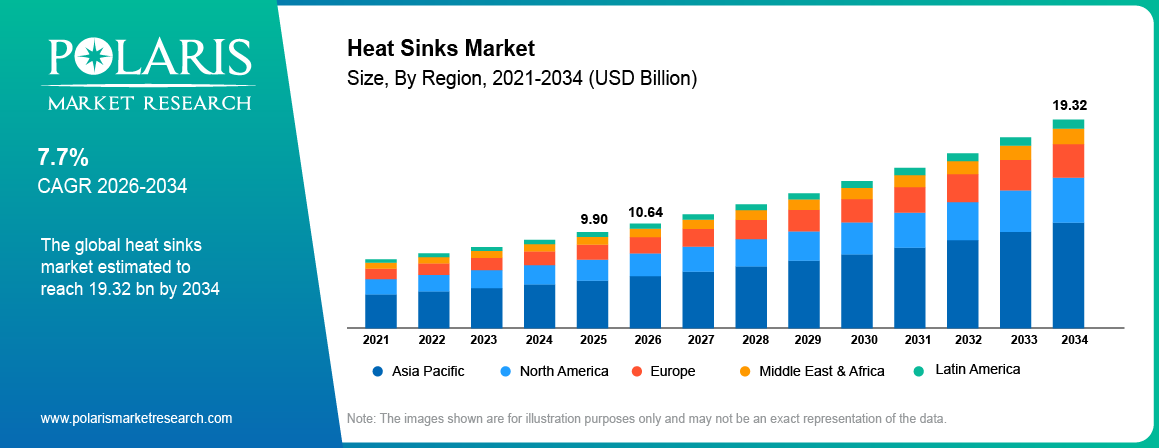
Heat sinks market size was valued at USD 9.90 billion in 2025. The market is expected to grow at a CAGR of 7.7% from 2026 to 2034. Market growth is driven by increasing electronic power densities, and growing adoption of advanced thermal management solutions. Liquid cooling is changing the heat sinks market, as AI chips above 1,000 watts of thermal design power shift demand from finned air coolers to liquid cold plates.
Market Statistics
Heat Sinks Market Key Takeaways
- The Asia Pacific heat sinks market accounted for 42.46% of the global share in 2025. The dominance is driven by its large electronics manufacturing base and strong semiconductor production.
- The market in North America is expected to exhibit a 7.54% CAGR during the forecast period. The growth is attributed to expanding data center capacity and rising demand for advanced computing infrastructure.
- Extruded heat sinks segment accounted for a major market share of 35.42% in 2025. The leading share is fueled by their simple manufacturing processes and flexible design options.
- Copper is projected to record a 7.46% CAGR during the projected period, owing to its higher thermal conductivity and suitability for applications with demanding heat dissipation requirements.
- Data centers & AI servers dominated the market with a share of 35.42% in the base year due to rising computing workloads and increasing power density in server infrastructure.
- Liquid cold plates segment is projected to record a 12.78% CAGR during the forecast period, owing to AI chips above 1,000 watts that air cooling cannot handle.
- Eaton, Asia Vital Components, Auras Technology, and Delta Electronics lead the competitive landscape, supplying heat sinks and liquid cooling modules for AI servers.
Note: Figures and projections outlined in this report are the result of Polaris Market Research’s proprietary analytical processes, grounded in the latest available datasets and market observations.
Heat Sinks Market Definition
Heat sinks are thermal management components that transfer heat away from electronic devices and systems. They help maintain safe operating temperatures during continuous use. Heat sinks use conductive materials and engineered surfaces to improve heat dissipation. Aluminum heat sink is widely used due to high heat transfer, low weight and ease of manufacturing for electronic application. They are well suited for thermal control applications. Pastes and pads placed between the chip and the heat sink are covered in the thermal interface materials market.
The heat sinks market includes passive and active cooling solutions for electronic and industrial equipment. These solutions support processors and power electronics. They are also used in lighting and telecommunications equipment. Heat sinks can work alongside direct-to-chip liquid cooling in high-performance computing systems. This combination supports efficient heat removal as equipment power density increases and thermal management requirements become more demanding. Their use supports device operation and longer component life. A heat sink releases heat into air through fins, while a cold plate carries heat away with flowing liquid; this report treats the liquid cold plate as part of the cold plate market within the broader electronics cooling market.
The growth of the market is driven by the increasing power densities and growing production of electronics. Higher computing performance also results in increasing thermal management requirements. Manufacturers are developing heat sinks capable of handling higher heat loads in smaller packages. Better lower thermal resistance improves the cooling efficiency and component reliability. These factors are driving the demand for thermal solutions in computing, industrial and electronic applications globally. The demand is driven by the increasing need for temperature control.
Market Dynamics
Driver Impact Analysis
| Market Driver | Est. Impact | Geographic Relevance | Impact Timeline |
| AI chips above 1,000 watts forcing a move to liquid cooling | High | North America, Asia Pacific | Short term (ongoing) |
| Power companies buying thermal suppliers | Medium | North America, Europe | Short to medium term |
| Data center and hyperscale capacity expansion | High | North America, Europe, Asia Pacific | Short to medium term |
| EV and power electronics heat density (silicon carbide modules) | Medium | China, Europe, North America | Medium term |
| New semiconductor and electronics capacity outside Taiwan | Low | India, Southeast Asia, United States | Long term |
Source: Polaris Market Research Analysis
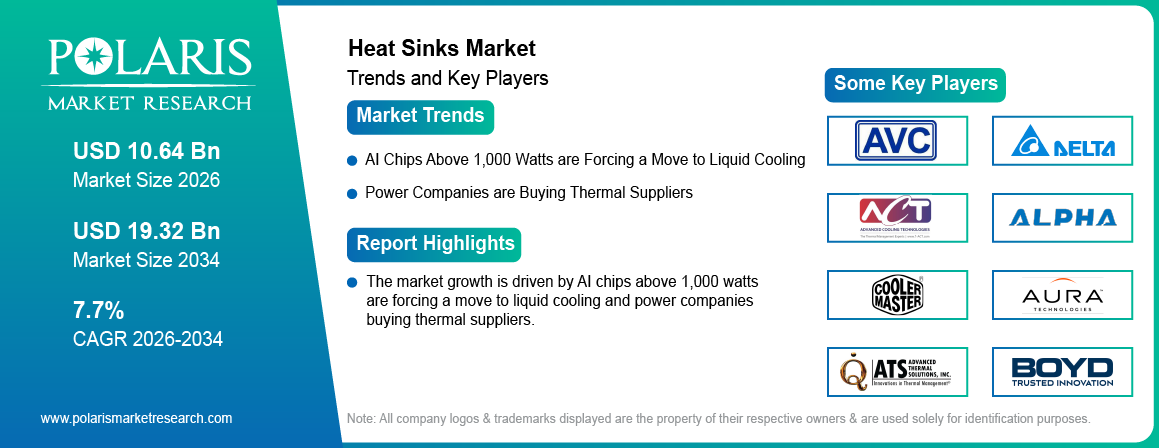
Driver: AI Chips Above 1,000 Watts Are Forcing a Move to Liquid Cooling Creating Market Demand
The power of the AI chip is growing fast and consequently the heat flux at the chip surface is increasing. For example, in 2026, NVIDIA stated that AI devices are quickly exceeding 1,000 watts per device, increasing their thermal design power requirements. At these power levels, the thermal limits of conventional air cooling are increasingly challenged. The demand for liquid cooling technologies that remove heat directly from high-power chips and enable stable operation is being fueled by this (Source: nvidia.com).
The move toward liquid cooling is changing the thermal management requirements for high-performance computing systems. As chip power continues to increase, cooling solutions will need to extract heat more effectively from concentrated sources. This is supporting demand for advanced heat sinks and liquid based cooling architectures. They help handle increased thermal loads to keep temperatures stable in AI computing environments. The data center build-out behind this demand is tracked in the AI data center market.
Driver: Power Companies Are Buying Thermal Suppliers Pushing Market Growth
Thermal technology is becoming an important part for the power management companies' operations due to rising demands for specialized cooling solutions. For example, in 2026, Eaton acquired Boyd Thermal from Goldman Sachs Asset Management to include the liquid cooling and thermal management solutions in their offerings. This is due to the increasing requirement for the thermal management of high-density computing systems which helps in the growth of the cold plate market (Source: eaton.com).
The acquisition highlights the increasing convergence of power management and thermal technologies. As electronic systems produce more heat, companies are searching for cooling solutions that are compatible with the existing power infrastructure. Such trend is propelling the demand for advanced heat dissipation technologies such as skived fin heat sink designs. These solutions enable efficient cooling in applications where compact designs and good thermal performance are increasingly important.
Restraint: Liquid Cooling Is Limiting the Adoption of Air-Cooled Solutions
Conventional air-cooled thermal management systems are facing challenges in meeting the demands of high-performance computing due to their inefficiencies as compared to liquid cooling systems. Liquid cooling systems are highly effective when it comes to dissipating heat from high power devices. Vapor chamber heat sinks and other such technologies still have a place in demanding thermal applications, but liquid cooling is gaining ground in areas where traditional air cooling is restricted in coping with higher heat loads.
The move to liquid cooling is putting pressure on the demand for traditional heat sinks in data centers and high-end computing systems. High-density processors and accelerators like those found in Nvidia Vera Rubin need advanced cooling technologies because of increasing power densities. Direct liquid cooling is much more effective for cooling such systems. This transition is influencing the heat sinks market analysis, as increasing adoption of liquid cooling reduces the use of traditional air-cooled solutions in some high-performance applications.
Opportunity: Liquid Modules Sell at Several Times the Price of Air Coolers to Open Market Opportunity
Liquid cooling modules creates opportunity in the heat sinks market as high-performance electronics require greater heat removal than conventional air-cooling systems. Liquid-based solutions can handle higher thermal loads in a compact design. This opens opportunities for manufacturers to serve data centers, high-performance computing systems and advanced power electronics where increasing power density is driving demand for more efficient thermal management solutions.
The biggest opportunity is the increasing use of liquid cold plate solutions for high power electronic components. Such systems use a liquid coolant to remove heat straight from the surface of the component. Liquid cooling modules tend to be more expensive than conventional air coolers as they require specific designs that incorporate the cooling elements. This ensures that the manufacturers get value for money while still fulfilling their stringent thermal management needs.
Opportunity: New Capacity Outside Taiwan is Creating Market Opportunity
New semiconductor and electronics manufacturing capacity outside Taiwan is creating an opportunity for the heat sinks market. For example, in May 2026, Tata Electronics signed an agreement with ASML to support its USD 11 billion semiconductor plant in Gujarat, India, signifying the requirement for heat sinks in the coming years. There is a need for quality cooling devices for new plants of semiconductor devices, power electronics, and computer systems. This growth creates further demand for heat sinks in the proximity of emerging manufacturing hubs (Source: india-briefing.com).
The biggest opportunity is the development of local supply chains for thermal management components market applications. Manufacturers can establish production closer to new semiconductor and electronics facilities. This can reduce supply chain dependence and support faster component delivery. Regional production can also help suppliers respond to changing customer requirements while supporting the expansion of electronics manufacturing capacity outside Taiwan.
Heat Sinks Market Segmentation Analysis
The report provides a comprehensive heat sinks market analysis by product form, material, end use, and region to identify the leading revenue-generating segments and emerging growth opportunities.
Product Form Insights
The extruded heat sinks accounted for the highest share of 35.42% in the base year due to their simple manufacturing processes and flexible design options. Extruded heatsinks are perfect for applications needing reliable heat dissipation at controlled production costs. These components are generally used in electronics and industrial equipment when there is a need for consistent performance in terms of temperature. The use of aluminum extrusion makes it possible to create varying sizes and forms of the fins. This allows manufacturers to design heat sinks to meet the thermal requirements. Rising demand for efficient cooling in electronics, power systems and computing equipment is further pushing adoption of extruded heat sinks across various applications and end-use industries.
Liquid cold plates segment is projected to record the fastest CAGR of 12.78% during the forecast year. Their growth is supported by increasing heat loads in high-performance computing and advanced power electronics. Liquid cold plates move heat directly from components to a coolant that continuously circulates. This enables efficient cooling for applications with high thermal requirements. Their use is increasing as conventional air-cooling is unable to cope with high-density systems. The rising power densities are also leading data centers to increasingly adopt liquid cooling. This trend is opening up new opportunities for cold plate makers. The demand for liquid cold plates is expected to be supported by continued investment in advanced computing infrastructure.
Heat pipe & vapor chamber assemblies are gaining traction in air-cooled AI servers, where the 3D vapor chamber spreads heat from hot spots into the fins. Bonded & skived fin and stamped & die cast designs serve telecom, power, and industrial equipment where compact designs and controlled costs matter.
Material Insights
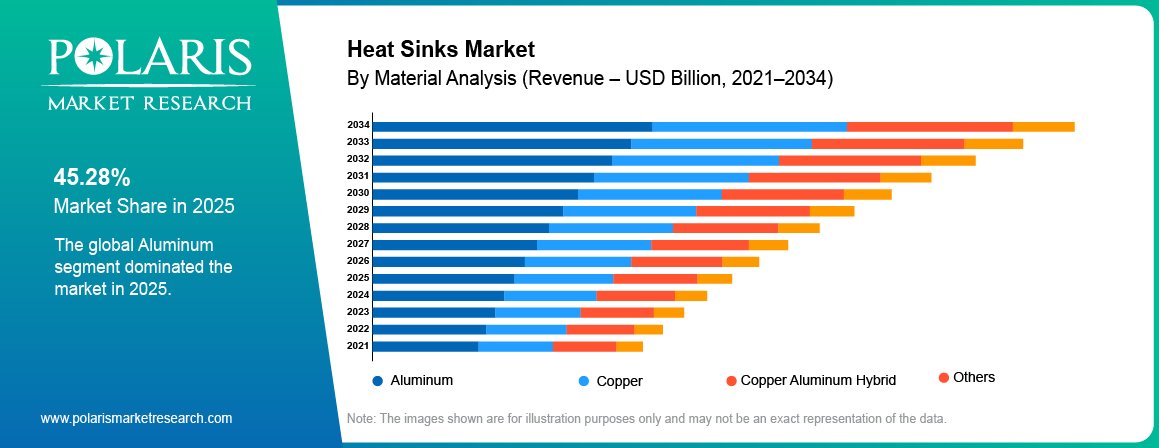
Aluminum held the dominant position in the base year market, with 45.28% share owing to its preferred balance of thermal performance, weight, cost and manufacturability. In electronic and electrical equipment, where high heat dissipation is needed without a lot of weight, aluminum heat sinks are generally used. Extrusion manufacturing also allows for the large scale production of complex fin structures. The material has flexibilities in design and sufficient thermal conductivity for many commercial applications. Its corrosion resistance and the relative cheapness of material encourage its use. The demand for compact electronic devices and efficient cooling solutions is likely to fuel the adoption of aluminum heat sinks for applications. Related thermal materials are covered in the electronic thermal management materials market.
Copper segment is expected to register the significant growth and hold 7.46% share during the forecast period due to its high thermal conductivity and suitability for applications that require strict heat dissipation. The increasing power densities in processors and power electronics create a need for materials with high thermal conductivity. Copper heat sinks are used in applications where the heat is too much for an aluminum heat sink to handle. It is finding increasing use in high-performance computing and other applications where better cooling is required.
End Use Insights
Data centers & AI servers dominated the market with 35.42% share in the base year due to rising computing workloads and increasing power density in server infrastructure. The increased processing needed for AI workloads results in more heat production. The heat sink is an important part that helps to handle the heat load and keep temperatures constant. Demand is also being supported by higher investments in data center infrastructure. The advent of AI computing is also creating the need for better thermal management solutions.
Automotive & EV segment is projected to register the highest CAGR of 8.22% during the forecast period, owing to increasing vehicle electrification and rising demand for efficient thermal management. Due to the large amount of heat to be dissipated, the operation of EV power electronics, including silicon carbide power module systems, requires efficient cooling techniques. The growth of this segment is further boosted by increasing adoption of electric vehicles. For instance, the International Energy Agency (IEA) reported that global electric car sales increased by 20% in 2025, surpassing 20 million units. Heat sinks are used to manage temperatures in critical electronic systems. Increasing integration of advanced electronics is creating additional demand for compact thermal solutions. Battery packs in the same vehicles are covered in the automotive battery thermal management system market. (Source: iea.org)
Regional Analysis
The heat sinks market regional analysis comprises North America, Europe, Asia Pacific, Latin America, and Middle East and Africa. This segmentation is based on the growing demand for electronic devices, data centers, electric vehicles, industrial equipment, and advanced computing systems. The heat sinks industry forecast is supported by expanding semiconductor manufacturing, increasing electronics production, rising computing power requirements, and the development of advanced thermal management technologies across these regions.
Asia Pacific Heat Sinks Market Trends
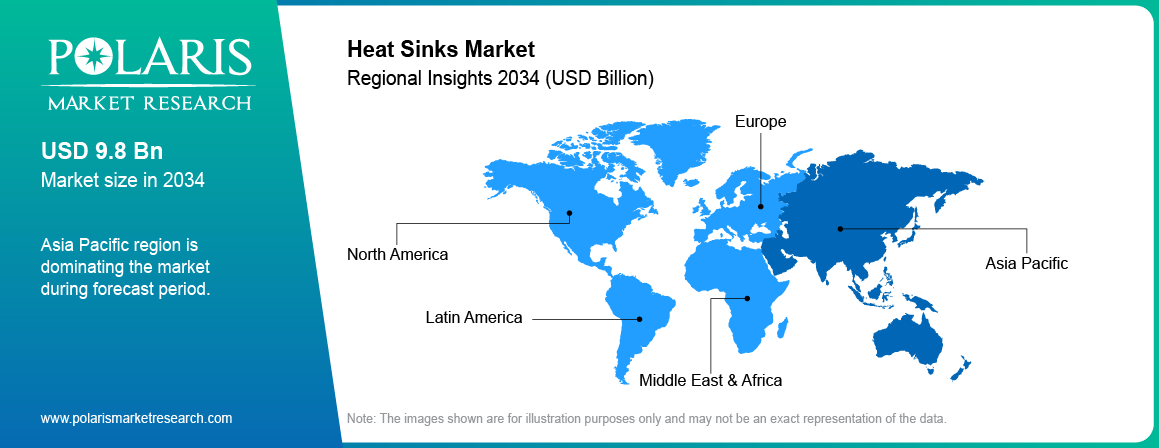
Asia Pacific dominated the heat sinks market with a share of 42.46% in 2025 due to its large electronics manufacturing base and strong semiconductor production. Countries such as China, Japan, South Korea, and Taiwan have extensive electronics and computing industries which is driving the market growth. Rising production of electronic devices and components supports demand for efficient thermal management solutions across data centers, consumer electronics, and industrial equipment. In addition, the increasing sales of EVs in countries such as China and India is also contributing to the growth of heat sinks market. For instance, the EV sales in China increased to 13.2 million units in 2025 from 11.2 million units in 2024, a rise of 17.86% in just one year. Taiwan-based suppliers, including Asia Vital Components, Auras Technology, and Jentech Precision, reported record monthly revenue in March 2026 on liquid cooling deman (Source: mdpi.com).
The region is likely to retain its leadership position over the forecast period on the back of ongoing investments in semiconductor manufacturing, data centers and the production of electric vehicles. With increasing computing requirements, electronic systems are generating more heat. Manufacturers are also ramping up thermal management components’ regional production to meet growing demand from electronics and automotive industries. This expansion is creating more opportunities for the suppliers of heat sinks.
North America Heat Sinks Market Trends
North America is expected to grow at the significant CAGR of 7.54% during the forecast period owing to the increase in data center capacity and rising demand for advanced computing infrastructure. The region is also seeing an increase in AI infrastructure and high performance computing systems. For example, in 2025, Meta committed to invest over USD 600 billion in the US by 2028 to boost artificial intelligence technology and data center infrastructure. Growing power density in AI data centers has made the use of heat sinks and other cooling technologies inevitable due to rising needs for thermal management solutions. These developments are leading to a need for better thermal management solutions in data centers and electronics. Hyperscale facility expansion is tracked in the hyperscale data center market. (Source: fb.com)
The region will also benefit from growing demand for compact and efficient cooling solutions. With investment pouring into semiconductor manufacturing and electric vehicle production, heat sinks are finding new applications. Higher power densities in electronic systems increase thermal management requirements further. In an effort to keep the systems compact, manufacturers are developing advanced heat sinks that can cope with higher heat loads.
Europe Heat Sinks Market Trends
The Europe heat sinks market was large, accounting for 20.36% of the total market in the base year. Growth is driven by expanding data center infrastructure, automotive electronics and industrial equipment manufacturing. For instance, in 2026, Amazon made an investment worth USD 39.8 billion (EUR 33.7 billion) in Spain for the construction of data center infrastructure in Europe as well as for AI capabilities. Additionally, the growing electrification in various sectors is contributing to the growth of the electronics cooling market (Source: aboutamazon.eu).
It is projected that this region will continue to grow due to increasing investment in data centers, electric vehicles, and semiconductor manufacturing. European manufacturers are also focusing on improving energy efficiency and thermal performance in electronic systems. Growing adoption of high-performance computing and power electronics is expected to support further demand for heat sinks across Europe.
Middle East and Africa Heat Sinks Market Trends
The Middle East and Africa holds a developing share of 4.66% in the heat sinks market due to growing investments in data centers, telecommunications infrastructure, industrial equipment, and electronics. Demand is supported by increasing computing requirements and rising equipment temperatures. The region’s hot climate is also increasing the need for reliable thermal management solutions across electronic and power applications.
The regional market is expected to grow through investments in electric mobility, renewable energy, and data centers. For instance, in 2026, Vodafone partnered with Cassava Technologies to develop sovereign AI infrastructure in Egypt using NVIDIA computing technology, supporting demand for advanced heat sinks and thermal management solutions. Demand for compact and efficient cooling solutions is increasing as equipment becomes more powerful. Local electronics manufacturing and infrastructure development will further support heat sink adoption (Source: cassavatechnologies.com).
Latin America Heat Sinks Market Trends
The Latin America heat sinks market is growing with a rate of 5.34% owing to increasing electronics production, data center development, and rising adoption of electric vehicles. Growing demand for computing equipment is also increasing thermal management requirements. Expanding industrial and power electronics applications are supporting the need for efficient heat dissipation solutions across the region. Manufacturers are also strengthening regional supply.
Growing electronics and automotive manufacturing will drive demand for heat sinks in Latin America. Thermal management solutions will be driven by additional demand from data center growth. This will favor a compact and efficient design enabling higher power densities. Local production and distribution networks can improve availability of supply and help to deliver faster to customers in the region.
Heat Sinks Market Competitive Landscape
The heat sinks market is fragmented, but the competition is becoming more and more focused on advanced cooling solutions. The market is led by such companies as Eaton, Asia Vital Components (AVC), Auras Technology, Delta Electronics. The Eaton and Boyd deal is also driving industry consolidation and impacting heat sinks market share for AI servers in high performance thermal management applications.
Vendor Positioning
| Company | Headquarters | Market Position | Core Offering | Competitive Positioning |
| Eaton Corporation plc (Boyd Thermal) | Dublin, Ireland | Leader | Air-cooled heat sinks, cold plates, heat pipes | Integrated power and cooling offer for AI data centers, with aerospace and data center reach |
| Asia Vital Components (AVC) Co., Ltd. | Taiwan | Leader | Vapor chambers, 3D vapor chambers, thermal modules | Deep supply to AI servers, with air and liquid cooling capability |
| Auras Technology Co., Ltd. | Taiwan | Leader | Liquid cold plate modules | Fast-scaling liquid cooling specialist for AI servers |
| Delta Electronics, Inc. | Taiwan | Leader | Cold plates, CDUs, power and cooling systems | System-level supplier combining heat sinks, liquid distribution and power |
| Jentech Precision Industrial Co., Ltd. | Taiwan | Challenger | AI server thermal components | Growing share in the Taiwan AI server supply chain |
| Sunonwealth Electric Machine Industry Co., Ltd. | Taiwan | Challenger | Fans and air cooling modules | Air cooling depth, exposed to the shift toward liquid |
| Advanced Cooling Technologies, Inc. | United States | Emerging Player | Heat pipes, cold plates | Scaling US cold plate capacity for AI data centers |
| Advanced Thermal Solutions, Inc. | United States | Niche Player | Board-level heat sinks | Edge AI and electronics cooling, including NVIDIA Jetson module heat sinks |
Source: Company disclosures and Polaris Market Research Analysis. Market position is Polaris's qualitative assessment
Asia Vital Components (AVC) is a notable player in this market. It supplies vapor chambers and thermal modules to AI servers, with May 2026 revenue of NT$15.9 billion, up 61% year on year. Competition is increasingly centered on vapor chamber and liquid cold plate technologies. Cold plates are gaining importance as AI server power density rises and thermal requirements become more demanding across modern data center infrastructure.
Heat Sinks Market Technology and Innovation Landscape
Technology and Innovation Landscape Snapshot
| Technology | How It Works | Typical Use | Outlook |
| Direct-to-chip liquid cold plate | Liquid flows through channels mounted on the processor | AI servers, HPC | Fastest growing |
| 3D vapor chamber | Sealed fluid spreads heat from hot spots into the fins | Air-cooled AI servers | Growing; qualified per GPU platform |
| Skived and bonded fin | Thin, dense fins cut or bonded onto a copper or aluminum base | Telecom, power electronics | Steady |
| Extruded aluminum | Aluminum pushed through a die to form fins | Consumer and industrial electronics | Mature; volume leader |
| Heat pipe | Sealed tube moves heat by evaporation and condensation | Aerospace, compact electronics | Steady |
| Two-phase cold plate | Coolant boils at the chip and condenses downstream | High-density AI racks | Emerging |
Source: Polaris Market Research Analysis
AI GPUs are producing ever higher heat loads, taking thermal designs beyond traditional air cooling. Direct-to-chip liquid cooling is becoming more important for high-performance computing systems at a heat flux above 1,000 watts per GPU. This method transfers heat directly from the processor through liquid-cooled plates. It allows for stable operating temperatures in advanced AI servers and data center infrastructure, while supporting higher computing density.
The 3D vapor chamber spreads heat from hot spots over a larger area before passing it to the fins. It uses a sealed fluid system that moves heat effectively throughout the chamber. Discussions around advanced computing and cooling technologies at Computex 2026 are further highlighting the need for efficient thermal management solutions. This technology offers a cooling capacity where traditional metal structures have their limits. These designs are gaining attention across the thermal management components market as suppliers develop solutions for AI servers and other high-density computing applications. Two-phase cold plates, in which the coolant boils at the chip and condenses downstream, are an emerging option for high-density AI racks.
Use Case Analysis
Heat sinks are used wherever electronic components generate heat and require controlled operating temperatures. The main applications span computing, aerospace, consumer devices, and vehicles. This heat sinks market report focuses on key use cases where thermal requirements are increasing. It also helps explain where are heat sinks used as electronic systems become more powerful and compact.
Data Centers and AI Servers
AI servers are creating higher thermal loads that push conventional air cooling toward its limits. Liquid cooling systems use a liquid cold plate to transfer heat directly from high-power components. Auras Technology and other suppliers are developing these solutions for AI infrastructure. Auras expects continued quarterly growth through 2026 and has raised its full-year target, supporting demand in the electronics cooling market.
Aerospace and Defense
Aerospace and defense electronics need dependable cooling in harsh operational environments. Design of aerospace electronics heat sinks is a demanding task because of space and performance constraints. Boyd Thermal provides thermal solutions including heat pipe and cold plate systems. Boyd Thermal’s aerospace thermal capabilities were a key reason for the acquisition, Eaton said, noting the importance of advanced cooling in these applications.
Consumer Electronics
Consumer electronics require compact cooling solutions as devices become thinner and more powerful. Heat sinks help remove heat from processors and other components while supporting stable device performance. This application remains an important part of the electronics cooling market. For example, in September 2026, Advanced Thermal Solutions released heat sinks for NVIDIA Jetson Thor modules, supporting compact edge AI and computing devices. (Source: qats.com)
Automotive and EV
Automotive and EV systems increasingly require thermal management as electronic content and power levels rise. Heat sinks support cooling in power electronics and other vehicle systems. Liquid cold plate solutions are also being adopted for higher thermal loads. This application contributes to the broader electronics cooling market. For example, in March 2026, Würth Elektronik released a heat sink portfolio for power electronics and ICs, including the WE-HTO and WE-HIC series. (Source: we-online.com)
Buyer Analysis and Market Entry Barriers
Buyer Decision Framework
| Buyer | Primary Driver | Typical Choice |
| AI server maker / hyperscale | Cooling capacity at 1,000W+ per chip | Liquid cold plates, 3D vapor chambers |
| Consumer electronics OEM | Cost, size, weight | Extruded or stamped aluminum |
| Industrial and power electronics | Reliability, thermal resistance | Bonded or skived fin, copper bases |
Source: Polaris Market Research Analysis
The key buyers in the heat sinks market are data center operators, electronics manufacturers, automotive companies, telecom service providers, and industrial equipment manufacturers. Cooling requirements are evaluated by the buyers according to power levels of components and operating conditions. The main concerns for data centers are thermal performance and reliability. Automotive and industrial buyers are also considering compact designs, ruggedness and thermal resistance when selecting heat sink solutions.
Typically, a purchase involves several roles. Thermal needs are engineered by engineering teams while performance testing is done by these same engineering teams. Procurement teams analyze prices and delivery options. Manufacturing teams consider compatibility issues. Buyers also look at quality of material, size requirements, customization options, maintenance and product reliability. Factors influencing supplier selection and long-term purchasing decisions in applications. How to choose a heat sink supplier comes down to proven thermal resistance results and capacity, not unit price.
Market Entry Barriers
- Platform qualification: AI server cooling products have to meet platform-specific requirements prior to deployment. GPU platforms require new vendors to go through testing and certification. That process requires technical validation and adds time before products can reach major customers.
- Capital and scale: Advanced cooling requires a heavy investment in manufacturing capacity and technology. Eaton’s USD 9.55 billion acquisition of Boyd Thermal shows how much capital is required to build a major liquid cooling business.
- Manufacturing capabilities: Manufacturing capabilities are specialized for advanced products. Skived fin heat sinks and brazed cold plates require precision processes and technical know how. New entrants require experienced teams and proper production equipment for consistent product quality.
- Customer concentration: AI server demand is concentrated among a limited number of large customers. This creates a challenge for new suppliers because winning major accounts requires strong qualification, reliable production, and the ability to meet large-volume requirements consistently.
Premium Insights and Forward Outlook
Liquid Cooling Will Not Replace Heat Sinks, It Will Change Which Ones Matter
Liquid cooling will not replace heat sinks outright, but it will shift demand toward designs that support higher power densities. Direct-to-chip liquid cooling is becoming important for AI servers and high-performance computing. Heat sinks will remain relevant in systems where air cooling is practical. Suppliers will increasingly develop products that complement liquid cooling and serve specific thermal requirements across applications worldwide.
Consolidation Will Follow the Eaton Template
Consolidation is expected to shape the heat sinks market as thermal requirements become more complex. The Eaton template shows how broader thermal management capabilities can strengthen a supplier’s position. Big companies could combine heat sinks with liquid cooling and other technologies. This can expand product portfolios, increase customer coverage and help deliver integrated thermal solutions for data centers and electronics.
Key Players in the Heat Sinks Market
-
Auras Technology Co., Ltd.
-
Alpha Company Ltd.
-
Advanced Thermal Solutions, Inc.
-
Advanced Cooling Technologies, Inc.
-
Cooler Master Technology Inc.
-
Delta Electronics, Inc.
-
Eaton Corporation plc (Boyd Thermal)
-
Jentech Precision Industrial Co., LTD.
-
Nidec Chaun-Choung Technology Corporation
-
Same Sky
-
Sunonwealth Electric Machine Industry Co., Ltd.
-
T-Global Technology Co., Ltd.
-
Taiwan Microloops Corp
-
Wakefield Thermal, Inc.
-
Würth Elektronik eiSos GmbH & Co. KG
Industry Developments
- September 2026: Advanced Thermal Solutions released new heat sinks specifically for the NVIDIA Jetson Thor modules, featuring thermal management for high-performance edge AI and computing applications. (Source: qats.com)
- June 2026: Asia Vital Components and Auras Technology forecast sustained growth through 2029 as NVIDIA drives the shift from air to liquid cooling. (Source: digitimes.com)
- June 2026: CoolIT Systems introduced a 15 kW single-phase direct liquid cooling cold plate for next-generation AI accelerators. (Source: datacenterfrontier.com)
- May 2026: Advanced Cooling Technologies expanded its Lancaster, Pennsylvania plant to scale single-phase and two-phase cold plate production for AI data centers. (Source: prnewswire.com)
- April 2026: Vertiv acquired Strategic Thermal Labs to add cold-plate design and high-density thermal validation to its liquid cooling offering. (Source: vertiv.com)
- March 2026: Eaton completed its USD 9.55 billion acquisition of Boyd Thermal from Goldman Sachs Asset Management to add liquid cooling for AI data centers. (Source: eaton.com)
- March 2026: Ecolab agreed to acquire CoolIT Systems, a liquid cooling specialist for AI data centers, from funds managed by KKR. (Source: sec.gov)
- March 2026: Delta Electronics began shipping its GoCool 3 MW liquid-to-liquid coolant distribution unit to AI data centers. (Source: deltapowersolutions.com)
- March 2026: Würth Elektronik released a new portfolio of heat sinks for power electronics and ICs with the WE-HTO and WE-HIC series and versions with pre-applied thermal interface material. (Source: we-online.com)
- January 2026: Alpha Novatech expanded its Vapor Chamber Series with new 60 mm and 70 mm H-specifications, engineered to improve heat spreading when combined with existing heatsinks. (Source: alphanovatech.com)
Heat Sinks Market Report Segmentation
By Product Form (Revenue, USD Billion, 2021–2034)
- Extruded
- Bonded & Skived Fin
- Stamped & Die Cast
- Heat Pipe & Vapor Chamber Assemblies
- Liquid Cold Plates
By Material (Revenue, USD Billion, 2021–2034)
- Aluminum
- Copper
- Copper Aluminum Hybrid
- Others
By End Use (Revenue, USD Billion, 2021–2034)
- Data Centers & AI Servers
- Consumer Electronics
- Automotive & EV
- Telecommunications
- Industrial & Power Electronics
- Aerospace & Defense
By Regional Outlook (Revenue, USD Billion, 2021-2034)
- North America
- US
- Canada
- Europe
- Germany
- France
- UK
- Italy
- Spain
- Netherlands
- Russia
- Rest of Europe
- Asia Pacific
- China
- Japan
- India
- Malaysia
- South Korea
- Indonesia
- Australia
- Vietnam
- Rest of Asia Pacific
- Middle East & Africa
- Saudi Arabia
- UAE
- Israel
- South Africa
- Rest of Middle East & Africa
- Latin America
- Mexico
- Brazil
- Argentina
- Rest of Latin America
Report Scope
| Report Attributes | Details |
| Market Size in 2025 | USD 9.90 Billion |
| Market Size in 2026 | USD 10.64 Billion |
| Revenue Forecast by 2034 | USD 19.32 Billion |
| CAGR | 7.7% from 2026 to 2034 |
| Base Year | 2025 |
| Historical Data | 2021–2024 |
| Forecast Period | 2026–2034 |
| Quantitative Units | Revenue in USD Billion and CAGR from 2026 to 2034 |
| Report Coverage | Revenue Forecast, Competitive Landscape, Growth Factors, and Industry Trends |
| Segments Covered |
|
| Regional Scope |
|
| Competitive Landscape |
|
| Report Format |
|
| Customization | Report customization as per your requirements with respect to countries, regions, and segmentation. |
Source: Polaris Market Research Analysis
Why Choose Polaris Market Research
Polaris Market Research & Consulting, Inc. combines company data with demand analysis, technology mapping, application analysis, and supplier benchmarking. The approach evaluates heat sink technologies across major end-use industries. It also discusses thermal requirements, material choices, cooling performance and industry developments, providing a clear view of market opportunities and competitive dynamics.
Clients can request customized analysis by cooling technology, end use, region, or application. Additional analysis can cover data centers, AI servers, automotive systems, aerospace electronics, and industrial equipment. The heat sinks market report can also provide supplier benchmarking based on product capabilities, technology development, manufacturing presence, and competitive positioning across key markets.
Research Methodology
The study uses five phases: market definition and scope control, secondary evidence collection, primary validation, model construction and triangulation, and analyst review. Secondary sources prioritize company disclosures, product documentation, technical publications, industry associations, and government data. The methodology supports consistent heat sinks market analysis across technologies, applications, regions, and end-use segments.
Thermal engineers, data center operators, electronics manufacturers, automotive suppliers, cooling technology providers and procurement experts are all primary research. Interviews test product performance, cooling requirements, pricing, buying criteria, replacement cycles, and technology adoption. The analysis also includes technologies such as heat pipe systems and liquid cooling for a variety of applications and environments of operation.
Five Phase Research Methodology
| Phase | Focus |
| 1. Secondary Mapping | Company disclosures, SEC filings, trade press |
| 2. Primary Validation | Eaton press release and 10-Q; supplier revenue reports |
| 3. Competitive Benchmarking | Segmentation and key player benchmarking |
| 4. Proprietary Reconciliation | Internal Polaris model |
| 5. Quality and Sourcing Review | Final editorial and citation check |
Source: Polaris Market Research Analysis
Heat Sinks Market FAQ's
• The heat sinks market was valued at USD 9.90 billion in 2025 and is projected to reach USD 19.32 billion by 2034. AI chips above 1,000 watts are forcing a move to liquid cooling which is driving the market growth.
• The market is expected to grow at a CAGR of 7.7% from 2026 to 2034. The growth will be driven by AI chips above 1,000 watts forcing a move to liquid cooling and power companies buying thermal suppliers.
• Asia Pacific dominated the market in 2025, due to its large electronics manufacturing base and strong semiconductor production.
• Liquid cold plates segment is growing at the fastest CAGR. Their growth is supported by increasing heat loads in high-performance computing and advanced power electronics.
• A heat sink is used to transfer and dissipate heat away from electronic components to maintain safe operating temperatures.
• A heat sink employs passive or forced air to carry the heat away. A cold plate employs a liquid coolant flowing in internal passages to carry the heat away from a component.
• Eaton said the acquisition of Boyd Thermal will expand its thermal management product portfolio and improve its capabilities for data centers, AI, aerospace and other high-performance applications.
• In general, aluminum is better for most heat sinks as it is cheaper, lighter and has a good thermal conductivity.
• Liquid cooling technology will not take the place of heat sink technology, as they both have their respective requirements in terms of thermal management for electronics and computers.
• The GPUs used in AI have a high density and produce more heat compared to what air cooling can effectively remove, necessitating liquid cooling for AI servers.
• A heat sink typically costs $1–$100+, depending on size, material, thermal performance, and application.
• Heat sinks are commonly grouped as passive, active, and hybrid. This report segments the market by product form instead: extruded, bonded & skived fin, stamped & die cast, heat pipe & vapor chamber assemblies, and liquid cold plates.
• Key players include Eaton Corporation plc (Boyd Thermal), Asia Vital Components (AVC) Co., Ltd., Auras Technology Co., Ltd., Delta Electronics, Inc., Jentech Precision Industrial Co., Ltd., Sunonwealth Electric Machine Industry Co., Ltd., and Advanced Thermal Solutions, Inc.
• In March 2026, Eaton completed its USD 9.55 billion acquisition of Boyd Thermal, and Ecolab agreed to acquire CoolIT Systems. In April 2026, Vertiv acquired Strategic Thermal Labs to add cold-plate design expertise.
Download Sample Report of Heat Sinks Market
Please fill out the form to request a customized copy of the research report.


