
Accelerated Processing Unit Market Size, Share, Trends & Forecast, 2026–2034
REPORT DETAILS
Accelerated Processing Unit Market Summary
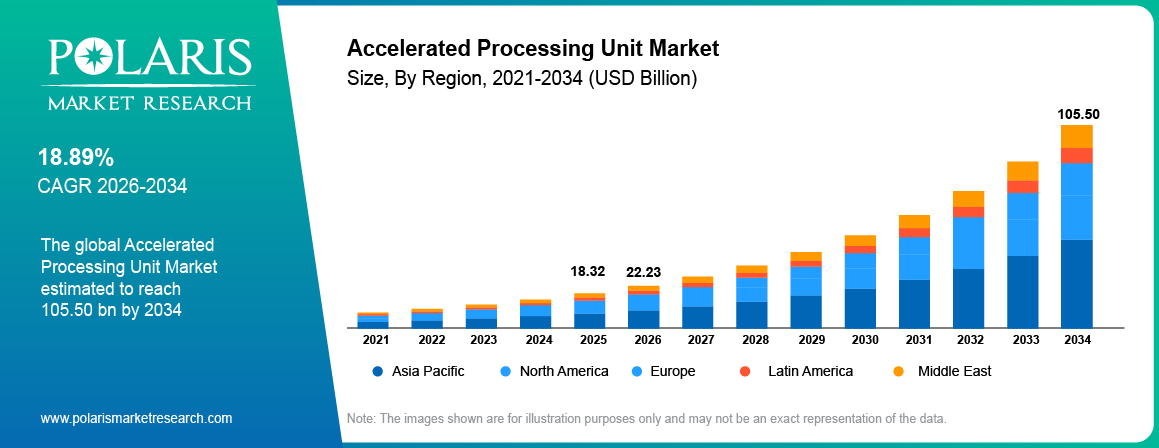
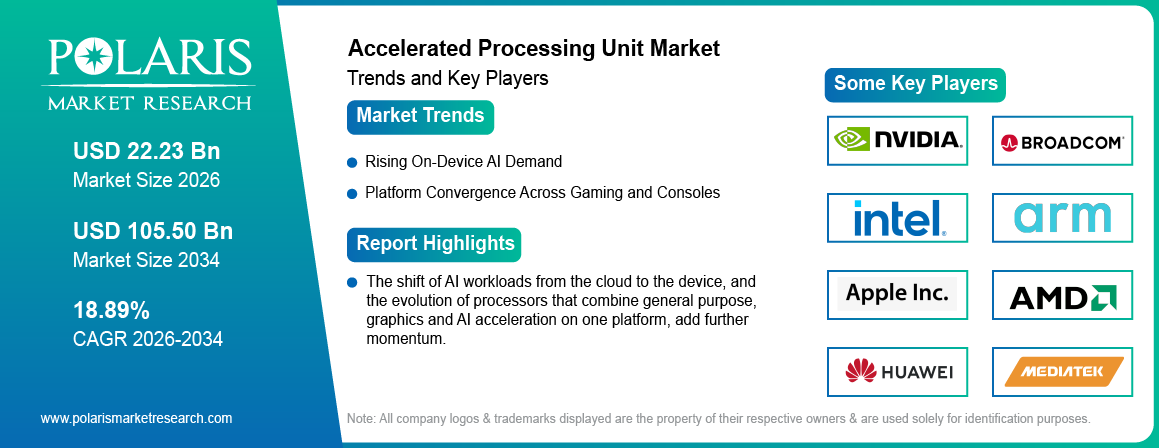
The accelerated processing unit market size was valued at USD 18.32 billion in 2025. The market is expected to register a CAGR of 18.89% from 2026 to 2034. Growth is driven by the rising demand for integrated CPU and GPU computing and broader adoption of AI PCs. The shift of AI workloads from the cloud to the device, and the evolution of processors that combine general purpose, graphics and AI acceleration on one platform, add further momentum.
Market Statistics
Accelerated Processing Unit Market Key Takeaways
- North America led the market share with 40.18% in 2025. The dominance is attributed to the presence of key processor companies and robust PC, gaming, and computing ecosystems.
- The Asia Pacific market is projected to record the highest CAGR of 21.72% during the forecast period. Growth is driven by expanding semiconductor capabilities and increasing demand for AI and HPC.
- In 2025, the laptop APUs segment dominated the market share with 36.72%. The segment dominance is supported by rising adoption of laptops in business and gaming applications.
- The data center APUs segment is expected to exhibit the highest CAGR of 24.68% during the projected period. Increasing AI and high-performance computing workloads drive the growth.
- The AI PCs segment is projected to record a CAGR of 27.86% during the forecast period. The AI PC market growth is fueled by the growing on-device AI demand and integrated AI acceleration.
- The competitive landscape is led by Advanced Micro Devices, Inc.; Intel Corporation; Apple Inc.; Qualcomm Incorporated; and NVIDIA Corporation. Competition is moving from CPU clock speed to NPU capability, memory architecture and software support.
Note: Figures and projections outlined in this report are the result of Polaris Market Research’s proprietary analytical processes, grounded in the latest available datasets and market observations.
Accelerated Processing Unit Market Definition
The accelerated processing units market encompasses processors that merge central processing unit (CPU) and graphics processing unit (GPU) functions on a single die or package, with current-generation designs increasingly incorporating dedicated neural processing units (NPUs) or AI engines. The market focuses on the development, manufacturing, and commercialization of APUs. APUs are increasingly used across laptops, desktops, gaming consoles, handheld systems, edge computing platforms, and selected data center and high-performance computing environments. The defined market scope excludes standalone CPUs without integrated graphics, discrete GPUs sold as add-in cards, and general-purpose AI accelerators that do not combine CPU and GPU compute.
The market forms a specialized segment within the broader semiconductor chipset market. APUs integrate the computing power of the CPU and GPU in one processor architecture for heterogeneous computing with fewer separate processing elements. As the need for general-purpose computing, graphics, and AI acceleration in a single platform increases with more AI PCs, integrated graphics and on-device AI workloads, so does the relevance of this architecture.
APU, CPU, GPU, NPU and SoC at a Glance
| Term | What It Is | How It Relates to an APU |
| CPU | General purpose processor | The APU contains CPU cores |
| GPU | Graphics and parallel compute processor | The APU contains an integrated GPU, not a discrete card |
| NPU | Block for low power AI inference | Current APUs add an NPU, measured in TOPS |
| APU | CPU and GPU, usually with an NPU, on one die or package | The subject of this report |
| SoC | Whole system on one chip, with memory controllers and connectivity | A broader category; many APUs are SoCs |
Source: Polaris Market Research Analysis.
The distinction between integrated processors and the discrete GPU market is crucial. Discrete GPUs and add-in graphics cards are still outside the scope of APUs, but integrated GPU functionality in the same processor die, or package, is in. The market is therefore focused on CPU-GPU integration, AI acceleration, power efficiency, and platform-level computing, not solely graphics performance.
This includes semi-custom silicon used in gaming consoles, as these processors combine CPU and GPU capabilities within a common architecture. This expands the market beyond traditional PC processors and embraces the role of integrated processing designs in gaming platforms where custom silicon powers graphics rendering, system processing, and platform-specific workloads.
The rise of AI workloads is transforming the APU market, with processor makers adding dedicated AI engines to CPU and GPU resources. AI PCs and other edge devices are fueling the demand for local inference capabilities. Heterogeneous computing and ARM-based SoC architecture developments are extending the scope of integrated processor designs in consumer, enterprise, and specialized computing environments.
Market Dynamics
Accelerated Processing Unit Market Driver Impact Analysis
| Market Dynamic | Type | Impact on Forecast | Regional Relevance | Impact Timeline |
| Rising On Device AI Demand | Driver | High | North America, Asia Pacific | Short to medium term (2026 to 2029) |
| Platform Convergence Across Gaming and Consoles | Driver | Medium | Global, led by North America and Japan | Medium to long term (2027 to 2034) |
| Adoption of ARM Based Processors and Edge Computing | Opportunity | Medium | Asia Pacific, North America | Medium term (2026 to 2030) |
| Data Center and HPC Convergence | Opportunity | Medium | North America, Asia Pacific | Long term (2028 to 2034) |
Source: Polaris Market Research Analysis.
Driver: Rising On-Device AI Demand
The market for accelerated processing units is strengthened by rising demand for on-device AI, as more AI workloads are handled locally rather than solely through cloud infrastructure. This shift is driving the need for processors that combine CPU and GPU resources with dedicated neural processing capabilities. Integrated AI acceleration enables devices to perform inference and other AI workloads closer to the edge, while maintaining general-purpose and graphics processing on the same platform.
AMD introduced the Ryzen AI 400 Series, with NPU performance of up to 60 TOPS, and new Ryzen AI Max+ processors at CES in January 2026. Intel launched Core Ultra Series 3 on its 18A process with up to 50 NPU TOPS, and Qualcomm announced Snapdragon X2 Plus with an 80 TOPS NPU in the same month. NVIDIA followed in May 2026 with RTX Spark, a Windows PC chip that pairs an Arm based CPU with a Blackwell GPU. These launches show AI acceleration moving into the core of client processor roadmaps (Source: amd.com).
The change extends beyond the addition of a dedicated AI processing block. AI capability is increasingly influencing processor selection, operating-system requirements, software compatibility, and overall platform design. This indicates well for continued demand for integrated processors that can coordinate CPU, GPU, and AI workloads in a unified computing architecture.
Driver: Platform Convergence Across Gaming and Consoles
The convergence of gaming, consoles, and personal computing platforms is broadening the application base for integrated processor architectures. Console processors typically combine CPU and GPU resources within semi-custom silicon. It creates long-duration design programs that differ from the shorter product cycles associated with many retail PC processors. This provides processor suppliers with a longer-term source of demand for integrated compute architectures.
AMD stated in its commentary on fourth quarter 2025 earnings that it was on track to develop next-generation Xbox semi-custom silicon for a 2027 launch while continuing development on Sony's next-generation PlayStation silicon. These multi-year programs provide visibility into future demand for processors that integrate CPU and GPU compute for dedicated gaming platforms (Source: xbox.com).
Semi-custom processor programs also allow suppliers to apply design and packaging capabilities across different computing categories. The overlap between console and PC engineering supports the broader commercial relevance of integrated processor architectures, while developments in gaming hardware can also contribute to capabilities applicable to the AI PC processor market.
Restraint: Memory and Thermal Cost Pressure
Memory and thermal cost pressure can constrain the expansion of the accelerated processing unit market. CPU, GPU, and AI workloads increasingly compete for memory resources within integrated platforms. Unified memory architectures improve communication between processing elements. However, changes in memory availability and pricing may impact the economics of the complete processor platform rather than an individual processing component. Memory makers have shifted capacity toward high bandwidth memory for AI servers, and the resulting memory shortage has raised DRAM and NAND prices for PC and console builders in 2026.
The effect can be more pronounced on entry level and mid-range systems where OEMs have less flexibility to absorb higher component costs. Memory capacity and bandwidth are closely tied to overall system performance, putting pressure on premium unified-memory systems as well. Thus, larger memory requirements can influence device pricing, system configurations, and thermal-management decisions across APU-enabled products.
These pressures are more relevant as integrated processors take on more demanding graphics and AI workloads. Increased compute density leads to higher memory and thermal requirements. OEMs and processor suppliers need to balance performance, power consumption, cooling requirements, and system costs.
Opportunity: Increasing Adoption of ARM-Based Processors and Edge Computing
The emergence of ARM-based processors opens up the possibility of more architectural diversity in on-chip computing. Qualcomm extended its Snapdragon X2 family with the X2 Plus in January 2026, built on the third generation Oryon CPU with an 80 TOPS NPU and aimed at mainstream Windows laptops. Earlier, Snapdragon X reached systems at around USD 600. (Source: qualcomm.com) The opportunity also extends beyond traditional personal computing. Edge computing environments require compact processors that balance local AI processing, graphics performance, power consumption, and thermal constraints. These requirements are well suited for integrated CPU, GPU, and AI architectures and create other applications for processors that can run multiple workloads in a constrained system footprint.
Opportunity: Data Centers and HPC Convergence to Create New Applications for Integrated Compute
Integrated processor architectures have an additional opportunity as data center and high-performance computing workloads converge. Increasing use of AI and HPC applications is fueling the need for tightly coupled CPU and GPU resources. This is driving demand for processor designs that can package these compute elements in a closely coupled system.
AMD's Instinct MI300A, which AMD describes as an accelerated processing unit, combines 24 Zen 4 CPU cores, 228 CDNA 3 compute units and 128 GB of HBM3 memory in one package for HPC and AI workloads. Designs like this show how tightly coupled CPU and GPU compute is moving into data center systems (Source: amd.com).
Advanced packaging is essential to this opportunity as it allows processor suppliers to integrate multiple dies while maintaining a tightly coupled computing platform. This approach expands the relevance of integrated processor architectures beyond conventional consumer devices and creates opportunities across AI, HPC, data center, and other compute-intensive applications.
Accelerated Processing Unit Market Segmentation Analysis
The accelerated processing unit market is segmented by form factor, architecture, application, end use, and sales channel. These dimensions distinguish the physical computing platform, processor design, workload environment, buyer profile, and route through which integrated processors reach end users.
Accelerated Processing Unit Market Segment Performance Summary
| Segment | Category | Position | Key Driver |
| Form Factor | Laptop APUs | Dominating | Growing AI PC demand |
| Form Factor | Data Center APUs | Fastest growing | Rising AI and HPC workloads |
| Architecture | x86-Based APUs | Dominating | Strong software compatibility |
| Architecture | ARM-Based Integrated SoCs | Fastest growing | Rising power efficiency needs |
| Application | Personal Computing | Dominating | Broad PC adoption |
| Application | AI PCs | Fastest growing | Growing on-device AI demand |
| End Use | PC OEMs | Dominating | Strong consumer PC demand |
| End Use | Data Center Operators | Fastest growing | Rising AI infrastructure demand |
| Sales Channel | OEM Supply | Dominating | High OEM adoption |
| Sales Channel | Cloud and HPC Platform Supply | Fastest growing | Expanding AI infrastructure |
Source: Polaris Market Research Analysis.
Form Factor Insights
The laptop APUs segment held 36.72% share in the market in 2025, supported by the large installed base of laptops across consumer, business, and gaming applications. Laptop platforms are demanding processors with CPU, graphics, and AI capabilities in a small power and thermal envelope. By combining these functions into a single processor, the number of dedicated processing components can be reduced, without impacting mainstream computing, graphics-intensive applications, and on-device AI workloads. The ongoing rollout of new laptop models and growing interest in AI-enabled PCs are creating a need for integrated processors across a broad range of consumer and professional computing devices.
The data center APUs segment is projected to grow at 24.68% CAGR during the forecast period, owing to the increasing demand for integrated processing in AI and high-performance computing workloads. In data center workloads, there is a mix of general-purpose processing and accelerated computation, requiring tight coupling between the CPU and GPU resources. Integrated architectures also help meet power, memory, and system-level efficiency requirements in compute-intensive environments. AMD’s MI300A is a good example of tightly coupled CPU and GPU compute for AI and high-performance computing and hints at how integrated processor architectures could expand beyond the usual client computing platforms.
Architecture Insights
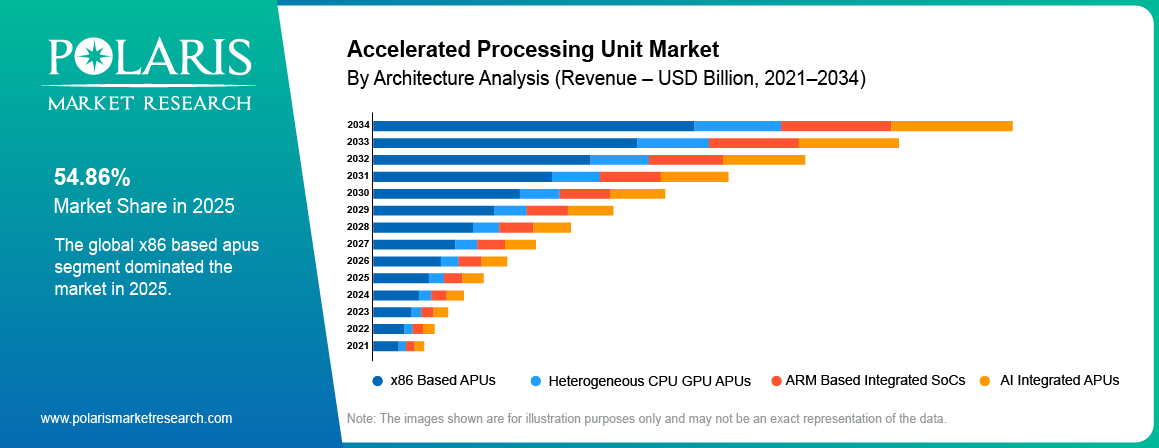
The x86-based APUs segment held 54.86% share in 2025 owing to the strong positioning of AMD and Intel in laptops, desktops, workstations, and business computing systems. The strength of the x86 architecture is also tied to the huge Windows software, driver, and enterprise application ecosystem built around x86 processors. Compatibility remains an important consideration for organizations and consumers replacing or upgrading existing computer systems. The established software base also fuels ongoing demand for x86-based integrated processors throughout mainstream personal computing, where compatibility and platform continuity remain important factors in purchase decisions.
The ARM-based integrated SoCs segment is expected to witness 23.18% CAGR during the forecast period. The demand for power-efficient computing and tightly integrated processor architectures is driving the segment growth. With ARM-based designs, CPU, GPU, memory, and AI processing functions can be integrated in a compact system architecture that can support performance and efficiency requirements across newer computing platforms. Qualcomm’s Snapdragon X platform has brought ARM-based computing to Windows PCs. Apple’s silicon portfolio continues to showcase the use of ARM architecture in personal computing products. These developments are expanding the application space for ARM-based integrated processors beyond their traditional mobile computing applications.
Application Insights
In 2025, the personal computing segment held the largest share of 31.84%, due to the ongoing adoption of APUs in laptops and desktop computers. Integrated processors are preferred for daily productivity, content consumption, business applications, and popular gaming as they combine CPU and graphics capabilities into a single platform. The ability to combine these processing functions also allows manufacturers to design systems without requiring separate CPU and graphics components for many use cases. The large installed base of personal computers, together with continuing device replacement and product refresh cycles, therefore provides a broad and established demand base for integrated processor architectures.
The AI PCs segment is projected to register a 27.86%CAGR during the forecast period. This is due to increasing demand for devices that can process AI workloads locally. PC makers are increasingly integrating dedicated AI processing into newer systems. It is creating demand for processors that combine CPU, GPU, and neural acceleration on a single platform. AMD’s Ryzen AI platforms and Intel’s NPU-enabled Core Ultra processors are examples of the growing trend to add AI capabilities to client computing platforms. The move to local AI inference is also boosting the importance of processor-level AI acceleration, software support, power efficiency, and overall platform integration.
End Use Insights
The PC OEMs segment led the accelerated processing unit market share with 34.72% in 2025. The dominance is driven by the large-volume processor procurement for laptops, desktops, workstations, and other computing systems. Most integrated processors reach consumers through complete devices rather than through direct individual processor purchases. Continuous PC product launches and replacement cycles therefore provide PC OEMs with a consistent source of demand for integrated CPU and GPU platforms. OEM relationships also give processor suppliers visibility into future platform requirements, product configurations, and processor-generation planning. These factors are reinforcing the importance of this customer group within the overall accelerated processing unit market.
The data center operators segment is anticipated to register a 24.72% CAGR during the forecast period, supported by rising AI and high-performance computing workloads. Data center operators are increasingly evaluating processor architectures that bring different computing resources closer together to improve workload efficiency within available power, memory, and system constraints. Integrated processor designs can support closer coordination between CPU and GPU resources while reducing the separation between general-purpose and accelerated computing functions. The expansion of AI infrastructure and high-performance workloads can broaden APU applications beyond traditional client devices. It can increase demand for integrated compute platforms in advanced data center environments.
Sales Channel Insights
The OEM supply segment dominated the market with 54.68% share in 2025, reflecting the way APUs are primarily incorporated into complete laptops, desktops, gaming systems, consoles, and other devices before reaching end users. Large-volume procurement agreements between processor suppliers and device manufacturers remain a key growth driver. This channel also gives processor vendors greater visibility into product-generation planning and platform design cycles. The concentration of processor demand within OEM relationships reflects the importance of system-level integration. CPU, GPU, AI capabilities, memory, and other components are evaluated together during device development and production.
The cloud and HPC platform supply segment is projected to exhibit a 25.18% CAGR during the forecast period. The growth is supported by increasing deployment of accelerated computing infrastructure for AI and other compute-intensive workloads. Cloud and high-performance computing platforms require greater processing capability while managing power, memory, and system-level efficiency. The growing use of integrated CPU and GPU platforms can therefore create a wider commercial opportunity for APU architectures in data center and advanced computing environments. Continued investments in AI infrastructure are driving demand for closely integrated processing resources that support diverse workloads within constrained system architectures.
Regional Analysis
North America Accelerated Processing Unit Market Trends
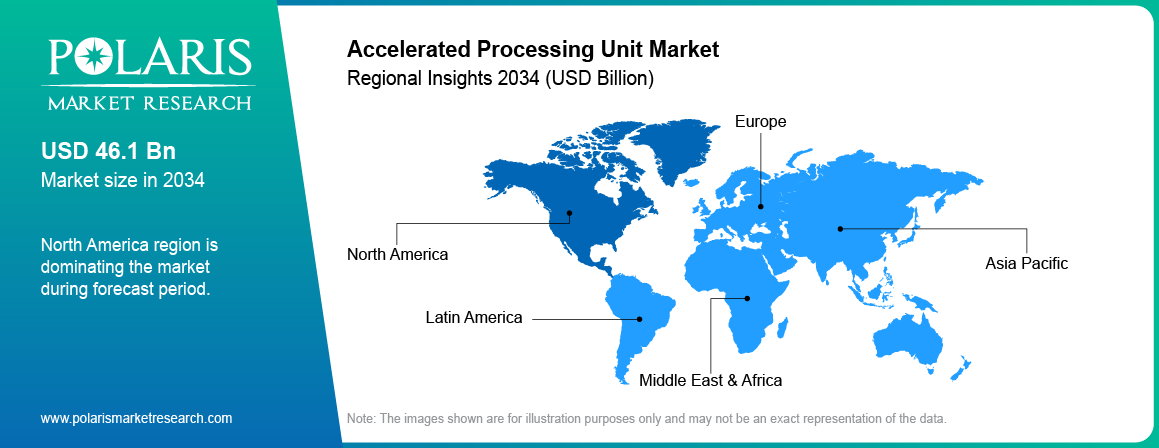
North America dominated the accelerated processing unit market share with 40.18% in 2025. The presence of major processor design companies, including Advanced Micro Devices, Inc.; Intel Corporation; NVIDIA Corporation; and Qualcomm Incorporated, supports this leading share. The region also benefits from established PC, gaming, enterprise computing, and accelerated-computing ecosystems. Key strengths remain in processor development and commercialization, while semiconductor manufacturing and advanced packaging are geographically distributed through global supply chains. The concentration of technology companies and the relationships between platforms drive the demand for integrated processors in personal computing, gaming, enterprise systems, and emerging AI-enabled computing applications.
Also, North America’s processor ecosystem is strengthened by robust PC and console platform relationships, which include next generation semi-custom silicon development. Therefore, the regional strength is more focused on processor architecture, chip design, platform integration, and commercialization rather than solely on semiconductor manufacturing. Overseas foundry and packaging capabilities remain important to the supply chain, while continued development of AI-capable processors is creating additional demand for integrated CPU, GPU, and AI processing. These factors provide a strong foundation for the regional CPU GPU integration market and support adoption across established and emerging computing platforms.
Asia Pacific Accelerated Processing Unit Market Trends
The Asia Pacific APU market is projected to register a 21.72% CAGR during the forecast period. The region combines major semiconductor manufacturing and advanced packaging capabilities with large PC, gaming, industrial, and consumer electronics markets. Taiwan and South Korea are important centers for advanced semiconductor production and packaging, and are home to MediaTek Inc. and Samsung Electronics Co., Ltd. China remains the largest PC and consumer electronics manufacturing base, and export controls on advanced chips are accelerating domestic processor development by firms such as Huawei Technologies Co., Ltd. Japan contributes through industrial electronics and gaming platforms.
India is growing its semiconductor ecosystem with policy support. Prime Minister of India inaugurated SEMICON India 2026 on September 17, 2026. The government announced the move toward Semicon 2.0, the next stage of its semiconductor programme. The budget of India Semiconductor Mission increased from USD 8 billion under the first phase to USD 13.5 billion (Source: ibef.org). These factors make the region a more important player in APU demand and in the overall semiconductor supply chain.
Europe Accelerated Processing Unit Market Trends
Europe registered 21.84% market share in 2025, driven by demand for enterprise PC refreshes, automotive electronics, industrial computing, and other applications where integrated processing can reduce system complexity. Automotive electronics are particularly relevant as vehicle architectures increasingly require coordinated CPU, GPU, and AI processing. European system suppliers therefore provide an important demand environment for integrated processor technologies, particularly where computing performance, power efficiency, and system-level integration influence platform design. Germany and the UK remain important contributors to European enterprise and automotive demand.
Regional expansion is comparatively constrained by slower enterprise refresh cycles and a more cautious corporate AI adoption pattern than some North American and Asian markets. Nevertheless, the growing use of AI-capable computing and increasingly sophisticated automotive and industrial electronics can support demand for integrated processors. European buyers are also looking at processor architectures in terms of performance, power consumption, system complexity, and application requirements. This creates opportunities for APU suppliers across enterprise computing, automotive electronics, industrial systems, and other embedded applications where CPU, graphics, and AI capabilities can be integrated into a common platform.
Policy support under the European Chips Act, which entered into force in September 2023, is encouraging regional design and packaging capacity, although most integrated processors used in Europe are still designed in North America and Asia (Source: eur-lex.europa.eu).
Latin America Accelerated Processing Unit Market Trends
Latin America registered 5.12% market share in 2025. Integrated graphics and mainstream computing tier demand is more concentrated in lower-cost AI PC platforms than premium ones. Brazil reports high APU demand, while Mexico adds value by assembling devices and integrating them with North American supply chains. Local assembly activity can support demand for cost-efficient processors, although final device manufacturing does not necessarily determine the geographic attribution of processor revenue. Regional growth therefore remains closely linked to PC penetration, affordability, and replacement cycles.
The regional opportunity is also supported by the gradual migration toward newer integrated processor configurations as consumers and businesses replace older computing systems. Adoption of higher-performance AI-capable platforms is likely to depend on device affordability, enterprise purchasing priorities, and the availability of suitable hardware. Brazil and Mexico are therefore important markets for assessing future demand, while broader Latin American growth will depend on the pace of PC modernization and the transition from conventional integrated graphics toward processors incorporating stronger graphics and AI capabilities.
Middle East and Africa Accelerated Processing Unit Market Trends
The Middle East & Africa represented 4.40% regional share in 2025 and continues to develop from a smaller installed base. Gulf markets are creating opportunities through government digital transformation programs, enterprise technology refreshes, and expanding demand for advanced computing infrastructure. The growing relevance of AI-ready hardware is supporting enterprise interest in processors capable of handling selected AI workloads locally. These developments create opportunities for integrated processors in business computing and other areas where companies are upgrading their technology infrastructure.
South Africa and other African markets remain more concentrated in lower-cost computing configurations. It reflects differences in purchasing power, installed infrastructure, and technology adoption. Enterprise and government procurement can nevertheless provide a route for newer AI-capable systems as infrastructure modernization progresses. Across the region, demand will depend on the pace of digital transformation, enterprise hardware replacement, affordability, and the availability of processors that combine general-purpose computing, graphics, and AI capabilities within a single platform.
Export Controls and Policy Signals
| Region | Stance | Key Instrument or Signal | Impact on the APU Market |
| United States | Supportive of design, restrictive on exports | CHIPS and Science Act (2022); BIS advanced computing export controls | Shapes access to leading edge AI and data center APUs |
| European Union | Supportive | European Chips Act, in force September 2023 | Builds regional design and packaging capacity |
| India | Strongly supportive | India Semiconductor Mission 2.0: outlay up from USD 8 billion to USD 13.5 billion (September 2026) | Long term ecosystem build |
| China | Constrained | Advanced chip export restrictions | Pushes domestic processors, limits access to top parts |
| Japan | Supportive | Government support for semiconductors and AI infrastructure | Backs domestic supply chains |
Source: Government publications, Polaris Market Research Analysis.
Technology and Innovation Landscape
Technology and Innovation Landscape Snapshot
| Technology | What It Does | Latest Reference Point | Market Impact |
| CPU, GPU and NPU integration | Combines general, graphics and AI compute on one chip | Intel Core Ultra Series 3: up to 12 Xe cores, 50 NPU TOPS | Becomes the baseline for AI PCs |
| Fusion and chiplet packaging | Joins several dies into one processor | Apple M5 Ultra: two M5 Max dies on UltraFusion, 80 GPU cores | Scales beyond one monolithic die |
| Unified memory | CPU, GPU and NPU share one memory pool | Apple up to 512 GB; AMD Ryzen AI Halo and NVIDIA RTX Spark up to 128 GB | Enables large local AI models |
| Arm based Windows platforms | Power efficient Arm CPUs on Windows | Snapdragon X2 Plus: 80 TOPS NPU; RTX Spark: 20 core Grace | Broadens competition beyond x86 |
| Advanced process nodes | Higher density and efficiency | Intel 18A; Apple M6 on 2 nanometer | Raises performance per watt |
| Tightly coupled data center APUs | CPU and GPU share HBM in one package | AMD Instinct MI300A: 24 Zen 4 cores, 228 compute units, 128 GB HBM3 | Extends the APU into HPC and AI |
Source: Company press releases, Polaris Market Research Analysis.
The main technology shift is the convergence of the traditional APU with full system on chip design. Current processors integrate CPU cores, a GPU, an NPU, memory controllers and connectivity in one tightly coordinated package. Apple's Fusion Architecture, introduced with the M5 Pro and M5 Max in March 2026, connects two dies into a single SoC and supports up to 128 GB of unified memory.
Advanced [chiplet] packaging is becoming a main route to performance scaling. Apple's M5 Ultra joins two M5 Max dies using UltraFusion, while AMD packages CPU and GPU compute with stacked memory in the Instinct MI300A. These approaches reduce reliance on a single large die as the only way to add compute.
The neural processing unit has become a core processor component. Intel's Core Ultra Series 3 delivers up to 50 NPU TOPS, AMD's Ryzen AI 400 Series up to 60 TOPS and Qualcomm's Snapdragon X2 Plus 80 TOPS. NVIDIA's RTX Spark takes a different route, pairing a 20 core Grace CPU with a Blackwell GPU for up to 1 petaflop of AI compute.
The resulting innovation landscape is increasingly centered on the interaction between compute density, memory architecture, packaging, power efficiency and software support. Processor suppliers are therefore competing at the system level rather than on individual CPU or GPU specifications.
Accelerated Processing Unit Market Competitive Landscape
Market Positioning Snapshot
| Company | Market Position | Flagship Platform | Primary Focus |
| Advanced Micro Devices, Inc. | Market Leader | Ryzen AI 400, Ryzen AI Max+, Instinct MI300A | PCs, handhelds, consoles, data center |
| Intel Corporation | Market Leader | Core Ultra Series 3 | Mainstream and enterprise PCs |
| Apple Inc. | Market Leader (premium devices) | M6, M5 Pro, M5 Max, M5 Ultra | Macs, tablets, premium computing |
| Qualcomm Incorporated | Emerging Challenger | Snapdragon X2 Plus | Windows on Arm laptops |
| NVIDIA Corporation | Emerging Challenger (client PCs) | RTX Spark | AI PCs, workstations, data center |
| MediaTek Inc. | Emerging Challenger | Dimensity, Kompanio, RTX Spark CPU partner | Mobile, tablets, Arm PCs |
| Huawei Technologies Co., Ltd. | Regional Challenger | Kirin, Ascend | China devices and AI compute |
| Samsung Electronics Co., Ltd. | Niche Player | Exynos | Mobile and wearables |
| NXP Semiconductors N.V. | Niche Player | i.MX applications processors | Automotive and industrial |
| Renesas Electronics Corporation | Niche Player | R Car SoCs | Automotive |
| Broadcom Inc. | Niche Player | BCM4918 | Edge networking |
| Arm Holdings plc | Technology Enabler | Arm CPU and Mali GPU IP | Licensing to SoC makers |
Source: Company filings and press releases, Polaris Market Research Analysis.
The accelerated processing unit market is concentrated among a small group of processor companies with the intellectual property, software relationships, manufacturing access, and capital required to develop integrated CPU and GPU platforms.
The market is led by Advanced Micro Devices, Inc. and Intel Corporation in x86 platforms, with Apple Inc. in premium vertically integrated devices and Qualcomm Incorporated, NVIDIA Corporation and MediaTek Inc. challenging in Arm based Windows PCs.
Competition is increasingly determined by more than processor benchmark performance. Software ecosystems, AI frameworks, operating-system support, OEM relationships, power efficiency, packaging capabilities, and developer access to integrated AI engines all influence platform selection.
AMD maintains a broad product footprint spanning desktop, laptop, data center, and semi-custom console applications. Intel remains deeply established in x86 enterprise and PC ecosystems. Qualcomm and Apple are expanding ARM-based approaches from different commercial positions, with Qualcomm supplying third-party OEMs and Apple controlling both silicon and hardware integration.
NVIDIA's role adds another dimension because its accelerated-compute platforms connect CPU and GPU resources with an emphasis on local AI. The resulting competitive structure is therefore becoming increasingly heterogeneous, reflecting the growing adoption of heterogeneous computing, rather than being limited to a traditional AMD versus Intel comparison.
APU Buyer Analysis
PC OEMs have substantial influence over processor roadmaps because their design decisions determine which silicon reaches mass-market devices. Processor selection occurs well before retail availability and therefore creates a significant barrier for suppliers attempting to establish a new platform.
Console makers have a distinctive relationship with processor suppliers because semi-custom silicon programs involve long-term co-engineering. The multi-year development cycle gives console customers substantial influence over processor configuration and roadmap requirements.
Enterprise IT buyers use a different evaluation framework. Total cost of ownership, manageability, security, support, and commercial platform features can be more important than peak consumer benchmark results.
There are some barriers to market entry. Compact devices have strict thermal and power constraints, including thermal design power requirements. Memory bandwidth can be a bottleneck when CPU, GPU and NPU resources share the same memory system. Another structural barrier is the maturity of software and drivers, particularly for vendors entering established PC ecosystems.
x86 software compatibility is a major obstacle for alternative architectures as Windows applications, drivers and enterprise software have decades of x86 support. ARM-based suppliers must therefore balance performance and efficiency advantages against compatibility and software-porting requirements.
Advanced packaging capacity creates another entry barrier. High-end chiplet and multi-die designs depend on access to specialized packaging ecosystems, increasing the capital and supply-chain requirements for new entrants.
Buyer Framework
| Buyer Type | Primary Purchase Driver | Typical Sales Channel |
| PC OEMs | Design-win economics and AI PC feature requirements | OEM supply |
| Console makers | Semi-custom silicon roadmap alignment | Direct design partnership |
| Enterprise IT buyers | Total cost of ownership and security | Enterprise procurement |
| Automotive electronics suppliers | Functional safety and thermal reliability | Embedded module distribution |
| Retail PC builders and gamers | Price-to-performance and gaming performance | Retail component sales |
Source: Polaris Market Research Analysis
Cost and Pricing Benchmarking Analysis
Pricing across the integrated processor market varies significantly by product tier, architecture, memory configuration, and intended application. Entry desktop processors occupy a substantially different price position from flagship desktop processors and premium unified-memory systems.
The pricing benchmarks below use public manufacturer pricing where available and current consumer pricing information for street-price observations.
Cost and Pricing Benchmarking
| Product Tier | Example | Manufacturer Price | Street Price |
| Entry desktop APU | AMD Ryzen 5 8500G | USD 179 at launch, January 2024 | - |
| Flagship desktop processor | Intel Core Ultra 9 285K | USD 589 recommended customer price | USD 475 to 570 (verify dated) |
| Arm based AI PC | Snapdragon X series laptops | Sold inside OEM devices | From about USD 600 at launch |
| Compact unified memory desktop | Apple Mac mini (M6) | From USD 899 | Not applicable |
Source: AMD, Intel, Qualcomm, Apple, Polaris Market Research Analysis.
The pricing spread demonstrates the market's broad product architecture. Entry point Desktop APUs compete on price and iGPU performance. However, flagship chips are priced higher based on performance, AI capabilities and platform positioning.
Street pricing can diverge from manufacturer recommended pricing, particularly when processor generations transition or component-cost conditions change. Memory-cost pressure during 2026 adds another variable to the economics of complete APU-equipped systems.
Accelerated Processing Unit Key Players
- Advanced Micro Devices, Inc.
- Apple Inc.
- Arm Holdings plc
- Broadcom Inc.
- Huawei Technologies Co., Ltd.
- Intel Corporation
- MediaTek Inc.
- NVIDIA Corporation
- NXP Semiconductors N.V.
- Qualcomm Incorporated
- Renesas Electronics Corporation
- Samsung Electronics Co., Ltd.
Accelerated Processing Unit Industry Developments
- August 2026: Apple Inc. introduced the M6, its first 2 nanometer chip, and the M5 Ultra, which joins two M5 Max dies using UltraFusion for up to 36 CPU cores, 80 GPU cores and 512 GB of unified memory. (Source: apple.com)
- June 2026: Valve opened Steam Machine orders at USD 1,049, built on a semi custom AMD Zen 4 six core processor with RDNA 3 graphics. (Source: pcworld.com)
- May 2026: NVIDIA Corporation and Microsoft unveiled RTX Spark, a Windows PC chip pairing a 20 core Grace CPU, co designed with MediaTek Inc., with a Blackwell GPU of 6,144 CUDA cores and up to 128 GB of unified memory. (Source: nvidia.com)
- March 2026: Apple Inc. introduced the M5 Pro and M5 Max with Fusion Architecture, which connects two dies into one SoC, with up to 128 GB of unified memory on M5 Max. (Source: apple.com)
- February 2026: AMD said on its fourth quarter 2025 earnings call that Microsoft's next generation Xbox, built on an AMD semi custom SoC, was progressing to support a 2027 launch. (Source: tomshardware.com)
- January 2026: Intel Corporation launched Core Ultra Series 3, the first processors built on Intel 18A, with up to 16 CPU cores, up to 12 Arc Xe graphics cores and up to 50 NPU TOPS. Global availability began on 27 January 2026. (Source: intel.com)
- January 2026: Qualcomm Incorporated announced Snapdragon X2 Plus with the third generation Oryon CPU and an 80 TOPS NPU for mainstream Windows laptops. (Source: qualcomm.com)
- January 2026: Advanced Micro Devices, Inc. introduced the Ryzen AI 400 Series, with NPU performance of up to 60 TOPS, and Ryzen AI Max+ 392 and 388 processors with 40 compute unit Radeon 8060S graphics at CES 2026. (Source: amd.com)
Premium Insights and Forward Outlook
Market Size Debate Is Shifting from Units to Compute Density
Unit shipments are becoming a less complete measure of market value as processors deliver substantially greater compute capability within individual chips. Premium integrated processors can combine CPU, GPU, AI acceleration, and large memory resources in a single platform. It is increasing the economic value represented by individual units. For instance, Apple's Mac Studio platform can be configured with up to 512 GB of unified memory. It demonstrates how premium systems increasingly combine high processor capability with substantial memory capacity in a single computing environment.
NPU Capability Is Becoming a Core Processor Comparison Point
Processor evaluation is moving beyond traditional CPU clock speed and GPU core count. NPU capability, local AI performance, and the availability of software frameworks that can use the neural engine are becoming increasingly important factors in AI PC positioning.
This shift changes the competitive assessment of processor suppliers. Hardware throughput alone does not determine practical AI performance. Developers also require operating-system integration, libraries, model support, and application-level access to the NPU.
The market is therefore moving toward a broader definition of processor performance that combines CPU, GPU, NPU, memory, power efficiency, and software compatibility.
Accelerated Processing Unit Market Report Segmentation
By Form Factor Outlook (Revenue, USD Billion, 2021–2034)
- Desktop APUs
- Laptop APUs
- Data Center APUs
- Embedded APUs
- Console and Gaming APUs
By Architecture Outlook (Revenue, USD Billion, 2021–2034)
- x86 Based APUs
- ARM Based Integrated SoCs
- Heterogeneous CPU GPU APUs
- AI Integrated APUs
By Application Outlook (Revenue, USD Billion, 2021–2034)
- Personal Computing
- Gaming Systems
- AI PCs
- Edge Computing
- High-Performance Computing
By End Use Outlook (Revenue, USD Billion, 2021–2034)
- Consumer Electronics Brands
- PC OEMs
- Data Center Operators
- Automotive Electronics Suppliers
- Industrial System Integrators
By Sales Channel Outlook (Revenue, USD Billion, 2021–2034)
- OEM Supply
- Retail Component Sales
- Enterprise Procurement
- Embedded Module Distribution
- Cloud and HPC Platform Supply
By Regional Outlook (Revenue, USD Billion, 2021–2034)
- North America
- U.S.
- Canada
- Europe
- Germany
- France
- UK
- Italy
- Spain
- Netherlands
- Rest of Europe
- Asia Pacific
- China
- Japan
- India
- South Korea
- Taiwan
- Australia
- Rest of Asia Pacific
- Latin America
- Brazil
- Mexico
- Argentina
- Rest of Latin America
- Middle East & Africa
- Saudi Arabia
- UAE
- South Africa
- Rest of Middle East & Africa
Accelerated Processing Unit Market Report Scope
| Report Attributes | Details |
| Market Size in 2025 | USD 18.32 Billion |
| Market Size in 2026 | USD 22.23 Billion |
| Revenue Forecast by 2034 | USD 105.50 Billion |
| CAGR | 18.89% from 2026–2034 |
| Base Year | 2025 |
| Historical Data | 2021–2024 |
| Forecast Period | 2026–2034 |
| Quantitative Units | Revenue in USD Billion and CAGR |
| Report Coverage | Revenue Forecast, Growth Factors, Competitive Landscape, Industry Trends, and Strategic Analysis |
| Segments Covered |
|
| Regional Scope |
|
| Report Format | PDF + Excel |
| Customization | Available by Country, Region, and Segment |
Source: Polaris Market Research Analysis
Why Choose Polaris Market Research
The accelerated processing unit market report by Polaris Market Research & Consulting, Inc. builds its analysis on company disclosures, SEC filings, product specifications and verifiable pricing, so every figure can be traced to an identifiable source.
The report also provides a broader segmentation framework covering form factor, architecture, application, end use, sales channel, and region. Architecture and Sales Channel provide additional visibility into structural differences that can be missed when analysis is limited to traditional product and application categories.
Customized APU market analysis comprises product tier, geography, application, buyer group, or other relevant market dimensions. Contact our analyst team to scope a custom-cut version of this study if a specific product tier, region, or buyer segment requires deeper analysis.
Research Methodology
Secondary research for this report draws from company newsroom and investor-relations disclosures from AMD, Intel, Qualcomm, Apple, and NVIDIA, supplemented by an SEC filing, product specification information, and trade reporting tied to identifiable primary disclosures or verifiable pricing information.
The analysis gives particular attention to edge computing and data-center-adjacent products that sit close to the report's scope boundary. AMD's MI300A and NVIDIA's accelerated-compute platforms are considered as boundary cases because their CPU-GPU integration connects consumer-oriented APU concepts with higher-performance computing architectures.
Semi-custom silicon analysis is grounded in company disclosures and earnings commentary rather than relying solely on secondary reporting. This approach is particularly relevant to console applications because platform development cycles extend across multiple years.
Forecasting uses a bottom-up approach based on product tier, architecture, application, and regional demand signals. The model recognizes the structural shift from established x86 designs toward broader ARM participation and integrated AI acceleration. Data validation is conducted against company disclosures, product information, pricing observations, and internal analyst review.
The accelerated processing unit market analysis was prepared by Polaris Market Research & Consulting, Inc.'s technology and semiconductors research team, comprising two research analysts, one senior research analyst, and one industry reviewer with experience in integrated graphics and client-computing platforms. Findings undergo internal peer review before publication.
Five-Phase Research Methodology
| Phase | Activity | Output |
| 1. Secondary Research | Company filings, investor disclosures, product specification pages, and trade press covering AMD, Intel, Qualcomm, Apple, and NVIDIA | Source log |
| 2. Primary Research | Structured conversations with OEM procurement and platform engineering contacts | Assumption validation |
| 3. Data Triangulation | Cross-checking company-disclosed segment revenue against independent pricing and shipment signals | Validated market inputs |
| 4. Forecasting | Bottom-up modeling by product tier, architecture, application, and region | Polaris internal model |
| 5. Validation | Internal peer review and analyst sign-off before publication | Final Report in PDF+Excel format |
Source: Polaris Market Research Analysis
Accelerated Processing Unit Market FAQ's
The accelerated processing unit market was valued at USD 18.32 billion in 2025 and is projected to reach USD 105.50 billion by 2034, growing at a CAGR of 18.89% from 2026 to 2034.
Publishers define the market differently. Estimates that include smartphone and tablet processors are several times larger. This report sizes integrated CPU, GPU and AI processors for PCs, consoles, handheld systems, edge platforms and selected data center systems.
North America led the market with 40.18% share in 2025, supported by Advanced Micro Devices, Inc., Intel Corporation, NVIDIA Corporation and Qualcomm Incorporated. Asia Pacific is projected to grow fastest at 21.72% CAGR.
Laptop APUs held the largest share at 36.72% in 2025, driven by laptop adoption in business and gaming. Data center APUs are expected to grow fastest at 24.68% CAGR through 2034.
Key players include Advanced Micro Devices, Inc., Intel Corporation, Apple Inc., Qualcomm Incorporated, NVIDIA Corporation, MediaTek Inc., Samsung Electronics Co., Ltd. and Huawei Technologies Co., Ltd.
Demand for AI PCs and on device AI is the main driver. Gartner estimated that AI PCs would reach 31% of the worldwide PC market by the end of 2025. Semi custom console programs, such as the next generation Xbox planned for 2027, add long term demand.
Memory and thermal costs. DRAM and NAND prices rose in 2026 as memory makers shifted capacity to high bandwidth memory, which raises the cost of entry and mid range systems.
APU stands for accelerated processing unit. It is a processor that combines a CPU and a GPU on one die or package, and in current designs also an NPU for AI workloads.
A CPU handles general computing and a GPU handles graphics and parallel work. An APU puts both on one chip, which cuts cost, space and power compared with a CPU paired with a discrete graphics card.
Yes, for mainstream and handheld gaming. Modern APUs run many popular games at reasonable settings, and console processors are semi custom APUs. Demanding titles at high resolution still benefit from a discrete GPU.
Ryzen AI processors combine Zen CPU cores, Radeon graphics and an NPU, so they are APUs. Intel does not use the APU label, but Core Ultra Series 3 integrates CPU cores, Arc graphics and an NPU of up to 50 TOPS, so it falls within this report's scope.
An AI PC runs AI tasks locally using a built in NPU alongside the CPU and GPU. The APU integrates all three, so inference runs on the device without sending data to the cloud.
Desktop APUs start near USD 179 (Ryzen 5 8500G at launch). Arm based AI PCs started at around USD 600, and the Apple Mac mini with the M6 starts at USD 899. Prices vary by tier, memory and platform.
Not in the near term. APUs now handle mainstream gaming and AI tasks, but demanding gaming, 3D rendering and AI training still need the higher memory bandwidth and power budget of discrete GPUs.
Download Sample Report of Accelerated Processing Unit Market
Please fill out the form to request a customized copy of the research report.


