
PFAS Treatment Chemicals Market Size, Share, and Forecast 2026 to 2034
REPORT DETAILS
PFAS Treatment Chemicals Market Summary
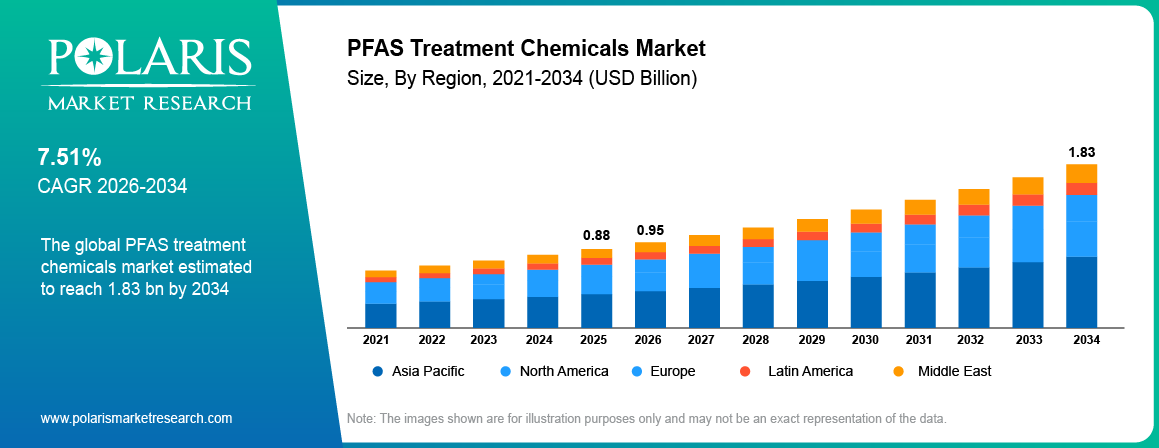
The PFAS Treatment Chemicals market size was valued at USD 0.88 billion in 2025. The market is expected to grow at a CAGR of 7.51% from 2026 to 2034. Growth is linked to drinking water MCL compliance, CERCLA-related cleanup activity, recurring media replacement, and increasing evaluation of lower-cost resin and destruction technologies.
Market Statistics
PFAS Treatment Chemicals Market Key Takeaways
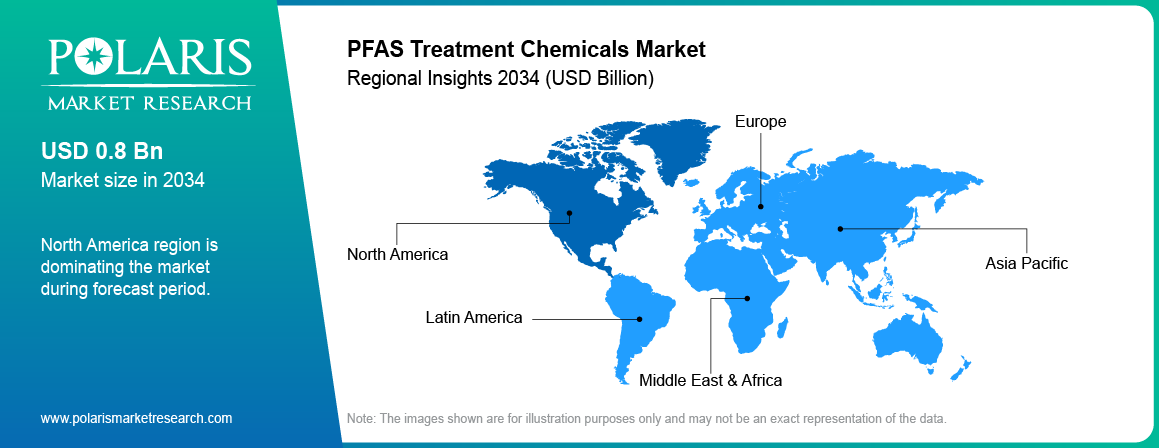
- North America dominated the PFAS treatment chemicals industry with 40.68% in 2025, driven by US PFAS drinking water regulations and MCL compliance requirements.
- Asia Pacific is expected to register 9.14% CAGR during 2026–2034, driven by growing PFAS monitoring and industrial water treatment demand.
- Granular activated carbon dominated the chemical and media type segment with 43.68% in 2025, due to its established installed base and utility supply relationships.
- Drinking water treatment dominated the application segment with 50.86% in 2025, driven by regulatory requirements for PFOA and PFOS.
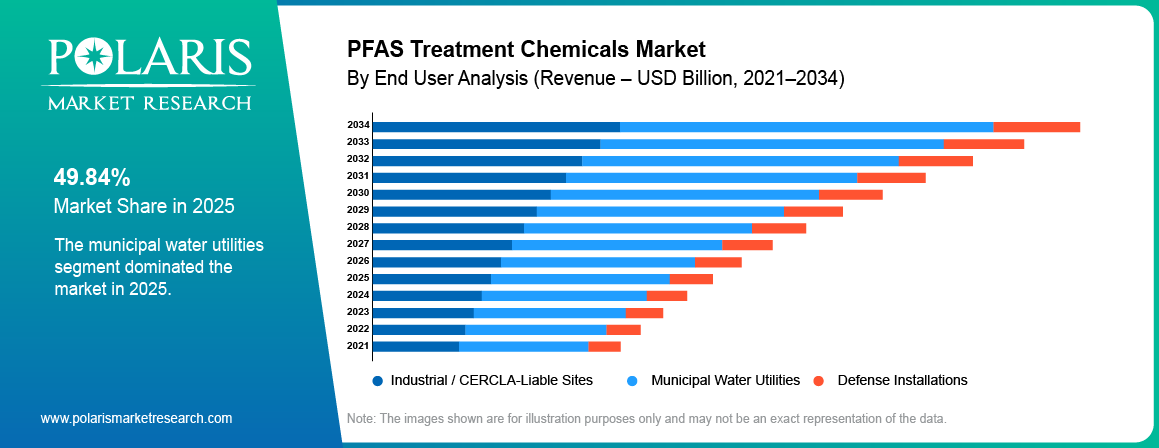
- Municipal water utilities dominated the end-user segment with 49.84% in 2025, driven by recurring treatment media demand and PFAS compliance requirements.
Note: Figures and projections outlined in this report are the result of Polaris Market Research’s proprietary analytical processes, grounded in the latest available datasets and market observations.
What is PFAS Treatment Chemicals Market?
The PFAS treatment chemicals market includes consumable media and reagents used to capture or destroy PFAS. This includes granular activated carbon, PFAS-selective ion exchange resin, destruction and oxidation reagents, and emerging sorbents. Applications cover drinking water, industrial wastewater, landfill leachate, groundwater remediation, and concentrated PFAS waste destruction. The market is separate from the larger PFAS treatment market which includes capital equipment such as filtration vessels, membrane systems and destruction reactors. This chemicals and media layer feeds directly into equipment covered separately in Polaris's Point of Entry PFAS Treatment Systems Market and Point of Exit PFAS Treatment Systems Market reports.
The PFAS chemicals market is also out of scope as it relates to PFAS-containing manufactured products rather than chemicals used to remove PFAS. PFAS remediation chemicals services are excluded, as they are engineering, construction and site services and not chemical manufacturing. Growth is correlated to MCL compliance and recurring demand for treatment media, consistent with EPA’s 2024 PFOA and PFOS limits and the original April 2029 compliance deadline.
A second demand channel is created by the CERCLA hazardous substance designation for PFOA and PFOS, opening up a separate remediation pathway for industrial and defense sites with historical contamination. Chemical demand in these projects is not based on municipal drinking water schedules but on cleanup orders, liability exposure and consent-decree timelines. The PFAS treatment chemicals market size thus reflects two separate demand cycles: one based on municipal demand relating to drinking water compliance, and the other based on industrial and defense demand relating to remediation and liability.
Market Dynamics
Driver Impact Analysis
| Market Driver | Geographic Relevance | Impact Timeline |
| Strengthening PFAS Drinking Water Regulations Are Increasing Treatment Media Demand | United States | Active, compliance deadline 2029, proposed extension to 2031 |
| Expanding PFAS Remediation Requirements Are Broadening Industrial Treatment Growth | United States, industrial and defense sites | Ongoing, case-by-case cleanup and consent-decree timelines |
| Treatment-Cost Advantages Are Creating Opportunities for PFAS-Selective Media | United States, expanding globally | Active, shaping new installations through the 2029/2031 compliance window |
| Advances in Concentrated PFAS Destruction Are Expanding Chemical Opportunities | United States, DoD-funded demonstrations | Near-term, AFFF concentrate and spent media focus |
Source: EPA, SERDP-ESTCP, company filings, and Polaris Market Research Analysis
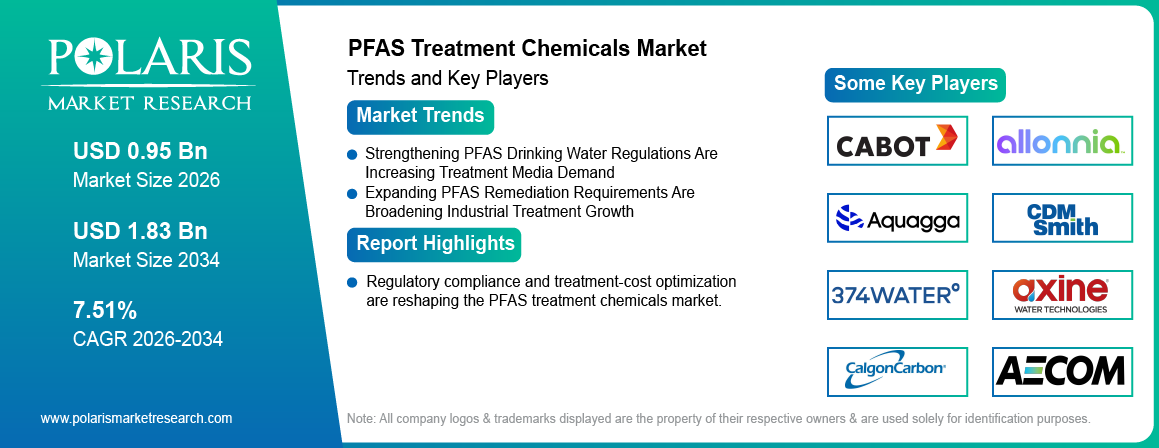
Driver: Strengthening PFAS Drinking Water Regulations Are Increasing Treatment Media Demand
Stricter PFAS drinking water regulations are increasing demand for the PFAS treatment chemicals market across municipal water systems. In April 2024, EPA’s drinking water rule set enforceable limits of 4 parts per trillion for PFOA and PFOS, affecting approximately 66,000 public water systems that serve about 90 percent of the US population. The requirements are generating a well-defined treatment demand base for GAC and ion exchange resin across affected systems. The ongoing consumption is also supported by the replacement of treatment media over time as the GAC and ion exchange resin reach their treatment capacity. This creates a recurring demand instead of a one-time procurement and tightens the link between regulatory implementation and chemical consumption (Source: epa.gov).
Driver: Expanding PFAS Remediation Requirements Are Broadening Industrial Treatment Growth
PFAS treatment chemicals market demand is driven by expanding PFAS remediation requirements in industrial and defense applications. The listing of PFOA and PFOS as hazardous substances under CERCLA has increased the need for PFAS treatment at contaminated industrial sites, airports and military bases, creating a demand beyond treatment of drinking water at municipal drinking water treatment plants. During clean-up activities, these remediation actions require GAC and ion exchange resin to treat the contaminated water. Another channel for growth for the PFAS treatment chemicals market, and supporting repeat consumption of treatment media, is the demand associated with site contamination, cleanup requirements, liability exposure, and remediation timelines.
Restraint: High PFAS Destruction Costs Limit Broad Adoption
High destruction costs are limiting broader adoption of PFAS destruction chemicals in dilute water applications. A Minnesota study estimated municipal wastewater PFAS removal and destruction costs at USD 2.7 million to USD 18 million per pound of PFAS eliminated, making full-scale destruction economically challenging under the modeled conditions. This cost structure can shift treatment demand toward capture technologies and concentrated waste streams where higher PFAS loading can support more manageable treatment economics. The economics therefore remain an important constraint on the broader deployment of PFAS destruction technologies across dilute municipal wastewater applications (Source: nacwa.org).
Opportunity: Treatment-Cost Advantages Are Creating Opportunities for PFAS-Selective Media
Treatment-cost advantages are creating opportunities for PFAS-selective ion exchange resin in new treatment installations as utilities evaluate alternatives to established GAC systems. A documented Purolite comparison placed Purofine PFA694E at approximately USD 0.26 per 1,000 gallons treated, compared with approximately USD 0.45 per 1,000 gallons for GAC for the referenced treatment target. This cost difference can encourage utilities to compare resin and GAC based on lifecycle treatment economics. Resin suppliers can therefore target new installations where buyers prioritize treatment cost, media capacity, and change-out requirements when selecting PFAS treatment solutions (Source: purolite.com).
Opportunity: Advances in Concentrated PFAS Destruction Are Expanding Chemical Opportunities
As treatment providers develop solutions for challenging waste streams, advances in concentrated PFAS destruction are creating opportunities for PFAS destruction chemicals. SERDP-ESTCP demonstrations of supercritical water oxidation using AFFF concentrate and spent GAC and ion exchange resin were conducted during 2025–2026, providing evidence of continued technology development for concentrated PFAS waste. Spent media reactivation also provides an alternative pathway for extending treatment-media utilization before final disposal or destruction. These developments can expand commercial opportunities for destruction technologies where higher PFAS loading supports more manageable treatment economics than dilute water treatment applications (Source: serdp-estcp.mil).
PFAS Treatment Chemicals Market Segmentation Analysis
The PFAS treatment chemicals market is segmented by chemical and media type, application, and end user. The analysis identifies the leading segment in 2025 and the segment expected to register the fastest growth through 2034.
Chemical and Media Type Insights
Granular activated carbon held dominating share of 43.68% of the market in 2025, supported by its established installed base, proven PFAS removal performance, and long-term utility supply relationships. Utilities have developed operating practices for carbon replacement, reactivation and disposal, so GAC is still widely used for municipal drinking water and contaminated site treatment. The ongoing demand for its products was also demonstrated by a nine-year exclusive GAC supply agreement between Calgon Carbon and American Water for more than 50 sites in 10 states. Spent media reactivation offers extension of carbon use and supports recurring demand for replacement and reactivated media. This proven operating model enhances GAC implementation for PFAS treatment for both municipal and industrial applications. GAC consumed in this market is a specialized PFAS application within the broader Activated Carbon Market that Polaris tracks separately.
PFAS-selective ion exchange resin is expected to register fastest CAGR of 8.12% during 2026–2034, driven by its treatment-cost advantages and growing consideration in new PFAS treatment installations. Purolite showed Purofine PFA694E at about USD 0.29 per 1,000 gallons treated versus about USD 0.39 per 1,000 gallons for GAC for the referenced treatment target. This cost difference can drive buyers to consider resin on the basis of treatment capacity, change-out frequency and lifecycle economics. Its selective PFAS removal capability provides an alternative to established GAC treatment approaches, particularly for buyers evaluating new installations and seeking treatment media that can support efficient PFAS removal.
Destruction and oxidation reagents are expected to witness a CAGR of 7.64% during 2026-2034, supported by increasing interest in permanent PFAS destruction for concentrated waste streams. Technologies include the advanced oxidation process, supercritical water oxidation, and hydrothermal alkaline treatment, which can address AFFF concentrate and spent treatment media where higher PFAS concentrations can support more manageable treatment economics. Development of PFAS destruction chemicals is creating a specialized opportunity within the broader treatment chemicals market. Additional technology demonstrations and continued development of concentrated-waste treatment approaches can increase commercial applications for destruction and oxidation reagents.
Emerging sorbents, including cyclodextrin-based media, remain the smallest category by disclosed commercial volume, validated mainly through Department of Defense-funded destruction feedstock testing rather than a comparable long-term supply agreement.
Application Matrix Insights
The drinking water treatment segment held the largest share of 50.86% in 2025, driven by regulatory aspects concerning PFOA and PFOS and the resulting need for periodic treatment media in public water systems. EPA’s drinking water rule created enforceable limits, as well as a defined, compliance-driven demand base for PFAS treatment chemicals. Municipal utilities can use GAC and ion exchange resin as treatment media, while ongoing media replacement creates recurring consumption. The application therefore represents the most established demand channel within the PFAS treatment chemicals market and remains closely linked to regulatory implementation and utility procurement cycles.
AFFF concentrate and spent media destruction is expected to register fastest CAGR of 10.36% during PFAS treatment chemicals industry forecast period, owing to growing interest in permanent treatment of concentrated PFAS waste. SERDP-ESTCP demonstrations have evaluated supercritical water oxidation using AFFF concentrate and spent GAC and ion exchange resin. These applications provide a targeted opportunity for destruction technologies because concentrated waste streams can offer more manageable treatment economics than dilute water. Reactivating spent media offers an alternative to extend the use of the media before it is finally destroyed or disposed of.
The treatment of industrial wastewater and landfill leachate is expected to grow at a CAGR of 8.61% from 2026 to 2034 due to PFAS contamination in industrial facilities and rising treatment demands for complex waste streams. These applications may involve higher PFAS concentrations than conventional drinking water streams, creating demand for GAC, ion exchange resin, and destruction technologies. Industrial operators and landfill owners can require treatment to manage discharge requirements and contaminated leachate. The application therefore provides an additional demand channel beyond municipal drinking water and supports adoption of both established capture media and emerging treatment approaches.
In 2025, groundwater remediation captured 17.68% of the market, fueled by treatment needs at contaminated industrial and defense sites. GAC and ion exchange resin can capture PFAS from groundwater in remediation programs. PFAS remediation chemicals support ongoing treatment needs. Longer project durations can create repeat media consumption and replacement demand. The treatment method chosen depends on the degree of contamination, ground water conditions, the length of the project, and site-specific requirements for remediation. Longer project durations can create recurring media consumption and replacement demand. Treatment selection depends on contamination levels, groundwater conditions, project duration, and site-specific remediation requirements.
End User Insights
Municipal water utilities represented 49.84% of the market in 2025, due to drinking water compliance requirements and repeated demand for treatment media. Utilities require dependable answers to comply with regulatory limits, so GAC and ion exchange resin are key purchasing categories. Ongoing replacement demand is also driven by reaching capacity of treatment media in regulatory implementation. Growing compliance programs can therefore sustain recurring purchases across municipal treatment facilities and support demand for consumable PFAS treatment chemicals as utilities build and maintain treatment capacity.
Industrial / CERCLA-liable sites are projected to grow at a 8.74% CAGR during 2026-2034 on the back of PFAS remediation mandates at contaminated industrial sites. CERCLA designation of PFOA and PFOS may result in more stringent treatment requirements on sites with legacy contamination, driving demand for GAC, ion exchange resin and PFAS remediation chemicals during clean-up activities. In addition to municipal requirements for industrial facilities that need to treat contaminated water on an ongoing basis, remediation programs may also represent an additional source of recurring chemical and media demand.
Defense installations accounted for 14.44% of the market in 2025 due to PFAS contamination arising from AFFF usage and its subsequent treatment and destruction demands. Demand for PFAS capture covers GAC and ion exchange resin, as well as PFAS destruction chemicals for concentrated AFFF and spent media streams. Federal technology demonstration efforts also are supporting the development of permanent PFAS destruction methods, which will create additional demand for treatment chemicals and related technologies across defense-related PFAS management and remediation programs.
Regional Analysis
North America PFAS Treatment Chemicals Market Trends
North America held 40.68% share of the PFAS treatment chemicals market in 2025. The US is a prominent country within North America that is expected to boost the growth of the market. The US regulatory framework for PFAS in drinking water, under the EPA’s drinking water rule, has created a well-defined compliance market for public water systems. In May 2026, the EPA proposed moving the compliance deadlines for PFOA and PFOS from 2029 to 2031, making timing of compliance a key procurement variable. Municipal treatment projects and federal PFAS and emerging contaminant funding can also help to bolster demand for GAC, PFAS-selective ion exchange resin and other PFAS treatment chemicals. These regulatory and funding developments are enabling sustained investment in treatment infrastructure and generating recurring demand for treatment media across impacted water systems (Source: californiawaterviews.com).
Europe PFAS Treatment Chemicals Market Trends
The Europe PFAS treatment chemicals market captured 25.44% market share in 2025, due to strong water infrastructure and active PFAS regulatory activity under the EU Drinking Water Directive. Europe tightening PFAS regulation ECHA has proposed restrictions on more than 10,000 PFAS and EU remediation costs could reach USD 379 billion by 2050. Demand is not concentrated on a single US-style compliance deadline as in North America but more distributed over the procurement cycle for national and utility programs, while industrial contamination management supports demand for PFAS remediation chemicals based on national implementation, local contamination findings and individual site treatment requirements. Regulatory developments are expected to further shape regional treatment demand (Source: aquatechtrade.com).
Asia Pacific PFAS Treatment Chemicals Market Trends
Asia Pacific is expected to register a CAGR of 9.14% from 2026 to 2034, driven by industrial contamination and water quality programs in China, Japan and India. ADB reported that 2.7 billion people in Asia have escaped extreme water insecurity, while it aims for USD 100 billion in climate financing by 2030. Site-specific contamination detection creates opportunities for GAC, PFAS-selective ion exchange resin and other treatment media. Multilateral development bank-funded water quality projects can support treatment investment in markets where domestic PFAS regulation is still maturing. These initiatives can expand opportunities for PFAS treatment chemicals across developing water treatment markets (Source: adb.org).
Latin America PFAS Treatment Chemicals Market Trends
Latin America held a market share of 5.48% in 2025 with industrial wastewater treatment as a key demand area across mining, manufacturing and energy-related applications. However, the absence of a regulatory uniformity and a regional PFAS drinking water standard similar to the US model means that near-term demand is more likely to emerge through individual industrial projects, site contamination and local water quality programs, supporting opportunities for GAC, PFAS-selective ion exchange resin and PFAS remediation chemicals.
Middle East and Africa PFAS Treatment Chemicals Market Trends
The Middle East & Africa PFAS treatment chemicals market is projected to grow at a CAGR of 8.36% during forecast period, as it is linked closely to water infrastructure development and desalination, creating potential integration points for PFAS-specific media and treatment chemicals. The region does not have a single PFAS compliance framework comparable to the US drinking water MCL system, so demand depends more on industrial water quality requirements, remediation projects, desalination programs, and future regulatory development, creating opportunities for PFAS treatment chemicals and PFAS remediation chemicals.
Export and Import Data Analysis
Public customs classifications do not separately identify PFAS-specific GAC or PFAS-selective ion exchange resin. The trade analysis therefore relies on disclosed supply relationships and manufacturing networks rather than a dedicated PFAS customs code.
Calgon Carbon is part of Japan-based Kuraray. Its position connects US GAC demand with a broader international manufacturing and reactivation network. Reactivation also reduces the relationship between first-sale imports and actual media consumption because spent carbon can return to reactivation facilities before being placed back into service.
PFAS Treatment Chemicals Market Competitive Landscape
The PFAS treatment chemicals market has two broad competitive groups. The first includes established capture-media suppliers. The second includes emerging companies focused on destruction chemistry, sorbents, and destruction feedstocks.
Competitive Landscape Snapshot
| Company | Category | Market Position |
| Calgon Carbon Corporation (Kuraray) | GAC | Market Leader |
| Cabot Corporation (Norit) | GAC | Established |
| Xylem (Evoqua) | GAC | Established |
| Purolite (Ecolab) | Ion Exchange Resin | Market Leader |
| DuPont Water Solutions | Ion Exchange Resin | Established |
| 374Water | Destruction Chemistry | Emerging Challenger |
| Aquagga | Destruction Chemistry | Emerging Challenger |
| Axine Water Technologies | Destruction Chemistry | Emerging Challenger |
| Cyclopure, Inc. | Emerging Sorbents | Niche Specialist |
| ECT2 | Emerging Sorbents | Niche Specialist |
| Allonnia | Emerging Sorbents | Niche Specialist |
Source: Company filings and Polaris Market Research Analysis
Calgon Carbon’s competitive position benefits from its established GAC franchise and utility supply relationships. Purolite has a PFAS selective resin and documented cost comparisons for treatment as a way to differentiate itself. Xylem has a wider media portfolio, including carbon and resin products.
The destruction segment operates under different commercial conditions. Companies such as 374Water and Aquagga focus on destruction rather than competing directly with GAC suppliers for every municipal treatment contract. Their addressable market is more closely tied to concentrated waste and federally supported demonstrations.
PFAS Treatment Chemicals Market Technology and Innovation Landscape
PFAS-selective ion exchange resin is an important area of technology development. Purolite states that Purofine PFA694E can treat 10 to 20 times more bed volumes than GAC before requiring change-out. This supports a single-use treatment model that differs from GAC reactivation.
Supercritical water oxidation is another important technology pathway. SERDP-ESTCP demonstrations have evaluated SCWO with AFFF concentrate and spent GAC and resin. The testing connects destruction chemistry with the back end of capture-based treatment systems.
Hydrothermal alkaline treatment is also being evaluated as a PFAS destruction pathway. Its commercial development remains earlier than established capture media. The technology's future adoption depends on additional commercial and regulatory validation.
The technology landscape is therefore moving toward two complementary models. Capture technologies remove PFAS from water and concentrate the contaminant. Destruction technologies then target concentrated PFAS waste for permanent treatment.
Use Case Analysis
Municipal Drinking Water Compliance
Municipal utilities require predictable treatment media supply to meet drinking water requirements. The Calgon Carbon and American Water agreement provides an example of a multi-year GAC procurement model covering more than 50 sites in 10 states. The model combines GAC supply, equipment, and reactivation services. This shows how utilities can use long-term supplier relationships to meet recurring media needs.
First-Time Media Selection
New PFAS treatment installations have the option to evaluate GAC and resin without a current media contract in place. Purolite's documented comparison places Purofine PFA694E at approximately USD 0.29 per 1,000 gallons versus approximately USD 0.39 per 1,000 gallons for GAC for the documented treatment target. This creates a commercial opening for resin suppliers among buyers that prioritize treatment cost and media utilization.
Industrial CERCLA Liability Response
CERCLA-related obligations may require PFAS treatment at industrial and defense sites. Buyers can use the same GAC and resin technologies as in municipal applications, but their buying decisions are driven by cleanup requirements rather than drinking water rate cases. This leads to a separate demand cycle for PFAS remediation chemicals, and permits suppliers to focus on remediation projects as well as municipal water utilities.
Concentrated Waste Destruction
AFFF concentrate and spent GAC or resin create concentrated waste streams that require a destruction pathway. SERDP-ESTCP demonstrations have tested SCWO with these materials at Clean Earth and General Atomics facilities. This use case provides a defined market for PFAS destruction chemicals while broader dilute-water destruction remains constrained by treatment economics.
Buyer Analysis and Barriers to Market Entry
PFAS chemical purchasing differs by buyer type. Municipal utilities purchase against drinking water compliance plans. Industrial sites purchase against remediation obligations. Defense installations can purchase against PFAS and AFFF contamination programs.
Buyer Decision Framework
| Buyer Type | Primary Decision Driver | Representative Example |
| Municipal Water Utilities | MCL compliance deadline, rate-case-approved budget | American Water's 9-year Calgon Carbon supply agreement |
| Industrial / CERCLA-Liable Sites | Cleanup order timeline, liability exposure reduction | GAC/resin deployment following PFOA PFOS CERCLA designation |
| Defense Installations | AFFF-linked contamination, federal remediation funding | SERDP-ESTCP-funded destruction demonstrations |
Source: Polaris Market Research Analysis
Buyers assess more than chemical price. Treatment performance, operating cost, replacement frequency, reactivation requirements, supply reliability and regulatory acceptance can affect procurement decisions.
Barriers to Market Entry
- Performance validation: New media should demonstrate effective PFAS removal.
- Regulatory requirements: Compliance applications need documentation that treatment performance meets applicable limits.
- Supply relationships: Long-term contracts may limit immediate access to existing utility demand.
- Economics of treatment: High destruction costs restrict the available market for destruction chemistry.
- Commercial scale: New technologies need enough production and service capacity.
- Customer qualification: Extensive testing may be necessary before a new treatment chemical can be adopted by utilities and industrial buyers.
The EPA’s designation of GAC, anion exchange, reverse osmosis and nanofiltration as best available technologies sets an important benchmark for suppliers coming into the compliance market.
PFAS Treatment Chemicals Market Premium Insights and Forward Outlook
Regulatory Timing Will Shape Chemical Procurement
The proposed change to the PFOA and PFOS compliance timeline introduces an additional procurement variable for US utilities. Suppliers will need to manage demand across systems that follow different compliance schedules. This creates commercial value for suppliers that can adjust delivery schedules, inventory planning, and contract structures around individual utility requirements.
Resin Adoption Will Increase Competitive Pressure on GAC
The documented treatment-cost difference between Purofine PFA694E and GAC provides resin suppliers with a direct commercial argument. The impact is particularly relevant to new installations where buyers have not already invested in GAC infrastructure. GAC remains supported by established supply agreements and reactivation infrastructure. The competitive dynamic will therefore depend on how utilities balance existing relationships against treatment cost and operating requirements.
Destruction Chemistry Has a Focused Commercial Entry Point
The near-term opportunity for destruction suppliers is concentrated around AFFF concentrate and spent media rather than broad municipal wastewater treatment. Federal demonstrations provide evidence of ongoing technology development. Further regulatory validation remains important. Suppliers that can demonstrate reliable destruction performance across concentrated waste streams can address a defined commercial need while the broader technology landscape develops.
Cost and Pricing Benchmarking Analysis
Publicly documented pricing shows a wide difference between capture media and PFAS destruction. Pricing varies by treatment volume, media configuration, supplier contract, treatment target, and application.
Pricing Analysis
| Product | Price Point | Comparison |
| Granular activated carbon (bulk media) | ~$1.50 per pound | Baseline capture-media reference cost |
| GAC system, per-gallon treatment cost | ~$0.39 per 1,000 gallons treated | Higher operating cost than resin for equivalent PFAS removal target |
| PFAS-selective ion exchange resin (Purofine PFA694E), per-gallon treatment cost | ~$0.29 per 1,000 gallons treated | ~42% lower than GAC on the same documented treatment target |
| Municipal wastewater PFAS destruction (all technologies combined) | $2.7 million to $18 million per pound of PFAS destroyed | Orders of magnitude above capture-media cost; limited to concentrated waste streams |
| California groundwater GAC treatment, stress-case scenario | ~$0.38 per cubic meter production cost increase (~119%) | Household expenditure increase of roughly $58 per month in worst-case modeled systems |
Source: Polaris Market Research Analysis
The documented comparison places PFAS-selective ion exchange resin below GAC on a per-gallon treatment-cost basis. This does not establish a universal price because actual costs vary by water chemistry, media loading, contract terms, and system design. The destruction cost range remains substantially higher than capture-media costs. This limits destruction chemistry to applications where permanent destruction is required and where concentrated waste improves treatment economics.
Key Players in the PFAS Treatment Chemicals Market
-
374Water Inc.
-
AECOM
-
Allonnia LLC
-
Aquagga, Inc.
-
Axine Water Technologies Inc.
-
CDM Smith, Inc.
-
Cyclopure, Inc.
-
DuPont de Nemours, Inc. (DuPont Water Solutions)
-
Emerging Compounds Treatment Technologies, Inc. (ECT2)
-
Purolite Corporation (an Ecolab company)
-
Veolia Environnement S.A.
-
Xylem Inc.
Industry Developments
- May 2026: Kemira and CuspAI used generative AI to create novel materials for PFAS removal from drinking water, advancing 20 priority candidates for further testing. (Source: kemira.com)
- May 2026: EPA proposed two rules as part of its Comprehensive PFAS Strategy. The first would extend the compliance deadline for PFOA and PFOS maximum contaminant levels from April 2029 to April 2031 for water systems that apply for a federal exemption. The second would rescind the 2024 maximum contaminant levels for four additional PFAS compounds, PFHxS, PFNA, HFPO-DA, and the Hazard Index for PFAS mixtures, while keeping the 4 ppt limits for PFOA and PFOS in place. (Source: jonesday.com )
- December 2025: Researchers at Rice University have developed a copper-aluminum layered double hydroxide (LDH) material that rapidly sequesters PFAS from water, allows thermal destruction of the captured chemicals and can be regenerated for repeated use, highlighting the promise of emerging sorbents for PFAS treatment. (Source: sciencedaily.com)
- October 2025: Clean Earth has installed a foam fractionation unit at its Detroit facility that removes PFAS from contaminated water. (Source: enviri.com)
- January 2025: Calgon Carbon, American Water inked nine-year deal to support PFAS treatment in 10 US states. (Source: calgoncarbon.com)
PFAS Treatment Chemicals Market Segmentation
By Chemical and Media Type Outlook (Revenue, USD Billion, 2021–2034)
-
Granular Activated Carbon (GAC)
-
PFAS-Selective Ion Exchange Resin
-
Destruction and Oxidation Reagents
-
Emerging Sorbents
By Application Outlook (Revenue, USD Billion, 2021–2034)
-
Drinking Water Treatment
-
Industrial Wastewater and Landfill Leachate Treatment
-
Groundwater Remediation
-
AFFF Concentrate and Spent Media Destruction
By End User Outlook (Revenue, USD Billion, 2021–2034)
-
Municipal Water Utilities
-
Industrial / CERCLA-Liable Sites
-
Defense Installations
By Regional Outlook (Revenue, USD Billion, 2021–2034)
-
North America
-
US
-
Canada
-
-
Europe
-
Germany
-
France
-
UK
-
Italy
-
Spain
-
Netherlands
-
Rest of Europe
-
-
Asia Pacific
-
China
-
Japan
-
India
-
South Korea
-
Taiwan
-
Australia
-
Rest of Asia Pacific
-
-
Latin America
-
Brazil
-
Mexico
-
Argentina
-
Rest of Latin America
-
-
Middle East & Africa
-
Saudi Arabia
-
UAE
-
South Africa
-
Rest of Middle East & Africa
-
PFAS Treatment Chemicals Market Report Scope
| Report Attributes | Details |
| Market Size in 2025 | USD 0.88 Billion |
| Market Size in 2026 | USD 0.95 Billion |
| Revenue Forecast by 2034 | USD 1.83 Billion |
| CAGR | 7.51% from 2026–2034 |
| Base Year | 2025 |
| Historical Data | 2021–2024 |
| Forecast Period | 2026–2034 |
| Quantitative Units | Revenue in USD Billion and CAGR |
| Report Coverage | Revenue Forecast, Growth Factors, Competitive Landscape, Industry Trends, and Strategic Analysis |
| Segments Covered |
|
| Regional Scope | North America, Europe, Asia Pacific, Latin America, Middle East & Africa |
| Competitive Landscape | Company Profiling, Product Benchmarking, Financial Analysis, Market Developments, and Strategic Initiatives |
| Report Format | PDF + Excel |
| Customization | Available by Country, Region, and Segment |
Source: Polaris Market Research Analysis
Why Choose Polaris Market Research
Polaris Market Research builds the PFAS treatment chemicals market analysis around regulatory documents, government cost studies, supplier disclosures, and treatment technology research. This approach supports analysis of market demand, chemical selection, pricing, and competitive activity. The report also isolates chemicals and media from the broader PFAS treatment market. This provides a focused framework for suppliers evaluating GAC, PFAS-selective ion exchange resin, destruction chemistry, and emerging sorbents. Clients assessing a specific chemical class, application, buyer group, or regional opportunity can request a tailored scope review to align the analysis with their commercial requirements.
PFAS Treatment Chemicals Market Research Methodology
The PFAS treatment chemicals market report uses secondary research across regulatory documents, government cost studies, peer-reviewed research, supplier disclosures, treatment technology demonstrations, and company information. These sources support the assessment of regulatory requirements, treatment technologies, supplier activities, and market developments. The research also considers documented developments across PFAS treatment applications and end-user requirements.
Primary research inputs may be incorporated where available. This research pass is based on secondary and disclosed supplier data including regulatory publications, technical studies, company disclosures and treatment demonstrations. These sources offer evidence on product development, treatment applications, commercial activities and technology adoption. Direct supplier and utility interviews are outside the current drafting scope.
Market sizing and forecasting are reserved for Polaris proprietary methodology. No third-party syndicated market-sizing figures are used as substitutes for Polaris estimates. Publicly available market information is used only to provide supporting industry context and does not replace proprietary market estimates. Segment, regional, and forecast values remain subject to the Polaris estimation framework.
Source review, regulatory cross-checking, evidence classification, and comparison of supplier disclosures with government and technical sources are all part of data validation. Regulatory information is compared to relevant government publications and treatment technology claims are compared to technical and peer reviewed evidence. Supplier disclosures are assessed against the specific product, application or deployment described. This process supports consistency and evidence-based analysis across the market.
Research Methodology Phases
| Phase | Approach |
| Secondary Research | EPA rulemaking/guidance, state cost studies, peer-reviewed research, supplier contract disclosures |
| Primary Research | Not conducted for this draft; reserved for analyst follow-up per Analyst Handoff Appendix |
| Sizing and Triangulation | Reserved for Polaris proprietary data; no third-party syndicated sizing cited |
| Forecasting Approach | Reserved for Polaris proprietary methodology |
| Data Validation | Banned-source cross-check; Tier A/B source classification per Step 0 Source Log |
Source: Polaris Market Research Analysis.
PFAS Treatment Chemicals Market FAQ's
PFAS treatment chemicals market size was valued at USD 0.88 billion in 2025 and is projected to reach USD 1.83 billion by 2034, growing at a CAGR of 7.51%. Growth is tied directly to EPA's compliance calendar rather than general water treatment spending, since roughly 66,000 public water systems must meet the agency's PFOA and PFOS limits.
PFAS treatment chemicals are the consumable media and reagents, granular activated carbon, ion exchange resin, and destruction reagents, loaded into treatment equipment, while PFAS treatment systems are the filtration vessels, membrane units, and reactors themselves. The two are tracked as separate markets because chemicals are recurring purchases and systems are capital equipment.
North America leads the PFAS treatment chemicals market, driven by EPA's maximum contaminant level requirements affecting roughly 66,000 public water systems. The region's regulatory compliance calendar gives it the clearest, most fixed demand base of any market covered in this report.
Yes, ion exchange resin is generally cheaper than granular activated carbon for PFAS removal in documented case comparisons. Purolite's Purofine PFA694E treats water at roughly USD 0.26 per 1,000 gallons, against roughly USD 0.45 per 1,000 gallons for GAC, a gap suppliers attribute to resin treating far more bed volumes before requiring change-out.
Granular activated carbon leads the PFAS treatment chemicals market by installed base, backed by Calgon Carbon's nine-year exclusive supply agreement with American Water covering more than 50 sites across 10 states. PFAS-selective ion exchange resin is the fastest-growing category on a documented cost basis.
PFAS destruction is far more expensive than removal because it requires breaking the carbon-fluorine bond rather than simply capturing and concentrating the contaminant. A Minnesota state cost study put full-scale municipal wastewater destruction at USD 2.7 million to USD 18 million per pound of PFAS eliminated.
Drinking water treatment drives the largest share of demand in the PFAS treatment chemicals market, tied directly to EPA's fixed compliance calendar. Industrial wastewater and landfill leachate treatment form a second, CERCLA-driven demand channel that moves on separate cleanup timelines.
The original compliance deadline for EPA's PFOA and PFOS limits is April 2029. In May 2026, EPA proposed extending that deadline to April 2031 for water systems that apply for and are granted a federal exemption.
Calgon Carbon, Cabot, and Xylem lead the granular activated carbon segment, while Purolite and DuPont Water Solutions lead PFAS-selective ion exchange resin. 374Water, Aquagga, and Axine Water Technologies lead emerging destruction chemistry.
EPA's designation of PFOA and PFOS as CERCLA hazardous substances created a second demand channel for PFAS treatment chemicals, separate from drinking water compliance. Industrial and defense sites facing this liability purchase treatment media on cleanup-order and consent-decree timelines rather than the fixed municipal compliance calendar.
Municipal water utilities lead the PFAS treatment chemicals market by end user, driven by recurring treatment media replacement under EPA's maximum contaminant level requirements. Industrial and CERCLA-liable sites form a smaller but fast-growing second segment.
PFAS destruction chemicals are commercially viable today only for concentrated waste streams such as AFFF concentrate and spent treatment media, not for dilute drinking water. Capture media like GAC and ion exchange resin remain the more economical choice for treating water directly.
Download Sample Report of PFAS Treatment Chemicals Market
Please fill out the form to request a customized copy of the research report.


