
SCADA Market Size, Share, Trends & Forecast, 2026–2034
REPORT DETAILS
SCADA Market Summary
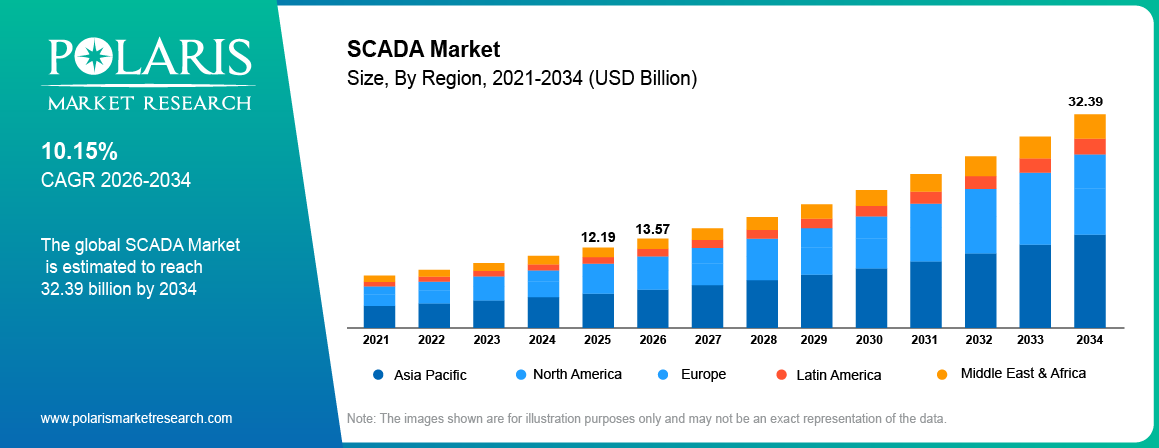
SCADA market size was valued at USD 12.19 billion in 2025. The market is expected to grow at a CAGR of 10.15% from 2026 to 2034. Growth is driven by grid modernization, aging infrastructure, cybersecurity needs, and cloud and edge adoption. Spending is shifting from first-time installations to the modernization of legacy SCADA systems, as operators add hybrid architectures, remote access, and stronger cybersecurity controls.
Market Statistics
SCADA Market Key Takeaways
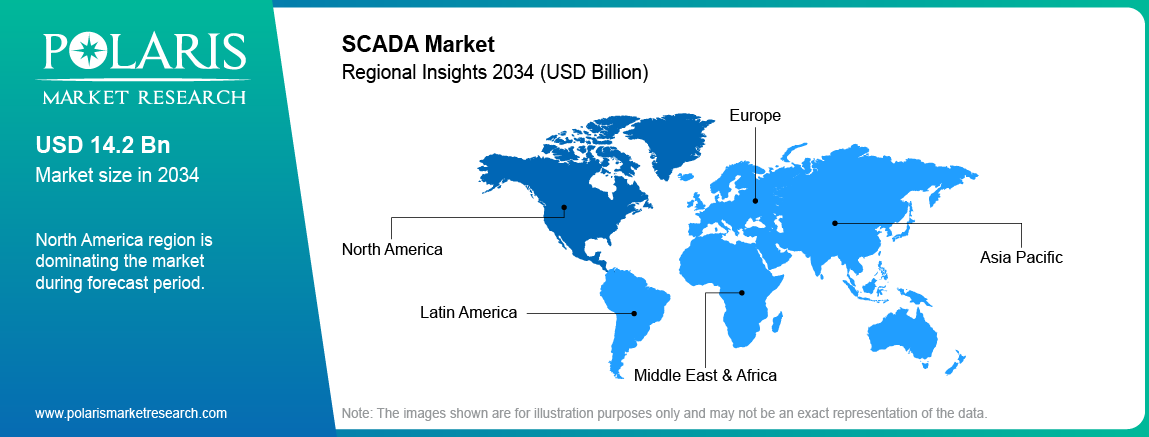
- North America held 34.72% in 2025. The share is driven by grid modernization, cybersecurity requirements, and established industrial infrastructure.
- Asia Pacific is expected to register the highest CAGR of 11.38%, driven by manufacturing expansion, electrification, industrial automation, and infrastructure investment.
- Utilities and energy held 32.86% in 2025. The share is driven by continuous monitoring across power generation, transmission, and distribution.
- Software held 28.98% in 2025. Demand in the SCADA software market is driven by HMI, alarm management, historian, reporting, and remote access requirements.
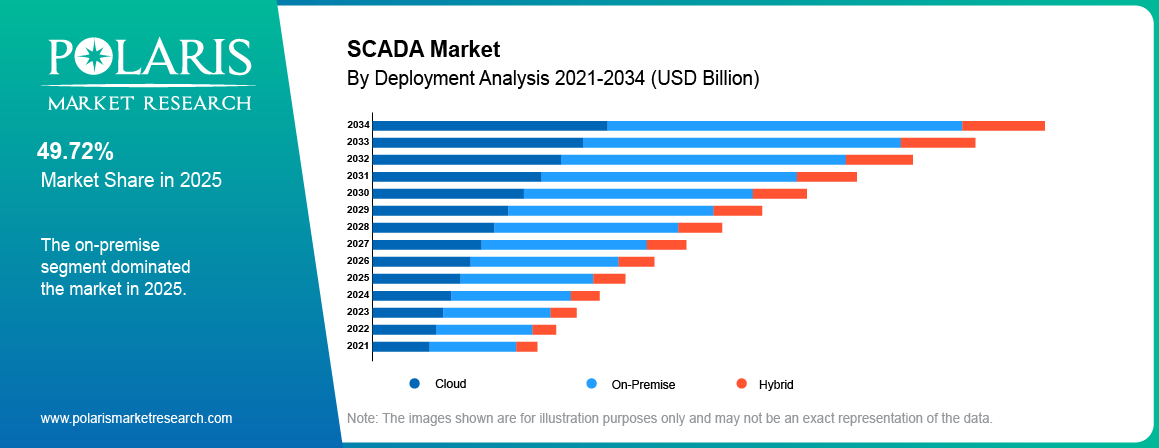
- Hybrid deployment held 18.60% in 2025. The segment is driven by integration of local control and cloud-based monitoring.
- Industrial control system (ICS) vulnerability disclosures reached 2,155 CVEs across 508 CISA advisories in 2025, making cybersecurity a primary SCADA purchase criterion.
Note: Figures and projections outlined in this report are the result of Polaris Market Research’s proprietary analytical processes, grounded in the latest available datasets and market observations
SCADA Market Definition
Supervisory Control and Data Acquisition (SCADA) is a collection of software, hardware, and services that monitor and control industrial and utility operations. SCADA systems collect field data, display the status of equipment, control the alarms, record storage and allow remote control. Typical systems include SCADA software, human machine interface (HMI), historians, remote terminal unit (RTU), programmable logic controller (PLC), communication networks and engineering services in power, water, oil and gas, manufacturing, transportation and mining. This report excludes standalone PLC hardware sold without a supervisory software layer and building management systems that do not supervise dispersed assets; these are covered under the industrial automation and control systems market.
SCADA is used for monitoring geographically dispersed assets, while distributed control system (DCS) is used primarily to control processes within a single facility. Utilities automate remote generation sites, pumping stations, pipelines and substations with SCADA automation, whereas refineries and chemical plants automate plant-level process control using DCS automation. Vendors are narrowing the distinction by introducing open and software-defined platforms, such as Schneider Electric’s EcoStruxure Foxboro Software Defined Automation launched in February 2026. In both architectures, programmable logic controller (PLC) and RTU hardware form the field layer that SCADA software supervises.
The growth of mature markets is turning away from first-time adoption to system replacement and modernization in the SCADA market. Operators are upgrading legacy platforms for better remote access, data visibility, alarm management and cyber security. Cloud and edge technologies are opening new possibilities, allowing companies to add analytics and edge devices onto existing SCADA systems, rather than having to replace them, modernizing in phases instead.
Grid modernization, aging industrial infrastructure, increasing cybersecurity requirements and increasing demand for remote monitoring are driving the SCADA market. The cloud and edge computing, Internet of Things, artificial intelligence in monitoring and hybrid systems are creating a chance for operators to modernize their legacy systems and at the same time keep control locally. There are also opportunities for growth in water infrastructure, renewable energy, manufacturing and distributed industrial assets.
Market Dynamics
Driver Impact Analysis
| Factor | Type | Impact | Timeline | Key Regions |
| Cybersecurity regulation | Driver | High | 2026–2029 | North America, Europe |
| Aging grid, water, and industrial infrastructure | Driver | High | 2026–2034 | North America, Europe |
| Hybrid and edge-to-cloud architectures | Opportunity | High | 2026–2030 | Global |
| Water utilities and multi-site manufacturing | Opportunity | Medium | 2027–2034 | Asia Pacific, Europe, North America |
Source: Polaris Market Research Analysis
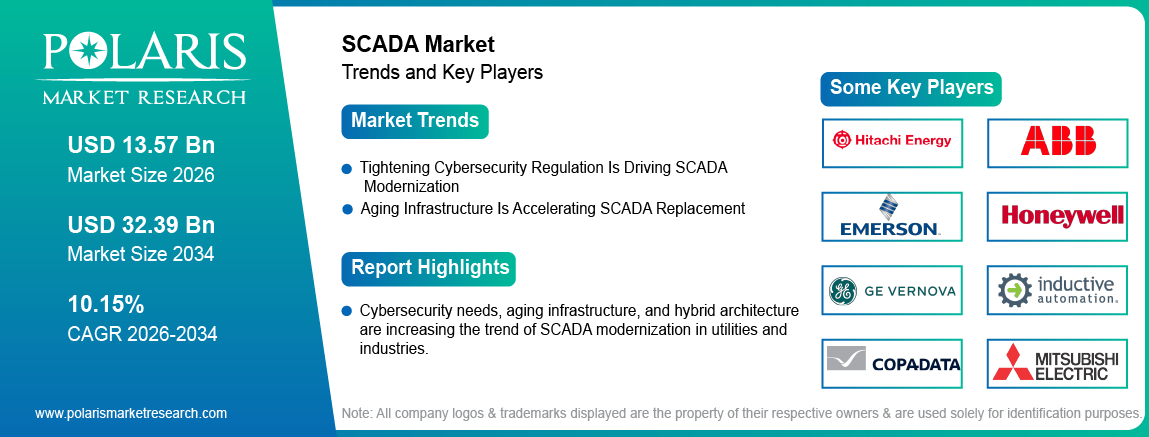
Driver: Strict Cybersecurity Regulation Is Driving SCADA Modernization
The increased need for cybersecurity requirements is driving the need for secure SCADA systems. In January 2026, NERC’s Critical Infrastructure Protection Roadmap identified risks associated with legacy protocols used for SCADA and Automatic Generation Control traffic over leased and carrier networks. Also noted in the roadmap are changes to CIP-003-9, CIP-012-2 and CIP-015, and a call for stronger confidentiality and integrity protections. FERC Order No. 918 also made CIP-003-11 effective on May 26, 2026, which expands mandatory cybersecurity controls to additional low-impact facilities. These considerations are creating an attractive case for upgrading old SCADA systems and implementing appropriate security controls. This is driving demand for secure SCADA platforms and NERC CIP compliance solutions (Source: nerc.com).
Cybersecurity requirements are also extending beyond North America. Emerson designed DeltaV SaaS SCADA with Edge Connect to align with IEC 62443 and the EU Cyber Resilience Act, which indicates that standards alignment is becoming a purchase condition for buyers across regions. Demand in the industrial control systems (ICS) security market is rising in parallel, as operators add network monitoring and access controls to legacy SCADA environments. (Source: emerson.com)
Driver: Aging Grid, Water, and Industrial Infrastructure Is Accelerating Replacement
The world’s aging power, water and industrial infrastructure is growing the need to replace SCADA and control systems. Eurelectric, for example, said that about 30% of power grids are over 40 years old, and this could rise to 90% by 2050. Older systems have limited alarm management, mobile access, remote diagnostics and scalability. At the same time, renewable energy and distributed energy resources are rapidly expanding the number of assets that utilities watch. Those changes are forcing operators to upgrade legacy platforms. This makes grid modernization a driver for SCADA systems that improve visibility, scalability, remote monitoring, and operational performance across distributed assets. Utilities are also aligning SCADA upgrades with smart grid market investments in distribution automation, advanced metering, and distributed energy resource management. (Source: gevernova.com)
Restraint: Cybersecurity Risks Are Slowing Modernization
Greater connectivity is increasing cybersecurity risks across operational technology (OT) environments. In 2025, CISA’s ICS Advisory Project recorded 2,155 CVEs across 508 advisories, compared with 103 CVEs across 67 advisories in its first full year. Average advisory severity increased from medium in 2010 to above 8.0 (high severity) in 2025. These risks add to SCADA upgrade complexity and security requirements. Operators are expanding connectivity, devices and remote access capabilities while having to defend legacy systems. Therefore, some organizations may choose a phased approach to modernization rather than a complete replacement of legacy systems, which can prolong the implementation time and slow down SCADA modernization projects (Source: infosecurity-magazine.com).
CISA continued to publish advisories naming mainstream SCADA and industrial control vendors through 2026, which keeps vulnerability management on the agenda of every modernization project. Critical infrastructure operators therefore tend to favor staged upgrades over a full cutover, since a single cutover concentrates cybersecurity validation into one high-risk window. This is also lifting spending in the operational technology (OT) security market alongside SCADA upgrades (Source: cisa.gov).
Opportunity: Hybrid and Edge-to-Cloud Architectures Create New Sales Opportunities
Hybrid and edge-to-cloud architectures are opening up opportunities for SCADA vendors, since operators can add in capabilities while still keeping local control. In February 2026, Siemens, with automation partner Mescada, announced a cloud SCADA deployment for Global Power Generation Australia (GPGA) across eight renewable energy sites, providing centralized control and monitoring of 300,000 data points. Cloud SCADA allows users to bring together data from various locations onto a single platform, while edge computing handles data processing nearer to the equipment. This combination can improve response times and ease monitoring across distributed assets. It also opens up opportunities across the industrial IoT (IIoT) market, as operators can plug existing SCADA installations into devices and analytics and monitoring tools without having to replace the control infrastructure (Source: siemens.com).
Opportunity: Water Utilities and Multi-Site Manufacturers Create New Demand
Water utilities and multi-site manufacturers with the need to monitor and control across distributed facilities are creating new demand for connected SCADA platforms. In December 2025, Honeywell was chosen to provide SCADA and automation solutions to modernize Rockhampton’s water infrastructure to enable real-time monitoring, control and operational efficiency. This can assist water and wastewater facilities in collecting data on assets and visibility. Multi-site manufacturers can utilize a centralized SCADA system to monitor their facilities from different locations effectively. This opens the door for vendors to offer water and wastewater automation solutions that link SCADA with asset management, and to integrate SCADA with plant-level distributed control system (DCS) environments at multi-site manufacturers (Source: honeywell.com).
SCADA Market Segmentation Analysis
The report provides a comprehensive analysis of the SCADA market by offering, deployment, end use industry, and region to identify key revenue-generating and high-growth segments.
Offering Insights
Software held the significant share of 28.98% in 2025, making it the leading offering segment in the SCADA market. SCADA software supports HMI, visualization, alarm management, historians, analytics, reporting, remote monitoring, and operational data management. Software is also central to modernization programs because operators can add newer monitoring, analytics, and remote-access capabilities while retaining portions of existing hardware infrastructure. The growth of hybrid and cloud architectures is making software even more important as users need platforms that can connect field equipment to centralized analytics and enterprise applications. This means that demand is driven by new SCADA installations and modernization of legacy environments.
The services segment is expected to witness the significant CAGR of 10.48% over the forecast period of 2026-2034, driven by the demand for system integration, migration, cybersecurity upgrades, modernization, technical support, and lifecycle management. SCADA environment upgrades often include legacy protocols, field devices, controllers, communication systems and software that necessitate specialized engineering. Hybrid and cloud deployments require more integration, as new platforms need to coexist with the existing control infrastructure. Service providers can support system assessment, architecture design, migration, testing, cybersecurity implementation, commissioning, and ongoing maintenance. Growth in services is therefore linked to the increasing complexity of modernization projects rather than only to the number of new SCADA installations.
Deployment Insights
On-premise deployment accounted for the largest share of 49.72% in 2025, due to continued need for local control, operational continuity, reliability and security across utilities, oil and gas and process industries. Organizations can directly control critical operating environments with on-premise systems, reducing dependence on external connectivity for core control functions. Many industrial operators also have existing infrastructure, engineering processes and field devices built around local SCADA architectures. Cloud technology proliferates, but the installed base continues to support demand for on-premise systems. New software, cybersecurity, analytics, and edge capabilities are increasingly being looked at for deployment into existing on-premise environments as part of modernization programs.
Hybrid deployment is expected to grow at the highest CAGR of 12.74% during 2026–2034 in the supervisory control and data acquisition market. This is owing to demand for local control along with cloud-based monitoring, analytics, and remote access. Hybrid architectures allow organizations to keep mission-critical control functions at the edge close to the equipment while offloading some operational data to centralized platforms. This model can allow for a phased modernization, as operators don’t have to move all SCADA functions to the cloud at once. Hybrid systems are good for utilities, manufacturing, water infrastructure and other distributed operations that require centralized visibility but also need to operate with local resilience. Rapid growth in the edge computing market supports this model, as edge devices process time-sensitive data locally and send selected data to cloud platforms for analytics and enterprise-level monitoring. Pure cloud deployment remains a smaller share, concentrated in less safety-critical applications such as facility energy monitoring.
End Use Industry Insights
Utilities and energy had the largest share of 32.86% in 2025, driven by the need for constant surveillance across power generation, transmission and distribution assets. Industrial SCADA market solutions allow utilities to monitor geographically dispersed infrastructure, identify operating conditions, deal with alarms and allow remote control. Grid modernization is making the number of assets and data points that operators need to monitor grow, while renewable energy and distributed energy resources are adding complexity to electricity networks. Demand in the power SCADA market is also rising as cybersecurity requirements push utilities toward modern SCADA architectures. Utilities can combine SCADA with edge computing, cloud analytics, cybersecurity monitoring and advanced communications, while retaining local control where required.
Water and wastewater segment is expected to register significant CAGR of 10.46% during 2026-2034 owing to infrastructure modernization, network monitoring, water-loss reduction, and centralized operational management. Water utilities need real-time visibility of treatment facilities, pumping stations, distribution networks and other geographically dispersed assets, which ties SCADA spending to the broader smart water management market. Connected SCADA platforms can bring together field data with sensors, analytics, hydraulic models, billing information and other operational sources. This enables cloud connected monitoring and predictive management, while retaining local operational control. Centralized dashboards can also facilitate multi-site water infrastructure assisting operators to identify abnormal conditions and coordinate maintenance. Recent platform developments, such as Schneider Electric’s EcoStruxure Water Advisor, are examples of a move toward integrated cloud-based intelligence for water infrastructure.
Buildings and critical facilities are emerging as a distinct demand pool within the others segment. Power-monitoring SCADA for data centers and large campuses is driven by uptime requirements rather than process safety, and this SCADA market report tracks the category separately to capture its rising share of new deployments.
Regional Analysis
North America SCADA Market Trends
North America SCADA market held the largest 34.72% market share in 2025 due to the stringent cybersecurity requirements, aging infrastructure and grid modernization. SCADA market analysis for the region shows that compliance, rather than first-time adoption, is now setting the pace of upgrade budgets. US DOE announced USD 1.9 billion investment to accelerate power grid upgrades to increase capacity, improve reliability, and reduce electricity costs. These investments are creating a need for SCADA systems that can support modern grid operations and remote monitoring. In addition, the need for secure SCADA upgrades is increasing with NERC CIP requirements for power utilities. Replacement demand is also being supported by aging utility infrastructure as operators upgrade legacy control systems and improve cybersecurity. The region also benefits from a strong base of SCADA vendors and system integrators, which supports implementation and modernization projects (Source: energy.gov).
Europe SCADA Market Trends
Europe is expected to register strong growth during the forecast period, driven by cybersecurity requirements, industrial automation, and water infrastructure modernization. The EU is supporting the modernization of water infrastructure in Czechia’s Ústí nad Labem Region with a USD 16.1 million grant and a USD 64.3 million EIB loan. Such investments are generating the need for SCADA systems capable of facilitating real-time monitoring, automation, and management of the water network. The EU Cyber Resilience Act is also increasing the focus on secure industrial technologies. At the same time, data centers and transport infrastructure are creating additional SCADA applications for power monitoring, equipment management, and remote operational visibility across critical infrastructure (Source: eib.org).
Asia Pacific SCADA Market Trends
Asia Pacific is expected to record the fastest growth in the SCADA market, driven by expanding manufacturing, grid development, electrification, and new water infrastructure. Asia represented 57.2% of global manufacturing value added and 47.2% of manufactured exports in 2024, according to UNIDO. This large industrial base is driving demand for automation, process monitoring and centralized control systems. Investments in industrial automation and digital infrastructure in China, Japan, South Korea and India are further driving SCADA adoption. New power generation, transmission and distribution projects are also creating demand for remote monitoring and control. These developments are driving opportunities for SCADA hardware, software, communication systems, and integration services across industrial and utility applications (Source: unido.org).
Middle East and Africa SCADA Market Trends
The Middle East and Africa SCADA market is driven by large power, water, and oil and gas projects. New infrastructure development is increasing the need to monitor and control geographically dispersed assets, particularly in energy and water applications. EPC-led projects are expanding the regional SCADA software market, along with demand for hardware, communication systems and remote monitoring solutions. SCADA systems enable oil and gas operators to monitor pipelines, production facilities and other remote assets. Water utilities can use SCADA systems to manage pumping stations and distribution networks. Further opportunities are expected in investments in power generation, transmission and water management. Growing automation requirements are also encouraging operators to improve operational visibility and reduce dependence on manual monitoring.
Latin America SCADA Market Trends
Latin America is witnessing demand for SCADA solutions across power, water, mining, and oil and gas projects. Infrastructure modernization is increasing the need for systems that can provide real-time monitoring and control across geographically dispersed assets. Mining operations are particularly suited to SCADA applications because many facilities operate across remote locations where continuous local monitoring can be difficult. SCADA systems enable remote connections and centralized visibility, and mining and pipeline operators are also adopting tools from the broader remote monitoring and control market to reduce site visits. There have been opportunities for the installation of SCADA as well as other types of power and water infrastructure projects. These developments are supporting demand for ruggedized SCADA hardware, remote monitoring solutions, connectivity systems, and integration services.
SCADA Regulatory and Standards Snapshot
| Regulation / Standard | Region | What It Means for SCADA |
| NERC CIP Roadmap | North America | Flags legacy SCADA and AGC traffic over leased networks for stronger protection |
| FERC Order No. 918, CIP-003-11 | US | Extends mandatory controls to low-impact substations and generation sites |
| IEC 62443 | Global | Security baseline vendors now design SCADA and edge products against |
| EU Cyber Resilience Act | Europe | Security-by-design rules for connected products; main obligations apply from December 2027 |
| ANSI/ISA-112 Part 1 | Global | Vendor-neutral lifecycle framework for SCADA design and modernization |
Source: NERC, FERC, ISA, European Commission, Polaris Market Research Analysis
SCADA Market Competitive Landscape and Key Players
The SCADA systems market is dominated by incumbent industrial technology vendors with large automation portfolios and installed bases. The competition is trending toward hybrid architectures, edge capabilities, cybersecurity and software-defined platforms. Vendors are targeting solutions that build on existing infrastructure while minimizing disruption during the modernization process. Most leading vendors released a hybrid, edge, or software-defined product update in the past twelve months, and buyers increasingly select platforms based on how well they extend the installed base.
Honeywell, ABB, Rockwell Automation, Emerson, Schneider Electric, Siemens and Inductive Automation compete across different customer segments and deployment models. Inductive Automation’s Ignition platform is unique in that it offers unlimited licensing, while larger vendors compete on integrated automation portfolios, long-term support and industrial cybersecurity capabilities aligned with NERC CIP and IEC 62443. TPG’s USD 600 million acquisition of GE Vernova’s Proficy business, completed in March 2026, has also created a standalone HMI/SCADA and MES software competitor.
SCADA Competitive Landscape Snapshot
| Company | HQ | Flagship SCADA Platform | Market Position |
| Siemens AG | Germany | SIMATIC WinCC Open Architecture, WinCC Unified | Leader (broad hardware and software portfolio) |
| Schneider Electric SE | France | EcoStruxure, Foxboro SDA | Leader (utilities, water, process) |
| AVEVA Group Limited (fully owned subsidiary of Schneider Electric SE) | UK | AVEVA Operations Control (System Platform, InTouch) | Leader (SCADA and HMI software) |
| Rockwell Automation, Inc. | US | FactoryTalk Optix, FactoryTalk View | Leader (discrete and hybrid manufacturing) |
| Emerson Electric Co. | US | DeltaV SaaS SCADA | Challenger (process, utility SCADA) |
| Honeywell International Inc. | US | Experion SCADA | Challenger (process, safety-critical) |
| ABB Ltd. | Switzerland | ABB Ability Network Manager, System 800xA | Challenger (utility and process automation) |
| Inductive Automation, LLC | US | Ignition | Disruptor (mid-market, integrator-led) |
Source: Company filings and named press releases.
SCADA Market Technology and Innovation Landscape
SCADA Technology and Innovation Landscape Snapshot
| Technology | Role in SCADA | Vendor, Year | Adoption Stage |
| Edge-to-cloud execution | Keeps control local, sends data to cloud analytics | Rockwell FactoryTalk ResilientEdge (2026) | Scaling |
| Cloud and SaaS SCADA | Hosts supervisory functions in the cloud | Emerson DeltaV SaaS SCADA (2025); Siemens for GPGA (2026) | Early scaling |
| Software-defined automation | Decouples control software from hardware | Schneider EcoStruxure Foxboro SDA (2026) | Emerging |
| On-device generative AI | Engineering and operator assistance on site | Rockwell FactoryTalk Design Studio with NVIDIA Nemotron Nano (2025) | Pilot to product |
| IT-style engineering | Git version control and CI/CD for HMI/SCADA projects | Siemens SIMATIC AX WinCC Unified Elements (2026) | Emerging |
| Web-first HMI and CRA-aligned security | Browser-based operations on hardened platforms | AVEVA Operations Control 2026 | Scaling |
| Purpose-built water analytics | Combines SCADA, sensor, billing, and hydraulic data | Schneider EcoStruxure Water Advisor (2026) | Early adoption |
Source: Company press releases, Polaris Market Research Analysis
IIoT, edge computing, cloud analytics, and AI are reshaping SCADA architectures. Rockwell Automation’s FactoryTalk ResilientEdge, made globally available in June 2026, gives industrial operations the power to run at the edge and leverage cloud-based analytics and AI capabilities so they can evaluate data locally when connectivity is lost. Vendors are also deploying software-defined architectures to modernize legacy control environments.
AI is moving closer to the engineering and operator workflow. Rockwell Automation integrated NVIDIA's Nemotron Nano small language model into FactoryTalk Design Studio for on-site decision support. Schneider Electric is also developing AI-enabled capabilities through EcoStruxure Foresight Operation for predictive facility management. Siemens is applying IT-style engineering, including Git-based version control and AI-ready workflows, to SCADA visualization through SIMATIC AX WinCC Unified Elements, an approach that is also spreading into distributed control system (DCS) engineering.
Buyer Analysis and Barriers to Market Entry
SCADA Buyer Persona Framework
| Buyer Persona | Primary Driver | Typical Deployment Choice |
| Utility grid operations | Regulatory compliance, reliability | Hybrid, with on-premise control retained |
| Water and wastewater utility | Non-revenue water reduction, budget constraints | Cloud or hybrid, purpose-built platforms |
| Multi-site discrete manufacturer | Standardization across plants | Unlimited-license software, cloud analytics |
| Oil and gas, remote assets | Remote monitoring, safety | Edge gateways, satellite or cellular backhaul |
SCADA purchasing increasingly involves operations, controls engineering, and operational technology (OT) security teams. Buyers are looking at technical functionality, cybersecurity standards, legacy system compatibility, remote access, integration requirements and lifecycle costs. Vendor selection is also impacted by compliance needs such as NERC CIP and IEC 62443.
Barriers to Market Entry
- High switching costs: The cost of replacing an already installed SCADA system is relatively high.
- Legacy compatibility: The new vendor needs to integrate with different protocols and field devices used in the legacy systems.
- Cybersecurity requirements: Requirements such as IEC 62443 and NERC CIP will add to compliance and certification cost.
- Integrator networks: Existing vendors have a network of integrators certified for deploying the system.
SCADA Market Premium Insights and Forward Outlook
Licensing Models Are Reshaping SCADA Economics
Pressure is mounting on SCADA vendors to offer more flexible licensing models. Inductive Automation has an unlimited server-based model, as opposed to a per-tag and per-client pricing model. This could lead to more pricing competition between system integrators and smaller industrial deployments like those used in water and wastewater automation. Polaris expects at least one additional major vendor to introduce a flatter licensing tier during the forecast period to defend share in system integrator-led deals.
On-Device AI Is Expanding Across SCADA Platforms
AI is shifting from standalone analytics use cases to embedded engineering and operator capabilities. We see this change in Rockwell Automation’s embedding of a small language model into FactoryTalk Design Studio. Similar capabilities could expand across SCADA and distributed control system (DCS) platforms as industrial users seek local decision support. Polaris expects embedded AI in engineering and operator workflows to become the default packaging approach among leading SCADA vendors within the forecast period.
Standardized Lifecycle Frameworks Will Shape SCADA Modernization Tenders
The International Society of Automation published ANSI/ISA-112 Part 1 in February 2026, a vendor-neutral framework for the SCADA lifecycle, diagrams, and terminology. Polaris expects utilities and water operators to reference the standard in modernization tenders, which favors vendors and integrators that can map their delivery process to a common lifecycle model.
Cost and Pricing Benchmarking Analysis
SCADA software follows different licensing models, including per-tag, per-client, per-device, and server-based structures. Inductive Automation's Ignition uses server-based licensing with unlimited tags, clients, designers, and connections. Its BasicCare support plan is priced at 16% of the software retail price per activation key annually.
System integration, migration, and support services are generally quote-based and depend on project scope, site complexity, legacy infrastructure, and required engineering work. Publicly comparable pricing data for integration services remains limited, so site-level cost estimates should be evaluated based on individual project requirements.
Key Players
- ABB Ltd.
- AVEVA Group Limited (fully owned subsidiary of Schneider Electric SE)
- COPA-DATA GmbH
- Emerson Electric Co.
- GE Vernova Inc.
- Hitachi Energy Ltd.
- Honeywell International Inc.
- ICONICS, Inc. (fully owned subsidiary of Mitsubishi Electric Corporation)
- Inductive Automation, LLC
- Mitsubishi Electric Corporation
- OMRON Corporation
- Rockwell Automation, Inc.
- Schneider Electric SE
- Siemens AG
- Survalent Technology Corporation
- Toshiba Corporation
- Velotic (Proficy)
- Yokogawa Electric Corporation
Industry Developments
- August 2026: AVEVA released AVEVA Operations Control 2026, a hybrid-first HMI/SCADA update with web visualization, CRA-aligned security, and gRPC-based communication. (Source: controlsys.org)
- June 2026: Rockwell Automation has announced the global availability of FactoryTalk ResilientEdge, a platform that enables edge execution, cloud analytics and AI training. (Source: rockwellautomation.com)
- June 2026: Schneider Electric has introduced EcoStruxure Water Advisor in the AVEVA CONNECT cloud ecosystem to assist water operators in decreasing non-revenue water. (Source: se.com)
- June 2026: Rockwell Automation has come up with FactoryTalk Orchestration software for improving the level of orchestration in manufacturing systems. (Source: prnewswire.com)
- April 2026: Rockwell Automation and Cytiva launched the Figurate SCADA system, an open-architecture supervisory platform for biopharmaceutical manufacturing. (Source: manufacturingchemist.com)
- March 2026: GE Vernova completed the USD 600 million sale of its Proficy software business, including HMI/SCADA and MES, to TPG. (Source: arcweb.com)
- February 2026: The International Society of Automation published ANSI/ISA-112 Part 1, a vendor-neutral standard for SCADA lifecycle management and modernization. (Source: isa.org)
- February 2026: Schneider Electric has unveiled EcoStruxure Foxboro Software Defined Automation, an open, software-defined distributed control system. (Source: plcdcspro.com)
SCADA Market Segmentation
By Offering Outlook (Revenue, USD Billion, 2021–2034)
- Software
- Hardware
- Services
By Deployment Outlook (Revenue, USD Billion, 2021–2034)
- On-Premise
- Cloud
- Hybrid
By End Use Industry Outlook (Revenue, USD Billion, 2021–2034)
- Utilities and Energy
- Water and Wastewater
- Oil and Gas
- Discrete Manufacturing and Process Industries
- Others
By Regional Outlook (Revenue, USD Billion, 2021–2034)
- North America
- US
- Canada
- Europe
- Germany
- France
- UK
- Italy
- Spain
- Netherlands
- Rest of Europe
- Asia Pacific
- China
- Japan
- India
- South Korea
- Taiwan
- Australia
- Rest of Asia Pacific
- Latin America
- Brazil
- Mexico
- Argentina
- Rest of Latin America
- Middle East & Africa
- Saudi Arabia
- UAE
- South Africa
- Rest of Middle East & Africa
SCADA Market Report Scope
| Report Attributes | Details |
| Market Size in 2025 | USD 12.19 Billion |
| Market Size in 2026 | USD 13.57 Billion |
| Revenue Forecast by 2034 | USD 32.39 Billion |
| CAGR | 10.15% from 2026–2034 |
| Base Year | 2025 |
| Historical Data | 2021–2024 |
| Forecast Period | 2026–2034 |
| Quantitative Units | Revenue in USD Billion and CAGR |
| Report Coverage | Revenue Forecast, Growth Factors, Competitive Landscape, Industry Trends, and Strategic Analysis |
| Segments Covered |
|
| Regional Scope | North America, Europe, Asia Pacific, Latin America, Middle East & Africa |
| Competitive Landscape | Company Profiling, Product Benchmarking, Financial Analysis, Market Developments, and Strategic Initiatives |
| Companies Profiled | ABB Ltd., AVEVA Group Limited, COPA-DATA GmbH, Emerson Electric Co., GE Vernova Inc., Hitachi Energy Ltd., Honeywell International Inc., ICONICS, Inc., Inductive Automation, LLC, Mitsubishi Electric Corporation, OMRON Corporation, Rockwell Automation, Inc., Schneider Electric SE, Siemens AG, Survalent Technology Corporation, Toshiba Corporation, Velotic (Proficy), and Yokogawa Electric Corporation |
| Report Format | PDF + Excel |
| Customization | Available by Country, Region, and Segment |
Source: Polaris Market Research Analysis
Why Choose Polaris Market Research
Polaris Market Research & Consulting, Inc. develops its SCADA industry forecast using regulatory filings, government publications, vendor disclosures, and industry sources. The research combines primary and secondary data to validate market estimates, technology developments, competitive activity, and regional trends. All proprietary estimates are subject to internal review for consistency across market sizing and segmentation.
The SCADA market report provides a detailed competitive landscape including the market share and profiles of the major players operating in the global market. Buyers can review the competitive landscape and technology trajectory based on company profiles and strategic developments. The scope can be tailored to the needs of a specific business case, investment priority, product strategy or geography.
SCADA Market Research Methodology
The SCADA market share analysis is conducted using a five-step methodology that includes secondary research, primary source validation, competitive benchmarking, proprietary data reconciliation, and final quality review. The research team evaluates market developments and confirms key findings by analyzing regulatory filings, government publications, company disclosures, industry reports, trade publications and other relevant sources.
Research for the supervisory control and data acquisition market focuses on regulatory and company sources for cybersecurity requirements, technology launches and strategic developments. Trade and industry publications are used to supplement product information, competitive activity, and market trends. The findings undergo a final sourcing and quality review before publication.
Research Methodology Phases
| Research Phase | Focus |
| Secondary Mapping | Regulatory filings, vendor newsrooms, trade press |
| Primary Validation | Company press releases and investor disclosures |
| Competitive Benchmarking | Third party segmentation structure comparison |
| Proprietary Reconciliation | Internal Polaris market model validation |
| Quality and Sourcing Review | Final editorial and citation check |
Source: Polaris Market Research Analysis.
SCADA Market FAQ's
The global SCADA market was valued at USD 12.19 billion in 2025 and is projected to reach USD 32.39 billion by 2034, growing at a CAGR of 10.15% from 2026 to 2034. Growth is driven by grid modernization, replacement of aging control infrastructure, stricter cybersecurity rules, and hybrid cloud adoption.
The SCADA market is expected to grow at a CAGR of 10.15% during 2026–2034. Most new spending comes from modernizing legacy SCADA systems rather than first-time installations, as utilities and manufacturers add hybrid architectures, remote access, and IEC 62443-aligned security.
North America held the largest share of the SCADA market in 2025, at 34.72%. NERC CIP requirements, FERC Order No. 918 (effective May 26, 2026), US Department of Energy grid funding, and a strong base of vendors such as Rockwell Automation, Emerson, and Honeywell support regional demand. Asia Pacific is expected to register the fastest growth during 2026–2034.
Utilities and energy held the largest share of the SCADA market in 2025, at 32.86%. Power generation, transmission, and distribution networks need continuous, real-time monitoring of dispersed assets, and NERC CIP rules make utilities the most active buyers of SCADA upgrades.
By deployment, hybrid SCADA is expected to grow the fastest at a CAGR of 12.74%, as operators keep time-critical control on site while moving monitoring and analytics to the cloud. By end use industry, water and wastewater is the fastest-growing segment, driven by non-revenue water reduction and infrastructure upgrades.
The main drivers of the SCADA market are tightening cybersecurity regulation, including NERC CIP, FERC CIP-003-11, IEC 62443, and the EU Cyber Resilience Act, and the replacement of aging grid, water, and industrial control systems. Renewable integration also adds monitored points that legacy SCADA platforms cannot handle.
Key players in the SCADA market include Siemens AG, Schneider Electric SE, ABB Ltd., Rockwell Automation, Inc., Honeywell International Inc., Emerson Electric Co., AVEVA Group Limited, Yokogawa Electric Corporation, Mitsubishi Electric Corporation, Hitachi Energy Ltd., GE Vernova Inc., and Inductive Automation, LLC.
SCADA (supervisory control and data acquisition) is a system of software, hardware, and networks used to monitor and control industrial processes and geographically dispersed assets in real time. Utilities, water operators, oil and gas companies, and manufacturers use SCADA to view live data, manage alarms, and operate equipment remotely.
The main components of a SCADA system are field sensors and actuators, remote terminal units (RTUs), programmable logic controllers (PLCs), a communication network, SCADA servers, a historian database, and human machine interface (HMI) software. Integration and support services connect these layers.
A PLC is a controller that runs automation logic for a machine or process. SCADA is a supervisory system that connects to many PLCs and RTUs across sites, giving operators a central view with visualization, alarms, data logging, and remote control. In most facilities, SCADA and PLCs work together.
SCADA monitors and controls assets spread over wide areas, such as pipelines, power grids, and water networks, often over public or leased networks. A distributed control system (DCS) controls continuous processes within a single plant. Software-defined platforms such as Schneider Electric's Foxboro SDA are now blurring the line.
Cloud-based SCADA can be secure when it follows IEC 62443, uses encrypted communication and strong authentication, and keeps safety-critical control on site. Most vendors use a hybrid model in which the cloud handles monitoring and analytics while local systems keep operating during connectivity loss.
Download Sample Report of SCADA Market
Please fill out the form to request a customized copy of the research report.


