
Generative AI in Financial Services Market Size, Share, Trends & Forecast, 2026–2034
REPORT DETAILS
Generative AI in Financial Services Market Summary
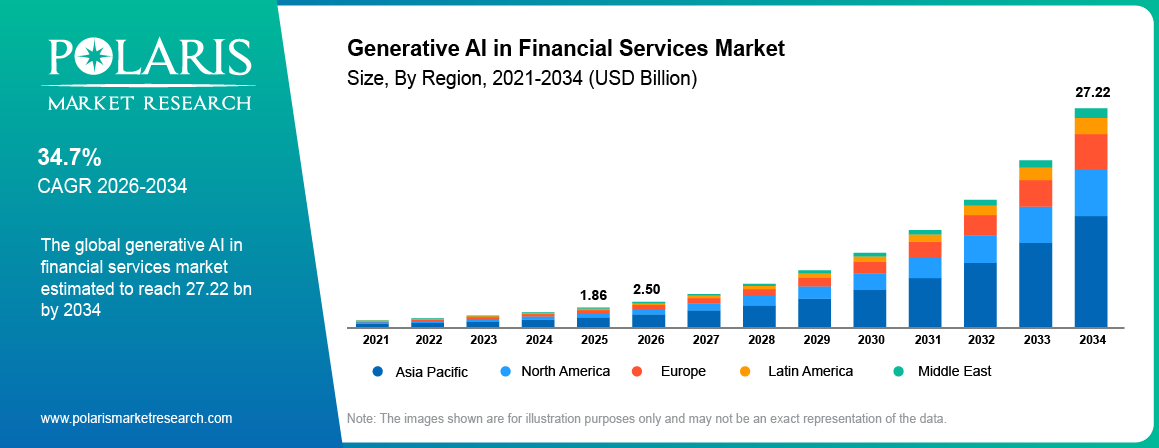
The generative AI in financial services market size was valued at USD 1.86 billion in 2025. The market is expected to register a CAGR of 34.7% from 2026 to 2034. Growth is supported by rising enterprise adoption of generative AI in financial applications and increasing use of financial services copilots. Also, expansion of AI across financial crime and wealth management workflows and growing demand for secure, governed, and workflow-specific AI solutions drive the industry expansion.
Market Statistics
Generative AI in Financial Services Market Key Takeaways
- North America accounted for 39.48% of the global generative AI in financial services market in 2025, supported by large financial institutions, established AI infrastructure, and scaled enterprise AI deployments.
- Asia Pacific is projected to register a 38.12% CAGR during the forecast period, driven by digital banking adoption, expanding AI programs, payments innovation, and growing use of AI across financial workflows.
- Software & platforms accounted for 48.64% of the generative AI in financial services market share in 2025. The leading share is fueled by rising demand for financial services copilots, workflow agents, retrieval, orchestration, evaluation, and governance capabilities.
- The agentic back-office workflow automation segment is projected to record a 39.94% CAGR during 2026–2034, driven by increasing use of AI systems that can retrieve information, use approved tools, and complete bounded financial workflows.
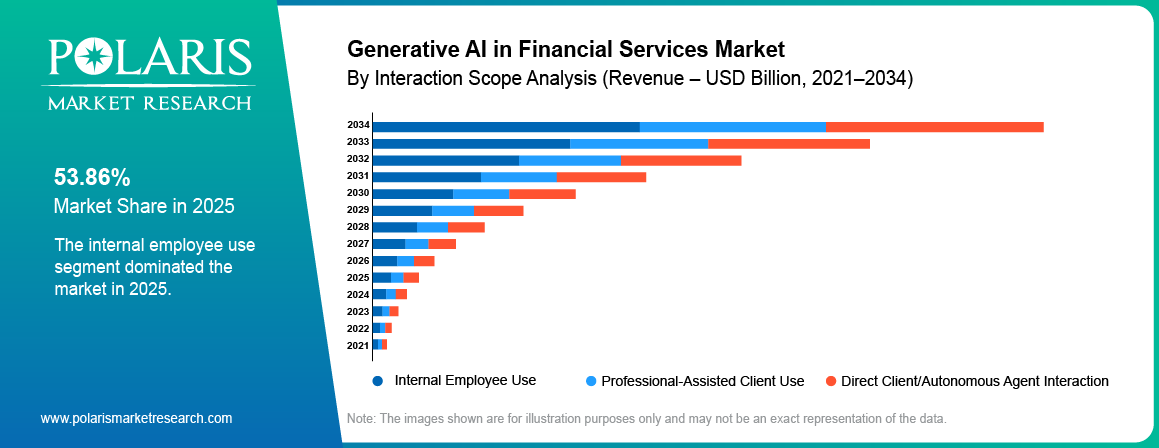
- The internal employee use segment represented 53.86% of the market share in 2025. It is reflecting the growing use of generative AI for research, drafting, coding, summarization, knowledge access, and other employee productivity workflows.
Note: Figures and projections outlined in this report are the result of Polaris Market Research’s proprietary analytical processes, grounded in the latest available datasets and market observations.
Generative AI in Financial Services Market Definition
The generative AI in financial services market comprises software, platforms, and implementation services in which foundation, generative, multimodal, or agentic models materially generate, summarize, retrieve, reason over, transform, or act on financial information. The scope includes employee copilots, research assistants, customer and employee assistants, compliance review, financial crime investigation, underwriting support, software engineering, operations automation, wealth management support, personalized communication, and agentic workflow execution.
The market differs from traditional AI in finance categories because predictive systems used only for scoring, classification, forecasting, optimization, or anomaly detection are outside the market boundary unless a generative or foundation-model layer materially contributes to the solution. Generic foundation-model API expenditure is counted only when it is consumed for financial-services workloads, limiting overlap with the broader generative AI market.
Financial institutions are increasingly using generative AI within controlled enterprise environments. Foundation models are combined with proprietary information, permissions, retrieval systems, monitoring, prompt controls, auditability, and human review before being introduced into regulated workflows.
The market boundary also distinguishes generative functions from the underlying predictive decision engine. For example, a generative system may summarize a fraud alert, explain supporting information, or prepare an investigation narrative while the underlying detection score continues to come from traditional machine learning. Similar distinctions apply to credit underwriting and trading analytics, preventing mature predictive-AI revenue from being counted merely because a natural-language interface has been added.
Market Dynamics
The table below summarizes the relative impact of the key drivers, opportunities, and restraints on the generative AI in financial services market over the forecast period.
Market Driver Impact Analysis
| Market Factor | Type | Impact Level | Impact Timeline | Primary Segments Affected |
| Enterprise-wide copilot adoption | Driver | High | Short to Medium Term | Software & platforms; internal employee use |
| Broader workflow deployment across banking functions | Driver | High | Medium Term | Professional & managed services; fraud/AML; retail & commercial banking |
| Domain-specific AI, RAG, and LLM orchestration | Opportunity | High | Medium to Long Term | Investment research; capital markets; model & API access |
| Agentic AI for financial crime and customer workflows | Opportunity | Medium | Long Term | Agentic back-office automation; client-facing production |
Source: Polaris Market Research Analysis
Driver: Large-Scale Enterprise Adoption Is Expanding Demand for Financial Services Copilots
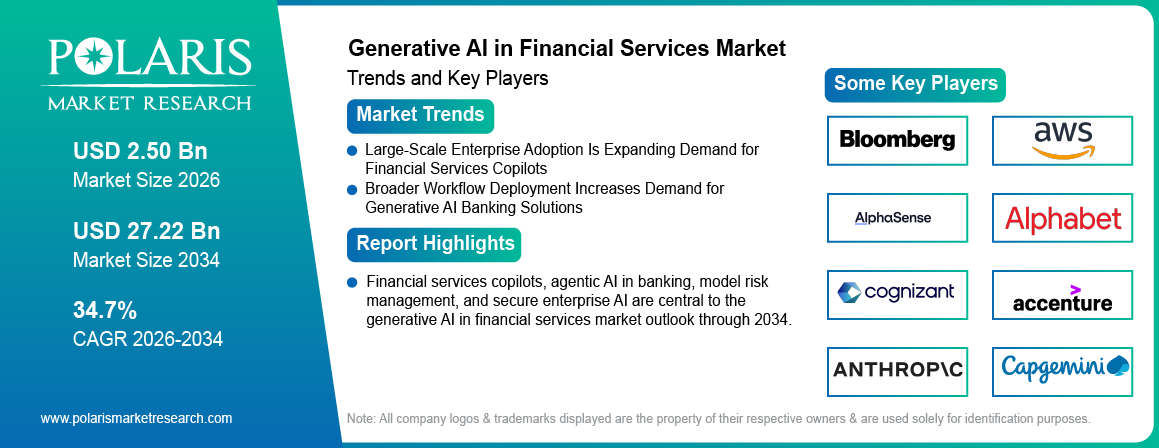
Enterprise adoption is creating a broader base for the generative AI in financial services market. JPMorganChase reported that more than 65,000 Corporate and Investment Bank colleagues actively use LLM Suite, showing that generative AI is moving beyond small pilot programs. The platform supports activities such as research, drafting, summarization, coding, operations, and client preparation. A common enterprise platform also allows financial institutions to apply shared access controls, data protections, and usage policies across several functions. This creates demand for scalable AI infrastructure that can support multiple financial workflows rather than separate tools for each department (Source: jpmorganchase.com).
The scale of internal adoption is also supporting demand for financial services copilots. Morgan Stanley separately reported 98% adoption of its AI Assistant across advisor teams, while its Debrief capability supports meeting notes, summaries, follow-up drafts, and CRM updates. These deployments are examples of how financial institutions are using AI to assist employees in their work, while keeping human professionals in the loop for customer-facing decisions. This model drive additional investment in shared platforms, retrieval tools, workflow integration, and secure enterprise AI capabilities (Source: hi-infinity.ai).
Driver: Broader Workflow Deployment Increases Demand for Generative AI Banking Solutions
Financial institutions are expanding generative AI beyond employee productivity into broader operating workflows. HSBC and Google Cloud announced a partnership expected to enable more than 200 new AI use cases over two years, initially covering wealth personalization, financial crime risk, and frontline relationship management. The planned scale indicates that agentic AI in banking is becoming part of wider enterprise transformation programs. Such deployments require model infrastructure, data integration, workflow controls, testing, governance, and change management. Demand can therefore extend beyond model access into the surrounding technology and services needed to deploy generative AI across multiple banking functions (Source: hsbc.com).
HSBC has also identified selected initiatives where expected benefits could exceed USD 100 million through revenue or efficiency improvements. This focus on measurable outcomes encourages financial institutions to connect generative AI banking solutions to defined business processes, rather than treating AI adoption as a technology experiment. Deployment are measured in areas like financial crime operations, software development, contact centers, wealth services, and employee productivity. By tying AI capabilities to operating metrics, workflow performance and governance requirements, vendors may discover broader opportunities for enterprise adoption. This supports continued spending on platforms, implementation, integration, and managed AI services.
Restraint: Limited AI Understanding Is Increasing Model Risk Management and Governance Requirements
The adoption of generative AI in regulated financial workflows is hindered by a lack of understanding of standard artificial intelligence systems, as institutions need clarity on how these systems work before scaling their use. The Bank of England and FCA highlighted that 34% of firms polled fully understand the AI they deploy, compared to 46% saying they have a partial understanding. It adds work around data sources, model behavior, provider changes, retrieval quality, monitoring and fallback procedures. These requirements enhance model risk management and extend the testing and approval processes for applications with greater impact (Source: bankofengland.co.uk).
Financial institutions’ use of third-party AI models, cloud services and data providers complicates governance, as they remain responsible for the use of these external providers. The Bank of England and FCA found that a third of the uses of AI involved third parties and noted concentration amongst external providers. This includes firms undertaking provider assessments, maintaining model inventories, testing performance, putting contractual controls in place and preparing fallback arrangements. Such activities increase the cost of implementation and the workload of operations, particularly when multiple external platforms support sensitive financial workflows. These requirements can slow broader adoption of AI governance.
Opportunity: Agentic AI Can Expand Generative AI Into Financial Crime and Customer Workflows
Growing interest in autonomous financial tools is creating an opportunity for financial crime analytics and related workflow applications as AI can support activities beyond basic information retrieval. The FCA’s Mills Review, published in July 2026, suggests that 11 million people are expected to use AI that act independently within specific objectives for personal finance. Financial institutions respond with systems that structure information, summarize cases, prepare applications, monitor activity, and support authorized action. The combination of these capabilities with controls defined for specific circumstances and with human supervision creat new demand for AI-enabled financial workflows (Source: fca.org.uk).
The emergence of agent-mediated financial journeys is providing a niche for financial services AI agents that interface with institutional systems under specified permissions. To support these interactions, banks need secure APIs, consent controls, identity controls, structured product information and escalation mechanisms. The FCA’s Mills Review highlighted in July 2026, there is increasing interest in the use of AI in personal finance, transforming the way that customers get access to financial products and services. Bounded agents help with product searches, account information, applications and routine service requests. Riskier actions still require human review and institutional controls.
Opportunity: Domain-Specific AI Is Creating Demand for Retrieval and LLM Orchestration
The need for domain-specific AI is creating opportunities for specialized financial applications, as professionals need tighter controls over security, auditability, data residency, and source traceability. In August 2026, Deutsche Bank was a key design partner for Google Cloud Financial Research Agent, helping to shape requirements in those areas. This underscores the requirement for solutions architected for financial research, due diligence, investment banking, compliance, and risk workflows. These systems fill needs that generic assistant may not fully meet, helping to grow the market for generative AI in financial services analysis (Source: db.com).
Retrieval augmented generation and LLM orchestration further expand this opportunity by connecting models with permissioned institutional information and multiple tools. Retrieval provides current evidence from research, policies, transaction information, product documents, and regulatory material at the time of a query. Orchestration routes tasks across models, retrieval systems, APIs, rules, and human approval steps. This shifts the commercial opportunity toward integration, evaluation, governance, and workflow design rather than model access alone. Financial institutions therefore build domain-specific AI environments that combine generative capabilities with existing controls and data infrastructure.
Generative AI in Financial Services Market Segmentation Analysis
The generative AI in financial services market is segmented by component, deployment model, application, financial sub-vertical, interaction scope, and solution maturity. These dimensions capture differences in technology spending, deployment requirements, financial use cases, customer exposure, and the level of autonomy used in AI-supported workflows.
Component-Based Insights
The Software & Platforms segment accounted for 48.64% of the market in 2025, fueled by demand for employee copilots, workflow agents, retrieval, orchestration, evaluation, and governance tools. Banks are moving away from buying individual artificial intelligence systems for every function. They are increasingly deploying shared platforms across multiple workflows. The JPMorganChase LLM Suite and Morgan Stanley’s AI tools are examples of how enterprise platforms improve research, drafting, coding, client prep, and meeting workflows. As generative AI becomes more widely adopted, demand increases for software that provides secure access to generative AI across financial institutions.
The model & API access segment held a share of 31.18% in 2025 owing to the increasing adoption of external foundation models in financial applications. Instead of releasing a model as a standalone product, banks can tie these models to proprietary data, retrieval systems, permissions, and monitoring. The Bank of England and FCA found that foundation models represented 17% of reported AI use cases and that one-third of AI use cases involved third parties, supporting demand for model access, orchestration, integration, governance, and managed services.
The professional & managed services segment is projected to register a 35.18% CAGR during the forecast period, supported by the implementation work required to move generative AI from pilots into controlled production. These services include strategy, integration, fine tuning, testing, governance, data integration and managed operations. Service providers assist financial institutions in linking models to existing systems, dealing with security, permissions, monitoring, model risk and operational controls.
Deployment Model-Based Insights
The public cloud/managed API segment contributed 35.84% of the market in 2025, fueled by access to external foundation models, scalable infrastructure, and managed AI capabilities. These environments are used by financial institutions for lower-materiality workflows with retrieval, control of access, and monitoring around model access. Significant third-party reliance across financial AI and highlights the concentration of providers as an important risk.
The private/on-premises/dedicated segment is expected to have a CAGR of 28.74% by 2034, driven by the requirement for improved control over sensitive financial data and model operations. Prompts, retrieval data, model access, and operational logs are kept within controlled infrastructure. Dedicated capacity is also used by financial institutions for workflows with higher materiality or more stringent security requirements. Security, data residency, auditability, and provider dependency are key factors, and advocate for the need for deployment architectures that enable more control over data and model access.
The hybrid/multi-model segment is anticipated to expand at a CAGR of 38.46% during the forecast period as financial institutions weigh the trade-offs between flexibility, security, model performance, and concentration of providers. A bank might send lower-risk tasks to public models but private endpoints or dedicated capacity for sensitive workflows. Multi-model gateways also help institutions to compare providers, maintain fallbacks and handle changes in pricing or model behavior. Model routing, provider concentration, and exit planning as important considerations, supporting demand for flexible architectures across financial AI environments.
Application-Based Insights
The customer service & engagement segment contributed 18.72% of the market in 2025, owing to adoption of financial services copilots for employee-assisted service and direct customer-facing communication. In simplified financial explanations and savings guidance, the FCA’s LLM pilots showed how generative systems make financial information easier to navigate. It requires stronger controls for customer-facing use, as generated responses can impact consumer outcomes. Financial institutions need to establish sources, add human supervision where needed, and set up access and monitoring controls before expanding generative AI across customer service workflows.
The compliance & document review segment accounted for 22.86% of the market in 2025, due to the ability of generative AI to diagnose information, extract evidence, compare policies, and organize large amounts of unstructured content. Those capabilities reduce the manual work in workflows where employees review financial documents and regulatory material. For regulated processes, financial institutions also require controlled access, retrieval, monitoring, and human approval when using these tools. This creates the need for secure enterprise AI solutions that combine document processing with governance and traceability requirements.
The fraud/AML/financial crime segment accounted for 16.84% of the market in 2025 driven by applications that summarize alerts, extract evidence, and assist investigators with case narratives and hypotheses. Financial crime risk management is an early focus for HSBC’s Google Cloud program in 2026, according to HSBC. JPMorganChase posted measurable productivity gains in transaction screening. These deployments demonstrate that generative artificial intelligence can assist investigative work and that deterministic monitoring and human decision processes are important. This combination fuels demand for financial crime analytics that boosts analyst throughput without removing accountability.
The investment & financial research segment is expected to grow at a 35.26% CAGR over the forecast period owing to the need for faster retrieval and synthesis of proprietary and external information. Deutsche Bank helped establish the requirements, including security, auditability, data residency, and professional user needs that formed the Google Cloud Financial Research Agent. Morgan Stanley also uses AI tools in workflows for advisor research. These tools help professionals to organize information and prepare analysis more efficiently, but still allow human judgment to make the final decisions. Demand thus stretches to LLM orchestration and traceable research workflows.
Financial Sub-Vertical-Based Insights
The retail & commercial banking segment had 35.42% market share in 2025. The segment is driven by applications in customer service, employee productivity, document review, financial crime, and operations. The FCA’s work on consumer guidance demonstrates the impact of generative AI on customer-facing financial interactions, and HSBC’s programs cover frontline relationship management. Banks need to balance these applications with governance, data protection, and human accountability. The variety of workflows in this sub-vertical is creating a demand for generative AI within banking platforms that can be used by both internal teams and with customers in a controlled manner.
The capital markets & investment banking segment is expected to grow at a CAGR of 35.76% during the forecast period owing to research, document analysis, client preparation, and workflow automation. Deutsche Bank’s work with the Financial Research Agent is a real-world example of domain-specific generative AI built for professional financial workflows, security, auditability, and data residency. These settings manage huge volumes of market and transaction data, creating a need for LLM orchestration, regulated model access, and traceable outputs. Human professionals remain responsible for material judgments and client decisions within these workflows.
Interaction Scope-Based Insights
The internal employee use segment accounted for 53.86% of the market in 2025. This is due to supported by the broad rollout of copilots for research, drafting, coding, summarization, and knowledge access. JPMorganChase reported more than 65,000 CIB colleagues actively using LLM Suite and the platform had also reached 200,000 onboarded users across the firm. Employee-facing systems can be introduced with verification expectations and controlled access, making them an important starting point for enterprise adoption. This supports demand for secure enterprise AI that scale across functions while maintaining governance.
The professional-assisted client use segment is projected to register a 35.72% CAGR during the forecast period as financial institutions use generative AI to support advisors, relationship managers, and other professionals serving customers. Morgan Stanley’s AI Assistant and Debrief offer examples of research, meeting summaries, follow-up drafts, and customer relationship management support within the framework of an advisor-led workflow. The professional must review outputs before communicating with the client. This scope of interaction thus drives demand for wealth management AI, retrieval, auditability and approval controls that increase service capacity while maintaining human accountability (Source: morganstanley.com).
Solution Maturity-Based Insights
The Experimentation/Sandbox segment accounted for 27.42% in 2025. This included early projects to test model capabilities, workflows, data access, and governance requirements. Financial institutions use controlled environments to assess retrieval quality, model behavior, and business value before going into production. These projects generate consulting and cloud consumption revenue but end after the proof of concept. This phase also drives demand for synthetic financial data when institutions need controlled test environments without exposing sensitive production data in early AI assessment.
The controlled internal production segment is projected to register a 34.80% CAGR during the forecast period as financial institutions move successful pilots into recurring employee workflows. Enterprise assistants provide model access, retrieval, governance, monitoring, and application integration under specific permissions. This shift is exemplified by the LLM Suite at JPMorganChase, which has seen extensive employee adoption. This maturity stage creates recurring software seats and model consumption while limiting customer-facing exposure. Demand is therefore linked to secure enterprise AI platforms that support production use without requiring unrestricted autonomy.
The client-facing production segment represented 25.14% of the market in 2025. This is fueled by financial institutions using generative AI to support advisors, relationship managers, service teams, and other customer-facing professionals, while still retaining human approval. These deployments support information preparation, customer communication, meeting support, and routine service activities without removing professional review. As artificial intelligence (AI) systems get closer to customers, institutions will need stronger source grounding, recordkeeping, control of access, and review procedures. This maturity stage therefore supports demand for financial services copilots that improve service capacity while maintaining human accountability.
Generative AI in Financial Services Market Regional Analysis
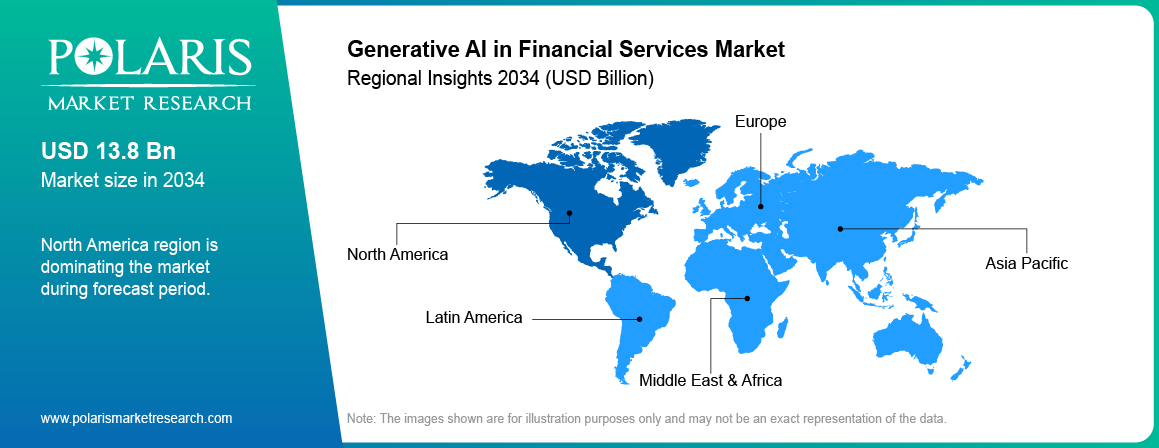
The generative AI in financial services market regional analysis includes North America, Europe, Asia Pacific, Latin America, and Middle East & Africa. Regional adoption varies by financial institution size, AI infrastructure, regulatory requirements, data architecture, model access, digital financial services, and the maturity of enterprise AI programs.
North America Generative AI in Financial Services Market Trends
In 2025, North America held 39.48% of the global generative AI in financial services market share. The presence of large financial institutions, strong technology infrastructure, and expanding enterprise AI programs supports the regional growth. The rise of autonomous workplace applications is also opening new opportunities for financial institutions to embrace AI beyond traditional conversational tools. In September 2026, OpenAI launched Dots, a product described as “always-on AI agents” that can pursue user goals across apps with minimal supervision. The development is a reflection of the broader expansion of enterprise AI programs in the U.S. toward agent-based workflows for research, data analysis, sales, software development, and other business activities (Source: openai.com)
The market is also driven by continued enterprise deployment and growing focus on measurable business outcomes. JPMorganChase reported AI allowed the bank to process more than twice the volume in transaction screening while reducing manual operator checks. These results bolster the business case for AI beyond experimentation. Large institutions also support multi-model approaches, layers of internal governance, and controlled access to foundation models, which increase the need for AI governance in production deployments.
Europe Generative AI in Financial Services Market Trends
In 2025, Europe held a share of 23.72% in the global GenAI in financial services market, driven by increasing enterprise AI adoption and high focus on governance, traceability, and controlled deployment. The FCA’s Mills Review in July 2026 pointed to the possible effect of AI on financial-services operations, consumer journeys, market power, and fraud and cyber risk. These factors are driving increased focus on financial services copilots that boost employee productivity while retaining human accountability, monitoring and controls in regulated workflows (Source: fca.org.uk).
The market growth is also driven by the demand for secure and traceable deployment of AI. Financial institutions across Europe are putting more emphasis on controlled deployment, data privacy, auditability, and oversight when deploying generative AI in regulated workflows. These requirements are pushing organizations to strengthen secure enterprise AI capabilities as they expand generative models across internal operations, customer service, research, and other financial applications.
Asia Pacific Generative AI in Financial Services Market Trends
The market in Asia Pacific is projected to register a 38.12% CAGR during the forecast period, supported by large financial-services markets, digital banking adoption, payments innovation, and expanding AI programs. MUFG started rolling out ChatGPT Enterprise to about 35,000 employees at Mitsubishi UFJ Bank in July 2026 as it builds AI-powered customer experiences for its digital banking services. This comes after a surge in AI usage throughout digital banking in Asia, from AI-powered financial services to more personalized client engagement. These developments are expected to boost the demand for wealth management AI across advisor, banking, and customer-facing workflows (Source: openai.com).
The regional market is growing further, as financial institutions focus on multilingual customer journeys, siloed systems, and increasing demand for digital financial services. Generative artificial intelligence supports relationship managers, operations teams, and contact centers in managing information and orchestrating workflows. Data localization, differing regulatory requirements, third-party model access, and model performance across languages remain important considerations. These conditions create demand for financial crime analytics and other controlled applications in which institutions pair generative capabilities with existing monetary systems and human review.
Latin America Generative AI in Financial Services Market Trends
Latin America held 4.96% share of the global generative AI in financial services industry in 2025, fueled by opportunities in digital banking, fintech, payments, customer service, and fraud related workflows. Brazil and Mexico are important financial markets and cloud-native fintechs embed generative capabilities into digitally focused applications. Organizations use AI to reduce servicing effort and make financial information easier to access. However, privacy, infrastructure, language quality and legacy-system integration can affect deployment. These factors fuel the demand for agentic AI in banking in controlled financial flows.
Smaller institutions and fintechs are adopting packaged AI services where it’s hard to maintain dedicated internal AI teams. This environment support demand for a financial services GenAI industry forecast that distinguishes scalable production applications from early experimentation and one-off deployments.
Middle East & Africa Generative AI in Financial Services Market Trends
Middle East & Africa accounted for 4.00% of the global market in 2025. This growth is driven by growing investments in AI, digital banking, and sovereign technology infrastructure. Middle Eastern financial centers are building opportunities in secure employee copilots, customer service, wealth support and compliance automation, while adoption in Africa is highly inconsistent. Mobile financial services, regional banks, and fintechs provide important entry points for generative AI. These developments support the regional retrieval augmented generation opportunity where institutions need controlled access to current financial information.
Regional adoption is driven by data residency, connectivity, AI infrastructure, language needs and the availability of managed services. Global banks deploy similar foundation-model families across markets but with localized retrieval, private routing and human approval. This creates demand for secure enterprise AI solutions that are deployed regionally and where the right controls can be kept over financial information and customer interactions.
Generative AI in Financial Services Regulatory Landscape Snapshot
| Jurisdiction | Framework | Status and Key Dates | Market Implication |
| European Union | EU AI Act (as amended by the Digital Omnibus on AI) | High-risk (Annex III) obligations, including credit scoring, deferred to 2 Dec 2027; Article 50 transparency duties apply from Aug 2026 | Demand for documentation, human oversight, and disclosure controls in customer-facing and credit workflows |
| United States | Interagency Model Risk Management Guidance (Fed SR 26-2, OCC Bulletin 2026-13) | Issued 17 Apr 2026, replacing SR 11-7; generative and agentic AI excluded from scope pending a planned request for information | Materiality-based governance for traditional models; GenAI oversight remains institution-defined |
| United Kingdom | FCA and Bank of England supervisory approach; FCA Mills Review | Principles-based approach; Mills Review published Jul 2026 | Emphasis on governance, testing, monitoring, and consumer outcomes |
| Singapore | MAS Guidelines on AI Risk Management | Finalized 7 Oct 2026; core expectations apply from 7 Oct 2027, remainder from 7 Oct 2028 | Board oversight, AI inventories, and full accountability for third-party AI |
Source: Polaris Market Research Analysis; European Commission; Sullivan & Cromwell LLP; Monetary Authority of Singapore
Generative AI in Financial Services Market Technology and Innovation Landscape
Retrieval augmented generation is an important architecture for financial services because models need access to current, permissioned institutional information. RAG combines retrieval, access controls, source citations, and generation so professionals can review the evidence supporting an output. Morgan Stanley's AI Assistant and Deutsche Bank's Financial Research Agent work illustrate the importance of grounded information in professional financial applications.
LLM orchestration is becoming an important control layer for multi-model environments. Financial institutions can route simple tasks to lower-cost models, complex reasoning to more capable models, sensitive workflows to controlled endpoints, and specialized tasks to external tools or deterministic services. Orchestration also coordinates retrieval, APIs, memory, policies, approvals, evaluation, and agent execution.
AI governance is increasingly becoming a technical capability rather than a policy document alone. Financial institutions need evaluation datasets, monitoring, red-team testing, access controls, data-loss prevention, explainability artifacts, prompt and response logging, and model-change management. FCA engagement has emphasized governance, testing, monitoring, fairness, and explainability as AI deployment develops.
Continuous evaluation provides another technology opportunity because model performance can change when the underlying model, prompt, retrieval index, or supporting data changes. Financial institutions therefore need testing environments based on realistic financial documents, customer questions, transaction contexts, and edge cases, together with measures for factuality, source support, policy compliance, and harmful behavior.
Use Case Analysis
Financial Crime and Transaction Screening
Financial crime teams manage high volumes of alerts, documents, and transaction information under regulatory and operational time pressure. Generative AI can summarize cases, extract evidence, prepare investigation narratives, and direct analysts toward relevant information while deterministic screening remains in place.
Wealth Management and Advisor Productivity
Wealth management applications focus on reducing research and administrative preparation for advisors. Morgan Stanley’s AI tools also support meeting notes and summaries, follow-up communication, and CRM updates, freeing up advisors’ time for client engagement and judgment, with communications generated needing review.
Software Engineering and Internal Operations
Generative artificial intelligence helps financial institutions explain legacy code, draft test cases, develop software, support code review, and transfer technical knowledge. Deutsche Bank reported that AI coding tools are increasingly used to support a wider range of software development activities, but developer review is still required before deploying AI-generated code.
Lending, Underwriting and Customer Decision Support
Generative AI can support underwriting by summarizing applicant documentation, extracting conditions, explaining policy language, preparing credit memoranda, and generating customer communications around established decision processes. The technology can reduce documentation effort, while approved rules and human oversight govern final eligibility and pricing decisions.
Across these applications, the common commercial model is augmentation before autonomy. Financial crime analysts, advisors, software engineers, and underwriters retain responsibility while AI compresses search, documentation, and drafting activities. This creates a gradual path from assisted workflows toward selected bounded agent actions.
Generative AI in Financial Services Market Competitive Landscape
The generative AI in financial services market includes horizontal foundation-model platforms, hyperscalers, financial software providers, financial data companies, specialist AI vendors, and financial institutions developing proprietary AI layers. JPMorganChase, Morgan Stanley, HSBC, and Deutsche Bank demonstrate different institution-led approaches, while technology providers contribute models, cloud infrastructure, data, workflow software, and specialist applications.
Institution-Led Generative AI Deployment Snapshot
| Institution | Platform / Partner | Scale Indicator | Primary Use Cases |
| JPMorganChase | LLM Suite | 65,000+ active CIB users; 200,000 onboarded firmwide | Research, drafting, summarization, coding, operations, client preparation |
| Morgan Stanley | AI Assistant and Debrief | 98% adoption across advisor teams | Advisor research, meeting notes, follow-up drafts, CRM updates |
| HSBC | Google Cloud partnership | 200+ planned AI use cases over two years | Wealth personalization, financial crime risk, frontline relationship management |
| Deutsche Bank | Google Cloud Financial Research Agent (design partner) | Domain-specific research agent | Financial research, due diligence, compliance, and risk workflows |
| MUFG (Mitsubishi UFJ Bank) | ChatGPT Enterprise | ~35,000 employees | Employee productivity and AI-powered digital banking experiences |
Source: Polaris Market Research Analysis; company disclosures
Financial services AI vendor benchmarking increasingly involves model quality, domain grounding, retrieval, permissioning, auditability, privacy, data residency, integration, workflow automation, human approval, cybersecurity, and operating economics. Provider concentration also remains relevant as financial institutions depend on several external cloud, model, and data providers.
Secure enterprise AI is developing as a distinct technology category. Vendors differentiate through private connectivity, customer-controlled data environments, model gateways, evaluation tools, guardrails, access controls, logging, and compliance capabilities. Financial software companies also embed these capabilities directly into research, CRM, fraud, compliance, underwriting, and service workflows.
The competitive structure also depends on ownership of trusted financial content. Foundation-model providers offer broad reasoning capabilities. However, financial data and workflow companies can differentiate through licensed information, established applications, proprietary research, and permissioned enterprise workflows. Financial institutions can create additional differentiation through internal data and institution-specific processes.
Vendor Positioning Landscape
| Company | Market Position | Category | Generative AI / Financial Services Focus |
| Alphabet Inc. | Market Leader | Foundation models & cloud AI | Gemini models, Google Cloud AI, enterprise agents, and financial research solutions |
| Amazon Web Services, Inc. | Market Leader | Cloud & AI infrastructure | Bedrock model access, SageMaker, security, and scalable GenAI infrastructure |
| Microsoft Corporation | Market Leader | Cloud, models & enterprise AI | Azure AI, Copilot, AI agents, and secure enterprise data integration |
| OpenAI, L.L.C. | Market Leader | Foundation models | Frontier models, ChatGPT Enterprise, API platform, and financial research and document analysis |
| Accenture plc | Market Leader | AI consulting & integration | End-to-end GenAI strategy, implementation, and banking transformation |
| NVIDIA Corporation | Market Leader | AI computing infrastructure | GPUs, accelerated computing, AI software, and inference for financial-services workloads |
| Anthropic PBC | Challenger | Foundation models | Claude models, enterprise AI, and agentic workflows for financial research and analysis |
| Bloomberg L.P. | Challenger | Financial data & analytics | Proprietary financial data, Terminal-integrated AI, and research and analytics workflows |
| Capgemini SE | Challenger | AI consulting & transformation | GenAI consulting, cloud transformation, and financial-services process automation |
| Cognizant Technology Solutions Corporation | Challenger | AI services & engineering | GenAI engineering for banking operations, customer service, and risk applications |
| Databricks, Inc. | Challenger | Data & AI platform | Unified data and AI platform, RAG, governance, and enterprise GenAI applications |
| International Business Machines Corporation | Challenger | Enterprise AI & hybrid cloud | watsonx, AI governance, model orchestration, and regulated-industry deployment |
| LSEG plc | Challenger | Financial data & analytics | Licensed financial data, AI-enabled research, and partnerships with leading model providers |
| Oracle Corporation | Challenger | Enterprise applications & cloud AI | Oracle Cloud AI, AI agents, and GenAI in ERP and financial applications |
| Palantir Technologies Inc. | Challenger | Data & AI platform | AIP platform for deploying LLMs on governed enterprise data and workflows |
| Salesforce, Inc. | Challenger | CRM & enterprise AI | Agentic AI and CRM-integrated GenAI for service, sales, and financial workflows |
| SAP SE | Challenger | Enterprise software & business AI | Joule copilot, AI agents, ERP integration, and financial operations |
| S&P Global Inc. | Challenger | Financial data & analytics | Kensho AI, Capital IQ data, and GenAI-enabled research and market intelligence |
| ServiceNow, Inc. | Challenger | Enterprise workflow & AI agents | GenAI and agentic workflows for employee service, risk, IT, and financial operations |
| Snowflake Inc. | Challenger | Data cloud & AI | Cortex AI, governed data sharing, and RAG on financial-services data |
| AlphaSense Inc. | Niche Player | Financial research & intelligence | GenAI market intelligence, document analysis, and enterprise knowledge discovery |
| Cohere Inc. | Niche Player | Enterprise foundation models | Enterprise LLMs with private deployment and retrieval-focused solutions for banks |
| FactSet Research Systems Inc. | Niche Player | Financial data & analytics | Financial datasets, research workflows, and AI-enabled investment analysis |
| FICO | Niche Player | Decisioning & analytics | AI-driven credit scoring, fraud detection, decision automation, and responsible AI |
| Finastra Group Holdings Limited | Niche Player | Banking software & AI | Embedded GenAI across lending, payments, treasury, and banking applications |
| Moody's Corporation | Niche Player | Credit risk & analytics | GenAI research assistants, credit risk intelligence, and proprietary ratings data |
| Pegasystems Inc. | Niche Player | AI workflow & automation | GenAI-enabled service, decisioning, and banking operations orchestration |
| SAS Institute Inc. | Niche Player | Analytics, risk & responsible AI | GenAI, fraud detection, risk management, compliance, and model governance |
| Temenos AG | Niche Player | Banking technology | AI-native banking platform, intelligent workflows, lending, and core banking modernization |
| Thomson Reuters Corporation | Niche Player | Regulatory & compliance content | Trusted content and GenAI assistants for regulatory, compliance, and risk research |
Note: Market position reflects Polaris Market Research's qualitative assessment of financial-services GenAI offerings, enterprise adoption, and ecosystem partnerships; it is not a ranking.
Source: Polaris Market Research Analysis; company websites and investor disclosures
Key Players in the AI in Financial Services Market
- Accenture plc
- Alphabet Inc.
- AlphaSense Inc.
- Amazon Web Services, Inc.
- Anthropic PBC
- Bloomberg L.P.
- Capgemini SE
- Cognizant Technology Solutions Corporation
- Cohere Inc.
- Databricks, Inc.
- FactSet Research Systems Inc.
- FICO
- Finastra Group Holdings Limited
- International Business Machines Corporation
- LSEG plc
- Microsoft Corporation
- Moody's Corporation
- NVIDIA Corporation
- OpenAI, L.L.C.
- Oracle Corporation
- Palantir Technologies Inc.
- Pegasystems Inc.
- Salesforce, Inc.
- SAP SE
- SAS Institute Inc.
- ServiceNow, Inc.
- Snowflake Inc.
- S&P Global Inc.
- Temenos AG
- Thomson Reuters Corporation
Buyer Analysis and Barriers to Market Entry
Model risk management is a major purchasing consideration because financial institutions need to understand an AI system's purpose, materiality, data flows, provider dependencies, model changes, and control mechanisms. The Bank of England and FCA found that only 34% of firms fully understood their AI systems, reinforcing the need for transparent model inventories, testing, human oversight, and change controls.
AI governance requirements extend into production monitoring. Financial institutions assess prompt logging, output monitoring, privacy, bias testing, red teaming, source attribution, access controls, audit trails, and approval workflows. Client-facing systems require stronger safeguards than internal drafting applications because generated outputs can directly affect customer outcomes.
Data integration is another barrier. Banking, trading, CRM, research, document, and risk platforms often use different data models and permission structures. Generative AI systems therefore need identity integration, retrieval controls, data catalogues, information barriers, and fine-grained authorization to ensure that a response does not expose information merely because it exists somewhere within the institution.
Rapid changes in model performance and pricing also complicate vendor evaluation. A financial institution may use one provider for reasoning, another for coding, and a smaller model for high-volume summarization. This increases the value of repeatable evaluation and model-routing capabilities while creating additional testing and operational requirements.
Organizational change can also restrict adoption. Employees need guidance on appropriate use, verification, confidentiality, and escalation, while risk and legal teams need clear rules around human approval. Business leaders must distinguish genuine productivity improvements from higher content output or user activity that does not translate into economic value.
Generative AI in Financial Services Buyer Decision Framework
| Buyer | Primary Objective | Critical KPI | Main Barrier |
| CIO/AI Platform | Secure reusable GenAI infrastructure | Adoption, portability, cost/use case | Legacy integration |
| Risk/Compliance | Controlled high-materiality deployment | Incident rate, explainability, review coverage | Model complexity |
| Business Unit | Workflow productivity | Time saved, cases processed, revenue uplift | Poor workflow fit |
| Data/Security | Protected proprietary information | Data leakage, access violations, retrieval quality | Fragmented entitlements |
| Finance/Procurement | Sustainable unit economics | Cost/request, cost/user, ROI/use case | Rapid model price change |
Source: Polaris Market Research Analysis
Third-party concentration is another procurement issue because institutions may rely on a combination of hyperscalers, foundation-model providers, and financial-data suppliers. Buyers therefore increasingly consider subcontractor transparency, data-location options, business continuity, model-change notification, and exit support alongside conventional technology performance.
Cybersecurity requirements become more significant as generative systems move from information retrieval toward action. Prompt injection, data exfiltration, malicious documents, and over-privileged agents can create direct consequences when AI systems have access to payment, trading, or account functions. Tool-level authorization, transaction limits, sandboxing, and separation between untrusted content and executable instructions are therefore important deployment controls.
Cost and Pricing Benchmarking Analysis
Public foundation-model API prices provide a lower-level reference point for generative AI economics, although financial-services deployments also incur costs related to retrieval, security, governance, integration, evaluation, and support. As of October 2026, OpenAI lists GPT-5.6 Sol at USD 4 per million input tokens and USD 20 per million output tokens under a promotional rate, while Anthropic prices Claude Sonnet 5.5 at USD 2 and USD 10. AWS Bedrock publishes model-specific pricing, and its Claude rates match Anthropic's direct API. These API rates should not be interpreted as the complete cost of an enterprise financial-services AI solution.
| Offering | Public Price, Oct 2026 (Input / Output) | Unit | Interpretation |
| OpenAI GPT-6 Astra | USD 10 / USD 50 | Per 1M tokens | Premium frontier-model benchmark |
| OpenAI GPT-5.6 Sol | USD 4 / USD 20 | Per 1M tokens | Flagship benchmark; promotional rate listed through at least 21 Nov 2026 |
| OpenAI GPT-5.6 Terra | USD 2 / USD 12 | Per 1M tokens | Mid-tier benchmark for drafting and summarization |
| OpenAI GPT-5.6 Luna | USD 0.20 / USD 1.20 | Per 1M tokens | Low-cost benchmark for high-volume tasks |
| Anthropic Claude Opus 5.5 | USD 4 / USD 20 | Per 1M tokens | Higher-end reasoning benchmark |
| Anthropic Claude Sonnet 5.5 | USD 2 / USD 10 | Per 1M tokens | Managed model-access benchmark |
| Anthropic Claude Haiku 4.5 | USD 1 / USD 5 | Per 1M tokens | Fast, low-cost model benchmark |
| Amazon Nova Micro (AWS Bedrock) | USD 0.035 / USD 0.14 | Per 1M tokens | Lowest-cost managed-model benchmark |
| Enterprise secure GenAI platform | - | Annual subscription/usage | Negotiated platform and governance pricing |
| Financial-services implementation services | - | Project/workstream | Dependent on integration and controls |
Source: Polaris Market Research Analysis; OpenAI; Anthropic; Amazon Web Services
Industry Developments
-
September 2026: Charles Schwab launched Charley, an AI-powered assistant. It gives U.S. retail investors insights into portfolio performance, market news, and research commentary. (Source: schwab.com)
-
September 2026: Bloomberg launched Enterprise MCP, enabling financial firms to connect Bloomberg data with enterprise AI applications and AI agents for financial workflows. (Source: bloomberg.com)
-
September 2026: AccountsOS launched Finn, an AI accounting assistant within ChatGPT that connects to live ledger data and lets businesses query financial information using natural language. (Source: ffnews.com)
-
September 2026: BNP Paribas and Google Cloud announced a five-year partnership to expand generative and agentic AI across banking workflows, including credit analysis, sales, trading, and research. (Source: bnpparibas.com)
Generative AI in Financial Services Market Premium Insights and Forward Outlook
The next phase of financial-services AI will likely shift from assistants that prepare information to bounded agents that can complete multiple workflow steps. Agentic systems can gather documents, query policies, perform calculations, call internal APIs, draft case material, and route outputs for approval. The resulting market opportunity extends beyond model access toward identity, orchestration, governance, integration, and workflow controls.
Financial services AI agents can also change internal operating economics. One user request may generate several model calls, searches, calculations, API actions, and approval steps. This increases demand for agent gateways, tool registries, policy engines, tracing, budget controls, and approval layers that connect model consumption to completed business processes.
The GenAI in financial services industry forecast is increasingly linked to the differentiation of financial data, workflow integration, governance, and trust. Foundation-model access may become less differentiated over time, while institutions and vendors can retain value through proprietary financial content, permissioned retrieval, evaluation systems, regulated workflow expertise, and transaction connectivity.
Pricing may increasingly move toward verified outcomes rather than model access alone. Compliance platforms could be associated with cases reviewed, contact-center systems with resolved interactions, research applications with professional usage, and agent platforms with completed workflows. Such approaches require reliable attribution and service-level measurement but can connect technology spending more directly to business value.
Generative AI in Financial Services Market Report Segmentation
By Component Outlook (Revenue, USD Billion, 2021–2034)
-
Software/Platforms
-
Model & API Access Attributable to Financial Workloads
-
Professional & Managed Services
By Deployment Model Outlook (Revenue, USD Billion, 2021–2034)
-
Public Cloud/Managed API
-
Private/On-Premises/Dedicated
-
Hybrid/Multi-Model
By Application Outlook (Revenue, USD Billion, 2021–2034)
-
Customer Service & Engagement
-
Compliance & Document Review
-
Fraud/AML/Financial Crime
-
Investment & Financial Research
-
Wealth & Advisory
-
Credit & Underwriting
-
Software Development & IT Operations
-
Agentic Back-Office Workflow Automation
By Financial Sub-Vertical Outlook (Revenue, USD Billion, 2021–2034)
-
Retail & Commercial Banking
-
Capital Markets & Investment Banking
-
Wealth & Asset Management
-
Insurance
-
Payments & FinTech
-
Market Infrastructure & Other Financial Services
By Interaction Scope Outlook (Revenue, USD Billion, 2021–2034)
-
Internal Employee Use
-
Professional-Assisted Client Use
-
Direct Client/Autonomous Agent Interaction
By Solution Maturity Outlook (Revenue, USD Billion, 2021–2034)
-
Experimentation/Sandbox
-
Controlled Internal Production
-
Client-Facing Production with Human Oversight
-
Agentic Execution with Bounded Autonomy
By Regional Outlook (Revenue, USD Billion, 2021–2034)
- North America
- U.S.
- Canada
- Europe
- Germany
- France
- UK
- Italy
- Spain
- Netherlands
- Rest of Europe
- Asia Pacific
- China
- Japan
- India
- South Korea
- Taiwan
- Australia
- Rest of Asia Pacific
- Latin America
- Brazil
- Mexico
- Argentina
- Rest of Latin America
- Middle East & Africa
- Saudi Arabia
- UAE
- South Africa
- Rest of Middle East & Africa
Generative AI in Financial Services Market Report Scope
| Report Attributes | Details |
| Market Size in 2025 | USD 1.86 Billion |
| Market Size in 2026 | USD 2.50 Billion |
| Revenue Forecast by 2034 | USD 27.22 Billion |
| CAGR | 34.7% from 2026–2034 |
| Base Year | 2025 |
| Historical Data | 2021–2024 |
| Forecast Period | 2026–2034 |
| Quantitative Units | Revenue in USD Billion and CAGR |
| Report Coverage | Revenue Forecast, Growth Factors, Competitive Landscape, Industry Trends, and Strategic Analysis |
| Segments Covered |
|
| Regional Scope |
|
| Competitive Landscape |
|
| Report Format | PDF + Excel |
| Customization | Available by Country, Region, and Segment |
Source: Polaris Market Research Analysis
Why Choose Polaris Market Research
Polaris Market Research & Consulting, Inc. separates generative AI workflows from traditional predictive AI and generic cloud or model spending. The analysis combines regulatory data, bank disclosures, company announcements, pricing, and workflow evidence to support generative AI in financial services market analysis.
Clients can request analysis by application, financial sub-vertical, deployment model, use type, vendor, or geography. Benchmarking can also cover architecture, deployment, governance, agentic maturity, API costs, adoption, productivity, and ROI, supporting financial services AI vendor benchmarking.
The market model separates financial-workload-related model/API consumption from workflow software and services. Production deployments and verified operating metrics receive greater weight than early announcements or low-materiality pilots.
Research Methodology
Polaris Market Research & Consulting, Inc. estimated the generative AI in financial services market using a structured, multi-stage framework that combines secondary evidence, primary interviews, and bottom-up and top-down modeling. The framework is designed to separate genuine generative AI revenue from traditional predictive AI, generic cloud consumption, and broader model-provider spending.
Research Framework
| Phase | Key Activities | Primary Inputs | Output |
| 1. Scope Definition | Define the market boundary, inclusion and exclusion criteria, and segmentation by component, deployment model, application, sub-vertical, interaction scope, and solution maturity | Polaris market taxonomy; regulatory and industry definitions | Market boundary and segmentation framework |
| 2. Secondary Research | Collect and classify evidence from regulators, financial institutions, and vendors; build a dated source log | Regulatory publications, annual reports, company announcements, public pricing, product documentation | Source log and fact base |
| 3. Primary Research | Interview stakeholders across the value chain to validate adoption, pricing, and deployment assumptions | Banks, insurers, asset managers, fintechs, risk leaders, AI vendors, system integrators | Validated assumptions and gap fills |
| 4. Market Modeling | Build revenue bottom-up by component, application, sub-vertical, deployment model, and region; cross-check top-down | Vendor revenue, deployment evidence, pricing benchmarks, technology spend indicators | 2025 base-year market size |
| 5. Forecasting | Project 2026 to 2034 revenue using adoption, pricing, workflow, and governance drivers, with upside and downside scenarios | Driver and restraint analysis, adoption trends, regulatory timelines | Revenue forecast and CAGR |
| 6. Validation and Review | Triangulate estimates, reconcile variances, and complete senior analyst review of sources, risks, and consistency | Model outputs, expert feedback | Final report and forecast |
Source: Polaris Market Research Analysis
Market Definition and Scope
The market includes software and platforms, model and API access attributable to financial workloads, and professional and managed services in which foundation, generative, multimodal, or agentic models materially generate, summarize, retrieve, reason over, transform, or act on financial information. Predictive systems used only for scoring, classification, forecasting, or anomaly detection are excluded unless a generative or foundation-model layer materially contributes to the solution. Generic foundation-model API spending is counted only when consumed for financial-services workloads, which limits overlap with the broader generative AI market. The base year is 2025, with historical data for 2021 to 2024 and forecasts for 2026 to 2034.
Secondary Research
Secondary research establishes the fact base and identifies where revenue is generated. Evidence is classified by reliability, and production deployments and verified operating metrics receive greater weight than early announcements or low-materiality pilots. The main source categories are:
· Regulators and central banks, including the Bank of England, the FCA, the European Commission, US federal banking agencies, and the Monetary Authority of Singapore
· Financial institution annual reports, investor disclosures, and press releases
· Vendor product documentation, partnership announcements, and public API and cloud pricing
· Industry publications, technical literature, and conference proceedings
· Polaris Market Research proprietary databases and prior market studies
Primary Research
Primary research validates secondary findings and fills gaps where public evidence is limited. Polaris analysts hold structured discussions with stakeholders across the value chain, including:
· Technology, AI platform, and data leaders at banks, insurers, and asset managers
· Risk, compliance, and model risk management executives
· Product, strategy, and sales leaders at model providers, cloud platforms, and financial software vendors
· System integrators, managed-service providers, and fintech executives
Primary research also distinguishes generated content from automated decisions. The methodology assesses whether a model summarizes information, recommends an action, selects an action within established rules, or executes a transaction. These stages have different risk profiles, architecture requirements, and revenue implications. Regional assumptions are additionally reviewed against regulation, cloud availability, institution size, digital banking maturity, and public evidence of production deployment.
Market Estimation and Forecasting
Polaris combines two estimation approaches to build the 2025 base-year market size:
· Bottom-up: Revenue is built from vendor software, platform, and services revenue, model and API consumption attributable to financial workloads, and deployment evidence by institution type. It is then aggregated by component, application, sub-vertical, deployment model, and region.
· Top-down: Results are cross-checked against financial-services technology spending, enterprise AI adoption indicators, and the broader generative AI market to confirm the estimate is a plausible share of total spend.
The 2026 to 2034 forecast reflects enterprise adoption, workflow expansion, pricing trends, and governance requirements. It also accounts for restraints such as model risk management, third-party concentration, and regulatory timing. Polaris tests the base case against upside and downside scenarios and reports the base case.
Data Triangulation and Validation
Estimates from each approach are reconciled, and variances are investigated before the model is finalized. Segment totals are checked against the overall market, and regional totals against the global figure. A senior analyst reviews sources, assumptions, and risks, and the model is refreshed when material regulatory, pricing, or product developments occur.
Key Assumptions and Limitations
Many institutions do not disclose generative AI spending separately, so Polaris infers revenue from disclosed deployments, vendor evidence, and pricing benchmarks. Rapidly changing model pricing, evolving regulation, and the pace of agentic AI adoption are the main sources of forecast uncertainty.
Generative AI in Financial Services Market FAQ's
The generative AI in financial services market was valued at USD 1.86 billion in 2025 and is forecast to reach USD 27.22 billion by 2034.
North America is the leading region with a 39.48 % share in 2025, supported by large financial institutions, established AI infrastructure, and expanding enterprise AI adoption.
The leading application is customer service & engagement, supported by growing adoption of generative AI across financial-services workflows.
The market is projected to grow at a CAGR of 34.7% from 2026 to 2034.
Generative AI supports employee copilots, research, customer service, compliance, fraud investigations, credit documentation, software development, wealth management, and operations.
Key use cases include customer service, financial research, compliance review, financial crime analysis, wealth management, underwriting, software development, and workflow automation.
Generative AI can be used safely when supported by access controls, testing, monitoring, human review, governance, and appropriate data protection. Banks govern it through model inventories, human approval, logging, change management, and incident-response processes.
Key frameworks include the EU AI Act, which defers high-risk obligations to December 2027, and the revised US interagency model risk management guidance issued in April 2026. Singapore's MAS AI risk guidelines apply from October 2027, and the UK relies on FCA and Bank of England supervision.
Generative AI can help summarize alerts, extract evidence, prepare case narratives, and review unstructured information. It generally complements existing screening and anomaly-detection systems.
Key players include Microsoft, Alphabet, Amazon Web Services, OpenAI, Anthropic, IBM, NVIDIA, Databricks, Salesforce, Oracle, and Accenture. Financial data and banking-technology providers such as Bloomberg, LSEG, S&P Global, FactSet, and Temenos also compete.
Agentic AI performs multi-step tasks by planning, retrieving information, using tools, and executing bounded actions under defined controls.
Key risks include hallucination, data leakage, cybersecurity threats, bias, model opacity, third-party dependency, changing provider behavior, and over-automation.
Key drivers include large-scale enterprise adoption of financial services copilots and broader workflow deployment across banking functions. Agentic AI, retrieval-augmented generation, and LLM orchestration add further opportunity.
Software & platforms led the market with a 48.64 % share in 2025, fueled by demand for copilots, workflow agents, retrieval, orchestration, evaluation, and governance capabilities.
Download Sample Report of Generative AI in Financial Services Market
Please fill out the form to request a customized copy of the research report.


