
Antimony Market Size, Share, Trends & Forecast, 2026–2034
REPORT DETAILS
Antimony Market Summary
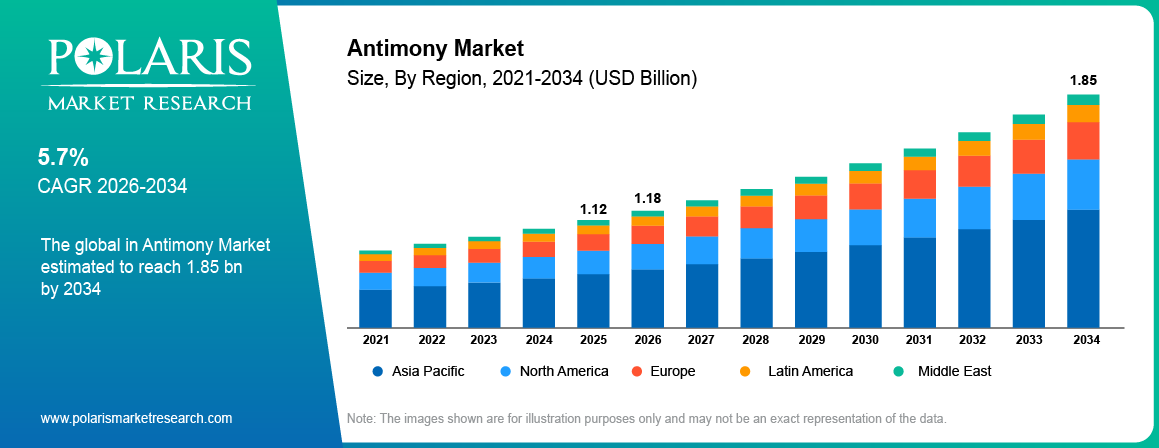
The antimony market size was valued at USD 1.12 billion in 2025. The market is expected to record a CAGR of 5.7% from 2026 to 2034. Growth is driven by supply diversification, domestic processing, recycling, high-purity demand, and strategic antimony applications.
Market Statistics
Antimony Market Key Takeaways
- In 2025, Asia Pacific held the largest regional share of 74.62%. The dominance is supported by China’s mining and refining capacity.
- North America is expected to record the significant CAGR of 5.96% during the forecast period. It is driven by domestic processing and supply diversification.
- The antimony trioxide and other compounds segment held the largest share of 57.24% in 2025, fueled by chemical and flame-retardant applications.
- Flame retardants held the largest share of 54.38% in 2025. The leading share is attributed to the increasing use of antimony trioxide as a synergist.
- The chemicals and polymers segment dominated with 42.86% market share in 2025. The dominating position is propelled by rising demand for antimony compounds.
Note: Figures and projections outlined in this report are the result of Polaris Market Research’s proprietary analytical processes, grounded in the latest available datasets and market observations.
Antimony Market Definition
The antimony market covers antimony entering commercial supply as ore or concentrate, refined metal, antimony trioxide, antimony trisulfide, other compounds, and antimony-bearing alloys. Antimony is a brittle metalloid commonly recovered from stibnite and is used because relatively small additions can change the performance of lead alloys, polymer flame retardant systems, glass formulations, and specialized electronic materials. Finished batteries, plastic components, textiles, ammunition, semiconductors, and solar products remain outside the market boundary, although their demand influences antimony consumption.
The supply structure differs materially from the downstream demand structure. By value, China was the largest destination for global imports of antimony ore and concentrate, reflecting its role as a leading producer and refining center. This combination gives China influence over mining availability, conversion economics, and the movement of material through the international antimony supply chain.
The market is closely connected to several adjacent industrial categories. Antimony trioxide functions as a synergist in halogen-containing flame retardant systems. Antimony metal and alloys are used in lead acid battery materials and other metallurgical applications. Antimony compounds also serve selected catalyst, chemical, electronic, and specialty material applications. These relationships connect the market to flame retardant additives and PET polymerization catalysts without including the downstream products themselves in market sizing. The rising antimony market value is increasingly influenced by supply security in addition to underlying industrial consumption. Buyers may increase inventory, diversify approved suppliers, qualify recycled feedstock, or accept higher delivered costs when restricted origin becomes a procurement concern.
Global Antimony Mine Production and Reserves by Country
| Country | 2025e Mine Production (t) | Share of World Output | Reserves (t) |
| China | 40,000 | 36% | 830,000 |
| Russia | 32,000 | 29% | 350,000 |
| Tajikistan | 22,000 | 20% | 60,000 |
| Bolivia | 5,000 | 5% | 310,000 |
| Myanmar | 4,500 | 4% | 140,000 |
| Türkiye | 3,000 | 3% | 99,000 |
| Australia | 1,300 | 1% | 110,000 |
| Rest of world | 2,200 | 2% | — |
| World total | 110,000 | 100% | >2,000,000 |
Source: Polaris Market Research Analysis; U.S. Geological Survey, Mineral Commodity Summaries 2026. Note: e = estimated; rest-of-world production is derived from the USGS world total, which is rounded.
Antimony Value Chain Snapshot
| Value Chain Stage | Key Activities | Primary Output | Market Observation |
| Mining | Extraction of stibnite and gold-antimony ores | Ore and concentrates | China, Russia and Tajikistan supplied about 85% of 2025e mine output |
| Smelting and refining | Conversion of concentrates into metal | Antimony metal and alloys | China is the largest refining base; non-Chinese capacity is emerging in the U.S., Australia and Europe |
| Compound conversion | Oxidation and chemical processing | Antimony trioxide, trisulfide and other compounds | Quality consistency and impurity control drive customer qualification |
| Secondary recovery | Recovery from spent lead-acid batteries | Antimonial lead | Supplied 12% of U.S. apparent consumption in 2025e |
| End-use manufacturing | Compounding, alloying, glass, catalyst and defense production | Flame retardants, batteries, glass, catalysts, ammunition | U.S. use: 49% metal products and flame retardants, 40% antimonial lead and ammunition, 11% nonmetal products |
Source: Polaris Market Research Analysis; U.S. Geological Survey, Mineral Commodity Summaries 2026; European Commission Joint Research Centre
Market Dynamics
Antimony Market Driver Impact Analysis
| Market Driver | Impact | Geographic Relevance | Impact Timeline |
| Supply security | High | Global, particularly North America | Short term, ongoing |
| Domestic processing investment | High | North America, Europe | Medium term |
| Downstream demand diversity | Medium | Global | Short to medium term |
| Secondary recovery and recycling | Medium | North America, Europe, Asia Pacific | Medium term |
| High-purity conversion | Low | North America, Asia Pacific, Europe | Medium to long term |
Source: Polaris Market Research Analysis; U.S. Geological Survey (USGS), Mineral Commodity Summaries 2026; Fastmarkets. Note: Impact ratings reflect Polaris Market Research’s assessment of each driver’s influence on market growth during 2026–2034.
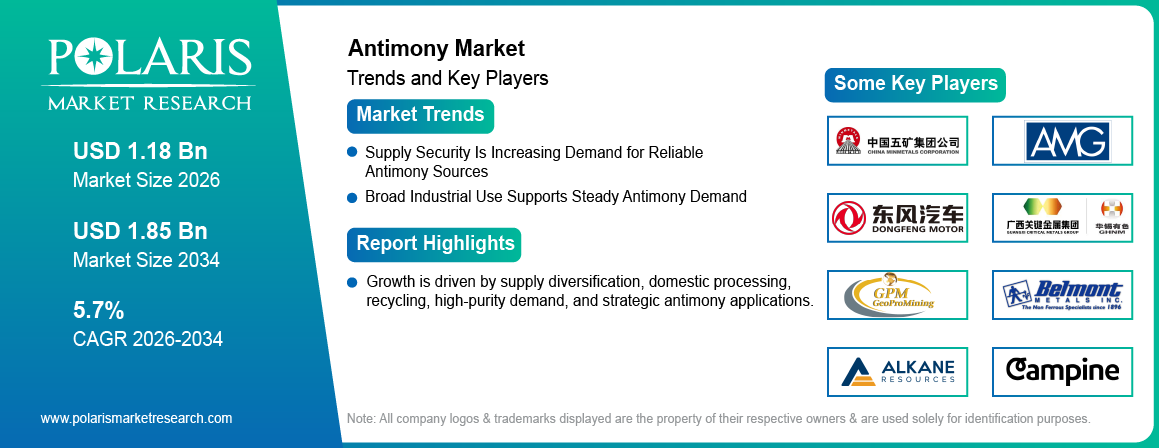
Driver: Supply Security Is Increasing Demand for Reliable Antimony Sources
Supply security is increasingly becoming a major factor supporting the antimony market growth. This is because the supply of antimony is concentrated in a few production and processing locations, leaving manufacturers more vulnerable to disruptions, export restrictions and changes in availability. This is driving buyers to seek alternative suppliers, hold higher inventories, and explore longer term procurement agreements.
The exposure is particularly important for industries that use antimony in batteries, defense materials, flame retardant systems, and specialty chemicals. When supply is uncertain, companies continue to purchase the material at higher prices as replacing an approved input involve product testing, reformulation or supplier qualification. This is increasing the importance of critical minerals supply chains and secure supply of antimony. According to USGS data, the U.S. had a net import dependence of 91% for antimony in 2025. Such developments have resulted in more attention being paid to the origin, availability and procurement planning throughout the antimony supply chain (Source: usgs.gov).
The effect is also visible in new domestic supply projects. Perpetua Resources began early works construction at the Stibnite Gold Project in October 2025 and has also worked on options for antimony processing. The company disclosed pilot-scale work with Idaho National Laboratory focused on producing antimony trisulfide for domestic uses. Such projects indicate that supply security is supporting investment not only in mining but also in domestic antimony processing.
Driver: Broad Industrial Use Supports Steady Antimony Demand
Rising use of antimony across several established industries supports the antimony market expansion. The main reason is that antimony is used across different product categories rather than depending on one single end market. Antimony trioxide is used in flame retardant systems, antimony metal and alloys are used in storage batteries and metallurgical applications, while other compounds serve chemical, catalyst, defense, and specialty uses.
This diversified demand base provides some protection against weakness in an individual application. For example, changes in flame retardant demand do not affect the entire market in the same way as they would if antimony were concentrated in one application. The combination of antimony applications therefore continues to support industrial consumption.
United States Antimony Corporation reports the use of antimony oxide in flame retardant systems for plastics, rubber, fiberglass, textiles, paints, coatings, and paper. The company also identifies antimony metal for storage batteries and ordnance and antimony trisulfide for ammunition primers (source: usantimony.com).
Flame retardants remain an important demand area because antimony trioxide works as a flame retardant synergist in halogen-containing formulations. This allows manufacturers to achieve the required flame performance using relatively small amounts of antimony-containing material. At the same time, qualification requirements can make it difficult to immediately replace an established formulation, supporting continued use in existing products. The market is also supported by lead-acid battery alloys. These batteries are still used in automotive starter systems, backup power, telecommunications, data centers, and industrial equipment.
Restraint: Sharp Price Increases Encourage Material Substitution
Higher prices for antimony are limiting market volume growth as customers seek alternatives. It can be substituted in some applications, particularly where antimony is used as a supporting rather than a functional material. When antimony prices rise, manufacturers have more of a financial incentive to reduce material usage, change formulations, or qualify alternative inputs. This changes the effect in applications. Mature defense specifications or highly qualified products may afford customers less flexibility to substitute. Manufacturers of plastics, coatings, batteries and other products may have more latitude to adjust formulations.
The impact extends beyond direct material costs. Companies also evaluate alternative flame retardants, lower-antimony battery formulations, different catalysts, or redesigned components when the expected savings justify the qualification work. This means higher prices can increase market revenue in the short term while creating a risk to long-term physical consumption.
Restraint: Handling and Compliance Requirements Increase Operating Costs
Product stewardship and handling requirements are expected to create an additional restraint for antimony-related businesses. Some antimony compounds are subject to controlled handling, record keeping, dust control, and proper waste treatment. Such requirements raise the operating costs for processors and users.
The effect is more pronounced when customers are under pressure to reduce hazardous substances or improve environmental performance. In these cases, the higher cost of compliance, plus the higher prices for antimony, make other materials more attractive.
The study says dust control, product stewardship, documentation, and safe disposal of waste are important considerations for companies that handle selected antimony compounds. While these requirements do not eliminate demand, they can influence material selection and purchasing decisions in applications where substitution is technically feasible.
Opportunity: Recycling to Provide an Alternative Source of Antimony
Antimony recycling reduces dependence on primary mined material by recovering antimony from industrial products and waste streams. This allows secondary antimony to fill gaps left by newly mined supply, especially when primary material is expensive or difficult to obtain.
Recycling of lead-acid batteries is especially suitable as there is already an established infrastructure for collection and recycling in many markets. Improved separation, refining, and impurity control can enable recovered material to meet the demands of higher-value applications. This also provides opportunities for specialty metal recycling companies to improve their antimony recovery capabilities.
Supply restrictions and higher primary prices also affect recovery economics. This drives investments in secondary supply, hydrometallurgical processing and advanced recovery technologies as companies increase recovery from residues, slags, spent alloys and other process streams.
Recycling also enhances supply resilience in the region. Qualified buyers of both virgin and recycled materials reduce dependence on any one source. Flexible feedstock refiners switch between mined concentrates and recovered material depending on availability and price. This is especially the case in North America and Europe where existing specialty metals recycling systems can allow for further recovery. But recycled supply cannot fully replace primary production because the volume of material that can be economically recovered is limited by recovery volumes, feedstock quality, metallurgy, and purity requirements.
Opportunity: Rising Preference for High-Purity Antimony
Growing demand for high purity materials is creating an opportunity beyond conventional commodity applications. Electronics, semiconductor, infrared, and defense applications require tighter purity and impurity limits than standard flame retardant or alloy applications.
This creates room for suppliers that do more than produce antimony-containing feedstock. Consistent refining and analytical testing, trace-element control, and customer qualification allow producers to serve specialized applications with higher technical requirements and more limited supply options.
China's controlled-item definitions include selected antimony materials, with purity requirements up to 99.999%, and specifically also high-purity oxide and indium antimonide. These specifications highlight the commercial difference between standard antimony products and high-purity antimony used in specialized applications.
Domestic conversion capacity increases the value of this opportunity. Buyers in strategic industries increasingly need qualified products from trusted supply chains rather than simply access to raw ore. Perpetua Resources' pilot work with Idaho National Laboratory on antimony trisulfide and United States Antimony Corporation's existing antimony trisulfide processing demonstrate the focus on downstream capability.
The opportunity therefore extends from mining to refining, purification, and conversion into application-ready materials. Suppliers that can combine secure feedstock with antimony processing technology, analytical capability, and customer qualification can address higher-value portions of the antimony value chain.
Antimony Market Report Segmentation Analysis
The report analyzes the antimony market across product form, application, end use industry, supply origin, and region. The segmentation provides a basis for identifying both the largest revenue pools and the areas expected to generate the strongest incremental growth over the forecast period.
Product Form Insights
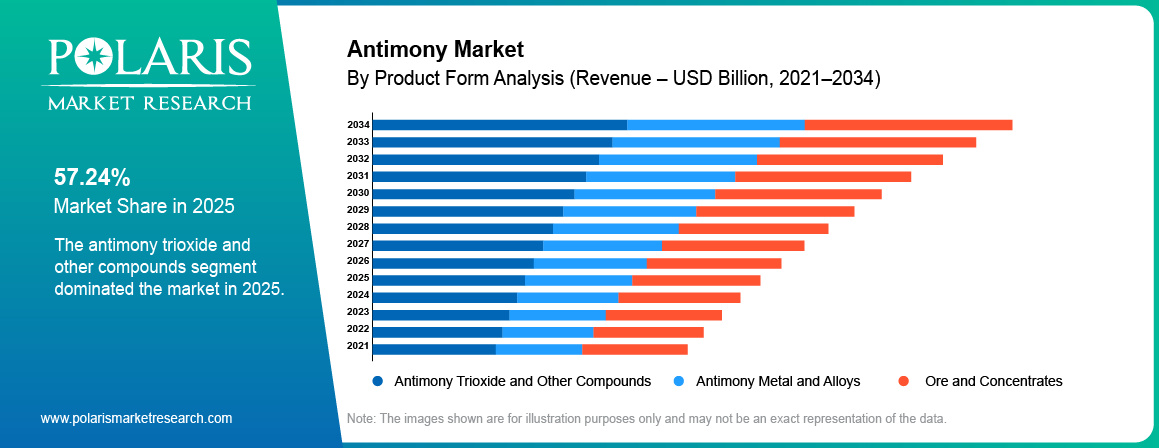
The market segmentation includes antimony metal and alloys, antimony trioxide and other compounds, and ore and concentrates. Each form has different buyers, purity requirements, processing routes, and price benchmarks even though the products ultimately depend on the same underlying antimony feedstock. The antimony trioxide and other compounds segment represented the leading market share of 57.24% in 2025. The segment benefits from established demand across flame retardant systems, catalysts, glass, ceramics, and other chemical applications. The material helps enhance flame resistance in rubber, plastics, textiles, coatings, and electrical components. Therefore, it has become important in automotive, construction, electronics, and consumer goods applications. Antimony trioxide is also used as a catalyst in polyethylene terephthalate (PET) production. It is used as a fining agent in specialty glass, and in pigments, paints, and ceramics. Rising fire-safety requirements, growing electronics and automotive manufacturing, and increasing PET consumption, particularly across Asia Pacific, contributed to the segment growth.
As per the antimony market forecast, the antimony metal and alloys segment is projected to grow at 6.44% CAGR during the forecast period. Demand is supported by the continued use of antimony-containing alloys in lead acid batteries and other metallurgical applications, while supply security is adding another layer to procurement decisions. Buyers reliant on qualified metal prioritize reliable sourcing, regional availability, and consistent specifications more when supply from major producing countries is uncertain. This underpins demand for material from alternative suppliers and domestic processing projects. Increasing emphasis on antimony metal, specialty products and domestic conversion capacity as supply chains become more focused on security and qualification requirements.
Application Insights
Flame retardants represented the leading application segment, accounting for 54.38% market share in 2025. The segment has a broad industrial customer base because antimony trioxide is used as a synergist in flame retardant systems rather than serving only one finished product category. Demand extends across plastics, rubber, textiles, paints, coatings, fiberglass, and paper applications. This gives the segment a relatively diversified demand base compared with applications that depend on a narrower set of products.
The glass and ceramics segment is expected to register the highest CAGR of 6.32% during the forecast period. In these applications, antimony compounds are used as refining and functional additives. Antimony trioxide is used as a fining agent in glass manufacturing. In this, it is adopted to remove unwanted bubbles and enhance the clarity, uniformity, and optical quality of finished glass. Antimony trioxide is also used in specialty and technical glass products, including display glass, optical glass, and glasses used in electronics. In ceramics, antimony compounds help in coloration, opacity, and specialized surface properties. Increasing demand for specialty glass, advanced ceramics, and electronic components will boost antimony consumption in this segment.
End Use Industry Insights
Chemicals and polymers represent the leading end use industry, holding 42.86% market share in the base year. The segment benefits from the widespread use of antimony compounds, particularly antimony trioxide. It is majorly used as flame-retardant synergists, catalysts, and functional additives. In polymer segment, antimony trioxide is combined with halogenated flame retardants. It helps improve fire resistance in plastics, rubber, coatings, and synthetic materials used across electronics, automotive, construction, and consumer products. Antimony compounds are also used as catalysts in PET manufacturing. It supports applications in packaging, textiles, and beverage containers. Rising demand for high-performance polymers, stringent fire-safety standards, and growing plastics and chemical production supported segment dominance.
Defense and aerospace are projected to grow at 6.82% CAGR during the forecast period. Supply security, material qualification, and traceability are driving demand. Buyers in defense related applications require uniform material properties and reliable supply from qualified processing routes. This increases the importance of domestic antimony processing and reliable feedstock sources. Recent developments also show greater attention toward downstream antimony products. Perpetua Resources disclosed pilot-scale work with Idaho National Laboratory involving antimony trisulfide for domestic uses, while United States Antimony Corporation continues to operate as a U.S. antimony processor.
Supply Origin Insights
The primary antimony dominated the supply-origin segment with 76.28% market share in 2025. The main source is mined antimony-bearing ore and concentrates that are refined into metal, oxides, alloys, and other commercial products. It continues to be the major source of large volume feedstock to the global market. The significance of primary supply is also connected with the concentration of mining activity in a limited number of countries. Antimony is commonly recovered from deposits containing stibnite (Sb₂S₃), as the principal mineral or a by-product of mining operations for lead, gold, tungsten, and other metals. The geographic concentration of mining and refining capacity, particularly in China, makes the global antimony supply chain vulnerable to production disruptions, export controls, and trade restrictions. Growing demand from flame retardants, lead-acid batteries, semiconductors, and specialty materials is increasing attention on supply diversification.
Secondary or recycled antimony is expected to grow rapidly at 7.26% CAGR during the forecast period. The segment is gaining attention because companies seek additional feedstock sources when primary concentrate availability becomes uncertain or expensive. Antimony can be recovered from lead acid battery recycling streams, residues, slags, spent alloys, and other industrial materials. Better separation and refining can improve the quality of recovered material and allow it to serve applications with higher specification requirements.
Regional Analysis
Asia Pacific Antimony Market Trends
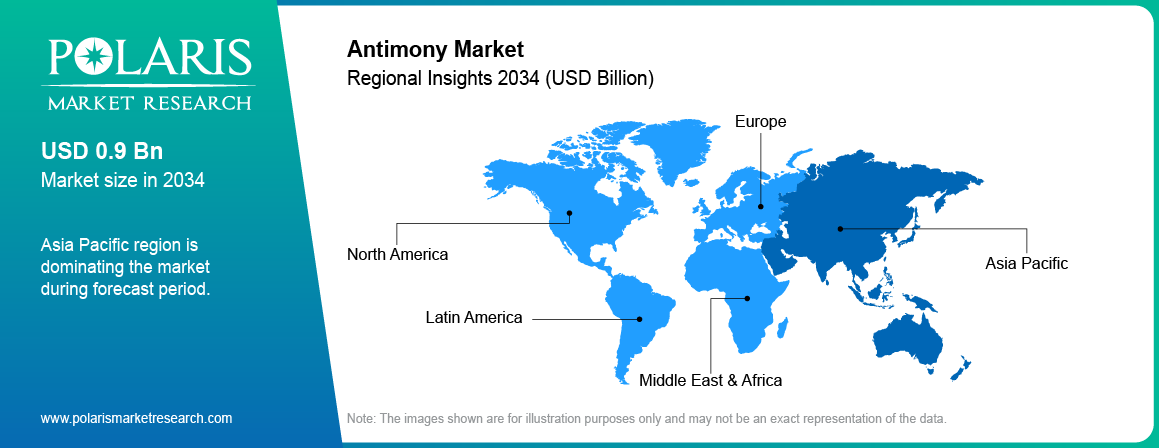
Asia Pacific accounted for 74.62% of global antimony market revenue in 2025. The region has the strongest upstream and midstream concentration, led by China. For 2025, China produced approx. 60,000 metric tons of mined antimony. It represented about 60% of mine production across the world (source: amazonaws.com). Asia Pacific also contains major markets across electronics, chemicals, batteries, and industrial manufacturing, driving the antimony market share. Chinese antimony ingot price increase can reflect declining reserves and ore grades, raw material constraints, and export controls. Japan, South Korea, and India remain important downstream users, while China’s position as a conversion center gives Asia Pacific an outsized influence on availability and price formation.
North America Antimony Market Trends
North America is projected to grow at 5.96% CAGR during the forecast period. The region’s strategic importance extends beyond its revenue share, as U.S. buyers remain highly exposed to imported antimony metal and oxide. In February 2026, the U.S. Geological Survey reported that the U.S. was 100% import reliant for 16 minerals and relied on imports for more than one-half of apparent consumption for 54 nonfuel mineral commodities, highlighting the importance of domestic processing and a diversified antimony supply. United States Antimony Corporation also reported domestic mining in Montana and continued processing operations. All these developments underpin a gradual rebuilding of regional capability, although in the short term imported feedstock remains important (Source: nma.org).
Europe Antimony Market Trends
The antimony market in Europe is expected to record a CAGR of 4.88% during the projected period, due to the diversification of supply chains and the security of critical mineral supply. The region has a strong base of metals-processing and recycling, with sustained market activity. The demand for circular metals is aided by their rising used in flame retardants, batteries, chemicals and specialty applications. As the importance of supply continuity grows, buyers are also beginning to look at a broader spectrum of primary and secondary sources of antimony. Tajikistan exports unwrought antimony powder to France and Belgium. Such trade flows highlight the significance of Europe as a destination for antimony supply outside of China. At the same time, the region’s existing recycling infrastructure supports secondary recovery from lead-acid batteries and industrial residues, which provide further opportunities to improve regional supply resilience.
Latin America Antimony Market Trends
Latin America market is projected to record a CAGR of 5.54% during the forecast period, as producers and processors look to diversify primary supply away from the more established Asian sources. The region has abundant antimony resources, with Bolivia a major source of mined material and Mexico providing processing capabilities to meet North America’s needs. Further developing the region’s mining and processing capacity would reinforce the region’s position in the wider antimony supply chain.
Bolivia exported antimony ores and concentrates worth about USD 44.05 million and with a volume of exports of 3.10 million kg, according to World Integrated Trade Solution (WITS). The rise indicates the ability of the region to increase exports when market conditions can take more supply. But mine scale, ore quality, infrastructure, processing capacity and cross-border logistics are still the key factors in turning resource availability into a consistent, qualified supply (Source: worldbank.org).
Middle East & Africa Antimony Market Trends
Middle East and Africa are slowly gaining importance in the antimony market, registering a CAGR of 5.76% during the forecast period. Companies and governments look for further supply sources outside the established production centers. The region has antimony resource potential but market development will depend on investments in mining and processing infrastructure, reliable power, metallurgical recovery, environmental compliance and access to qualified buyers. These factors will determine the pace at which regional resources can enter the commercial supply chain. New antimony supply from the region also faces longer qualification and logistics requirements before it can compete with established suppliers. Higher prices improve the economics of new projects, while long-term offtake agreements, reliable concentrate marketing, and downstream processing capacity can improve project viability and help developers build more stable routes to market.
Export and Import Data Analysis
According to USGS Mineral Commodity Summaries 2026, U.S. apparent consumption of antimony rose to an estimated 45,000 metric tons in 2025 from 28,600 tons in 2024, as oxide imports climbed to 39,000 tons. U.S. net import reliance reached 91% of apparent consumption, with China supplying 55% of metal and oxide imports during 2021–2024. In Europe, Eurostat data show Tajikistan supplied 52% of EU antimony imports in 2025, while China’s share fell to 3%. These figures highlight the concentrated nature of the trade market and the sensitivity of supply availability to changes involving major exporters and import-dependent markets.
Export and Import Data Snapshot
| Country / Region | Trade Flow | Volume / Value | Key Trend |
| China | Antimony oxide exports | Approx. 6,000 t in 2025e vs. 34,200 t in 2024; 135 t (Jul 2026) and 170 t (Aug 2026) per month | Sharply lower under export licensing |
| China | Antimony ore and concentrate imports | 59,461 t in H1 2026 vs. approx. 38,000 t in full-year 2025 | Rising as domestic mining quotas tighten |
| United States | Antimony oxide imports | 39,000 t in 2025e vs. 24,000 t in 2024 | Up approx. 63%; net import reliance at 91% |
| European Union | Antimony imports (covered customs codes) | 21,000 t in 2025 vs. 25,000 t in 2019 | Tajikistan 52%, Vietnam 12%, Myanmar 9%, China 3% |
| Tajikistan | Mine output and exports to the EU | 22,000 t mine output in 2025e | Largest single supplier to the EU |
| Bolivia | Ore and concentrate exports | 3,100 t valued at USD 44.05 million in 2024 | Mine output eased to 5,000 t in 2025e |
Source: Polaris Market Research Analysis; USGS Mineral Commodity Summaries 2026; Eurostat; SunSirs (China Customs data); Shanghai Metals Market; PricePedia; World Integrated Trade Solution (WITS). 2025e = estimated; H1 = first half.
China Antimony Export Control Timeline
| Date | Policy Measure | Market Implication |
| Aug–Sep 2024 | China announces licensing for antimony ore, metal, oxides and related compounds, effective mid-September 2024 | Exports fall sharply; Western buyers face tighter spot availability |
| Dec 2024 | China prohibits antimony exports to the United States (Announcement No. 46) | Average monthly price rises to USD 18.10/lb from USD 9.80/lb in Aug 2024 |
| Jun 2025 | Controls and U.S. ban remain in force | Monthly average price peaks at USD 27.50/lb; eases to USD 20.30/lb by Nov 2025 |
| Nov 2025 | U.S.-specific ban suspended from 9 Nov 2025 until 27 Nov 2026 (Announcement No. 72) | Worldwide licensing and the ban on U.S. military end users remain in force |
| 27 Nov 2026 | Scheduled expiry of the suspension | No extension announced as of Aug 2026; any new arrangement subject to U.S.–China consultation |
Source: Polaris Market Research Analysis; USGS Mineral Commodity Summaries 2026 (antimony chapter); Pillsbury Winthrop Shaw Pittman; Fastmarkets; Materials Dispatch (MOFCOM tracker)
Antimony Market Technology and Innovation Landscape
Technology development in the antimony market is focused on three practical areas: recovering more material from difficult feedstocks, producing cleaner grades, and increasing recovery from recycled sources. Conventional thermal processing remains important, while hydrometallurgical and electrochemical methods can help improve recovery or control impurities for selected feedstocks. The commercial benefit is broader feedstock flexibility because processors can potentially convert more complex ores, residues, and secondary materials into usable antimony products.
Product quality is also becoming an important part of processing capability. To avoid impurities, processors need consistent refining and testing capabilities rather than simply access to antimony-bearing feedstock. Such requirements are particularly relevant for buyers that need stable chemical composition across repeated shipments.
Another development is the expansion of domestic antimony trisulfide processing for strategic applications. Perpetua Resources disclosed pilot-scale work with Idaho National Laboratory focused on antimony trisulfide for domestic uses, while United States Antimony Corporation has existing trisulfide processing capabilities. These developments show growing attention toward converting antimony into application-ready products closer to strategic end users.
Antimony Market Buyer Analysis
Antimony buyers include flame retardant compounders, battery manufacturers and recyclers, defense and aerospace material suppliers, glass and ceramics producers, and electronics or specialty-material companies. Antimony procurement decisions depend on more than the quoted material price. Factors such as Sb2O3 quality, alloy performance, supply continuity, origin, impurity levels, recycled content, and analytical certification can influence supplier selection. These requirements become more important when the material is used in products that require consistent performance or formal qualification.
Qualification requirements can make supplier changes difficult for several buyer groups. Defense and electronics customers generally require tighter material specifications, while battery and flame-retardant customers may face testing or reformulation costs when changing inputs. This can increase the value of suppliers that provide consistent material, technical documentation, testing records, and reliable delivery. Price therefore remains an important purchasing factor, but it is considered alongside quality and supply reliability.
Buyer Use Cases and Decision Framework
| Buyer Group | Primary Requirement | Procurement Friction |
| Flame retardant compounders | Consistent Sb2O3 quality, color, particle size, impurity limits | Qualification delay, reformulation cost, price volatility |
| Battery manufacturers/recyclers | Alloy performance, recycled content, supply continuity | Shortage risk, specification changes, working capital |
| Defense/aerospace suppliers | Traceability, domestic or allied origin, trisulfide/metal specification | Security review, long qualification, limited approved sources |
| Glass/ceramics producers | Optical/color performance and predictable chemistry | Impurity sensitivity, process consistency |
| Electronics/specialty material buyers | High purity and analytical certification | Very high purity barriers, low tolerance for contamination |
Source: Polaris Market Research Analysis.
Antimony Market Barriers to Entry
Entering the antimony market requires more than securing access to an ore deposit. New suppliers must have the processing capabilities to handle variable feedstock, meet product specifications and provide consistent quality from shipment to shipment. Capital requirements extend beyond mining to processing equipment, environmental controls, testing facilities, logistics, and customer qualification.
There are a number of other factors that make entry more difficult. Limited access to suitable ore or secondary feedstock can limit production, and volatile prices can strain working capital. Customers in defense and high-purity applications also take longer to approve new suppliers as material changes require more testing and qualification. Compliance work can be increased by export controls, origin documentation, end-use requirements, and supply-chain transparency.
Price also impacts the economics of new projects. Perpetua Resources used a long-term antimony price of USD 10.00 per pound in its technical report, while United States Antimony Corporation published an average realized price of USD 25.12 per pound in 2025. The difference illustrates why prospective producers need project economics that remain workable when market prices move away from shortage-driven levels.
Antimony Market Cost and Pricing Benchmarking
United States Antimony Corporation reported an average realized antimony sales price of USD 7.61 per pound in 2024, increasing to USD 25.12 per pound in 2025. (Source: United States Antimony Corporation, Form 10-K 2025). Realized prices have since eased to USD 19.92 per pound in Q1 2026 and USD 13.70 per pound in Q2 2026, against USD 28.32 per pound in Q2 2025. USGS reports a 2025 average benchmark of USD 25 per pound, with monthly averages falling from USD 27.50 per pound in June 2025 to USD 20.30 per pound in November 2025. By comparison, Perpetua Resources used USD 10.00 per pound as a long-term price assumption for its Stibnite project economics. (Source: Perpetua Resources technical report.) These figures show the difference between prices realized during constrained market conditions and assumptions used for longer-term project planning.
Cost and Pricing Snapshot
| Benchmark | Period | Price | Context |
| USGS average antimony metal price (99.65%, CIF) | 2024 | USD 10.24/lb | Annual average benchmark |
| USGS average antimony metal price (99.65%, CIF) | 2025 | USD 25.00/lb | More than double 2024; USD 20.30/lb by Nov 2025 |
| USAC average realized price | Q1 2026 | USD 19.92/lb | Company realized price |
| USAC average realized price | Q2 2026 | USD 13.70/lb | Down 52% year on year; average cost USD 13.34/lb |
| Spot reference cited by USAC | Q2 2026 | Approx. USD 10.50/lb | Company-cited spot market pricing |
| Rotterdam in-warehouse, max 100 ppm Bi | 5 Aug 2026 | USD 18,000–20,500/t | Fastmarkets European benchmark assessment |
| China antimony ingot, 99.65% Sb min | 12 Aug 2026 | Approx. USD 11,388/t | SMM domestic price; below export-market levels |
| Antimony trioxide, 99.5% Sb2O3, FOB | 12 Aug 2026 | Approx. USD 25,450/t | SMM export-market assessment |
| Perpetua Stibnite long-term assumption | Effective 31 Dec 2025 | USD 10.00/lb | Project economic assumption |
Source: Polaris Market Research Analysis; U.S. Geological Survey (Argus Media data); United States Antimony Corporation Q2 2026 results; Q1 2026 results; Fastmarkets; Shanghai Metals Market; Perpetua Resources technical report. USAC = United States Antimony Corporation.
Antimony Market Competitive Landscape
Vendor Positioning
| Company | Market Position | Value Chain Position | Key Differentiator |
| Hsikwangshan Twinkling Star Co., Ltd. | Market Leader | Mining, smelting and downstream products (China) | Two mines and two smelters; 20,000 t/yr ingot and 40,000 t/yr product capacity; exports to 50+ countries |
| Hunan Gold Corporation Limited | Market Leader | Mining and antimony products (China) | Major Chinese producer identified in USGS reporting |
| Alkane Resources Limited (Mandalay Resources Corporation) | Challenger | Gold-antimony mining (Australia, Sweden) | Costerfield mine, Victoria, described as the largest antimony producer in the Western world |
| United States Antimony Corporation | Challenger | Integrated U.S. antimony smelting and processing | Metal, oxide and trisulfide output; company-described as the only fully integrated antimony company outside China and Russia |
| Campine N.V. | Challenger | Belgium-based metals processing | European antimony trioxide and lead products supplier |
| China Minmetals Corporation | Challenger | State-owned metals and minerals group (China) | Large integrated portfolio with global trading reach |
| Guangxi China Tin Group Co., Ltd. | Challenger | Tin and non-ferrous mining and smelting (China) | Integrated tin-antimony mining and smelting base in Guangxi |
| Yunnan Muli Antimony Industry Co., Ltd. | Challenger | Antimony smelting and products (Yunnan) | Antimony ingot and oxide production |
| Yiyang City Huachang Antimony Industry Co., Ltd. | Challenger | Antimony smelting and products (Hunan) | Broad antimony product range and customer base |
| Guizhou Dongfeng Antimony Industry Co., Ltd. | Challenger | Antimony smelting and products (Guizhou) | Antimony ingot and oxide production |
| Nihon Seiko Co., Ltd. | Challenger | Antimony smelting and processing (Japan) | Leading Japanese antimony processor |
| Polyus | Challenger | Russian gold mining with antimony in ore output | Exposure to Russia, the world’s second-largest mine producer |
| Korea Zinc Co., Ltd. | Follower | Non-ferrous smelting (South Korea) | Diversified multi-metal smelting platform |
| Youngsun Chemicals Corporation | Follower | Antimony chemicals (China) | Antimony trioxide and chemical products |
| Belmont Metals Inc. | Niche Player | U.S. secondary non-ferrous metals processing | Lead and antimony alloys; domestic U.S. alloy capability |
| AMG Critical Materials N.V. | Niche Player | Critical materials production and processing (Netherlands) | Specialty metallurgical processing capability |
| GeoProMining Ltd. | Niche Player | Eurasian mining group | Historical antimony mining exposure in Tajikistan |
| Tibet Huayu Mining Co., Ltd. | Niche Player | Mining (China, Tajikistan) | Gold-antimony joint venture with TALCO in Tajikistan |
| Tri-Star Resources plc | Niche Player | UK-headquartered metals and minerals supply | International sourcing and supply of minor metals |
| Lambert Metals International Ltd. | Niche Player | Minor metals trading and distribution | Global distribution network for antimony metal and compounds |
| Suzuhiro Chemical Co., Ltd. | Niche Player | Antimony chemicals (Japan) | Antimony trioxide for flame-retardant applications |
| Perpetua Resources Corp. | Emerging Player | U.S. mine development (Idaho) | Stibnite Gold Project, a U.S. gold-antimony deposit |
| Larvotto Resources Ltd. | Emerging Player | Gold-antimony mining (New South Wales) | Hillgrove mine, an Australian antimony source |
Source: Polaris Market Research Analysis; company publications and filings; U.S. Geological Survey; Mordor Intelligence. Market position reflects Polaris Market Research’s qualitative classification of each company’s scale and influence in the antimony value chain.
Antimony competitive landscape is influenced by access to feedstock, processing capacity, product quality, regulatory compliance, and customer qualification. Chinese producers continue to have an important position in mining and refining. However, non-Chinese companies are developing alternative supply through domestic processing, new mining projects, recycling, and specialized products. The competitive factors also differ by product. Oxide suppliers need consistent chemical quality, metal suppliers need dependable alloy performance, and high-purity producers need strong analytical and qualification capabilities.
Key Players in the Antimony Market
- Alkane Resources Limited (Mandalay Resources Corporation)
- AMG Critical Materials N.V.
- Belmont Metals Inc.
- Campine N.V.
- China Minmetals Corporation
- GeoProMining Ltd.
- Guangxi China Tin Group Co., Ltd.
- Guizhou Dongfeng Antimony Industry Co., Ltd.
- Hsikwangshan Twinkling Star Co., Ltd.
- Hunan Gold Corporation Limited
- Korea Zinc Co., Ltd.
- Lambert Metals International Ltd.
- Larvotto Resources Ltd.
- Nihon Seiko Co., Ltd.
- Perpetua Resources
- Polyus
- Suzuhiro Chemical Co., Ltd.
- Tibet Huayu Mining Co., Ltd.
- Tri-Star Resources Plc
- United States Antimony Corporation
- Yiyang City Huachang Antimony Industry Co., Ltd
- Youngsun Chemicals Corporation
- Yunnan Muli Antimony Industry Co., Ltd.
Industry Developments
- September 2026: Nova Minerals received nearly 500 tonnes of crushing, sorting, milling, flotation, and refining equipment at Port MacKenzie, Alaska, supporting the construction of a domestic antimony processing facility targeted to begin production in 2027. (source: globenewswire.com)
- September 2026: American Tungsten & Antimony produced its first antimony ingot at the Del Sol Hydromet Refinery in Nevada using material from its White Spar Antimony Mine, demonstrating a U.S. mine-to-metal production pathway. (source: prnewswire.com)
- August 2026: Larvotto Resources commenced antimony and gold production at its Hillgrove mine in New South Wales, establishing Australia’s largest antimony operation with an expected annual output of 4,900 tonnes. (source: larvottoresources.com)
- January 2026: United States Antimony Corporation announced a new hydrometallurgical processing facility in Bolivia, supported by its technology and financing, to expand commercial-scale antimony processing. (source: juniorminingnetwork.com)
Antimony Market Premium Insights and Forward Outlook
Supply Diversification Is Becoming More Important for Buyers
USGS trade analysis indicates that China supplied 55% of U.S. antimony metal and oxide imports during 2021–2024. This level of concentration makes alternative sourcing, recycled material, inventory planning and additional qualified suppliers more important. Therefore, buyers have been looking more closely at the number of reliable processing routes available to them rather than just the availability of mined material (source: usgs.gov). Pricing is also becoming a more important factor in procurement decisions. Differences between regional markets are attributed to logistics, local availability, and trade conditions. This makes regional sourcing and contract structures more important as buyers manage their exposure to changes in international supply.
Processing Capacity Is Becoming More Important Across Value Chain
New mining capacity alone does not guarantee additional usable supply. The antimony-bearing material must still be converted to the particular form of metal, oxide, sulfide or other form desired by customers. Perpetua Resources' work on antimony processing and pilot-scale trisulfide production with Idaho National Laboratory illustrates the increasing focus on downstream conversion. Recycling and purification projects can address the same requirement by creating additional sources of application-ready material.
Higher-purity products further increase the importance of processing expertise. Electronics and defense-related applications require tighter impurity control, analytical certification, traceability, and repeatable product specifications, and buyers request these as well. Development of a domestic trisulfide process creates opportunities for suppliers that combine reliable feedstock with consistent refining and product qualification.
Antimony Market Report Segmentation
By Product Form Outlook (Revenue - USD Billion, Volume - Kilotons, 2021–2034)
- Antimony Metal and Alloys
- Antimony Trioxide and Other Compounds
- Ore and Concentrates
By Application Outlook (Revenue - USD Billion, Volume - Kilotons, 2021–2034)
- Flame Retardants
- Batteries
- Glass and Ceramics
- Catalysts
- Others
By End Use Industry Outlook (Revenue - USD Billion, Volume - Kilotons 2021–2034)
- Chemicals and Polymers
- Automotive and Transportation
- Electrical and Electronics
- Energy Storage and Backup Power
- Building and Construction
- Defense and Aerospace
By Supply Origin Outlook (Revenue - USD Billion, Volume - Kilotons 2021–2034)
- Primary Antimony
- Secondary/Recycled Antimony
By Regional Outlook (Revenue - USD Billion, Volume - Kilotons, 2021–2034)
- North America
- U.S.
- Canada
- Europe
- Germany
- France
- UK
- Italy
- Spain
- Netherlands
- Rest of Europe
- Asia Pacific
- China
- Japan
- India
- South Korea
- Taiwan
- Australia
- Rest of Asia Pacific
- Latin America
- Brazil
- Mexico
- Argentina
- Rest of Latin America
- Middle East & Africa
- Saudi Arabia
- UAE
- South Africa
- Rest of Middle East & Africa
Antimony Market Report Scope
| Report Attributes | Details |
| Market Size in 2025 | USD 1.12 Billion |
| Market Size in 2026 | USD 1.18 Billion |
| Revenue Forecast by 2034 | USD 1.85 Billion |
| CAGR | 5.7% from 2026–2034 |
| Base Year | 2025 |
| Historical Data | 2021–2024 |
| Forecast Period | 2026–2034 |
| Quantitative Units | Revenue in USD Billion and CAGR, Volume in Kilotons |
| Report Coverage | Revenue Forecast, Growth Factors, Competitive Landscape, Industry Trends, and Strategic Analysis |
| Segments Covered |
|
| Regional Scope |
|
| Competitive Landscape |
|
| Report Format | PDF + Excel |
| Customization | Available by Country, Region, and Segment |
Source: Polaris Market Research Analysis
Why Choose Polaris Market Research
Polaris Market Research & Consulting, Inc. combines company records, regulatory information, trade data, production statistics, and structured secondary research to develop a reliable antimony market report. The research process uses market research methodology to distinguish between mined ore, concentrates, refined metal, oxides, and downstream product values. Separating these layers before market sizing helps maintain a consistent commercial scope and reduces the risk of double counting.
This research combines antimony market analysis with a supply-side evaluation to provide a pragmatic view on the antimony industry. Demand patterns, export controls, recycling, refining capacity, product qualification and regional sourcing are considered. This approach is useful for bespoke market research, showing how changes in supply availability, processing capacity, and buyer demands can affect different parts of the antimony value chain.
Research Methodology
The antimony market research methodology follows five phases: scope definition, source mapping, evidence extraction, triangulation, and analyst review. The research uses U.S. Geological Survey mineral statistics and country profiles, Chinese policy documents, company filings and technical reports, the International Energy Agency policy database, and specialist pricing benchmarks. Source triangulation is used to compare production, trade, pricing, regulatory, and company-level information before incorporating it into the analysis.
The methodology also separates proprietary market estimates from independently verifiable industry evidence. This provides a structured basis for evaluating historical developments and preparing the antimony industry forecast. The assessment considers changes in supply, demand, processing capacity, recycling, pricing, and regulatory conditions to support a consistent antimony market analysis and market outlook.
| Phase | Execution |
| Scope Definition | Definition included products, downstream exclusions, geographic frame, and segmentation |
| Source Mapping | Prioritize government, regulatory, company filings, technical reports, and pricing sources |
| Evidence Extraction | Capture production, trade, pricing, policy, capacity, and company facts with date and source |
| Triangulation | Reconcile product forms and avoid mixing ore, contained antimony, refined metal, and downstream values |
| Analyst Review | Validate assumptions, segment logic, source traceability, narrative consistency, and proprietary figure insertion points |
Source: Polaris Market Research Analysis.
Antimony Market FAQ's
The antimony market was valued at USD 1.12 billion in 2025 and is expected to reach USD 1.85 billion by 2034, at a CAGR of 5.7% during 2026–2034.
Asia Pacific is the dominant region, reflecting China’s leadership in mined antimony production and the region’s strong refining and downstream industrial base. North America is expected to record the fastest growth, supported by domestic processing and supply diversification.
Antimony Trioxide is the leading product-form segment, with established application in flame retardant systems, catalysts, glass and chemical applications.
Major applications include flame retardants, lead acid batteries, glass and ceramics, catalysts, chemicals and defense and electronics. Flame retardants hold the largest application share.
China, Russia and Tajikistan lead global mine production. USGS estimates 2025 output at 40,000 t for China, 32,000 t for Russia and 22,000 t for Tajikistan, out of a world total of 110,000 t.
The increase came as supply bottlenecks, lower Chinese output, shortages of raw materials and export curbs took their toll. USGS data show the average monthly price nearly doubled from USD 9.80 per pound in August 2024 to USD 18.10 per pound in December 2024, and peaked at USD 27.50 per pound in June 2025.
China requires export licenses for antimony ore, metal and oxides, which adds compliance obligations, end-use review and supply-chain friction. The U.S.-specific export ban is suspended until 27 November 2026, while worldwide licensing and the ban on U.S. military end users remain in force.
Antimony metal is used primarily in alloy and metallurgical applications. Antimony trioxide is an oxide powder used primarily in chemical and flame retardant systems.
Antimony is of strategic importance due to its concentrated supply and its use in batteries, flame retardants, defense, and electronics industries.
Key players include Hsikwangshan Twinkling Star, Hunan Gold Corporation, Yunnan Muli Antimony Industry, Yiyang City Huachang Antimony Industry, Alkane Resources (Mandalay Resources), United States Antimony Corporation, Campine, Nihon Seiko, China Minmetals and Perpetua Resources.
Antimony averaged USD 25 per pound in 2025 but has since eased. United States Antimony Corporation realized USD 13.70 per pound in Q2 2026, and Rotterdam in-warehouse prices were assessed at USD 18,000–20,500 per tonne in August 2026.
Yes, antimony can be recovered in existing lead-acid battery recycling systems. Recycling supplied 12% of U.S. apparent consumption in 2025, according to USGS.
Only in limited volumes. USGS reports one domestic company began mining antimony in Montana in 2025, while primary metal and oxide are produced from imported feedstock. U.S. net import reliance was 91% of apparent consumption in 2025.
Yes. Antimony metal and trisulfide are used in defense and ammunition-related applications. In the U.S., antimonial lead and ammunition accounted for 40% of antimony use.
Download Sample Report of Antimony Market
Please fill out the form to request a customized copy of the research report.


