
Enterprise Agentic AI Market Size, Share, Trends & Forecast, 2026–2034
REPORT DETAILS
Enterprise Agentic AI Market Summary
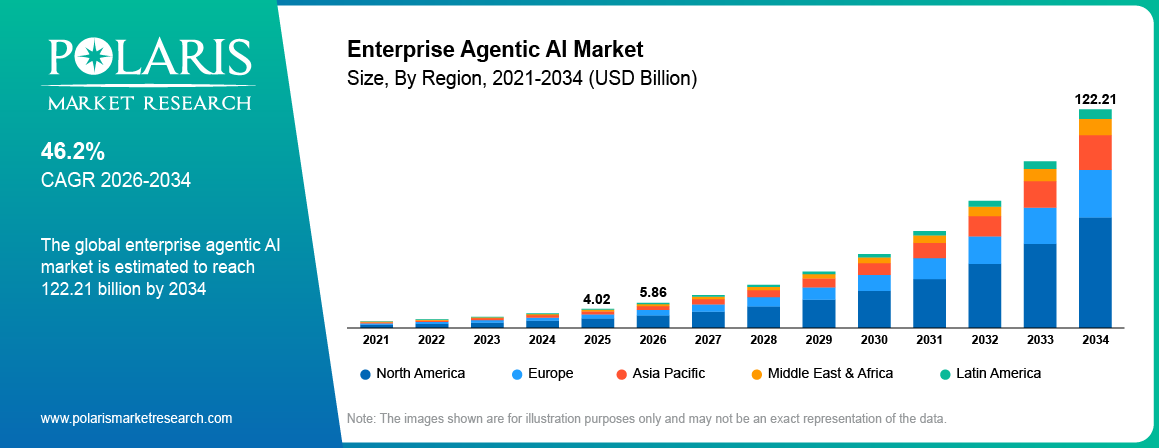
The global enterprise agentic AI market was valued at around USD 4.02 billion in 2025 and is projected to reach USD 122.21 billion by 2034, registering a CAGR of 46.2% during the forecast period. The market is expanding due to growing adoption of autonomous agents, advancements in multi-agent orchestration, and increasing enterprise investment in AI governance.
Market Statistics
Enterprise Agentic AI Market Key Takeaways
- North America held the largest market share of 40.16% in 2025 owing to the early adoption of enterprise AI solutions, advanced cloud infrastructure, and robust investments made by the top technology firms.
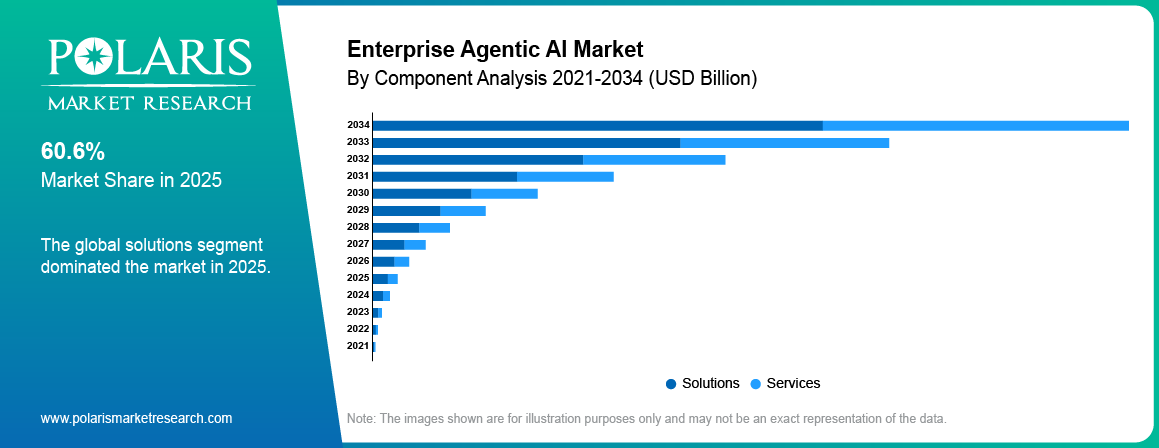
- The solutions segment accounted for the largest market share of more than 60.6% in 2025 owing to increasing deployment of enterprise AI platforms and orchestration software.
- The cloud deployment segment dominated the market due to its scalability, lower infrastructure costs, and rapid implementation capabilities.
- BFSI industry segment size was estimated to be USD 1.01 billion in 2026 and is anticipated to grow at a CAGR of 46.8% during the forecast period.
- The Customer Service & Virtual Assistance application segment was valued at approximately USD 1 billion, compared to the IT Operations & Software Development segment, which was valued at approximately USD 907 million in 2025.
- The multi-agent architecture segment is projected to grow at the fastest CAGR of 46.5% during the forecast period.
Note: Figures and projections outlined in this report are the result of Polaris Market Research’s proprietary analytical processes, grounded in the latest available datasets and market observations.
Market Definition and Growth Analysis
Enterprise agentic AI is an intelligent software system that is capable of planning, reasoning, making decisions, and performing business activities without much human intervention. Enterprise agentic AI interacts with enterprise applications, databases, APIs, and digital workflows to perform business activities such as finance, customer service, IT, human resource management, and supply chain management. Enterprise agentic AI platforms offer capabilities such as tool calling, enterprise connectors, agent memory, and agent runtime for automation of complex enterprise workloads.
The enterprise agentic AI value chain participants include foundation model providers, AI infrastructure providers, cloud providers, agent development platform providers, systems integrators, enterprise software providers, consulting firms, and the end users. The aforementioned participants enable enterprises to implement, monitor, and optimize their agentic AI in business.
Digital transformation efforts, the adoption of cloud services, the improvement of large language models, and increasing demand for business automation is expected to drive further market growth. Enterprises are adopting AI platforms in order to increase efficiency, save costs, and facilitate decision-making using data. An SAP and Oxford Economics survey found that organizations are achieving a 16% ROI on AI investments, with returns expected to nearly double within two years (Source: sap.com).
Market Dynamics
Driver Impact Analysis
| Market Driver | Est. CAGR Impact | Geographic Relevance | Impact Timeline |
| Enterprise workflow automation | +2.3% | Global | Short to Medium Term |
| Large language model advancements | +1.9% | North America, Europe | Medium Term |
| Cloud AI platform expansion | +1.7% | Global | Medium Term |
| Multi-agent collaboration | +1.3% | Global | Long Term |
| AI governance and compliance | +1.0% | Europe, North America | Long Term |
Source: Polaris Market Research Analysis. CAGR reflect Polaris proprietary sizing methodology.
The enterprise agentic AI market is projected to grow rapidly during the forecast period due to rising demand for intelligent automation and autonomous business operations. OpenAI's 2025 Enterprise AI report found that ChatGPT workplace adoption surpassed 7 million enterprise seats, with enterprise seats increasing 9x year over year, reflecting rapid enterprise AI adoption (Source: openai.com). Increasing adoption of AI agents, advancements in foundation models and agent orchestration, and growing investments in AI governance and enterprise security are driving market expansion.
Source: Polaris Market Research Analysis
Driver: Growing Enterprise Automation
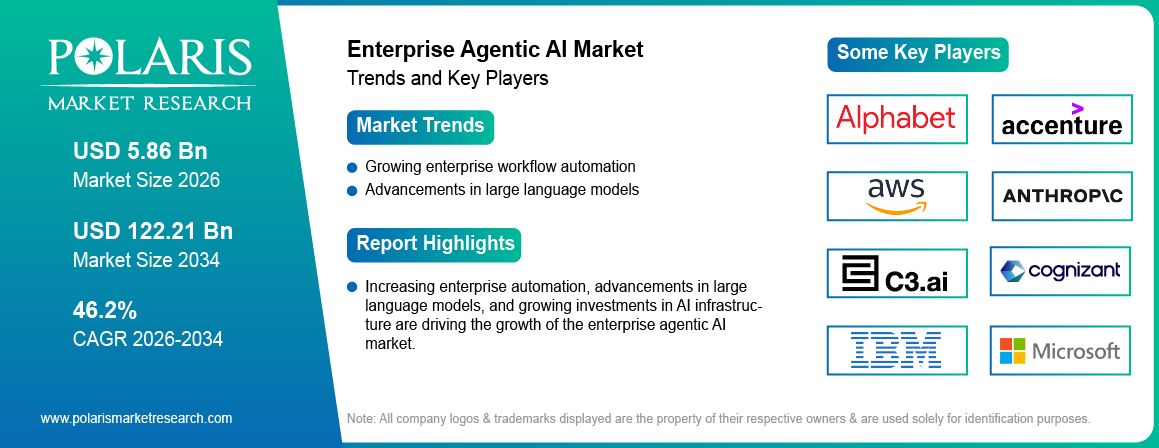
The increasing adoption of enterprise agentic AI across organizations to automate processes, improve operational efficiency, and reduce manual workload is driving market growth. Tasks such as customer service, process automation, software development, and document management are being done by AI agents with little human assistance. Digital transformation has continued to see investments that increase enterprise agentic AI implementation. In March 2025, the investment worth USD 1.50 billion was contributed by the European Commission via the Digital Europe program for supporting enterprise AI, cybersecurity, and digital literacy in Europe (Source: digital-strategy.ec.europa.eu ).
Driver: Advancements in Large Language Models Reshaping the Market
The advancements in large language models, reasoning, and agent orchestration tools have increased the efficiency of enterprise AI agents. Today's AI agents are able to understand the context of the business environment, interact with the enterprise applications and perform complex workflows better than before. In April 2025, Google launched new capabilities of the Agentspace that enable organizations to develop and deploy AI agents efficiently through business workflows (Source: google.com). Such innovations are enabling companies to implement AI across various business functions.
Restraint: Data Security and Governance Challenges
AI agents for enterprises need to access sensitive information of the organizations, which raises issues of cybersecurity, compliance, and privacy. It is essential for organizations to put in place a robust governance structure and access and monitoring mechanisms before using AI agents autonomously. This can be a hindrance to their adoption in regulated sectors.
Opportunity: Growing Adoption of Multi-Agent Enterprise Systems
Businesses are now making use of several AI agents, which work together to complete the tasks required in the business workflow. The use of multi-agent systems enhances the ability of task specialization, workflow efficiency, and scalability in businesses. In March 2025, Amazon Bedrock made multi-agent collaboration available, allowing organizations to create and manage customized AI agents for complex business processes (Source: aws.amazon.com). Growing investments by leading technology companies in agent orchestration platforms are expected to create significant opportunities during the forecast period.
Source: Polaris Market Research Analysis
Market Segment Analysis
The report provides a comprehensive analysis of the enterprise agentic AI market by component, deployment, agent architecture, application, organization size, and industry to identify key revenue-generating and high-growth segments.
Technology Insights
Machine learning is considered the most dominant technological segment in the enterprise agentic AI market with an estimated market size of USD 1.9 billion in 2025. This growth is majorly because agentic technologies employ machine learning algorithms to analyze large datasets and perform various processes such as pattern recognition and decision-making. The technology allows the AI agents to adapt to different inputs and help in carrying out tasks autonomously. Since machine learning involves learning from both historical and live data, it becomes applicable in workflow automation and intelligent process management.
Deep learning is expected to see the highest growth rate of more than 44% throughout the forecast period owing to the ability of AI agents to learn from interactions with the environment and take better decisions according to the results obtained. The rising need for self-decision, adaptive behaviors, and step-wise task completion is making deep learning more relevant in the development of agentic applications using AI. This technology provides the ability of the agent to constantly improve strategies in response to changing environments and hence is useful in complicated situations demanding autonomy and sequential decision-making.
Component Insights
The solutions segment dominated the market with an estimated market size of USD 2.43 billion in 2025, due to increasing adoption of enterprise AI platforms, agent orchestration software, and workflow automation tools. Enterprises are allocating resources towards AI technologies for automating monotonous processes, increasing efficiency and expediting business decisions. Rising adoption in areas such as finance, customer support, and IT processes has added weightage to the segment’s market position. In June 2025, Salesforce came up with Agentforce 3 that would assist enterprises in developing and scaling AI agents with greater governance and interoperability (Source: salesforce.com )
The services segment is expected to grow at the fastest CAGR of 46.6% during the forecast period due to increasing demand for AI consultation, system integration, implementation, training, and managed services, which is encouraging companies to look out for expert advice for deploying AI on a large scale. Service providers are also helping organizations optimize AI governance and improve deployment efficiency.
Deployment Insights
The cloud segment dominated the market with more than 55% share in 2025 due to its scalability, reduced infrastructure costs, and quick deployment. The cloud deployment allows companies to leverage advanced AI models, enterprise data, and computational capabilities without making any capital investments.
The hybrid segment is projected to grow at the fastest CAGR during the forecast period. Businesses have been moving towards hybrid deployment strategies that combine the benefits of cloud flexibility with the security of the on-premises data. In June 2026, Lenovo extended its Hybrid AI Advantage product line to offer agentic AI and inferencing solutions that enable businesses to use AI agents at reduced costs and greater speed (Source: lenovo.com). This deployment strategy allows businesses to stay compliant with regulations while remaining flexible.
Agent Architecture Insights
Single agent systems led the market with the market size of USD 2.18 billion in 2025, owing to their easy deployment, reduced cost of implementation, and applicability to automation of specific tasks. Many companies still prefer implementing single AI agents for purposes of customer service, document management, and automation of workflows within their respective departments.
The multi-agent segment is estimated to exhibit the highest CAGR of 46.5% over the forecast period. Multi-agent technology makes it possible for multiple AI agents to work together in order to solve complex business processes, thus making the process specialized, efficient, and accurate. Rising investment in agent orchestration tools is driving their adoption in large companies.
Application Insights
The customer service & virtual assistance application held the largest share of 24.81% of the market in 2025 due to growing usage of AI agents for customer service, ticketing, and conversation assistance. Enterprises are using intelligent virtual agents to cut down their cost, reduce response time, and improve the customer experience.
The IT operations and software development segment is projected to grow at the fastest CAGR of more than 46.7% during the forecast period. AI agents are being deployed in organizations for software testing, code generation, incident management, infrastructure monitoring, and cybersecurity. Rising demand for intelligent DevOps solutions is driving segment growth.
Organization Size Insights
The large enterprises sector led the market with the market size of USD 2.89 billion in 2025 due to higher investments in IT, existing digital infrastructure, and larger investment capabilities. The large enterprises are swiftly implementing enterprise AI agents to automate workflows in various departments as well as to enhance operational efficiency.
The small and medium-sized enterprises (SMEs) segment is projected to grow at the fastest CAGR of 46.6% during the forecast period. Growing availability of cloud-based AI platforms and subscription pricing models is enabling SMEs to adopt enterprise AI solutions with lower upfront investment. Increasing digital transformation initiatives are further supporting market growth.
Industry Insights
The BFSI segment dominated the market during 2025 with an estimated market size of USD 1.01 billion. This was majorly due to the rising adoption of AI agents for fraud detection, customer interaction, loan process, compliance, and financial analytics. The companies are using autonomous AI to enhance their performance and comply with regulatory requirements.
The healthcare segment is expected to witness the highest CAGR of more than 47% during the forecast period. There is an increasing use of enterprise AI agents for documentation, engagement, automation, and process improvement by healthcare enterprises. Increasing investments in digital healthcare technologies have been driving the adoption of enterprise AI solutions across the healthcare industry.
Market Segment Performance Summary
| Segment | Category | 2025 Status | Forecast CAGR | Key Driver |
| Solutions | Component | Largest Share | High | Enterprise AI platform adoption |
| Services | Component | Fastest Growing | Highest | AI consulting and integration |
| Cloud | Deployment | Largest Share | High | Cloud infrastructure expansion |
| Hybrid | Deployment | Fastest Growing | Highest | Data security and compliance |
| Single-Agent | Agent Architecture | Largest Share | Moderate | Task-specific automation |
| Multi-Agent | Agent Architecture | Fastest Growing | Highest | Complex workflow automation |
| BFSI | Industry | Largest Share | High | Financial process automation |
| Healthcare | Industry | Fastest Growing | Highest | Digital healthcare transformation |
Source: Polaris Market Research Analysis. Segment share and CAGR reflect Polaris proprietary sizing methodology.
Source: Polaris Market Research Analysis
Regional Insights
North America Enterprise Agentic AI Market Trends
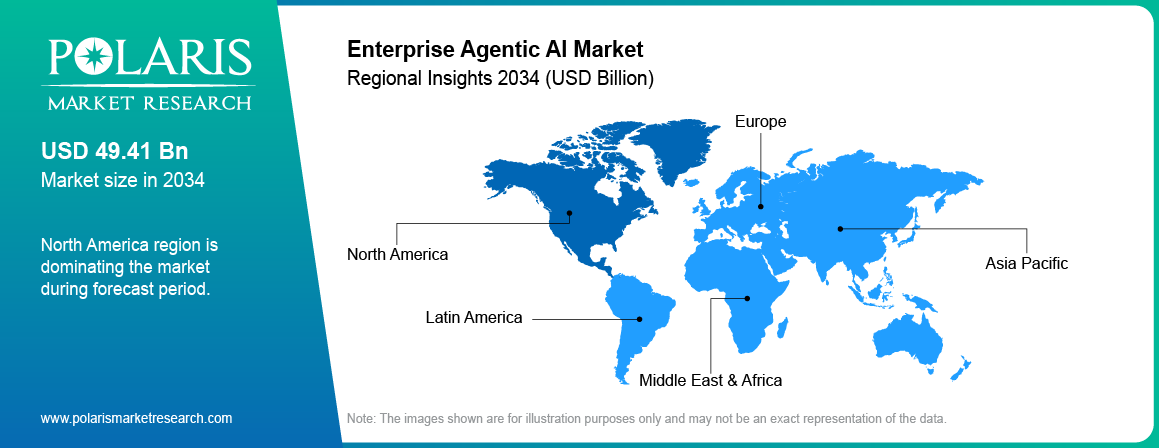
North America accounted for the largest market share of 40.16% in the enterprise agentic AI market in 2025 owing to large investments in artificial intelligence, cloud computing, and the presence of major technology players. CIBC launched Canada's first enterprise agentic AI workspace in July 2026 to automate processes and improve productivity at its banks (Source: cibc.com). The US dominates the regional markets owing to increasing deployment of AI agents in the financial, healthcare, manufacturing, and IT sectors.
Europe Enterprise Agentic AI Market Trends
Europe's enterprise agentic AI market was valued at USD 1.17 billion in 2025. This was due to the growing adoption of enterprise AI and regulatory frameworks. Some countries like Germany, the UK, and France are concentrating on enterprise automation and ethical AI adoption. In June 2026, Cognizant established the EMEA AI Unit that is expected to assist enterprises in deploying agentic AI solutions (Source: cognizant.com). Growing demand for secure and compliant AI solutions is supporting regional market growth.
Asia Pacific Enterprise Agentic AI Market Trends
Asia Pacific is projected to grow at the fastest CAGR of 46.9% during the forecast period due to rapid digital transformation and increasing enterprise AI investments. There is an increasing trend towards AI-driven business automation in countries like China, Japan, India, South Korea, and Singapore. In June 2026, Hyland announced an expansion of its partnership with AWS to make its Content Innovation Cloud available in the Asia Pacific region, deploying enterprise agentic AI closer to customer data (Source: hyland.com).
Latin America Enterprise Agentic AI Market Trends
Latin America is experiencing consistent growth with a CAGR of 43.8% owing to increasing cloud adoption and digitalization of enterprises. Brazil and Mexico are leading in the regional market owing to increasing investment in intelligent customer engagement, financial automation, and modernization of enterprise software. Expanding cloud infrastructure is creating new opportunities for AI platform providers.
Middle East & Africa Enterprise Agentic AI Market Trends
The Middle East & Africa market is expected to grow steadily during the forecast period due to increasing investments in digital transformation and smart government initiatives. Saudi Arabia, the UAE, and South Africa are implementing enterprise AI solutions in order to boost efficiency within the banking, healthcare, energy, and government sectors.
Cross-Regional Procurement Outlook
Cross-regional competition in the enterprise agentic AI market extends beyond model performance. Enterprises evaluate vendors based on data residency, regulatory compliance, credential management, log retention, regional availability of AI models and tools, and incident response capabilities. Consequently, vendors are differentiating themselves through localized deployment, compliance engineering, managed services, and vertical AI, giving them an edge in regional procurement.
Source: Polaris Market Research Analysis
Regulatory Scenario
| Country | Policy Environment | Key Regulations | Market Implication | Trend |
| US | Favorable | NIST AI Risk Management Framework | Encourages responsible AI deployment | Expanding |
| Canada | Developing | Federal AI initiatives | Promotes enterprise AI adoption | Developing |
| Germany | Favorable | EU AI Act | Supports responsible enterprise AI | Expanding |
| UK | Developing | AI governance framework | Encourages enterprise innovation | Stable |
| China | Favorable | National AI Development Plan | Accelerates AI commercialization | Expanding |
| Japan | Favorable | AI Governance Guidelines | Supports enterprise automation | Growing |
| India | Developing | IndiaAI Mission | Encourages AI ecosystem development | Expanding |
| Singapore | Favorable | Model AI Governance Framework | Supports trusted AI adoption | Growing |
Source: NIST, Government of Canada, European Commission, Gov UK, National Development and Reform Commission, METI, IndiaAI, IMDA
Enterprise Agentic AI Market Competitive Landscape
There is moderate fragmentation in the enterprise agentic AI market as there is competition between global technology companies, cloud service providers, enterprise software providers, and AI platform vendors. Leading organizations leverage AI by providing state of the art AI reasoning capabilities, secure deployment models, scalable cloud services, and industry focused AI solutions. Vendors are also emphasizing governance, interoperability, and compliance functionality to cater to the growing demands of the enterprise.
Strategic alliances, mergers & acquisitions, and constant product innovations continue to be the key strategies used in the market. The organizations are making AI ecosystems using strategic associations with cloud computing companies, cybersecurity organizations, and enterprise software firms while focusing on developing capabilities of agent orchestration, multi-agent collaboration, and enterprise AI platforms to create a stronger position for themselves and increase their customer base across the globe.
Competitive Landscape Snapshot
| Company | Est. Market Position | Primary Focus | Geographic Focus | In Report |
| Microsoft | Top Tier | Enterprise AI Platform | Global | Microsoft |
| Amazon Web Services | Top Tier | AI Infrastructure | Global | Amazon Web Services |
| C3 AI | Top Tier | Enterprise AI Solutions | Global | C3 AI |
| OpenAI | Leading Innovator | Foundation Models | Global | OpenAI |
| Salesforce | Market Leader | CRM AI Agents | Global | Salesforce |
| IBM | Strong Player | AI Governance | Global | IBM |
| SAP | Major Enterprise Vendor | Business AI | Global | SAP |
Source: Company filings and press release
Enterprise Agentic AI Market Technology and Innovation Landscape
Enterprise agentic AI technology continues to advance with innovations in autonomous reasoning, multi-agent collaboration, enterprise orchestration, and AI governance. The organizations are increasingly using AI agents that can plan, perform, and coordinate complex business activities with minimum human interference. There have been advances in large language models, retrieval-augmented generation, and workflow automation capabilities of enterprise AI.
AI technology companies have been putting immense effort into developing technologies like AI deployment, AI models monitoring, AI identity management, and AI governance for responsible use of artificial intelligence. Technologies like hybrid cloud AI deployment, AI observability, runtime security, and enterprise orchestration tools are supporting organizations to implement agentic AI solutions while being compliant with regulations and security requirements.
Technology and Innovation Landscape Snapshot
| Technology | Adoption Stage | Key Development | Market Impact |
| Agent Orchestration | Growing | Workflow automation platforms | Improves operational efficiency |
| Multi-Agent Systems | Early Commercial | Collaborative AI agents | Supports complex workflows |
| AI Governance | Mainstream | Compliance and monitoring tools | Enhances enterprise trust |
| Enterprise AI Security | Growing | Identity and access management | Improves data protection |
| AI Agent Observability | Early Commercial | Agent performance monitoring | Optimizes AI operations |
| Model Context Protocol | Early Commercial | Standardized communication | Improves interoperability |
| Human-in-the-loop | Mainstream | Human oversight | Supports compliance |
Source: Polaris Market Research Analysis, press release, and IP & patent filings
Who Buys Enterprise Agentic AI Market Research and Why?
Market research for enterprise agentic AI helps businesses evaluate market opportunities, technology adoption, and competitive positioning to support decisions on implementing artificial intelligence solutions. Market research offers detailed data about market size, growth drivers, regional demand, competition, and technology which makes it easy to make decisions.
Market research is very valuable for technology vendors, cloud service providers, enterprise software providers, investors, consulting organizations, system integration firms, and corporate management teams. Market research helps in identifying the high growth segments, evaluating customer demand in different industries, competitive analysis, regional opportunities, and long-term product development and market expansion strategies.
| Buyer / Investor Type | Primary Use Case | Key Insight Sought | Decision Horizon |
| Corporate Strategy Teams | Market expansion | Growth opportunities | 2–5 Years |
| Technology Providers | Product development | Technology trends | 1–3 Years |
| Private Equity & Venture Capital | Investment analysis | Market attractiveness | 3–7 Years |
| Enterprise CIOs | Vendor evaluation | Platform capabilities | 1–3 Years |
| System Integrators | Service expansion | Enterprise adoption trends | 2–5 Years |
Source: Polaris Market Research Analysis
What are the Barriers to Entering the Enterprise Agentic AI Market?
Privacy Issues and Regulations
Since enterprise agentic AI systems work with confidential business and client data, compliance with data privacy regulations such as GDPR, HIPAA, and regional data protection laws is required. This raises deployment complexity for market newcomers.
High Development Costs
Development of enterprise-level agentic AI solutions demands substantial investments in the development of foundational models, cloud computing resources, AI training, cybersecurity measures, and ongoing model optimization. High development costs represent a significant obstacle for startup firms and vendors.
Integration Complexity
Enterprises have aging IT infrastructure, which makes it difficult to incorporate AI agents into enterprise applications and databases. Seamless interoperability calls for extensive tailoring and technological know-how.
Shortage of AI Professionals
Availability of trained AI engineers, machine learning experts, data scientists, and AI governance personnel is a constraint on the creation and implementation of products. Competition for quality manpower adds to the cost of recruiting.
Concerns Related to Security and Reliability:
Organizations need their AI agents to be secure, accurate, and reliable before deploying them in critical environments. Concerns over cybersecurity threats, hallucinations, unauthorized actions, and operational reliability increase testing, validation, and governance requirements for vendors.
Premium Insights and Forward Outlook
Enterprise AI Becomes Business Operations Platform
Enterprise AI technology is rapidly moving away from being simple productivity helpers to becoming fully-fledged business execution systems. Companies are now relying more on deploying AI agents to perform entire business processes rather than individual tasks. It is expected to have a huge impact on the adoption of enterprise software in coming years.
Multi-Agent Collaboration Drives Future Growth
Organizations are evolving towards collaborative AI ecosystems where various specialized agents collaborate with each other across different departments. This enhances efficiency, scalability, and business productivity of an organization while minimizing manual intervention.
Cost and Pricing Benchmarking Analysis Snapshot
| Product | Est. Price Range | Key Cost Driver | Complexity Tier |
| Cloud Deployment | USD 50,000–250,000 | Subscription and usage | Medium |
| Hybrid Deployment | USD 150,000–700,000 | Infrastructure integration | High |
| Enterprise AI Platform | USD 250,000–1 Million+ | Custom implementation | High |
| Managed AI Services | Project Based | Consulting and support | Medium |
Source: Polaris Market Research Analysis, public pricing sources, and company filings
Key Players in the Enterprise Agentic AI Market
- Alphabet Inc.
- Amazon Web Services, Inc.
- Accenture plc
- Anthropic PBC
- C3.ai, Inc.
- Cognizant Technology Solutions Corporation
- IBM
- Microsoft Corporation
- NVIDIA Corporation
- OpenAI, Inc.
- Oracle Corporation
- Palantir Technologies Inc.
- Salesforce, Inc.
- SAP SE
- ServiceNow, Inc.
- UiPath Inc.
Enterprise Agentic AI Market Industry Developments
- August 13, 2026: IBM announced a strategic partnership with OpenAI to embed frontier models including GPT-5.6, Codex, and ChatGPT Work into IBM Consulting Advantage, targeting enterprise deployments in financial services, government, telecommunications, and retail. (Source: ibm.com)
- August 3, 2026: Cyera released Agent Guardian for improving security and governance of autonomous AI agents within enterprises. (Source: businesswire.com)
- July 28, 2026: Cognizant established its EMEA AI Unit to help enterprises scale agentic AI adoption across the region. (Source:cognizant.com)
- July 14, 2026: AT&T adopted H2O AI Super Agent to expedite agentic AI for enterprise customer service, fraud prevention, and business processes through autonomous AI workflows. (Source:businesswire.com)
- June 2026: HiddenLayer joined the Databricks Unity AI Gateway ecosystem to bring AI-native security to enterprise AI workloads. (Source:prnewswire.com)
- May 6, 2026: ServiceNow and Accenture launched a Forward Deployed Engineering program, giving joint clients access to more than 300 pre-built AI agent skills to move agentic AI from pilot to production. (Source: accenture.com)
- May 2026: eGain launched Agentic Studio with multi-agent orchestration to help businesses automate customer service processes through AI agents. (Source: egain.com)
Global Enterprise Agentic AI Market Report Segmentation
By Technology Outlook (Revenue, USD Million, 2021–2034)
- Machine Learning
- Natural Language Processing (NLP)
- Deep Learning
- Computer Vision
- Others
By Component Outlook (Revenue, USD Million, 2021–2034)
- Solutions
- Services
By Deployment Outlook (Revenue, USD Million, 2021–2034)
- Cloud
- On-Premises
- Hybrid
By Agent Architecture Outlook (Revenue, USD Million, 2021–2034)
- Single-Agent
- Multi-Agent
By Application Outlook (Revenue, USD Million, 2021–2034)
- Customer Service & Virtual Assistance
- IT Operations & Software Development
- Sales & Marketing
- Human Resource Management
- Finance & Accounting
- Supply Chain Management
- Others
By Organization Size Outlook (Revenue, USD Million, 2021–2034)
- Large Enterprises
- Small & Medium Enterprises (SMEs)
By Industry Outlook (Revenue, USD Million, 2021–2034)
- BFSI
- Healthcare
- Retail & E-commerce
- Manufacturing
- IT & Telecommunications
- Government
- Energy & Utilities
- Others
By Regional Outlook (Revenue, USD Billion, 2021-2034)
- North America
- US
- Canada
- Europe
- Germany
- France
- UK
- Italy
- Spain
- Netherlands
- Russia
- Rest of Europe
- Asia Pacific
- China
- Japan
- India
- Malaysia
- South Korea
- Indonesia
- Australia
- Vietnam
- Rest of Asia Pacific
- Middle East & Africa
- Saudi Arabia
- UAE
- Israel
- South Africa
- Rest of Middle East & Africa
- Latin America
- Mexico
- Brazil
- Argentina
- Rest of Latin America
Report Scope
| Report Attributes | Details |
| Market Size in 2025 | USD 4.02 Billion |
| Market Size in 2026 | USD 5.86 Billion |
| Revenue Forecast by 2034 | USD 122.21 Billion |
| CAGR | 46.2% from 2026 to 2034 |
| Base Year | 2025 |
| Historical Data | 2021–2024 |
| Forecast Period | 2026–2034 |
| Quantitative Units | Revenue in USD Billion and CAGR from 2026 to 2034 |
| Report Coverage | Revenue Forecast, Competitive Landscape, Growth Factors, and Industry Trends |
| Segments Covered |
|
| Regional Scope |
|
| Competitive Landscape |
|
| Report Format |
|
| Customization | Report customization as per your requirements with respect to countries, regions, and segmentation. |
Enterprise Agentic AI Market – Research Methodology Overview
We built this study on a mix of primary interviews and secondary desk research, cross-checked against each other to make sure the numbers hold up. On the secondary side, we tracked vendor product launches, enterprise AI spending disclosures, and regulatory filings like the NIST AI Risk Management Framework and the EU AI Act to understand where the market stands today and where the rules are headed. On the primary side, we spoke with enterprise CIOs, platform vendors, and systems integrators directly, since public announcements only tell part of the story, actual deployment decisions and budget allocations tell the rest.
Market sizing used both top-down and bottom-up methods. We estimated the total addressable spend and then built it back up from vendor revenues and reported enterprise deployments across each segment, component, deployment mode, agent architecture, application, organization size, industry, and region, so the two approaches could check each other. Forecasts factored in how fast foundation models and orchestration platforms are maturing, how enterprise AI governance requirements are evolving, and where vendor investment is actually flowing, not just where it's announced. Every figure went through a final consistency pass across segments before it made it into the report.
| Research Phase | Key Activities | Data Sources | Purpose |
| Secondary research | Review of vendor announcements, investment disclosures, and regulatory publications | Industry associations, vendor filings, government agencies | Establish market fundamentals and technology trends |
| Primary research | Interviews with enterprise CIOs, AI vendors, and systems integrators | Industry executives and enterprise stakeholders | Validate adoption patterns and buying behavior |
| Market sizing | Top-down and bottom-up estimation with data triangulation | Vendor revenues, deployment data, enterprise spending | Estimate market size and segment share |
| Forecasting | Assessment of technology, governance, and investment trends | Platform maturity signals, regulatory developments | Develop long-term market forecast |
| Data validation | Cross-verification of quantitative and qualitative findings | Primary interviews and secondary sources | Improve accuracy and consistency |
Source: Polaris Market Research Analysis
Enterprise Agentic AI Market FAQ's
The global market size was valued at USD 5.86 Billion in 2026 and is projected to grow to USD 122.21 Billion by 2034 at a CAGR of 46.2% from 2026 till 2034.
Enterprises are investing in agentic AI to automate workflows, improve productivity, and reduce operational costs.
North America dominated the market in 2025 due to strong AI investments, advanced cloud infrastructure, and the presence of leading technology companies.
Agentic AI can independently plan and execute business tasks, while chatbots mainly provide conversational responses.
Major companies include Microsoft Corporation, Amazon Web Services, Alphabet Inc., OpenAI, C3 AI, Salesforce, IBM Corporation, SAP SE, Oracle Corporation, NVIDIA Corporation, ServiceNow, UiPath, Anthropic, and Cognizant.
Yes, multi-agent systems are increasingly being deployed for enterprise workflow automation.
The NIST AI Risk Management Framework and the EU AI Act are key regulations influencing enterprise AI adoption.
The multi-agent architecture segment is projected to grow at the fastest CAGR during the forecast period.
The cloud segment dominated the market with more than 55% share in 2025, driven by its scalability, reduced infrastructure costs, and rapid deployment capabilities.
Key barriers include data privacy and regulatory compliance requirements, high development costs for foundational models and infrastructure, integration complexity with legacy enterprise systems, a shortage of skilled AI professionals, and the need for extensive security and reliability testing before deployment.
Recent developments include IBM's August 2026 strategic partnership with OpenAI to embed GPT-5.6 into IBM Consulting Advantage, Cyera's Agent Guardian for AI agent security, and ServiceNow and Accenture's Forward Deployed Engineering program for scaling agentic AI deployments.
Download Sample Report of Enterprise Agentic AI Market
Please fill out the form to request a customized copy of the research report.


