
Intelligent Document Processing Market Share, Size, Trends, Industry Analysis Report, 2026 - 2034
REPORT DETAILS
Intelligent Document Processing Market Summary
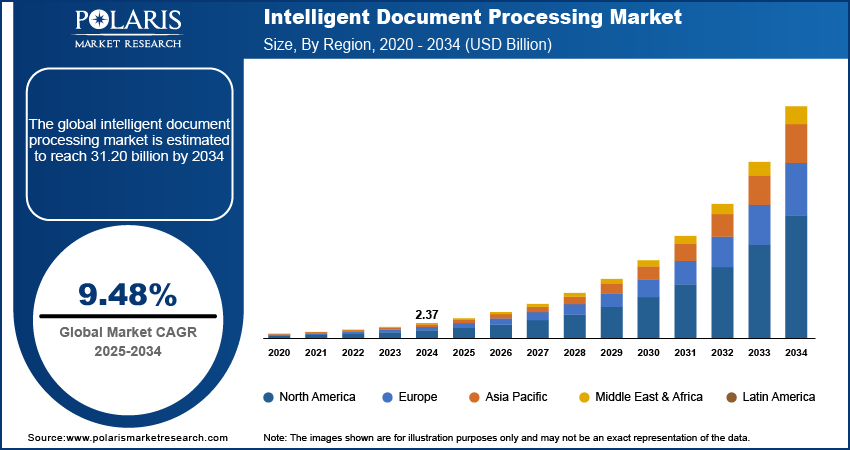
The intelligent document processing market size was valued at USD 3.09 billion in 2025. The IDP market CAGR is projected to expand at 29.6% from 2026 to 2034. This growth is driven by rising spending on digital transformation and the need to process documents faster and more cost-effectively. Most businesses are evaluating document AI vs IDP to choose the right solution. In general, an IDP is a technology that automates the extraction and processing of data from documents.
Market Statistics
Key Takeaways
- North America led with a 47.6% revenue share in 2025. This is due to the rapid adoption of AI, ML, NLP, and computer vision techniques.
- The Europe intelligent document processing market is expected to experience strong growth at a 33.6% CAGR, as banks are adopting IDP for KYC onboarding automation and other activities.
- The healthcare document automation segment led with a 34.2% revenue share in 2025. This is due to numerous organizations in the life sciences industry focusing on improving the efficiency and management of healthcare documents.
- The RPA and IDP category is projected to expand significantly at a 33.0% CAGR. This is owing to growing reliance on straight-through processing and intelligent document processing.
- The cloud-based deployment accounted for a 75.0% revenue share in 2025. The scalability and lower upfront costs of cloud solutions contribute to the segment’s dominance.
Note: Figures and projections outlined in this report are the result of Polaris Market Research’s proprietary analytical processes, grounded in the latest available datasets and market observations.
Industry Dynamics
- Rising investments in digital transformation have increased demand for IDP to automate the processing of vast document archives as companies shift from paper-based to digital workflows.
- The growing need for efficient, cost-effective document processing solutions reduces operational costs, improves workflows, and delivers clear ROI.
- Processing unstructured or complex documents poses challenges because it requires custom solutions.
- The demand for AI tools to process unstructured data creates opportunities to automate extraction and classification.
AI Impact on Intelligent Document Processing Market
- AI is capable of automatically extracting data from documents, minimizing the chances of errors.
- It increases accuracy by enabling the extraction of important details from invoices, forms, and other reports.
- AI processes a huge number of documents much faster than manual methods.
- It gives deeper insights through analysis of data from various documents
Source: Polaris Market Research Analysis
What does Current Market Landscape Look for Intelligent Document Processing Industry?
Intelligent Document Processing (IDP): IDP solutions extract semi-structured and unstructured data and convert it into useful information. Most business information feeds the digital transformation process. However, about 80% of this information is confined to emails, PDFs, images, and business documents. The intelligent document processing workflow: IDP automates tasks that are either impossible or hard to do. IDP uses AI technologies such as NLP, ML, and computer vision to classify, extract, and validate data. It is observed that IDP has better features compared to OCR. Also, when integrated with RPA, the process becomes fully automated. Companies can reduce expenses and accomplish their strategic objectives. Comparisons between Document AI and IDP indicate that IDP offers better overall workflow automation. IDP solutions find great applications in invoice processing automation, claims processing automation, and KYC document automation.
Document processing is common in most organizations, and the department has handled it for many years. It involves converting documents into valuable data. Examples of document processing include invoices and accounts payable (AP), claims, KYC onboarding, bills of lading, and clinical/regulatory submissions. All such high-volume processes are repetitive, time-consuming, and frustrating. IDP helps in automating such processes.
IDP vs OCR, IDP vs RPA, Document AI vs IDP
| Comparison | Key Differences | Primary Use Cases | Automation Level | Human Dependency |
| IDP vs OCR | OCR only extracts text; IDP automates extraction, classification, and validation | Digitizing invoices, receipts, forms; end-to-end workflows | IDP: High, OCR: Low | IDP: Low, OCR: High |
| IDP vs RPA | RPA automates repetitive tasks; IDP processes and structures unstructured data | Invoice/AP automation, claims processing, KYC onboarding | IDP: High, RPA: Medium | IDP: Low, RPA: Medium |
| Document AI vs IDP | Document AI focuses on data extraction and insights; IDP adds workflow automation | Data extraction, regulatory submissions, document validation | IDP: High, Document AI: Medium | IDP: Low, Document AI: Medium |
Source: Polaris Market Research Analysis
The amount of data generated by businesses is increasing exponentially, which is the main driver of the intelligent document processing market. With the explosion of digital transformation, enterprises are generating data at an accelerated rate. Industry experts predict that global data will exceed 175 zettabytes by 2025. The majority of this data is only available in text, emails, PDFs, and scanned documents. The government sector, including banking, finance, healthcare, and education, has traditionally struggled to process documents manually.
However, the procedures become more efficient with the introduction of sophisticated document processing systems. Invoices, sales orders, and other semi-structured and unstructured documents that are frequently insufficiently processed by rules-based automation software are received in large quantities by organizations. As a result, intelligent document processing solutions have become increasingly important to businesses and are anticipated to experience rapid adoption during the anticipated timeframe.
However, international regulations governing document processing have tightened. Additionally, compliance standards are subject to periodic revision, which is anticipated to be a significant barrier for the market. The laws governing document and data processing frequently change, particularly in the US and Europe. The need to comply with these rules is anticipated to be a significant barrier for market participants in intelligent document processing.
Source: Polaris Market Research Analysis
Industry Dynamics
What are Factors Driving Expansion Opportunities?
The adoption of AI for document processing has received a major boost from advances in the field and the availability of no-code IDP solutions. Digitalization and digital transformation have become crucial for businesses to compete successfully in the market. Major market participants are now developing AI-based solutions, thereby propelling market growth. For instance, in March 2021, ABBYY announced the release of Vantage 2, a no-code solution that equips digital workers with cognitive capabilities to interpret and extract data from documents, thereby helping companies accelerate IDP time-to-value.
ABBYY Marketplace provides customers access to a vast collection of pre-built document models for tasks such as document classification and data extraction. These document models include process flows and connectors for invoices, receipts, customer orders, loan documents, insurance claims, and bills of lading. As procurement becomes even more strategic, many purchasing organizations today shortlist suppliers based on IDP supplier selection criteria such as document type support, language support, governance/audit capabilities, and integration readiness with their ERP, ECM, CRM, and RPA infrastructure. Integration of current IDP technologies with advanced AI technologies has become essential for such enterprises today.
Which Emerging Trends are Shaping Growth of Market?
Strong Focus on Multilingual and Cross-Region IDP
With the expansion of businesses worldwide, there has been increasing demand for IDP solutions that support multilingual documents and enable cross-region workflows. As a result, vendors are improving their platforms to support multiple languages, regional formats, and local compliance requirements. This encourages the use of IDPs in sectors such as BFSI, healthcare, and logistics, which often generate documents from various geographies and formats. Buyers increasingly prefer solutions with strong document-type coverage and seamless ERP/ECM/CRM integration.
What Challenges Could Limit Growth of IDP Market?
Regulatory and Compliance Challenges
The frequent changes to data governance and compliance rules, especially in the US and Europe, remain a significant barrier. Every organization needs to make sure that IDP solutions support audit, governance, and security standards. Usage in sensitive documents, such as KYC forms, healthcare submissions, and financial records, further raises the complexity of adaptation and delays adoption.
Segmental Insights
Technology Analysis
Which Segment by Technology is Expected to Witness Fastest Growth?
The segment of RPA is projected to grow at the highest CAGR of 33.0% over the forecast period, as intelligent automation requires accurate, usable data. There is a limitation to mere automation when the data is missing or unstructured. Most business processes still rely on manual inputs, whereas IDP enables touchless processing by extracting and structuring data at scale. By integrating with RPA, IDP will enable the organization to increase its STP rate and achieve complete operational automation.
| Technology | Simple Explanation | Main Purpose | Common Applications |
| Natural Language Processing (NLP) | Helps computers understand text. | Understand document content. | Emails, simple text files |
| Optical Character Recognition (OCR) | Reads text from images or scans. | Turn images into text. | Scanned papers, PDFs |
| Machine Learning (ML) | Learns from data. | Improve accuracy over time. | Sorting documents |
| Artificial Intelligence (AI) | Makes computers act smart. | Automate tasks. | Smart document tools |
| Robotic Process Automation (RPA) | Does repetitive tasks automatically. | Save time and effort. | Data entry tasks |
| Google Vision | Reads information from images. | Extract text from images. | ID scans, photos |
| Deep Learning (DL) | Handles complex data. | Understand difficult documents. | Handwritten text |
Source: Polaris Market Research Analysis
In their own right, IDP and RPA are a powerful enterprise automation stack. However, better results are often achieved by combining IDP with BPM, case management, and ECM systems. An IDP + BPM or IDP + ECM approach provides better governance, auditability, and exception handling than automations developed solely in RPA. This broader integration ecosystem allows new automation opportunities across industries to be explored and provides a strong revenue opportunity for IDP solution providers.
Source: Polaris Market Research Analysis
End Use Analysis
Why Healthcare and Life Sciences Segment Held the Largest Share?
The healthcare document automation industry held the largest market share of 34.2% in 2025, primarily due to life science companies' interest in improved efficiency and better process control. The increasing demand for accurate, rapid information processing is emerging in regulatory information management (RIM). The company IDP is also working to make document-intensive operations, such as pharmacovigilance and prior authorization automation, more efficient. However, they also ensure an audit trail.
In the insurance industry, insurance claims automation has accelerated with RPA and IDP, reducing manual processing and improving the work of customer service advisors. This is attributed to faster claims processing and improved service delivery during the pandemic, when insurance companies focused on improving their claims processing and customer service. Apart from the healthcare and insurance industries, other public-use areas, such as smart cities, also use IDP to transform manual processes, such as invoice handling.
Regional Analysis
What are the Factors for the North America Region's Domination?
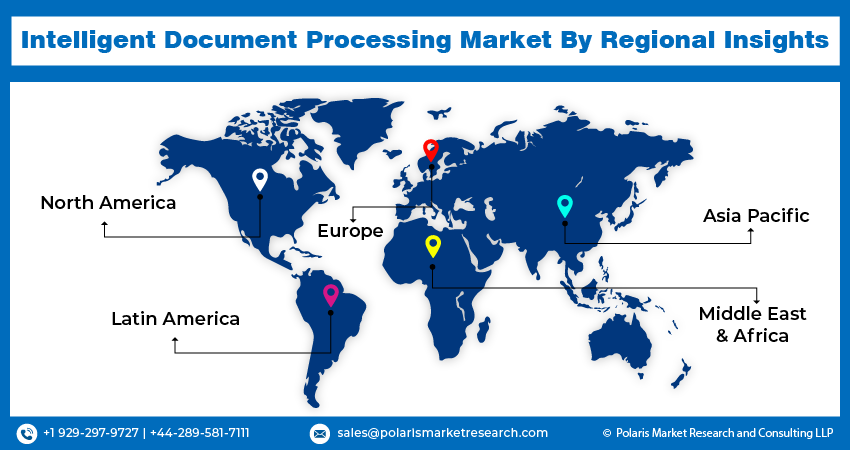
The North America intelligent document processing market had the largest market share of 47.6% in 2025, and it is expected to grow at the highest rate during the forecast period. North American corporations are embracing innovative technologies like AI, machine learning, NLP, and computer vision. Additionally, North American firms are pioneering innovations in AI, character recognition, and natural language processing. Leading corporations across the public sector, logistics and transportation, BFSI, and healthcare and life sciences are at the forefront of implementing Intelligent Document Processing solutions.
In addition, the demand for intelligent document processing from buyers in the North America intelligent document processing market is also driven by strong enterprise compliance initiatives. As a result, there is a growing need for audit-ready automation, and this is fueling the uptake of compliant IDP solutions.
Why Europe is Projected to Witness Substantial Growth?
The Europe intelligent document processing market is expected to grow at a CAGR of 33.6% during the forecast period, driven primarily by the BFSI industry segment. The rising demand for BFSI document automation and the consequent adoption of IDP solutions by banks for KYC onboarding and loan document processing are key drivers of market growth in Europe. The UK market accounts for the largest share in Europe, and significant investment is also being seen in Germany and France; however, adoption is rising in the Benelux and Nordic markets as well. Additionally, the stringent government regulations to safeguard consumer information are promoting IDP technology adoption in the market.
Source: Polaris Market Research Analysis
Competitive Landscape
The competitive landscape of the intelligent document processing market comprises existing intelligent document processing suppliers and IDP software suppliers experiencing rapid growth. The intelligent document processing market is shifting toward ability-based competition, moving beyond the limitations of price-based competition. Companies are now evaluating IDP platforms based on diverse factors, including language support, handwriting recognition, document types, and extraction accuracy, making IDP platform comparison an integral part of the enterprise buying decision process, particularly for large enterprise document automation projects.
Buyers are also using a clear checklist of items when they are evaluating their vendors. These include integration capabilities with ERP, ECM, and RPA systems. Governance and audit requirements are also high on their list. They want a vendor that can deploy their systems easily and whose pricing is transparent and tangible. Organisations are using a vendor capability matrix to compare their vendors on requirements such as invoice extraction, claim processing, KYC document processing, support for on-premises systems of regulated clients, and ECM system integration.
Some of the major players operating in the global market include:
- ABBYY Solutions,
- AntWorks,
- Automation Anywhere,
- Appian Corporation,
- Celaton, Datamatics Global,
- Deloitte Touche,
- HCL Technologies,
- IBM Corporation,
- Kodak Alaris,
- Kofax Corp.,
- OpenText Corp.,
- UiPath Inc.,
- WorkFusion.
Future of IDP Market
The IDP market is likely to experience rapid growth, driven by the increased usage of artificial intelligence and generative AI technology. Companies are increasingly using automation for processing unstructured data. There will be increased adoption of cloud IDP software solutions because of their scalability and flexibility. The real-time IDP capability is expected to play an important role in the industry.
Intelligent Document Processing Recent Developments
- January 2026: ABBYY announced the launch of Vantage 3.0. The company stated that the document AI platform offers direct integration with LLMs. ABBYY Vantage bridges the reliability gap between Generative AI and traditional AI. It increases trustworthiness and explainability of data output. (source: abbyy.com)
- February 2026: UiPath released UiPath Document Understanding 2026.2. This version includes native Gemini 1.5 Pro integration. According to UiPath, it allows zero-shot extraction on custom document types. (source: uipath.com)
- June 2025: Hyland launched a next-generation intelligent document processing offering targeted at IDP workflow automation. The product leverages AI-based and semantic document processing capabilities for end-to-end business automation. It enables more intelligent, context-aware processes. (Source: hyland.com)
- July 2024: A partnership between Reveille Software and ABBYY brought improvements in IDP through the area of monitoring and observability. The combined offering provides advantages such as touchless processing, fast onboarding, reduced operational expenses, and enhanced visibility into documents and system activity. (Source: documentmedia.com)
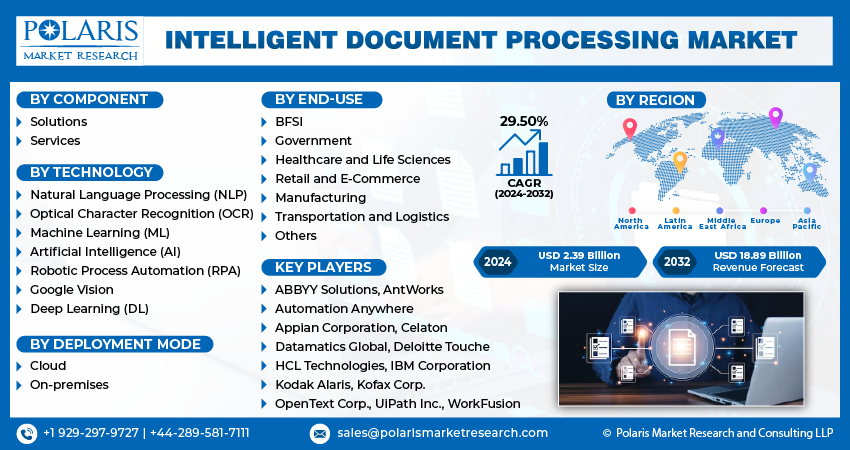
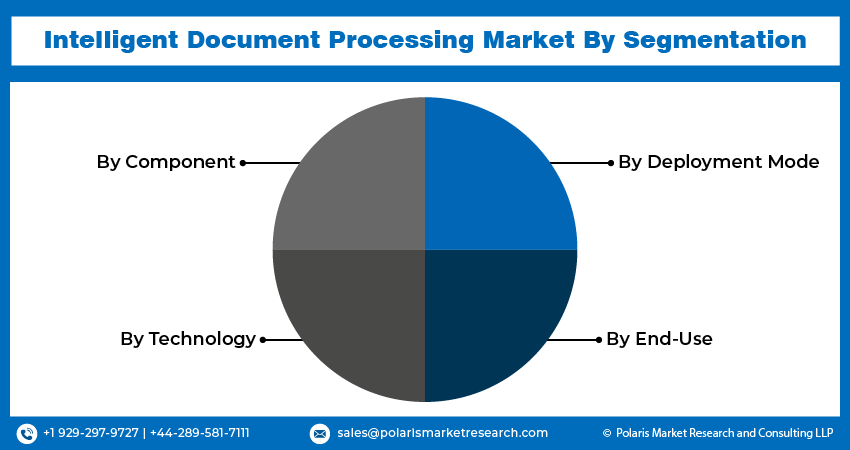
Intelligent Document Processing Market Segmentation
By Component Outlook (Revenue – USD Billion, 2021–2034)
- Solutions
- Services
By Technology Outlook (Revenue – USD Billion, 2021–2034)
- Natural Language Processing (NLP)
- Optical Character Recognition (OCR)
- Machine Learning (ML)
- Artificial Intelligence (AI)
- Robotic Process Automation (RPA)
- Google Vision
- Deep Learning (DL)
By Deployment Mode Outlook (Revenue – USD Billion, 2021–2034)
- Cloud
- On-premises
By Organization Size Outlook (Revenue – USD Billion, 2021–2034)
- Small and Medium Sized Enterprises (SMEs)
- Large Size Enterprises
By End-Use Outlook (Revenue – USD Billion, 2021–2034)
- BFSI
- Government
- Healthcare and Life Sciences
- Retail and E-Commerce
- Manufacturing
- Transportation and Logistics
- Others
By Regional Outlook (Revenue-USD Billion, 2021–2034)
- North America
- US
- Canada
- Mexico
- Europe
- Germany
- France
- UK
- Italy
- Spain
- Netherlands
- Russia
- Rest of Europe
- Asia Pacific
- China
- Japan
- India
- Malaysia
- South Korea
- Indonesia
- Australia
- Vietnam
- Rest of Asia Pacific
- Middle East & Africa
- Saudi Arabia
- UAE
- Israel
- South Africa
- Rest of Middle East & Africa
- Latin America
- Brazil
- Argentina
- Rest of Latin America
Intelligent Document Processing Market Report Scope
| Report Attributes | Details |
| Market Size in 2025 | USD 3.09 Billion |
| Market Size in 2026 | USD 4.00 Billion |
| Revenue Forecast by 2034 | USD 31.83 Billion |
| CAGR | 29.6% from 2026 to 2034 |
| Base Year | 2025 |
| Historical Data | 2021–2024 |
| Forecast Period | 2026–2034 |
| Quantitative Units | Revenue in USD billion, 2021–2034, and CAGR from 2026 to 2034 |
| Report Coverage | Revenue Forecast, Market Competitive Landscape, Growth Factors, and Trends |
| Segments Covered |
|
| Regional Scope |
|
| Competitive Landscape |
|
| Report Format |
|
| Customization | Report customization as per your requirements with respect to countries, regions, and segmentation. |
Source: Polaris Market Research Analysis
Intelligent Document Processing Market FAQ's
Intelligent Document Processing employs AI, OCR, NLP, and machine learning to extract, classify, and verify data from unstructured documents, enabling automated processing of documents from start to finish.
The intelligent document processing market was estimated at USD 3.09 billion in 2025 and is expected to reach USD 31.83 billion in 2034, registering a CAGR of 29.6%.
BFSI, healthcare & life sciences, government, retail, manufacturing, and logistics are the sectors that benefit most from IDP. In this case, IDP technology has been utilized for commercial invoice processing, claims automation, and KYC.
While OCR does not, IDP introduces AI-based classification, validation, and automation, enabling higher accuracy, touchless processing, and RPA, BPM, and enterprise system interface capabilities.
The market is growing rapidly due to accelerating digital transformation, rising volumes of unstructured data, the need for cost-effective automation, and the widespread adoption of AI-based workflows.
Download Sample Report of Intelligent Document Processing Market
Please fill out the form to request a customized copy of the research report.


