
Physical AI Market Size, Share, and Forecast 2026 to 2034
REPORT DETAILS
Physical AI Market Summary
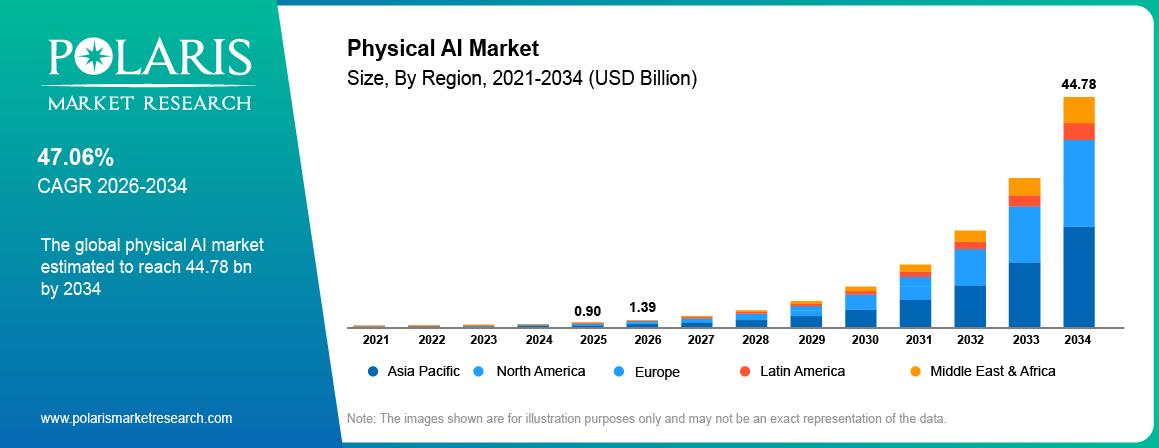
The global physical AI market was valued at USD 0.90 Billion in 2025. The market is expected to grow at a CAGR of 47.06% from 2026 to 2034. Growth is supported by increasing adoption of world foundation models, robot foundation models, simulation and digital twin platforms, and dedicated compute infrastructure that enable robots and autonomous machines to perceive, reason, plan, and act in physical environments.
Market Statistics
Key Takeaways
- North America accounted for 31.12% share of the Physical AI market in 2025, supported by major platform companies, robotics developers, AI infrastructure providers, and venture-funded Physical AI companies.
- Asia Pacific is projected to register a 51.83% CAGR during the forecast period, driven by expanding robotics activity, manufacturing capabilities, AI infrastructure development, and growing adoption of embodied AI technologies.
- Robot Foundation Models & VLA Models accounted for 31.74% share of the component segment in 2025, reflecting growing demand for reusable AI models that enable robots to perceive, reason, plan, and execute physical tasks.
- Edge/On-Robot Inference is expected to grow at a 50.74% CAGR during the forecast period, supported by the need for low-latency processing and real-time decision-making in physical AI applications.
- Humanoid Robotics accounted for 28.46% share of the application segment in 2025, supported by increasing development of AI systems capable of performing tasks across manufacturing, logistics, warehousing, and other physical environments.
Note: Figures and projections outlined in this report are the result of Polaris Market Research’s proprietary analytical processes, grounded in the latest available datasets and market observations.
Physical AI Market Definition
The Physical AI market covers the AI models, world foundation models, robot foundation models, simulation and digital twin platforms, and compute infrastructure that enable machines to perceive, reason, plan, and act in physical environments. The physical AI technology therefore focuses on the intelligence and infrastructure layer that supports embodied systems rather than the robot hardware itself. These technologies provide the underlying capabilities required to develop, train, simulate, and deploy AI systems that operate in real-world environments.
The market also includes enabling technologies that support the development and deployment of Physical AI systems. World foundation models generate and simulate physical environments, while robot foundation models support perception, reasoning, planning, and action across robotic platforms. NVIDIA Cosmos 3, introduced as an open world foundation model for Physical AI, demonstrates the growing role of world models in simulation, synthetic data generation, and AI development (Source: nvidia.com).
The commercialization of Physical AI is also driving demand for simulation, digital twins and dedicated computing infrastructure. NVIDIA's Physical AI Data Factory Blueprint combines Cosmos world models with OSMO to support data generation and model development, while smaller model variants such as Cosmos 3 Nano are designed for local or edge inference. These capabilities create opportunities for suppliers involved in simulation platforms, synthetic data generation, model training, inference infrastructure, and deployment tools as Physical AI systems move from controlled development environments toward real-world applications.
Market development is closely linked to progress in humanoid robotics, industrial automation, autonomous vehicles, and other embodied systems. The growing availability of robot foundation models and vision language action models allows developers to build intelligence that can interpret visual information, understand instructions, plan actions, and execute tasks in physical environments. Funding activity for physical AI companies also indicates increasing investment in this technology layer, which supports continued development of foundation models, simulation environments, compute infrastructure, and commercially deployable robotic intelligence.
Market Dynamics
Driver and Opportunity Impact Analysis
| Driver / Opportunity | Impact Level | Time Horizon | Key Evidence |
| Driver: Advancements in full-stack physical AI infrastructure | High | Short to medium term | NVIDIA Cosmos 3 and Physical AI Data Factory Blueprint; Cognichip ACI Enterprise for AI chip design |
| Driver: Increasing capital investment in physical AI development | High | Short to medium term | Skild AI USD 1.4 billion Series C; Figure AI valued at USD 39 billion post-money |
| Driver: Rising demand for flexible automation amid labor constraints | Medium to high | Medium to long term | Agility Robotics Digit 5 orders above USD 300 million; Doosan Robotics government-backed physical AI projects |
| Opportunity: Expansion of industry-specific physical AI solutions | Medium to high | Medium to long term | Mind Robotics total funding above USD 1 billion for factory-focused robotics |
| Opportunity: Development of portable robot intelligence platforms | High | Medium term | Physical Intelligence general robot policies; Skild AI general-purpose robot intelligence; Gemini Robotics 2 built to work across robot types |
Source: Polaris Market Research Analysis
Driver: Advancements in Full-Stack Physical AI Infrastructure
Integrated Physical AI infrastructure is evolving to extend the technology ecosystem needed for physical AI applications. In September 2026, Cognichip released ACI Enterprise, a physics-informed, full-stack AI platform for semiconductor design. It covers architecture, RTL design, verification, optimization and FPGA development. This development supports the physical AI infrastructure layer by assisting engineers to design specialized chips to enable AI-powered robotics, autonomous systems and other physical AI applications (Source: cognichip.ai).
NVIDIA’s larger Physical AI ecosystem also links world models, simulation, data generation and robotics development. FieldAI and Skild AI leverage the NVIDIA Cosmos and Isaac technologies for robotics development, while Generalist AI utilizes Cosmos for synthetic data generation. These developments are making it easier to get integrated tools for building and deploying Physical Artificial Intelligence (Source: nvidia.com).
Driver: Increasing Capital Investment in Physical AI Development
Physical AI platforms, robot foundation models and humanoid systems are seeing increased capital investment. Skild AI raised a USD 1.4 billion Series C in January 2026, reportedly at a valuation of over USD 14 billion. Figure AI raised a Series C round that valued it at USD 39 billion post-money. The funding activities signal continued investor interest in building general purpose robot intelligence and vertically integrated robotic systems (Source: skild.ai, figure.ai).
Driver: Rising Demand for Flexible Automation Amid Labor Constraints
Manufacturers and logistics operators are turning to physical AI to address labor shortages and an aging skilled workforce that conventional automation cannot fully offset. Doosan Robotics, which was selected for two government-backed physical AI projects in October 2026 with a combined R&D budget of about KRW 98.9 billion, cited labor shortages and the aging of skilled workers as structural challenges behind its on-device AI collaborative robot strategy. Agility Robotics reported more than USD 300 million in multi-year orders for its Digit 5 humanoid, subject to contractual milestones, from manufacturing, warehousing, and logistics customers. These commitments point to growing enterprise demand for adaptable robot intelligence, which supports demand for robot foundation models, simulation platforms, and edge inference (Source: doosanrobotics.com, sec.gov).
Restraint: Persistent Sim-to-Real Generalization Challenges
Sim-to-real transfer challenge is a significant bottleneck for the development of Physical AI. Models trained in simulation exhibit erratic behavior when transferred to different robot hardware or novel physical environments. Model performance is also affected by differences in objects, lighting, movement, surfaces and operating conditions. Generalization is a big challenge for Physical AI, reported by NVIDIA. The company’s GR00T roadmap is focused on making robots better performers in new environments. Further training, testing and model refinement may be required to address these gaps, adding to development time and infrastructure costs.
Restraint: Safety Standards and Reliability Requirements for Real-World Deployment
Deploying physical AI systems alongside human workers requires safety validation that industry standards are still evolving to address. Agility Robotics designed Digit 5 to operate in close proximity to people without physical safety barriers, yet reporting on its securities filings notes that international safety standards for industrial humanoids are continuing to develop and that most of its headline order value is concentrated in a single customer agreement. Such regulatory and commercial uncertainty can lengthen certification timelines and slow large-scale rollouts of robot foundation models in factories and warehouses. (Source: techrepublic.com)
Opportunity: Expansion of Industry-Specific Physical AI Solutions
Industry-tailored physical AI solutions enable companies to develop systems based on their own production requirements and operating conditions. Mind Robotics is focusing on industrial robotics and factory automation. Earlier, the company raised USD 500 million in a funding round and another USD 400 million in May 2026, bringing the reported funding to over USD 1 billion. Such an investment helps develop Physical artificial intelligence systems tailored to specific industrial settings, production tasks and factory workflows (Source: reuters.com).
Opportunity: Development of Portable Robot Intelligence Platforms
The portable vision language action model technologies give AI capabilities to various robot platforms and physical environments. Physical Intelligence has created general robot policies that are used for many different robotic platforms. Skild AI calls its technology a general-purpose robot intelligence system. This approach helps robot manufacturers add advanced AI capabilities without developing a complete foundation model internally. It also creates opportunities for reusable intelligence platforms that can support different robot bodies, tasks, and operating conditions while reducing duplicated AI development efforts.
Physical AI Market Segmentation Analysis
The Physical AI market is segmented by component, deployment, application, end use industry, and region. These dimensions distinguish the underlying AI model category, training and inference environment, physical application, customer industry, and geographic market structure.
Component Insights
The robot foundation models & VLA Models segment accounted for 31.74% share of the physical AI market in 2025, propelled by the development of AI models that connect perception, language understanding, reasoning, planning, and physical action. These models provide a software intelligence layer that support different robotic platforms and tasks. NVIDIA Isaac GR00T represents a robot foundation model approach for humanoid robotics. Companies such as Skild AI and Physical Intelligence are developing general-purpose robotic intelligence. The segment therefore reflects the growing emphasis on reusable AI models for embodied systems.
The world foundation models segment is projected to register a 54.16% CAGR during the forecast period, driven by increasing use of simulated environments and generated training data for Physical AI development. World models represent physical environments, generate scenarios, and help the developer in training and evaluating artificial intelligence systems before deploying them in real world settings. This class includes the physical-world simulation and model development capabilities of the NVIDIA Cosmos 3. The increasing need for scalable training environments and synthetic data generation is driving the demand for world foundation models for robotics and other embodied AI applications.
Deployment Insights
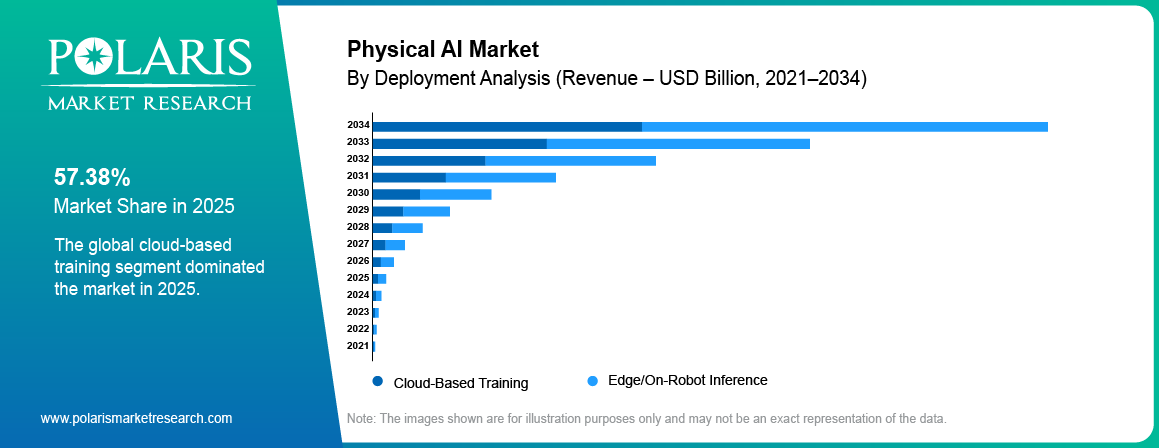
The cloud-based training segment accounted for 57.38% of the Physical AI market in 2025. This is due to the substantial computing power required to train foundation models and generate vast amounts of simulation data. By using cloud-based infrastructure, developers are able to take advantage of high-performance computing resources while developing their models, rather than running all training workloads on physical robots. An example of this workflow is NVIDIA’s Physical AI ecosystem combining high-performance computing, world models, simulation, and robotics development.
The Edge/On-Robot Inference segment is projected to register a 50.74% CAGR during the forecast period, supported by increasing demand for edge AI processing in robotics and other time-sensitive physical applications. Latency is reduced by operating the models closer to the physical system, enabling fast responses in perception, navigation, manipulation and task execution. NVIDIA’s robotics computing platforms bring AI workloads closer to deployed systems. Such developments are expanding the scope of edge inference and increasing demand for edge AI accelerators in Physical AI deployment.
Application Insights
Humanoid Robotics accounted for 28.46% of the Physical AI market in 2025, driven by the increasing development of general-purpose humanoids and the AI models required to power them. Companies working on humanoid robotics platforms include Figure AI, Apptronik, and Humanoid, while NVIDIA Isaac GR00T is the foundation-model layer for building humanoid robots. Physical artificial intelligence help humanoid systems perceive, understand tasks, navigate, manipulate and execute, creating a need for models and infrastructure that work across different physical environments.
The Industrial & Warehouse Automation segment is anticipated to record a 44.28% CAGR during the forecast period, attributed to the increasing efforts to use Physical AI in manufacturing, material handling, logistics, and warehouse automation. These are environments which demand systems that respond to changing layouts, objects, tasks and operating conditions. Physical AI platforms combine simulation, world models, robot intelligence, and edge inference to support these applications. This is driving demand for Physical AI tools for factories and warehouses, fueled by the rise of industrial robotics and factory simulation projects.
End Use Industry Insights
Automotive segment accounted for a 56.42% share of the Physical AI market in 2025. This is due to the use of automotive physical AI in the industry across autonomous driving, intelligent manufacturing, simulation and robotics. Physical artificial intelligence technologies combine world models, simulation, robotics and computing infrastructure to enable vehicle-level autonomy and factory-level applications. NVIDIA’s physical AI work includes autonomous driving and robotics, and automotive robotics work also shows the industry’s interest in using AI for manufacturing environments and physical production workflows.
The logistics & warehousing segment is projected to grow at a CAGR of 49.53% during the forecast period owing to the growing need for flexible robotic systems, including autonomous mobile robots, in material handling, warehouse operations, and logistics workflows. Physical AI allows robots to react to changes in objects, environments and task demands, rather than simply obeying preprogrammed operating instructions. The development of humanoid and general-purpose robotic systems, together with simulation and robot foundation models, is creating opportunities for broader deployment across logistics and warehouse environments.
Physical AI Market Segment Snapshot
| Segment | Leading in 2025 | Fastest-Growing, 2026–2034 | Key Growth Driver |
| By Component | Robot Foundation Models & VLA Models (31.74%) | World Foundation Models (54.16% CAGR) | Reusable AI models; scalable simulation and synthetic data |
| By Deployment | Cloud-Based Training (57.38%) | Edge/On-Robot Inference (50.74% CAGR) | High compute needs for training; low-latency inference |
| By Application | Industrial & Warehouse Automation (35.72%) | Humanoid Robotics (55.62% CAGR) | General-purpose humanoid development; flexible factory automation |
| By End Use Industry | Automotive (56.42%) | Logistics & Warehousing (49.53% CAGR) | Autonomous driving and intelligent manufacturing; adaptive material handling |
Source: Polaris Market Research Analysis
Regional Analysis
The Physical AI market spans North America, Europe, Asia Pacific, Latin America, and Middle East & Africa, with regional development shaped by AI infrastructure, robotics capabilities, semiconductor ecosystems, private investment, research activity, and the adoption of autonomous and embodied AI systems.
North America Physical AI Market Trends
North America held 31.12% share of the Physical AI market in 2025, owing to the presence of platform companies, robotics startups, compute infrastructure and venture-funded physical AI companies in the US. NVIDIA, Skild AI, Figure AI, Physical Intelligence and Apptronik are all based in the region, and Mind Robotics provides an entry point into industrial robotics originating in the automotive industry. Boston Dynamics and Agility Robotics add to the regional base, with Boston Dynamics appointing former Amazon AI executive Rohit Prasad as CEO in October 2026 to accelerate its physical AI commercialization strategy. This region also benefits from strong AI computing capabilities, robotics research, semiconductor expertise, and investment activity. Growing adoption across manufacturing, logistics, autonomous mobility, and industrial automation is expected to create further demand for Physical AI models, simulation platforms, and edge computing infrastructure. (Source: bostondynamics.com)
Europe Physical AI Market Trends
Europe accounted for 24.38% of the physical AI market share in 2025 driven by a growing industrial AI, robotics development, digital twin adoption and investment in humanoid and embodied AI companies. Humanoid, based in London, raised USD 152 million in 2026 at a reported USD 1.35 billion valuation, strengthening the region’s expanding humanoid robotics ecosystem. NVIDIA also highlighted European deployments around factory simulation, robot training and industrial AI infrastructure. Europe also benefits from established automotive and manufacturing industries that provide deployment opportunities for Physical AI across production, inspection, material handling, and warehouse operations (Source: reuters.com).
Asia Pacific Physical AI Market Trends
Asia Pacific is projected to register a 51.83% CAGR in the physical AI industry during the forecast period, as the region combines large manufacturing bases, robotics ecosystems, semiconductor capabilities, and growing national initiatives around embodied AI. China has a large population of robotics developers and manufacturers, while Japan is expanding activity around physical AI for industrial production. NVIDIA has highlighted Japan's Physical AI Initiative and partnerships with manufacturers such as FANUC, Yaskawa and Kawasaki Heavy Industries. The region also has significant electronics, automotive, logistics, and industrial automation activities that can support Physical AI deployment (Source: nvidia.com).
Middle East & Africa Physical AI Market Trends
The Middle East and Africa physical AI market analysis indicates growing interest in artificial intelligence, robotics, autonomous systems, and advanced industrial technologies across the region. The region accounted for 6.19% of the global Physical AI market in 2025, supported by investments in AI infrastructure, smart industrial environments, logistics automation, and autonomous applications. Physical AI solutions can help organizations improve machine perception, decision-making, and task execution across physical environments. Increasing integration of AI models with robotics and autonomous systems is expected to create opportunities for technology providers as regional industries expand intelligent automation.
Latin America Physical AI Market Trends
The Latin America physical AI industry forecast reflects developing adoption of AI-enabled robotics, industrial automation, autonomous systems, and intelligent technologies for physical operations. The region accounted for 8.47% of the global Physical AI market in 2025, while demand across manufacturing, logistics, warehousing, automotive activities, and other industrial applications can support wider adoption of Physical AI solutions. These platforms enable perception, reasoning, planning, and autonomous action across physical systems. Continued investment in AI capabilities, computing infrastructure, and robotics technologies is expected to create opportunities for solution providers as organizations across Latin America explore broader applications of embodied intelligence.

Physical AI Market Competitive Landscape
The Physical AI market comprises platform and compute providers, robot foundation model specialists, vertically integrated humanoid developers and industrial robotics companies. NVIDIA's position spans compute, world models, simulation, and robotics development, while companies such as Google DeepMind, Skild AI, Figure AI, Physical Intelligence, Apptronik, Mind Robotics, Humanoid, Unitree, Boston Dynamics, Agility Robotics, Doosan Robotics, FieldAI, and Generalist AI represent different approaches to building the robot brain layer of Physical AI systems. Recent financing activity also shows substantial capital concentration across the sector.
Physical AI Competitive Landscape Snapshot
| Company | Positioning | Stack Layer | Core Offering |
| NVIDIA | Platform leader | Compute, world models, simulation | Cosmos world foundation models, Isaac GR00T, Isaac simulation, Jetson edge computing |
| Google DeepMind | Robot brain specialist | Robot foundation models | Gemini Robotics 2 VLA, embodied reasoning, and on-device models |
| Skild AI | Robot brain specialist | Robot foundation models | General-purpose, hardware-agnostic robot intelligence |
| Physical Intelligence | Robot brain specialist | Robot foundation models | General robot policies for multiple robotic platforms |
| Figure AI | Vertically integrated humanoid developer | Humanoid robots | Full-stack humanoid systems with in-house intelligence |
| Apptronik | Humanoid developer | Humanoid robots | Apollo humanoid for logistics and industrial use |
| Boston Dynamics | Robotics incumbent | Humanoid and mobile robots | Atlas humanoid and industrial robots with integrated AI |
| Agility Robotics | Commercial humanoid deployer | Humanoid robots | Digit humanoid for warehouse and factory material handling |
| Mind Robotics | Industrial specialist | Industrial robotics | Factory-focused robotic intelligence for production workflows |
| Humanoid | Humanoid challenger (Europe) | Humanoid robots | General-purpose humanoid platforms |
| Unitree Robotics | Hardware-led humanoid maker (Asia Pacific) | Humanoid and quadruped robots | Humanoid and quadruped robots |
| Doosan Robotics | Industrial cobot player | Collaborative robots | On-device AI cobots and AI-assisted welding |
| FieldAI | Ecosystem adopter | Robot intelligence | Robotics development on NVIDIA Cosmos and Isaac |
| Generalist AI | Ecosystem adopter | Robot intelligence | Synthetic data generation using NVIDIA Cosmos |
Source: Polaris Market Research Analysis
Physical AI Market Technology and Innovation Landscape
Cosmos 3 uses a mixture-of-transformers architecture that combines vision reasoning, world generation, and action prediction. NVIDIA positions the model as a foundation for physical AI applications including robotics and autonomous vehicles, while its Cosmos 3 family includes variants intended for different development and inference requirements. These capabilities strengthen the role of vision language action model technologies and world models in connecting perception, reasoning, simulation, and physical action.
The NVIDIA Physical AI Data Factory Blueprint provides a framework for synthetic data generation by combining Cosmos world models with data curation, augmentation, evaluation, and orchestration. NVIDIA states that the blueprint is intended to turn compute into large-scale training data and address limitations associated with collecting sufficient real-world physical AI data.
Physical AI Technology and Innovation Landscape Snapshot
| Technology Layer | Key Innovation | Representative Players |
| World Foundation Models | NVIDIA Cosmos 3 uses a mixture-of-transformers architecture for vision reasoning, world generation, and action prediction; Cosmos 3 Nano targets edge inference | NVIDIA |
| Robot Foundation Models & VLA Models | NVIDIA Isaac GR00T, Gemini Robotics 2 (VLA, embodied reasoning, and on-device models), and general-purpose robot policies | NVIDIA, Google DeepMind, Skild AI, Physical Intelligence |
| Synthetic Data Generation | Physical AI Data Factory Blueprint combines Cosmos world models with data curation, augmentation, and evaluation | NVIDIA, Generalist AI |
| Simulation & Digital Twins | Isaac simulation frameworks and warehouse digital twins used to validate robot policies before deployment | NVIDIA, FieldAI, Skild AI |
| Edge/On-Robot Inference | Local processing for low-latency perception and control, including on-device AI models and NPU-based collaborative robots | NVIDIA, Google DeepMind, Doosan Robotics |
| Sensing & Chip Design | Physical AI sensor microfabrication platform and physics-informed AI platform for semiconductor design | Atomica, Cognichip |
Source: Polaris Market Research Analysis
Use Case Analysis
Automotive Manufacturing
Mind Robotics, which originated from Rivian, is developing industrial robotics aimed at factory operations rather than limiting its strategy to general-purpose humanoids. Its funding activity suggests ongoing investment in applying Physical AI to manufacturing settings. This use case shows how humanoid robot AI can evolve into more specialized industrial systems when manufacturers need solutions tailored to specific workflows, facilities, and production tasks.
Logistics and Warehousing
Logistics and warehousing provide an important deployment environment for robot foundation model technologies because robots must perform material handling and movement tasks while adapting to changing physical conditions. Apptronik identifies logistics among the initial industries for Apollo, while NVIDIA has demonstrated warehouse digital twins and simulation-based robot fleet development.
Technology and Robotics Development
FieldAI and Skild AI are among the developers using NVIDIA Cosmos world models and Isaac simulation frameworks for Physical AI development. These workflows enable developers to develop training data, simulate environments and validate policies prior to deployment. This approach tackles the sim-to-real transfer problem by offering a controlled environment to evaluate the behavior of robots prior to their deployment in the real world.
Key Players in the Physical AI Market
- Agility Robotics, Inc.
- Apptronik, Inc.
- Boston Dynamics, Inc.
- DeepMind Technologies Limited (Google DeepMind)
- Doosan Robotics Inc.
- Field AI, Inc.
- Figure AI, Inc.
- Generalist AI, Inc.
- Hangzhou Yushu Technology Co., Ltd. (Unitree Robotics)
- Mind Robotics Inc.
- NVIDIA Corporation
- Physical Intelligence, Inc.
- Skild AI, Inc.
- SKL Robotics Ltd (Humanoid)
Industry Developments
- October 2026: XPENG launches its Physical AI ecosystem at the Paris Motor Show introducing AI-defined vehicles, humanoid robots and other intelligent mobility systems and globally launches its G9L SUV. (Source: prnewswire.com)
- October 2026: Boston Dynamics appointed Rohit Prasad, a former Amazon AI executive, as CEO to accelerate its physical AI strategy and commercialize intelligent robotic systems at scale. (Source: businesswire.com)
- September 2026: Atomica launches Physical AI Sensor Platform offering microfabrication and manufacturing capabilities for sensors used in robotics, autonomous systems, industrial equipment, healthcare and defense. (Source: prweb.com)
- September 2026: Agility Robotics unveiled Digit 5, a humanoid robot designed to work alongside people without safety barriers, with more than USD 300 million in multi-year orders. (Source: roboticsandautomationnews.com)
- July 2026: Mistral AI launched its first model for robotics, bringing its artificial intelligence (AI) technology to factories, warehouses and industrial automation. (Source: reuters.com)
- July 2026: Google DeepMind launched Gemini Robotics 2, a suite of vision language action, embodied reasoning, and on-device models that enables whole-body humanoid control. (Source: therobotreport.com)
- July 2026: Unitree Robotics received approval from China’s securities regulator for a Shanghai STAR Market IPO to fund R&D and production of humanoid robots. (Source: caixinglobal.com)
- June 2026: Cognizant announced its Sovereign Physical AI Platform-as-a-Service, which combines sensors, robots, IoT devices and factory systems to enable enterprises to deploy Physical AI at scale. (Source: cognizant.com)
- May 2026: NVIDIA announced open-source tools and agent skills for Physical AI such as robotics, autonomous vehicles, industrial digital twins and edge AI. The launch enables developers to automate physical AI development from simulation and training to deployment. (Source: nvidia.com)
Physical AI Market Report Segmentation
By Component Outlook (Revenue, USD Billion, 2021–2034)
- Robot Foundation Models & VLA Models
- World Foundation Models
- Simulation & Digital Twin Platforms
- Compute Infrastructure
By Deployment Outlook (Revenue, USD Billion, 2021–2034)
- Cloud-Based Training
- Edge/On-Robot Inference
By Application Outlook (Revenue, USD Billion, 2021–2034)
- Humanoid Robotics
- Industrial & Warehouse Automation
- Autonomous Vehicles
- Other Embodied Systems
By End Use Industry Outlook (Revenue, USD Billion, 2021–2034)
- Automotive
- Logistics & Warehousing
By Region Outlook (Revenue, USD Billion, 2021–2034)
- North America
- US
- Canada
- Europe
- Germany
- France
- UK
- Italy
- Spain
- Netherlands
- Rest of Europe
- Asia Pacific
- China
- Japan
- India
- South Korea
- Taiwan
- Australia
- Rest of Asia Pacific
- Latin America
- Brazil
- Mexico
- Argentina
- Rest of Latin America
- Middle East & Africa
- Saudi Arabia
- UAE
- South Africa
- Rest of Middle East & Africa
Physical AI Market Report Scope
| Report Attributes | Details |
| Market Size in 2025 | USD 0.90 Billion |
| Market Size in 2026 | USD 1.39 Billion |
| Revenue Forecast by 2034 | USD 44.78 Billion |
| CAGR | 47.06% from 2026–2034 |
| Base Year | 2025 |
| Historical Data | 2021–2024 |
| Forecast Period | 2026–2034 |
| Quantitative Units | Revenue in USD Billion and CAGR |
| Report Coverage | Revenue Forecast, Growth Factors, Competitive Landscape, Industry Trends, and Strategic Analysis |
| Segments Covered | By Component, Deployment, Application, End Use Industry, and Region |
| Regional Scope | North America, Europe, Asia Pacific, Latin America, Middle East & Africa |
| Competitive Landscape | Company Profiling, Product Benchmarking, Financial Analysis, Market Developments, and Strategic Initiatives |
| Report Format | PDF + Excel |
| Customization | Available by Country, Region, and Segment |
Source: Polaris Market Research Analysis
Why Choose Polaris Market Research
Polaris Market Research & Consulting, Inc. can assess the Physical AI ecosystem across world foundation models, robot foundation models, simulation platforms, compute infrastructure, deployment models, applications, end-use industries, and regional markets. The approach separates the intelligence layer from robot hardware while evaluating how advances in models, simulation, data generation, and computing contribute to the commercialization of Physical AI systems.
The research can be customized by component, deployment model, application, end-use industry, physical AI company benchmarking, or geography. Additional analysis can cover world models, robot foundation models, vision language action models, simulation platforms, synthetic data generation, edge inference, compute infrastructure, humanoid robotics, autonomous vehicles, industrial automation, funding activity, and commercialization pathways.
A further differentiator is milestone normalization. A foundation-model launch, a robotics funding round, a simulation platform release, and a robot deployment milestone are not treated as equivalent indicators of market maturity. Each development can be assessed according to its relevance to model development, training, simulation, inference, deployment, and the broader commercialization of Physical AI.
Physical AI Market Research Methodology
Physical AI market research begins with a defined scope covering world foundation models, robot foundation models and VLA models, simulation and digital twin platforms, and compute infrastructure. The analysis distinguishes the AI and infrastructure layer from robot hardware while evaluating its role across humanoid robotics, industrial and warehouse automation, autonomous vehicles, and other embodied systems.
Secondary research can assess company disclosures, technology launches, funding announcements, platform developments, industry publications, and other approved market evidence. The research evaluates developments across model architecture, simulation, synthetic data generation, compute infrastructure, deployment models, applications, end-use industries, commercialization activity, and regional development.
The market model evaluates Physical AI components separately before reconciling them into an overall ecosystem forecast. World foundation models, robot foundation models, simulation platforms, and compute infrastructure represent different layers of the technology stack and therefore require separate assessment. Deployment through cloud-based training and edge or on-robot inference is also evaluated independently.
Five-Phase Research Methodology
| Phase | Activity | Output |
| 1. Scope Definition | Define Physical AI across models, simulation, deployment, applications, and compute infrastructure | Market boundary |
| 2. Secondary Research | Review approved company, technology, funding, and industry evidence | Source log |
| 3. Primary Research | Validate market assumptions with relevant industry participants where applicable | Assumption validation |
| 4. Modeling | Triangulate component, deployment, application, end-use, and regional data | Polaris internal model |
| 5. Review | Conduct senior analyst review of sources, segmentation, assumptions, and forecast logic | Final RD and forecast |
Source: Polaris Market Research Analysis
Forecast construction evaluates the progression of Physical AI from model development and simulation toward deployment in physical environments. Model development, infrastructure requirements, commercial applications, and deployment maturity are assessed separately so that technology announcements and investment activity are not treated as direct equivalents of market revenue.
Physical AI Market FAQ's
Growth is driven by advancements in full-stack physical AI infrastructure, increasing capital investment in physical AI development, and rising demand for flexible automation amid labor constraints. Wider adoption of world foundation models, robot foundation models, and simulation platforms is further supporting market expansion.
The Physical AI Market was valued at USD 0.90 Billion in 2025 and is forecast to reach USD 44.78 Billion by 2034, growing at a CAGR of 47.06% from 2026 to 2034.
North America is leading the market and accounts for 31.12% of the global market in 2025. Asia Pacific is projected to register the fastest growth at a 51.83% CAGR during 2026–2034.
Robot Foundation Models & VLA Models accounted for 31.74% of the Physical AI market share in 2025. This is attributed to the increasing demand for reusable AI models that allow robots to perceive, reason, plan, and complete tasks in various physical environments.
Physical AI refers to the artificial intelligence systems that perceive, reason, plan and act in physical environments using models, simulation and computing infrastructure.
World foundation models are used to simulate physical environments and contribute to the generation of data and scenarios to train and develop Physical Artificial Intelligence systems.
Robot foundation models deliver reusable AI capabilities that help robots interpret environments, understand instructions, plan actions and perform physical tasks.
A vision-language-action model combines visual perception, language understanding, and actions a physical system can take.
Generative AI creates digital content such as text, code, images, and video, while physical AI produces actions such as motion, manipulation, and navigation in real environments. Physical AI often uses generative AI models as its reasoning layer but must also meet real-time, safety, and reliability requirements.
Key applications include humanoid robotics, industrial and warehouse automation, autonomous vehicles, and other embodied systems. Automotive and logistics & warehousing are the leading end use industries, with sensor and robotics use cases also emerging in healthcare and defense.
Major challenges include the sim-to-real generalization gap, data requirements, model reliability, computing requirements, and the complexity of operating in unfamiliar physical environments.
Embodied AI focuses on intelligent agents that perceive and act through physical bodies such as robots and autonomous vehicles. Physical AI is a broader term that also covers the world models, simulation, synthetic data, and compute infrastructure that support those systems, which is the intelligence layer covered in this report.
Edge or on-robot inference allows AI models to run on or close to the physical system itself, enabling real-time decision making.
Companies identified in the market ecosystem are NVIDIA, Google DeepMind, Skild AI, Figure AI, Physical Intelligence, Apptronik, Mind Robotics, Humanoid, Unitree, Boston Dynamics, Agility Robotics, Doosan Robotics, FieldAI and Generalist AI.
NVIDIA participates across several layers of the stack, including Cosmos world foundation models, Isaac GR00T robot foundation models, Isaac simulation frameworks, and Jetson edge computing platforms. Partners such as FieldAI, Skild AI, and Generalist AI use NVIDIA technologies for robotics development and synthetic data generation.
Download Sample Report of Physical AI Market
Please fill out the form to request a customized copy of the research report.


